
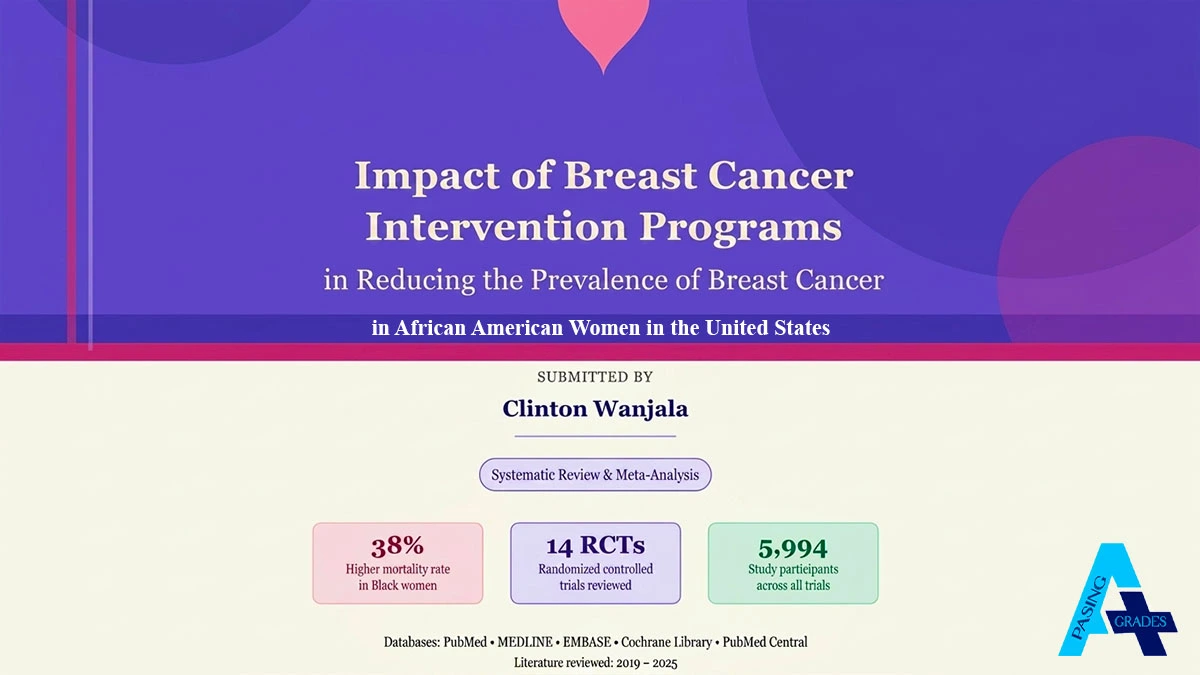
Impact of Breast Cancer Intervention Programs in Reducing the Prevalence of Breast Cancer in African American Women in the US
How to cite:
PasingGrades Research and Education Initiative. (2026). Impact of breast cancer intervention programs in reducing the prevalence of breast cancer in African American women in the US. PasingGrades. https://pasinggrades.com
Download full research paper (PDF)
Background
Breast cancer is the second most common type of cancer among women in the United States. African American females die faster than White females from breast cancer. Breast cancer is diagnosed in more females than any other form of cancer. In the United States, an estimated 316,950 women will be diagnosed with invasive breast cancer, with an additional 59,080 cases of ductal carcinoma in situ (DCIS), according to the American Cancer Society's Breast Cancer Facts & Figures 2024–2025.
Breast cancer incidence has continued to rise at approximately 1% annually between 2012 and 2021, with the steepest increases observed among women under the age of 50 (American Cancer Society, 2024). Breast cancer is expected to claim approximately 42,680 lives in 2025 (American Cancer Society, 2024). When describing the cancer survival rate, a 5-year survival rate represents the percentage of patients who survive at least five years after being diagnosed with any cancer. The percentage refers to the number of instances out of 100.
Therefore, females with non-metastatic malignant breast cancer have an approximate 5-year survival rate of 90percent. Females with non-metastatic malignant breast cancer have an approximate 10-year survival rate of 84 percent. If metastatic breast cancer is limited to the breast, females with this illness have a 99 percent 5-year survival probability (Yedjou et al., 2019). This phase is diagnosed in 63percent of females with breast cancer.
47percent of females between the ages of 15 and 38 in the US are less likely to be diagnosed with breast cancer at a preliminary phase than 68 percent of women over the age of 65. This could be because the United States Preventive Services Task Force historically recommended screening begin at age 50 for average-risk women; however, in April 2024, this guideline was updated to recommend biennial mammography beginning at age 40 for all women at average risk (USPSTF, 2024).
Historically, breast cancer prevalence rates amongst African American females have generally been lower than those amongst White American women (Duma et al., 2018). However, during the last two decades, breast cancer incidence among African American women has risen substantially, though incidence rates remain approximately 5% lower than those among White women; the more critical concern is that African American women now have a 38% higher breast cancer mortality rate than White women despite this lower incidence (American Cancer Society, 2024).
Although the reasons for the increased incidence rates are not fully characterized, they may be partially explained by lifestyle variables like obesity and nutrition. In comparison, population-based breast cancer death rates were roughly comparable until the early 1980s, when they began to decline amongst White American females but stayed relatively steady amongst African American women. These mortality discrepancies most probably represent the elucidation of tumor biology disparities.
Tamoxifen, the first successful endocrine medication used adjuvantly in breast cancer treatment, became widely available in the late 1970s, and the breast cancer death gap became obvious within a few years. This mortality disparity most likely developed due to African American women having a twofold increased risk of glucocorticoid receptor breast carcinoma. Early successes with therapeutic strategies conferred survival benefits on a disproportionate number of White American patients.
Objective
This paper aims to research the impact of breast cancer intervention programs in reducing the prevalence of breast cancer in African American females in the United States.
Study Design
A systematic review of peer-reviewed literature published between 2019 and 2025 was conducted for this study. Several databases, including PubMed, MEDLINE, EMBASE, the Cochrane Library, UpToDate, and PubMed Central, were consulted.
Keywords include "Impact of breast cancer intervention programs," "Prevalence of breast cancer in African American females in the US," "Risk factors in the onset of breast cancer in African American women," "Healthcare disparities in treatment of breast cancer in African American women," "Systemic racism in the treatment of breast cancer in African American women," "Impact of breast cancer intervention programs in reducing the prevalence of breast cancer in African American females in the US," "USPSTF breast cancer screening guidelines 2024," "triple-negative breast cancer treatment advances," and "culturally tailored cancer interventions African American women."
Population at Risk
The focus of this study will be on African American women. African American women face a heightened risk of breast cancer-related comorbidities and mortality. African American females have historically been a tough group for standard breast cancer intervention initiatives to approach. Cultural and health attitudes that vary from contemporary culture are cited as attributing to this group's low percentage of screening mammography (Jones et al. 2023). In addition to these attitudes, elderly African American females make up a disproportionate share of the underinsured and uninsured population. As a result, most of these females face financial barriers to mammography screening.
Additionally, for decades, substantial discrepancies in the burden and incidence of breast cancer have been recorded amongst African American females and White Americans. According to Giaquinto et al. (2022), breast cancer is associated with a 38% higher mortality rate in the African American population despite a 5% lower incidence rate, a younger age dispersion, a higher prevalence of advanced stages, a heightened risk of physiologically aggressive illnesses like the triple-negative phenotypes, and a significantly greater likelihood of male breast cancer.
Public health specialists, multidisciplinary oncology teams, geneticists, medical trialists, and activists must work collaboratively to holistically address the multifaceted etiology of and therapies for breast cancer inequalities. Efforts to establish breast health equality through increased access to affordable, high-quality care and culturally sensitive breast cancer intervention programs are critical in light of the persistent and well-documented socioeconomic burden of structural racism on African American communities.
Rationale
According to Hendrick et al. (2021), African American females are more likely than white females to be diagnosed with breast cancer in its advanced phases. Therefore, the comorbidities and mortality rates among African American females owing to breast cancer are greater than those among white females in the United States, even though African American females have a substantially decreased prevalence of breast cancer. According to Jones et al. (2023), African American women's underutilization of mammography screening has been linked to low perceived susceptibility to breast cancer, medical mistrust, lack of insurance, and systemic access barriers including cost and transportation.
Additionally, in many cases, these characteristics distinguish between timely diagnoses and interventions and late diagnoses and interventions. It has proven to be challenging for those who implement breast cancer intervention programs to reach African American women across all age groups, particularly those aged 40 and older, given the 2024 USPSTF recommendation that average-risk women begin biennial mammography screening at age 40 (U.S. Preventive Services Task Force, 2024).
Research shows that African American women experience disparities not only in physician referral for mammography but also in follow-through after referral; Ganguly et al. (2023) found that Black race was associated with 15–26% lower mammography completion rates, with the highest attrition occurring after mammograms had already been scheduled. Beyond the lack of referral, Ganguly et al. (2023) note that lower rates of self-efficacy and breast cancer risk awareness among African American women shaped by structural inequities rather than individual choice contribute to reduced rates of self-initiated screening compared to White women To this end, additional strategies for educating and screening African American females must be implemented with breast cancer intervention programs that specifically target this minority population.
Breast Cancer Intervention Programs
Late-stage detection and lower survival rates for African American women with breast cancer are critical public health issues. The crucial need for therapies directed at African American females stems from the significant gap in breast cancer life expectancies between African American women and white women.
According to Giaquinto et al. (2022), despite a lower breast cancer incidence rate among Black women compared to White women (127.8 vs. 133.7 per 100,000), the racial disparity in breast cancer mortality remains stark, with Black women experiencing a death rate of 27.6 per 100,000 compared to 19.7 per 100,000 among White women — a disparity of approximately 40%. The increased breast cancer death rate amongst African American females has been ascribed mainly to late-stage diagnoses.
Mammography is by and large the most efficient technique for early breast cancer detection currently available. Many public health interventions have been established to boost the proportion of females who undergo mammography and are educated on how to self-examine their breasts, a procedure called BSE breast self-examination. Generally, these initiatives have been found to be helpful for white females but have struggled to meet a significant number of African American females.
Social drivers of health, including income below the federal poverty line and underutilization of screening mammography, have been significantly associated with later-stage breast cancer diagnosis among African American women, with underutilization of screening mammography carrying an odds ratio of 3.21 for stage III/IV diagnosis (Nik-Ahd et al., 2025). Additionally, cultural variations in perceived vulnerability and psychological barriers such as fear, medical mistrust, and perceived discrimination contribute to underutilization of mammography among African American women across all age groups, including those in their 40s who are now recommended for biennial screening under the 2024 USPSTF guidelines (U.S. Preventive Services Task Force, 2024; Haidari et al., 2024).
Research consistently demonstrates that culturally grounded beliefs, community trust, and lived experiences of structural racism shape African American women's health-seeking behaviors, and that interventions must be designed to align with, rather than displace, these cultural frameworks (Jones et al., 2023). Furthermore, African American females often assemble, share information, and socialize in locations distinct from those frequented by mainstream American females.
Furthermore, workplace-wide information programs enhance African American women's utilization of screening services. To promote the utilization of cancer screenings, it is advised that communications about their availability and accessibility be improved. For instance, flyers or pamphlets promoting the screening mammography could be displayed in staff meeting spaces and discussion forums.
Additionally, corporate organizations could consider sending documentation and reminders to staff members' homes, as well as sending corporate-wide e-mails to staff. Miller et al. (2024) reported in the MMWR that mammography use is strongly linked to social determinants of health, and that sustained, accessible communication strategies including workplace reminders and community outreach remain effective tools for improving screening uptake, particularly among underserved populations.
Additionally, intervention programs established in African American female's centers, health centers, and religious institutions have successfully reached out to them. A 2023 scoping review by Kaneri et al. confirmed that beauty salons serve as effective health promotion environments for African American women, with hairdressers successfully delivering disease prevention programs, particularly in disadvantaged communities, and that integrating salon-based networks into primary care pathways can help address inequalities in access to health care (Kaneri et al., 2023). Their responsibilities encompass knowledge transfer and the delivery of beauty services.
In summary, research has demonstrated that when suitable breast cancer intervention programs are implemented, the incidence of breast cancer among African American females decreases. Breast cancer intervention programs have effectively raised public awareness about the critical nature of cancer screening.
Description of Event
It is widely established that inefficiencies in providing appropriate breast care result in a more severe disease state at the time of medical diagnosis, increased mortality, and reduced years of survivability (Nik-Ahd et al., 2025). Females of African American descent bear this burden. Ethnicity, poverty, and socioeconomic, political, and structural variables, which are frequently known as social predictors of health, obviously contribute to these obstacles to cancer care accessibility. These variables contribute to the emergence of several barriers to care, resulting in care inefficiencies. Indeed, extensive population-based surveys demonstrate that providing equal access to high-quality care can considerably minimize differences in mortality across race minorities.
Nonetheless, African American females remain underrepresented in clinical trials, accounting for less than 4% of participants in cancer treatment trials, even though Black women are approximately 40% more likely to die from breast cancer than White women (Fairley et al., 2024; AACR Cancer Disparities Progress Report, 2024). There are numerous hurdles to trial enrollment for ethnic minority individuals at the physician, patient, and institutional levels, all of which must be resolved effectively. A lack of diversification in medical trials negates critical safety evidence critical for medical advances.
Barriers at the patient level in ethnic minority populations date back to the 1800s when enslaved African Americans were used for medical research. This racially gross misconduct and malpractice in human research persevered over time, as evidenced by the notorious Tuskegee experiment, in which US Public Health Service scientists withheld syphilis treatment from more than 600 African American men in Macon County, Alabama between 1932 and 1972 — four decades of withheld care that resulted in preventable deaths and a lasting legacy of medical mistrust that continues to affect clinical trial participation among Black communities today (Riggan et al., 2023).
Additionally, systemic racism is thoroughly documented in contemporary American discourse, spanning areas such as wealth distribution, higher education, employment opportunities, and access to health care. Falcone et al. (2024) describe a conceptual model in which structural racism and racial discrimination contribute to increased breast cancer mortality risk by promoting adverse social determinants of health that elevate exposure to environmental hazards and chronic stress, which in turn drive epigenetic and immune dysregulation — ultimately altering breast cancer outcomes for African American women. These factors cumulatively contribute to significant inequalities in life expectancy of approximately two decades in some counties, with African Americans experiencing higher all-cause breast cancer mortality rates than non-Hispanic Whites (Falcone et al., 2024).
Description of the Disease
According to Ambrosone et al. (2025), there is hard proof for the involvement of nonbiological variables in African American females that may alter the functioning of physiological mechanisms to encourage the early development of breast cancer. These are essentially reproductive elements that may work to enhance or impede the biochemical mechanisms but may also contain confusing social influences.
Multiple childbirths, as well as earlier commencement of motherhood, are more typical amongst African American females. This could impart a more pronounced carcinogenic shock and an elevated susceptibility and risk for breast cancer amongst African American females. According to Prakash et al. (2020), a short-term increment in the risk and vulnerability for breast cancer normally occurs just after full-term pregnancies in African American women, and numerous researchers have suggested that if African American women have children at interims of three years or less, and have multiple children at early ages, the greater pervasiveness of this variable could serve to uplift the risk and susceptibility for younger African American women.
Additionally, full-term pregnancy is marked by a large rise of the growth hormone, which can trigger oncologic change, as well as IGF-1, which is a recognized and prominent risk factor for breast carcinoma. IGF-1 is an essential oncogene for breast carcinoma, and high levels from numerous pregnancies could significantly expedite proliferation and the emergence of breast carcinoma in African American women. Estrogen and IGF-1 serum concentrations are also considerably higher in premenopausal Black Women than White women, which could be predicted to promote cell cycle progression, particularly in cells with impaired G1/S checkpoints due to inactivation of tumor-suppressive alleles and increased cyclin E.
Nonetheless, breastfeeding as well as the waist-hip ratio (a measurement of obesity) are key reproductive and socioeconomic variables (nonbiological factors) related to the onset of breast cancer risk and vulnerability in African American females. In their study, Marcus Post et al. (2026) discovered that younger African-American females had a higher incidence of each of the primary risk indicators for basal-like breast carcinoma: greater parity, reduced breast-feeding, greater parity paired with reduced breastfeeding, higher usage of breastfeeding suppressants, and an increased waist-hip ratio.
Basal-like breast carcinoma was found to be more common in females who had many live births but did not breastfeed and in females who took drugs to suppress their lactation. John et al. (2018) reveal that socioeconomic level had a larger influence on breastfeeding practices amongst African American women.
The Basic Epidemiological Concepts About the Prevalence of Breast Cancer in African American Females in the US.
The breast cancer mortality rate is approximately 38 percent greater in African American females than in White females. More Black American women are diagnosed with advanced breast carcinoma compared to White females. During diagnosis, African American patients' tumors are also more likely to be bigger and to have advanced to the axillary lymph nodes and glands (American Cancer Society, 2024).
While all females face an increased risk of developing breast cancer as they grow older, African American females are the most susceptible group to be afflicted with the illness at a younger age than their counterparts from other races. In females more youthful than 40-45 years of age, black females bear a higher population-based breast cancer occurrence rate than white women. Approximately 23 percent of recently diagnosed African American breast cancer patients are under the age of 50, compared to 16 percent of White patients (Saka et al., 2025).
Worldwide, women are commonly diagnosed with breast cancer malignancy. It is second-ranked after lung cancer, the dominant cause of cancer deaths in the United States. Despite advancements in the identification, diagnosis, and therapy of breast cancer, it is widely established that African American females continue to be disproportionately afflicted by the illness. Before reaching the age of 40 years, reports show that African-American women have significantly more cases of diagnosis with breast cancer than white women.
The former further experience a higher mortality rate compared to Caucasian women. According to the American Cancer Society, significant racial disparities exist in breast cancer mortality rates and incidence frequencies. Despite the fact that this minority group has lower cumulative risks of breast cancer than Caucasian women, their mortality rates are also significantly higher. As reported by Hendrick et al. (2021) and American Cancer Society (2024), White females have five-year survivorship of 92 percent in the United States.
On the other hand, African American females have a five-year survivorship of 83 percent. According to the National Cancer Institute in America, this is the poorest of any ethnicity. The underlying causes of these disparities are multifaceted and encompass disparities in employment, wealth distribution, income disparities, education level, housing, and general standard of living, as well as impediments to high-quality cancer preventative programs, early diagnosis, and therapeutic services.
Recently, various breast cancer subtypes discovered a significant physiological distinction between the most frequent forms of cancers in each ethnic group. According to Ensenyat-Mendez et al. (2023), young African American females are more susceptible to developing basal-like breast carcinoma. This is an invasive subtype for which there is no specific treatment. Basal-like breast malignancies are often estrogen and progesterone hormone receptor-positive and triple-negative breast cancer, significantly proliferating, and have generally poor and relapse-free survivorship. In African American women below 50 years old, around 33 percent of aggressive breast cancer cases are basal-like, which puts this group roughly twice as likely to develop basal-like breast carcinoma as Whites.
According to Ambrosone et al. (2025), epidemiologic research has pinpointed several critical preventative measures for basal-like breast cancer reduction, particularly increased breastfeeding and weight loss; nevertheless, public health messages on these subjects will necessitate personalized advertising that addresses knowledge gaps amongst young African American females.
Furthermore, while there is a substantial corpus of literature on breast cancers and African American females, there are scarce researches that offer insights into risk communication and none that concentrate on obesity and inadequate breastfeeding as risk factors for African American females developing basal-like breast carcinoma. These messages are critical since it is projected that by eliminating obesity and boosting breastfeeding, 68 percent of basal-like breast cancers might be averted.
The Epidemiology of Breast Cancer in African American Females in the USA
Recent times have seen a substantial stabilization, if not drop, in the prevalence and death rates for all cancers together. Despite these advancements, differences in cancer prevalence, fatality, stage at diagnoses, and survivability continue to exist. For all cancer sites aggregated, there is a lower prevalence rate but a greater mortality incidence among black women than non-Hispanic white women (Yedjou, 2019).
Additionally, when contrasted to white women, a poorer stage dispersion and lower 5-year life expectancies (with risk-adjusted for ages and phase of diagnoses) were found for African American women among most cancer sites. Additionally, African American women have profited less from early diagnosis and intervention breakthroughs than white women. These inequalities in cancer epidemiology are observed even for prevalent malignancies, such as breast cancer.
Nonetheless, breast cancer incidence and mortality rates continue to show significant global variation. Worldwide, breast cancer incidence has been rising steadily, with an average annual percent change of approximately 1.6% from 1990 to 2021, with the fastest growth observed in women aged 15–49 years (Priyadarshini & Panda, 2024). In the United States specifically, incidence rose by approximately 1% per year during 2012–2021, while age-adjusted death rates declined by an average of 1.2% per year over 2015–2024, representing an overall 44% reduction in breast cancer mortality since 1989 (Giaquinto et al., 2024; National Cancer Institute, 2025)
Additionally, epidemiologic research indicates that significant inequalities in breast carcinoma experience exist between African American women and Caucasian women. Taking skin cancers out of the equation, breast carcinoma is the predominant cancer in females and has the second-highest mortality rate in the United States. According to Gupta & Akinyemiju (2024), while overall cancer mortality declined for both Black and White individuals between 2000 and 2020, Black women consistently experienced higher mortality than White women across nearly all cancer sites.
Notably, the breast cancer mortality rate ratio between Black and non-Hispanic White women increased over this period, indicating that the relative disparity in breast cancer mortality widened even as overall cancer mortality declined. According to the American Cancer Society (2024), the breast cancer death rate for Black women in the United States is 26.8 per 100,000, compared to 19.4 per 100,000 for White women, a disparity of 36% that, despite declining from a peak of 44% in 2011, has persisted for over three decades and remains a major public health concern.
The Occurrence, Signs and Symptoms, And Control of Breast Cancer in African American Women
A range of factors contributes to the onset and progression of breast cancer, especially among African American women. According to Zavala et al. (2021), various risk factors may disproportionately affect African American females, including a lack of accessibility to healthcare and heightened distress resulting from prejudice and systemic racism.
Among the reproductive risk factors in African American women are the following:
beginning menstruation at a younger age, using contraceptives, suffering a late menopausal onset, ageing, having dense breasts, having a background of ovarian or breast cancer in one's family, personal or familial background of noncancerous breast illness or breast cancer, having used diethylstilbestrol or having a biological parent who consumed this substance, having undergone breast radiotherapy, and possessing genetic alterations such as those found in BRCA1 and BRCA2.
Nevertheless, attaining or sustaining a healthy BMI can help African American females reduce their chance of contracting breast cancer. However, health inequalities can make it difficult to alter one's diet or increase one's physical activity. According to research, there is a link between lower-income and poorer degrees of fitness and nutrition. This results from socioeconomic inequalities in the United States, disproportionately impacting African Americans. Breast cancer is typically symptom-free in its initial phases when the tumour is modest and difficult to detect.
This is also the period at which breast cancer is most treatable, which is why diagnostic mammography is critical. In women, mostly African Americans, breast cancer commonly starts in the breast region as a painless lump. Lumps are ordinarily benign (noncancerous) and are a regular phenomenon. However, if the individual discovers an uncommon bulge in their breast, they should consult their doctor immediately.
Furthermore, African American females are more prone than other women to triple-negative breast cancer, which is, upon diagnosis, more challenging to treat and more prone to return than different varieties of breast cancer. Findings show that among African American women specifically, approximately 1 in 5 (19 percent) are likely to be diagnosed with triple-negative breast cancer, nearly twice the rate observed in White women (Giaquinto et al., 2022).
Following this, scientists have investigated why the African American women population is more susceptible to triple-negative breast cancer than any other population (Giaquinto et al. 2022). A more severe form of breast cancer affects more women from this demographic below the age of 45 years. In a recent study, Ambrosone et al. (2025) found that African American females may have a higher chance of getting hormone-receptor-negative breast cancer if they do any of the following:
- At a young age, have three or more children
- Never breastfed a child
- Have a greater waist-to-hip ratio
Additionally, IBC inflammatory breast cancer is uncommon and invasive, characteristically very aggressive and highly prevalent in African American women. Although IBC accounts for approximately 2.5 percent of all breast cancers, African American women are more than 70 percent more prone to developing it, with an incidence rate of 4.5 per 100,000 compared to 2.6 per 100,000 in White women (Abraham et al., 2021). IBC progresses swiftly, obstructing lymphatic veins in the breast, culminating in swollen, reddish, and painful breasts. According to statistics, African American women with IBC had shorter five-year survivorship than White women, irrespective of cancer's hormone receptor subtype or the patient's age.
Epidemiological Design
Study Design
Randomized clinical trials examining the effect of breast cancer intervention programs on reducing the incidence of breast cancer in African American women were identified through database searches between January 2019 and December 2025. Numerous databases were searched, notably PubMed, UpToDate, EMBASE, MEDLINE, the Cochrane Library, and PubMed Central. Search words including "Impact of breast cancer preventive interventions," "Breast cancer preponderance in African American women in the United States," "Risk factors for the emergence of breast cancer in African American females," "Healthcare inequities in the breast cancer treatment in African American females," "Institutionalized racism in the breast cancer treatment in African American females," and "Impact of breast cancer preventive interventions on minimizing the preponderance of breast cancer in African American females."
Research Objectives
This study aims to examine the impact of breast cancer preventive interventions on minimizing breast cancer incidence among African American women in the United States.
Population
This research will concentrate on African American females. African American females are at an increased risk of developing breast cancer-related complications and death. African American women have historically been difficult to reach with conventional breast cancer management strategies. Cultural and health perceptions that differ from those of present culture are recognized as contributing to this cohort's low rate of mammography screening. Apart from these attitudes, older African American women account for a disproportionate proportion of the under- and uninsured populace. As a result, most of these women have financial constraints when it comes to mammography screening.
Methodology
Selection of Studies
A thorough literature search was conducted to identify papers released between January 2019 and December 2025. Studies performed in the United States and authored in English were eligible for inclusion if they (1) used psychosocial, cognitive, or academic approaches to ramp up mammography screening rates in primarily African American females of all ages; (2) used a randomized, controlled trial design; and (3) mentioned quantifiable screening rates post-intervention.
Current treatment approaches for ethnic minority women's mammography screening fall into three basic classifications: psychosocial, behavioral, and pedagogical approaches. These intervention strategies usually draw on various theoretical viewpoints, including the health belief model, the transtheoretical design, and the social learning model, emphasizing psychological, behavioral, and pedagogical aspects. Numerous studies demonstrate that there is a strong positive link between these intervention strategies as well as breast cancer screening behaviors.
Extraction of data
The first author extracted data, and the second and third authors verified the results. Differences of opinion between the two reviewers (second and third) were addressed through dialogue. After compiling the publications that would be featured in this study, the data for this meta-analysis were extracted from each study. If the information could not be gleaned from the papers, the study's authors were approached. Each paper contained the following information: the mean population age, the number of participants, the timeframe of the trial, and a summary of the procedures.
Data Analysis Strategies
Leveraging metafor, a range of random effects multivariate meta-analytic designs were created to investigate culturally centered breast cancer intervention programs' aggregated effectiveness in African American women. Odds ratios were calculated using the sample group and then weighted according to their estimated variances. Due to the possibility of a single study contributing several impact sizes, random effects designs were utilized as a nesting element to compensate for the reliance between effect sizes from particular research. Heterogeneity in effect sizes was determined utilizing the Q statistic, which is based on a chi-squared distribution with k 1 degrees of freedom; substantial Q statistic results indicate substantial heterogeneity in research effect values (Viechtbauer, 2021).
Moderators were explored in the face of substantial heterogeneity between trials employing multivariate regression moderator designs predicated on a priori stated research parameters. Finally, to determine the extent to which publishing bias may affect meta-analysis results, the failsafe N was calculated using Rosenthal's methodology for determining the number of unreported null-finding studies necessary to eradicate any substantial positive advantages witnessed from pre-screening initiatives (Nakagawa et al., 2022).
How Surveillance Data, and Monitoring and Control Measures, Can Be Used to Identify and Characterize the Prevalence of Breast Cancer In African American Female Population.
Surveillance is the continuous collecting of health data for the purpose of tracking the population's health status and delivering or revising essential interventions. In summary, breast cancer incidence, costs, and implications are growing at a worrisome rate in the United States. Most of what we understand regarding the breast cancer burden among African-American women come from current cancer surveillance data.
We have learned from these regularly gathered information that while African American females have a generally lower breast cancer prevalence rate than white females, they are diagnosed with the disease at a later stage, have a shorter survival time, and have the largest proportion of breast cancer death rates of all ethnic and racial communities in the United States. Additionally, surveillance data have aided in the development of more extensive research of breast cancer prevalence trends and patterns, screenings, risk factors, treatments, morbidity, mortality and survivability amongst African American females.
Nonetheless, African American females in the United States are, on average, younger at diagnosis and are more susceptible to be identified with invasive or advanced types of breast cancer than White females. Additionally, they have a higher risk of dying from breast carcinoma than females of all other races and ethnic groups. These discrepancies, or disparities, are believed to be the result of the interaction of numerous factors, ranging from cancer pathogenesis to issues such as wealth, diet, and access to high-quality health care, as well as other aspects associated with systematic and institutional racism.
Additionally, breast cancer prevalence and outcomes disparities between African American and white women are complicated and multivariate. Disparities may be explained in part by sociological, socioeconomic, and behavioural variables. African American females are disproportionately more inclined to have diabetes, hypertension, heart disease, and obesity, as well as being less inclined to breastfeed following childbirth – all of which are major risk factors for breast cancer.
Additionally, they are more susceptible than white females to lack proper medical insurance coverage or accessibility to health care institutions, which can jeopardize screening, follow-up treatment, and therapy completion. Continuing study demonstrates that genetics also plays an important role. African American females are disproportionately impacted by more deadly breast cancer subtypes, like TNBC, triple-negative breast cancer and proinflammatory breast cancer, and are more susceptible to be diagnosed at early ages and with more progressive disease.
Outcomes, Results and Interpretation of Epidemiologic Study Findings
This meta-analysis included 14 randomized controlled trials of breast cancer screening strategies in African American females. Thirty-one appropriate statistical estimates were generated across 5994 people in the eligible trials. The study sampled between 85 and 1,398 participants, with an average age of 55.43 (SD = 9.81) years and an average research period of 10.72 (SD = 6.34) months.
Approximately 65percent of publications utilized high-contact strategies that involved considerable in-person or customized contact with respondents to promote screenings for breast cancer through culturally sensitive interventions. The majority (79 percent) of research employed culturally sensitive breast cancer interventions tailored to African American females' educational and therapeutic elements.
Ten trials employed complex interventions, such as letters, pamphlets, prompts, DVDs, videos, telephone conversations, participatory computers, and lay health consultants. Three studies were selected as interventions involving lay health advisors. Two trials incorporated a customized psychotherapy approach, while another assessed an on-site culturally sensitive breast cancer intervention. Four research relied entirely on mail, periodicals, or telephone alerts.
Ten studies contained an element on African American female culture. In terms of the faithfulness of the intended treatments, 15 trials achieved a high level of consistency, two studies achieved a low level of adherence, and four studies achieved an uncertain level of adherence. The interventions ranged in regularity and length from twice to 10 folds and from two hours to one year. The comparison groupings received either no intervention or a variety of interventions, comprising instructional content, postal reminders, personalized letters, pamphlets, videos, immersive computers, and a breast cancer education program.
Discussion
Given the association between screening mammography and fatalities, raising mammography frequencies through culturally targeted breast cancer interventions can serve as both a general and specific strategy for lowering cancer mortality tolls in African American females. From an evidence-based practice perspective, these conclusions are drawn by integrating the best available research evidence from clinical studies with population health data. In my review of clinical studies, African American females, and breast preventative care, I discovered that some interventions were beneficial because they were tailored to the risk perception of African American females. Nevertheless, the conditions surrounding the effectiveness of breast cancer therapies were distinctive. The personalized breast cancer intervention strategies that were found to be successful were influenced by social cognition frameworks of health awareness and advocacy.
These techniques were diverse and incorporated instructional awareness; they drew on the health attitudes and phases of conceptual frameworks. The interventions occurred in a variety of communal settings as well as the individuals' homes. I discovered that screening interventions tailored to women's socio-cultural, ethnic, racial, and intellectual identities were helpful, but no systemic variables corroborate this conclusion. Certain culturally sensitive breast cancer therapies were related to improved mammography screening rates.
Limitations
This review is not without limitations. I began by evaluating over 19 papers, including date-based screening mammography. However, my inclusion criteria were narrowed to include randomized clinical trials, Black Women, scholarly articles authored in English and performed in the United States, quantifiable screening rates post-culturally tailored breast cancer intervention, and behavioral, psychosocial, or educational initiatives; I identified 14 studies. As a result, my findings are confined to the females featured in the examined papers.
Conflict of Interest
There were no reported conflicts of interest.
Clinical Significance
Culturally tailored breast cancer intervention programs targeting lifestyle education and regular mammography screening may assist African American females in overcoming barriers to breast cancer and comorbidity management. Educating and supporting African American females about breast cancer self-management tactics may be crucial for effective breast cancer prevention and self-management strategies. Furthermore, breast cancer intervention programs must be customized to the unique needs of underserved populations, such as African American women.
References
- Abraham, H. G., Xia, Y., Mukherjee, B., & Merajver, S. D. (2021). Incidence and survival of inflammatory breast cancer between 1973 and 2015 in the SEER database. Breast Cancer Research and Treatment, 185(3), 799–809.
- Ambrosone, C. B., Yao, S., Long, M. D., Liu, C., Chen, J., Davis, W., ... & Palmer, J. R. (2025). Associations of DNA methylation in breast tumour subtypes with parity and breastfeeding in a cohort of 1459 Black women: implications for public health. BMJ oncology, 4(1), e000675.
- American Association for Cancer Research. (2024). AACR Cancer Disparities Progress Report 2024: Achieving the bold vision of health equity.
- Coughlin, S. S. (2019). Epidemiology of breast cancer in women. Breast cancer metastasis and drug resistance, 9–29.
- DeSantis, C. E., Ma, J., Gaudet, M. M., Newman, L. A., Miller, K. D., Goding Sauer, A., ... & Siegel, R. L. (2019). Breast cancer statistics, 2019. CA: A Cancer Journal for Clinicians, 69(6), 438–451.
- Duma, N., Vera Aguilera, J., Paludo, J., Haddox, C. L., Gonzalez Velez, M., Wang, Y., ... & Adjei, A. A. (2018). Representation of minorities and women in oncology clinical trials: a review of the past 14 years. Journal of Oncology Practice, 14(1), e1–e10.
- Ensenyat-Mendez, M., Solivellas-Pieras, M., Llinàs-Arias, P., Íñiguez-Muñoz, S., Baker, J. L., Marzese, D. M., & DiNome, M. L. (2023). Epigenetic profiles of triple-negative breast cancers of African American and White females. JAMA Network Open, 6(10), e2335821.
- Fairley, R., Lillard, J. W., Berk, A., Cornew, S., Gaspero, J., Gillespie, J., ... & Weiss, M. C. (2024). Increasing clinical trial participation of Black women diagnosed with breast cancer. Journal of Racial and Ethnic Health Disparities, 11(3), 1701–1717.
- Falcone, M., Salhia, B., Hughes Halbert, C., Roussos Torres, E. T., Stewart, D., Stern, M. C., & Lerman, C. (2024). Impact of structural racism and social determinants of health on disparities in breast cancer mortality. Cancer Research, 84(23), 3924–3935.
- Ganguly, A. P., Bhatt, D. L., Elmore, J. G., et al. (2023). Racial disparities in the screening mammography continuum within a heterogeneous health care system. Cancer, 129(19), 3054–3063.
- Giaquinto, A. N., Sung, H., Miller, K. D., Kramer, J. L., Newman, L. A., Minihan, A., Jemal, A., & Siegel, R. L. (2022). Breast cancer statistics, 2022. CA: A Cancer Journal for Clinicians, 72(6), 524–541.
- Haidari, L. A., Renna, M., Lopez, K., et al. (2024). Perceived everyday discrimination, socioeconomic status, and mammography behavior. Scientific Reports, 14, Article 30886.
- Hendrick, R. E., Monticciolo, D. L., Biggs, K. W., & Malak, S. F. (2021). Age distributions of breast cancer diagnosis and mortality by race and ethnicity in US women. Cancer, 127(23).
- John, E. M., Hines, L. M., Phipps, A. I., Koo, J., Longacre, T. A., Ingles, S. A., ... & Wu, A. H. (2018). Reproductive history, breast-feeding and risk of triple-negative breast cancer: the Breast Cancer Etiology in Minorities (BEM) study. International Journal of Cancer, 142(11).
- Jones, T., Wisdom-Chambers, K., Freeman, K., & Edwards, K. (2023). Barriers to mammography screening among Black women at a community health center in South Florida, USA. Medical Research Archives, 11(4).
- Kaneri, P., Lima do Vale, M., Harding, S., & Molokhia, M. (2023). A scoping review of the evidence available for the use of salons as health promotion environments, for the prevention and management of non-communicable diseases in women from different ethnic backgrounds. Frontiers in Public Health, 11, 1161645.
- Lehman, C. D., Arao, R. F., Sprague, B. L., Lee, J. M., Buist, D. S., Kerlikowske, K., ... & Miglioretti, D. L. (2017). National performance benchmarks for modern screening digital mammography: update from the Breast Cancer Surveillance Consortium. Radiology, 283(1), 49–58.
- Marcus Post, L., Cho, Y. I., Topitzes, J., Do, D., Pathak, D. R., Hamilton, A. S., ... & Velie, E. M. (2025). Adverse childhood experiences, adult adiposity, and risk of young-onset breast cancer subtypes in a population-based case-control study. Cancer Causes & Control, 37(6), 97.
- Miller, J. W., et al. (2024). Vital signs: Mammography use and association with social determinants of health and health-related social needs among women — United States, 2022. MMWR Morbidity and Mortality Weekly Report, 73, 351–357.
- Nakagawa, S., Lagisz, M., Jennions, M. D., Koricheva, J., Noble, D. W. A., Parker, T. H., Gurevitch, J., & Senior, A. M. (2022). Methods for testing publication bias in ecological and evolutionary meta-analyses. Methods in Ecology and Evolution, 13(1), 4–21.
- National Cancer Institute. (2025). Cancer stat facts: Female breast cancer. Surveillance, Epidemiology, and End Results Program.
- Nik-Ahd, F., Kushi, L. H., Bandera, E. V., Ambrosone, C. B., Hong, C. C., Bethea, T. N., ... & Rosenberg, L. (2025). Associations between social drivers of health and breast cancer stage at diagnosis among U.S. Black women. npj Breast Cancer, 11, Article 82.
- Prakash, O., Hossain, F., Danos, D., Lassak, A., Scribner, R., & Miele, L. (2020). Racial disparities in triple negative breast cancer: A review of the role of biologic and non-biologic factors. Frontiers in Public Health, 8, 576964.
- Riggan, K. A., Rousseau, A., Halyard, M., James, S. E., Kelly, M., Phillips, D., & Allyse, M. A. (2023). "There's not enough studies": Views of Black breast and ovarian cancer patients on research participation. Cancer Medicine, 12(8), 9391–9401.
- Saka, M., Tatalovich, Z., & others. (2025). Cancer statistics for African American and Black people, 2025. CA: A Cancer Journal for Clinicians, 75(2), 111–140.
- U.S. Preventive Services Task Force. (2024). Screening for breast cancer: U.S. Preventive Services Task Force recommendation statement. JAMA, 331(22), 1918–1930.
- Viechtbauer, W. (2021). Model checking in meta-analysis. In C. H. Schmid, T. Stijnen, & I. R. White (Eds.), Handbook of meta-analysis (pp. 219–254). CRC Press.
- Yedjou, C. G., Sims, J. N., Miele, L., Noubissi, F., Lowe, L., Fonseca, D. D., ... & Tchounwou, P. B. (2019). Health and racial disparity in breast cancer. Breast cancer metastasis and drug resistance, 31–49.
- Yedjou, C. G., Tchounwou, P. B., Payton, M., Miele, L., Fonseca, D. D., Lowe, L., & Alo, R. A. (2017). Assessing the racial and ethnic disparities in breast cancer mortality in the United States. International Journal of Environmental Research and Public Health, 14(5), 486.
- Zavala, V. A., Bracci, P. M., Carethers, J. M., et al. (2021). Cancer health disparities in racial/ethnic minorities in the United States. British Journal of Cancer, 124(2), 315–332.
0
148