
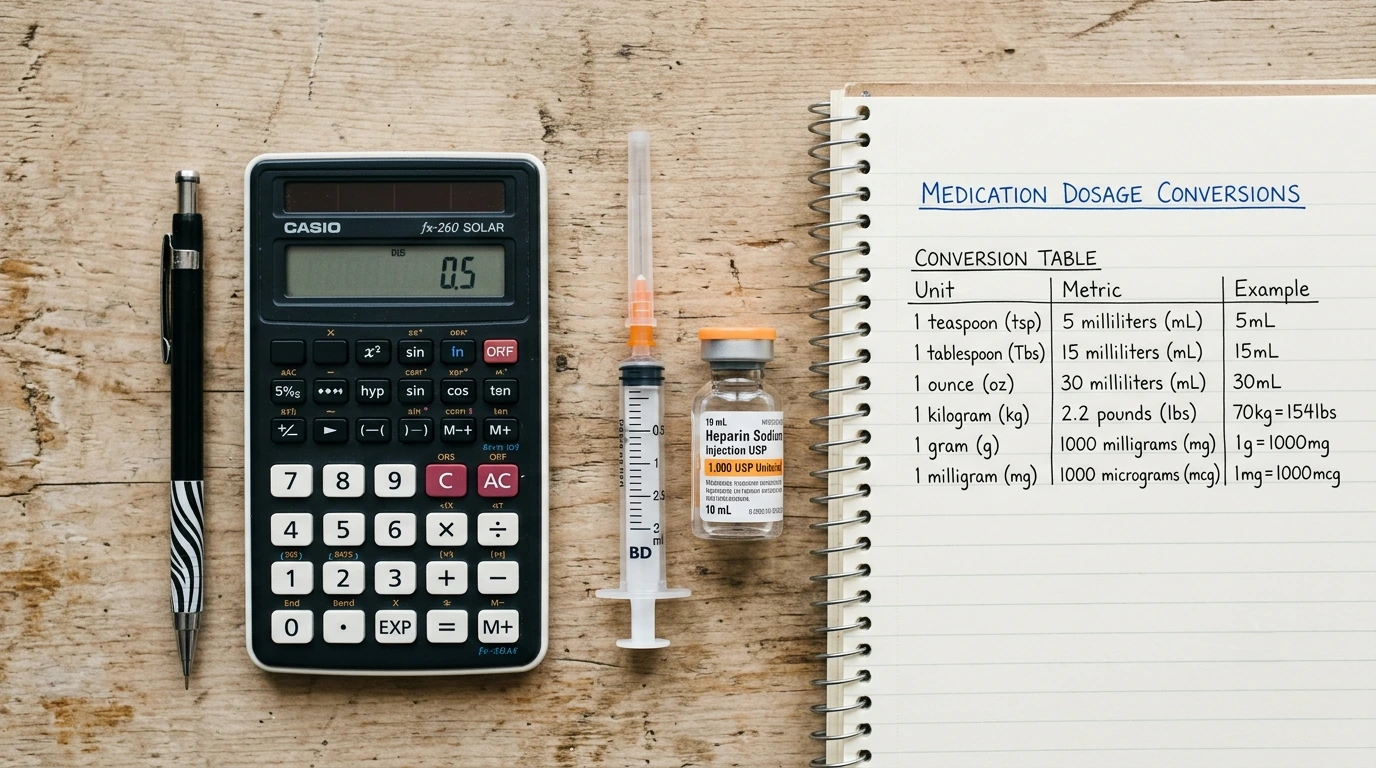
HOSA Medical Math: The Ultimate NLC Prep Guide
There is a version of HOSA Medical Math exam that beats you before the timer starts. Yes, you might be knowing the formulas, it's true, you studied the conversions, but the pressure of competition math is what brings chaos to many students. The fact that a single unit error collapses a five-step problem is what makes this particular test different. This guide prepares you for that version.
What follows is the same framework I have used to prepare students for the HOSA National Leadership Conference Medical Math event for over a decade. It covers the event structure, every testable domain, the two calculation methods you must know, IV flow rate math, and the most common errors that cost competitors points at the NLC level. Work through it methodically. Do not skip the worked examples.
Already prepping for NLC? This HOSA Medical Math Practice Test for NLC includes 50+ problems at full NLC difficulty. Each question has a complete step-by-step solution. Instant digital access.
Section 1: What Is the HOSA Medical Math Event?
HOSA Medical Math is a competitive event in the Health Science category of the Health Occupations Students of America (HOSA) program. It is designed to evaluate a student's ability to perform healthcare-relevant calculations with speed, accuracy, and clinical reasoning.
Event Structure
|
Component |
Details |
|
Format |
Written examination, individual competition |
|
Time Limit |
60 minutes |
|
Question Type |
Multiple choice and free-response calculation problems |
|
Competition Levels |
Regional → State → National Leadership Conference (NLC) |
|
NLC Difficulty |
Significantly higher than regional and state levels |
The NLC event is not simply a harder version of your regional exam. At the national level, problems are multi-step, units are deliberately mismatched to test conversion fluency, and distractors in multiple-choice options are designed to capture the most common arithmetic errors. Preparation that gets you to state will not get you to the podium at NLC.
What the Event Tests
HOSA Medical Math covers five domains. Every domain appears on every exam at every level:
- Metric System Conversions: moving fluently between units of mass, volume, and length
- Household to Metric Conversions: translating clinical orders into patient-friendly measurements and back
- Roman Numerals and Apothecary Notation: decoding older prescription formats still used in some clinical settings
- Solution and Concentration Calculations: percentage solutions, dilutions, and solute/solvent relationships
- Dosage Calculations: the D/H × Q formula, dimensional analysis, and weight-based dosing
Section 2: Foundational Conversions
Most calculation errors at the NLC level are not formula errors. They are conversion errors that happen before the formula is even applied. A student who cannot convert micrograms to milligrams automatically, without stopping to think, will lose time on every multi-step problem and introduce errors on every unit mismatch.
You are supposed to own these tables. Instead of referring them during study sessions, try reproducing them from memory until they are automatic.
Metric System: Mass
|
Unit |
Abbreviation |
Relationship |
|
Kilogram |
kg |
1 kg = 1,000 g |
|
Gram |
g |
1 g = 1,000 mg |
|
Milligram |
mg |
1 mg = 1,000 mcg |
|
Microgram |
mcg (or µg) |
base of the micro scale |
The conversion rule:
- Moving from a larger unit to a smaller unit: multiply.
- Moving from a smaller unit to a larger unit: divide.
2.5 g → mg: multiply by 1,000 → 2,500 mg 500 mcg → mg: divide by 1,000 → 0.5 mg
Metric System: Volume
|
Unit |
Abbreviation |
Relationship |
|
Liter |
L |
1 L = 1,000 mL |
|
Milliliter |
mL |
equivalent to 1 cc (cubic centimeter) |
Household to Metric Conversions
|
Household Measure |
Metric Equivalent |
|
1 teaspoon (tsp) |
5 mL |
|
1 tablespoon (tbsp) |
15 mL |
|
1 fluid ounce (fl oz) |
30 mL |
|
1 cup (8 fl oz) |
240 mL |
|
1 pint (16 fl oz) |
480 mL |
|
1 quart (32 fl oz) |
960 mL |
|
1 pound (lb) |
2.2 kg (for weight-based dosing: divide lbs by 2.2) |
Roman Numerals and Apothecary Notation
|
Symbol |
Value |
Clinical Context |
|
ss |
½ |
apothecary fractions |
|
i / I |
1 |
grain (gr) measurements |
|
v / V |
5 |
older prescription orders |
|
x / X |
10 |
still used in some controlled substance orders |
|
L |
50 |
rare in clinical math |
|
C |
100 |
rare in clinical math |
Critical Rule: In apothecary notation, the numeral follows the unit, for instance, gr x means 10 grains, not "x grains." This reversal is deliberately tested.
Temperature Conversions
|
Direction |
Formula |
Example |
|
Celsius → Fahrenheit |
(°C × 9/5) + 32 |
38°C = 100.4°F |
|
Fahrenheit → Celsius |
(°F − 32) × 5/9 |
101°F = 38.3°C |
There are two primary methods for solving dosage calculation problems. Both are correct. The difference is in how they handle multi-step problems. It's worth noting that at the NLC level, multi-step problems are the standard.
Method 1: Dimensional Analysis (Recommended for NLC)
Dimensional analysis is the method of choice for complex, multi-step problems. The reason for choosing dimensional analysis is because it carries units through every step of the calculation thus making errors visible before they compound. This way, if your units do not cancel correctly, you know immediately that something is wrong.
The framework:
- Start with what you want to find.
- Set up a chain of fractions using known equivalences.
- Cancel units until only the desired unit remains.
- Solve.
Worked Example: Standard Oral Dosage:
Order: Metoprolol 75 mg PO once daily. Available: Metoprolol 25 mg tablets. Question: How many tablets do you administer?
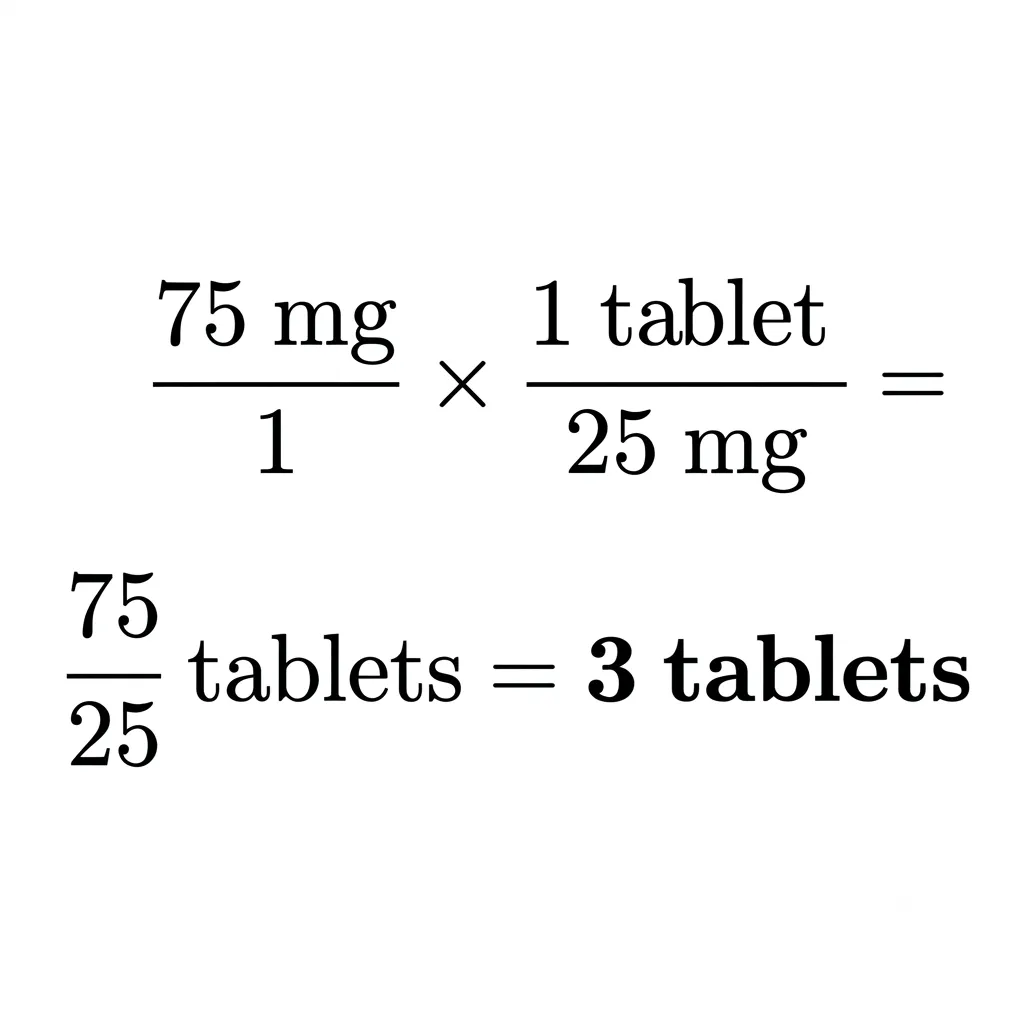
Units cancel (mg ÷ mg), leaving tablets. The answer is confirmed by unit analysis before arithmetic is performed.
Worked Example: Weight-Based Dosing (Multi-Step):
Order: Gentamicin 2.5 mg/kg IV q8h. Patient weighs 154 lbs. Available: Gentamicin 40 mg/mL. Question: How many mL per dose?
Step 1: Convert weight: $$154 \text{ lbs} \times \frac{1 \text{ kg}}{2.2 \text{ lbs}} = 70 \text{ kg}$$
Step 2: Calculate ordered dose: $$70 \text{ kg} \times \frac{2.5 \text{ mg}}{1 \text{ kg}} = 175 \text{ mg per dose}$$
Step 3: Calculate volume: $$175 \text{ mg} \times \frac{1 \text{ mL}}{40 \text{ mg}} = \textbf{4.375 mL} \approx \textbf{4.4 mL}$$
Three steps. Each one confirmed by unit cancellation before moving forward. This is the discipline that separates NLC-level competitors from everyone else.
Method 2: Desired Over Have × Quantity (D/H × Q)
This method works efficiently for single-step problems where no unit conversion is required before applying the formula.
$$\text{Amount to Give} = \frac{\text{Desired Dose}}{\text{Dose on Hand}} \times \text{Quantity}$$
Worked Example:
Order: Amoxicillin 500 mg PO. Available: Amoxicillin 250 mg/5 mL suspension.
$$\frac{500 \text{ mg}}{250 \text{ mg}} \times 5 \text{ mL} = 2 \times 5 = \textbf{10 mL}$$
When to use which method: Use D/H × Q when the units in the order and the units on hand already match. Use dimensional analysis when they do not, or when the problem has more than one conversion step. At NLC, default to dimensional analysis.
The worked examples above are a sample of what NLC problems look like. Get today a copy of the HOSA Medical Math Practice Test. The set of questions in this particular exam prep guide contains 50+ problems at this difficulty level with every step of the solution worked out so you can identify exactly where your process breaks down under timed conditions.
Section 4: IV Flow Rate Calculations
Intravenous math is the domain where most competitors lose points, because it introduces a time variable that oral dosage calculations do not have. There are two calculations you must master.
Calculation 1: Infusion Rate in mL/hr
Used when programming an infusion pump. The pump requires mL per hour.
$$\text{mL/hr} = \frac{\text{Total Volume (mL)}}{\text{Total Time (hrs)}}$$
Worked Example:
Order: Infuse 1,000 mL of Normal Saline over 8 hours.
$$\frac{1,000 \text{ mL}}{8 \text{ hrs}} = \textbf{125 mL/hr}$$
Calculation 2: Gravity Drip Rate in gtt/min
Used when an infusion pump is unavailable and the nurse must manually regulate the drip rate by counting drops.
$$\text{gtt/min} = \frac{\text{Volume (mL)} \times \text{Drop Factor (gtt/mL)}}{\text{Time (minutes)}}$$
Drop factors are determined by the IV tubing set and will always be provided in the problem:
|
Tubing Type |
Drop Factor |
|
Macrodrip (standard adult) |
10, 15, or 20 gtt/mL |
|
Microdrip (pediatric/precise) |
60 gtt/mL |
Worked Example:
Order: Infuse 500 mL D5W over 4 hours. Tubing drop factor: 15 gtt/mL.
Step 1: Convert time to minutes: 4 hrs × 60 = 240 minutes
Step 2: Apply formula: $$\frac{500 \text{ mL} \times 15 \text{ gtt/mL}}{240 \text{ min}} = \frac{7,500}{240} = 31.25 \approx \textbf{31 gtt/min}$$
Critical Rule: Drip rates are always rounded to the nearest whole number. You cannot count a fraction of a drop.
Section 5: The Four Errors That Cost NLC Competitors Points
After reviewing the performance of students at regional, state, and national levels, the same four errors appear consistently. Knowing they exist is not enough, what you should to is take a sample past exam, time yourself and in this way things will be much clear when you recognize them in the middle of a timed exam.
Error 1: Skipping the Unit Conversion Before Calculating The order is in grams. The label is in milligrams. The student plugs the numbers directly into D/H × Q without converting. The answer is off by a factor of 1,000. This is the most common and most preventable error in HOSA Medical Math.
The fix: Before writing any formula, confirm that the units in the order and the units on the label match. If they do not, convert first.
Error 2: Forgetting to Convert Pounds to Kilograms for Weight-Based Dosing Weight-based orders are always calculated in kilograms. Patient weights in clinical problems are frequently given in pounds. Students who skip the conversion calculate a dose that is 2.2 times too high.
The fix: Any time you see a patient weight in a dosage problem, divide by 2.2 before doing anything else.
Error 3: Using the Wrong Time Unit in IV Calculations The gtt/min formula requires time in minutes. Students who leave time in hours produce answers that are 60 times too low.
The fix: IV flow rate calculations — convert hours to minutes before applying the formula, every time, without exception.
Error 4: Rounding Too Early Rounding an intermediate step before the final answer introduces compounding error. In a three-step problem, rounding after step one can produce a final answer that is meaningfully different from the correct value.
The fix: Carry full decimal precision through every intermediate step. Round only the final answer, and round according to the clinical context — mL/hr and gtt/min round to whole numbers; oral liquid doses round to the nearest tenth mL.
Section 6: Practice Questions with Fully Worked Solutions
Apply the methods from this guide before checking the answers. Work each problem on paper, showing every unit.
Question 1 Order: Furosemide 0.5 g PO. Available: Furosemide 250 mg tablets. How many tablets?
Solution: Convert: 0.5 g = 500 mg D/H × Q: 500 ÷ 250 × 1 = 2 tablets
Question 2 Order: Infuse 750 mL NS over 6 hours via pump. What rate do you set in mL/hr?
Solution: 750 ÷ 6 = 125 mL/hr
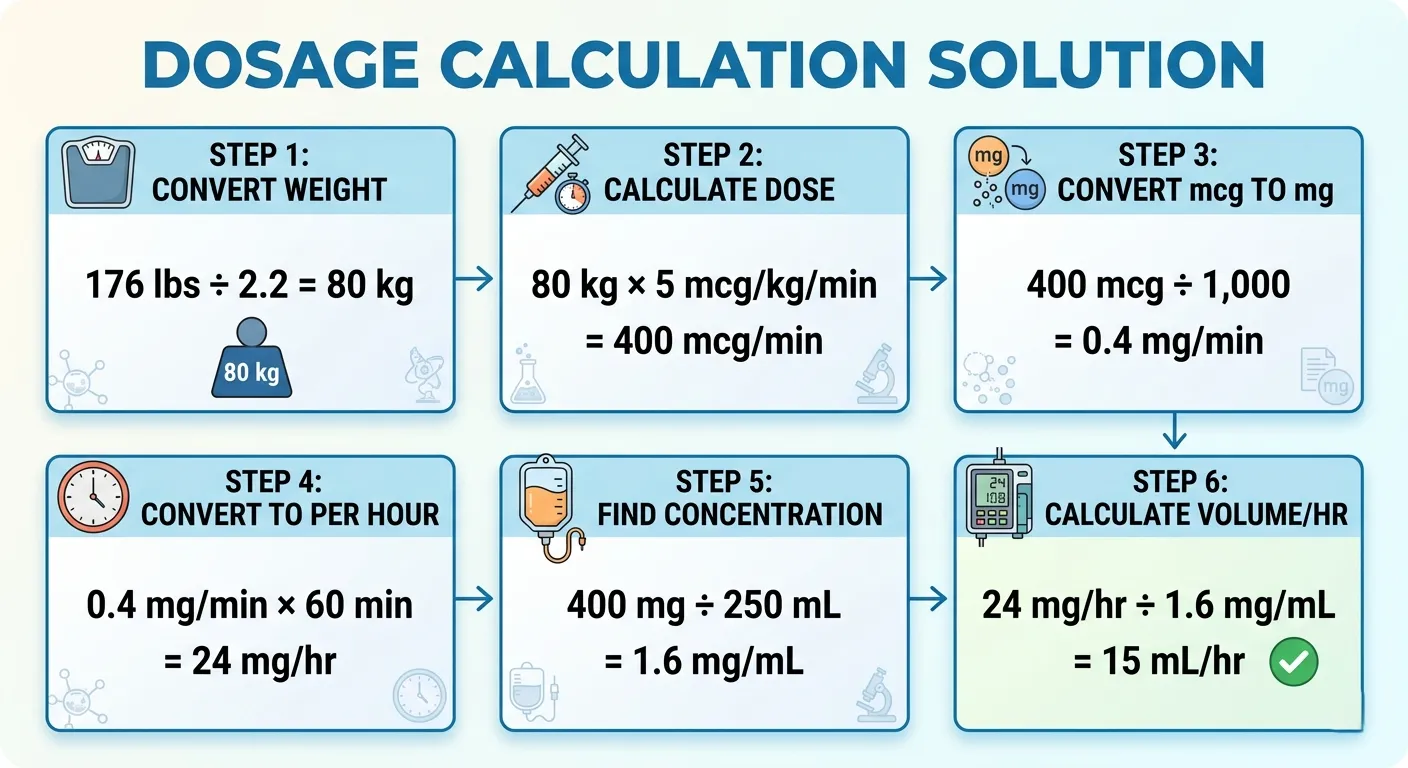
Question 3 Order: Dopamine 5 mcg/kg/min IV. Patient weighs 176 lbs. Available: Dopamine 400 mg in 250 mL D5W. What rate do you set in mL/hr?
Solution: Step 1 — Convert weight: 176 ÷ 2.2 = 80 kg Step 2 — Calculate dose: 80 × 5 = 400 mcg/min Step 3 — Convert mcg to mg: 400 mcg ÷ 1,000 = 0.4 mg/min Step 4 — Convert to per hour: 0.4 × 60 = 24 mg/hr Step 5 — Concentration: 400 mg ÷ 250 mL = 1.6 mg/mL Step 6 — Volume/hr: 24 ÷ 1.6 = 15 mL/hr
Question 4 A physician orders gr xv of aspirin. Available: Aspirin 325 mg tablets (1 grain = 60 mg). How many tablets?
Solution: Convert grains: 15 × 60 = 900 mg D/H × Q: 900 ÷ 325 = 2.77 → 3 tablets (round to nearest whole tablet)
Question 5 Order: Infuse 1,000 mL LR over 10 hours. Drop factor: 20 gtt/mL. What is the drip rate in gtt/min?
Solution: Time: 10 × 60 = 600 minutes gtt/min: (1,000 × 20) ÷ 600 = 20,000 ÷ 600 = 33.3 → 33 gtt/min
These five questions cover four of the five HOSA Medical Math domains and three levels of complexity. If you worked through them systematically; units first, formula second, rounding last, then you have applied the correct process. If you got the right answer through a different method, verify that your method would still work if the units had been mismatched from the start.
The NLC exam contains problems at the difficulty level of Question 3 and above. Speed and accuracy under time pressure require more than understanding the method — they require having solved enough problems that the method is automatic.
Sharpen Your Speed Before the NLC
Understanding the framework is the foundation. Building the speed and accuracy the NLC demands requires deliberate, timed practice on problems that match the actual event format — across all five domains, at NLC difficulty, with full worked solutions that explain every step of the reasoning.
Our HOSA Medical Math Practice Test with Fully Worked Solutions was built specifically for NLC-level preparation. Every problem includes a complete step-by-step solution so you understand not just the answer, but the exact decision process behind it. Download it, time yourself, and use the worked solutions to diagnose exactly where your process breaks down.
Below are sample questions from the above Hosa Medical Math Exam revision material.
HOSA Medical Math Sample Exam Questions
- An 88 pound child has an order for pain medication that reads morphine liquid PO 0.2 mg/kg q4h PRN. How many milliliters per dose would be given if the concentration is 2 mg/ml?
- What is the correct fractional equivalent of the ratio 2:7?
- Levothyroxine 0.5 mg PO is ordered. It is available in 125 mcg tablets. How many tablets would be needed for one dose?
- A vial of dactinomycin reads l.5 mg = 1 ml. A patient weighing 120 kg is to receive 15 mcg/kg IM. How many ml of this antibiotic antineoplastic drug should be prepared? (Round to the nearest tenth.)
- An order is written for heparin 1500 units/hour. On hand is a 250 ml IV bag of D5W with 25,000 units of heparin. How many milliliters per hour should be infused?
- A physician orders a 1000 ml IV bag of D5W with 30 mg of Dilaudid to infuse at
- 140 ml/hour. How many milligrams of Dilaudid per hour will the patient receive? (Round to the nearest tenth.)
- A pharmacist poured a 20% NaCl solution into a flask that contained a NaCl solution of an unknown concentration. If the total volume of the mixed solution is 500 ml and its concentration is 5% NaCl, how many milliliters of the 20% NaCl solution was poured into the flask?
- A label on a bottle of solution reads 5% dextrose, which means that there are 5 grams of dextrose in how many liters of finished solution? (Round to the nearest tenth.)
- The physician orders 25 mg of gentamicin IM. The label says to add 1.3 ml of sterile water to yield 50 mg/1.5 ml. How many milliliters of reconstituted solution should be given? (Round to the nearest hundredth.)
- How many grams of a pure drug are needed to prepare 4,000 ml of a 2% neomycin-polymixin B antibiotic solution?
- How many grams of NaCl are in 45 deciliters of a 30% w/v NaCl solution?
- According to the graph to the right about malpractice claims against physicians, what percent of general surgeons end up paying malpractice claims every year?
- According to the chart below, what is the cost in dollars of the average routine office visit outside the United States?
- A child weighs 55 pounds and is 85 cm tall. The physician orders amoxicillin based on BSA for the child. BSA for this child based on the nomogram is 0.82 m2. The adult dose of amoxicillin is 293 mg/m2/day. What is the daily dose for the child in milligrams?
0
229