
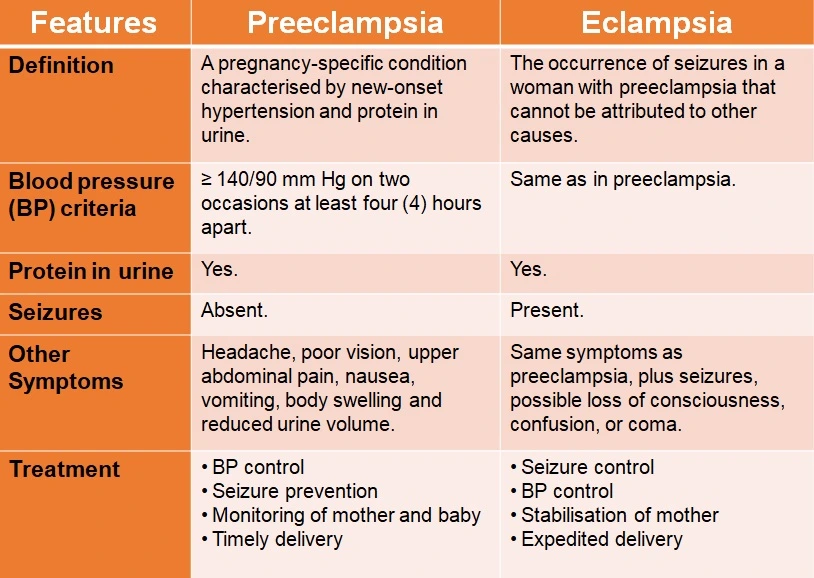
1. The nurse knows that preeclampsia tends to occur during what time in a pregnancy?
A. before 20 weeks
B. in the third trimester and postpartum
C. after 20 weeks
D. in the first and second trimester
The answer is C. Preeclampsia tends to occur AFTER 20 weeks gestation.
Check this Preeclampsia Eclampsia RAPID Reasoning; Dana Myers, 40 years old for actual clinical reasoning case study for simulated patient Dana Myers.
2. A patient is currently 34 weeks pregnant with her first baby. Which findings below could indicate the development of preeclampsia in this patient that would need to be reported to the physician? Select all that apply:
A. 1600: blood pressure 144/100, 1700: blood pressure 120/80
B. 3+ dipstick urine protein
C. 1 hour glucose tolerance test 90 mg/dL
D. 0800: blood pressure 142/92, 1230: blood pressure: 144/98
E. <300 mg/dL 24-hour urine protein
The answers are B and D. Signs and symptoms of preeclampsia include: proteinuria (>1+ dipstick urine protein or >300 mg/dL 24 hour urine protein, hypertension >140/90…two reading at least 4-6 hours apart), swelling in face, eyes, extremities, headaches, vision changes, etc.
3. You’re providing an in-service to a group of new labor and delivery nurse graduates about the pathophysiology of preeclampsia. Which statement by one of the group participants demonstrates they understood how this condition develops?
A. “The basal arteries of the myometrium fail to widen to support blood flow to the placenta.”
B. “The placenta experiences ischemia because the spiral arteries of the uterus fail to reshape and increase in diameter.”
C. “The cardiovascular system of the mother fails to compensate for the increased blood flow from the fetus and placental ischemia occurs.”
D. “If the mother experience uncontrolled hypertension and proteinuria, it compromises blood flow to the placenta and leads to preeclampsia.”
The answer is B. This is the only correct statement. When preeclampsia occurs it is because the spiral arteries of the uterus failed to widen in diameter due to poor trophoblast invasion during the beginning of the pregnancy. Overtime, this causes problems (usually after 20 weeks gestation) and the placenta experiences ischemia. When the placenta becomes ischemic is releases substances into mom’s circulation that are very toxic to her endothelial cells, which causes all the signs and symptoms seen in preeclampsia. Severity varies in patients.
4. A 37-year-old female patient who is 36 weeks pregnant is diagnosed with mild preeclampsia. The nurse will include what information in the patient’s education? Select all that apply:
A. Report weight gain of >4 lbs in one week to physician
B. Incorporate foods like eggs, nuts, fish, meat in your diet
C. Follow a no salt diet
D. Headache and vision changes are expected side effects of this condition and cause no reason for concern.
E. Importance of monitoring urine protein at home
F. Lying on left-side is recommended along with rest
G. Report a decrease in fetal activity immediately
The answers are: B, E, F, and G. These options are topics the nurse wants to include in the patient’s teaching with preeclampsia. Option A is wrong because the patient should report a weight gain of >2 lbs (NOT 4 lbs) in one week. Option C is wrong become it is no longer recommended the patient restrict salt in diet but limit it. Option D is wrong because a headache and vision changes are serious complications that may indicate the development of eclampsia, and the patient should report it immediately.
5. Fill-in-the-blank: The signs and symptoms of preeclampsia are mainly occurring because substances released by the ischemic placenta cause damage to the _________________ in mom’s body, which injures organs.
A. spiral arteries
B. epithelial cells
C. endothelial cells
D. juxtaglomerular cells
The answer is C: The signs and symptoms of preeclampsia are mainly occurring because substances released by the ischemic placenta cause damage to the ENDOTHELIAL CELLS in mom’s body, which injures organs.
6. Select all the risk factors below that increases a woman’s risk for developing preeclampsia:
A. Nulligravida
B. Primigravida
C. BMI 34
D. Pregnant with twins
E. Maternal history of preeclampsia
F. Age: 25-years-old
G. History of Lupus and Diabetes
The answers are: B, C, D, E, and G. Risk factors for preeclampsia include: History of preeclampsia or family history, first pregnancy (primigravida), significant health history prior to pregnancy: diabetes, lupus, high blood pressure, kidney disease, Obese: BMI >30, having more than one baby (twins, triplets etc.), age (young <18 or advanced >35).
7. Your patient is 36 weeks pregnant with severe preeclampsia. The physician has ordered lab work to assess for HELLP Syndrome. Which findings on the patient’s lab results correlate with HELLP Syndrome?
A. Hemoglobin 12 g/dL
B. Platelets 90,000 μL
C. ALT 100 IU/L
D. AST 90 IU/L
E. Glucose 350 mg/dL
F. Abnormal RBC peripheral smear
The answers are: B, C, D, and F. HELLP Syndrome causes of Hemolysis of RBCs (abnormal RBC peripheral smear), Elevated Liver enzymes (>70 IU/L for AST or ALT), Low Platelets (<100,000 μL ).
8. Your patient with preeclampsia is started on Magnesium Sulfate. The nurse knows to have what medication on standby?
A. Acetylcysteine
B. Calcium carbonate
C. Oxytocin
D. Calcium gluconate
The answer is D: The antidote for Magnesium Sulfate is Calcium Gluconate. The nurse should have this on hand in case Magnesium toxicity occurs.
9. A 39 week pregnant patient is in labor. The patient has preeclampsia. The patient is receiving IV Magnesium Sulfate. Which finding below indicates Magnesium Sulfate toxicity and requires you to notify the physician?
A. Deep tendon reflex 4+
B. Respiratory rate of 13 breaths per minute
C. Urinary output of 600 mL over 12 hours
D. Clonus presenting in the lower extremities
E. Patient reports flushing or feeling hot
The answer is E. The nurse should monitor for Magnesium Sulfate toxicity. Signs of this include: EARLY: flushing or feeling hot/warm, later on: decreased or absent reflexes (finding of 4+ Deep tendon reflex is considered HYPERreflexia), Respiratory rate less than 12 breaths per minute, Urinary output of less than 30 mL/hr, EKG changes.
10. In a patient with preeclampsia, what signs and symptoms indicate that the patient has a high risk of experiencing a seizure due to central nervous system irritability? Select all that apply:
A. You note bouncing of the foot when it is quickly dorsiflexed.
B. Patellar and bicep deep tendon reflexes are graded 4+.
C. Platelet count 200,000
D. Patient reports a decrease in headache pain.
The answers are A and B. Option A indicates positive clonus and Option B is indicative of hyperreflexia. If these findings are present it demonstrates that the central nervous system is irritated and there is a high risk of potential seizure activity. Seizure precautions should be initiated and the physician notified.
11. How would the nurse check for clonus in a patient with preeclampsia?
A. Assess the patellar and bicep tendon with a reflex hammer and grade the reaction.
B. Assess for muscular rigidity by having the patient extend the arms and place resistance against the arms.
C. Assess for beating of the foot when the foot is quickly dorsiflexed.
D. Assess for dorsiflexion of the foot by quickly plantar flexing the foot.
The answer is C: To check for clonus the nurse will have the patient dangle the leg and support the patient’s lower leg. Then the nurse will quickly dorsiflex the foot. The nurse is assessing for bouncing or beating of the foot (hence the foot attempts to plantarflex). If the foot attempts to bounce or beat 3 or more times, it is positive for clonus.
12. A 37 week pregnant patient is admitted with severe preeclampsia. The patient begins to experiences a tonic-clonic seizure. Which of the following would the nurse AVOID during the seizure?
A. Placing the patient in a supine position
B. Holding down the patient’s head to prevent injury
C. Staying with the patient and activating the emergency response team
D. Timing the seizure
E. Providing 8 to 10 L of oxygen
The answers are A and B. The nurse would want to place the patient on their side (preferably the left-side…not supine) to help prevent the tongue from obstructing the airway, preventing aspiration, and improving blood flow to the placenta. In addition, the nurse would NOT want to restrain the patient, which can cause injury. Option C, D, and E are steps the nurse would want to take.
For more practice questions and case scenarios, download the ATI RN Maternal Newborn Preeclampsia Latest Exam with NGN. This is the actual exam prep guide best suited for students who are about to sit for their midterm and final exams.
0
1365