Pasing Grades
  • Start Selling
  • Blog
  • Contact
  • 0

    Your cart is empty!

English

  • English
  • Spanish
  • Arabic
Create Account Sign In
  • Library
    • New Prep Guides
    • Featured Prep Guides
    • Free Exam Prep Guides
    • Best sellers
  • General
  • Nursing
    • Research Paper
    • Case Study
    • Discussion Post
    • Assignment
    • Exam
    • Practice Questions and Answers
    • Test Bank
    • solutions manual
  • Accounting
    • Case Study
    • Thesis
    • Study Guide
    • Summary
    • Research Paper
    • test bank
  • English
    • Creative Writing
    • Research Paper
    • Summary
    • Rhetorics
    • Literature
    • Journal
    • Exam
    • Grammar
    • Discussion Post
    • Essay
  • Psychology
    • Hesi
    • Presentation
    • Essay
    • Summary
    • Study Guide
    • Essay
    • Solution Manual
    • Final Exam Review
    • Class Notes
    • test bank
  • Business
    • Lecture Notes
    • Solution Manual
    • Presentation
    • Business Plan
    • Class Notes
    • Experiment
    • Summary
    • Practice Questions
    • Study Guide
    • Case Study
    • test bank
    • Exam
  • More
    • Computer Science
    • Economics
    • Statistics
    • Engineering
    • Biology
    • Religious Studies
    • Physics
    • Chemistry
    • Mathematics
    • History
    • Sociology
    • Science
    • Philosophy
    • Law
  • Pages
    • About Us
    • Selling Tips
    • Delivery Policy
    • Faq
    • Privacy Policy
  • Flash Sale
  • Home
  • Zahra Shajani: Test Bank For Wright & Leaheys Nurses and Families A Guide to Family Assessment and Intervention 7th Edition

Zahra Shajani: Test Bank For Wright & Leaheys Nurses and Families A Guide to Family Assessment and Intervention 7th Edition

Preview page 1 Preview page 2 Preview page 3
Add To Favorites

Share this item Share this item

  • Item Details
  • Comments (0)
  • Reviews (0)
  • Contact Seller

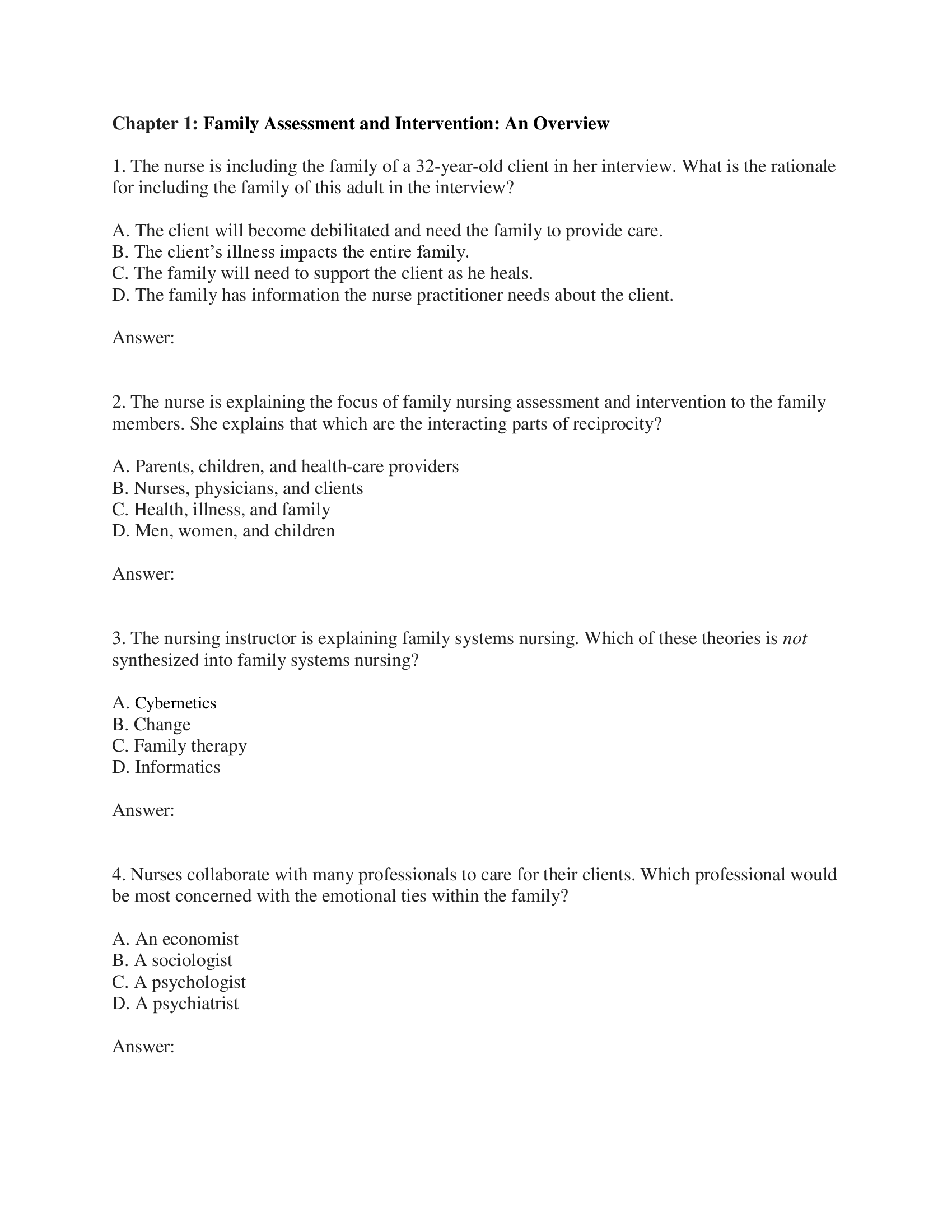
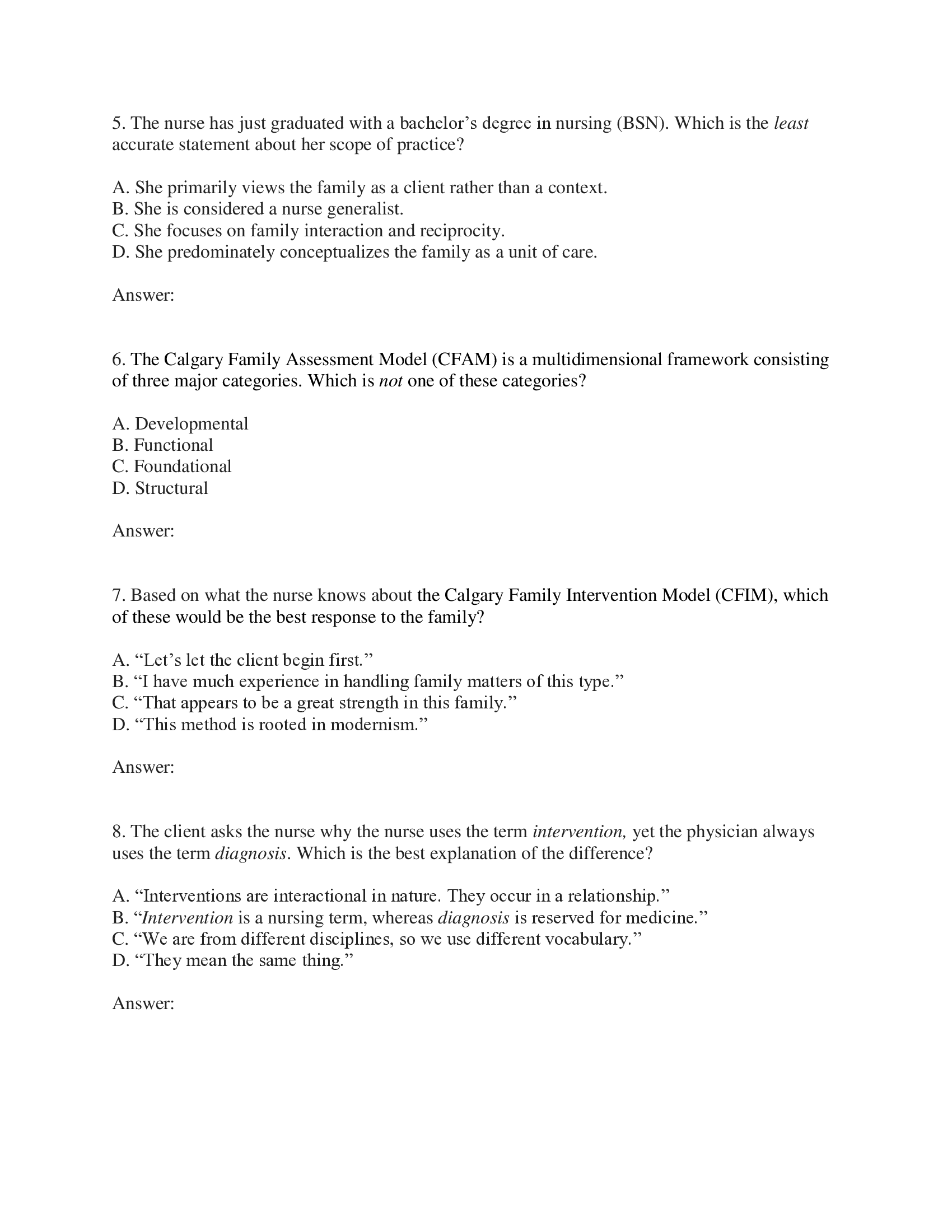
Test Bank For Wright & Leahey's Nurses and Families A Guide to Family Assessment and Intervention 7th Edition by Zahra Shajani, Diana Snell 9780803669628 Chapter 1-13 Complete Guide. Chapter 1: Family Assessment and Intervention: An Overview 1. The nurse is including the family of a 32-year-old client in her interview. What is the rationale for including the family of this adult in the interview? A. The client will become debilitated and need the family to provide care. B. The client’s illness impacts the entire family. C. The family will need to support the client as he heals. D. The family has information the nurse practitioner needs about the client. Answer: 2. The nurse is explaining the focus of family nursing assessment and intervention to the family members. She explains that which are the interacting parts of reciprocity? A. Parents, children, and health-care providers B. Nurses, physicians, and clients C. Health, illness, and family D. Men, women, and children Answer: 3. The nursing instructor is explaining family systems nursing. Which of these theories is not synthesized into family systems nursing? A. Cybernetics B. Change C. Family therapy D. Informatics Answer: 4. Nurses collaborate with many professionals to care for their clients. Which professional would be most concerned with the emotional ties within the family? A. An economist B. A sociologist C. A psychologist D. A psychiatrist Answer: 5. The nurse has just graduated with a bachelor’s degree in nursing (BSN). Which is the least accurate statement about her scope of practice? A. She primarily views the family as a client rather than a context. B. She is considered a nurse generalist. C. She focuses on family interaction and reciprocity. D. She predominately conceptualizes the family as a unit of care. Answer: 6. The Calgary Family Assessment Model (CFAM) is a multidimensional framework consisting of three major categories. Which is not one of these categories? A. Developmental B. Functional C. Foundational D. Structural Answer: 7. Based on what the nurse knows about the Calgary Family Intervention Model (CFIM), which of these would be the best response to the family? A. “Let’s let the client begin first.” B. “I have much experience in handling family matters of this type.” C. “That appears to be a great strength in this family.” D. “This method is rooted in modernism.” Answer: 8. The client asks the nurse why the nurse uses the term intervention, yet the physician always uses the term diagnosis. Which is the best explanation of the difference? A. “Interventions are interactional in nature. They occur in a relationship.” B. “Intervention is a nursing term, whereas diagnosis is reserved for medicine.” C. “We are from different disciplines, so we use different vocabulary.” D. “They mean the same thing.” Answer: 9. The nurse decides to visit the family of a client with attention deficit-hyperactivity disorder (ADHD). This intervention is most important for families with children with this diagnosis for which reason? A. They are more prone to have cluttered and messy homes. B. They are more likely to abuse their children. C. There is more interpersonal conflict in these homes. D. There are more safety risks in these homes. Answer: 10. The nurse is preparing to transition an elderly client to another level of care. Which is the least important priority? A. Providing timely communication to the family and caregiving team B. Involving the client and caregiver in establishing goals C. Educating the family about resources and levels of care D. Notifying the insurance company of the change Answer: 11. The nurse finds that more of her clients are asking for applications and Web sites to promote health. What would be a barrier to the use of applications and Web sites for most clients? A. Electronic accessibility B. Culture and literacy needs C. Available at all times D. Web site flexibility Answer: 12. The nurse is bringing the family session to a close. What is the best way to determine when the next appointment should be scheduled? A. Ask the family members how many meetings they believe it will take to resolve the problem. B. Schedule the next session and determine after each session how many more are needed. C. The insurance company will determine a reasonable amount. D. Offer the same time on the same day of the week each week to develop a habit. Answer: 13. The nurse is determining the need for a family intervention. Which would be the lowest priority? A. A child being bullied on social media B. An elderly client receiving a terminal diagnosis C. The birth of a child D. A child making the soccer team Answer: 14. The nurse is surprised that the family does not want an intervention. Which would be an unusual reason for a family not to want an intervention? A. The nurse works for the state department of social services. B. The nurse once dated a member of the family. C. The nurse works at the hospital where one of the family members is being admitted. D. The client is moving to another state. Answer: 15. The nurse is reviewing charts to determine which family needs a family intervention. Which would be the least appropriate? A. A family member dies after a long, terminal disease. B. An adolescent strives to make the cheerleading team to please her sick mother. C. A child begins doing poorly in school. D. A young adult returns home after a long stay in a drug rehabilitation facility. Answer:   Chapter 1: Family Assessment and Intervention: An Overview – Answers and Rationales 1. The nurse is including the family of a 32-year-old client in her interview. What is the rationale for including the family of this adult in the interview? A. The client will become debilitated and need the family to provide care. B. The client’s illness impacts the entire family. C. The family will need to support the client as he heals. D. The family has information the nurse practitioner needs about the client. ANS: B Page: 2 Feedback A. This is incorrect. There is no evidence that the client will become debilitated. B. This is correct. When a client is ill, the entire family is impacted and should be considered in the assessment and intervention. C. This is incorrect. There is no evidence that the client will need support from the family. D. This is incorrect. Although the family members may have information about the client, this is not the primary reason for including them in the interview. 2. The nurse is explaining the focus of family nursing assessment and intervention to the family members. She explains that which are the interacting parts of reciprocity? A. Parents, children, and health-care providers B. Nurses, physicians, and clients C. Health, illness, and family D. Men, women, and children ANS: C Page: 2 Feedback A. This is incorrect. Parents, children, and health-care providers may interact but are not considered the interacting parts of reciprocity. B. This is incorrect. Although nurses, physicians, and clients should interact, they are not considered the interacting parts of reciprocity. C. This is correct. The interacting parts of reciprocity are the family and its interaction with health and illness. D. This is incorrect. Men, women, and children interact as a family, but they are not relating with health and illness. 3. The nursing instructor is explaining family systems nursing. Which of these theories is not synthesized into family systems nursing? A. Cybernetics B. Change C. Family therapy D. Informatics ANS: D Page: 2 Feedback A. This is incorrect. Cybernetics theory is synthesized into family systems nursing. B. This is incorrect. Change theory is synthesized into family systems nursing. C. This is incorrect. Family therapy theory is synthesized into family systems nursing. D. This is correct. Informatics theory is not synthesized into family systems nursing. 4. Nurses collaborate with many professionals to care for their clients. Which professional would be most concerned with the emotional ties within the family? A. An economist B. A sociologist C. A psychologist D. A psychiatrist ANS: C Page: 5 Feedback A. This is incorrect. An economist would be concerned with how the family works together to meet material needs. B. This is incorrect. A sociologist would be concerned with how the family relates with society. C. This is correct. A psychologist would be most concerned with the emotional ties within the family. D. This is incorrect. A psychiatrist would be most concerned with medication management. 5. The nurse has just graduated with a bachelor’s degree in nursing (BSN). Which is the least accurate about her scope of practice? A. She primarily views the family as a client rather than a context. B. She is considered a nurse generalist. C. She focuses on family interaction and reciprocity. D. She predominately conceptualizes the family as a unit of care. ANS: A Page: 6 Feedback A. This is correct. Nurses with a BSN usually view the family as a context, rather than a client. B. This is incorrect. Nurses with a BSN are considered nurse generalists. C. This is incorrect. Higher-level nurses with BSNs focus on family interaction and reciprocity. D. This is incorrect. Nurses at the graduate level, rather than those with a BSN, conceptualize the family as a unit of care. 6. The Calgary Family Assessment Model (CFAM) is a multidimensional framework consisting of three major categories. Which is not one of these categories? A. Developmental B. Functional C. Foundational D. Structural ANS: C Page: 6 Feedback A. This is incorrect. Developmental is one of the categories of the CFAM. B. This is incorrect. Functional is one of the categories of the CFAM. C. This is correct. Foundational is not one of the categories of the CFAM. D. This is incorrect. Structural is one of the categories of the CFAM. 7. Based on what the nurse knows about the Calgary Family Intervention Model (CFIM), which of these would be the best response to the family? A. “Let’s let the client begin first.” B. “I have much experience in handling family matters of this type.” C. “That appears to be a great strength in this family.” D. “This method is rooted in modernism.” ANS: C Page: 9 Feedback A. This is incorrect. The CFIM is nonhierarchal, so the entire family contributes equally. B. This is incorrect. The CFIM assumes that the family is the expert on the family system. C. This is correct. The CFIM is a strengths-based model. D. This is incorrect. The CFIM is rooted in postmodernism, or an emphasis on subjectivity. 8. The client asks the nurse why the nurse uses the term intervention, yet the physician always uses the term diagnosis. Which is the best explanation of the difference? A. “Interventions are interactional in nature. They occur in a relationship.” B. “Intervention is a nursing term, whereas diagnosis is reserved for medicine.” C. “We are from different disciplines, so we use different vocabulary.” D. “They mean the same thing.” ANS: A Page: 9 Feedback A. This is correct. Interventions are interactions between the nurse and the client. B. This is incorrect. Physicians do interventions, and nurses have nursing diagnoses. C. This is incorrect. As health-care workers collaborate, they should be using similar terms with the same meaning. D. This is incorrect. Intervention and diagnosis do not have the same meaning. 9. The nurse decides to visit the family of a client with attention deficit-hyperactivity disorder (ADHD). This intervention is most important for families with children with this diagnosis for which reason? A. They are more prone to have cluttered and messy homes. B. They are more likely to abuse their children. C. There is more interpersonal conflict in these homes. D. There are more safety risks in these homes. ANS: C Page: 14 Feedback A. This is incorrect. There is no evidence that families with a member with ADHD have more cluttered and messy homes. B. This is incorrect. There is no evidence that parents with a child with ADHD are more likely to abuse their children. C. This is correct. There is evidence that families with a child with ADHD have more interpersonal conflict. D. This is incorrect. There is no evidence that families with a child with ADHD have more safety risks in their homes. 10. The nurse is preparing to transition an elderly client to another level of care. Which is the least important priority? A. Providing timely communication to the family and caregiving team B. Involving the client and caregiver in establishing goals C. Educating the family about resources and levels of care D. Notifying the insurance company of the change ANS: D Page: 15 Feedback A. This is incorrect. Timely communication among the caregiving team is vital for transitions. B. This is incorrect. Both the client and the caregiver should be involved in goal setting. C. This is incorrect. The family should be aware of resources, levels of care, and possible venues. D. This is correct. This is a family responsibility. 11. The nurse finds that more of her clients are asking for applications and Web sites to promote health. What would be a barrier to the use of applications and Web sites for most clients? A. Electronic accessibility B. Culture and literacy needs C. Available at all times D. Web site flexibility ANS: B Page: 15 Feedback A. This is incorrect. Most clients have access to electronic devices. B. This is correct. Culture and literacy needs may be a barrier unless these are taken into consideration when developing the application or Web site. C. This is incorrect. Being available at all times would be an advantage. D. This is incorrect. Having a flexible and interactive Web site is an advantage. 12. The nurse is bringing the family session to a close. What is the best way to determine when the next appointment should be scheduled? A. Ask the family members how many meetings they believe it will take to resolve the problem. B. Schedule the next session and determine after each session how many more are needed. C. The insurance company will determine a reasonable amount. D. Offer the same time on the same day of the week each week to develop a habit. ANS: A Page: 17 Feedback A. This is correct. The family is the best judge of how many sessions will be needed. B. This is incorrect. There should be a collaborative process in scheduling sessions. C. This is incorrect. The nurse should provide assessment data to the insurance company to explain the need for future sessions. D. This is incorrect. Although regular appointments are often good, the nurse should not assume they are always convenient for the family. 13. The nurse is determining the need for a family intervention. Which would be the lowest priority? A. A child being bullied on social media B. An elderly client receiving a terminal diagnosis C. The birth of a child D. A child making the soccer team ANS: D Page: 18 Feedback A. This is incorrect. A child being cyberbullied should have an intervention. B. This is incorrect. End-of-life decisions necessitate an intervention. C. This is incorrect. The birth, or adoption, of a child will cause changes in the family dynamics. D. This is correct. Although it might disrupt the family schedule a bit, it is not as disruptive to the family as the other situations. 14. The nurse is surprised that the family does not want an intervention. Which would be an unusual reason for a family not to want an intervention? A. The nurse works for the state department of social services. B. The nurse once dated a member of the family. C. The nurse works at the hospital where one of the family members is being admitted. D. The client is moving to another state. ANS: C Page: 17 Feedback A. This is incorrect. The family may believe that the nurse is coming to investigate them for child abuse or disrupt their family in some way. B. This is incorrect. The nurse should not be working with this family because she had a dating relationship with one member of the family. C. This is correct. If a family member is being admitted to the hospital, it would be appropriate for a staff member of the hospital to intervene with them. D. This is incorrect. The family may not see the purpose in meeting for an intervention if the client will be establishing himself with other providers in a different state. 15. The nurse is reviewing charts to determine which family needs a family intervention. Which would be the least appropriate? A. A family member dies after a long, terminal disease. B. An adolescent strives to make the cheerleading team to please her sick mother. C. A child begins doing poorly in school. D. A young adult returns home after a long stay in a drug rehabilitation facility. ANS: B Page: 18 Feedback A. This is incorrect. The death of a family member can severely disrupt family dynamics because of the void it leaves. B. This is correct. This adolescent is showing strength and achieving goals. Family intervention is not as important in this case. C. This is incorrect. If a child acts out or performs badly in schoolwork, the family should have an intervention. D. This is incorrect. Returning from drug rehabilitation changes the family dynamics and necessitates an intervention.

Contact the Seller

Please Sign In to contact this seller.


  • 👎  Report Copyright Violation

Frequently Asked Questions

What Do I Get When I Buy This Study Material?

+

When you buy a study material on Passing Grades, an instant download link will be sent directly to your email, giving you access to the file anytime after payment is completed.

Is Passing Grades a Trusted Platform?

+

Yes, Passing Grades is a reputable students’ marketplace with a secure payment system and reliable customer support. You can trust us to ensure a safe and seamless transaction experience.

Will I Be Stuck with a Subscription?

+

No, all purchases on Passing Grades are one-time transactions. You only pay for the notes you choose to buy, with no subscriptions or hidden fees attached.

Who Am I Buying These Study Materials From?

+

Passing Grades is a marketplace, which means you are purchasing the document from an individual vendor, not directly from us. We facilitate the payment and delivery process between you and the vendor.

Does Passing Grades Offer Free Study Materials?

+

Yes, sellers on Passing Grades have uploaded numerous free test banks, exams, practice questions, and class notes that can be downloaded at no cost.


Pasinggrades - Quality Study Materials

USD 17

    • Quality checked by Pasing Grades
    • 100% satisfaction guarantee
    • Seller: Namwaki
Buy PDF $17

Seller Information

Namwaki

Member since April 2021

  • icon
  • icon
  • icon
View Profile
  • total sales

    0
  • Favourites

    0
  • Comments

    0
    ( 0 Ratings )

Item Information

  • Uploaded

    10 February 2024

  • Updated

    24 October 2025

  • Category

    Nursing

  • Item Type

    study guide

  • Tags

    Test Bank Wright & Leahey's Nurses and Families A Guide to Family Assessment and Intervention 7th Edition by Zahra Shajani Diana Snell

Related Exam Prep Guides by Namwaki

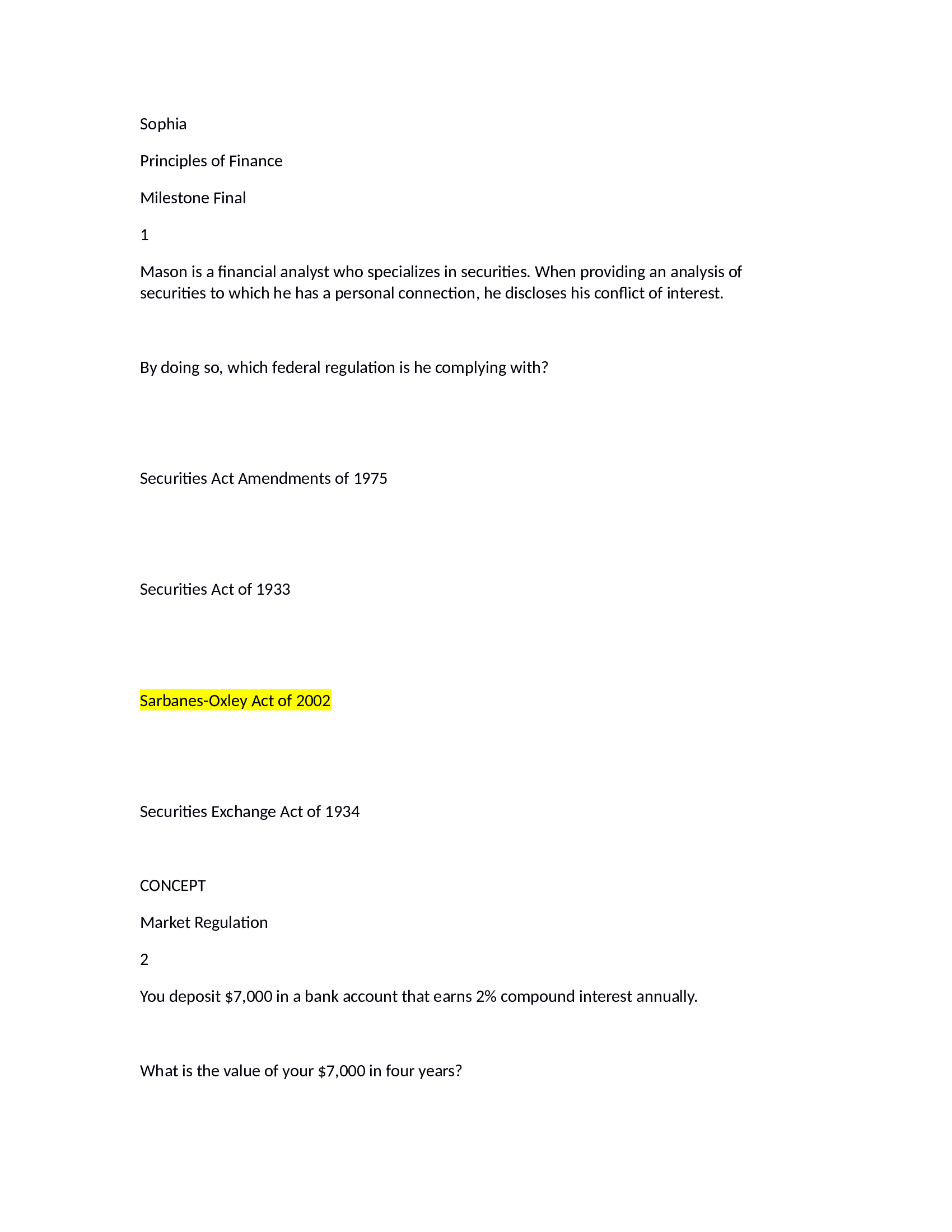
Sophia Finance Milestone Final_Complete Questions and Answers 2021.
View Document

Sophia Finance Miles...

  • Namwaki

    Namwaki

  • study guide

Sophia Finance Milestone Final_Complete Questions and Answers 2021...

17 USD

0

0

Medical Parasitology 7th Edition Leventhal Test Bank
View Document

Medical Parasitology...

  • Namwaki

    Namwaki

  • study guide

Medical Parasitology 7th Edition Leventhal Test Bank...

17 USD

0

0

TEST- BANK FOR WONGS NURSING CARE OF INFANTS AND CHILDREN 11TH EDITION HOCKENBERRY
View Document

TEST- BANK FOR WONGS...

  • Namwaki

    Namwaki

  • study guide

TEST- BANK FOR WONGS NURSING CARE OF INFANTS AND CHILDREN 11TH EDITION HOCKENBERRY – Download PDF...

17 USD

0

0

Purchase

Download link will be sent to this email immediately after purchase.

IMPORTANT LINKS

  • How To Upload Class Notes
  • Selling Tips
  • Passing Grades's Study Materials
  • Scholarships for International Students 2025

POPULAR CATEGORIES

  • Law
  • Accounting
  • English
  • Psychology
  • Business
  • Nursing
  • Computer Science
  • General

View Document

  • Blog
  • Contact
  • Delivery Policy
  • Latest Scholarships Around the World
  • How to Pass Bar Exams: Passing Grades’ Strategies
  • How to Study and Pass the CPA Exam
  • All Test Banks
  • Faq
  • Copyright Claims
  • Privacy Policy
  • Terms of Use

KNOWLEDGE BASE

  • How to Write A+ Grade Good Research Paper
  • How to Manage Stress During Exam Period
  • Best Time to Study
  • How to Pass NCLEX-RN Exam
  • How To Effectively Utilize Test Banks
  • Popular Shadow Health Exam Assessments
  • Popular HESI Case Studies
  • How to Prepare for a Nursing Career
  • The Importance Of Summaries in Exam Revisvion

© 2026 Pasing Grades. All rights reserved.