Pasing Grades
  • Start Selling
  • Blog
  • Contact
  • 0

    Your cart is empty!

English

  • English
  • Spanish
  • Arabic
Create Account Sign In
  • Library
    • New Prep Guides
    • Featured Prep Guides
    • Free Exam Prep Guides
    • Best sellers
  • General
  • Nursing
    • Research Paper
    • Case Study
    • Discussion Post
    • Assignment
    • Exam
    • Practice Questions and Answers
    • Test Bank
    • solutions manual
  • Accounting
    • Case Study
    • Thesis
    • Study Guide
    • Summary
    • Research Paper
    • test bank
  • English
    • Creative Writing
    • Research Paper
    • Summary
    • Rhetorics
    • Literature
    • Journal
    • Exam
    • Grammar
    • Discussion Post
    • Essay
  • Psychology
    • Hesi
    • Presentation
    • Essay
    • Summary
    • Study Guide
    • Essay
    • Solution Manual
    • Final Exam Review
    • Class Notes
    • test bank
  • Business
    • Lecture Notes
    • Solution Manual
    • Presentation
    • Business Plan
    • Class Notes
    • Experiment
    • Summary
    • Practice Questions
    • Study Guide
    • Case Study
    • test bank
    • Exam
  • More
    • Computer Science
    • Economics
    • Statistics
    • Engineering
    • Biology
    • Religious Studies
    • Physics
    • Chemistry
    • Mathematics
    • History
    • Sociology
    • Science
    • Philosophy
    • Law
  • Pages
    • About Us
    • Selling Tips
    • Delivery Policy
    • Faq
    • Privacy Policy
  • Flash Sale
  • Home
  • Wall Street Prep Exam Questions and Answers

Wall Street Prep Exam Questions and Answers

Preview page 1 Preview page 2 Preview page 3
Add To Favorites

Share this item Share this item

  • Item Details
  • Comments (0)
  • Reviews (0)
  • Contact Seller
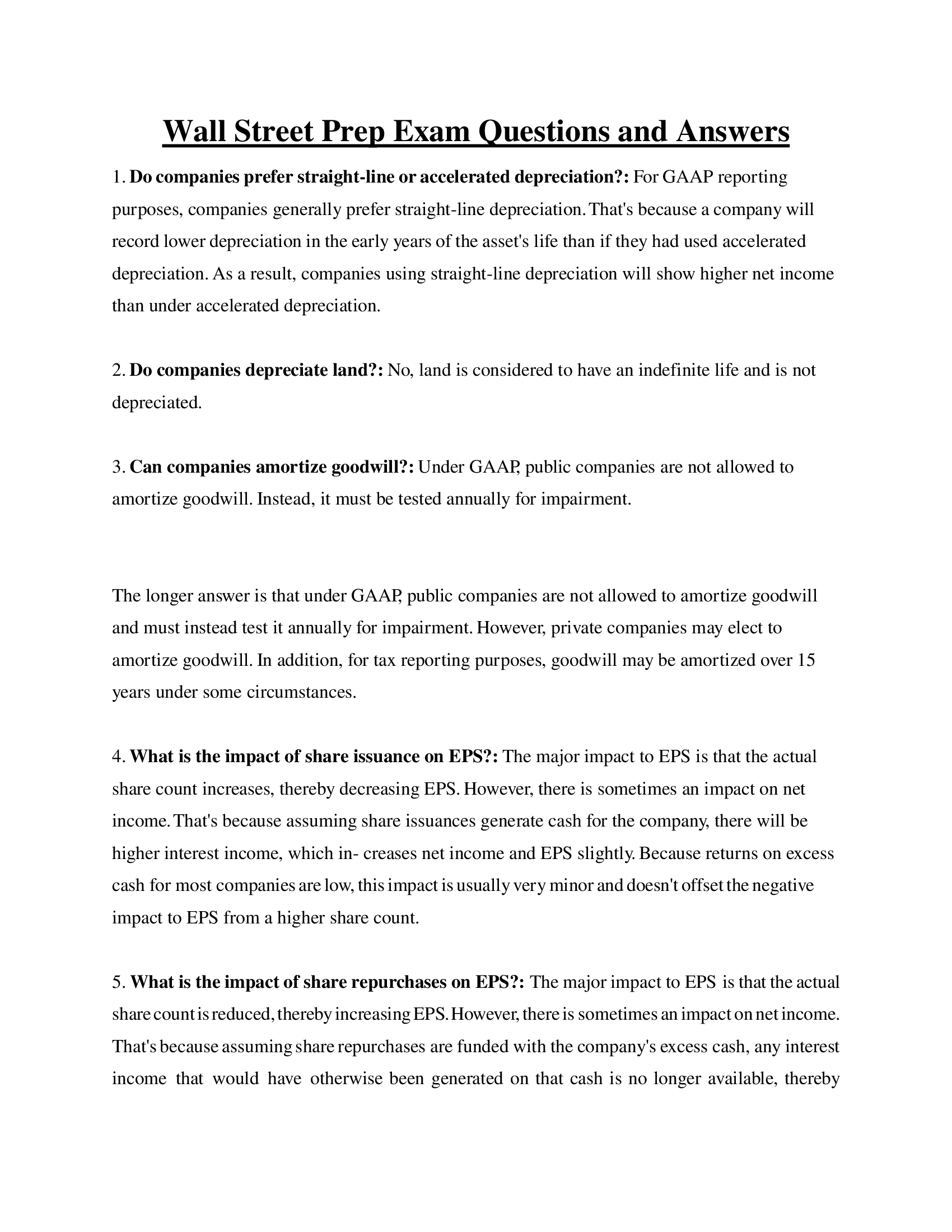
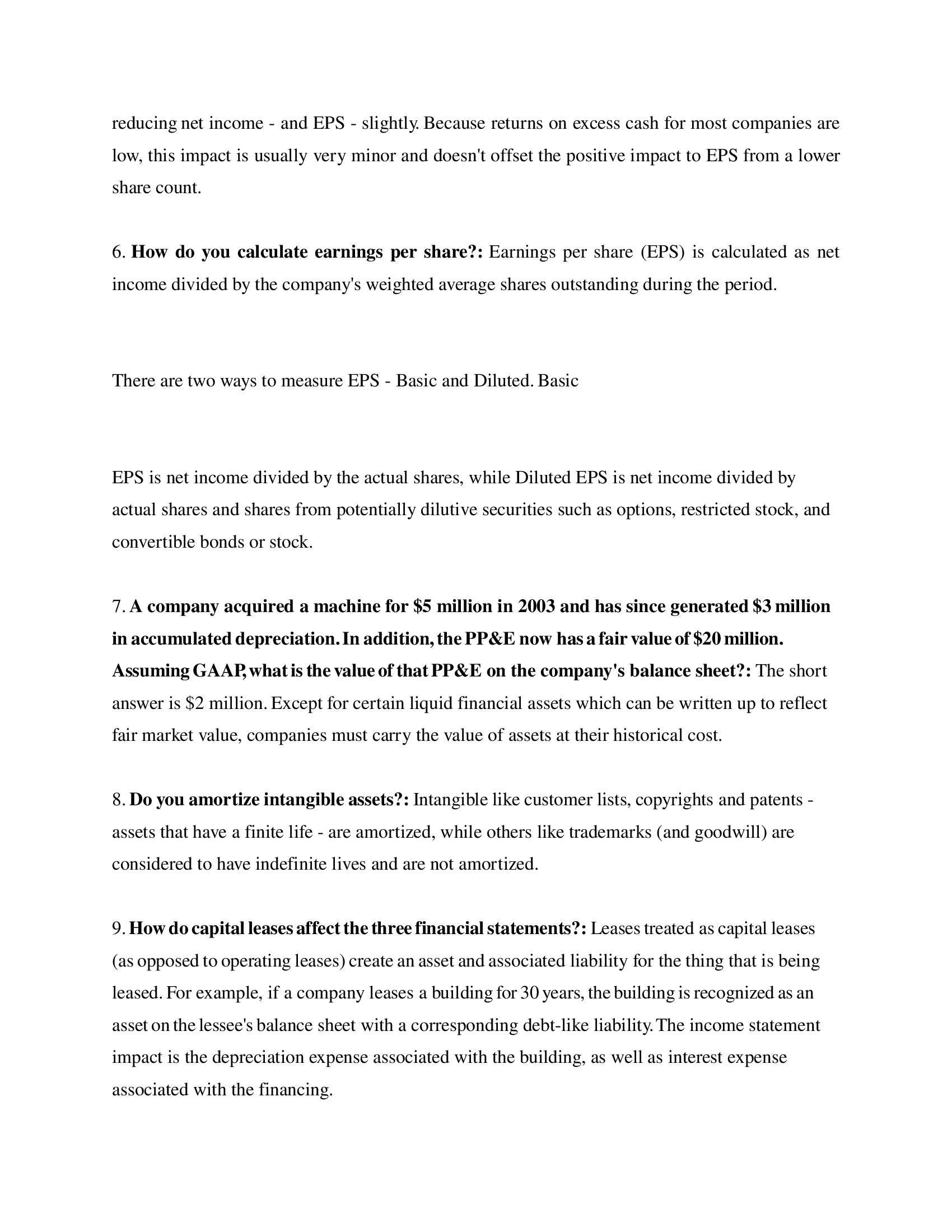
Wall Street Prep Exam Questions and Answers reducing net income - and EPS - slightly. Because returns on excess cash for most companies are low, this impact is usually very minor and doesn't offset the positive impact to EPS from a lower share count. 6. How do you calculate earnings per share?: Earnings per share (EPS) is calculated as net income divided by the company's weighted average shares outstanding during the period. There are two ways to measure EPS - Basic and Diluted. Basic EPS is net income divided by the actual shares, while Diluted EPS is net income divided by actual shares and shares from potentially dilutive securities such as options, restricted stock, and convertible bonds or stock. 7. A company acquired a machine for $5 million in 2003 and has since generated $3 million in accumulated depreciation. In addition, the PP&E now has a fair value of $20 million. Assuming GAAP, what is the value of that PP&E on the company's balance sheet?: The short answer is $2 million. Except for certain liquid financial assets which can be written up to reflect fair market value, companies must carry the value of assets at their historical cost. 8. Do you amortize intangible assets?: Intangible like customer lists, copyrights and patents - assets that have a finite life - are amortized, while others like trademarks (and goodwill) are considered to have indefinite lives and are not amortized. 9. How do capital leases affect the three financial statements?: Leases treated as capital leases (as opposed to operating leases) create an asset and associated liability for the thing that is being leased. For example, if a company leases a building for 30 years, the building is recognized as an asset on the lessee's balance sheet with a corresponding debt-like liability. The income statement impact is the depreciation expense associated with the building, as well as interest expense associated with the financing. 10. How do operating leases affect the three financial statements?: Under US GAAP, companies can choose to account for leases as operating or capital leases. Operating leases primarily only impact the income statement. When leases are accounted for as operating leases, lease (rent) payments are treated as operating expenses like wages and utilities: Regardless of whether you sign a 1-year lease or a 30-year lease, every time you pay the rent, cash is credited and an operating expense is debited. The only significant balance sheet impacts have to do with timing differences between payments (prepaid and accrued rent) and the matching of rent payments to when the tenant benefits from that rent (leading to balance sheet accruals for smoothing of rent escalations and upfront rent incentives like a free month). Starting in 2019, operating leases will no longer be allowed under US GAAP. 11. How can a profitable firm go bankrupt?: To be profitable, a company must generate revenues that exceed expenses. However, if the company is ineffective at collecting cash from customers and allows its receivables to balloon, or if it is unable to get favorable terms from suppliers and must pay cash for all inventories and supplies, what can occur is that despite a profitable income statement, the company suffers from liquidity problems due to the timing mismatch of cash inflows and outflows. While reliably profitable companies who simply have these working capital issues can usually secure financing to deal with it, theoretically, if financing becomes unavailable for some reason (the 2008 credit crisis is an example where even profitable companies couldn't secure financing), even a profitable company could be forced to declare bankruptcy. 12. Is it bad if a company has negative retained earnings?: Not necessarily. Retained earnings will be negative if the company has generated more accounting losses than profits. This is often the case for early-stage companies that are invest- ing heavily to support future growth. The other component of retained earnings is common or preferred dividends, which could contribute to a lower or even negative retained earnings. 13. What's more important: the income statement or the cash flow state- ment?: hey are both important and any serious analysis requires using both. However, I would think that the cash flow is slightly more important because it reconciles net income, the accrual-based bottom line on the income statement to what's happening to cash, while also showing you the critical movement of cash during the period. Without the cash flow statement, I can only see what's happening from an accrual profitability standpoint. The cash flow statement on the other hand can alert me to any liquidity issues, as well as any other major investments or financial activities that do not hit the income statement. The one situation in which I would prefer the income statement is if I also have the beginning and end-of-year balance sheet. That's because I could reconcile the cash flow statement simply by looking at the balance sheet year over changes along with the income statement. 14. Why are increases in accounts receivable a cash reduction on the cash flow statement?: Since cash flow statements start with net income, and net income captures all of a company's revenue - not just cash revenue - an increase in accounts receivable suggests that more customers paid with credit during the period and so an adjustment down needs to be made to net income when arriving at cash since the company never actually received those funds - they're still sitting on the balance sheet as receivables. 15. How should increases in inventory get handled on the cash flow state- ment?: Increases in inventory, as well as any other working capital assets, reflect a usage of cash and should thus be reflected as an outflow on the cash from operations section of the cash flow statement. Conversely, increases in working capital liabilities represent a source of cash and should be presented as an inflow in the section. 16. Do inventories get captured on the income statement?: There is no inven- tory line on the income statement, but it does get captured, if only partially, and indirectly in cost of goods sold (and potentially other operating expenses). For example, COGS is recognized on the income statement during a period, regardless of whether the associated inventory was purchased during the same period. That means that a portion of the COGS line on the income statement will likely reflect a portion of inventory used up. That's why the other two financial state- ments are better for understanding what is happening to inventory. Specifically, the cash flow statement shows the year-over-year changes in inventory, while the absolute balance of beginning and end-of-period inventory can be observed on the balance sheet. 17. Which section of the cash flow statement captures interest expense?: - Interest expense is recognized on the income statement and thus gets indirectly captured in the cash from operations section. 18. How does buying a building impact the 3 statements?: Cash goes down by the purchase price and is reflected in the cash from investing section. On the balance sheet, the offsetting entry to the cash reduction is an increase in PP&E. There is no immediate impact on the income statement. Over the life of the asset, depreciation expense from the building is recognized on the income statement and reduces net income by the amount of depreciation expense net of tax expense saved due to the depreciation expense. That's because depreciation is generally tax deductible. On the cash flow statement, depreciation is added back since it is non-cash. On the balance sheet, PPE is reduced by the depreciation and is offset by a reduction to retained earnings for the depreciation expense. 19. How does selling a building impact the 3 statements?: If I sell a building for $10 million that has a book value of $6 million on my balance sheet, I will recognize a $4 million gain on sale on the income statement which will - ignoring taxes for a moment - increase my net income by $4 million. On the cash flow statement, since the $4 million gain is non-cash, it will be subtracted out from net income in the cash from operations section. In the investing section, the full cash proceeds of $10 million are captured. On the balance sheet, the $6 million book value of the building is removed, while retained earnings increases by $4 million. The net credit of $10 million is offset by a $10 million debit to cash that came from the cash flow statement. Stop here for non-finance students. Business students should expand as follows: The gain on sale will also however result in higher taxes. Assuming a 25% tax rate, I will pay $1 million in additional tax - 25% of $4 million - which will be recognized on the income statement. This lowers retained earnings by $1 million and is offset by a $1 million credit to cash. 20. Is EBITDA a good proxy for cash flow?: Not really. That's because even though EBITDA does add back D&A - typically the largest non-cash expense - it does not capture any working capital changes during the period. It also doesn't capture cash outflows from taxes or interest payments. Those adjustments would need to be made to get to operating cash flows. EBITDA also doesn't capture stock-based compensation (SBC) expenses required to get to operating cash flows (although an increasingly used "adjusted EBITDA" calculation does add back SBC) 21. How are the 3 financial statements connected?: The financial statements are very interconnected, both directly and indirectly. The income statement is directly connected to the balance sheet through retained earnings. Specifically, net income (the bottom line in the income statement) flows through retained earnings as an increase each period less dividends issued during the period. The offsetting balance sheet adjustments to the increase in retained earnings impacts a variety of line items on the balance sheet, including cash, working capital and fixed assets. The cash flow statement is connected to the income statement through net income as well, which is the starting line of the cash flow statement. Lastly, the cash flow statement is connected to the balance sheet because the cash impact of changes in balance sheet line items like working capital, PP&E (through capex), debt, equity and treasury stock are all reflected in the cash flow statement. In addition, the final calculation in the cash flow statement - net change in cash - is directly connected to balance sheet, as it grows the beginning of the period cash balance to arrive at the end of period cash balance on the balance sheet. 22. What are the financial statements you'll typically find in a 10K?: You will find an income statement, cash flow statement, and balance sheet. Those are the three core financial statements. In addition, companies also include a statement of shareholders' equity and statement of comprehensive income. 23. What are some common equity multiples?: P/E, Price/Book, Equity/Levered Cash Flows. 24. Why might one company trade at a higher multiple than another: Supe- rior fundamental performance such as better growth prospects, higher return on invested capital, lower cost of capital (WACC), stronger cash flows. 25. What's included in net debt?: Net debt includes all types of debt - short-term and long-term, loans and bonds. It includes other non-equity financial claims such as preferred stock and noncontrolling interests. From this gross debt amount, cash and any other non-operating asset such as short-term investments and equity investments should be subtracted to arrive at net debt. 26. Can a company have negative net debt?: Yes. Negative debt simply means that a company has more cash than debt. For example, Apple and Microsoft have massive negative net debt because they hoard so much cash. In these cases, companies will have enterprise values lower than their equity value. Note: If it seems counter-intuitive that enterprise value can be lower than equity value, remember that enterprise value just represents the value of a company's operations - which excludes any non-operating assets. When you think of it this way, it should come as no surprise that companies with a lot of cash (which is treated as a non-operating asset in the prevailing definition of enterprise value) will have higher equity than enterprise values. 27. Why would a company issue equity vs. debt (and vice versa)?: Perhaps the greatest advantage of equity is that it has no required payments, thus giving management more flexibility around the repayment of capital (equity eventually gets it back in the form of dividends, but timing and magnitude are entirely at the board and management's discretion). Another advantage in the case of public equity is that it gives companies access to a very large investor base. On the other hand, equity dilutes ownership, and is generally more expensive (i.e. higher cost of capital). In addition, public equity comes with more regulation and scrutiny. An advantage of debt is that unlike equity, debt is tax-deductible (although recent tax reform rules limit the deduction for highly-levered companies). In addition, debt results in no ownership dilution and generally has a lower cost of capital. Of course, the disadvantages are that debt means the company faces required interest and principal payments, and it introduces the risk of default. In addition, debt covenants can restrict management from undertaking a variety of activities. 28. How many years would it take to double a $100,000 investment at a 9% annual return (no calculator)?: The rule of 72 says that in order to figure out how long it would take to double an investment, divide 72 by the investment's annual return. In this case, the rule of 72 suggests that it would take approximately 72/9 = 8 years. 29. Why would a company buy back (aka repurchase) shares? What would be the impact on share price and the financial statements?: A company buys back shares primarily as a way to move cash from the company's balance sheet to shareholders, similar to issuing dividends. The primary difference is that instead of shareholders receiving cash (in the case of dividends), a share repurchase removes shareholders, leaving a smaller shareholder base. The impact on share price is theoretically neutral - as long as shares are priced correctly, a share buyback should not lead to a change in share price because while the share count (denominator) is reduced, the equity value is also reduced by the now lower company cash balances. That said, share buybacks can impact share price movement positively or negatively if they are perceived as a new signal about the company's future behavior or growth prospects. For example, cash-rich but otherwise risky companies could see artificially low share prices if investors are discounting that cash. In this case, a buyback should lead to a higher share price, as the upward share price impact of a lower denom- inator is greater than the downward share price impact of a lower equity value numerator. Conversely, if shareholders view the buyback as a signal that the company's invest- ment prospects aren't great (otherwise, why not pump the cash into investments?), the denominator impact will be more than offset by a lower equity value (due to lower cash AND lower perceived growth and investment prospects). On the financial statements, a $100 million share buyback would be treated as follows: Cash is credited by $100 million Treasury stock is debited by $100 million 30. Assume a company has ROA of 10% and a 50/50 debt-to-equity capital structure. What is the ROE?: Return on assets = net income/average assets, while return on equity = net income / average equity. Imagine a company with $100 in assets. An ROA of 10% implies $10 in net income. Since the debt/equity mix is 50/50, the return on equity is $10/$50 = 20%. Q. 31. Define free cash flow yield and compare it to dividend yield and P/E ratios.: Free cash flow (FCF) yield = FCF/share price (FCF is defined as cash from operations - capital expenditures). For the purposes of this calculation, FCF is usually defined as cash from operations less investing activities. FCF yield is similar to dividend yield (dividend per share/share price) as both are a way to gauge equity returns relative to a company's share price. Unlike dividend yield, however, FCF yield is based on cash generated, as opposed to cash actually distributed. As a measure of fundamental value, FCF yield is more useful because many companies don't issue dividends (or an arbitrary fraction of their free cash flows). If you flip the FCF yield you get share price/FCF, which produces a cash flow version of a P/E ratio. This has the advantage of benchmarking price against actual cash flows as opposed to accrual profits. It also, however, has the disadvantage that cash flows can be volatile and period specific swings in working capital and deferred revenue can have a material impact on the multiple. 32. Why might two companies with identical growth and cost of capital trade at different P/E multiples?: Growth and cost of capital are not the only drivers of value. Another critical component is return on invested capital. All else equal, if one of the companies has a higher return on equity, you would expect its PE ratio to be higher. Other reasons may include relative mispricing or inconsistent calculations of EPS due to things like nonrecurring items and different accounting assumptions. 33. Should two identical companies but with different rates of leverage trade at different EV/EBITDA multiples?: You would expect the EV/EBITDA multiples to be similar because enterprise value and EBITDA measure a company's value and profits independent of its capital structure. Technically, they will not be exactly equal because EV does depend on cost of capital so there will be some variation 34. Should two identical companies but with different rates of leverage trade at different P/E multiples?: P/E multiples can vary significantly due to leverage difference for otherwise identical companies. All else equal, as a company borrows money (debt), the EPS (denominator) will decline due to higher interest expense. The impact on the share price, on the other hand, is harder to predict and depends on how the debt will be used. At the two most extreme cases, imagine the debt proceeds will go unused, generating no return, the share price will decline to reflect the incremental cost of debt with no commensurate growth or investment. In this scenario, the share price can be expected to decline to such a level that the PE ratio declines. On the other hand, if the debt is used to efficiently invest and grow the business, the P/E ratio will increase. 35. You are evaluating a company that has net income of $100 million and a PE multiple of 15x. The company is considering raising $200 million in debt in order to pay a one-time special cash dividend to shareholders. Do you think this is a good idea?: The answer depends on several factors. If we make an assumption that the PE multiple stays the same after the dividend and a cost of debt of 5% (note: there's also tax impact since interest is mostly deductible but in the interview you can probably ignore taxes for simplicity), the impact to shareholders is as follows: Net income will drop from $100 to $90 [($200 new borrowing x 5%) = $10 million] Equity value will drop from $1,500 million (15.0 x $100 million) to $1,350 million (15.0 x $90 million). That's a $150 million drop in equity value. However, shareholders are immediately getting $200 million. So ignoring any tax impact, there's a net benefit of $200 - $150 million to shareholders from this move. Obviously, the assumptions we made about taxes, cost of debt and the multiple staying the same inform the result. If any of those variables are different - for example, if the cost of debt is higher, equity value might be destroyed in light of this move. A key assumption in getting the answer here was that PE ratios will stay the same at 15x. A company's PE multiple is a function of its growth prospects, returns on equity and cost of equity. Borrowing more without any compensatory increase in investment or growth will raise the cost of equity (via a higher beta) which will pressure the PE multiple down. So while it appears based on our assumptions that this is an ok idea, it could easily be a bad idea given a different set of assumptions. Moreover, it is possible to broadly say that borrowing for the sake of issuing dividends is unsustainable indefinitely, because eventually debt levels will rise to a point where cost of capital and PE ratios are adversely impacted. Debt should generally be used to support investments and activities that will increase firm and shareholder value rather than to extract cash from the business. The most notable exceptions to this are companies like Apple with low cost of debt and large excess cash that can't be distributed due to repatriation reasons and thus borrow to issue dividends. 36. How would you evaluate the buy vs. rent decision in NYC?: In order to do a proper comparison, let's assume that I have enough upfront capital to make a downpayment, otherwise obviously I have to rent. Let's also assume the investment period is 10 years. Assuming I buy, during this investment period I have to pay monthly mortgage, real estate tax and maintenance fees (which will be offset by some tax deductions on interest and depreciation). I assume I'll be able to sell the property at a price that probably reflects the historical growth rate in real estate in NYC. Based on the initial and subsequent monthly outlays and the final inflow due to a sale, I can calculate my IRR. I would then compare this IRR against the IRR from renting as follows: First, I would estimate the rental cost of a comparable property, factoring in rent escalations over a 10-year period. In addition, since I don't have an initial down-payment to make, I would put that money to work elsewhere - say as a passive investment in the stock market. I would assume an annual return over the 10-year period consistent with the historical long-term return on the stock market (5-7%). I would then be able to calculate an IRR based on these inflows and outflows and compare the IRRs and make a decision. Of course, I would keep in mind that this comparison isn't perfectly apples to apples. For example, investing in a NYC property is riskier than investing in the stock market due to the leverage and the lower liquidity. NYC real estate is liquid but not as liquid as public stocks. For example, if I get two identical IRRs, I would probably go with renting, since it wouldn't appear that I'm being compensated for the added risk. 37. What's the difference between levered FCF (FCFE) and unlevered FCF (FCFF)?: Unlevered FCF represent cash flows a company generates from its core operations after accounting for all operating expenses and investments. To calculate those, you start with EBIT which is an unlevered measure of profit because it excludes interest and any other payments to lenders. Then you tax effect EBIT and add back non-cash items, make working capital adjustments and subtract capital expenditures. By contrast, levered FCF represent cash flows that remain after payments to lenders including interest expense and debt paydowns are accounted for. These are cash flows that belong to equity owners. Instead of starting with tax effected EBIT, you start with net income, add back non-cash items and make working capital adjustments, subtract capital expenditures and add cash inflows or outflows for cash from new borrowing, net of dept paydowns. 38. Contrast the DCF approach to comps.: The DCF values a company based on the company's forecasted cash flows. This is viewed as the most direct and academically rigorous way to measure value, but it suffers from several drawbacks, most notably that it is very sensitive to assumptions which makes it easily to manipulate. Comps, on the other hand, values a company by looking at how the market values similar businesses. Comps relies much more heavily on market pricing to determine value than the DCF. While the value derived from a comps analysis is viewed by many as a more realistic assessment of how a company could expect to be priced in an acquisition, it is vulnerable to two criticisms - 1) The market isn't always right and therefore a comps analysis is simply pricing, as opposed to valuing a business and 2) There are very few truly comparable companies so you're in effect always comparing apples and oranges.

Contact the Seller

Please Sign In to contact this seller.


  • 👎  Report Copyright Violation

Frequently Asked Questions

What Do I Get When I Buy This Study Material?

+

When you buy a study material on Passing Grades, an instant download link will be sent directly to your email, giving you access to the file anytime after payment is completed.

Is Passing Grades a Trusted Platform?

+

Yes, Passing Grades is a reputable students’ marketplace with a secure payment system and reliable customer support. You can trust us to ensure a safe and seamless transaction experience.

Will I Be Stuck with a Subscription?

+

No, all purchases on Passing Grades are one-time transactions. You only pay for the notes you choose to buy, with no subscriptions or hidden fees attached.

Who Am I Buying These Study Materials From?

+

Passing Grades is a marketplace, which means you are purchasing the document from an individual vendor, not directly from us. We facilitate the payment and delivery process between you and the vendor.

Does Passing Grades Offer Free Study Materials?

+

Yes, sellers on Passing Grades have uploaded numerous free test banks, exams, practice questions, and class notes that can be downloaded at no cost.


Pasinggrades - Quality Study Materials

USD 10

    • Quality checked by Pasing Grades
    • 100% satisfaction guarantee
    • Seller: Angelicer
Buy PDF $10

Seller Information

Angelicer

Member since April 2021

  • icon
  • icon
View Profile
  • total sales

    0
  • Favourites

    0
  • Comments

    0
    ( 0 Ratings )

Item Information

  • Uploaded

    27 May 2023

  • Updated

    21 June 2025

  • Category

    No category

  • Item Type

    study guide

  • Tags

    Wall Street Prep Exam Questions and Answers

Related Exam Prep Guides by Angelicer

Test Bank for Success in Practical Vocational Nursing 8th Edition by Knecht
View Document

Test Bank for Succes...

  • Angelicer

    Angelicer

  • study guide

Enhance your study with the Test Bank for Success in Practical Vocational Nursing 8th Edition by Kne...

10 USD

0

0

Test Bank for Illustrated Anatomy of the Head and Neck 5th Edition by Fehrenbach
View Document

Test Bank for Illust...

  • Angelicer

    Angelicer

  • study guide

Boost your understanding with the Test Bank for Illustrated Anatomy of the Head and Neck 5th Edition...

10 USD

0

0

ATI PEDS Proctored Exam Questions and Answers 2026 | Comprehensive Study Guide
View Document

ATI PEDS Proctored E...

  • Angelicer

    Angelicer

  • study guide

Get the ATI PEDS Proctored Exam Questions and Answers for 2025. This comprehensive study guide offer...

10 USD

0

0

Purchase

Download link will be sent to this email immediately after purchase.

IMPORTANT LINKS

  • How To Upload Class Notes
  • Selling Tips
  • Passing Grades's Study Materials
  • Scholarships for International Students 2025

POPULAR CATEGORIES

  • Law
  • Accounting
  • English
  • Psychology
  • Business
  • Nursing
  • Computer Science
  • General

View Document

  • Blog
  • Contact
  • Delivery Policy
  • Latest Scholarships Around the World
  • How to Pass Bar Exams: Passing Grades’ Strategies
  • How to Study and Pass the CPA Exam
  • All Test Banks
  • Faq
  • Copyright Claims
  • Privacy Policy
  • Terms of Use

KNOWLEDGE BASE

  • How to Write A+ Grade Good Research Paper
  • How to Manage Stress During Exam Period
  • Best Time to Study
  • How to Pass NCLEX-RN Exam
  • How To Effectively Utilize Test Banks
  • Popular Shadow Health Exam Assessments
  • Popular HESI Case Studies
  • How to Prepare for a Nursing Career
  • The Importance Of Summaries in Exam Revisvion

© 2026 Pasing Grades. All rights reserved.