Pasing Grades
  • Start Selling
  • Blog
  • Contact
  • 0

    Your cart is empty!

English

  • English
  • Spanish
  • Arabic
Create Account Sign In
  • Library
    • New Prep Guides
    • Featured Prep Guides
    • Free Exam Prep Guides
    • Best sellers
  • General
  • Nursing
    • Research Paper
    • Case Study
    • Discussion Post
    • Assignment
    • Exam
    • Practice Questions and Answers
    • Test Bank
    • solutions manual
  • Accounting
    • Case Study
    • Thesis
    • Study Guide
    • Summary
    • Research Paper
    • test bank
  • English
    • Creative Writing
    • Research Paper
    • Summary
    • Rhetorics
    • Literature
    • Journal
    • Exam
    • Grammar
    • Discussion Post
    • Essay
  • Psychology
    • Hesi
    • Presentation
    • Essay
    • Summary
    • Study Guide
    • Essay
    • Solution Manual
    • Final Exam Review
    • Class Notes
    • test bank
  • Business
    • Lecture Notes
    • Solution Manual
    • Presentation
    • Business Plan
    • Class Notes
    • Experiment
    • Summary
    • Practice Questions
    • Study Guide
    • Case Study
    • test bank
    • Exam
  • More
    • Computer Science
    • Economics
    • Statistics
    • Engineering
    • Biology
    • Religious Studies
    • Physics
    • Chemistry
    • Mathematics
    • History
    • Sociology
    • Science
    • Philosophy
    • Law
  • Pages
    • About Us
    • Selling Tips
    • Delivery Policy
    • Faq
    • Privacy Policy
  • Flash Sale
  • Home
  • TEST BANK FOR STRUCTURE AND FUNCTION OF THE BODY, 15TH EDITION, KEVIN T. PATTON, GARY A. THIBODEAU

TEST BANK FOR STRUCTURE AND FUNCTION OF THE BODY, 15TH EDITION, KEVIN T. PATTON, GARY A. THIBODEAU

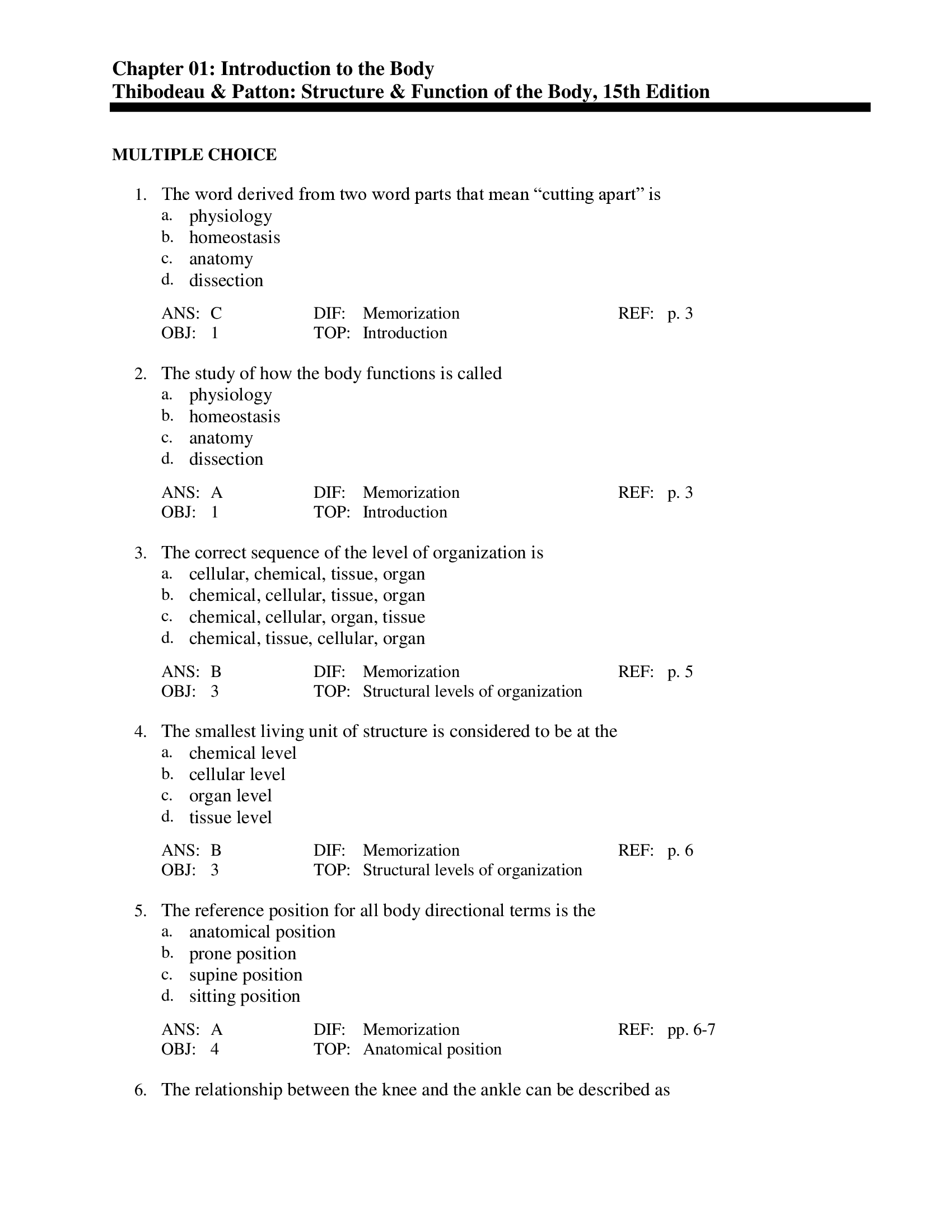
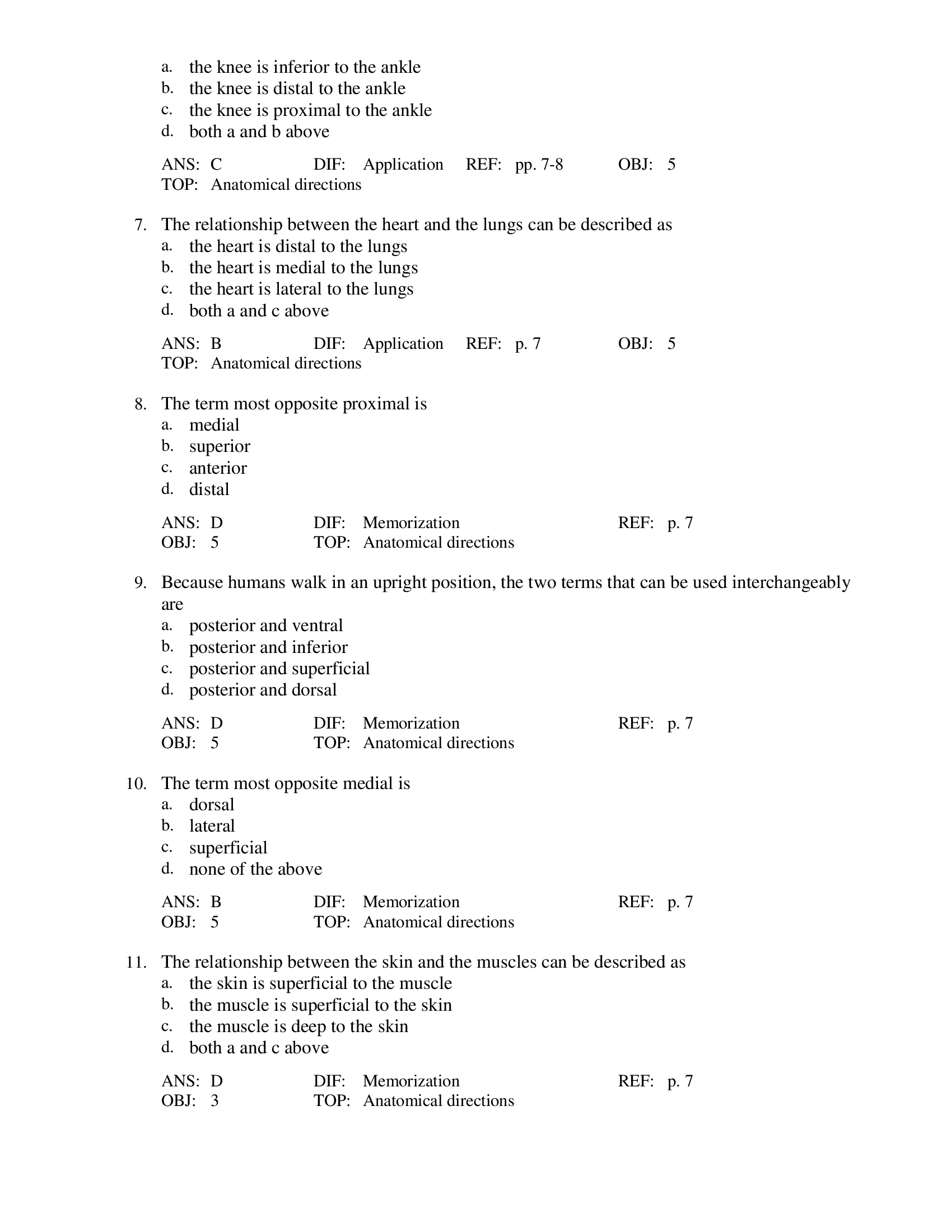
Preview page 1 Preview page 2 Preview page 3
Add To Favorites

Share this item Share this item

  • Item Details
  • Comments (0)
  • Reviews (0)
  • Contact Seller

TEST BANK FOR STRUCTURE AND FUNCTION OF THE BODY, 15TH EDITION, KEVIN T. PATTON, GARY A. THIBODEAU/ TEST BANK FOR STRUCTURE AND FUNCTION OF THE BODY, 15TH EDITION, KEVIN T. PATTON, GARY A. THIBODEAU

Chapter 01: Introduction to the Body

Thibodeau & Patton: Structure & Function of the Body, 15th Edition


MULTIPLE CHOICE


     1.   The word derived from two word parts that mean “cutting apart” is

a.

physiology

b.

homeostasis

c.

anatomy

d.

dissection


ANS:  C                    DIF:    Memorization                                 REF:   p. 3

OBJ:   1                    TOP:   Introduction


     2.   The study of how the body functions is called

a.

physiology

b.

homeostasis

c.

anatomy

d.

dissection


ANS:  A                    DIF:    Memorization                                 REF:   p. 3

OBJ:   1                    TOP:   Introduction


     3.   The correct sequence of the level of organization is

a.

cellular, chemical, tissue, organ

b.

chemical, cellular, tissue, organ

c.

chemical, cellular, organ, tissue

d.

chemical, tissue, cellular, organ


ANS:  B                    DIF:    Memorization                                 REF:   p. 5

OBJ:   3                    TOP:   Structural levels of organization


     4.   The smallest living unit of structure is considered to be at the

a.

chemical level

b.

cellular level

c.

organ level

d.

tissue level


ANS:  B                    DIF:    Memorization                                 REF:   p. 6

OBJ:   3                    TOP:   Structural levels of organization


     5.   The reference position for all body directional terms is the

a.

anatomical position

b.

prone position

c.

supine position

d.

sitting position


ANS:  A                    DIF:    Memorization                                 REF:   pp. 6-7

OBJ:   4                    TOP:   Anatomical position


     6.   The relationship between the knee and the ankle can be described as

a.

the knee is inferior to the ankle

b.

the knee is distal to the ankle

c.

the knee is proximal to the ankle

d.

both a and b above


ANS:  C                    DIF:    Application    REF:   pp. 7-8           OBJ:   5

TOP:   Anatomical directions


     7.   The relationship between the heart and the lungs can be described as

a.

the heart is distal to the lungs

b.

the heart is medial to the lungs

c.

the heart is lateral to the lungs

d.

both a and c above


ANS:  B                    DIF:    Application    REF:   p. 7                OBJ:   5

TOP:   Anatomical directions


     8.   The term most opposite proximal is

a.

medial

b.

superior

c.

anterior

d.

distal


ANS:  D                    DIF:    Memorization                                 REF:   p. 7

OBJ:   5                    TOP:   Anatomical directions


     9.   Because humans walk in an upright position, the two terms that can be used interchangeably are

a.

posterior and ventral

b.

posterior and inferior

c.

posterior and superficial

d.

posterior and dorsal


ANS:  D                    DIF:    Memorization                                 REF:   p. 7

OBJ:   5                    TOP:   Anatomical directions


   10.   The term most opposite medial is

a.

dorsal

b.

lateral

c.

superficial

d.

none of the above


ANS:  B                    DIF:    Memorization                                 REF:   p. 7

OBJ:   5                    TOP:   Anatomical directions


   11.   The relationship between the skin and the muscles can be described as

a.

the skin is superficial to the muscle

b.

the muscle is superficial to the skin

c.

the muscle is deep to the skin

d.

both a and c above


ANS:  D                    DIF:    Memorization                                 REF:   p. 7

OBJ:   3                    TOP:   Anatomical directions


   12.   A cut dividing the body into anterior and posterior portions is called a

a.

sagittal section

b.

frontal section

c.

transverse section

d.

none of the above


ANS:  B                    DIF:    Memorization                                 REF:   p. 9

OBJ:   5                    TOP:   Planes or body sections


   13.   A cut dividing the body into upper and lower portions is called a

a.

sagittal section

b.

frontal section

c.

transverse section

d.

coronal section


ANS:  C                    DIF:    Memorization                                 REF:   p. 9

OBJ:   5                    TOP:   Planes or body sections


   14.   A cut dividing the body into right and left portions is called a

a.

sagittal section

b.

frontal section

c.

transverse section

d.

coronal section


ANS:  A                    DIF:    Memorization                                 REF:   pp. 8-9

OBJ:   5                    TOP:   Planes or body sections


   15.   The mediastinum is part of the

a.

dorsal cavity

b.

ventral cavity

c.

abdominal cavity

d.

both b and c above


ANS:  B                    DIF:    Memorization                                 REF:   p. 9

OBJ:   6                    TOP:   Body cavities          


   16.   The two major cavities of the body are the

a.

dorsal and ventral

b.

thoracic and abdominal

c.

pleural and mediastinum

d.

none of the above


ANS:  A                    DIF:    Memorization                                 REF:   p. 9

OBJ:   6                    TOP:   Body cavities          


   17.   The diaphragm divides the

a.

dorsal from the ventral cavity

b.

abdominal from the pelvic cavity

c.

thoracic from the abdominal cavity

d.

pleural from the mediastinum


ANS:  C                    DIF:    Memorization                                 REF:   p. 9

OBJ:   6                    TOP:   Body cavities          


   18.   The upper abdominopelvic regions include the

a.

right and left hypochondriac and umbilical

b.

right and left lumbar and umbilical

c.

right and left iliac and epigastric

d.

right and left hypochondriac and epigastric


ANS:  D                    DIF:    Memorization                                 REF:   p. 10

OBJ:   7                    TOP:   Body cavities          


   19.   The middle abdominopelvic regions include the

a.

right and left lumbar and umbilical

b.

right and left lumbar and epigastric

c.

right and left iliac and hypogastric

d.

right and left iliac and umbilical


ANS:  A                    DIF:    Memorization                                 REF:   p. 10

OBJ:   7                    TOP:   Body cavities          


   20.   The lower abdominopelvic regions include the

a.

right and left iliac and umbilical

b.

right and left lumbar and epigastric

c.

right and left lumbar and hypogastric

d.

right and left iliac and hypogastric


ANS:  D                    DIF:    Memorization                                 REF:   p. 10

OBJ:   7                    TOP:   Body cavities          


   21.   The brain is in the

a.

ventral cavity

b.

cranial cavity

c.

mediastinum

d.

none of the above


ANS:  B                    DIF:    Memorization                                 REF:   p. 10

OBJ:   6                    TOP:   Body cavities          


   22.   The spinal cavity is part of the

a.

dorsal cavity

b.

ventral cavity

c.

cranial cavity

d.

none of the above


ANS:  A                    DIF:    Memorization                                 REF:   p. 9

OBJ:   6                    TOP:   Body cavities          


   23.   The left upper quadrant of the abdominopelvic cavity includes all of the

a.

left lumbar region

b.

left iliac region

c.

left hypochondriac region

d.

left inguinal region


ANS:  C                    DIF:    Application    REF:   p. 10              OBJ:   7

TOP:   Body cavities           


   24.   Using the maintaining of a constant temperature in a building as an example of a feedback loop, the thermometer would be an example of a(n)

a.

sensor

b.

control center

c.

effector

d.

positive feedback loop


ANS:  A                    DIF:    Memorization                                 REF:   p. 14

OBJ:   9                    TOP:   The balance of body functions


   25.   Using the maintaining of a constant temperature in a building as an example of a feedback loop, the furnace would be an example of a(n)

a.

sensor

b.

control center

c.

effector

d.

positive feedback loop


ANS:  C                    DIF:    Memorization                                 REF:   p. 14

OBJ:   9                    TOP:   The balance of body functions


   26.   Using the maintaining of a constant temperature in a building as an example of a feedback loop, the thermostat would be an example of a(n)

a.

sensor

b.

control center

c.

effector

d.

positive feedback loop


ANS:  B                    DIF:    Memorization                                 REF:   p. 14

OBJ:   9                    TOP:   The balance of body functions


   27.   The abdominopelvic region that can be found in each of the four quadrants is the

a.

umbilical

b.

hypogastric

c.

epigastric

d.

left iliac


ANS:  A                    DIF:    Application    REF:   p. 10              OBJ:   7

TOP:   Body cavities           


   28.   The lower right abdominopelvic quadrant includes all of the

a.

right hypochondriac region

b.

right lumbar region

c.

right iliac region

d.

right epigastric region


ANS:  C                    DIF:    Application    REF:   p. 10              OBJ:   7

TOP:   Body cavities           


   29.   An example of a positive feedback loop would be

a.

maintaining proper body temperature

b.

forming a blood clot

c.

uterine contractions during childbirth

d.

both b and c above


ANS:  D                    DIF:    Application    REF:   p. 15              OBJ:   9

TOP:   The balance of body functions


   30.   An example of a negative feedback loop would be

a.

maintaining proper body temperature

b.

forming a blood clot

c.

uterine contractions during childbirth

d.

both b and c above


ANS:  A                    DIF:    Application    REF:   p. 15              OBJ:   9

TOP:   The balance of body functions


   31.   A midsagittal section through the head would divide

a.

the forehead from the chin

b.

the nose from the back of the head

c.

the right eye from the left eye

d.

none of the above


ANS:  C                    DIF:    Application    REF:   pp. 8-9           OBJ:   5

TOP:   Planes or body sections


   32.   A transverse section through the head would divide

a.

the forehead from the chin

b.

the nose from the back of the head

c.

the right eye from the left eye

d.

none of the above


ANS:  A                    DIF:    Application    REF:   pp. 8-9           OBJ:   5

TOP:   Planes or body sections


   33.   A frontal section through the head would divide

a.

the forehead from the chin

b.

the nose from the back of the head

c.

the right eye from the left eye

d.

none of the above


ANS:  B                    DIF:    Application    REF:   pp. 8-9           OBJ:   5

TOP:   Planes or body sections


   34.   If this kind of section were made through the center of the head, both the right and left eyes would be on the same section.

a.

Coronal section

b.

Midsagittal section

c.

Transverse section

d.

Both a and c above


ANS:  D                    DIF:    Application    REF:   pp. 8-9           OBJ:   5

TOP:   Planes or body sections


   35.   The relationship between an organ and organ system is similar to the relationship between a cell and

a.

an organism

b.

the cellular level of organization

c.

a tissue

d.

none of the above


ANS:  C                    DIF:    Synthesis       REF:   p. 6                OBJ:   3

TOP:   Structural levels of organization


   36.   The heart is an example of this level or organization.

a.

Tissue

b.

Organ

c.

Organ system

d.

Organism


ANS:  B                    DIF:    Memorization                                 REF:   pp. 4-5

OBJ:   3                    TOP:   Structural levels of organization


   37.   Blood vessels are examples of this level or organization.

a.

Organ system

b.

Tissue

c.

Organ

d.

Cellular


ANS:  C                    DIF:    Memorization                                 REF:   pp. 4-5

OBJ:   3                    TOP:   Structural levels of organization


   38.   On a directional rosette, a letter L would stand for

a.

“left” if it is opposite the letter R

b.

“lateral” if it is opposite the letter D

c.

“lateral” if it is opposite the letter A

d.

“lower” if it is opposite the letter U


ANS:  A                    DIF:    Memorization                                 REF:   pp. 7-8

OBJ:   5                    TOP:   Anatomical directions


   39.   Which of the following terms do not refer to a part of the head region?

a.

Olecranal

b.

Zygomatic

c.

Frontal

d.

All of the above terms refer to parts of the head


ANS:  A                    DIF:    Memorization                                 REF:   p. 13 (Table 1-2)

OBJ:   8                    TOP:   Body regions           


   40.   Which of the following is not controlled by a negative feedback loop?

a.

Body temperature

b.

Blood oxygen concentration

c.

Fluid levels of the body

d.

Blood clot formation


ANS:  D                    DIF:    Memorization                                 REF:   p. 15

OBJ:   9                    TOP:   The balance of body functions


   41.   The organ level of organization contains all of these lower levels.

a.

The cellular and tissue levels only

b.

The chemical and tissue levels only

c.

The chemical, cellular, and tissue levels only

d.

The chemical, cellular, tissue, and system levels


ANS:  C                    DIF:    Application    REF:   pp. 5-6           OBJ:   3

TOP:   Structural levels of organization


   42.   This structure physically separates the pelvic cavity from the abdominal cavity.

a.

Mediastinum

b.

Diaphragm

c.

Mesenteries

d.

None of the above


ANS:  D                    DIF:    Memorization                                 REF:   p. 9

OBJ:   6                    TOP:   Body cavities          


   43.   The lungs are located in the

a.

thoracic cavity

b.

mediastinum

c.

dorsal cavity

d.

both b and c above


ANS:  A                    DIF:    Memorization                                 REF:   p. 10

OBJ:   6                    TOP:   Body cavities          


   44.   A scientific experiment testing a new drug used two groups, one getting the drug and one getting the sugar pill. The group getting the sugar pill is the

a.

test group

b.

hypothesis group

c.

control group

d.

observational group


ANS:  C                    DIF:    Application    REF:   p. 4                OBJ:   2

TOP:   Scientific method    


   45.   A scientific experiment testing a new drug used two groups, one getting the drug and one getting a sugar pill. If the two groups had the same result, it would indicate

a.

the drug was safe and effective

b.

the drug was ineffective because it did no better than the sugar pill

c.

the experiment was a failure and no information could be gained

d.

both b and c


ANS:  B                    DIF:    Application    REF:   p. 4                OBJ:   2

TOP:   Scientific method    


   46.   A scientific experiment testing a new drug used two groups, one getting the drug and one getting a sugar pill. If the group getting the drug did much better than the group with the sugar pill:

a.

it would indicate that the drug was more effective than the sugar pill

b.

a theory would be formed

c.

the control group would be shown to have improved because of the drug

d.

all of the above


ANS:  A                    DIF:    Application    REF:   p. 4                OBJ:   2

TOP:   Scientific method    


   47.   In the metric system

a.

a meter is longer than a yard

b.

a centimeter is longer than an inch

c.

a nanometer is longer than a micrometer

d.

all of the above


ANS:  A                    DIF:    Memorization                                 REF:   p. 4

OBJ:   2                    TOP:   Metric System                                


   48.   If a person lost a little more than 3 pounds on a diet, they would have lost about

a.

500 grams

b.

1000 grams

c.

1500 grams

d.

2000 grams


ANS:  C                    DIF:    Application    REF:   p. 4                OBJ:   2

TOP:   Metric System                                


   49.   The word supine describes

a.

the body lying face downward

b.

an anatomical direction

c.

the reference position of the body

d.

the body lying face upward


ANS:  D                    DIF:    Memorization                                 REF:   p. 7

OBJ:   4                    TOP:   Anatomical position


   50.   Which process is used as the principal technique used to isolate and study the structural components or parts of the human body?

a.

Imaging

b.

Dissection

c.

X-rays

d.

Resection


ANS:  B                    DIF:    Memorization                                 REF:   p. 3

OBJ:   1                    TOP:   Introduction


TRUE/FALSE


     1.   The word dissection is derived from two word parts that mean “cutting apart.”


ANS:  F                    DIF:    Memorization                                 REF:   p. 3

OBJ:   1                    TOP:   Introduction


     2.   The cell is the smallest living structural unit of the body.


ANS:  T                    DIF:    Memorization                                 REF:   p. 6

OBJ:   3                    TOP:   Structural levels of organization


     3.   An organ is defined as a group of several types of cells working together to perform a specific function.


ANS:  F                    DIF:    Memorization                                 REF:   p. 6

OBJ:   3                    TOP:   Structural levels of organization


     4.   The reference position for the directional terms of the body is called the anatomical position.


ANS:  T                    DIF:    Memorization                                 REF:   p. 7

OBJ:   4                    TOP:   Anatomical position


     5.   The prone position is a position in which the body is lying face down.


ANS:  T                    DIF:    Memorization                                 REF:   p. 7

OBJ:   4                    TOP:   Anatomical position


     6.   The prone position is a position in which the body is lying face up.


ANS:  F                    DIF:    Memorization                                 REF:   p. 7

OBJ:   4                    TOP:   Anatomical position


     7.   The supine position is a position in which the body is lying face up.


ANS:  T                    DIF:    Memorization                                 REF:   p. 7

OBJ:   4                    TOP:   Anatomical position


     8.   Superior means toward the head.


ANS:  T                    DIF:    Memorization                                 REF:   p. 7

OBJ:   5                    TOP:   Anatomical directions


     9.   Because humans walk upright, superior and superficial mean the same thing.


ANS:  F                    DIF:    Memorization                                 REF:   p. 7

OBJ:   5                    TOP:   Anatomical directions


   10.   Anterior and proximal are opposite terms.


ANS:  F                    DIF:    Memorization                                 REF:   p. 7

OBJ:   5                    TOP:   Anatomical directions


   11.   Medial and lateral are opposite terms.


ANS:  T                    DIF:    Memorization                                 REF:   p. 7

OBJ:   5                    TOP:   Anatomical directions


   12.   Proximal and distal are opposite terms.


ANS:  T                    DIF:    Memorization                                 REF:   p. 7

OBJ:   5                    TOP:   Anatomical directions


   13.   Because humans walk upright, inferior and deep mean the same thing.


ANS:  F                    DIF:    Memorization                                 REF:   p. 7

OBJ:   5                    TOP:   Anatomical directions


   14.   Because humans walk upright, ventral and anterior mean the same thing.


ANS:  T                    DIF:    Memorization                                 REF:   p. 7

OBJ:   5                    TOP:   Anatomical directions


   15.   Because humans walk upright, dorsal and posterior mean the same thing.


ANS:  T                    DIF:    Memorization                                 REF:   p. 7

OBJ:   5                    TOP:   Anatomical directions


   16.   The hand is distal to the elbow.


ANS:  T                    DIF:    Application    REF:   p. 7                OBJ:   5

TOP:   Anatomical directions


   17.   The foot is proximal to the knee.


ANS:  F                    DIF:    Application    REF:   p. 7                OBJ:   5

TOP:   Anatomical directions


   18.   The nose is superior to the mouth.


ANS:  T                    DIF:    Application    REF:   p. 7                OBJ:   5

TOP:   Anatomical directions


   19.   The mouth is inferior to the chin.


ANS:  F                    DIF:    Application    REF:   p. 7                OBJ:   5

TOP:   Anatomical directions


   20.   The big toe is lateral to the little toe.


ANS:  F                    DIF:    Application    REF:   p. 7                OBJ:   5

TOP:   Anatomical directions


   21.   The ears are lateral to the nose.


ANS:  T                    DIF:    Application    REF:   p. 7                OBJ:   5

TOP:   Anatomical directions


   22.   The heart is medial to the lungs.


ANS:  T                    DIF:    Application    REF:   p. 7                OBJ:   5

TOP:   Anatomical directions


   23.   The skin is superficial to the ribs.


ANS:  T                    DIF:    Application    REF:   p. 7                OBJ:   5

TOP:   Anatomical directions


   24.   The lungs are deep to the ribs.


ANS:  T                    DIF:    Application    REF:   p. 7                OBJ:   5

TOP:   Anatomical directions


   25.   The bones of the arm are superficial to the muscles of the arm.


ANS:  F                    DIF:    Application    REF:   p. 7                OBJ:   5

TOP:   Anatomical directions


   26.   The nose is on the anterior side of the body.


ANS:  T                    DIF:    Application    REF:   p. 7                OBJ:   5

TOP:   Anatomical directions


   27.   The navel is on the dorsal side of the body.


ANS:  F                    DIF:    Application    REF:   p. 7                OBJ:   5

TOP:   Anatomical directions


   28.   The vertebrae are on the dorsal side of the body.


ANS:  T                    DIF:    Application    REF:   p. 7                OBJ:   5

TOP:   Anatomical directions


   29.   A sagittal section divides the body into upper and lower parts.


ANS:  F                    DIF:    Memorization                                 REF:   pp. 8-9

OBJ:   5                    TOP:   Planes or body sections


   30.   A sagittal section divides the body into right and left parts.


ANS:  T                    DIF:    Memorization                                 REF:   pp. 8-9

OBJ:   5                    TOP:   Planes or body sections


   31.   A frontal section divides the body into front and back parts.


ANS:  T                    DIF:    Memorization                                 REF:   p. 9

OBJ:   5                    TOP:   Planes or body sections


   32.   A transverse section divides the body into upper and lower parts.


ANS:  T                    DIF:    Memorization                                 REF:   p. 9

OBJ:   5                    TOP:   Planes or body sections


   33.   The two major cavities of the body are the abdominal and thoracic cavities.


ANS:  F                    DIF:    Memorization                                 REF:   p. 9

OBJ:   6                    TOP:   Body cavities          


   34.   The two major cavities of the body are the dorsal and ventral cavities.


ANS:  T                    DIF:    Memorization                                 REF:   p. 9

OBJ:   6                    TOP:   Body cavities          


   35.   The diaphragm divides the thoracic cavity and the abdominal cavity.


ANS:  T                    DIF:    Memorization                                 REF:   p. 9

OBJ:   6                    TOP:   Body cavities          


   36.   The mediastinum is in both the ventral and thoracic cavities.


ANS:  T                    DIF:    Memorization                                 REF:   p. 9

OBJ:   6                    TOP:   Body cavities          


   37.   The pleural cavity is in both the thoracic and dorsal cavities.


ANS:  F                    DIF:    Memorization                                 REF:   p. 9

OBJ:   6                    TOP:   Body cavities          


   38.   The brain and spinal cord are in the dorsal cavity.


ANS:  T                    DIF:    Memorization                                 REF:   p. 9

OBJ:   6                    TOP:   Body cavities          


   39.   The cranial cavity contains the brain and spinal cord.


ANS:  F                    DIF:    Memorization                                 REF:   p. 9

OBJ:   6                    TOP:   Body cavities          


   40.   The upper abdominopelvic area consists of the right and left hypogastric and the epigastric regions.


ANS:  F                    DIF:    Memorization                                 REF:   p. 10

OBJ:   7                    TOP:   Body cavities          


   41.   The lower abdominopelvic area contains the left iliac region.


ANS:  T                    DIF:    Memorization                                 REF:   p. 10

OBJ:   7                    TOP:   Body cavities          


   42.   The middle abdominopelvic area contains the umbilical region.


ANS:  T                    DIF:    Memorization                                 REF:   p. 10

OBJ:   7                    TOP:   Body cavities          


   43.   The epigastric, umbilical, and left lumbar regions are all in the middle abdominopelvic area.


ANS:  F                    DIF:    Memorization                                 REF:   p. 10

OBJ:   7                    TOP:   Body cavities          


   44.   Homeostasis refers to the relatively constant internal environment the body tries to maintain.


ANS:  T                    DIF:    Memorization                                 REF:   p. 13

OBJ:   9                    TOP:   The balance of body functions


   45.   A negative feedback loop is one way the body tries to maintain homeostasis.


ANS:  T                    DIF:    Memorization                                 REF:   p. 15

OBJ:   9                    TOP:   The balance of body functions


   46.   The sensor in a feedback loop compares the actual condition to the “normal” condition the body tries to maintain.


ANS:  F                    DIF:    Memorization                                 REF:   p. 14

OBJ:   9                    TOP:   The balance of body functions


   47.   The effector in a negative feedback loop does something to move the regulated condition back to “normal.”


ANS:  T                    DIF:    Memorization                                 REF:   pp. 14-15

OBJ:   9                    TOP:   The balance of body functions


   48.   The sensor in a negative feedback loop detects a change in the regulated condition.


ANS:  T                    DIF:    Memorization                                 REF:   pp. 14-15

OBJ:   9                    TOP:   The balance of body functions


   49.   In the negative feedback loop, the effector is the link between the sensor and the control center.


ANS:  F                    DIF:    Memorization                                 REF:   pp. 14-15

OBJ:   9                    TOP:   The balance of body functions


   50.   The formation of a blood clot is an example of a negative feedback loop.


ANS:  F                    DIF:    Memorization                                 REF:   p. 15

OBJ:   9                    TOP:   The balance of body functions


   51.   The control of the volume of body fluid is an example of a negative feedback loop.


ANS:  T                    DIF:    Memorization                                 REF:   p. 15

OBJ:   9                    TOP:   The balance of body functions


   52.   The regulation of blood pH is an example of a positive feedback loop.


ANS:  F                    DIF:    Memorization                                 REF:   p. 15

OBJ:   9                    TOP:   The balance of body functions


   53.   The contraction of the uterus during childbirth is an example of a positive feedback loop.


ANS:  T                    DIF:    Memorization                                 REF:   p. 15

OBJ:   9                    TOP:   The balance of body functions


   54.   The arms and legs are part of the axial body portion.


ANS:  F                    DIF:    Memorization                                 REF:   p. 12

OBJ:   8                    TOP:   Body regions           


   55.   The head and trunk are part of the axial body portion.


ANS:  T                    DIF:    Memorization                                 REF:   p. 12

OBJ:   8                    TOP:   Body regions           


   56.   The arms and legs are part of the appendicular body portion.


ANS:  T                    DIF:    Memorization                                 REF:   p. 12

OBJ:   8                    TOP:   Body regions           


   57.   Feedback loops continue to improve throughout life, reaching their peak in late adulthood.


ANS:  F                    DIF:    Memorization                                 REF:   p. 16

OBJ:   9                    TOP:   The balance of body functions


   58.   The word organism can be used to describe a living thing.


ANS:  T                    DIF:    Memorization                                 REF:   p. 3

OBJ:   3                    TOP:   Structural levels of organization


   59.   A body in a supine position has its dorsal side to the ground.


ANS:  T                    DIF:    Application    REF:   p. 7                OBJ:   4

TOP:   Anatomical position | Anatomical directions                  


   60.   A body in a prone position has its dorsal side to the ground.


ANS:  F                    DIF:    Application    REF:   p. 7                OBJ:   4

TOP:   Anatomical position | Anatomical directions                  


   61.   On the compass rosettes in a figure, the letter P opposite the letter D would stand for the word proximal.


ANS:  T                    DIF:    Memorization                                 REF:   p. 8

OBJ:   5                    TOP:   Anatomical directions


   62.   The thoracic cavity is divided into two parts, the mediastinum and the dorsal cavity.


ANS:  F                    DIF:    Memorization                                 REF:   p. 10

OBJ:   6                    TOP:   Body cavities          


   63.   The midsagittal and transverse sections, which divide the abdomen into quadrants, intersect at the base of the mediastinum.


ANS:  F                    DIF:    Memorization                                 REF:   p. 9

OBJ:   5                    TOP:   Body cavities          


   64.   The diaphragm divides the axial from the appendicular region of the body.


ANS:  F                    DIF:    Memorization                                 REF:   p. 9

OBJ:   8                    TOP:   Body regions           


   65.   The word leg refers only to the part of the body between the knee and the ankle.


ANS:  T                    DIF:    Memorization                                 REF:   p. 12

OBJ:   8                    TOP:   Body regions           


   66.   Women can have one more body function regulated by a positive feedback loop than men can.


ANS:  T                    DIF:    Application    REF:   p. 15              OBJ:   9

TOP:   The balance of body functions


   67.   Exercise helps to maintain homeostasis.


ANS:  F                    DIF:    Memorization                                 REF:   p. 16

OBJ:   9                    TOP:   Health and Well-Being: Exercise Physiology


   68.   The cell is the simplest level of organization in a living thing.


ANS:  F                    DIF:    Memorization                                 REF:   p. 6

OBJ:   3                    TOP:   Structural levels of organization


   69.   When reading a compass rosette in a figure, the letter L can mean either left or lateral.


ANS:  T                    DIF:    Memorization                                 REF:   p. 8

OBJ:   5                    TOP:   Anatomical directions


   70.   When reading a compass rosette in a figure, the letter P opposite the letter D stands for posterior.


ANS:  F                    DIF:    Memorization                                 REF:   p. 8

OBJ:   5                    TOP:   Anatomical directions


   71.   The dorsal cavity is a made up of a single cavity containing the brain and spinal cord.


ANS:  F                    DIF:    Memorization                                 REF:   p. 9

OBJ:   6                    TOP:   Body cavities          


   72.   The abdominopelvic region is divided into four quadrants, the left and right lumbar regions on the upper part and the left and right iliac regions on the lower part.


ANS:  F                    DIF:    Memorization                                 REF:   p. 9

OBJ:   7                    TOP:   Body regions           


   73.   The cells in the body live in a water environment that contains dissolved salts and other substances.


ANS:  T                    DIF:    Memorization                                 REF:   p. 13

OBJ:   9                    TOP:   Balance of body functions


   74.   The terms ophthalmic and orbital both refer to the eye area.


ANS:  T                    DIF:    Memorization                                 REF:   p. 13 (Table 1-2)

OBJ:   6                    TOP:   Descriptive terms for body regions


   75.   In the scientific method, a hypothesis is based on observation.


ANS:  T                    DIF:    Memorization                                 REF:   p. 4

OBJ:   2                    TOP:   Scientific method    


   76.   The single method used for all scientific investigation is called the scientific method.


ANS:  F                    DIF:    Memorization                                 REF:   p. 4

OBJ:   2                    TOP:   Scientific method    


   77.   An accepted hypothesis must be retested numerous times to become a theory.


ANS:  T                    DIF:    Memorization                                 REF:   p. 4

OBJ:   2                    TOP:   Scientific method    


   78.   If the effects of a drug are being tested by a scientific experiment, two groups would be used: a group that gets the drug and a group that gets an inactive substance. The group that gets the inactive substance is called the control group.


ANS:  T                    DIF:    Application    REF:   p. 4                OBJ:   2

TOP:   Scientific method    


   79.   The term atrophy describes a body structure that is at the peak of its efficiency.


ANS:  F                    DIF:    Memorization                                 REF:   p. 12

OBJ:   8                    TOP:   Body regions           


   80.   The term dystrophy describes a degenerative process on a body structure due to lack of use.


ANS:  F                    DIF:    Memorization                                 REF:   p. 12

OBJ:   8                    TOP:   Body regions           


   81.   The study of the structure of an organism and the relationships of its parts is often defined as physiology.


ANS:  F                    DIF:    Memorization                                 REF:   p. 3

OBJ:   1                    TOP:   Introduction


MATCHING


Match each of the following terms with its correct definition.

a.

Anterior

b.

Lateral

c.

Superior

d.

Medial

e.

Proximal

f.

Superficial

g.

Posterior


     1.   Toward the head, upper or above


     2.   Toward the midline of the body


     3.   In humans, this term means the same as ventral


     4.   Nearest to the point of origin


     5.   Toward the back of the body


     6.   Nearest the surface of the body


     7.   Toward the side of the body


     1.   ANS:  C                    DIF:    Memorization                                 REF:   p. 7

OBJ:   5                    TOP:   Anatomical directions


     2.   ANS:  D                    DIF:    Memorization                                 REF:   p. 7

OBJ:   5                    TOP:   Anatomical directions


     3.   ANS:  A                    DIF:    Memorization                                 REF:   p. 7

OBJ:   5                    TOP:   Anatomical directions


     4.   ANS:  E                    DIF:    Memorization                                 REF:   p. 7

OBJ:   5                    TOP:   Anatomical directions


     5.   ANS:  G                    DIF:    Memorization                                 REF:   p. 7

OBJ:   5                    TOP:   Anatomical directions


     6.   ANS:  F                    DIF:    Memorization                                 REF:   p. 7

OBJ:   5                    TOP:   Anatomical directions


     7.   ANS:  B                    DIF:    Memorization                                 REF:   p. 7

OBJ:   5                    TOP:   Anatomical directions


Match the body region with the correct body part.

a.

Skull

b.

Groin

c.

Chest

d.

Mouth

e.

Brachial

f.

Wrist

g.

Cephalic

h.

Antebrachial

i.

Antecubital

j.

Cervical

k.

Axillary

l.

Femoral

m.

Lumbar

n.

Popliteal

o.

Tarsal

p.

Plantar


     8.   Arm


     9.   Head


   10.   Cranial


   11.   Oral


   12.   Inguinal


   13.   Thoracic


   14.   Carpal


   15.   Sole of the foot


   16.   Neck


   17.   Thigh


   18.   Armpit


   19.   Depressed area in the front of the elbow


   20.   Lower back between ribs and pelvis


   21.   Ankle


   22.   Forearm


   23.   Area behind the knee


     8.   ANS:  E                    DIF:    Memorization                                 REF:   p. 13 (Table 1-2)

OBJ:   8                    TOP:   Body regions           


     9.   ANS:  G                    DIF:    Memorization                                 REF:   p. 13 (Table 1-2)

OBJ:   8                    TOP:   Body regions           


   10.   ANS:  A                    DIF:    Memorization                                 REF:   p. 13 (Table 1-2)

OBJ:   8                    TOP:   Body regions           


   11.   ANS:  D                    DIF:    Memorization                                 REF:   p. 13 (Table 1-2)

OBJ:   8                    TOP:   Body regions           


   12.   ANS:  B                    DIF:    Memorization                                 REF:   p. 13 (Table 1-2)

OBJ:   8                    TOP:   Body regions           


   13.   ANS:  C                    DIF:    Memorization                                 REF:   p. 13 (Table 1-2)

OBJ:   8                    TOP:   Body regions           


   14.   ANS:  F                    DIF:    Memorization                                 REF:   p. 13 (Table 1-2)

OBJ:   8                    TOP:   Body regions           


   15.   ANS:  P                    DIF:    Memorization                                 REF:   p. 13 (Table 1-2)

OBJ:   8                    TOP:   Body regions           


   16.   ANS:  J                     DIF:    Memorization                                 REF:   p. 13 (Table 1-2)

OBJ:   8                    TOP:   Body regions           


   17.   ANS:  L                    DIF:    Memorization                                 REF:   p. 13 (Table 1-2)

OBJ:   8                    TOP:   Body regions           


   18.   ANS:  K                    DIF:    Memorization                                 REF:   p. 13 (Table 1-2)

OBJ:   8                    TOP:   Body regions           


   19.   ANS:  I                     DIF:    Memorization                                 REF:   p. 13 (Table 1-2)

OBJ:   8                    TOP:   Body regions           


   20.   ANS:  M                   DIF:    Memorization                                 REF:   p. 13 (Table 1-2)

OBJ:   8                    TOP:   Body regions           


   21.   ANS:  O                    DIF:    Memorization                                 REF:   p. 13 (Table 1-2)

OBJ:   8                    TOP:   Body regions           


   22.   ANS:  H                    DIF:    Memorization                                 REF:   p. 13 (Table 1-2)

OBJ:   8                    TOP:   Body regions           


   23.   ANS:  N                    DIF:    Memorization                                 REF:   p. 13 (Table 1-2)

OBJ:   8                    TOP:   Body regions           


Match the term with the correct definition or explanation.

a.

Hypothesis

b.

Scientific method

c.

Theory

d.

Experimentation

e.

Control group

f.

Test group


   24.   A hypothesis that has been supported by repeated testing and has gained a high level of confidence


   25.   A systematic approach to discovery


   26.   A group that does not get what is being tested


   27.   A reasonable guess based on previous informal observations


   28.   A process used to test a hypothesis


   29.   A group that receives what is being tested


   24.   ANS:  C                    DIF:    Memorization                                 REF:   p. 4

OBJ:   2                    TOP:   Scientific method    


   25.   ANS:  B                    DIF:    Memorization                                 REF:   p. 4

OBJ:   2                    TOP:   Scientific method    


   26.   ANS:  E                    DIF:    Memorization                                 REF:   p. 4

OBJ:   2                    TOP:   Scientific method    


   27.   ANS:  A                    DIF:    Memorization                                 REF:   p. 4

OBJ:   2                    TOP:   Scientific method    


   28.   ANS:  D                    DIF:    Memorization                                 REF:   p. 4

OBJ:   2                    TOP:   Scientific method    


   29.   ANS:  F                    DIF:    Memorization                                 REF:   p. 4

OBJ:   2                    TOP:   Scientific method    


ESSAY


     1.   Explain the concept of homeostasis. Why is this so important to the survival of the body?


ANS: 

(Answers may vary)


DIF:    Application    REF:   pp. 12-14       OBJ:   9                   

TOP:   The balance of body functions


     2.   Explain a positive feedback loop. Give an example of a positive feedback loop in the body.


ANS: 

(Answers may vary)


DIF:    Application    REF:   p. 15              OBJ:   9                   

TOP:   The balance of body functions


     3.   Explain a negative feedback loop. How does a negative feedback loop assist in maintaining homeostasis?


ANS: 

(Answers may vary)


DIF:    Synthesis        REF:   p. 15              OBJ:   9                   

TOP:   The balance of body functions


     4.   List and briefly explain the levels of organization in the body.


ANS: 

(Answers may vary)


DIF:    Memorization                                 REF:   pp. 4-6           OBJ:   3

TOP:   Structural levels of organization


     5.   List and briefly explain the process of the scientific method.


ANS: 

(Answers may vary)


DIF:    Memorization                                 REF:   p. 4                OBJ:   2

TOP:   Scientific method    


     6.   Develop and explain an experiment that tests the hypothesis that people with high levels of vitamin C in their diets have fewer colds than people with low levels of vitamin C in their diets.


ANS: 

(Answers may vary)


DIF:    Memorization                                 REF:   p. 4                OBJ:   2

TOP:   Scientific method    


     7.   Explain the difference between a hypothesis and a theory.


ANS: 

(Answers may vary)


DIF:    Application    REF:   p. 4                OBJ:   2                    TOP:   Scientific method


     8.   Explain how the control group is used to determine the success of the test group and the experiment.


ANS: 

(Answers may vary)


DIF:    Application    REF:   p. 4                OBJ:   2                    TOP:   Scientific method


     9.   What is the relationship between a meter and a yard, an inch and a centimeter, and a pound and a gram?


ANS: 

(Answers may vary)


DIF:    Application    REF:   p. 4                OBJ:   2                    TOP:   Metric System


   10.   Describe anatomical position. Explain the terms supine and prone.


ANS: 

(Answers may vary)


DIF:    Memorization                                 REF:   p. 7                OBJ:   4

TOP:   Anatomical position


   11.   Name and explain the 10 anatomical directions.


ANS: 

(Answers may vary)


DIF:    Memorization                                 REF:   p. 7                OBJ:   5

TOP:   Anatomical directions


   12.   Name and describe the three planes or body sections.


ANS: 

(Answers may vary)


DIF:    Memorization                                 REF:   pp. 8-9           OBJ:   5

TOP:   Planes or body sections


   13.   Describe the parts of the ventral body cavity.


ANS: 

(Answers may vary)


DIF:    Memorization                                 REF:   p. 9                OBJ:   6

TOP:   Body cavities           


   14.   Describe the parts of the dorsal cavity and explain what each part contains.


ANS: 

(Answers may vary)


DIF:    Memorization                                 REF:   p. 9                OBJ:   6

TOP:   Body cavities           


   15.   What makes up the axial portion of the body? What makes up the appendicular portion of the body?


ANS: 

(Answers may vary)


DIF:    Memorization                                 REF:   p. 13 (Table 1-2)     

OBJ:   8                    TOP:   Body regions           

Contact the Seller

Please Sign In to contact this seller.


  • 👎  Report Copyright Violation

Frequently Asked Questions

What Do I Get When I Buy This Study Material?

+

When you buy a study material on Passing Grades, an instant download link will be sent directly to your email, giving you access to the file anytime after payment is completed.

Is Passing Grades a Trusted Platform?

+

Yes, Passing Grades is a reputable students’ marketplace with a secure payment system and reliable customer support. You can trust us to ensure a safe and seamless transaction experience.

Will I Be Stuck with a Subscription?

+

No, all purchases on Passing Grades are one-time transactions. You only pay for the notes you choose to buy, with no subscriptions or hidden fees attached.

Who Am I Buying These Study Materials From?

+

Passing Grades is a marketplace, which means you are purchasing the document from an individual vendor, not directly from us. We facilitate the payment and delivery process between you and the vendor.

Does Passing Grades Offer Free Study Materials?

+

Yes, sellers on Passing Grades have uploaded numerous free test banks, exams, practice questions, and class notes that can be downloaded at no cost.

Pasinggrades - Quality Study Materials

USD 15

    • Quality checked by Pasing Grades
    • 100% satisfaction guarantee
    • Seller: GradeA
Buy PDF $15

Seller Information

GradeA

Member since April 2021

  • icon
  • icon
  • icon
View Profile
  • total sales

    2
  • Favourites

    0
  • Comments

    0
    ( 0 Ratings )

Item Information

  • Uploaded

    22 May 2022

  • Updated

    24 October 2025

  • Category

    Nursing

  • Item Type

    test bank

  • Tags

    TEST BANK STRUCTURE AND FUNCTION OF THE BODY 15TH EDITION KEVIN T. PATTON GARY A. THIBODEAU

Related Exam Prep Guides by GradeA

Test Bank for Fundamentals of Corporate Finance 12th Edition By Stephen Ross and Randolph Westerfield and Bradford Jordan
View Document

Test Bank for Fundam...

  • GradeA

    GradeA

  • test bank

Test Bank for Fundamentals of Corporate Finance 12th Edition By Stephen Ross and Randolph Westerfiel...

15 USD

0

2

[SOLUTION MANUAL) Fundamentals of Corporate Finance 12th Edition By Stephen Ross and Randolph Westerfield and Bradford Jordan
View Document

[SOLUTION MANUAL) Fu...

  • GradeA

    GradeA

  • test bank

[SOLUTION MANUAL) Fundamentals of Corporate Finance 12th Edition By Stephen Ross and Randolph Wester...

15 USD

0

2

QMI1500 Assignment 02 2021 AS PER UPDATED TUTORIAL LETTER
View Document

QMI1500 Assignment 0...

  • GradeA

    GradeA

  • test bank

QMI1500 Assignment 02 2021 AS PER UPDATED TUTORIAL LETTER...

15 USD

0

2

Purchase

Download link will be sent to this email immediately after purchase.

IMPORTANT LINKS

  • How To Upload Class Notes
  • Selling Tips
  • Passing Grades's Study Materials
  • Scholarships for International Students 2025

POPULAR CATEGORIES

  • Law
  • Accounting
  • English
  • Psychology
  • Business
  • Nursing
  • Computer Science
  • General

View Document

  • Blog
  • Contact
  • Delivery Policy
  • Latest Scholarships Around the World
  • How to Pass Bar Exams: Passing Grades’ Strategies
  • How to Study and Pass the CPA Exam
  • All Test Banks
  • Faq
  • Copyright Claims
  • Privacy Policy
  • Terms of Use

KNOWLEDGE BASE

  • How to Write A+ Grade Good Research Paper
  • How to Manage Stress During Exam Period
  • Best Time to Study
  • How to Pass NCLEX-RN Exam
  • How To Effectively Utilize Test Banks
  • Popular Shadow Health Exam Assessments
  • Popular HESI Case Studies
  • How to Prepare for a Nursing Career
  • The Importance Of Summaries in Exam Revisvion

© 2026 Pasing Grades. All rights reserved.