Pasing Grades
  • Start Selling
  • Blog
  • Contact
  • 0

    Your cart is empty!

English

  • English
  • Spanish
  • Arabic
Create Account Sign In
  • Library
    • New Prep Guides
    • Featured Prep Guides
    • Free Exam Prep Guides
    • Best sellers
  • General
  • Nursing
    • Research Paper
    • Case Study
    • Discussion Post
    • Assignment
    • Exam
    • Practice Questions and Answers
    • Test Bank
    • solutions manual
  • Accounting
    • Case Study
    • Thesis
    • Study Guide
    • Summary
    • Research Paper
    • test bank
  • English
    • Creative Writing
    • Research Paper
    • Summary
    • Rhetorics
    • Literature
    • Journal
    • Exam
    • Grammar
    • Discussion Post
    • Essay
  • Psychology
    • Hesi
    • Presentation
    • Essay
    • Summary
    • Study Guide
    • Essay
    • Solution Manual
    • Final Exam Review
    • Class Notes
    • test bank
  • Business
    • Lecture Notes
    • Solution Manual
    • Presentation
    • Business Plan
    • Class Notes
    • Experiment
    • Summary
    • Practice Questions
    • Study Guide
    • Case Study
    • test bank
    • Exam
  • More
    • Computer Science
    • Economics
    • Statistics
    • Engineering
    • Biology
    • Religious Studies
    • Physics
    • Chemistry
    • Mathematics
    • History
    • Sociology
    • Science
    • Philosophy
    • Law
  • Pages
    • About Us
    • Selling Tips
    • Delivery Policy
    • Faq
    • Privacy Policy
  • Flash Sale
  • Home
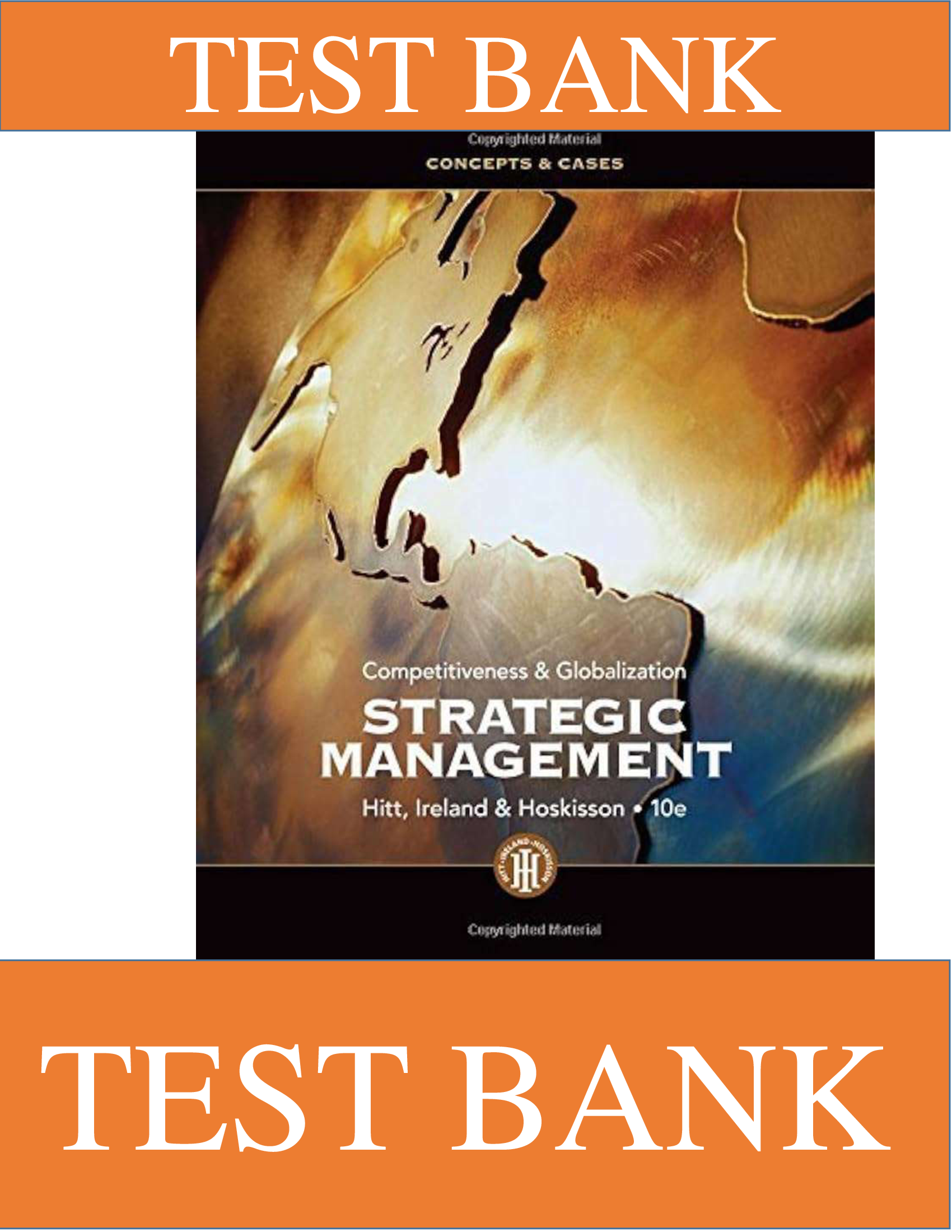
  • Test Bank for Strategic Management, 10th Edition by Hitt

Test Bank for Strategic Management, 10th Edition by Hitt

Preview page 1 Preview page 2 Preview page 3
Add To Favorites

Share this item Share this item

  • Item Details
  • Comments (0)
  • Reviews (0)
  • Contact Seller

Strategic Management, 10th Edition Test Bank 

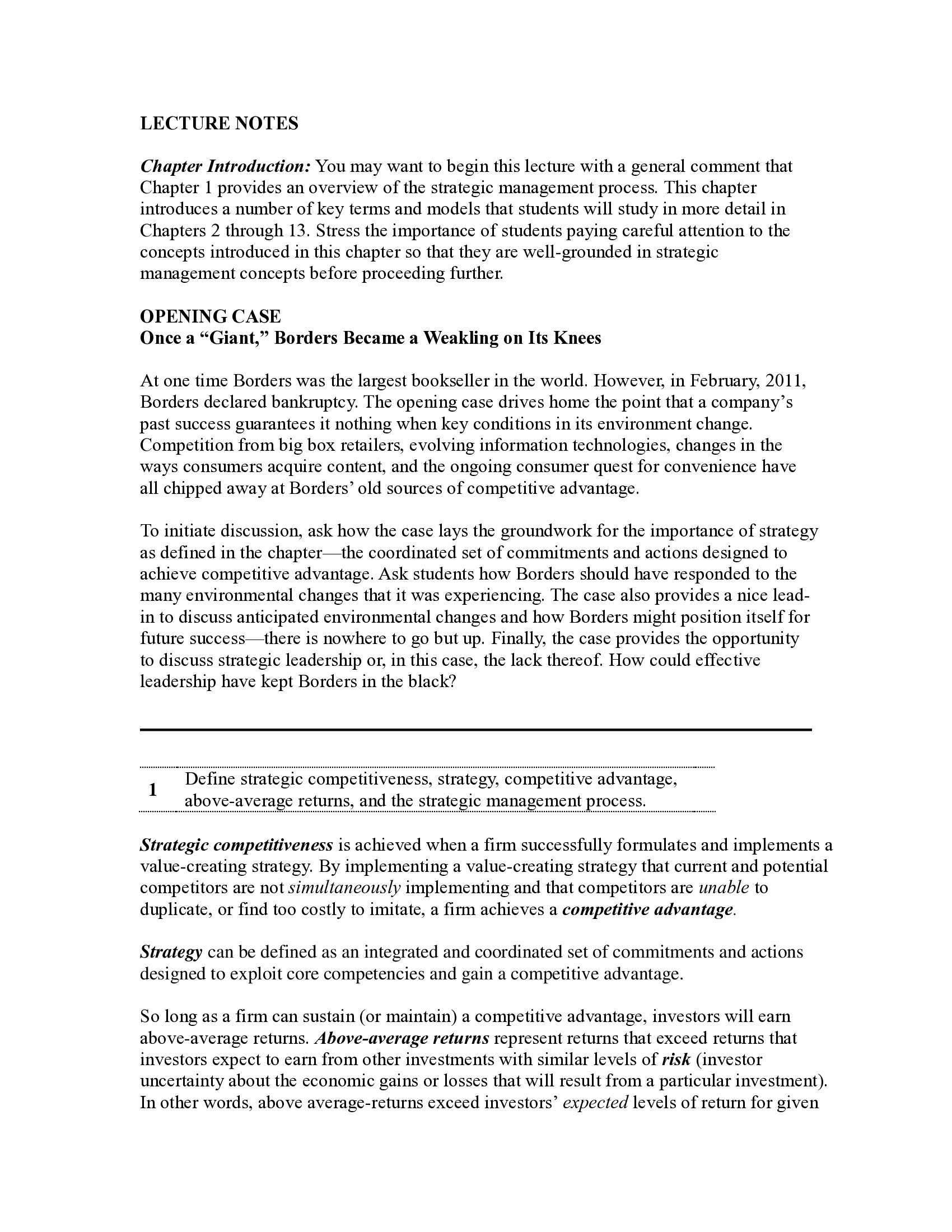
Chapter Introduction: You may want to begin this lecture with a general comment that Chapter 1 provides an overview of the strategic management process. This chapter introduces a number of key terms and models that students will study in more detail in Chapters 2 through 13. Stress the importance of students paying careful attention to the concepts introduced in this chapter so that they are well-grounded in strategic management concepts before proceeding further.

OPENING CASE  Once a “Giant,” Borders Became a Weakling on Its Knees

At one time Borders was the largest bookseller in the world. However, in February, 2011, Borders declared bankruptcy. The opening case drives home the point that a company’s past success guarantees it nothing when key conditions in its environment change. Competition from big box retailers, evolving information technologies, changes in the ways consumers acquire content, and the ongoing consumer quest for convenience have all chipped away at Borders’ old sources of competitive advantage.

To initiate discussion, ask how the case lays the groundwork for the importance of strategy as defined in the chapter—the coordinated set of commitments and actions designed to achieve competitive advantage. Ask students how Borders should have responded to the many environmental changes that it was experiencing. The case also provides a nice leadin to discuss anticipated environmental changes and how Borders might position itself for future success—there is nowhere to go but up. Finally, the case provides the opportunity to discuss strategic leadership or, in this case, the lack thereof. How could effective leadership have kept Borders in the black?

1              Define strategic competitiveness, strategy, competitive advantage, above-average returns, and the strategic management process.  

Strategic competitiveness is achieved when a firm successfully formulates and implements a value-creating strategy. By implementing a value-creating strategy that current and potential competitors are not simultaneously implementing and that competitors are unable to duplicate, or find too costly to imitate, a firm achieves a competitive advantage.

Strategy can be defined as an integrated and coordinated set of commitments and actions designed to exploit core competencies and gain a competitive advantage.

So long as a firm can sustain (or maintain) a competitive advantage, investors will earn above-average returns. Above-average returns represent returns that exceed returns that investors expect to earn from other investments with similar levels of risk (investor uncertainty about the economic gains or losses that will result from a particular investment). In other words, above average-returns exceed investors’ expected levels of return for given risk levels.  

Teaching Note: Point out that in the long run, firms must earn at least average returns and provide investors with average returns if they are to survive. If a firm earns below-average returns and provides investors with below-average returns, investors will withdraw their funds and place them in investments that earn at least average returns. At this point it may be useful to highlight the role institutional investors play in regulating above average performances.

In smaller new venture firms, performance is sometimes measured in terms of the amount and speed of growth rather than more traditional profitability measures—new ventures require time to earn acceptable returns.

A framework that can assist firms in their quest for strategic competitiveness is the strategic management process, the full set of commitments, decisions and actions required for a firm to systematically achieve strategic competitiveness and earn above-average returns. This process is illustrated in Figure 1.1. 

FIGURE 1.1

The Strategic Management Process

Figure 1.1 illustrates the dynamic, interrelated nature of the elements of the strategic management process and provides an outline of where the different elements of the process are covered in this text. 

Feedback linkages among the three primary elements indicate the dynamic nature of the strategic management process: strategic inputs, strategic actions, and strategic outcomes.

  • Strategic inputs, in the form of information gained by scrutinizing the internal environment and scanning the external environment, are used to develop the firm's vision and mission.
  • Strategic actions are guided by the firm's vision and mission, and are represented by strategies that are formulated or developed and subsequently implemented or put into action.
  • Desired strategic outcomes—strategic competitiveness and above-average returns—result when a firm is able to successfully formulate and implement value-creating strategies that others are unable to duplicate.
  • Feedback links the elements of the strategic management process together and helps firms continuously adjust or revise strategic inputs and strategic actions in order to achieve desired strategic outcomes.

In addition to describing the impact of globalization and technological change on the current business environment, this chapter also discusses two approaches to the strategic management process. The first, the industrial organization model, suggests that the external environment should be considered as the primary determinant of a firm’s strategic actions. The second is the resource-based model, which perceives the firm’s resources and capabilities (the internal environment) as critical links to strategic competitiveness. Following the discussion in this chapter, as well as in Chapters 2 and 3, students should see that these models must be integrated to achieve strategic competitiveness.

Teaching Note: The transient nature of strategic competitiveness is pointed out even more clearly when one realizes that only 16 of the 100 largest US industrial corporations in 1900 remained competitive in the 1990s and that four members of 1998's top ten were not among the top ten in 1992. This does not even take into account the great number of US businesses that fail every year (16,150 in 2004).

2              Describe the competitive landscape and explain how      globalization and technological changes shape it.

THE COMPETITIVE LANDSCAPE

The competitive landscape can be described as one in which the fundamental nature of competition is changing in a number of the world’s industries. Further, the boundaries of industries are becoming blurred and more difficult to define.

Consider recent changes that have taken place in the telecommunication and TV industries— e.g., not only cable companies and satellite networks compete for entertainment revenue from television, but telecommunication companies also are stepping into the entertainment business through significant improvements in fiber-optic lines. Partnerships further blur industry boundaries (e.g., MSNBC is co-owned by NBC, itself owned by General Electric and Microsoft). Many firms are looking into the delivery of video on demand (VOD). Apple iPod has the current lead in offering VOD content, but Netflix is vying hard to compete in this arena since VOD could be the kiss of death to its current online DVD rental service. Blockbuster and Amazon are also seeking a piece of this competitive pie.

The twenty-first century competitive landscape thus implies that traditional sources of competitive advantage—economies of scale and large advertising budgets—may not be as important in the future as they were in the past. The rapid and unpredictable technological change that characterizes this new competitive landscape implies that managers must adopt new ways of thinking. The new competitive mind-set must value flexibility, speed, innovation, integration, and the challenges that evolve from constantly changing conditions.

A term often used to describe the new realities of competition is hypercompetition, a condition that results from the dynamics of strategic moves and countermoves among innovative, global firms: a condition of rapidly escalating competition that is based on pricequality positioning, efforts to create new know-how and achieve first-mover advantage, and battles to protect or to invade established product or geographic markets (discussed in more detail in Chapter 5). 

The Global Economy

A global economy is one in which goods, services, people, skills, and ideas move freely across geographic borders.

The emergence of this global economy results in a number of challenges and opportunities. For instance, Europe is now the world’s largest single market (despite the difficulties of adapting to multiple national cultures and the lack of a single currency. The European Union has a gross domestic product (GDP) that is over 35% greater than that of  the US, with 700 million potential customers.  

Today, China is seen as an extremely competitive market in which local market-seeking MNCs (multinational corporations) fiercely compete against other MNCs and local low-cost producers. China has long been viewed as a low-cost producer of goods, but here’s an interesting twist. China is now an exporter of local management talent. Procter & Gamble actually exports Chinese management talent; it has been dispatching more Chinese abroad than it has been importing expatriates to China. GE estimates that by 2024, China will be the world’s greatest consumer of electricity and will also be the world’s largest consumer and consumer-finance market. GE is making strategic decisions today, such as significant investing in China and India, that will enhance its competitive posture in both countries in the future.

Teaching Note: The relative competitiveness of nations can be found in the World Economic Forum’s Global Competitiveness Report, which can be accessed for free on the Internet. It is useful to assemble these data into an overhead or PowerPoint slide and show it in class. Students find it interesting to see where their country stands relative to the others listed. Allow enough time for them to see these numbers and sort out what it all means.

The expectations of US firms for global business are changing rapidly.

• GE expects as much as 60 percent of its revenue growth between 2005 and 2015 to be generated by competing in rapidly developing economies (e.g., China and India).

STRATEGIC FOCUS   Huawei Also Needs Guanxi in the United States

Guanxi, the Chinese term for “building strong relationships in which each party feels obligated to help the other” is an important dimension to successful business in China. Huawei, the Chinese phone network manufacturer has also learned that Guanxi helps it do business abroad. Huawei is an extremely innovative company and its innovations are helping it gain respect within the industry. While relationships with other firms have been strong because of past ties with the Chinese military, Huawei has had trouble convincing the US government that potential acquisitions in the US should be allowed.  

Teaching Note: Huawei helps illustrate just how global business has become. Once the province of US firms, Huawei shows how foreign companies have become significant players in major US (and global) industries. Ask students if they believe the US government’s actions to block Huawei’s potential acquisitions with US firms are justified (and to explain their rationale). Ask them to identify other actions that Huawei might take to convince the US government that they do not pose a threat to national security. Is Guanxi with the US government possible?

The March of Globalization

Globalization is the increasing economic interdependence among countries as reflected in the flow of goods and services, financial capital, and knowledge across country borders. This is illustrated by the following:

  • Financial capital might be obtained in one national market and used to buy raw materials in another one. • Manufacturing equipment bought from another market produces products sold in yet another market.
  • Globalization enhances the available range of opportunities for firms.

Global competition has increased performance standards in many dimensions, including quality, cost, productivity, product introduction time, and operational efficiency. Moreover, these standards are not static; they are exacting, requiring continuous improvement from a firm and its employees. Thus, companies must improve their capabilities and individual workers need to sharpen their skills. In the twenty-first century competitive landscape, only firms that meet, and perhaps exceed, global standards are likely to earn strategic competitiveness.

Teaching Note: As a result of the new competitive landscape, firms of all sizes must re-think how they can achieve strategic competitiveness by positioning themselves to ask questions from a more global perspective to enable them to (at least) meet or exceed global standards:

  • Where should value-adding activities be performed?
  • Where are the most cost-effective markets for new capital?
  • Can products designed in one market be successfully adapted for sale in others?
  • How can we develop cooperative relationships or joint ventures with other firms that will enable us to capitalize on international growth opportunities?

Although globalization seems an attractive strategy for competing in the current competitive landscape, there are risks as well. These include such factors as:

  • The “liability of foreignness” (i.e., the risk of competing internationally) 
  • Overdiversification beyond the firm’s ability to successfully manage operations in multiple foreign markets

A point to emphasize: entry into international markets requires proper use of the strategic management process.

Though global markets are attractive strategic options for some companies, they are not the only source of strategic competitiveness. In fact, for most companies, even for those capable of competing successfully in global markets, it is critical to remain committed to and strategically competitive in the domestic market. And domestic markets can be testing grounds for possibly entering an international market at some point in the future.

Teaching Note: Indicate that the risks that often accompany internationalization and strategies for minimizing their impact on firms are discussed in more detail in Chapter 8.

Teaching Note:  As a result of globalization and the spread of technology, competition will become more intense. Some principles to consider include the following:

  • Customers will continue to expect high levels of product quality at competitive prices.
  • Global competition will continue to pressure companies to shorten product development-introduction time frames.
  • Strategically competitive companies successfully leverage insights learned both in domestic and global markets, modifying them as necessary.
  • Before a company can hope to achieve any measure of success in global markets, it must be strategically competitive in its domestic market.

Technology and Technological Changes

Three technological trends and conditions are significantly altering the nature of competition:

  • Increasing rate of technological change and diffusion
  • The information age
  • Increasing knowledge intensity

Technologic Diffusion and Disruptive Technologies

Both the rate of change and the introduction of new technologies have increased greatly over the last 15 to 20 years.

A term that is used to describe rapid and consistent replacement of current technologies by new, information-intensive technologies is perpetual innovation. This implies that innovation—discussed in more detail in Chapter 13—must be continuous and carry a high priority for all organizations.   

The shorter product life cycles that result from rapid diffusion of innovation often means that products may be replicated within very short time periods, placing a competitive premium on a firm’s ability to rapidly introduce new products into the marketplace. In fact, speed-to-market may become the sole source of competitive advantage. In the computer industry during the early 1980s, hard disk drives would typically remain current for four to six years, after which a new and better product became available. By the late 1980s, the expected life had fallen to two to three years. By the 1990s, it was just six to nine months.

The rapid diffusion of innovation may have made patents a source of competitive advantage only in the pharmaceutical and chemical industries. Many firms do not file patent applications to safeguard (for at least a time) the technical knowledge that would be disclosed explicitly in a patent application.

Disruptive technologies (in line with the Schumpeterian notion of “creative destruction”) can destroy the value of existing technologies by replacing them with new ones. Current examples include the success of iPods, PDAs, and WiFi.

The Information Age

Changes in information technology have made rapid access to information available to firms all over the world, regardless of size. Consider the rapid growth in the following technologies: personal computers (PCs), cellular phones, computers, personal digital assistants (PDAs), artificial intelligence, virtual reality, and massive databases. These examples show how information is used differently as a result of new technologies. The ability to access and use information has become an important source of competitive advantage in almost every industry.

  • There have been dramatic changes in information technology in recent years.
  • The number of PCs is expected to grow to 278 million by 2010.
  • The Internet provides an information-carrying infrastructure available to individuals and firms worldwide.

The ability to access a high level of relatively inexpensive information has created strategic opportunities for many information-intensive businesses. For example, retailers now can use the Internet to provide shopping to customers virtually anywhere.

STRATEGIC FOCUS   The Core of Apple: Technology and Innovation

Apple has been on a hot streak for over a decade. It is an exceptionally innovative company and its products have revolutionized multiple industries. Its brand is incredibly strong on a global scale and customers continue to purchase its products even though cheaper substitutes in the market abound. iPod, iTunes, iPhone, and iPad have powered the company to the point that it had the second largest market capitalization of all firms in the world in 2011.  

Teaching Note: Apple illustrates the power of well-conceived and managed innovation. Over the past decade it has produced a number of breakthrough products that are in high demand. Ask students to compare some of Apple’s products with those of competitors. What do they know about the products and how important is the strength of the Apple brand in shaping perceptions? With the passing of legendary founder and CEO Steve Jobs, ask students if they think that Apple will be able to continue current momentum into the future.

Increasing Knowledge Intensity

It is becoming increasingly apparent that knowledge—information, intelligence, and expertise—is a critical organizational resource, and increasingly, a source of competitive advantage. As a result, 

  • Many companies are working to convert the accumulated knowledge of employees into a corporate asset
  • Shareholder value is increasingly influenced by the value of a firm’s intangible assets, such as knowledge

Note: Intangible assets are discussed more fully in Chapter 3.

Teaching Note: This means that to achieve competitive advantage in the information-intensive competitive landscape, firms must move beyond accessing information to exploiting information by:

  • Capturing intelligence
  • Transforming intelligence into usable knowledge
  • Embedding it as organizational learning
  • Diffusing it rapidly throughout the organization

The implication of this discussion is that to achieve strategic competitiveness and earn above-average returns, firms must develop the ability to adapt rapidly to change or achieve strategic flexibility.

Strategic flexibility represents the set of capabilities—in all areas of their operations—that firms use to respond to the various demands and opportunities that are found in dynamic, uncertain environments. This implies that firms must develop certain capabilities, including the capacity to learn continuously, that will provide the firm with new skill sets. However, those working within firms to develop strategic flexibility should understand that the task is not an easy one, largely because of inertia that can build up over time. A firm’s focus and past core competencies may actually slow change and strategic flexibility.

Teaching Note: Firms capable of rapidly and broadly applying what they learn achieve strategic flexibility and the resulting capacity to change in ways that will increase the probability of succeeding in uncertain, hypercompetitive environments. Some firms must change dramatically to remain competitive or return to competitiveness. How often are firms able to make this shift? Overall, does it take more effort to make small, periodic changes, or to wait and make more dramatic changes when these become necessary?

Two models describing key strategic inputs to a firm's strategic actions are discussed next:

the Industrial Organization (or externally focused) model and the Resource-Based (or internally focused) model.

3 Use the industrial organization (I/O) model to explain how firms can earn above-average returns. 

Contact the Seller

Please Sign In to contact this seller.


  • 👎  Report Copyright Violation

Frequently Asked Questions

What Do I Get When I Buy This Study Material?

+

When you buy a study material on Passing Grades, an instant download link will be sent directly to your email, giving you access to the file anytime after payment is completed.

Is Passing Grades a Trusted Platform?

+

Yes, Passing Grades is a reputable students’ marketplace with a secure payment system and reliable customer support. You can trust us to ensure a safe and seamless transaction experience.

Will I Be Stuck with a Subscription?

+

No, all purchases on Passing Grades are one-time transactions. You only pay for the notes you choose to buy, with no subscriptions or hidden fees attached.

Who Am I Buying These Study Materials From?

+

Passing Grades is a marketplace, which means you are purchasing the document from an individual vendor, not directly from us. We facilitate the payment and delivery process between you and the vendor.

Does Passing Grades Offer Free Study Materials?

+

Yes, sellers on Passing Grades have uploaded numerous free test banks, exams, practice questions, and class notes that can be downloaded at no cost.


Pasinggrades - Quality Study Materials

USD 15

    • Quality checked by Pasing Grades
    • 100% satisfaction guarantee
    • Seller: Angelicer
Buy PDF $15

Seller Information

Angelicer

Member since April 2021

  • icon
  • icon
View Profile
  • total sales

    0
  • Favourites

    0
  • Comments

    0
    ( 0 Ratings )

Item Information

  • Uploaded

    12 July 2025

  • Updated

    12 July 2025

  • Category

    Business

  • Item Type

    test bank

  • Tags

    Test Bank for Strategic Management 10th Edition by Hitt

Related Exam Prep Guides by Angelicer

Test Bank for Success in Practical Vocational Nursing 8th Edition by Knecht
View Document

Test Bank for Succes...

  • Angelicer

    Angelicer

  • test bank

Enhance your study with the Test Bank for Success in Practical Vocational Nursing 8th Edition by Kne...

15 USD

0

0

Test Bank for Illustrated Anatomy of the Head and Neck 5th Edition by Fehrenbach
View Document

Test Bank for Illust...

  • Angelicer

    Angelicer

  • test bank

Boost your understanding with the Test Bank for Illustrated Anatomy of the Head and Neck 5th Edition...

15 USD

0

0

ATI PEDS Proctored Exam Questions and Answers 2026 | Comprehensive Study Guide
View Document

ATI PEDS Proctored E...

  • Angelicer

    Angelicer

  • test bank

Get the ATI PEDS Proctored Exam Questions and Answers for 2025. This comprehensive study guide offer...

15 USD

0

0

Purchase

Download link will be sent to this email immediately after purchase.

IMPORTANT LINKS

  • How To Upload Class Notes
  • Selling Tips
  • Passing Grades's Study Materials
  • Scholarships for International Students 2025

POPULAR CATEGORIES

  • Law
  • Accounting
  • English
  • Psychology
  • Business
  • Nursing
  • Computer Science
  • General

View Document

  • Blog
  • Contact
  • Delivery Policy
  • Latest Scholarships Around the World
  • How to Pass Bar Exams: Passing Grades’ Strategies
  • How to Study and Pass the CPA Exam
  • All Test Banks
  • Faq
  • Copyright Claims
  • Privacy Policy
  • Terms of Use

KNOWLEDGE BASE

  • How to Write A+ Grade Good Research Paper
  • How to Manage Stress During Exam Period
  • Best Time to Study
  • How to Pass NCLEX-RN Exam
  • How To Effectively Utilize Test Banks
  • Popular Shadow Health Exam Assessments
  • Popular HESI Case Studies
  • How to Prepare for a Nursing Career
  • The Importance Of Summaries in Exam Revisvion

© 2026 Pasing Grades. All rights reserved.