Pasing Grades
  • Start Selling
  • Blog
  • Contact
  • 0

    Your cart is empty!

English

  • English
  • Spanish
  • Arabic
Create Account Sign In
  • Library
    • New Prep Guides
    • Featured Prep Guides
    • Free Exam Prep Guides
    • Best sellers
  • General
  • Nursing
    • Research Paper
    • Case Study
    • Discussion Post
    • Assignment
    • Exam
    • Practice Questions and Answers
    • Test Bank
    • solutions manual
    • study guide
  • Accounting
    • Case Study
    • Thesis
    • Study Guide
    • Summary
    • Research Paper
    • test bank
  • English
    • Creative Writing
    • Research Paper
    • Summary
    • Rhetorics
    • Literature
    • Journal
    • Exam
    • Grammar
    • Discussion Post
    • Essay
  • Psychology
    • Hesi
    • Presentation
    • Essay
    • Summary
    • Study Guide
    • Essay
    • Solution Manual
    • Final Exam Review
    • Class Notes
    • test bank
  • Business
    • Lecture Notes
    • Solution Manual
    • Presentation
    • Business Plan
    • Class Notes
    • Experiment
    • Summary
    • Practice Questions
    • Study Guide
    • Case Study
    • test bank
    • Exam
  • More
    • Computer Science
    • Economics
    • Statistics
    • Engineering
    • Biology
    • Religious Studies
    • Physics
    • Chemistry
    • Mathematics
    • History
    • Sociology
    • Science
    • Philosophy
    • Law
  • Pages
    • About Us
    • Selling Tips
    • Delivery Policy
    • Faq
    • Privacy Policy
  • Flash Sale
  • Home
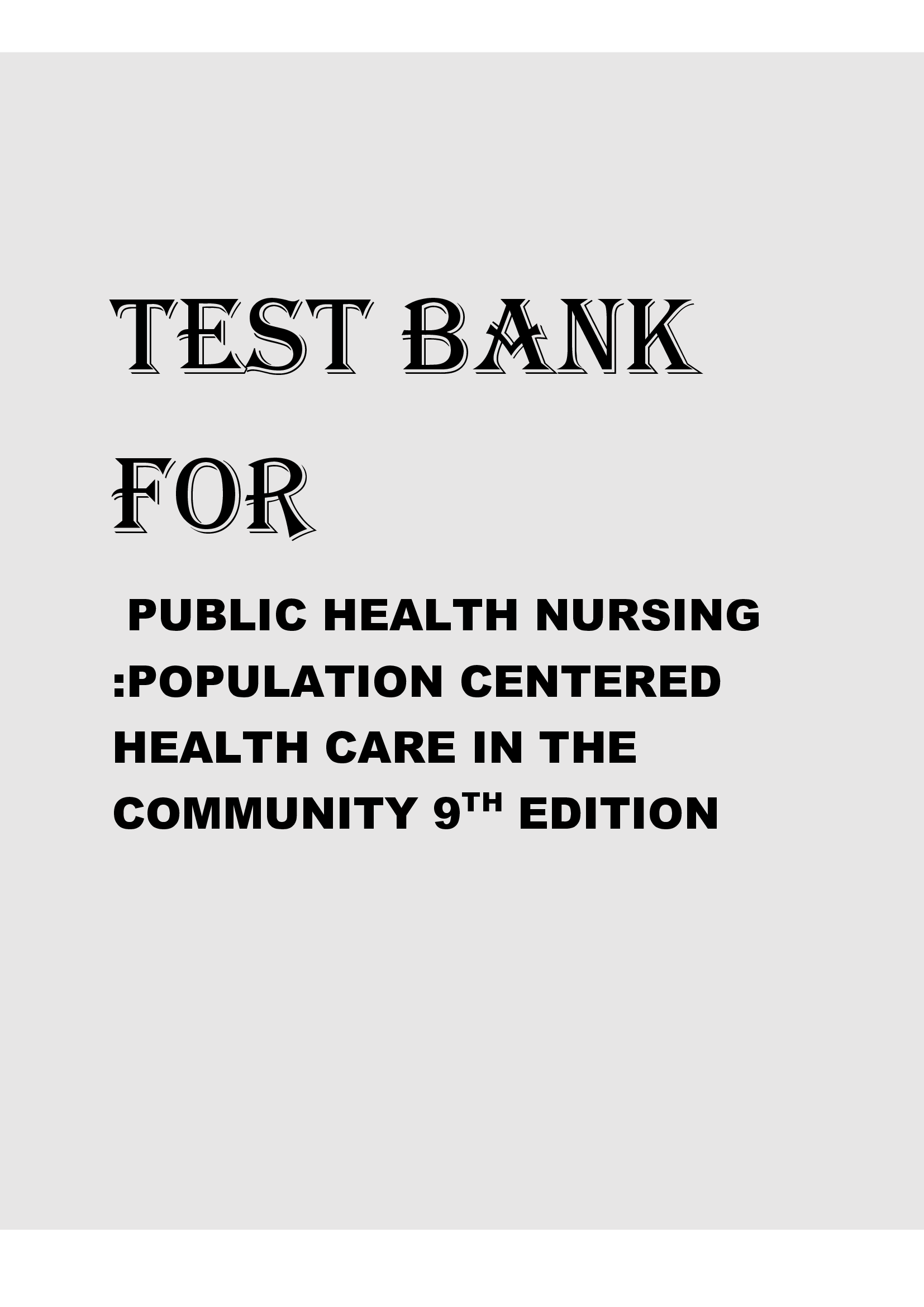
  • Test Bank for Public Health Nursing: Population-Centered Health Care in the Community (9th Edition) | Complete & Verified | All Chapters Included

Test Bank for Public Health Nursing: Population-Centered Health Care in the Community (9th Edition) | Complete & Verified | All Chapters Included

Preview page 1 Preview page 2 Preview page 3
Add To Favorites

Share this item Share this item

  • Item Details
  • Comments (0)
  • Reviews (0)
  • Contact Seller

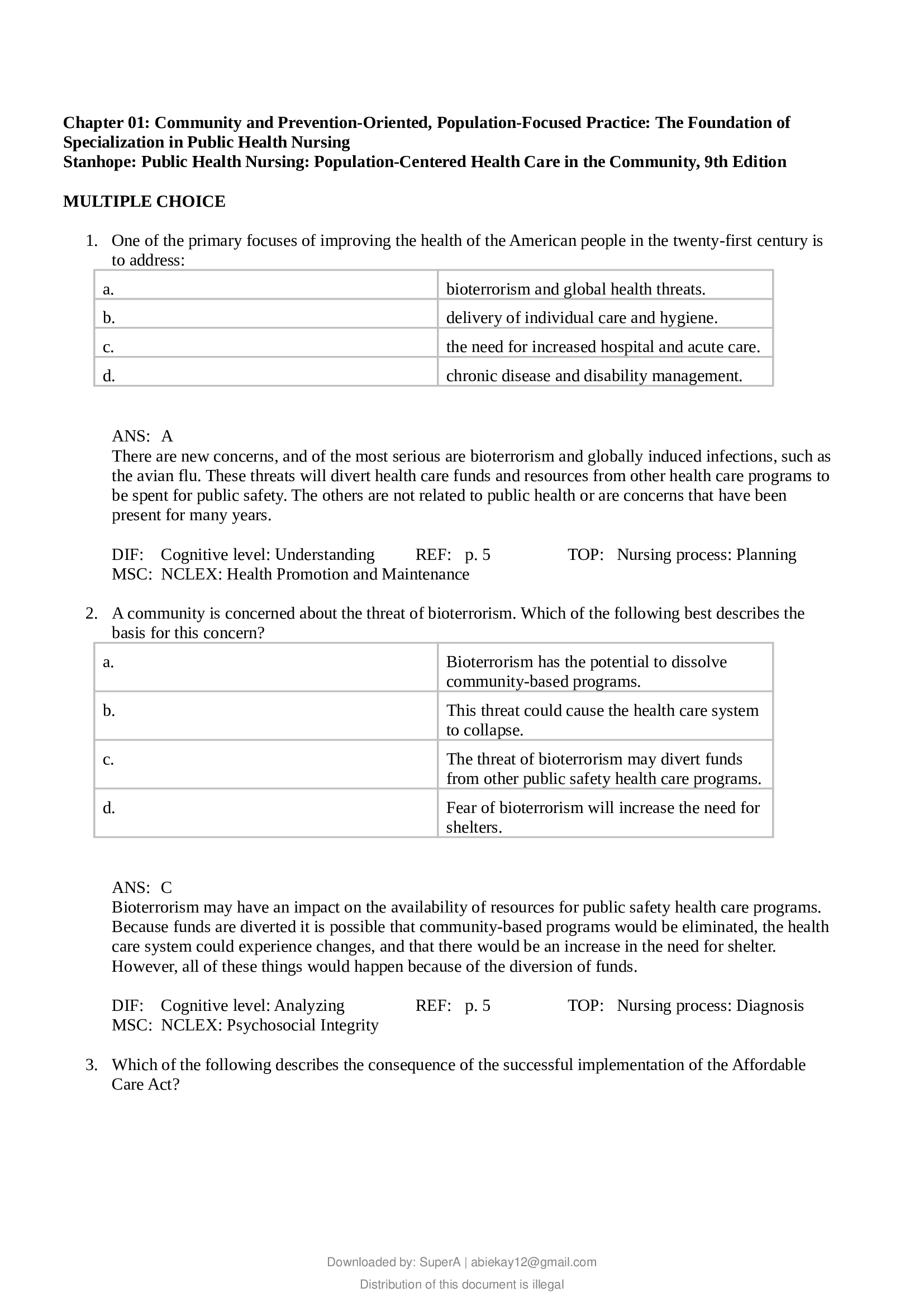
Public Health Nursing: Population-Centered Health Care in the Community Test Bank

9.   A screening for diabetes revealed 20 previously diagnosed diabetics and 10 probable new cases, which were later confirmed, for a total of 30 cases. Which of the following best describes what is being measured?

a.


Prevalence


b. c. d.


Incidence Attack rate Morbidity rate

ANS:

A


Prevalence is the measure of existing disease in a population at a particular time. Incidence

quantifies the rate of development of new cases in a population at risk, whereas an incidence proportion indicates the proportion of the population at risk who experience the event over some period of time. Attack rate is defined as the proportion of persons who are exposed to an agent and develop the disease. Morbidity rate is the incidence of disease.


DIF:    Cognitive level: Applying                 REF:   p. 263

TOP:   Nursing process: Assessment

MSC:  NCLEX: Safe and Effective Care Environment: Safety and Infection Control

 10.   Which statement is true about mortality rates? Mortality rates:

a. are informative only for fatal diseases.

b. provide information about existing disease in the population.

c. are calculated using a population estimate at year-end.

d. reveal the risk of getting a particular disease.

ANS:  A

Mortality rates are informative only for fatal diseases and do not provide direct information about the level of existing disease or the risk of getting a particular disease. Because the population changes during the course of a year, typically an estimate of the population at midyear is taken as the denominator for annual rates, because the midyear population approximates the amount of person-time contributed by the population during a given year.

DIF:

Cognitive level: Understanding

REF:   p. 265

TOP:

Nursing process: Evaluation


MSC:  NCLEX: Safe and Effective Care Environment: Management of Care

11.   A public health nurse (PHN) reports an attack rate. Which of the following has most likely been reported?

a. Number of cases of cancer recorded at a medical center

b. Number of people who died of Ebola in a given year

 c. Number of beef cattle inoculated against mad-cow disease on a farm

d. Proportion of people becoming ill after eating at a fast-food restaurant

ANS:  D

Attack rates are often specific to exposures, such as food-specific attack rates. The number of cases of cancer, exposure to Ebola, and beef cattle are not significant without knowing the total number of people so that a proportion can be calculated.

DIF:

Cognitive level: Analyzing

REF:   p. 265

TOP:

Nursing process: Implementation


MSC:  NCLEX: Safe and Effective Care Environment: Safety and Infection Control

 12.   The interaction between an agent, a host, and the environment is called:

a. natural history of disease.

b. risk.

c. web of causality.

d. the epidemiologic triangle.

ANS:  D

The epidemiologic triangle consists of the interaction between an agent, a host, and the environment. The natural history of disease is the course of the disease process from onset to resolution. Risk is the probability an event will occur within a specified period of time. The web of causality reflects the more complex interrelationship among the numerous factors interacting, sometimes in subtle ways, to increase (or decrease) risk of disease.

DIF:

Cognitive level: Remembering

REF:   p. 266

TOP:

Nursing process: Assessment


MSC:  NCLEX: Safe and Effective Care Environment: Safety and Infection Control

 13.   Public health professionals refer to three levels of prevention as tied to specific stages in the:

a. epidemiologic triangle.

b. web of causation.

c.                                                                       natural history of disease. d.                                                                      surveillance process.

ANS:  C

The natural history of disease is the course of the disease process from onset to resolution. The three levels of prevention provide a framework commonly used in public health practice to depict this process. The epidemiologic triangle consists of the interaction between an agent, a host, and the environment. The web of causality reflects the more complex interrelationship among the numerous factors interacting, sometimes in subtle ways, to increase (or decrease) risk of disease. The surveillance process involves the systematic collection, analysis, and interpretation of data related to the occurrence of disease and the health status of a given population.

DIF:

Cognitive level: Understanding

REF:   p. 268

TOP:

Nursing process: Assessment


MSC:  NCLEX: Safe and Effective Care Environment: Management of Care

14.   A nurse is studying the characteristics of an agent as part of the epidemiologic triangle. Which of the following is the nurse most likely studying?

a. Human population distribution

b. Salmonella

c. Genetic susceptibility

d. Climate

ANS:  B

An agent includes infectious organisms, such as Salmonella, chemical agents, and physical agents. Genetic susceptibility is considered to be a characteristic of a host. Human population distribution and climate are considered to be characteristics of the environment.

DIF:    Cognitive level: Applying                 REF:   p. 266 (Box 12-1) TOP:   Nursing process: Assessment

MSC:  NCLEX: Safe and Effective Care Environment: Safety and Infection Control

15.   A PHN implements a primary prevention intervention in the community. Which of the following is most likely being implemented?

a.                                                                       Pap smear


b.                                                                      Blood pressure screening c.                                                                       Diet and exercise

d.                                                                      Physical therapy


ANS:  C

Primary prevention refers to those interventions aimed at preventing the occurrence of disease, injury, or disability. Blood pressure screening and pap smears are secondary prevention interventions. Physical therapy is a tertiary prevention intervention.


DIF:

Cognitive level: Analyzing

REF:   pp. 268-269

TOP:

Nursing process: Implementation


MSC:  NCLEX: Health Promotion and Maintenance

16.   A PHN conducts an immunization clinic for measles. Which of the following is being implemented?

a.


Primary prevention


b. c. d.


Secondary prevention Tertiary prevention Health promotion

ANS:

A


Primary prevention refers to those interventions aimed at preventing the occurrence of disease, injury, or disability. Immunizations are an example of primary prevention. Secondary prevention interventions are designed to increase the probability that a person with a disease will have that condition diagnosed at a stage when treatment is likely to result in cure. Tertiary prevention includes interventions aimed at disability limitation and rehabilitation from disease, injury, or disability. Health promotion is a specific primary prevention strategy.

DIF:

Cognitive level: Applying

REF:   pp. 268-269

TOP:

Nursing process: Implementation


MSC:  NCLEX: Health Promotion and Maintenance

 17.   As a result of an outbreak of influenza in a community, a nurse encourages members of the community to receive the influenza vaccine. Which of the following levels of prevention is being used?

a.


Primary prevention


b. c. d.


Secondary prevention Tertiary prevention Multifactorial prevention

ANS:

A


Nurses are involved in epidemiologic surveillance by monitoring the potential for disease

outbreaks. Primary prevention refers to interventions aimed at preventing the occurrence of disease, injury, or disability. Immunizations are an example of primary prevention. Secondary prevention interventions are designed to increase the probability that a person with a disease will have that condition diagnosed at a stage when treatment is likely to result in cure. Tertiary prevention includes interventions aimed at disability limitation and rehabilitation from disease, injury, or disability. Multifactorial prevention is not possible with a disease like influenza, which has one cause.

DIF:

Cognitive level: Applying

REF:   pp. 268-269

TOP:

Nursing process: Implementation


MSC:  NCLEX: Health Promotion and Maintenance

 18.   A nurse offers a screening for hearing defects at a local community center. Which of the following best describes the action of the nurse?

a. Primary prevention

b. Secondary prevention

c.


Tertiary prevention

d.


ANS:


B

Health promotion

Secondary prevention focuses on early detection and prompt treatment of disease, injury, or disability. Screenings are part of secondary prevention interventions. Primary prevention refers to interventions aimed at preventing the occurrence of disease, injury, or disability. Tertiary prevention includes interventions aimed at disability limitation and rehabilitation from disease, injury, or disability. Health promotion is a specific primary prevention strategy.

DIF:

Cognitive level: Applying

REF:   p. 269

TOP:

Nursing process: Implementation


MSC:  NCLEX: Health Promotion and Maintenance

19.   A nurse refers a client with a neuromuscular disease to a vocational rehabilitation program.

Which of the following best describes the action of the nurse?

a. Primary prevention

b. Secondary prevention

c. Tertiary prevention d. Health promotion

ANS:  C

Tertiary prevention includes those interventions aimed at disability limitation and rehabilitation from disease, injury, or disability. Referral of a client with a disease is an example of tertiary prevention. Primary prevention refers to interventions aimed at preventing the occurrence of disease, injury, or disability. Secondary prevention focuses on early detection and prompt treatment of disease, injury, or disability. Health promotion is a specific primary prevention strategy.

DIF:

Cognitive level: Applying

REF:   p. 269

TOP:

Nursing process: Implementation


MSC:  NCLEX: Health Promotion and Maintenance

20.   A nurse implements a program that focuses on secondary prevention. Which of the following is most likely the topic of this program?

a. Rehabilitation

b. Avoidance of high-risk behaviors

c. Immunization

d.                                                                      Mammogram

ANS:  D

Secondary prevention focuses on early detection and prompt treatment of disease, injury, or disability. Mammograms are a screening test. Avoidance of high-risk behaviors and immunizations are examples of primary prevention. Rehabilitation is an example of tertiary prevention.

DIF:

Cognitive level: Applying

REF:   p. 269

TOP:

Nursing process: Implementation


MSC:  NCLEX: Health Promotion and Maintenance

21.   An intervention that focuses on the tertiary level of prevention is implemented by the nurse?

Which of the following did the nurse most likely complete?

a. Rehabilitative job training

b. Parenting education

c. Testicular self-examination

d.  Family counseling

ANS:  A

Tertiary prevention includes those interventions aimed at disability limitation and rehabilitation from disease, injury, or disability. Rehabilitative job training would be an example of tertiary prevention. Parenting education is an example of primary prevention. Testicular self-examination and family counseling are examples of secondary prevention.


DIF:

Cognitive level: Applying

REF:   p. 269

TOP:

Nursing process: Implementation


MSC:  NCLEX: Health Promotion and Maintenance

22.   A nurse is told that a screening test has high specificity. Which of the following is the best interpretation of this information?

a. The test provides precise and consistent readings.

b. The test accurately identifies those with the condition or trait.

c. The test accurately identifies those without the trait.

d. The test has a high level of false positives.

ANS:  C

Specificity refers to the test accurately identifying those without the trait. High specificity is needed when rescreening is impractical and when reduction of false positives is important. The test would have a low level of false positives.

DIF:    Cognitive level: Applying                 REF:   p. 271

TOP:   Nursing process: Evaluation

MSC:  NCLEX: Safe and Effective Care Environment: Management of Care

Contact the Seller

Please Sign In to contact this seller.


  • 👎  Report Copyright Violation

Frequently Asked Questions

What Do I Get When I Buy This Study Material?

+

When you buy a study material on Passing Grades, an instant download link will be sent directly to your email, giving you access to the file anytime after payment is completed.

Is Passing Grades a Trusted Platform?

+

Yes, Passing Grades is a reputable students’ marketplace with a secure payment system and reliable customer support. You can trust us to ensure a safe and seamless transaction experience.

Will I Be Stuck with a Subscription?

+

No, all purchases on Passing Grades are one-time transactions. You only pay for the notes you choose to buy, with no subscriptions or hidden fees attached.

Who Am I Buying These Study Materials From?

+

Passing Grades is a marketplace, which means you are purchasing the document from an individual vendor, not directly from us. We facilitate the payment and delivery process between you and the vendor.

Does Passing Grades Offer Free Study Materials?

+

Yes, sellers on Passing Grades have uploaded numerous free test banks, exams, practice questions, and class notes that can be downloaded at no cost.

Pasinggrades - Quality Study Materials

USD 15

    • Quality checked by Pasing Grades
    • 100% satisfaction guarantee
    • Seller: mentor2000
Buy PDF $15

Seller Information

mentor2000

Member since April 2021

  • icon
  • icon
View Profile
  • total sales

    0
  • Favourites

    0
  • Comments

    0
    ( 0 Ratings )

Item Information

  • Uploaded

    22 May 2022

  • Updated

    28 April 2025

  • Category

    Nursing

  • Item Type

    test bank

  • Tags

    TEST BANK FOR PUBLIC HEALTH NURSING POPULATION CENTERED HEALTH CARE IN THE COMMUNITY 9TH EDITION

Related Exam Prep Guides by mentor2000

Test Bank for Essentials for Nursing Practice 8th Edition by Potter | All Chapters
View Document

Test Bank for Essent...

  • mentor2000

    mentor2000

  • test bank

Master nursing concepts with this study material; Test Bank for Essentials for Nursing Practice, 8th...

15 USD

0

0

A &P 1 MA278 BSC2 Final Module II Questions & Answers 2026 Update
View Document

A &P 1 MA278 BSC2 Fi...

  • mentor2000

    mentor2000

  • test bank

Prepare for success with A&P 1 MA278 BSC2 Final Module II 2024 Q&A. Boost your grades with this comp...

15 USD

0

0

ATI Comprehensive Predictor Exam 2026
View Document

ATI Comprehensive Pr...

  • mentor2000

    mentor2000

  • test bank

Prepare for success with the ATI Comprehensive Predictor Exam 2026. Access key practice questions to...

15 USD

0

0

Purchase

Download link will be sent to this email immediately after purchase.

IMPORTANT LINKS

  • How To Upload Class Notes
  • Selling Tips
  • Passing Grades's Study Materials
  • Scholarships for International Students 2026

POPULAR CATEGORIES

  • Law
  • Accounting
  • English
  • Psychology
  • Business
  • Nursing
  • Computer Science
  • General

View Document

  • Blog
  • Contact
  • Delivery Policy
  • Latest Scholarships Around the World
  • How to Pass Bar Exams: Passing Grades’ Strategies
  • How to Study and Pass the CPA Exam
  • All Test Banks
  • Faq
  • Copyright Claims
  • Privacy Policy
  • Terms of Use

KNOWLEDGE BASE

  • How to Write A+ Grade Good Research Paper
  • How to Manage Stress During Exam Period
  • Best Time to Study
  • How to Pass NCLEX-RN Exam
  • How To Effectively Utilize Test Banks
  • Popular Shadow Health Exam Assessments
  • Popular HESI Case Studies
  • How to Prepare for a Nursing Career
  • The Importance Of Summaries in Exam Revisvion

© 2026 Pasing Grades. All rights reserved.