Pasing Grades
  • Start Selling
  • Blog
  • Contact
  • 0

    Your cart is empty!

English

  • English
  • Spanish
  • Arabic
Create Account Sign In
  • Library
    • New Prep Guides
    • Featured Prep Guides
    • Free Exam Prep Guides
    • Best sellers
  • General
  • Nursing
    • Research Paper
    • Case Study
    • Discussion Post
    • Assignment
    • Exam
    • Practice Questions and Answers
    • Test Bank
    • solutions manual
  • Accounting
    • Case Study
    • Thesis
    • Study Guide
    • Summary
    • Research Paper
    • test bank
  • English
    • Creative Writing
    • Research Paper
    • Summary
    • Rhetorics
    • Literature
    • Journal
    • Exam
    • Grammar
    • Discussion Post
    • Essay
  • Psychology
    • Hesi
    • Presentation
    • Essay
    • Summary
    • Study Guide
    • Essay
    • Solution Manual
    • Final Exam Review
    • Class Notes
    • test bank
  • Business
    • Lecture Notes
    • Solution Manual
    • Presentation
    • Business Plan
    • Class Notes
    • Experiment
    • Summary
    • Practice Questions
    • Study Guide
    • Case Study
    • test bank
    • Exam
  • More
    • Computer Science
    • Economics
    • Statistics
    • Engineering
    • Biology
    • Religious Studies
    • Physics
    • Chemistry
    • Mathematics
    • History
    • Sociology
    • Science
    • Philosophy
    • Law
  • Pages
    • About Us
    • Selling Tips
    • Delivery Policy
    • Faq
    • Privacy Policy
  • Flash Sale
  • Home
  • Test Bank for Psychology Applied to Modern Life Adjustment in the 21st Century 12th Edition Weiten

Test Bank for Psychology Applied to Modern Life Adjustment in the 21st Century 12th Edition Weiten

Preview page 1 Preview page 2 Preview page 3
Add To Favorites

Share this item Share this item

  • Item Details
  • Comments (0)
  • Reviews (0)
  • Contact Seller

Complete Test Bank for Psychology Applied to Modern Life Adjustment in the 21st Century

by Weiten 12th Edition

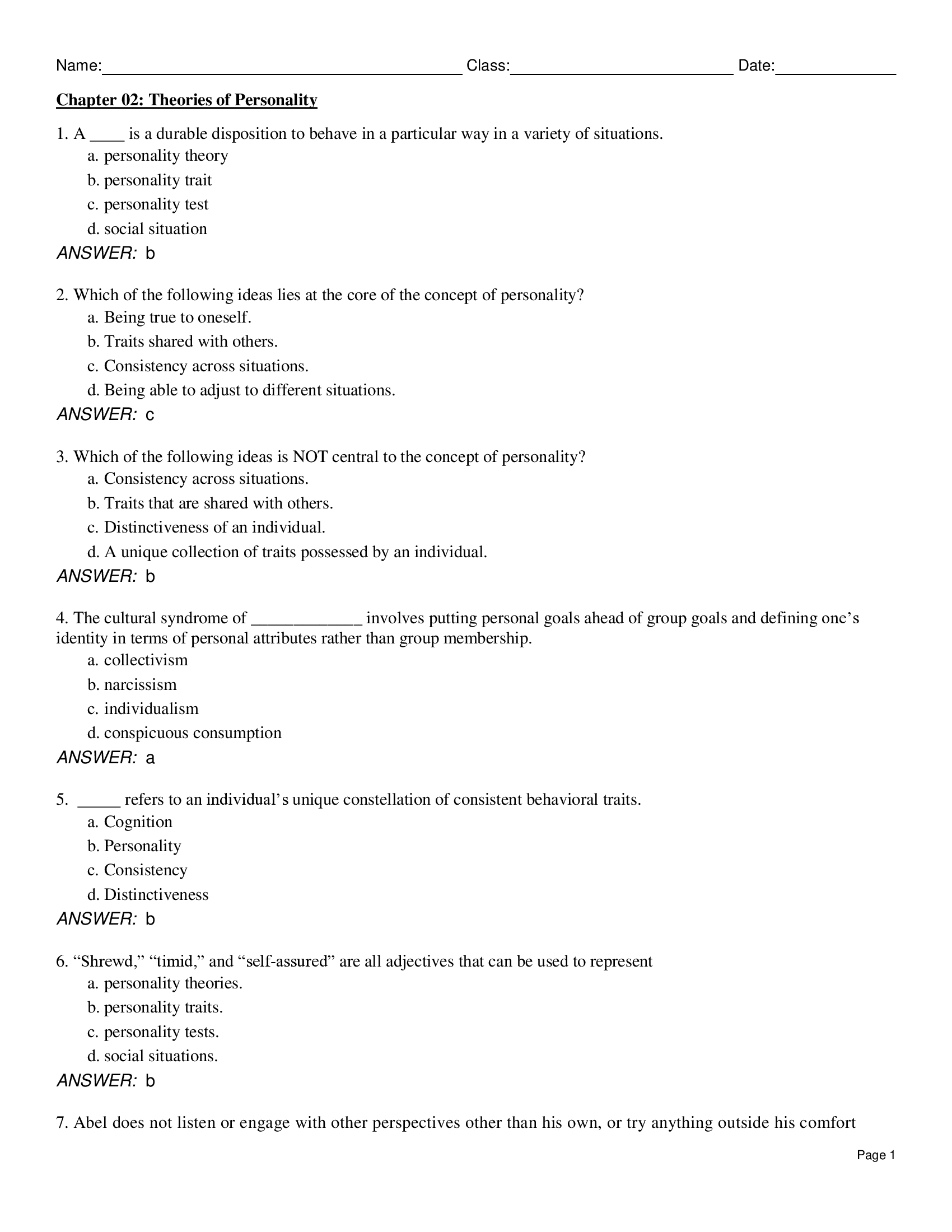
1.           A          is a durable disposition to behave in a particular way in a variety of situations.    a.  personality theory

b.       personality trait  

c.        personality test  

d.       social situation ANSWER:  b 

2.           Which of the following ideas lies at the core of the concept of personality?

a.        Being true to oneself.

b.       Traits shared with others.

c.        Consistency across situations.

d.       Being able to adjust to different situations.

ANSWER:  c

3.           Which of the following ideas is NOT central to the concept of personality?

a.        Consistency across situations.

b.       Traits that are shared with others.

c.        Distinctiveness of an individual.

d.       A unique collection of traits possessed by an individual. ANSWER:  b 

4.           The cultural syndrome of _____________ involves putting personal goals ahead of group goals and defining one’s identity in terms of personal attributes rather than group membership.   a.  collectivism  

b.       narcissism  

c.        individualism  

d.       conspicuous consumption  ANSWER:  a 

5.           refers to an individual’s unique constellation of consistent behavioral traits.    a.  Cognition          

b.       Personality

c.        Consistency       

d.       Distinctiveness ANSWER:  b 

6.           “Shrewd,” “timid,” and “self-assured” are all adjectives that can be used to represent   a.  personality theories.       

b.       personality traits.  

c.        personality tests.            

d.       social situations. ANSWER:  b 

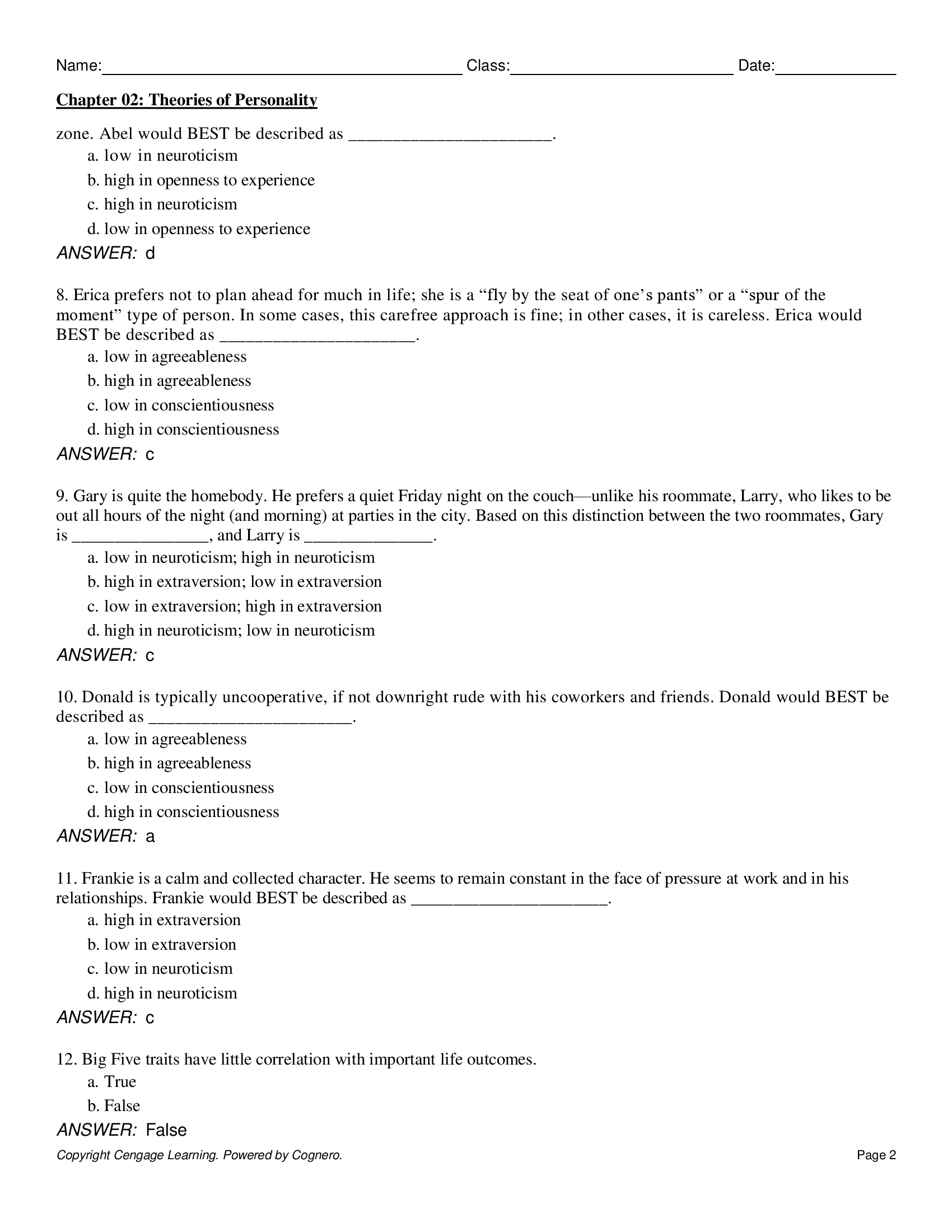
7.           Abel does not listen or engage with other perspectives other than his own, or try anything outside his comfort zone. Abel would BEST be described as _______________________.    a.  low in neuroticism          

b.       high in openness to experience

c.        high in neuroticism

d.       low in openness to experience ANSWER:  d 

8.           Erica prefers not to plan ahead for much in life; she is a “fly by the seat of one’s pants” or a “spur of the moment” type of person. In some cases, this carefree approach is fine; in other cases, it is careless. Erica would BEST be described as ______________________.    a.  low in agreeableness          

b.       high in agreeableness

c.        low in conscientiousness       

d.       high in conscientiousness ANSWER:  c

9.           Gary is quite the homebody. He prefers a quiet Friday night on the couch—unlike his roommate, Larry, who likes to be out all hours of the night (and morning) at parties in the city. Based on this distinction between the two roommates, Gary is ________________, and Larry is _______________.     a.  low in neuroticism; high in neuroticism

b.       high in extraversion; low in extraversion

c.        low in extraversion; high in extraversion      

d.       high in neuroticism; low in neuroticism ANSWER:  c

10.       Donald is typically uncooperative, if not downright rude with his coworkers and friends. Donald would BEST be described as _______________________.     a.  low in agreeableness      

b.       high in agreeableness

c.        low in conscientiousness

d.       high in conscientiousness ANSWER:  a 

11.       Frankie is a calm and collected character. He seems to remain constant in the face of pressure at work and in his relationships. Frankie would BEST be described as _______________________.                a.  high in extraversion     

b.       low in extraversion

c.        low in neuroticism

d.       high in neuroticism ANSWER:  c

12.       Big Five traits have little correlation with important life outcomes.   a.  True

b.       False

ANSWER:  False                 

13.   Which of the following are Big Five traits?

a.        Neuroticism and intelligence.

b.       Openness to experience and intelligence.

c.        Neuroticism and openness to experience.

d.       Neuroticism, openness to experience, and fortitude. ANSWER:  c

14.   Which of the following statements is NOT true according to Big Five research?

a.        Conscientiousness is a positive predictor of longer life.

b.       Conscientiousness is a positive predictor of career success.  

c.        Neuroticism is a positive predictor of career success.

d.       Neuroticism is a positive predictor of mental disorders. ANSWER:  c

15.   Based on research regarding Big Five personality traits and life outcomes, which of the following hypotheses is MOST justifiable?  

a.        Those high in conscientiousness should be more likely to report experimentation with drugs and alcohol while in college.

b.       Those low in neuroticism should be more likely to report experimentation with drugs and alcohol while in college.

c.        Those high in openness to experience should be more likely to report experimentation with drugs and alcohol while in college.

d.       Those high in conscientiousness and low in openness to experience should be more likely to report experimentation with drugs and alcohol while in college. ANSWER:  c

16.   Which of the following statements is true according to Big Five research?

a.        Conscientiousness and neuroticism are positive predictors of longer life.

b.       Extraversion and conscientiousness are positive predictors of career success.  

c.        Neuroticism and extraversion are positive predictors of career success.

d.       Extraversion is a positive predictor of mental disorders. ANSWER:  b 

17.   All psychodynamic theories stem from the work of  

a.        Jung.

b.       Adler.

c.        Freud.       

d.       Rogers. ANSWER:  c

18.   The id engages in primary process thinking, while the ego engages in secondary process thinking.   a.  True

                b. False

ANSWER:  True  

19.   Psychodynamic theories of personality tend to focus on  

a.        a set of basic personality traits.

b.       unconscious mental processes.

c.        the unique qualities of human beings.  

d.       laboratory research with children. ANSWER:  b 

20.   In psychoanalytic theory, the personality component that operates according to the pleasure principle is the    a.  id.                   

b.       ego.

c.        superego.

d.       superid. ANSWER:  a 

21.   The moral component of personality, according to Freud, is represented by the    a.  id.                   

b.       ego.

c.        superego.       

d.       superid. ANSWER:  c

22.   Which of the following is NOT one of the three levels of awareness proposed by Freud?   a.  Conscious.    

b.       Unconscious.

c.        Preconscious.      

d.       Collective unconscious. ANSWER:  d 

23.   According to Freud, the              contains thoughts and feelings that are just below the surface of awareness.    a.  unconscious  

b.       subconscious

c.        preconscious       

d.       collective unconscious ANSWER:  c

24.   Freud attributed anxiety to your

a.        ego worrying about the id getting out of control.  

b.       superego getting out of control.

c.        id taking over your mind and will.

d.       ego getting out of control and taking over your mind. ANSWER:  a 

25.   According to Freud, conflicts centering on              and              impulses are especially likely to have far-reaching consequences.

a.        sexual; death               

b.       power; death

c.        sexual; aggressive       

d.       aggressive; achievement ANSWER:  c

26.   You’re feeling guilty after your third bowl of ice cream. You tell yourself it's all right because yesterday you skipped lunch. This is an example of

a.        conceptualization.        

b.       rationalization.  

c.        displacement.              

d.       identification. ANSWER:  b 

27.   Defense mechanisms are largely unconscious reactions that protect a person from painful emotions.   a.  True

b.       False

ANSWER:  True  

28.   A witness to a brutal murder has trouble remembering any details of the crime. According to Freud, which defense mechanism is at work in this example?   a.  Projection.         

b.       Reaction formation.

c.        Regression.       

d.       Repression. ANSWER:  d 

29.   Attributing your own thoughts, feelings, or motives to others to ward off anxiety or guilt is called    a.  regression.       

b.       displacement.

c.        projection.        

d.       reaction formation. ANSWER:  c

30.   Two months ago, your best friend did not win a major scholarship that she had been counting on to help pay for graduate school. Now she is always fighting with you, her boyfriend, and her roommates. She is most likely using the defense mechanism called   a.  regression.       

b.       displacement.  

c.        projection.        

d.       identification. ANSWER:  b 

31.   In psychoanalytic theory, failure to move forward from one developmental stage to another is called  

a.           extinction.

b.           regression.

c.           inertia.             

d.           fixation. ANSWER:  d 

32.   Freud’s psychosexual stages, in their correct order, include ____________________.  

a.        Anal, oral, phallic, genital, latency       

b.       Phallic, anal, oral, latency, genital  

c.        Oral, genital, phallic, anal, latency       

d.       Oral, anal, phallic, latency, genital ANSWER:  d 

33.   According to Freud, a toddler is in the                      stage of psychosexual development.    a.  anal       

b.       latency

c.        oral        

d.       phallic

ANSWER:  a 

34.              According to Freud, in order to achieve healthy development, a child in the phallic stage must resolve the Oedipal complex and learn to                    the same-sex parent.   a.  annoy  

b.       be fearful of  

c.        deceive

d.       identify with ANSWER:  d 

35.              Jan relies on obsessive eating and smoking to cope with her problems. According to Freud, Jan is suffering from fixation in the

a.        phallic stage.       

b.       oral stage.

c.        anal stage.           

d.       genital stage. ANSWER:  b 

36.              Jung proposed the collective unconscious, which is essentially the same as Freud’s version of the unconscious.   a.  True

b.       False

ANSWER:  False                 

37.              Carl Jung proposed that the unconscious consists of two layers, the              and the              .    a.  preconscious; subconscious

b.            personal unconscious; collective unconscious  

c.             personal unconscious; universal preconscious  

d.            individual archetype; collective archetype ANSWER:  b 

38.              According to Jung, the collective unconscious is a storehouse of latent memory traces inherited from people’s ancestral past, which is

a.        unique to each individual.

b.       shared with the entire human race.  

c.        shared with one’s blood relatives.

d.       accessible only through free association. ANSWER:  b 

39.              Dominant themes in cultural art represented by images of nurturing mothers and protective fathers are examples of Jung’s conceptualization of archetypes.   a.  True

b.            False

ANSWER:  True  

40.   Archetypes are ___________________

a.        memories of actual, personal experiences.

b.       storehouses of latent memory traces inherited from people’s ancestral past that are shared with the entire human race.

c.        emotionally charged images and thought forms that have universal meaning.

d.       efforts to overcome imagined or real inferiorities by developing one’s abilities.  ANSWER:  c

41.   According to Adler,              involves efforts to overcome imagined or real inferiorities by developing one’s abilities.    a.  introversion      

b.       compensation

c.        reaction formation       

d.       individual psychology ANSWER:  b 

42.   John is always putting himself down and expressing doubts in his own abilities. According to Adler, John may have a(n)

a.        inferiority complex.  

b.       Oedipal complex.

c.        fixation at the oral stage of development.  

d.       weak sexuality drive. ANSWER:  a 

43.   Which of the following notions is NOT considered one of the major contributions of psychoanalytic theory?

a.        Role of childhood experiences in influencing adult personality.  

b.       Role of internal conflict in generating psychological distress.

c.        Influence of reinforcement in maintaining specific behaviors.

d.       Importance of unconscious motivation in influencing behavior. ANSWER:  c

44.   Many critics have argued that humanistic theories of personality harbor a bias against women.   a.  True

                b. False

ANSWER:  False                 

45.   The psychodynamic perspective has been decried by opponents as _____________________

a.        biased against males and overemphasizing unconscious desires.  

b.       empirically untestable and biased against males.

c.        biased against females and difficult to test.  

d.       All of these are critiques. ANSWER:  c

46.   Which of the following theoretical orientations asserts that scientific psychology should focus on the study of observable behavior?   a.  Humanism.    

b.       Behaviorism.  

c.        Psychoanalysis.        

d.       Structuralism. ANSWER:  b 

47.   The difference between negative reinforcement and punishment is that they have opposite outcomes.   a.  True

b.       False

ANSWER:  True  

48.   Which of the following individuals is generally recognized for initiating the development of behaviorism?            a.  John B. Watson.       

b.       Alfred Adler.

c.        Albert Bandura.      

d.       Hans Eysenck. ANSWER:  a 

49.   Imagine you were visiting a professor during office hours. The conversation moved toward personality and his views on the research tradition. If he is an avowed behaviorist, which of the following would he be MOST likely to say?  

a.        “Personality is a collection of response tendencies that arise in various stimulus situations.”

b.       “Personality exemplifies a person’s striving for achievement.”

c.        “Personality is someone’s consistent dispositions carried across a variety of situations.”

d.       “Personality is the scientific nature of a person’s mental processes.” ANSWER:  a 

50.   Which of the following individuals is credited with discovering classical conditioning?

a.                      Carl Rogers.            

b.                      Ivan Pavlov.

c.                      Sigmund Freud.       

d.                      Abraham Maslow. ANSWER:  b 

Contact the Seller

Please Sign In to contact this seller.


  • 👎  Report Copyright Violation

Frequently Asked Questions

What Do I Get When I Buy This Study Material?

+

When you buy a study material on Passing Grades, an instant download link will be sent directly to your email, giving you access to the file anytime after payment is completed.

Is Passing Grades a Trusted Platform?

+

Yes, Passing Grades is a reputable students’ marketplace with a secure payment system and reliable customer support. You can trust us to ensure a safe and seamless transaction experience.

Will I Be Stuck with a Subscription?

+

No, all purchases on Passing Grades are one-time transactions. You only pay for the notes you choose to buy, with no subscriptions or hidden fees attached.

Who Am I Buying These Study Materials From?

+

Passing Grades is a marketplace, which means you are purchasing the document from an individual vendor, not directly from us. We facilitate the payment and delivery process between you and the vendor.

Does Passing Grades Offer Free Study Materials?

+

Yes, sellers on Passing Grades have uploaded numerous free test banks, exams, practice questions, and class notes that can be downloaded at no cost.


Pasinggrades - Quality Study Materials

USD 15

    • Quality checked by Pasing Grades
    • 100% satisfaction guarantee
    • Seller: Angelicer
Buy PDF $15

Seller Information

Angelicer

Member since April 2021

  • icon
  • icon
View Profile
  • total sales

    0
  • Favourites

    0
  • Comments

    0
    ( 0 Ratings )

Item Information

  • Uploaded

    12 January 2025

  • Updated

    21 June 2025

  • Category

    No category

  • Item Type

    solution manual

  • Tags

    Test Bank for Psychology Applied to Modern Life Adjustment in the 21st Century 12th Edition Weiten

Related Exam Prep Guides by Angelicer

Test Bank for Success in Practical Vocational Nursing 8th Edition by Knecht
View Document

Test Bank for Succes...

  • Angelicer

    Angelicer

  • solution manual

Enhance your study with the Test Bank for Success in Practical Vocational Nursing 8th Edition by Kne...

15 USD

0

0

Test Bank for Illustrated Anatomy of the Head and Neck 5th Edition by Fehrenbach
View Document

Test Bank for Illust...

  • Angelicer

    Angelicer

  • solution manual

Boost your understanding with the Test Bank for Illustrated Anatomy of the Head and Neck 5th Edition...

15 USD

0

0

ATI PEDS Proctored Exam Questions and Answers 2026 | Comprehensive Study Guide
View Document

ATI PEDS Proctored E...

  • Angelicer

    Angelicer

  • solution manual

Get the ATI PEDS Proctored Exam Questions and Answers for 2025. This comprehensive study guide offer...

15 USD

0

0

Purchase

Download link will be sent to this email immediately after purchase.

IMPORTANT LINKS

  • How To Upload Class Notes
  • Selling Tips
  • Passing Grades's Study Materials
  • Scholarships for International Students 2025

POPULAR CATEGORIES

  • Law
  • Accounting
  • English
  • Psychology
  • Business
  • Nursing
  • Computer Science
  • General

View Document

  • Blog
  • Contact
  • Delivery Policy
  • Latest Scholarships Around the World
  • How to Pass Bar Exams: Passing Grades’ Strategies
  • How to Study and Pass the CPA Exam
  • All Test Banks
  • Faq
  • Copyright Claims
  • Privacy Policy
  • Terms of Use

KNOWLEDGE BASE

  • How to Write A+ Grade Good Research Paper
  • How to Manage Stress During Exam Period
  • Best Time to Study
  • How to Pass NCLEX-RN Exam
  • How To Effectively Utilize Test Banks
  • Popular Shadow Health Exam Assessments
  • Popular HESI Case Studies
  • How to Prepare for a Nursing Career
  • The Importance Of Summaries in Exam Revisvion

© 2026 Pasing Grades. All rights reserved.