Pasing Grades
  • Start Selling
  • Blog
  • Contact
  • 0

    Your cart is empty!

English

  • English
  • Spanish
  • Arabic
Create Account Sign In
  • Library
    • New Prep Guides
    • Featured Prep Guides
    • Free Exam Prep Guides
    • Best sellers
  • General
  • Nursing
    • Research Paper
    • Case Study
    • Discussion Post
    • Assignment
    • Exam
    • Practice Questions and Answers
    • Test Bank
    • solutions manual
  • Accounting
    • Case Study
    • Thesis
    • Study Guide
    • Summary
    • Research Paper
    • test bank
  • English
    • Creative Writing
    • Research Paper
    • Summary
    • Rhetorics
    • Literature
    • Journal
    • Exam
    • Grammar
    • Discussion Post
    • Essay
  • Psychology
    • Hesi
    • Presentation
    • Essay
    • Summary
    • Study Guide
    • Essay
    • Solution Manual
    • Final Exam Review
    • Class Notes
    • test bank
  • Business
    • Lecture Notes
    • Solution Manual
    • Presentation
    • Business Plan
    • Class Notes
    • Experiment
    • Summary
    • Practice Questions
    • Study Guide
    • Case Study
    • test bank
    • Exam
  • More
    • Computer Science
    • Economics
    • Statistics
    • Engineering
    • Biology
    • Religious Studies
    • Physics
    • Chemistry
    • Mathematics
    • History
    • Sociology
    • Science
    • Philosophy
    • Law
  • Pages
    • About Us
    • Selling Tips
    • Delivery Policy
    • Faq
    • Privacy Policy
  • Flash Sale
  • Home
  • Test Bank for Principles of Pediatric Nursing: Caring for Children 6th Edition by Ball

Test Bank for Principles of Pediatric Nursing: Caring for Children 6th Edition by Ball

Preview page 1 Preview page 2 Preview page 3
Add To Favorites

Share this item Share this item

  • Item Details
  • Comments (0)
  • Reviews (0)
  • Contact Seller

Test Bank for Principles of Pediatric Nursing Caring for Children 6th Edition by Ball

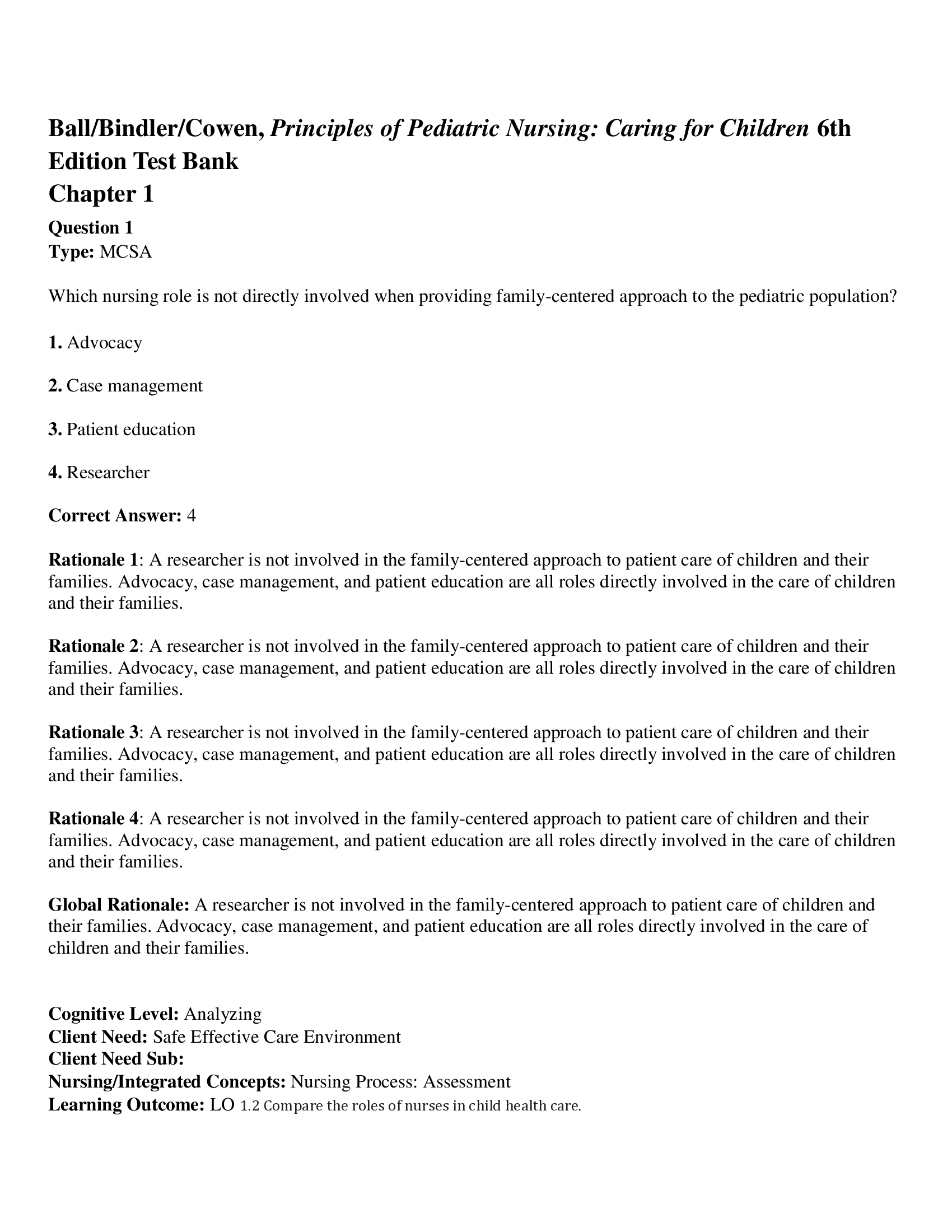
Ball/Bindler/Cowen, Principles of Pediatric Nursing: Caring for Children 6th Edition Test Bank
Chapter 1

Question 1

Type: MCSA

Which nursing role is not directly involved when providing family-centered approach to the pediatric population? 

1. Advocacy

2. Case management

3. Patient education

4. Researcher

Correct Answer: 4

Rationale 1: A researcher is not involved in the family-centered approach to patient care of children and their families. Advocacy, case management, and patient education are all roles directly involved in the care of children and their families.

Rationale 2: A researcher is not involved in the family-centered approach to patient care of children and their families. Advocacy, case management, and patient education are all roles directly involved in the care of children and their families.

Rationale 3: A researcher is not involved in the family-centered approach to patient care of children and their families. Advocacy, case management, and patient education are all roles directly involved in the care of children and their families.

Rationale 4: A researcher is not involved in the family-centered approach to patient care of children and their families. Advocacy, case management, and patient education are all roles directly involved in the care of children and their families.

Global Rationale: A researcher is not involved in the family-centered approach to patient care of children and their families. Advocacy, case management, and patient education are all roles directly involved in the care of children and their families.


Cognitive Level: Analyzing

Client Need: Safe Effective Care Environment

Client Need Sub:

Nursing/Integrated Concepts: Nursing Process: Assessment

Learning Outcome: LO 1.2 Compare the roles of nurses in child health care.


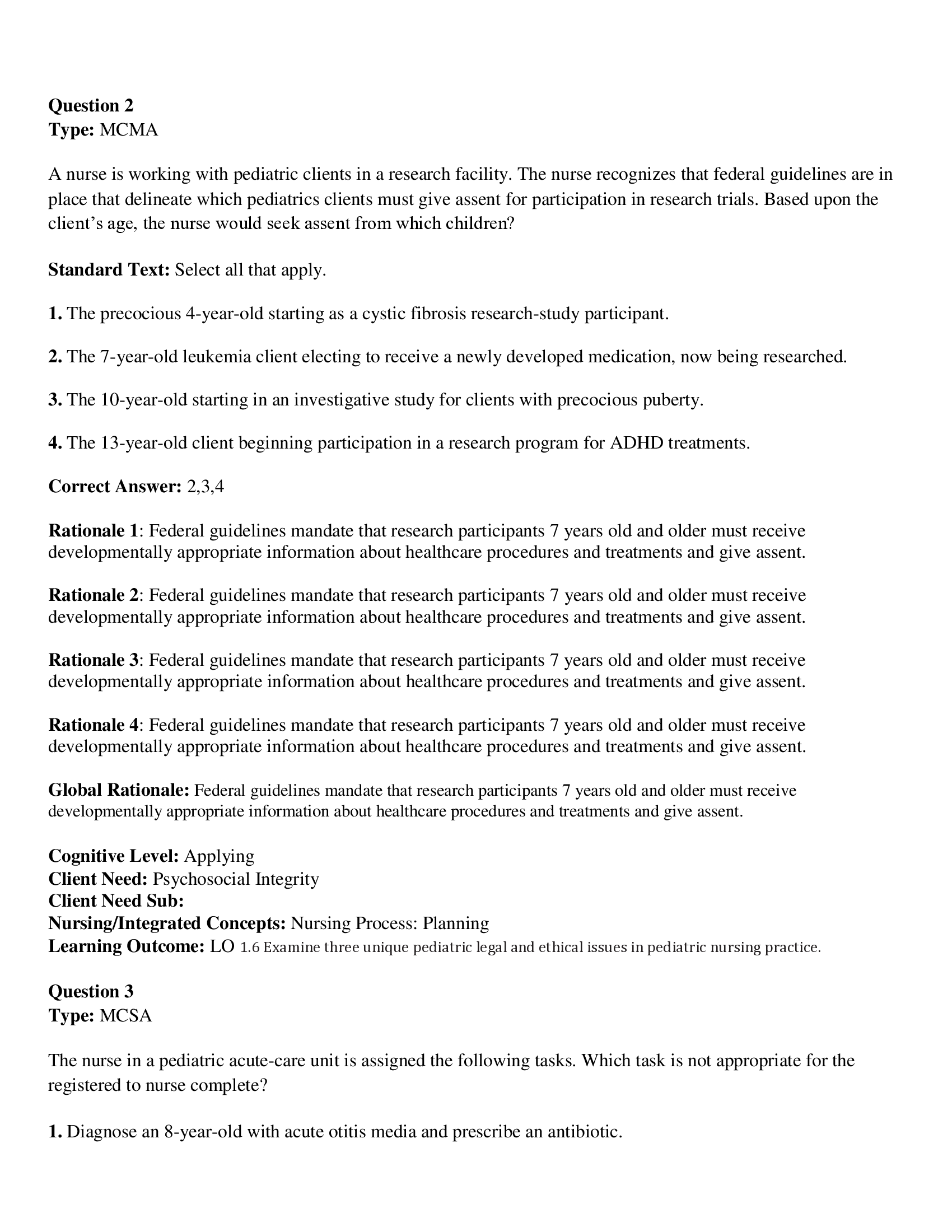
Question 2

Type: MCMA

A nurse is working with pediatric clients in a research facility. The nurse recognizes that federal guidelines are in place that delineate which pediatrics clients must give assent for participation in research trials. Based upon the client’s age, the nurse would seek assent from which children?

Standard Text: Select all that apply.

1. The precocious 4-year-old starting as a cystic fibrosis research-study participant.

2. The 7-year-old leukemia client electing to receive a newly developed medication, now being researched.

3. The 10-year-old starting in an investigative study for clients with precocious puberty.

4. The 13-year-old client beginning participation in a research program for ADHD treatments.

Correct Answer: 2,3,4

Rationale 1: Federal guidelines mandate that research participants 7 years old and older must receive developmentally appropriate information about healthcare procedures and treatments and give assent.

Rationale 2: Federal guidelines mandate that research participants 7 years old and older must receive developmentally appropriate information about healthcare procedures and treatments and give assent.

Rationale 3: Federal guidelines mandate that research participants 7 years old and older must receive developmentally appropriate information about healthcare procedures and treatments and give assent.

Rationale 4: Federal guidelines mandate that research participants 7 years old and older must receive developmentally appropriate information about healthcare procedures and treatments and give assent.

Global Rationale: Federal guidelines mandate that research participants 7 years old and older must receive developmentally appropriate information about healthcare procedures and treatments and give assent.


Cognitive Level: Applying

Client Need: Psychosocial Integrity

Client Need Sub:

Nursing/Integrated Concepts: Nursing Process: Planning

Learning Outcome: LO 1.6 Examine three unique pediatric legal and ethical issues in pediatric nursing practice.


3. To advocate for the child by encouraging the family to investigate its SCHIP eligibility

4. To educate the family about the need for keeping regular well-child–visit appointments

Correct Answer: 3

Rationale 1: In the role of an advocate, a nurse will advance the interests of another; by suggesting the family investigate its SCHIP eligibility, the nurse is directing their action toward the child’s best interest. Financial assessment is more commonly the function of a social worker. The case-management activity mentioned will not provide a source of funding nor will the educational effort described.

Rationale 2: In the role of an advocate, a nurse will advance the interests of another; by suggesting the family investigate its CHIP eligibility, the nurse is directing their action toward the child’s best interest. Financial assessment is more commonly the function of a social worker. The case-management activity mentioned will not provide a source of funding nor will the educational effort described.

Rationale 3: In the role of an advocate, a nurse will advance the interests of another; by suggesting the family investigate its CHIP eligibility, the nurse is directing his action toward the child’s best interest. Financial assessment is more commonly the function of a social worker. The case-management activity mentioned will not provide a source of funding nor will the educational effort described.

Rationale 4: In the role of an advocate, a nurse will advance the interests of another; by suggesting the family investigate its CHIP eligibility, the nurse is directing their action toward the child’s best interest. Financial assessment is more commonly the function of a social worker. The case-management activity mentioned will not provide a source of funding nor will the educational effort described.

Global Rationale: In the role of an advocate, a nurse will advance the interests of another; by suggesting the family investigate its CHIP eligibility, the nurse is directing their action toward the child’s best interest. Financial assessment is more commonly the function of a social worker. The case-management activity mentioned will not provide a source of funding nor will the educational effort described.


Cognitive Level: Analyzing

Client Need: Health Promotion and Maintenance

Client Need Sub:

Nursing/Integrated Concepts: Nursing Process: Planning

Learning Outcome: LO 1.2 Compare the roles of nurses in child health care.


Question 8

Type: MCSA

A supervisor is reviewing the documentation of the nurses in the unit. Which client documentation is the most accurate and contains all the required part for a narrative entry?

1. “2/2/05 1630 Catheterized using an 8 French catheter, 45 mL clear yellow urine obtained, specimen sent to lab, squirmed and cried softly during insertion of catheter. Quiet in mother’s arms following catheter removal. M. May RN”

2. “1/9/05 2 pm NG tube placement confirmed and irrigated with 30 ml sterile water. Suction set at low, intermittent. Oxygen via nasal canal at 2 L/min. Nares patent, pink, and nonirritated. K. Earnst RN”

3. “4:00 Trach dressing removed with dime-size stain of dry serous exudate. Site cleansed with normal saline. Dried with sterile gauze. New sterile trach sponge and trach ties applied. Respirations regular and even throughout the procedure. F. Luck RN”

4. “Feb. ’05 Port-A-Cath assessed with Huber needle. Blood return present. Flushed with NaCl sol., IV gamma globins hung and infusing at 30cc/hr. Child smiling and playful throughout the procedure. P. Potter, RN”

Correct Answer: 1

Rationale 1: The client record should include the date and time of entry, nursing care provided, assessments, an objective report of the client’s physiologic response, exact quotes, and the nurse’s signature and title.

Rationale 2: The client record should include the date and time of entry, nursing care provided, assessments, an objective report of the client’s physiologic response, exact quotes, and the nurse’s signature and title.

Rationale 3: The client record should include the date and time of entry, nursing care provided, assessments, an objective report of the client’s physiologic response, exact quotes, and the nurse’s signature and title.

Rationale 4: The client record should include the date and time of entry, nursing care provided, assessments, an objective report of the client’s physiologic response, exact quotes, and the nurse’s signature and title.

Global Rationale: The client record should include the date and time of entry, nursing care provided, assessments, an objective report of the client’s physiologic response, exact quotes, and the nurse’s signature and title.


Cognitive Level: Applying

Client Need: Safe Effective Care Environment

Client Need Sub:

Nursing/Integrated Concepts: Nursing Process: Assessment

Learning Outcome: LO 1.2 Compare the roles of nurses in child health care.


Question 9

Type: MCSA

A 12-year-old pediatric client is in need of surgery. Which member of the health care team is legally responsible for obtaining informed consent for an invasive procedure?

1. Nurse

2. Physician

3. Unit secretary

4. Social worker

Correct Answer: 2

Rationale 1: Informed consent is legal preauthorization for an invasive procedure. It is the physician’s legal responsibility to obtain this, because it consists of an explanation about the medical condition, a detailed description of treatment plans, the expected benefits and risks related to the proposed treatment plan, alternative treatment options, the client’s questions, and the guardian’s right to refuse treatment.

Rationale 2: Informed consent is legal preauthorization for an invasive procedure. It is the physician’s legal responsibility to obtain this, because it consists of an explanation about the medical condition, a detailed description of treatment plans, the expected benefits and risks related to the proposed treatment plan, alternative treatment options, the client’s questions, and the guardian’s right to refuse treatment.

Rationale 3: Informed consent is legal preauthorization for an invasive procedure. It is the physician’s legal responsibility to obtain this, because it consists of an explanation about the medical condition, a detailed description of treatment plans, the expected benefits and risks related to the proposed treatment plan, alternative treatment options, the client’s questions, and the guardian’s right to refuse treatment.

Rationale 4: Informed consent is legal preauthorization for an invasive procedure. It is the physician’s legal responsibility to obtain this, because it consists of an explanation about the medical condition, a detailed description of treatment plans, the expected benefits and risks related to the proposed treatment plan, alternative treatment options, the client’s questions, and the guardian’s right to refuse treatment.

Global Rationale: Informed consent is legal preauthorization for an invasive procedure. It is the physician’s legal responsibility to obtain this, because it consists of an explanation about the medical condition, a detailed description of treatment plans, the expected benefits and risks related to the proposed treatment plan, alternative treatment options, the client’s questions, and the guardian’s right to refuse treatment.


Cognitive Level: Applying

Client Need: Safe Effective Care Environment

Client Need Sub:

Nursing/Integrated Concepts: Nursing Process: Planning

Learning Outcome: 1.5 Contrast the policies for obtaining informed consent of minors to policies for adults.


Question 10

Type: MCSA

A child is being prepared for an invasive procedure. The mother of the child has legal custody but is not present. After details of the procedure are explained, who can provide legal consent on behalf of a minor child for treatment?

1. The divorced parent without custody

2. A cohabitating unmarried boyfriend of the child’s mother

3. A grandparent who lives in the home with the child

4. A babysitter with written proxy consent

Correct Answer: 4

Rationale 1: A parent may grant proxy consent in writing to another adult so that children are not denied necessary health care. In the case of divorced parents, the parent with custody may be the only parent allowed by some states to give informed consent. Residence in the same household with a child does not authorize an adult to sign consent for treatment.

Rationale 2: A parent may grant proxy consent in writing to another adult so that children are not denied necessary health care. In the case of divorced parents, the parent with custody may be the only parent allowed by some states to give informed consent. Residence in the same household with a child does not authorize an adult to sign consent for treatment.

Rationale 3: A parent may grant proxy consent in writing to another adult so that children are not denied necessary health care. In the case of divorced parents, the parent with custody may be the only parent allowed by some states to give informed consent. Residence in the same household with a child does not authorize an adult to sign consent for treatment.

Rationale 4: A parent may grant proxy consent in writing to another adult so that children are not denied necessary health care. In the case of divorced parents, the parent with custody may be the only parent allowed by some states to give informed consent. Residence in the same household with a child does not authorize an adult to sign consent for treatment.

Global Rationale: A parent may grant proxy consent in writing to another adult so that children are not denied necessary health care. In the case of divorced parents, the parent with custody may be the only parent allowed by some states to give informed consent. Residence in the same household with a child does not authorize an adult to sign consent for treatment.


Cognitive Level: Applying

Client Need: Safe Effective Care Environment

Client Need Sub:

Nursing/Integrated Concepts: Nursing Process: Planning

Learning Outcome: LO 1.5 Contrast the policies for obtaining informed consent of minors to policies for adults.


Question 11

Type: MCSA

A 12-year-old child is admitted to the unit for a surgical procedure. The child is accompanied by two parents and a younger sibling. What is the level of involvement in treatment decision making for this child?

1. That of an emancipated minor.

2. That of a mature minor.

3. That of assent.

4. None.

Correct Answer: 3

Rationale 1: Assent requires the ability to generally understand what procedure and treatments are planned, to understand what participation is required, and to make a statement of agreement or disagreement with the plan. Usually, in Piaget’s stage of formal operations, 11- to 13-year-olds should be able to problem solve using abstract concepts and are able to give valid assent when parents sign the informed consent. An emancipated minor is a self-supporting adolescent who is not subject to the control of a parent or guardian. A mature minor is a 14- or 15-year-old whom the state law designates as being able to understand medical risks and who is thus permitted to give informed consent for treatment.

Rationale 2: Assent requires the ability to generally understand what procedure and treatments are planned, to understand what participation is required, and to make a statement of agreement or disagreement with the plan. Usually, in Piaget’s stage of formal operations, 11- to 13-year-olds should be able to problem solve using abstract concepts and are able to give valid assent when parents sign the informed consent. An emancipated minor is a self-supporting adolescent who is not subject to the control of a parent or guardian. A mature minor is a 14- or 15-year-old whom the state law designates as being able to understand medical risks and who is thus permitted to give informed consent for treatment.

Rationale 3: Assent requires the ability to generally understand what procedure and treatments are planned, to understand what participation is required, and to make a statement of agreement or disagreement with the plan. Usually, in Piaget’s stage of formal operations, 11- to 13-year-olds should be able to problem solve using abstract concepts and are able to give valid assent when parents sign the informed consent. An emancipated minor is a self-supporting adolescent who is not subject to the control of a parent or guardian. A mature minor is a 14- or 15-year-old whom the state law designates as being able to understand medical risks and who is thus permitted to give informed consent for treatment.

Rationale 4: Assent requires the ability to generally understand what procedure and treatments are planned, to understand what participation is required, and to make a statement of agreement or disagreement with the plan. Usually, in Piaget’s stage of formal operations, 11- to 13-year-olds should be able to problem solve using abstract concepts and are able to give valid assent when parents sign the informed consent. An emancipated minor is a self-supporting adolescent who is not subject to the control of a parent or guardian. A mature minor is a 14- or 15-year-old whom the state law designates as being able to understand medical risks and who is thus permitted to give informed consent for treatment.

Global Rationale: Assent requires the ability to generally understand what procedure and treatments are planned, to understand what participation is required, and to make a statement of agreement or disagreement with the plan. Usually, in Piaget’s stage of formal operations, 11- to 13-year-olds should be able to problem solve using abstract concepts and are able to give valid assent when parents sign the informed consent. An emancipated minor is a self-supporting adolescent who is not subject to the control of a parent or guardian. A mature minor is a 14- or 15-year-old whom the state law designates as being able to understand medical risks and who is thus permitted to give informed consent for treatment.


Cognitive Level: Applying

Client Need: Safe Effective Care Environment

Client Need Sub:

Nursing/Integrated Concepts: Nursing Process: Planning

Learning Outcome: LO 1.5 Contrast the policies for obtaining informed consent of minors to policies for adults.


Question 12

Type: MCSA

Which nursing intervention is most appropriate when providing education to the pediatric client and family?

1. Giving primary care for high-risk children who are in hospital settings

2. Giving primary care for healthy children

3. Working toward the goal of informed choices with the family

4. Obtaining a physician consultation for any technical procedures at delivery

Correct Answer: 3

Rationale 1: The educator works with the family toward the goal of making informed choices through education and explanation.

Rationale 2: The educator works with the family toward the goal of making informed choices through education and explanation.

Rationale 3: The educator works with the family toward the goal of making informed choices through education and explanation.

Rationale 4: The educator works with the family toward the goal of making informed choices through education and explanation.

Global Rationale: The educator works with the family toward the goal of making informed choices through education and explanation.


Cognitive Level: Applying

Client Need: Safe Effective Care Environment

Client Need Sub:

Nursing/Integrated Concepts: Nursing Process: Planning

Learning Outcome: 1.2 Compare the roles of nurses in child health care.


Question 13

Type: MCSA

What is the pediatric nurse’s best defense against an accusation of malpractice or negligence?

1. Following the physician’s written orders

2. Meeting the scope and standards of practice for pediatric nursing

3. Being a nurse practitioner or clinical nurse specialist

4. Acting on the advice of the nurse manager

Correct Answer: 2

Rationale 1: Meeting the scope and standards of practice for pediatric nursing would cover the pediatric nurse against an accusation of malpractice or negligence because the standards are rigorous and cover all bases of excellent nursing practice. Following the physician’s written orders or acting on the advice of the nurse manager are not enough to defend the nurse from accusations because the orders and/or advice may be wrong or unethical. Being a clinical nurse specialist or nurse practitioner does not defend the nurse against these accusations if he or she does not follow the Society of Pediatric Nurses standards of practice.

Rationale 2: Meeting the scope and standards of practice for pediatric nursing would cover the pediatric nurse against an accusation of malpractice or negligence because the standards are rigorous and cover all bases of excellent nursing practice. Following the physician’s written orders or acting on the advice of the nurse manager are not enough to defend the nurse from accusations because the orders and/or advice may be wrong or unethical. Being a clinical nurse specialist or nurse practitioner does not defend the nurse against these accusations if he or she does not follow the Society of Pediatric Nurses standards of practice.

Rationale 3: Meeting the scope and standards of practice for pediatric nursing would cover the pediatric nurse against an accusation of malpractice or negligence because the standards are rigorous and cover all bases of excellent nursing practice. Following the physician’s written orders or acting on the advice of the nurse manager are not enough to defend the nurse from accusations because the orders and/or advice may be wrong or unethical. Being a clinical nurse specialist or nurse practitioner does not defend the nurse against these accusations if he or she does not follow the Society of Pediatric Nurses standards of practice.

Rationale 4: Meeting the scope and standards of practice for pediatric nursing would cover the pediatric nurse against an accusation of malpractice or negligence because the standards are rigorous and cover all bases of excellent nursing practice. Following the physician’s written orders or acting on the advice of the nurse manager are not enough to defend the nurse from accusations because the orders and/or advice may be wrong or unethical. Being a clinical nurse specialist or nurse practitioner does not defend the nurse against these accusations if he or she does not follow the Society of Pediatric Nurses standards of practice.

Global Rationale: Meeting the scope and standards of practice for pediatric nursing would cover the pediatric nurse against an accusation of malpractice or negligence because the standards are rigorous and cover all bases of excellent nursing practice. Following the physician’s written orders or acting on the advice of the nurse manager are not enough to defend the nurse from accusations because the orders and/or advice may be wrong or unethical. Being a clinical nurse specialist or nurse practitioner does not defend the nurse against these accusations if he or she does not follow the Society of Pediatric Nurses standards of practice.


Cognitive Level: Applying

Client Need: Safe Effective Care Environment

Client Need Sub:

Nursing/Integrated Concepts: Nursing Process: Planning

Learning Outcome: LO 1.6 Examine three unique pediatric legal and ethical issues in pediatric nursing practice.


Question 14

Type: MCSA

Which legal or ethical offense would be committed if a nurse tells family members the condition of a newborn baby without first consulting the parents?

1. A breach of privacy

2. Negligence

3. Malpractice

4. A breach of ethics

Correct Answer: 1

Rationale 1: A breach of privacy would have been committed in this situation, because it violates the right to privacy of this family. The right to privacy is the right of a person to keep his or her person and property free from public scrutiny, including other family members. Negligence and malpractice are punishable legal offenses and are more serious. A breach of ethics would not apply to this situation.

Rationale 2: A breach of privacy would have been committed in this situation, because it violates the right to privacy of this family. The right to privacy is the right of a person to keep his or her person and property free from public scrutiny, including other family members. Negligence and malpractice are punishable legal offenses and are more serious. A breach of ethics would not apply to this situation.

Rationale 3: A breach of privacy would have been committed in this situation, because it violates the right to privacy of this family. The right to privacy is the right of a person to keep his or her person and property free from public scrutiny, including other family members. Negligence and malpractice are punishable legal offenses and are more serious. A breach of ethics would not apply to this situation.

Rationale 4: A breach of privacy would have been committed in this situation, because it violates the right to privacy of this family. The right to privacy is the right of a person to keep his or her person and property free from public scrutiny, including other family members. Negligence and malpractice are punishable legal offenses and are more serious. A breach of ethics would not apply to this situation.

Global Rationale: A breach of privacy would have been committed in this situation, because it violates the right to privacy of this family. The right to privacy is the right of a person to keep his or her person and property free from public scrutiny, including other family members. Negligence and malpractice are punishable legal offenses and are more serious. A breach of ethics would not apply to this situation.


Cognitive Level: Applying

Client Need: Safe Effective Care Environment

Client Need Sub:

Nursing/Integrated Concepts: Nursing Process: Implementation

Learning Outcome: LO 1.6 Examine three unique pediatric legal and ethical issues in pediatric nursing practice.


Question 15

Type: MCSA

Pediatric nurses have foundational knowledge obtained in nursing school and add specific competencies related to the pediatric client. Which would be considered an additional specific expected competency of the pediatric nurse?

1. Physical assessment

2. Anatomical and developmental differences

3. Nursing process

4. Management of healthcare conditions

Correct Answer: 2

Rationale 1: Assessing anatomical and developmental differences would be a specific expected competency for the pediatric nurse that would not be learned in nursing school. Physical assessment, nursing process, and management of health conditions are all foundational knowledge learned in nursing school.

Rationale 2: Assessing anatomical and developmental differences would be a specific expected competency for the pediatric nurse that would not be learned in nursing school. Physical assessment, nursing process, and management of health conditions are all foundational knowledge learned in nursing school.

Rationale 3: Assessing anatomical and developmental differences would be a specific expected competency for the pediatric nurse that would not be learned in nursing school. Physical assessment, nursing process, and management of health conditions are all foundational knowledge learned in nursing school.

Rationale 4: Assessing anatomical and developmental differences would be a specific expected competency for the pediatric nurse that would not be learned in nursing school. Physical assessment, nursing process, and management of health conditions are all foundational knowledge learned in nursing school.

Global Rationale: Assessing anatomical and developmental differences would be a specific expected competency for the pediatric nurse that would not be learned in nursing school. Physical assessment, nursing process, and management of health conditions are all foundational knowledge learned in nursing school.


Cognitive Level: Analyzing

Client Need: Safe Effective Care Environment

Client Need Sub:

Nursing/Integrated Concepts: Nursing Process: Assessment

Learning Outcome: LO 1.2 Compare the roles of nurses in child health care.


Contact the Seller

Please Sign In to contact this seller.


  • 👎  Report Copyright Violation

Frequently Asked Questions

What Do I Get When I Buy This Study Material?

+

When you buy a study material on Passing Grades, an instant download link will be sent directly to your email, giving you access to the file anytime after payment is completed.

Is Passing Grades a Trusted Platform?

+

Yes, Passing Grades is a reputable students’ marketplace with a secure payment system and reliable customer support. You can trust us to ensure a safe and seamless transaction experience.

Will I Be Stuck with a Subscription?

+

No, all purchases on Passing Grades are one-time transactions. You only pay for the notes you choose to buy, with no subscriptions or hidden fees attached.

Who Am I Buying These Study Materials From?

+

Passing Grades is a marketplace, which means you are purchasing the document from an individual vendor, not directly from us. We facilitate the payment and delivery process between you and the vendor.

Does Passing Grades Offer Free Study Materials?

+

Yes, sellers on Passing Grades have uploaded numerous free test banks, exams, practice questions, and class notes that can be downloaded at no cost.

Pasinggrades - Quality Study Materials

USD 15

    • Quality checked by Pasing Grades
    • 100% satisfaction guarantee
    • Seller: mentor2000
Buy PDF $15

Seller Information

mentor2000

Member since April 2021

  • icon
  • icon
View Profile
  • total sales

    0
  • Favourites

    0
  • Comments

    0
    ( 0 Ratings )

Item Information

  • Uploaded

    22 May 2022

  • Updated

    19 May 2025

  • Category

    Nursing

  • Item Type

    test bank

  • Tags

    test bank nursing Principles of Pediatric Nursing

Related Exam Prep Guides by mentor2000

Test Bank for Essentials for Nursing Practice 8th Edition by Potter | All Chapters
View Document

Test Bank for Essent...

  • mentor2000

    mentor2000

  • test bank

Master nursing concepts with this study material; Test Bank for Essentials for Nursing Practice, 8th...

15 USD

0

0

A &P 1 MA278 BSC2 Final Module II Questions & Answers 2026 Update
View Document

A &P 1 MA278 BSC2 Fi...

  • mentor2000

    mentor2000

  • test bank

Prepare for success with A&P 1 MA278 BSC2 Final Module II 2024 Q&A. Boost your grades with this comp...

15 USD

0

0

ATI Comprehensive Predictor Exam 2026
View Document

ATI Comprehensive Pr...

  • mentor2000

    mentor2000

  • test bank

Prepare for success with the ATI Comprehensive Predictor Exam 2026. Access key practice questions to...

15 USD

0

0

Purchase

Download link will be sent to this email immediately after purchase.

IMPORTANT LINKS

  • How To Upload Class Notes
  • Selling Tips
  • Passing Grades's Study Materials
  • Scholarships for International Students 2025

POPULAR CATEGORIES

  • Law
  • Accounting
  • English
  • Psychology
  • Business
  • Nursing
  • Computer Science
  • General

View Document

  • Blog
  • Contact
  • Delivery Policy
  • Latest Scholarships Around the World
  • How to Pass Bar Exams: Passing Grades’ Strategies
  • How to Study and Pass the CPA Exam
  • All Test Banks
  • Faq
  • Copyright Claims
  • Privacy Policy
  • Terms of Use

KNOWLEDGE BASE

  • How to Write A+ Grade Good Research Paper
  • How to Manage Stress During Exam Period
  • Best Time to Study
  • How to Pass NCLEX-RN Exam
  • How To Effectively Utilize Test Banks
  • Popular Shadow Health Exam Assessments
  • Popular HESI Case Studies
  • How to Prepare for a Nursing Career
  • The Importance Of Summaries in Exam Revisvion

© 2026 Pasing Grades. All rights reserved.