Pasing Grades
  • Start Selling
  • Blog
  • Contact
  • 0

    Your cart is empty!

English

  • English
  • Spanish
  • Arabic
Create Account Sign In
  • Library
    • New Prep Guides
    • Featured Prep Guides
    • Free Exam Prep Guides
    • Best sellers
  • General
  • Nursing
    • Research Paper
    • Case Study
    • Discussion Post
    • Assignment
    • Exam
    • Practice Questions and Answers
    • Test Bank
    • solutions manual
  • Accounting
    • Case Study
    • Thesis
    • Study Guide
    • Summary
    • Research Paper
    • test bank
  • English
    • Creative Writing
    • Research Paper
    • Summary
    • Rhetorics
    • Literature
    • Journal
    • Exam
    • Grammar
    • Discussion Post
    • Essay
  • Psychology
    • Hesi
    • Presentation
    • Essay
    • Summary
    • Study Guide
    • Essay
    • Solution Manual
    • Final Exam Review
    • Class Notes
    • test bank
  • Business
    • Lecture Notes
    • Solution Manual
    • Presentation
    • Business Plan
    • Class Notes
    • Experiment
    • Summary
    • Practice Questions
    • Study Guide
    • Case Study
    • test bank
    • Exam
  • More
    • Computer Science
    • Economics
    • Statistics
    • Engineering
    • Biology
    • Religious Studies
    • Physics
    • Chemistry
    • Mathematics
    • History
    • Sociology
    • Science
    • Philosophy
    • Law
  • Pages
    • About Us
    • Selling Tips
    • Delivery Policy
    • Faq
    • Privacy Policy
  • Flash Sale
  • Home
  • Test Bank for Medical Terminology and Anatomy for Coding 4th Edition by Shiland

Test Bank for Medical Terminology and Anatomy for Coding 4th Edition by Shiland

Preview page 1 Preview page 2 Preview page 3
Add To Favorites

Share this item Share this item

  • Item Details
  • Comments (0)
  • Reviews (0)
  • Contact Seller

Test Bank for Medical Terminology and Anatomy for Coding 4th Edition by Shiland

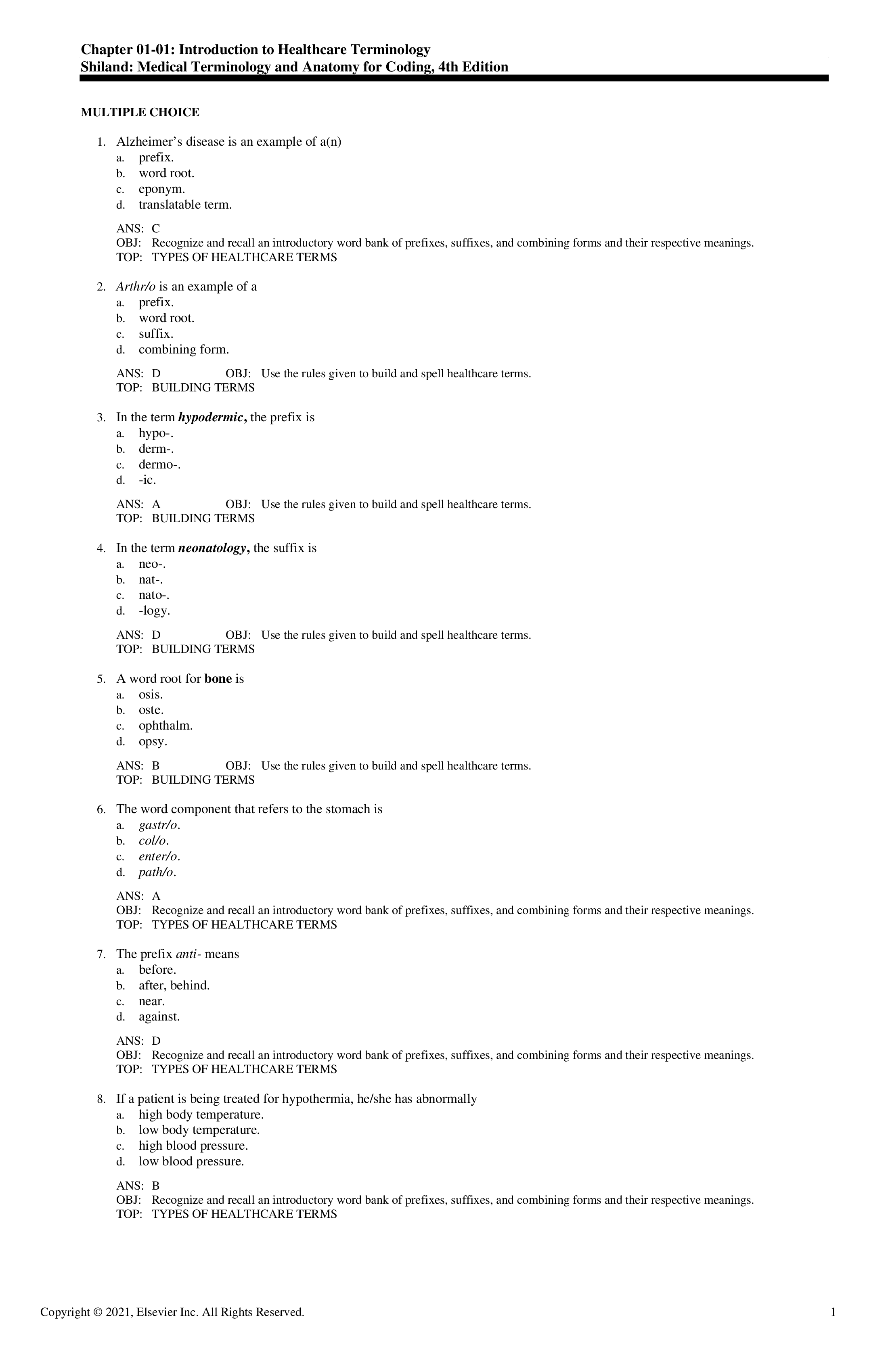
Chapter 01: Introduction to Healthcare Terminology Test Bank

Shiland: Medical Terminology and Anatomy for Coding, 4th Edition

MULTIPLE CHOICE

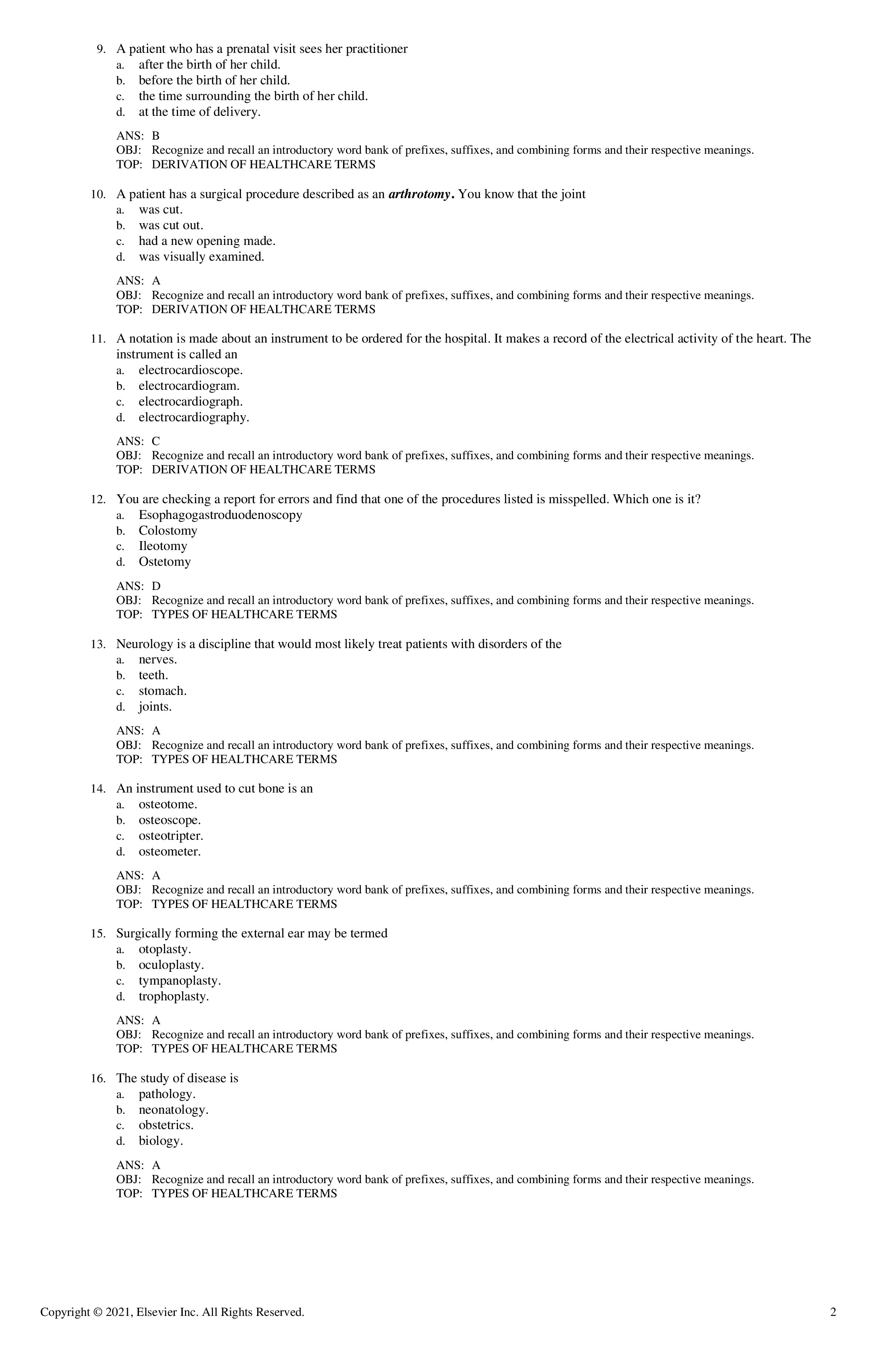
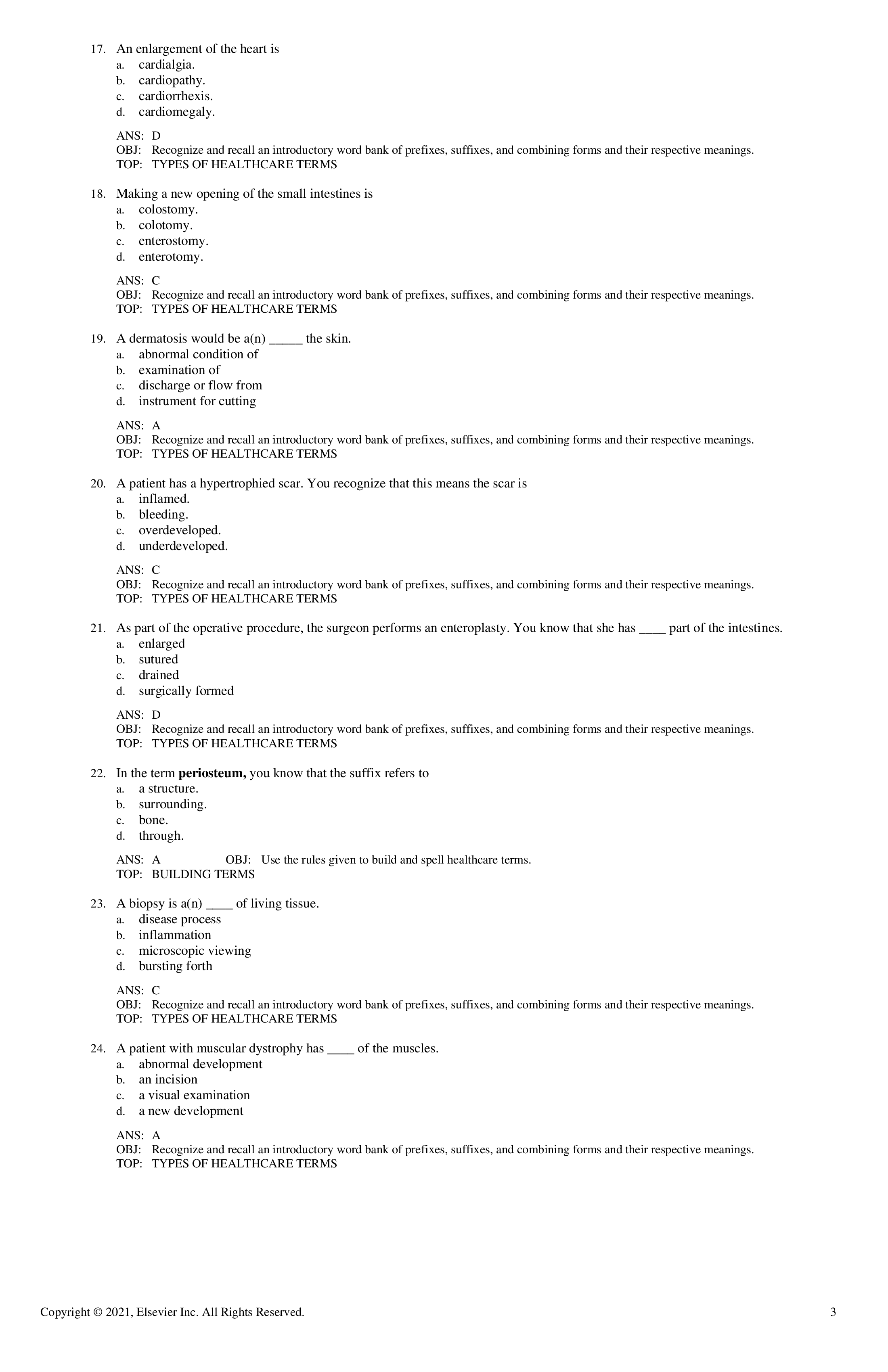
1.         Alzheimer’s disease is an example of a(n)a.        prefix.b.        word root.c.        eponym.d.        translatable term.ANS: COBJ: Recognize and recall an introductory word bank of prefixes, suffixes, and combining forms and their respective meanings.  TOP: TYPES OF HEALTHCARE TERMS2.         Arthr/o is an example of aa.        prefix.b.        word root.c.        suffix.d.        combining form.ANS: D OBJ: Use the rules given to build and spell healthcare terms. TOP: BUILDING TERMS3.         In the term hypodermic, the prefix isa.        hypo-.b.        derm-.c.        dermo-.d.        -ic.ANS: A OBJ: Use the rules given to build and spell healthcare terms. TOP: BUILDING TERMS4.         In the term neonatology, the suffix isa.        neo-.b.        nat-.c.        nato-.d.        -logy.ANS: D OBJ: Use the rules given to build and spell healthcare terms. TOP: BUILDING TERMS5.         A word root for bone isa.        osis.b.        oste.c.        ophthalm.d.        opsy.ANS: B OBJ: Use the rules given to build and spell healthcare terms. TOP: BUILDING TERMS6.         The word component that refers to the stomach isa.        gastr/o.b.        col/o.c.        enter/o.d.        path/o.ANS: AOBJ: Recognize and recall an introductory word bank of prefixes, suffixes, and combining forms and their respective meanings.  TOP: TYPES OF HEALTHCARE TERMS7.         The prefix anti- meansa.        before.b.        after, behind.c.        near.d.        against.ANS: DOBJ: Recognize and recall an introductory word bank of prefixes, suffixes, and combining forms and their respective meanings.  TOP: TYPES OF HEALTHCARE TERMS8.         If a patient is being treated for hypothermia, he/she has abnormallya.        high body temperature.b.        low body temperature.c.        high blood pressure.d.        low blood pressure.ANS: BOBJ: Recognize and recall an introductory word bank of prefixes, suffixes, and combining forms and their respective meanings.  TOP: TYPES OF HEALTHCARE TERMS9.         A patient who has a prenatal visit sees her practitionera.        after the birth of her child.b.        before the birth of her child.c.        the time surrounding the birth of her child.d.        at the time of delivery.ANS: BOBJ: Recognize and recall an introductory word bank of prefixes, suffixes, and combining forms and their respective meanings.  TOP: DERIVATION OF HEALTHCARE TERMS10.     A patient has a surgical procedure described as an arthrotomy. You know that the joint a.          was cut.b.        was cut out.c.        had a new opening made.d.        was visually examined.ANS: AOBJ: Recognize and recall an introductory word bank of prefixes, suffixes, and combining forms and their respective meanings.  TOP: DERIVATION OF HEALTHCARE TERMS11.     A notation is made about an instrument to be ordered for the hospital. It makes a record of the electrical activity of the heart. The instrument is called ana.        electrocardioscope.b.        electrocardiogram.c.        electrocardiograph.d.        electrocardiography.ANS: COBJ: Recognize and recall an introductory word bank of prefixes, suffixes, and combining forms and their respective meanings.  TOP: DERIVATION OF HEALTHCARE TERMS12.     You are checking a report for errors and find that one of the procedures listed is misspelled. Which one is it? a.     Esophagogastroduodenoscopyb.        Colostomyc.        Ileotomyd.        OstetomyANS: DOBJ: Recognize and recall an introductory word bank of prefixes, suffixes, and combining forms and their respective meanings.  TOP: TYPES OF HEALTHCARE TERMS13.     Neurology is a discipline that would most likely treat patients with disorders of the a.   nerves.b.        teeth.c.        stomach.d.        joints.ANS: AOBJ: Recognize and recall an introductory word bank of prefixes, suffixes, and combining forms and their respective meanings.  TOP: TYPES OF HEALTHCARE TERMS14.     An instrument used to cut bone is ana.        osteotome.b.        osteoscope.c.        osteotripter.d.        osteometer.ANS: AOBJ: Recognize and recall an introductory word bank of prefixes, suffixes, and combining forms and their respective meanings.  TOP: TYPES OF HEALTHCARE TERMS15.     Surgically forming the external ear may be termeda.        otoplasty.b.        oculoplasty.c.        tympanoplasty.d.        trophoplasty.ANS: AOBJ: Recognize and recall an introductory word bank of prefixes, suffixes, and combining forms and their respective meanings.  TOP: TYPES OF HEALTHCARE TERMS16.     The study of disease isa.        pathology.b.        neonatology.c.        obstetrics.d.        biology.ANS: AOBJ: Recognize and recall an introductory word bank of prefixes, suffixes, and combining forms and their respective meanings.  TOP: TYPES OF HEALTHCARE TERMS17.     An enlargement of the heart isa.        cardialgia.b.        cardiopathy.c.        cardiorrhexis.d.        cardiomegaly.ANS: DOBJ: Recognize and recall an introductory word bank of prefixes, suffixes, and combining forms and their respective meanings.  TOP: TYPES OF HEALTHCARE TERMS18.     Making a new opening of the small intestines isa.        colostomy.b.        colotomy.c.        enterostomy.d.        enterotomy.ANS: COBJ: Recognize and recall an introductory word bank of prefixes, suffixes, and combining forms and their respective meanings.  TOP: TYPES OF HEALTHCARE TERMS19.     A dermatosis would be a(n) _____ the skin.a.        abnormal condition ofb.        examination ofc.        discharge or flow fromd.        instrument for cuttingANS: AOBJ: Recognize and recall an introductory word bank of prefixes, suffixes, and combining forms and their respective meanings.  TOP: TYPES OF HEALTHCARE TERMS20.     A patient has a hypertrophied scar. You recognize that this means the scar isa.        inflamed.b.        bleeding.c.        overdeveloped.d.        underdeveloped.ANS: COBJ: Recognize and recall an introductory word bank of prefixes, suffixes, and combining forms and their respective meanings.  TOP: TYPES OF HEALTHCARE TERMS21.     As part of the operative procedure, the surgeon performs an enteroplasty. You know that she has ____ part of the intestines. a.  enlargedb.        suturedc.        drainedd.        surgically formedANS: DOBJ: Recognize and recall an introductory word bank of prefixes, suffixes, and combining forms and their respective meanings.  TOP: TYPES OF HEALTHCARE TERMS22.     In the term periosteum, you know that the suffix refers toa.        a structure.b.        surrounding.c.        bone.d.        through.ANS: A OBJ: Use the rules given to build and spell healthcare terms. TOP: BUILDING TERMS23.     A biopsy is a(n) ____ of living tissue.a.        disease processb.        inflammationc.        microscopic viewingd.        bursting forthANS: COBJ: Recognize and recall an introductory word bank of prefixes, suffixes, and combining forms and their respective meanings.  TOP: TYPES OF HEALTHCARE TERMS24.     A patient with muscular dystrophy has ____ of the muscles.a.        abnormal developmentb.        an incisionc.        a visual examinationd.        a new developmentANS: AOBJ: Recognize and recall an introductory word bank of prefixes, suffixes, and combining forms and their respective meanings.  TOP: TYPES OF HEALTHCARE TERMS25.     Patients with food caught in their interdental spaces have pieces of food _____ their teeth. a.       withinb.        betweenc.        underd.        aboveANS: BOBJ: Recognize and recall an introductory word bank of prefixes, suffixes, and combining forms and their respective meanings.  TOP: TYPES OF HEALTHCARE TERMS26.     Examining the term epidermis, you would expect that the word part epi- refers to a structure ____ the dermis. a.            belowb.        aroundc.        withind.        aboveANS: DOBJ: Recognize and recall an introductory word bank of prefixes, suffixes, and combining forms and their respective meanings.  TOP: TYPES OF HEALTHCARE TERMS27.     If you are told that “cutaneo” is a combining form for the skin, then percutaneous would refer to a term that describes something that is ____ the skin.a.        underb.        throughc.        surroundingd.        beforeANS: BOBJ: Recognize and recall an introductory word bank of prefixes, suffixes, and combining forms and their respective meanings.  TOP: TYPES OF HEALTHCARE TERMS28.     The rules for combining a word root and a suffix that starts with a vowel dictate that you shoulda.        add a combining vowel before the suffix.b.        directly connect the word root and suffix.c.        reverse the suffix and word root so the suffix comes first.d.        add another word root to join the suffix and initial word root.ANS: B OBJ: Use the rules given to build and spell healthcare terms. TOP: BUILDING TERMS29.     The rule for the order of joining word roots at the beginning of a term isa.        put them in alphabetic order and add combining vowels, regardless of whether the initial letter is a consonant or a vowel.b.        put them in alphabetic order and add combining vowels only if the initial letter is a vowel.c.        put them in order of the directionality of the body system and add combining vowels between each word root, regardless of whether the initial letter starts with a consonant or a vowel.d.        put them in order of the directionality of the body system and add combining vowels between the word roots only if the initial letter is a consonant.ANS: C OBJ: Use the rules given to build and spell healthcare terms. TOP: BUILDING TERMS30.     Most medical terms are from which two languages?a.        Spanish, Englishb.        English, Latinc.        English, Greekd.        Greek, LatinANS: D OBJ: State the derivation of most healthcare terms. TOP: DERIVATION OF HEALTHCARE TERMS31.     Which is spelled correctly?a.        Gastrotomyb.        Gastroectomyc.        Gastrscopyd.        GastroistisANS: AOBJ: Recognize and recall an introductory word bank of prefixes, suffixes, and combining forms and their respective meanings.  TOP: TYPES OF HEALTHCARE TERMS32.     The plural of vertebra isa.        vertebri.b.        vertebras.c.        vertebrus.d.        vertebrae.               ANS: D                  OBJ: Use the rules given to change singular terms to their plural forms.TOP: SINGULAR/PLURAL RULES33.     The plural of diagnosis isa.        diagnoses.b.        diagnosi.c.        diagnosises.d.        diagnosae.ANS: A OBJ: Use the rules given to change singular terms to their plural forms. TOP: SINGULAR/PLURAL RULES34.     The plural of phalanx isa.        phalangi.b.        phalanxae.c.        phalanges.d.        phalangus.ANS: C OBJ: Use the rules given to change singular terms to their plural forms. TOP: SINGULAR/PLURAL RULES35.     What is the singular of thrombi?a.        Thrombab.        Thrombusc.        Thrombisd.        ThrombaANS: B OBJ: Use the rules given to change singular terms to their plural forms. TOP: SINGULAR/PLURAL RULES36.     What is the singular of septa?a.        Septusb.        Septic.        Septaed.        SeptumANS: D OBJ: Use the rules given to change singular terms to their plural forms. TOP: SINGULAR/PLURAL RULES37.     What is the singular of prognoses?a.        Prognosumb.        Prognosisc.        Prognosad.        PrognoseANS: B OBJ: Use the rules given to change singular terms to their plural forms. TOP: SINGULAR/PLURAL RULES38.     What is the singular of larynges?a.        Larynxb.        Laryngec.        Larynisd.        LarynaANS: A OBJ: Use the rules given to change singular terms to their plural forms. TOP: SINGULAR/PLURAL RULES39.     What is the plural of digitus?a.        Digitesb.        Digitiesc.        Digitusid.        DigitiANS: D OBJ: Use the rules given to change singular terms to their plural forms. TOP: SINGULAR/PLURAL RULES40.     Which is a diagnostic sign?a.        Feverb.        Painc.        Dizzinessd.        ItchingANS: AOBJ: Recognize and recall an introductory word bank of prefixes, suffixes, and combining forms and their respective meanings.  TOP: TYPES OF HEALTHCARE TERMS41.     What type of diagnosis begins abruptly and severely?a.        Signb.        Symptomc.        Acuted.        ChronicANS: COBJ: Recognize and recall an introductory word bank of prefixes, suffixes, and combining forms and their respective meanings.  TOP: TYPES OF HEALTHCARE TERMS42.     A patient is treated for kidney stones with a machine called a lithotripter. Its function is to ____ stones. a.      crushb.        incisec.        viewd.        recordANS: AOBJ: Recognize and recall an introductory word bank of prefixes, suffixes, and combining forms and their respective meanings.  TOP: TYPES OF HEALTHCARE TERMS43.     The study and treatment of the eye isa.        ophthalmology.b.        oncology.c.        otology.d.        odontology.ANS: AOBJ: Recognize and recall an introductory word bank of prefixes, suffixes, and combining forms and their respective meanings.  TOP: TYPES OF HEALTHCARE TERMS44.     Which of the following disorders is an inflammation?a.        Cardiomegalyb.        Enteritisc.        Ophthalmologyd.        GastralgiaANS: BOBJ: Recognize and recall an introductory word bank of prefixes, suffixes, and combining forms and their respective meanings.  TOP: TYPES OF HEALTHCARE TERMS45.     An antibacterial agent _____ bacteria.a.        producesb.        is againstc.        surroundsd.        is withoutANS: BOBJ: Recognize and recall an introductory word bank of prefixes, suffixes, and combining forms and their respective meanings.  TOP: TYPES OF HEALTHCARE TERMS46.     A patient with an enteropathy has a(n) ____ of the intestines.a.        diseaseb.        surgical repairc.        sutured.        enlargementANS: AOBJ: Recognize and recall an introductory word bank of prefixes, suffixes, and combining forms and their respective meanings.  TOP: TYPES OF HEALTHCARE TERMS47.     The o in the term thermometer is aa.        prefix.b.        word root.c.        combining form.d.        combining vowel.ANS: D OBJ: Use the rules given to build and spell healthcare terms. TOP: BUILDING TERMS48.     Which of the following is an acronym?a.        IMb.        C2c.        ngd.        TURPANS: DOBJ: Recognize and recall an introductory word bank of prefixes, suffixes, and combining forms and their respective meanings.  TOP: TYPES OF HEALTHCARE TERMS49.     A patient reports, “I can’t sleep, my throat is sore, my muscles ache, and my fever is 102.4° F.” Which is considered a sign? a.     Sleeplessnessb.        Sore throatc.        Muscle achesd.        102.4° F feverANS: DOBJ: Recognize and recall an introductory word bank of prefixes, suffixes, and combining forms and their respective meanings.  TOP: TYPES OF HEALTHCARE TERMS50.     The patient reports that her breathing difficulties of the last few years have been getting progressively worse. After testing, her disease is diagnosed as one that she will most likely have for the next several years. Her disease is considered to be a.     acute.b.        chronic.c.        therapeutic.d.        CABG.ANS: BOBJ: Recognize and recall an introductory word bank of prefixes, suffixes, and combining forms and their respective meanings.  TOP: TYPES OF HEALTHCARE TERMS51.     Intra- has a similar meaning toa.        infra-.b.        inter-.c.        peri-.d.        endo-.ANS: DOBJ: Recognize and recall an introductory word bank of prefixes, suffixes, and combining forms and their respective meanings.  TOP: TYPES OF HEALTHCARE TERMS52.     The opposite of hyper- isa.        anti-.b.        hypo-.c.        epi-.d.        pre-.ANS: BOBJ: Recognize and recall an introductory word bank of prefixes, suffixes, and combining forms and their respective meanings.  TOP: TYPES OF HEALTHCARE TERMS53.     Which of the following means below or under?a.        Dys-b.        Hypo-c.        Trans-d.        Post-ANS: BOBJ: Recognize and recall an introductory word bank of prefixes, suffixes, and combining forms and their respective meanings.  TOP: TYPES OF HEALTHCARE TERMS54.     The plural of pleura isa.        pleurae.b.        pleuri.c.        pleurus.d.        pleures.ANS: A OBJ: Use the rules given to change singular terms to their plural forms. TOP: SINGULAR/PLURAL RULES55.     Which of the following suffixes indicates a procedure?a.        -megalyb.        -rrheac.        -tripsyd.        -itisANS: COBJ: Recognize and recall an introductory word bank of prefixes, suffixes, and combining forms and their respective meanings.  TOP: TYPES OF HEALTHCARE TERMS56.     The basketball player was back for yet another procedure to view his knee joint. He was there for an a.         arthrotomy.b.        arthroscopy.c.        arthrotome.d.        arthroscope.ANS: BOBJ: Recognize and recall an introductory word bank of prefixes, suffixes, and combining forms and their respective meanings.  TOP: TYPES OF HEALTHCARE TERMS57.     A patient scheduled for a gastrectomy was having part or all of his stomacha.        viewed.b.        cut.c.        cut out.d.        enlarged.ANS: COBJ: Recognize and recall an introductory word bank of prefixes, suffixes, and combining forms and their respective meanings.  TOP: TYPES OF HEALTHCARE TERMS58.     A patient scheduled for a procedure for viewing the interior of a body cavity is having a(n) a.     endoscopy.b.        biopsy.c.        pathology.d.        CABG.ANS: AOBJ: Recognize and recall an introductory word bank of prefixes, suffixes, and combining forms and their respective meanings.  TOP: TYPES OF HEALTHCARE TERMS59.     An esophagogastroduodenoscopy is a procedure for _____ organs.a.        removingb.        viewingc.        joiningd.        incisingANS: BOBJ: Recognize and recall an introductory word bank of prefixes, suffixes, and combining forms and their respective meanings.  TOP: TYPES OF HEALTHCARE TERMS60.     Which of the following is misspelled?a.        Hematologyb.        Opthalmologyc.        Otorhinolaryngologyd.        NeurologyANS: BOBJ: Recognize and recall an introductory word bank of prefixes, suffixes, and combining forms and their respective meanings.  TOP: TYPES OF HEALTHCARE TERMS61.     A patient with arthritis has an inflammation of hisa.        joints.b.        ear.c.        throat.d.        voice box.ANS: AOBJ: Recognize and recall an introductory word bank of prefixes, suffixes, and combining forms and their respective meanings.  TOP: TYPES OF HEALTHCARE TERMS62.     A patient with a heart disorder would most likely be treated by a(n)a.        hematologist.b.        geriatrician.c.        anesthesiologist.d.        cardiologist.ANS: DOBJ: Recognize and recall an introductory word bank of prefixes, suffixes, and combining forms and their respective meanings.  TOP: TYPES OF HEALTHCARE TERMS63.     The singular of bacteria isa.        bacterius.b.        bacterus.c.        bacterium.d.        bacteri.ANS: C OBJ: Use the rules given to change singular terms to their plural forms. TOP: SINGULAR/PLURAL RULES64.     The plural of psychotherapy isa.        pyschotherapies.b.        psychotherapys.c.        psychotherapyes.d.        psychotherapies.ANS: D OBJ: Use the rules given to change singular terms to their plural forms. TOP: SINGULAR/PLURAL RULES65.     A patient whose muscles have atrophied shows _____ muscle development.a.        excessiveb.        abnormalc.        a lack ofd.        painfulANS: COBJ: Recognize and recall an introductory word bank of prefixes, suffixes, and combining forms and their respective meanings.  TOP: TYPES OF HEALTHCARE TERMS66.     An intraaortic balloon pump is placed ____ the aorta.a.        withinb.        outsidec.        surroundingd.        belowANS: AOBJ: Recognize and recall an introductory word bank of prefixes, suffixes, and combining forms and their respective meanings.  TOP: TYPES OF HEALTHCARE TERMS67.     A child has otorrhea. Knowing that -rrhea means a discharge, you know that he has aa.        discharge from his eye.b.        discharge from his nose.c.        discharge from his ear.d.        tumor of his eye.ANS: COBJ: Recognize and recall an introductory word bank of prefixes, suffixes, and combining forms and their respective meanings.  TOP: TYPES OF HEALTHCARE TERMS68.     Epi-, endo-, and pre- are examples ofa.        prefixes.b.        word roots.c.        combining forms.d.        suffixes.ANS: A OBJ: Use the rules given to build and spell healthcare terms. TOP: BUILDING TERMS69.     The study of a newborn baby isa.        obstetrics.b.        neonatology.c.        fetology.d.        gynecology.ANS: BOBJ: Recognize and recall an introductory word bank of prefixes, suffixes, and combining forms and their respective meanings.  TOP: TYPES OF HEALTHCARE TERMS70.     The branch of medicine that deals with treatment of the mind isa.        geriatrics.b.        psychiatry.c.        immunology.d.        anesthesiology.ANS: BOBJ: Recognize and recall an introductory word bank of prefixes, suffixes, and combining forms and their respective meanings.  TOP: TYPES OF HEALTHCARE TERMS


Chapter 01-02: Introduction to Healthcare Terminology

Shiland: Medical Terminology and Anatomy for Coding, 4th Edition

MULTIPLE CHOICE

1.         The term biopsy is an example of a(n)

a.        diagnosis/condition.

b.        procedure.

c.        instrument.

d.        specialist.

e.        discipline.

ANS: B

OBJ: Recognize and recall an introductory word bank of prefixes, suffixes, and combining forms and their respective meanings. 

TOP: TYPES OF HEALTHCARE TERMS

2.         The term gastritis is an example of a(n)

a.        diagnosis/condition.

b.        procedure.

c.        instrument.

d.        specialist.

e.        discipline.

ANS: A

OBJ: Recognize and recall an introductory word bank of prefixes, suffixes, and combining forms and their respective meanings. 

TOP: TYPES OF HEALTHCARE TERMS

3.         The term osteoarthritis is an example of a(n)

a.        diagnosis/condition.

b.        procedure.

c.        instrument.

d.        specialist.

e.        discipline.

ANS: A

OBJ: Recognize and recall an introductory word bank of prefixes, suffixes, and combining forms and their respective meanings. 

TOP: TYPES OF HEALTHCARE TERMS

4.         The term arthroplasty is an example of a(n)

a.        diagnosis/condition.

b.        procedure.

c.        instrument.

d.        specialist.

e.        discipline.

ANS: B

OBJ: Recognize and recall an introductory word bank of prefixes, suffixes, and combining forms and their respective meanings. 

TOP: TYPES OF HEALTHCARE TERMS

5.         The term CABG is an example of a(n)

a.        diagnosis/condition.

b.        procedure.

c.        instrument.

d.        specialist.

e.        discipline.

ANS: B

OBJ: Recognize and recall an introductory word bank of prefixes, suffixes, and combining forms and their respective meanings. 

TOP: TYPES OF HEALTHCARE TERMS

6.         The term hepatitis is an example of a(n)

a.        diagnosis/condition.

b.        procedure.

c.        instrument.

d.        specialist.

e.        discipline.

ANS: A

OBJ: Recognize and recall an introductory word bank of prefixes, suffixes, and combining forms and their respective meanings. 

TOP: TYPES OF HEALTHCARE TERMS

7.         The term gastrectomy is an example of a(n)

a.        diagnosis/condition.

b.        procedure.

c.        instrument.

d.        specialist.

e.        discipline.

ANS: B

OBJ: Recognize and recall an introductory word bank of prefixes, suffixes, and combining forms and their respective meanings. 

TOP: TYPES OF HEALTHCARE TERMS

8.         The term osteotomy is an example of a(n)

a.        diagnosis/condition.

b.        procedure.

c.        instrument.

d.        specialist.

e.        discipline.

ANS: B

OBJ: Recognize and recall an introductory word bank of prefixes, suffixes, and combining forms and their respective meanings. 

TOP: TYPES OF HEALTHCARE TERMS

9.         The term cardiology is an example of a(n)

a.        diagnosis/condition.

b.        procedure.

c.        instrument.

d.        specialist.

e.        discipline.

ANS: E

OBJ: Recognize and recall an introductory word bank of prefixes, suffixes, and combining forms and their respective meanings. 

TOP: TYPES OF HEALTHCARE TERMS

10.     The term appendectomy is an example of a(n)

a.        diagnosis/condition.

b.        procedure.

c.        instrument.

d.        specialist.

e.        discipline.

ANS: B

OBJ: Recognize and recall an introductory word bank of prefixes, suffixes, and combining forms and their respective meanings. 

TOP: TYPES OF HEALTHCARE TERMS

11.     The term arthroscopy is an example of a(n)

a.        diagnosis/condition.

b.        procedure.

c.        instrument.

d.        specialist.

e.        discipline.

ANS: B

OBJ: Recognize and recall an introductory word bank of prefixes, suffixes, and combining forms and their respective meanings. 

TOP: TYPES OF HEALTHCARE TERMS

12.     The term ophthalmalgia is an example of a(n)

a.        diagnosis/condition.

b.        procedure.

c.        instrument.

d.        specialist.

e.        discipline.

ANS: A

OBJ: Recognize and recall an introductory word bank of prefixes, suffixes, and combining forms and their respective meanings. 

TOP: TYPES OF HEALTHCARE TERMS

13.     The term cardiomegaly is an example of a(n)

a.        diagnosis/condition.

b.        procedure.

c.        instrument.

d.        specialist.

e.        discipline.

ANS: A

OBJ: Recognize and recall an introductory word bank of prefixes, suffixes, and combining forms and their respective meanings. 

TOP: TYPES OF HEALTHCARE TERMS

14.     The term hypothermia is an example of a(n)

a.        diagnosis/condition.

b.        procedure.

c.        instrument.

d.        specialist.

e.        discipline.

ANS: A

OBJ: Recognize and recall an introductory word bank of prefixes, suffixes, and combining forms and their respective meanings. 

TOP: TYPES OF HEALTHCARE TERMS

15.     The term endoscope is an example of a(n)

a.        diagnosis/condition.

b.        procedure.

c.        instrument.

d.        specialist.

e.        discipline.

ANS: C

OBJ: Recognize and recall an introductory word bank of prefixes, suffixes, and combining forms and their respective meanings. 

TOP: TYPES OF HEALTHCARE TERMS

16.     The term osteotome is an example of a(n)

a.        diagnosis/condition.

b.        procedure.

c.        instrument.

d.        specialist.

e.        discipline.

ANS: C

OBJ: Recognize and recall an introductory word bank of prefixes, suffixes, and combining forms and their respective meanings. 

TOP: TYPES OF HEALTHCARE TERMS

17.     The term lithotripter is an example of a(n)

a.        diagnosis/condition.

b.        procedure.

c.        instrument.

d.        specialist.

e.        discipline.

ANS: C

OBJ: Recognize and recall an introductory word bank of prefixes, suffixes, and combining forms and their respective meanings. 

TOP: TYPES OF HEALTHCARE TERMS

18.     The term colitis is an example of a(n)

a.        diagnosis/condition.

b.        procedure.

c.        instrument.

d.        specialist.

e.        discipline.

ANS: A

OBJ: Recognize and recall an introductory word bank of prefixes, suffixes, and combining forms and their respective meanings. 

TOP: TYPES OF HEALTHCARE TERMS

19.     The term dermatosis is an example of a(n)

a.        diagnosis/condition.

b.        procedure.

c.        instrument.

d.        specialist.

e.        discipline.

ANS: A

OBJ: Recognize and recall an introductory word bank of prefixes, suffixes, and combining forms and their respective meanings. 

TOP: TYPES OF HEALTHCARE TERMS

20.     The term hysterectomy is an example of a(n)

a.        diagnosis/condition.

b.        procedure.

c.        instrument.

d.        specialist.

e.        discipline.

ANS: B

OBJ: Recognize and recall an introductory word bank of prefixes, suffixes, and combining forms and their respective meanings. 

TOP: TYPES OF HEALTHCARE TERMS

COMPLETION

1.         A suffix that means “inflammation” is ____________________.

ANS: -itis

OBJ: Recognize and recall an introductory word bank of prefixes, suffixes, and combining forms and their respective meanings. 

TOP: TYPES OF HEALTHCARE TERMS

2.         A prefix that means “excessive or above” is ____________________. ANS: hyper-

OBJ: Recognize and recall an introductory word bank of prefixes, suffixes, and combining forms and their respective meanings. 

TOP: TYPES OF HEALTHCARE TERMS

3.         A word root plus a combining vowel is called a(n) ____________________. ANS: combining form

OBJ: Recognize and recall an introductory word bank of prefixes, suffixes, and combining forms and their respective meanings. 

TOP: TYPES OF HEALTHCARE TERMS

4.         The prefix that means “forward, in front of, before” is ____________________. ANS: ante-

OBJ: Recognize and recall an introductory word bank of prefixes, suffixes, and combining forms and their respective meanings. 

TOP: TYPES OF HEALTHCARE TERMS

5.         Neo- is a prefix meaning ____________________. ANS: new

OBJ: Recognize and recall an introductory word bank of prefixes, suffixes, and combining forms and their respective meanings. 

TOP: TYPES OF HEALTHCARE TERMS

6.         The plural of fornix is ____________________. ANS: fornices

OBJ: Use the rules given to change singular terms to their plural forms.

TOP: SINGULAR/PLURAL RULES

7.         The singular of phalanges is ____________________. ANS: phalanx

OBJ: Use the rules given to change singular terms to their plural forms.

TOP: SINGULAR/PLURAL RULES

8.         The singular of bacteria is ____________________. ANS: bacterium

OBJ: Use the rules given to change singular terms to their plural forms.

TOP: SINGULAR/PLURAL RULES

9.         The plural of thrombus is ____________________. ANS: thrombi

OBJ: Use the rules given to change singular terms to their plural forms.

TOP: SINGULAR/PLURAL RULES

10.     The plural of larynx is ____________________. ANS: larynges

OBJ: Use the rules given to change singular terms to their plural forms.

TOP: SINGULAR/PLURAL RULES

11.     The singular of prognoses is ____________________. ANS: prognosis

OBJ: Use the rules given to change singular terms to their plural forms.

TOP: SINGULAR/PLURAL RULES

12.     The singular of myocardia is ____________________. ANS: myocardium

OBJ: Use the rules given to change singular terms to their plural forms.

TOP: SINGULAR/PLURAL RULES

13.     A(n) ____________________ condition is one that develops slowly and lasts for a long time. ANS: chronic

OBJ: Recognize and recall an introductory word bank of prefixes, suffixes, and combining forms and their respective meanings. 

TOP: TYPES OF HEALTHCARE TERMS

14.     The specialist in a branch of medicine that concentrates on the care, diagnosis, and treatment of the newborn is a(n) ____________________. ANS: neonatologist

OBJ: Recognize and recall an introductory word bank of prefixes, suffixes, and combining forms and their respective meanings. 

TOP: TYPES OF HEALTHCARE TERMS

15.     Inflammation of the small intestine is ____________________.

ANS: enteritis

OBJ: Recognize and recall an introductory word bank of prefixes, suffixes, and combining forms and their respective meanings. 

TOP: TYPES OF HEALTHCARE TERMS

16.     Instrument to view the ear is a(n) ____________________. ANS: otoscope

OBJ: Recognize and recall an introductory word bank of prefixes, suffixes, and combining forms and their respective meanings. 

TOP: TYPES OF HEALTHCARE TERMS

17.     Cutting the stomach is termed ____________________. ANS: gastrotomy

OBJ: Recognize and recall an introductory word bank of prefixes, suffixes, and combining forms and their respective meanings. 

TOP: TYPES OF HEALTHCARE TERMS

18.     Instrument for viewing the eyes is a(n) ____________________. ANS: ophthalmoscope

OBJ: Recognize and recall an introductory word bank of prefixes, suffixes, and combining forms and their respective meanings. 

TOP: TYPES OF HEALTHCARE TERMS

19.     Inflammation of the liver is ____________________.

ANS: hepatitis

OBJ: Recognize and recall an introductory word bank of prefixes, suffixes, and combining forms and their respective meanings. 

TOP: TYPES OF HEALTHCARE TERMS

20.     Instrument to measure heat or temperature is a(n) ____________________. ANS: thermometer

OBJ: Recognize and recall an introductory word bank of prefixes, suffixes, and combining forms and their respective meanings. 

TOP: TYPES OF HEALTHCARE TERMS

21.     Surgically forming a joint is called ____________________.

ANS: arthroplasty

OBJ: Recognize and recall an introductory word bank of prefixes, suffixes, and combining forms and their respective meanings. 

TOP: TYPES OF HEALTHCARE TERMS

22.     Study of the nervous system is ____________________. ANS: neurology

OBJ: Recognize and recall an introductory word bank of prefixes, suffixes, and combining forms and their respective meanings. 

TOP: TYPES OF HEALTHCARE TERMS

23.     Making a new opening of the large intestine is called ____________________. ANS: colostomy

OBJ: Recognize and recall an introductory word bank of prefixes, suffixes, and combining forms and their respective meanings. 

TOP: TYPES OF HEALTHCARE TERMS

24.     Which word part comes at the end of some terms? ____________________

ANS: Suffix

            OBJ: Use the rules given to build and spell healthcare terms.      TOP: BUILDING TERMS

25.     Which word part comes before a word root and gives more information about the term described by the word root and suffix? ____________________

ANS: Prefix

            OBJ: Use the rules given to build and spell healthcare terms.      TOP: BUILDING TERMS

26.     Which word part is used to join a word root and a suffix beginning with a consonant? ____________________

ANS: Combining vowel

            OBJ: Use the rules given to build and spell healthcare terms.      TOP: BUILDING TERMS

27.     What is an inflammation of the tongue? ____________________

ANS: Glossitis

OBJ: Recognize and recall an introductory word bank of prefixes, suffixes, and combining forms and their respective meanings. 

TOP: TYPES OF HEALTHCARE TERMS

28.     What is viewing the ear? ____________________ ANS: Otoscopy

OBJ: Recognize and recall an introductory word bank of prefixes, suffixes, and combining forms and their respective meanings. 

TOP: TYPES OF HEALTHCARE TERMS

29.     What is an inflammation of the colon/large intestine? ____________________ ANS: Colitis

OBJ: Recognize and recall an introductory word bank of prefixes, suffixes, and combining forms and their respective meanings. 

TOP: TYPES OF HEALTHCARE TERMS

30.     What term pertains to on top of the stomach? ____________________ ANS: Epigastric

OBJ: Recognize and recall an introductory word bank of prefixes, suffixes, and combining forms and their respective meanings. 

TOP: TYPES OF HEALTHCARE TERMS

31.     What is an instrument to view a joint? ____________________ ANS: Arthroscope

OBJ: Recognize and recall an introductory word bank of prefixes, suffixes, and combining forms and their respective meanings. 

TOP: TYPES OF HEALTHCARE TERMS

32.     What is the process of the study of the skin? ____________________ ANS: Dermatology

OBJ: Recognize and recall an introductory word bank of prefixes, suffixes, and combining forms and their respective meanings. 

TOP: TYPES OF HEALTHCARE TERMS

33.     What is inflammation of the skin? ____________________ ANS: Dermatitis

OBJ: Recognize and recall an introductory word bank of prefixes, suffixes, and combining forms and their respective meanings. 

TOP: TYPES OF HEALTHCARE TERMS

34.     What is enlargement of the heart? ____________________ ANS: Cardiomegaly

OBJ: Recognize and recall an introductory word bank of prefixes, suffixes, and combining forms and their respective meanings. 

TOP: TYPES OF HEALTHCARE TERMS

35.     What is the term for a structure within the heart? ____________________ ANS: Endocardium

OBJ: Recognize and recall an introductory word bank of prefixes, suffixes, and combining forms and their respective meanings. 

TOP: TYPES OF HEALTHCARE TERMS

36.     What is inflammation surrounding a joint? ____________________

ANS: Periarthritis

OBJ: Recognize and recall an introductory word bank of prefixes, suffixes, and combining forms and their respective meanings. 

TOP: TYPES OF HEALTHCARE TERMS

MATCHING

Match each definition with the correct word part below.

a.        Stomach

b.        Joint, articulation

c.        Disease

d.        Through

e.        Bone

f.         Colon, large intestine

g.        Birth, born

h.        No, not, without

i.          Recording

j.          Surgically forming

k.        Against

l.          Within

m.      Uterus

n.        Bad, difficult, painful, abnormal

o.        Deficient, below, under

p.        Heart

  1. Anti 2. Arthr/o

3.      Cardi/o

4.      Col/o

5.      Dys            6. Endo-

  7. A 8. Gastr/o

9.         -graphy

10.     Hyster/o

11.     Hypo-

12.     Nat/o

13.     Oste/o

14.     Path/o

15.     Per 16. -plasty

1.         ANS: K OBJ: Use the rules given to build and spell healthcare terms. TOP: BUILDING TERMS

2.         ANS: B OBJ: Use the rules given to build and spell healthcare terms. TOP: BUILDING TERMS

3.         ANS: P OBJ: Use the rules given to build and spell healthcare terms. TOP: BUILDING TERMS

4.         ANS: F OBJ: Use the rules given to build and spell healthcare terms. TOP: BUILDING TERMS

5.         ANS: N OBJ: Use the rules given to build and spell healthcare terms. TOP: BUILDING TERMS

6.         ANS: L OBJ: Use the rules given to build and spell healthcare terms. TOP: BUILDING TERMS

7.         ANS: H OBJ: Use the rules given to build and spell healthcare terms. TOP: BUILDING TERMS

8.         ANS: A OBJ: Use the rules given to build and spell healthcare terms. TOP: BUILDING TERMS

9.         ANS: I OBJ: Use the rules given to build and spell healthcare terms. TOP: BUILDING TERMS

10.     ANS: M OBJ: Use the rules given to build and spell healthcare terms. TOP: BUILDING TERMS

11.     ANS: O OBJ: Use the rules given to build and spell healthcare terms. TOP: BUILDING TERMS

12.     ANS: G OBJ: Use the rules given to build and spell healthcare terms. TOP: BUILDING TERMS

13.     ANS: E OBJ: Use the rules given to build and spell healthcare terms. TOP: BUILDING TERMS

14.     ANS: C OBJ: Use the rules given to build and spell healthcare terms. TOP: BUILDING TERMS

15.     ANS: D OBJ: Use the rules given to build and spell healthcare terms. TOP: BUILDING TERMS

16.     ANS: J OBJ: Use the rules given to build and spell healthcare terms. TOP: BUILDING TERMS

Match each definition with the correct term below. a. Subjective indication of disease

b.        A condition that results from an injury or disease

c.        Term that can be analyzed and defined

d.        Word component that is the subject of a term

e.        Pronounceable word from the initial letters of a healthcare term

f.         An outward demonstration or perception

g.        A grouping of procedures

h.        The disease or condition named after evaluating the patient’s signs, symptoms, and history

i.          Word component that appears at the end of a term

j.          Term that cannot be divided into component parts

k.        A technique that is performed to diagnose or treat a patient

17.     Acronym

18.     Manifestation

19.     Classification

20.     Translatable term

21.     Diagnosis

22.     Nontranslatable term

23.     Sequela

24.     Symptom

25.     Word root

17.     ANS: E

OBJ: Recognize and recall an introductory word bank of prefixes, suffixes, and combining forms and their respective meanings. 

TOP: TYPES OF HEALTHCARE TERMS

18.     ANS: F

OBJ: Recognize and recall an introductory word bank of prefixes, suffixes, and combining forms and their respective meanings. 

TOP: TYPES OF HEALTHCARE TERMS

19.     ANS: G

OBJ: Recognize and recall an introductory word bank of prefixes, suffixes, and combining forms and their respective meanings. 

TOP: TYPES OF HEALTHCARE TERMS

20.     ANS: C

OBJ: Recognize and recall an introductory word bank of prefixes, suffixes, and combining forms and their respective meanings. 

TOP: TYPES OF HEALTHCARE TERMS

21.     ANS: H

OBJ: Recognize and recall an introductory word bank of prefixes, suffixes, and combining forms and their respective meanings. 

TOP: TYPES OF HEALTHCARE TERMS

22.     ANS: J

OBJ: Recognize and recall an introductory word bank of prefixes, suffixes, and combining forms and their respective meanings. 

TOP: TYPES OF HEALTHCARE TERMS

23.     ANS: B

OBJ: Recognize and recall an introductory word bank of prefixes, suffixes, and combining forms and their respective meanings. 

TOP: TYPES OF HEALTHCARE TERMS

24.     ANS: A

OBJ: Recognize and recall an introductory word bank of prefixes, suffixes, and combining forms and their respective meanings. 

TOP: TYPES OF HEALTHCARE TERMS

25.     ANS: D

OBJ: Recognize and recall an introductory word bank of prefixes, suffixes, and combining forms and their respective meanings. 

TOP: TYPES OF HEALTHCARE TERMS

TRUE/FALSE

1.         Most healthcare terms are derived from Greek and Latin.

               ANS: T                   OBJ: State the derivation of most healthcare terms.

TOP: DERIVATION OF HEALTHCARE TERMS

2.         The word root hyster- means “female.”

ANS: F

OBJ: Recognize and recall an introductory word bank of prefixes, suffixes, and combining forms and their respective meanings. 

TOP: TYPES OF HEALTHCARE TERMS

3.         Eponyms are terms named after the person who first identified the condition or devised the object bearing its name.

ANS: T OBJ: State the derivation of most healthcare terms. TOP: DERIVATION OF HEALTHCARE TERMS

4.         C2 is an example of an acronym.

               ANS: F                    OBJ: State the derivation of most healthcare terms.

TOP: DERIVATION OF HEALTHCARE TERMS

5.         In the term hysterectomy, the suffix means “cutting out.”

ANS: T

OBJ: Recognize and recall an introductory word bank of prefixes, suffixes, and combining forms and their respective meanings. 

TOP: TYPES OF HEALTHCARE TERMS

6.         Asthma is an example of a translatable term.

ANS: F

OBJ: Recognize and recall an introductory word bank of prefixes, suffixes, and combining forms and their respective meanings. 

TOP: TYPES OF HEALTHCARE TERMS

7.         Troph/o is an example of a suffix.

ANS: F OBJ: Use the rules given to build and spell healthcare terms. TOP: BUILDING TERMS

8.         The suffix -opsy means “viewing.”

ANS: T OBJ: Use the rules given to build and spell healthcare terms. TOP: BUILDING TERMS

9.         The symbol for female is 

ANS: T OBJ: Use the rules given to build and spell healthcare terms. TOP: BUILDING TERMS

10.     The plural of vertebra is vertebri.

ANS: F OBJ: Use the rules given to change singular terms to their plural forms. TOP: SINGULAR/PLURAL RULES

11.     The plural of digitus is digiti.

ANS: T OBJ: Use the rules given to change singular terms to their plural forms. TOP: SINGULAR/PLURAL RULES

12.     The plural of diagnosis is diagnosies.

ANS: F OBJ: Use the rules given to change singular terms to their plural forms. TOP: SINGULAR/PLURAL RULES

13.     Pain and itching are examples of symptoms.

ANS: T

OBJ: Recognize and recall an introductory word bank of prefixes, suffixes, and combining forms and their respective meanings. 

TOP: TYPES OF HEALTHCARE TERMS

14.     A fever or rash is an example of a symptom.

ANS: F

OBJ: Recognize and recall an introductory word bank of prefixes, suffixes, and combining forms and their respective meanings. 

TOP: TYPES OF HEALTHCARE TERMS

15.     A prognosis is a prediction of the probable outcome of a disease.

ANS: T

OBJ: Recognize and recall an introductory word bank of prefixes, suffixes, and combining forms and their respective meanings. 

TOP: TYPES OF HEALTHCARE TERMS

16.     An acute diagnosis is one that begins slowly and lasts a long time.

ANS: F

OBJ: Recognize and recall an introductory word bank of prefixes, suffixes, and combining forms and their respective meanings. 

TOP: TYPES OF HEALTHCARE TERMS

17.     A medical term that ends with -tome denotes an instrument to measure.

ANS: F

OBJ: Recognize and recall an introductory word bank of prefixes, suffixes, and combining forms and their respective meanings. 

TOP: TYPES OF HEALTHCARE TERMS

18.     The prefix per- means “around, surrounding.”

ANS: F

OBJ: Recognize and recall an introductory word bank of prefixes, suffixes, and combining forms and their respective meanings. 

TOP: TYPES OF HEALTHCARE TERMS

Contact the Seller

Please Sign In to contact this seller.


  • 👎  Report Copyright Violation

Frequently Asked Questions

What Do I Get When I Buy This Study Material?

+

When you buy a study material on Passing Grades, an instant download link will be sent directly to your email, giving you access to the file anytime after payment is completed.

Is Passing Grades a Trusted Platform?

+

Yes, Passing Grades is a reputable students’ marketplace with a secure payment system and reliable customer support. You can trust us to ensure a safe and seamless transaction experience.

Will I Be Stuck with a Subscription?

+

No, all purchases on Passing Grades are one-time transactions. You only pay for the notes you choose to buy, with no subscriptions or hidden fees attached.

Who Am I Buying These Study Materials From?

+

Passing Grades is a marketplace, which means you are purchasing the document from an individual vendor, not directly from us. We facilitate the payment and delivery process between you and the vendor.

Does Passing Grades Offer Free Study Materials?

+

Yes, sellers on Passing Grades have uploaded numerous free test banks, exams, practice questions, and class notes that can be downloaded at no cost.

Pasinggrades - Quality Study Materials

USD 15

    • Quality checked by Pasing Grades
    • 100% satisfaction guarantee
    • Seller: mentor2000
Buy PDF $15

Seller Information

mentor2000

Member since April 2021

  • icon
  • icon
View Profile
  • total sales

    0
  • Favourites

    0
  • Comments

    0
    ( 0 Ratings )

Item Information

  • Uploaded

    22 May 2022

  • Updated

    18 May 2025

  • Category

    Nursing

  • Item Type

    test bank

  • Tags

    Test Bank for Medical Terminology and Anatomy for Coding 4th Edition by Shiland

Related Exam Prep Guides by mentor2000

Test Bank for Essentials for Nursing Practice 8th Edition by Potter | All Chapters
View Document

Test Bank for Essent...

  • mentor2000

    mentor2000

  • test bank

Master nursing concepts with this study material; Test Bank for Essentials for Nursing Practice, 8th...

15 USD

0

0

A &P 1 MA278 BSC2 Final Module II Questions & Answers 2026 Update
View Document

A &P 1 MA278 BSC2 Fi...

  • mentor2000

    mentor2000

  • test bank

Prepare for success with A&P 1 MA278 BSC2 Final Module II 2024 Q&A. Boost your grades with this comp...

15 USD

0

0

ATI Comprehensive Predictor Exam 2026
View Document

ATI Comprehensive Pr...

  • mentor2000

    mentor2000

  • test bank

Prepare for success with the ATI Comprehensive Predictor Exam 2026. Access key practice questions to...

15 USD

0

0

Purchase

Download link will be sent to this email immediately after purchase.

IMPORTANT LINKS

  • How To Upload Class Notes
  • Selling Tips
  • Passing Grades's Study Materials
  • Scholarships for International Students 2025

POPULAR CATEGORIES

  • Law
  • Accounting
  • English
  • Psychology
  • Business
  • Nursing
  • Computer Science
  • General

View Document

  • Blog
  • Contact
  • Delivery Policy
  • Latest Scholarships Around the World
  • How to Pass Bar Exams: Passing Grades’ Strategies
  • How to Study and Pass the CPA Exam
  • All Test Banks
  • Faq
  • Copyright Claims
  • Privacy Policy
  • Terms of Use

KNOWLEDGE BASE

  • How to Write A+ Grade Good Research Paper
  • How to Manage Stress During Exam Period
  • Best Time to Study
  • How to Pass NCLEX-RN Exam
  • How To Effectively Utilize Test Banks
  • Popular Shadow Health Exam Assessments
  • Popular HESI Case Studies
  • How to Prepare for a Nursing Career
  • The Importance Of Summaries in Exam Revisvion

© 2026 Pasing Grades. All rights reserved.