Pasing Grades
  • Start Selling
  • Blog
  • Contact
  • 0

    Your cart is empty!

English

  • English
  • Spanish
  • Arabic
Create Account Sign In
  • Library
    • New Prep Guides
    • Featured Prep Guides
    • Free Exam Prep Guides
    • Best sellers
  • General
  • Nursing
    • Research Paper
    • Case Study
    • Discussion Post
    • Assignment
    • Exam
    • Practice Questions and Answers
    • Test Bank
    • solutions manual
  • Accounting
    • Case Study
    • Thesis
    • Study Guide
    • Summary
    • Research Paper
    • test bank
  • English
    • Creative Writing
    • Research Paper
    • Summary
    • Rhetorics
    • Literature
    • Journal
    • Exam
    • Grammar
    • Discussion Post
    • Essay
  • Psychology
    • Hesi
    • Presentation
    • Essay
    • Summary
    • Study Guide
    • Essay
    • Solution Manual
    • Final Exam Review
    • Class Notes
    • test bank
  • Business
    • Lecture Notes
    • Solution Manual
    • Presentation
    • Business Plan
    • Class Notes
    • Experiment
    • Summary
    • Practice Questions
    • Study Guide
    • Case Study
    • test bank
    • Exam
  • More
    • Computer Science
    • Economics
    • Statistics
    • Engineering
    • Biology
    • Religious Studies
    • Physics
    • Chemistry
    • Mathematics
    • History
    • Sociology
    • Science
    • Philosophy
    • Law
  • Pages
    • About Us
    • Selling Tips
    • Delivery Policy
    • Faq
    • Privacy Policy
  • Flash Sale
  • Home
  • Test Bank for Legal and Ethical Aspects of Health Information Management 5th Edition by McWay

Test Bank for Legal and Ethical Aspects of Health Information Management 5th Edition by McWay

Preview page 1 Preview page 2 Preview page 3
Add To Favorites

Share this item Share this item

  • Item Details
  • Comments (0)
  • Reviews (0)
  • Contact Seller

Test Bank for Legal and Ethical Aspects of Health Information Management 5th Edition by McWay

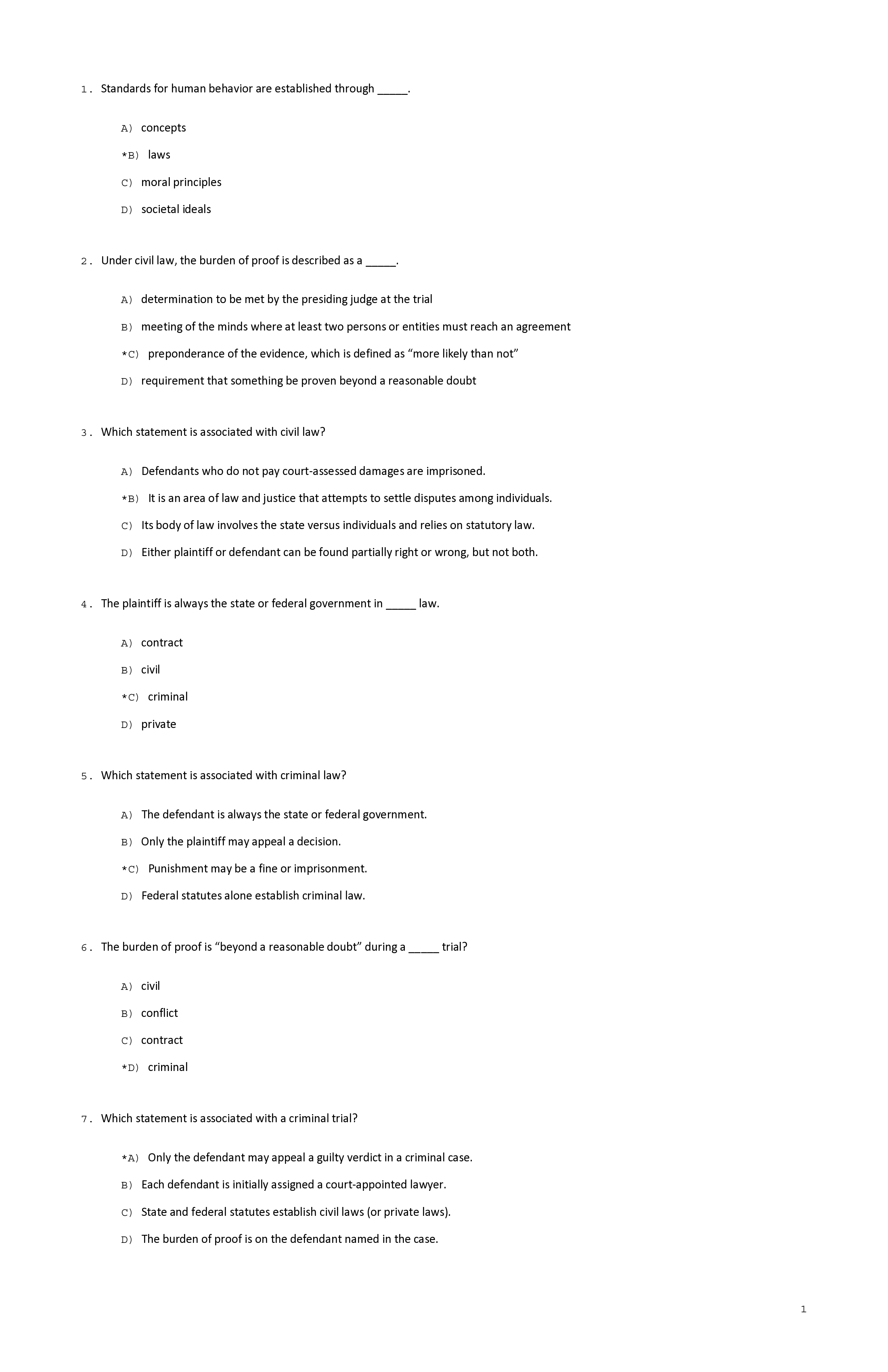
1.    Standards for human behavior are established through _____.  

A)    concepts  

*B) laws  

C)  moral principles  

D)  societal ideals  

2.    Under civil law, the burden of proof is described as a _____.  

A)    determination to be met by the presiding judge at the trial  

B)    meeting of the minds where at least two persons or entities must reach an agreement  

*C) preponderance of the evidence, which is defined as “more likely than not”  

D) requirement that something be proven beyond a reasonable doubt  

3.    Which statement is associated with civil law?  

A)    Defendants who do not pay court-assessed damages are imprisoned.  

*B) It is an area of law and justice that attempts to settle disputes among individuals.   C) Its body of law involves the state versus individuals and relies on statutory law.  

D) Either plaintiff or defendant can be found partially right or wrong, but not both.  

4.    The plaintiff is always the state or federal government in _____ law.  

A)    contract   B) civil  

*C) criminal  

D) private  

5.    Which statement is associated with criminal law?  

A)    The defendant is always the state or federal government.  

B)    Only the plaintiff may appeal a decision.  

*C) Punishment may be a fine or imprisonment.   D) Federal statutes alone establish criminal law.   

6.    The burden of proof is “beyond a reasonable doubt” during a _____ trial?  

A)    civil  

B)    conflict  

C)    contract  

*D) criminal  

7.    Which statement is associated with a criminal trial?  

*A) Only the defendant may appeal a guilty verdict in a criminal case.   B) Each defendant is initially assigned a court-appointed lawyer.  

C)  State and federal statutes establish civil laws (or private laws).  

D)  The burden of proof is on the defendant named in the case.  

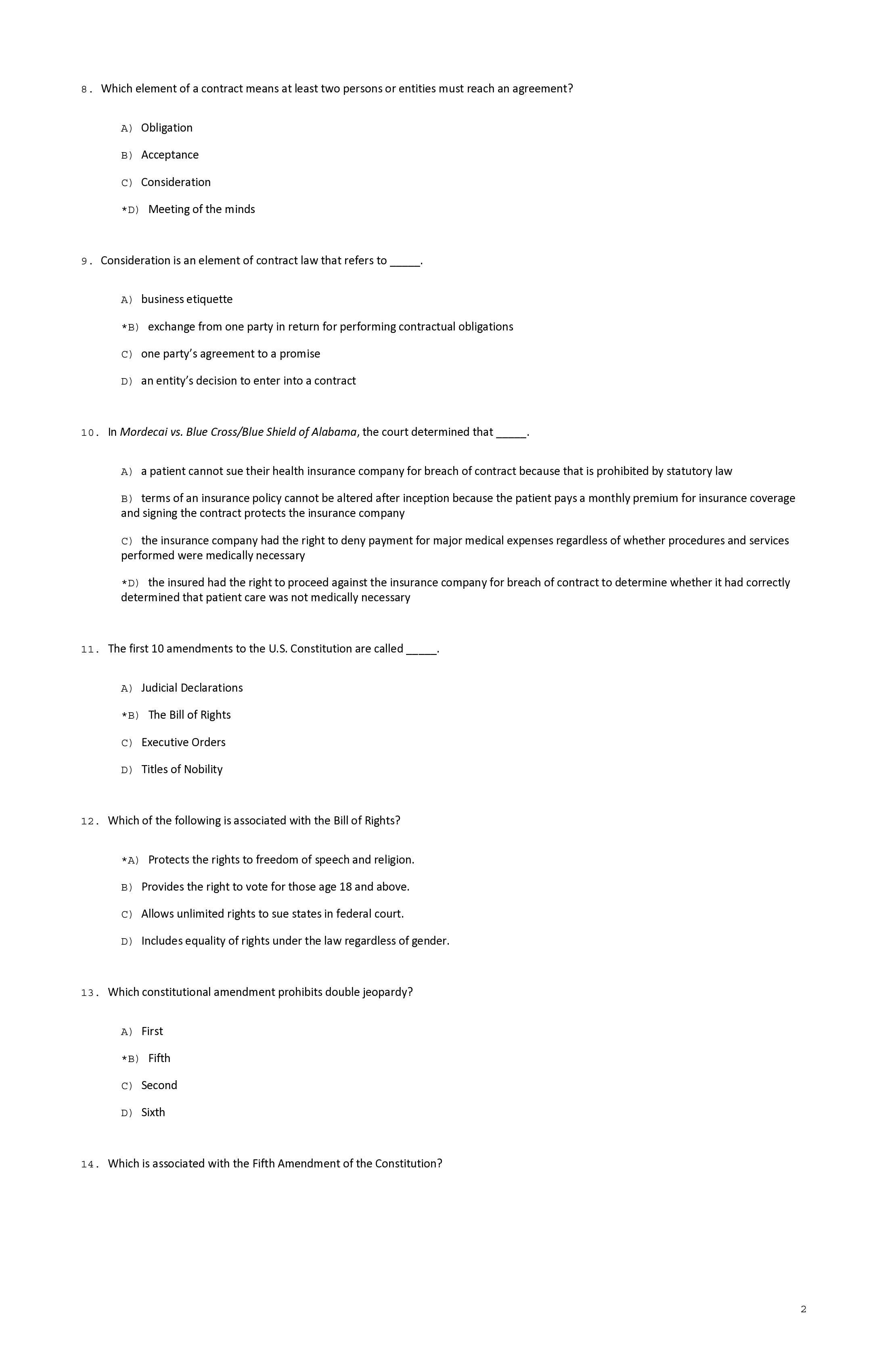
8.    Which element of a contract means at least two persons or entities must reach an agreement?  

A)    Obligation  

B)    Acceptance  

C)    Consideration  

*D) Meeting of the minds  

9.    Consideration is an element of contract law that refers to _____.  

A)    business etiquette  

*B) exchange from one party in return for performing contractual obligations  

C)  one party’s agreement to a promise  

D)  an entity’s decision to enter into a contract  

10.  In Mordecai vs. Blue Cross/Blue Shield of Alabama, the court determined that _____.  

A)    a patient cannot sue their health insurance company for breach of contract because that is prohibited by statutory law  

B)    terms of an insurance policy cannot be altered after inception because the patient pays a monthly premium for insurance coverage and signing the contract protects the insurance company  

C)    the insurance company had the right to deny payment for major medical expenses regardless of whether procedures and services performed were medically necessary  

*D) the insured had the right to proceed against the insurance company for breach of contract to determine whether it had correctly determined that patient care was not medically necessary  

11.  The first 10 amendments to the U.S. Constitution are called _____.  

A)    Judicial Declarations  

*B) The Bill of Rights  

C)  Executive Orders  

D)  Titles of Nobility  

12.  Which of the following is associated with the Bill of Rights?  

*A) Protects the rights to freedom of speech and religion.   B) Provides the right to vote for those age 18 and above.  

C)  Allows unlimited rights to sue states in federal court.  

D)  Includes equality of rights under the law regardless of gender.  

13.  Which constitutional amendment prohibits double jeopardy?  

A)    First  

*B) Fifth  

C)  Second  

D)  Sixth  

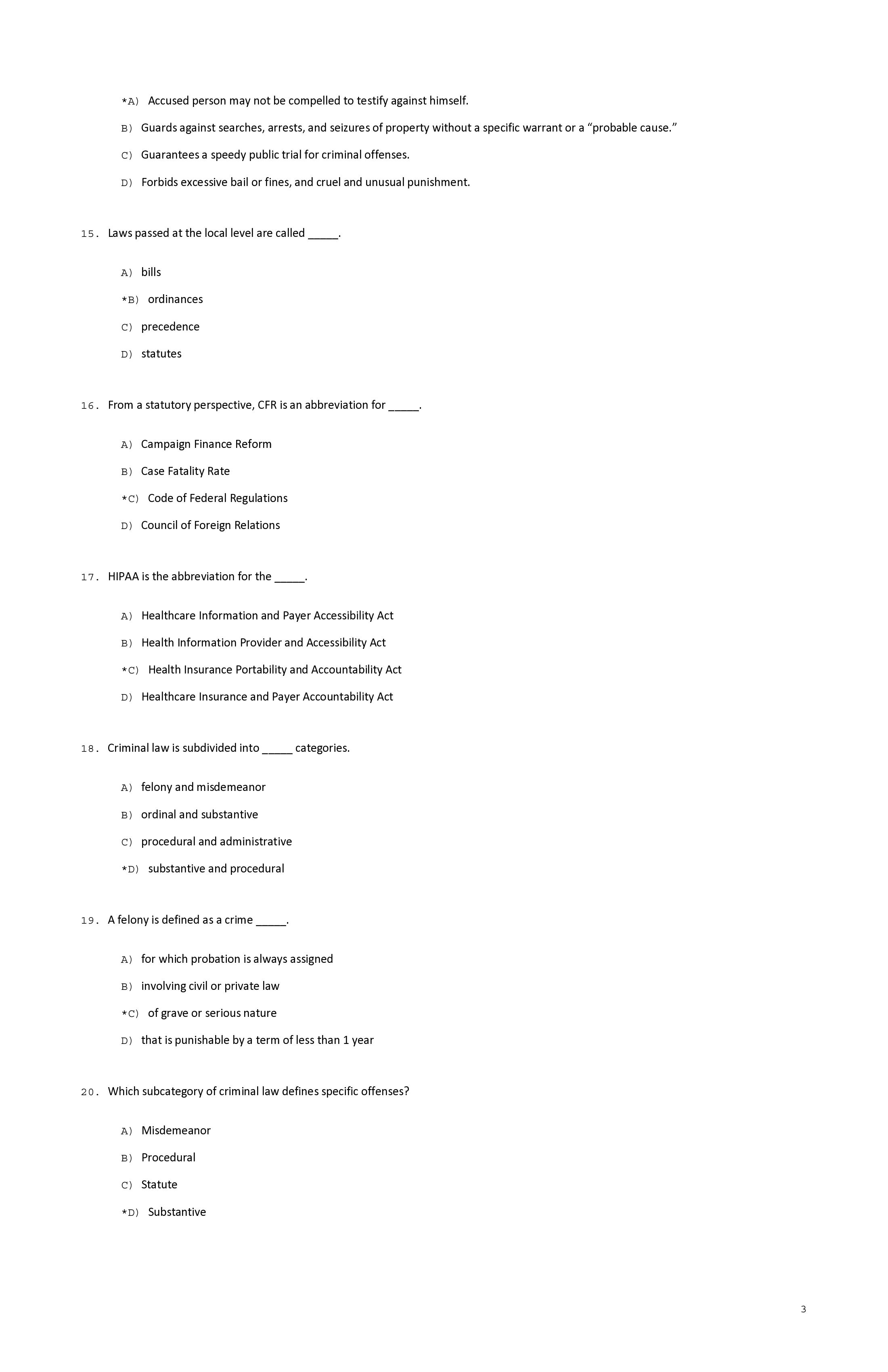
14.  Which is associated with the Fifth Amendment of the Constitution?  

*A) Accused person may not be compelled to testify against himself.  

B)  Guards against searches, arrests, and seizures of property without a specific warrant or a “probable cause.”  

C)  Guarantees a speedy public trial for criminal offenses.  

D)  Forbids excessive bail or fines, and cruel and unusual punishment.  

15.  Laws passed at the local level are called _____.  

A)    bills  

*B) ordinances  

C)  precedence  

D)  statutes  

16.  From a statutory perspective, CFR is an abbreviation for _____.  

A)    Campaign Finance Reform   B) Case Fatality Rate  

*C) Code of Federal Regulations  

D) Council of Foreign Relations  

17.  HIPAA is the abbreviation for the _____.  

A)    Healthcare Information and Payer Accessibility Act  

B)    Health Information Provider and Accessibility Act  

*C) Health Insurance Portability and Accountability Act  

D) Healthcare Insurance and Payer Accountability Act  

18.  Criminal law is subdivided into _____ categories.  

A)    felony and misdemeanor  

B)    ordinal and substantive  

C)    procedural and administrative  

*D) substantive and procedural  

19.  A felony is defined as a crime _____.  

A)    for which probation is always assigned  

B)    involving civil or private law  

*C) of grave or serious nature  

D) that is punishable by a term of less than 1 year  

20.  Which subcategory of criminal law defines specific offenses?  

A)    Misdemeanor  

B)    Procedural  

C)    Statute  

*D) Substantive  

21.  Primary sources of public law include _____.  

A)    law of contracts or torts  

B)    law of obligations  

C)    policies and procedures  

*D) statutes and constitutions  

22.  A constitution is a set of fundamental principles or established precedents according to which a state or other organization is governed.

Thus, it _____.  

A)    defines principles for individuals, not the nation or state in which it is based  

B)    delineates procedures by which a court awards the defendant monetary damages  

*C) is considered the fundamental law of a nation or state  

D) undergoes interpretation according to modern day statutes and regulations  

23.  Under stare decisis, _____.  

A)    U.S. Courts of Appeal are bound by trial court decisions of U.S. district courts in other jurisdictions  

*B) U.S. district courts are bound by decisions of both the U.S. Courts of Appeal and U.S. Supreme Court within the same geographic area   

C)  U.S. Supreme Court is bound by decisions of all U.S. courts of appeal within different jurisdictions  

D)  U.S. Supreme Court is obligated to follow precedent, regardless of decisions in Courts of Appeal or district courts  

tent authority, such as a legislature, establishes legal rules.  

*B) differing jurisdictions were inconsistent about the same legal issue.   C) excessive fines and excessive bail were imposed by judges.  

D) judgments passed by some judges became other significant sources of law.  

43.  Changes to the U.S. Constitution occur through _____.  

*A) amendments  

B)  majority Senate vote  

C)  popular culture  

D)  presidential order  

44.  Executive orders have the effect of law after being published (in the case of the federal system) in the:  

A)    Registrar’s Office  

B)    Executive Register  

*C) Federal Register  

D) Federal Case System  

45.  Zoning, building, or public safety ordinances are examples of laws passed at:  

*A) a local level  

B)  an executive level  

C)  congressional hearings  

D)  the state legislature  

46.  Administrative procedure acts govern the way in which administrative agencies of the _____ government may propose and establish regulations.  

A)    county  

*B) federal  

C)  municipal  

D)  local  

47.  Common law (also called case law or precedent) is a source of law that is derived from:  

A)    a single document that contains all laws.  

*B) court decisions.   C) popular culture.  

D) federal rules and regulations.  

48.  Stare decisis is Latin for:  

A)    a matter [already] judged.  

B)    let the master answer.  

*C) to let the decision stand.   D) utmost good faith.  

49.  Res judicata is a doctrine that courts are subject to, and it means:  

*A) a matter [already] judged.   B) let the master answer.  

C)  to let the decision stand.  

D)  utmost good faith.  

50.  Separation of powers as it pertains to the branches of federal government is in place:  

A)    as a way to increase the number of jobs created in the country.  

B)    if the president is unable to fulfill his duties and responsibilities.  

*C) so that no one particular branch overpowers the other branches.   D) to prevent any interaction between factions of political parties.  

51.  The legislative branch of the federal government is responsible for:  

A)    adhering to the doctrine of stare decisis and res judicata.  

*B) determining the need for new laws and changes to existing laws.   C) functioning to enforce and administer laws.  

D) interpreting laws using an alternate resolution of dispute.  

52.  Legislative proposals are called:  

A)    amendments.  

*B) bills.  

C)  ordinances.  

D)  torts.  

53.  Private law is sometimes referred to as civil law because it is concerned with private rights and remedies.  

*A)  True

B)  False

54.  A misdemeanor is a crime of less serious nature punishable by fine or a term of imprisonment of less than one year.  

*A)  True

B)  False

55.  Tort law is followed in criminal law cases.  

A)    True

*B)  False

56.  Civil law is also known as case law.  

A)    True

*B)  False

57.  Administrative procedure acts are the acts that govern the way in which administrative agencies of the federal government of the United States may propose and establish regulations.  

*A)  True

B)  False

58.  Match each term to its correct description.  

[D]     1) Concerned with agreements between two or more parties that create some type of obligation to act or refrain from acting.  

[E]     2) A law that regulates conflicts between private parties.  

[A] 3) The rights and duties that exist between parties that are independent of a contract.

A)  Tort Law  

B)  Substantive Law  

C)  Procedural Law  

D)  Contract Law  

E)  Private Law  

[C] 4) Portion of law that focuses on the steps through which a case passes.  

[B] 5) Portion of the law that creates, defines, and regulates rights and duties.  

59.  Explain the three branches of government.  

60.  List two elements of civil law.  

Contact the Seller

Please Sign In to contact this seller.


  • 👎  Report Copyright Violation

Frequently Asked Questions

What Do I Get When I Buy This Study Material?

+

When you buy a study material on Passing Grades, an instant download link will be sent directly to your email, giving you access to the file anytime after payment is completed.

Is Passing Grades a Trusted Platform?

+

Yes, Passing Grades is a reputable students’ marketplace with a secure payment system and reliable customer support. You can trust us to ensure a safe and seamless transaction experience.

Will I Be Stuck with a Subscription?

+

No, all purchases on Passing Grades are one-time transactions. You only pay for the notes you choose to buy, with no subscriptions or hidden fees attached.

Who Am I Buying These Study Materials From?

+

Passing Grades is a marketplace, which means you are purchasing the document from an individual vendor, not directly from us. We facilitate the payment and delivery process between you and the vendor.

Does Passing Grades Offer Free Study Materials?

+

Yes, sellers on Passing Grades have uploaded numerous free test banks, exams, practice questions, and class notes that can be downloaded at no cost.

Pasinggrades - Quality Study Materials

USD 15

    • Quality checked by Pasing Grades
    • 100% satisfaction guarantee
    • Seller: mentor2000
Buy PDF $15

Seller Information

mentor2000

Member since April 2021

  • icon
  • icon
View Profile
  • total sales

    0
  • Favourites

    0
  • Comments

    0
    ( 0 Ratings )

Item Information

  • Uploaded

    22 May 2022

  • Updated

    16 May 2025

  • Category

    Nursing

  • Item Type

    test bank

  • Tags

    Test Bank for Legal and Ethical Aspects of Health Information Management 5th Edition by McWay

Related Exam Prep Guides by mentor2000

Test Bank for Essentials for Nursing Practice 8th Edition by Potter | All Chapters
View Document

Test Bank for Essent...

  • mentor2000

    mentor2000

  • test bank

Master nursing concepts with this study material; Test Bank for Essentials for Nursing Practice, 8th...

15 USD

0

0

A &P 1 MA278 BSC2 Final Module II Questions & Answers 2026 Update
View Document

A &P 1 MA278 BSC2 Fi...

  • mentor2000

    mentor2000

  • test bank

Prepare for success with A&P 1 MA278 BSC2 Final Module II 2024 Q&A. Boost your grades with this comp...

15 USD

0

0

ATI Comprehensive Predictor Exam 2026
View Document

ATI Comprehensive Pr...

  • mentor2000

    mentor2000

  • test bank

Prepare for success with the ATI Comprehensive Predictor Exam 2026. Access key practice questions to...

15 USD

0

0

Purchase

Download link will be sent to this email immediately after purchase.

IMPORTANT LINKS

  • How To Upload Class Notes
  • Selling Tips
  • Passing Grades's Study Materials
  • Scholarships for International Students 2026

POPULAR CATEGORIES

  • Law
  • Accounting
  • English
  • Psychology
  • Business
  • Nursing
  • Computer Science
  • General

View Document

  • Blog
  • Contact
  • Delivery Policy
  • Latest Scholarships Around the World
  • How to Pass Bar Exams: Passing Grades’ Strategies
  • How to Study and Pass the CPA Exam
  • All Test Banks
  • Faq
  • Copyright Claims
  • Privacy Policy
  • Terms of Use

KNOWLEDGE BASE

  • How to Write A+ Grade Good Research Paper
  • How to Manage Stress During Exam Period
  • Best Time to Study
  • How to Pass NCLEX-RN Exam
  • How To Effectively Utilize Test Banks
  • Popular Shadow Health Exam Assessments
  • Popular HESI Case Studies
  • How to Prepare for a Nursing Career
  • The Importance Of Summaries in Exam Revisvion

© 2026 Pasing Grades. All rights reserved.