Pasing Grades
  • Start Selling
  • Blog
  • Contact
  • 0

    Your cart is empty!

English

  • English
  • Spanish
  • Arabic
Create Account Sign In
  • Library
    • New Prep Guides
    • Featured Prep Guides
    • Free Exam Prep Guides
    • Best sellers
  • General
  • Nursing
    • Research Paper
    • Case Study
    • Discussion Post
    • Assignment
    • Exam
    • Practice Questions and Answers
    • Test Bank
    • solutions manual
  • Accounting
    • Case Study
    • Thesis
    • Study Guide
    • Summary
    • Research Paper
    • test bank
  • English
    • Creative Writing
    • Research Paper
    • Summary
    • Rhetorics
    • Literature
    • Journal
    • Exam
    • Grammar
    • Discussion Post
    • Essay
  • Psychology
    • Hesi
    • Presentation
    • Essay
    • Summary
    • Study Guide
    • Essay
    • Solution Manual
    • Final Exam Review
    • Class Notes
    • test bank
  • Business
    • Lecture Notes
    • Solution Manual
    • Presentation
    • Business Plan
    • Class Notes
    • Experiment
    • Summary
    • Practice Questions
    • Study Guide
    • Case Study
    • test bank
    • Exam
  • More
    • Computer Science
    • Economics
    • Statistics
    • Engineering
    • Biology
    • Religious Studies
    • Physics
    • Chemistry
    • Mathematics
    • History
    • Sociology
    • Science
    • Philosophy
    • Law
  • Pages
    • About Us
    • Selling Tips
    • Delivery Policy
    • Faq
    • Privacy Policy
  • Flash Sale
  • Home
  • Test Bank for Kinns The Medical Assistant 14th Edition by Niedzwiecki

Test Bank for Kinns The Medical Assistant 14th Edition by Niedzwiecki

Preview page 1 Preview page 2 Preview page 3
Add To Favorites

Share this item Share this item

  • Item Details
  • Comments (0)
  • Reviews (0)
  • Contact Seller

Test Bank for Kinns The Medical Assistant 14th Edition by Niedzwiecki

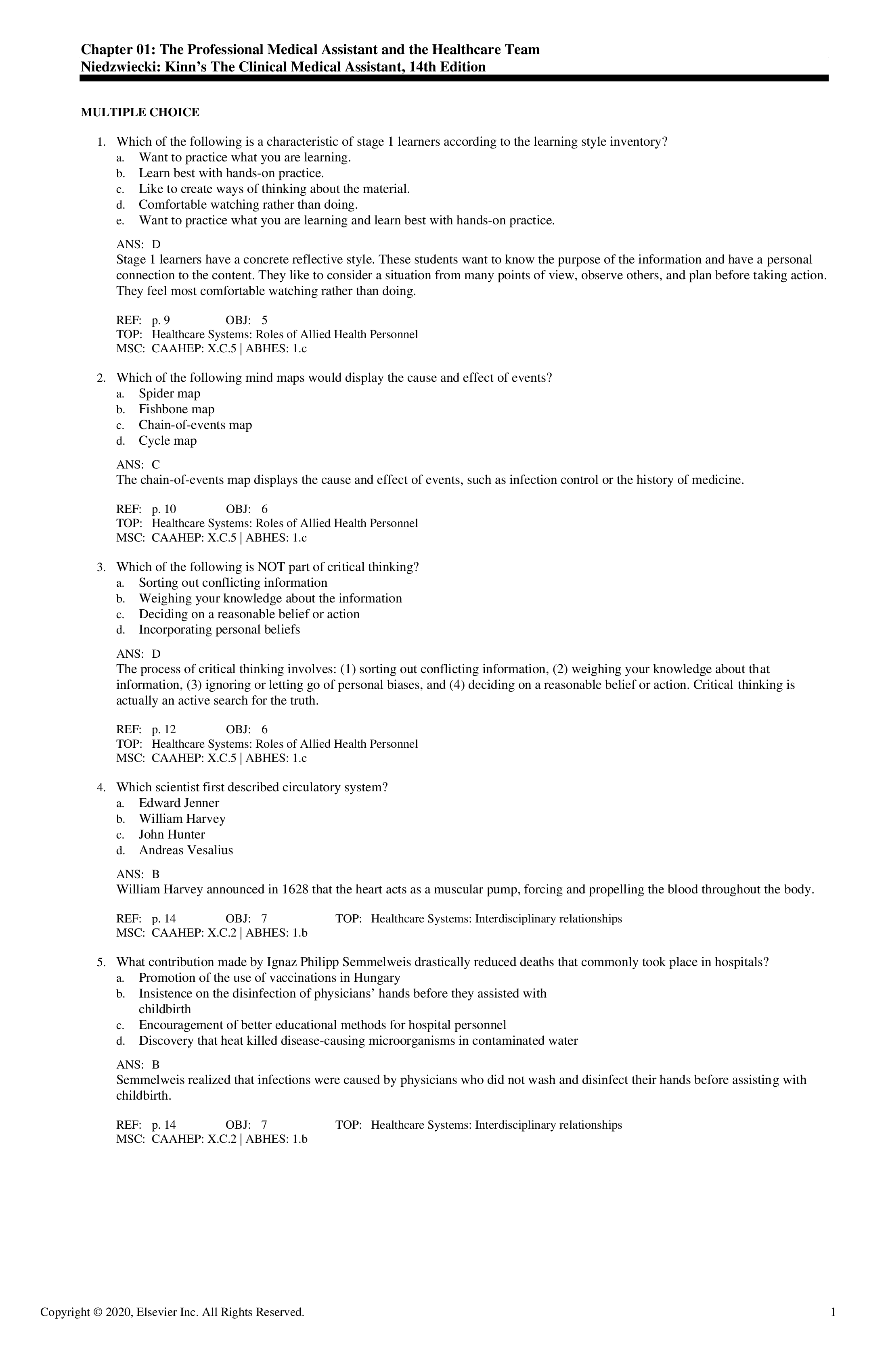
Chapter 01: The Professional Medical Assistant and the Healthcare Team

Niedzwiecki: Kinn’s The Clinical Medical Assistant, 14th Edition

MULTIPLE CHOICE

1.         Which of the following is a characteristic of stage 1 learners according to the learning style inventory? a.     Want to practice what you are learning.

b.        Learn best with hands-on practice.

c.        Like to create ways of thinking about the material.

d.        Comfortable watching rather than doing.

e.        Want to practice what you are learning and learn best with hands-on practice.

ANS: D

Stage 1 learners have a concrete reflective style. These students want to know the purpose of the information and have a personal connection to the content. They like to consider a situation from many points of view, observe others, and plan before taking action. They feel most comfortable watching rather than doing.

               REF: p. 9                  OBJ: 5

TOP: Healthcare Systems: Roles of Allied Health Personnel MSC: CAAHEP: X.C.5 | ABHES: 1.c

2.         Which of the following mind maps would display the cause and effect of events? a.  Spider map

b.        Fishbone map

c.        Chain-of-events map

d.        Cycle map

ANS: C

The chain-of-events map displays the cause and effect of events, such as infection control or the history of medicine.

               REF: p. 10                OBJ: 6

TOP: Healthcare Systems: Roles of Allied Health Personnel MSC: CAAHEP: X.C.5 | ABHES: 1.c

3.         Which of the following is NOT part of critical thinking?

a.        Sorting out conflicting information

b.        Weighing your knowledge about the information

c.        Deciding on a reasonable belief or action

d.        Incorporating personal beliefs

ANS: D

The process of critical thinking involves: (1) sorting out conflicting information, (2) weighing your knowledge about that information, (3) ignoring or letting go of personal biases, and (4) deciding on a reasonable belief or action. Critical thinking is actually an active search for the truth.

               REF: p. 12                OBJ: 6

TOP: Healthcare Systems: Roles of Allied Health Personnel MSC: CAAHEP: X.C.5 | ABHES: 1.c

4.         Which scientist first described circulatory system?

a.        Edward Jenner

b.        William Harvey

c.        John Hunter

d.        Andreas Vesalius

ANS: B

William Harvey announced in 1628 that the heart acts as a muscular pump, forcing and propelling the blood throughout the body.

REF: p. 14 OBJ: 7 TOP: Healthcare Systems: Interdisciplinary relationships MSC: CAAHEP: X.C.2 | ABHES: 1.b

5.         What contribution made by Ignaz Philipp Semmelweis drastically reduced deaths that commonly took place in hospitals? a.        Promotion of the use of vaccinations in Hungary

b.        Insistence on the disinfection of physicians’ hands before they assisted with childbirth

c.        Encouragement of better educational methods for hospital personnel

d.        Discovery that heat killed disease-causing microorganisms in contaminated water

ANS: B

Semmelweis realized that infections were caused by physicians who did not wash and disinfect their hands before assisting with childbirth.

REF: p. 14 OBJ: 7 TOP: Healthcare Systems: Interdisciplinary relationships MSC: CAAHEP: X.C.2 | ABHES: 1.b

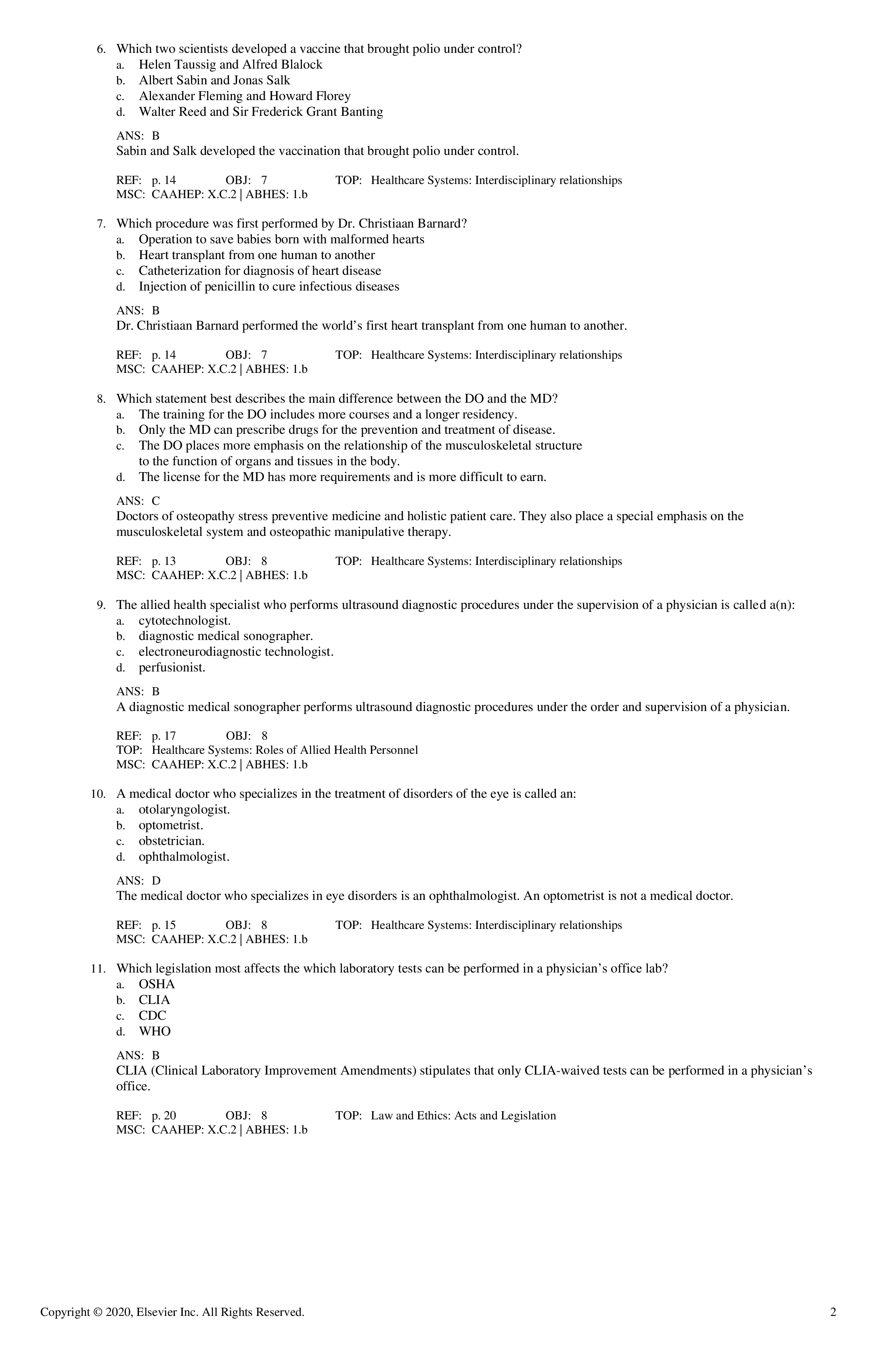
6.         Which two scientists developed a vaccine that brought polio under control?

a.        Helen Taussig and Alfred Blalock

b.        Albert Sabin and Jonas Salk

c.        Alexander Fleming and Howard Florey

d.        Walter Reed and Sir Frederick Grant Banting

ANS: B

Sabin and Salk developed the vaccination that brought polio under control.

REF: p. 14 OBJ: 7 TOP: Healthcare Systems: Interdisciplinary relationships MSC: CAAHEP: X.C.2 | ABHES: 1.b

7.         Which procedure was first performed by Dr. Christiaan Barnard?

a.        Operation to save babies born with malformed hearts

b.        Heart transplant from one human to another

c.        Catheterization for diagnosis of heart disease

d.        Injection of penicillin to cure infectious diseases

ANS: B

Dr. Christiaan Barnard performed the world’s first heart transplant from one human to another.

REF: p. 14 OBJ: 7 TOP: Healthcare Systems: Interdisciplinary relationships MSC: CAAHEP: X.C.2 | ABHES: 1.b

8.         Which statement best describes the main difference between the DO and the MD?

a.        The training for the DO includes more courses and a longer residency.

b.        Only the MD can prescribe drugs for the prevention and treatment of disease.

c.        The DO places more emphasis on the relationship of the musculoskeletal structure to the function of organs and tissues in the body.

d.        The license for the MD has more requirements and is more difficult to earn.

ANS: C

Doctors of osteopathy stress preventive medicine and holistic patient care. They also place a special emphasis on the musculoskeletal system and osteopathic manipulative therapy.

REF: p. 13 OBJ: 8 TOP: Healthcare Systems: Interdisciplinary relationships MSC: CAAHEP: X.C.2 | ABHES: 1.b

9.         The allied health specialist who performs ultrasound diagnostic procedures under the supervision of a physician is called a(n): a.            cytotechnologist.

b.        diagnostic medical sonographer.

c.        electroneurodiagnostic technologist.

d.        perfusionist.

ANS: B

A diagnostic medical sonographer performs ultrasound diagnostic procedures under the order and supervision of a physician.

               REF: p. 17                OBJ: 8

TOP: Healthcare Systems: Roles of Allied Health Personnel MSC: CAAHEP: X.C.2 | ABHES: 1.b

10.     A medical doctor who specializes in the treatment of disorders of the eye is called an: a.     otolaryngologist.

b.        optometrist.

c.        obstetrician.

d.        ophthalmologist.

ANS: D

The medical doctor who specializes in eye disorders is an ophthalmologist. An optometrist is not a medical doctor.

REF: p. 15 OBJ: 8 TOP: Healthcare Systems: Interdisciplinary relationships MSC: CAAHEP: X.C.2 | ABHES: 1.b

11.     Which legislation most affects the which laboratory tests can be performed in a physician’s office lab?

a.        OSHA

b.        CLIA

c.        CDC

d.        WHO

ANS: B

CLIA (Clinical Laboratory Improvement Amendments) stipulates that only CLIA-waived tests can be performed in a physician’s office.

               REF: p. 20                OBJ: 8                     TOP: Law and Ethics: Acts and Legislation

MSC: CAAHEP: X.C.2 | ABHES: 1.b

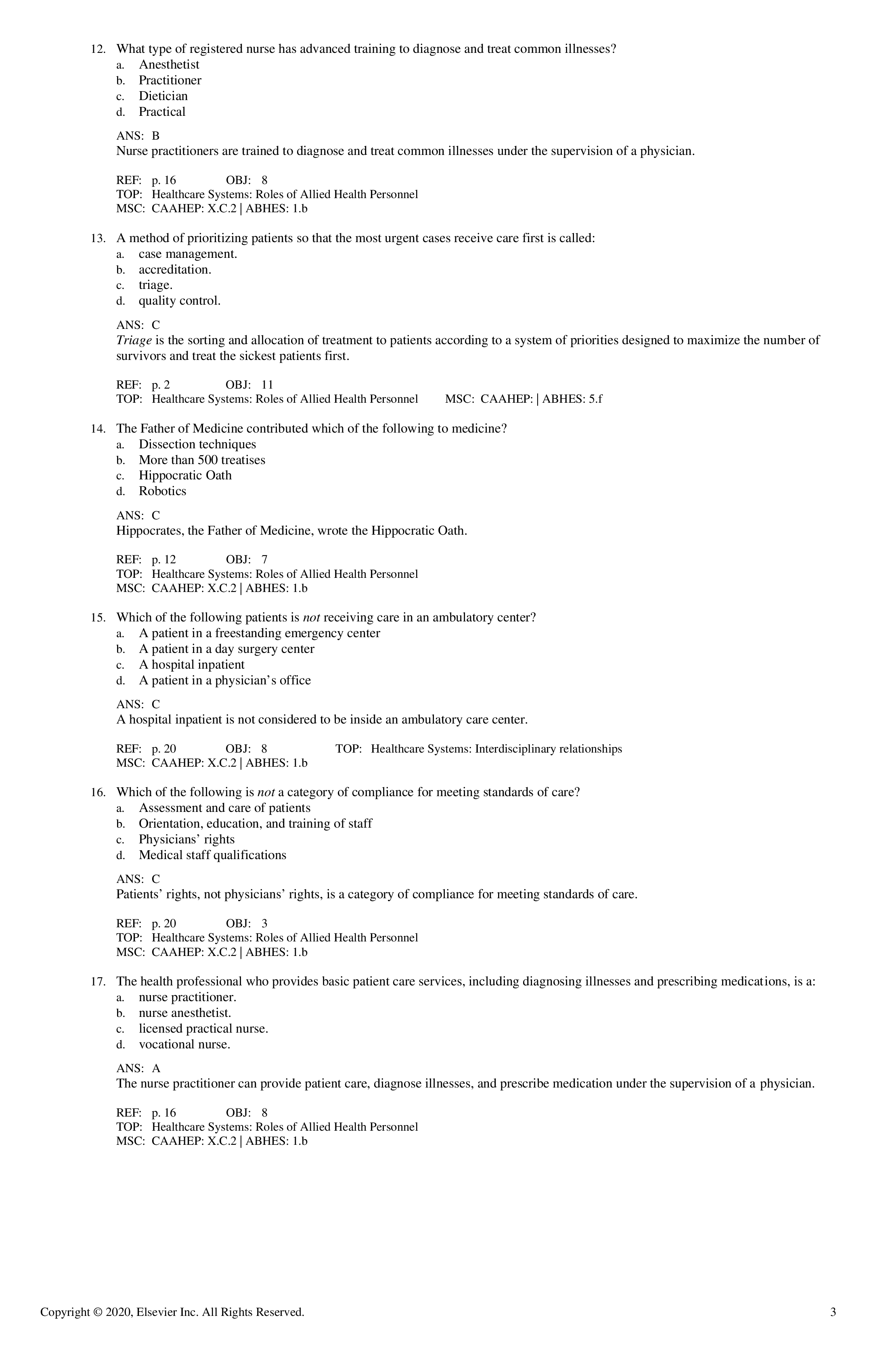
12.     What type of registered nurse has advanced training to diagnose and treat common illnesses? a.     Anesthetist

b.        Practitioner

c.        Dietician

d.        Practical

ANS: B

Nurse practitioners are trained to diagnose and treat common illnesses under the supervision of a physician.

               REF: p. 16                OBJ: 8

TOP: Healthcare Systems: Roles of Allied Health Personnel MSC: CAAHEP: X.C.2 | ABHES: 1.b

13.     A method of prioritizing patients so that the most urgent cases receive care first is called: a.   case management.

b.        accreditation.

c.        triage.

d.        quality control.

ANS: C

Triage is the sorting and allocation of treatment to patients according to a system of priorities designed to maximize the number of survivors and treat the sickest patients first.

REF: p. 2           OBJ: 11 TOP: Healthcare Systems: Roles of Allied Health Personnel             MSC: CAAHEP: | ABHES: 5.f

14.     The Father of Medicine contributed which of the following to medicine?

a.        Dissection techniques

b.        More than 500 treatises

c.        Hippocratic Oath

d.        Robotics

ANS: C

Hippocrates, the Father of Medicine, wrote the Hippocratic Oath.

               REF: p. 12                OBJ: 7

TOP: Healthcare Systems: Roles of Allied Health Personnel MSC: CAAHEP: X.C.2 | ABHES: 1.b

15.     Which of the following patients is not receiving care in an ambulatory center?

a.        A patient in a freestanding emergency center

b.        A patient in a day surgery center

c.        A hospital inpatient

d.        A patient in a physician’s office

ANS: C

A hospital inpatient is not considered to be inside an ambulatory care center.

REF: p. 20 OBJ: 8 TOP: Healthcare Systems: Interdisciplinary relationships MSC: CAAHEP: X.C.2 | ABHES: 1.b

16.     Which of the following is not a category of compliance for meeting standards of care?

a.        Assessment and care of patients

b.        Orientation, education, and training of staff

c.        Physicians’ rights

d.        Medical staff qualifications

ANS: C

Patients’ rights, not physicians’ rights, is a category of compliance for meeting standards of care.

               REF: p. 20                OBJ: 3

TOP: Healthcare Systems: Roles of Allied Health Personnel MSC: CAAHEP: X.C.2 | ABHES: 1.b

17.     The health professional who provides basic patient care services, including diagnosing illnesses and prescribing medications, is a: a.   nurse practitioner.

b.        nurse anesthetist.

c.        licensed practical nurse.

d.        vocational nurse.

ANS: A

The nurse practitioner can provide patient care, diagnose illnesses, and prescribe medication under the supervision of a physician.

               REF: p. 16                OBJ: 8

TOP: Healthcare Systems: Roles of Allied Health Personnel

MSC: CAAHEP: X.C.2 | ABHES: 1.b

18.     Which of the following agencies, founded in 1939, is a nationally recognized certification agency for multiple allied health professionals?

a.        NHA

b.        AMT

c.        AAMA

d.        CAAHEP

ANS: B

The American Medical Technologists (AMT) was founded in 1939 as a nationally recognized certification agency for multiple allied health professionals, including Medical Laboratory Technician (MLT), Phlebotomy Technician (RPT), Medical Assistant (RMA), Medical Administrative Specialist (CMAS), and Dental Assistant (RDA).

REF: p. 7 OBJ: 4 TOP: Law and Ethics: Licensure/Certification MSC: CAAHEP: X.C.5 | ABHES: 1.c

19.     DO refers to which of the following physicians?

a.        Doctor of medicine

b.        Osteopathic physicians

c.        Doctor of chiropractic

d.        Doctor of optometry

ANS: B

Osteopathic physicians (Doctor of Osteopathy [DO]) complete requirements similar to those of MDs to graduate and practice medicine. Osteopaths use medicine and surgery, in addition to osteopathic manipulative therapy (OMT), in treating their patients.

REF: p. 13 OBJ: 8 TOP: Healthcare Systems: Interdisciplinary relationships MSC: CAAHEP: X.C.2 | ABHES: 1.b

20.     Medical centers and regional and specialty hospitals are considered _________________. a.  primary level of care

b.        secondary level of care

c.        tertiary level of care

d.        interconnected level of care

ANS: C

Tertiary level of care includes the following: a referral system for primary or secondary care facilities, providing care for complicated cases for trauma and medical centers and regional and specialty hospitals.

               REF: p. 18                OBJ: 8

TOP: Healthcare Systems: Roles of Allied Health Personnel MSC: CAAHEP: X.C.2 | ABHES: 1.b

21.     Which of the following is not a key feature of the PCMH?

a.        Comprehensive care

b.        Patient-centered care

c.        Inpatient services

d.        Accessible services

e.        Quality and safety

ANS: C

According to the AHRQ, the patient-centered medical home has five core functions and attributes: (1). Comprehensive care, (2). Patient-centered care, (3). Coordinated care, (4). Accessible services, and (5). Quality and safety.

REF: pp. 21-22 OBJ: 9 TOP: Healthcare Systems: Delivery Models MSC: CAAHEP: VIII.C.4 | ABHES: 5.g

22.     One factor is absolutely true about all practicing medical assistants—they are not independent practitioners. Whether certified or not, regardless of length of training or experience, every medical assistant must practice under the direct supervision of a physician or other licensed practitioner (e.g., nurse practitioner or physician assistant). a.        Both statements are true.

b.        Both statements are false.

c.        The first statement is true; the second is false.

d.        The first statement is false; the second is true.

ANS: A

One factor is absolutely true about all practicing medical assistants—they are not independent practitioners. Whether certified or not, regardless of length of training or experience, every medical assistant must practice under the direct supervision of a physician or other licensed practitioner (e.g., nurse practitioner or physician assistant).

               REF: p. 5                  OBJ: 3

TOP: Healthcare Systems: Roles of Allied Health Personnel

MSC: CAAHEP: X.C.2 | ABHES: 1.b

23.     All of the following are examples of specific tasks that are beyond the scope of practice of medical assistants except one. Which is the exception?

a.        Giving out drug samples with provider permission

b.        Making recommendations about OTC drugs and remedies

c.        Operating laser equipment

d.        Analyzing test results

ANS: A

Some specific tasks are beyond the scope of practice of medical assistants, including the following: performing telephone or in-person triage, assessing or diagnosing symptoms, prescribing medications or making recommendations about over-the-counter drugs and remedies, giving out drug samples without provider permission, automatically submitting refill prescription requests without provider orders, administering intravenous (IV) medications and starting, flushing, or removing IV lines unless permitted by state law, analyzing or interpreting test results, and/or operating laser equipment.

               REF: p. 5                  OBJ: 3                     TOP: Law and Ethics: Scope of Practice

MSC: CAAHEP: X.C.2 | ABHES: 1.b | ABHES: 1.d

24.     The mental or emotional condition with respect to cheerfulness or confidence is called: a.      morale.

b.        tenacity.

c.        insubordination.

d.        initiative.

ANS: A

Morale is defined as the emotional or mental condition with respect to cheerfulness or confidence.

               REF: p. 2                  OBJ: 12

TOP: Healthcare Systems: Roles of Allied Health Personnel MSC: CAAHEP: X.C.2 | ABHES: 5.f

25.     Deciding which tasks are most important is called:

a.        modification.

b.        teaching.

c.        prioritizing.

d.        procrastinating.

ANS: C

The medical assistant is prioritizing tasks when he or she is deciding which tasks are most important.

REF: p. 23 OBJ: 11 TOP: Clerical Procedures: Time Management MSC: CAAHEP: X.C.5 | ABHES: 5.f

26.     Which of the following statements about professionalism is true?

a.        It must be practiced at all times in the workplace.

b.        It can lead to wage increases and promotions.

c.        Unacceptable behavior is detrimental to the medical assistant’s career. d.           All are correct.

ANS: D

Students must practice professionalism throughout their time in the classroom because habits are difficult to break. Good habits will carry over into the externship experience.

               REF: p. 4                  OBJ: 2

TOP: Healthcare Systems: Roles of Allied Health Personnel

MSC: CAAHEP: X.C.5 | ABHES: 5.f

27.     A person who is characterized by or conforms to the technical or ethical standards of a certain profession is considered to be: a.      detrimental.

b.        commensurate.

c.        professional.

d.        moral.

ANS: C

The professional medical assistant displays ethics above reproach.

               REF: p. 4                  OBJ: 2

TOP: Healthcare Systems: Roles of Allied Health Personnel MSC: CAAHEP: X.C.5 | ABHES: 5.f

28.     An obstruction to professionalism could be:

a.        a cooperative co-worker.

b.        a co-worker who assists in completing a difficult task.

c.        bringing personal problems to the office.

d.        speaking in an even, calm tone.

ANS: C

Personal problems and baggage can distract the medical assistant and become an obstruction to professionalism in the workplace.

               REF: p. 24                OBJ: 12

TOP: Healthcare Systems: Roles of Allied Health Personnel

MSC: CAAHEP: X.C.5 | ABHES: 5.f


5.         A standard is an item or indicator that is used as a measure of quality or compliance.

ANS: T

Standards measure quality or compliance.

               REF: p. 6                  OBJ: 3

TOP: Healthcare Systems: Roles of Allied Health Personnel MSC: CAAHEP: X.C.2 | ABHES: 1.b

6.         Holistic refers to the individual parts of the body rather than all of its systems.

ANS: F

Holistic refers to all the systems of the body as a whole rather than to individual parts.

REF: p. 13 OBJ: 8 TOP: Healthcare Systems: Alternative Services MSC: CAAHEP: X.C.2 | ABHES: 5.g

7.         Doctors of osteopathy usually practice allopathic medicine.

ANS: F

Doctors of osteopathy practice osteopathic medicine. Medical doctors practice allopathic medicine.

REF: p. 13 OBJ: 8 TOP: Healthcare Systems: Interdisciplinary relationships MSC: CAAHEP: X.C.2 | ABHES: 1.b

8.         A hospitalist spends most of his or her time in the office.

ANS: F

The hospitalist spends most of the workday in the hospital, caring for inpatients.

REF: p. 16 OBJ: 8 TOP: Healthcare Systems: Interdisciplinary relationships MSC: CAAHEP: X.C.2 | ABHES: 1.b

9.         Salk and Pasteur developed the polio vaccine.

ANS: F

The polio vaccine was developed by Salk and Sabin.

               REF: p. 14                OBJ: 7

TOP: Healthcare Systems: Roles of Allied Health Personnel MSC: CAAHEP: X.C.2 | ABHES: 1.b

10.     Employees should be aware of the attendance policies in their facility’s policy and procedures manual.

ANS: T

All employers should know the attendance policies in their facility as outlined in the policy and procedures manual.

               REF: p. 23                OBJ: 10

TOP: Healthcare Systems: Roles of Allied Health Personnel MSC: CAAHEP: X.C.2 | ABHES: 5.f

11.     Checking personal e-mail several times a day in the medical office is always acceptable.

ANS: F

Medical assistants should attend to personal business and e-mail on their own time, away from the office.

               REF: p. 24                OBJ: 12

TOP: Healthcare Systems: Roles of Allied Health Personnel MSC: CAAHEP: X.C.2 | ABHES: 5.f

12.     Long nails and colored polish are always acceptable in the medical profession.

ANS: F

Nails should be kept conservatively short, and clear or muted polish shades should be worn.

               REF: p. 6                  OBJ: 2

TOP: Healthcare Systems: Roles of Allied Health Personnel

MSC: CAAHEP: X.C.2 | ABHES: 5.f

Contact the Seller

Please Sign In to contact this seller.


  • 👎  Report Copyright Violation

Frequently Asked Questions

What Do I Get When I Buy This Study Material?

+

When you buy a study material on Passing Grades, an instant download link will be sent directly to your email, giving you access to the file anytime after payment is completed.

Is Passing Grades a Trusted Platform?

+

Yes, Passing Grades is a reputable students’ marketplace with a secure payment system and reliable customer support. You can trust us to ensure a safe and seamless transaction experience.

Will I Be Stuck with a Subscription?

+

No, all purchases on Passing Grades are one-time transactions. You only pay for the notes you choose to buy, with no subscriptions or hidden fees attached.

Who Am I Buying These Study Materials From?

+

Passing Grades is a marketplace, which means you are purchasing the document from an individual vendor, not directly from us. We facilitate the payment and delivery process between you and the vendor.

Does Passing Grades Offer Free Study Materials?

+

Yes, sellers on Passing Grades have uploaded numerous free test banks, exams, practice questions, and class notes that can be downloaded at no cost.

Pasinggrades - Quality Study Materials

USD 15

    • Quality checked by Pasing Grades
    • 100% satisfaction guarantee
    • Seller: mentor2000
Buy PDF $15

Seller Information

mentor2000

Member since April 2021

  • icon
  • icon
View Profile
  • total sales

    0
  • Favourites

    0
  • Comments

    0
    ( 0 Ratings )

Item Information

  • Uploaded

    22 May 2022

  • Updated

    16 May 2025

  • Category

    Nursing

  • Item Type

    test bank

  • Tags

    Test Bank for Kinns The Medical Assistant 14th Edition by Niedzwiecki

Related Exam Prep Guides by mentor2000

Test Bank for Essentials for Nursing Practice 8th Edition by Potter | All Chapters
View Document

Test Bank for Essent...

  • mentor2000

    mentor2000

  • test bank

Master nursing concepts with this study material; Test Bank for Essentials for Nursing Practice, 8th...

15 USD

0

0

A &P 1 MA278 BSC2 Final Module II Questions & Answers 2026 Update
View Document

A &P 1 MA278 BSC2 Fi...

  • mentor2000

    mentor2000

  • test bank

Prepare for success with A&P 1 MA278 BSC2 Final Module II 2024 Q&A. Boost your grades with this comp...

15 USD

0

0

ATI Comprehensive Predictor Exam 2026
View Document

ATI Comprehensive Pr...

  • mentor2000

    mentor2000

  • test bank

Prepare for success with the ATI Comprehensive Predictor Exam 2026. Access key practice questions to...

15 USD

0

0

Purchase

Download link will be sent to this email immediately after purchase.

IMPORTANT LINKS

  • How To Upload Class Notes
  • Selling Tips
  • Passing Grades's Study Materials
  • Scholarships for International Students 2025

POPULAR CATEGORIES

  • Law
  • Accounting
  • English
  • Psychology
  • Business
  • Nursing
  • Computer Science
  • General

View Document

  • Blog
  • Contact
  • Delivery Policy
  • Latest Scholarships Around the World
  • How to Pass Bar Exams: Passing Grades’ Strategies
  • How to Study and Pass the CPA Exam
  • All Test Banks
  • Faq
  • Copyright Claims
  • Privacy Policy
  • Terms of Use

KNOWLEDGE BASE

  • How to Write A+ Grade Good Research Paper
  • How to Manage Stress During Exam Period
  • Best Time to Study
  • How to Pass NCLEX-RN Exam
  • How To Effectively Utilize Test Banks
  • Popular Shadow Health Exam Assessments
  • Popular HESI Case Studies
  • How to Prepare for a Nursing Career
  • The Importance Of Summaries in Exam Revisvion

© 2026 Pasing Grades. All rights reserved.