Pasing Grades
  • Start Selling
  • Blog
  • Contact
  • 0

    Your cart is empty!

English

  • English
  • Spanish
  • Arabic
Create Account Sign In
  • Library
    • New Prep Guides
    • Featured Prep Guides
    • Free Exam Prep Guides
    • Best sellers
  • General
  • Nursing
    • Research Paper
    • Case Study
    • Discussion Post
    • Assignment
    • Exam
    • Practice Questions and Answers
    • Test Bank
    • solutions manual
  • Accounting
    • Case Study
    • Thesis
    • Study Guide
    • Summary
    • Research Paper
    • test bank
  • English
    • Creative Writing
    • Research Paper
    • Summary
    • Rhetorics
    • Literature
    • Journal
    • Exam
    • Grammar
    • Discussion Post
    • Essay
  • Psychology
    • Hesi
    • Presentation
    • Essay
    • Summary
    • Study Guide
    • Essay
    • Solution Manual
    • Final Exam Review
    • Class Notes
    • test bank
  • Business
    • Lecture Notes
    • Solution Manual
    • Presentation
    • Business Plan
    • Class Notes
    • Experiment
    • Summary
    • Practice Questions
    • Study Guide
    • Case Study
    • test bank
    • Exam
  • More
    • Computer Science
    • Economics
    • Statistics
    • Engineering
    • Biology
    • Religious Studies
    • Physics
    • Chemistry
    • Mathematics
    • History
    • Sociology
    • Science
    • Philosophy
    • Law
  • Pages
    • About Us
    • Selling Tips
    • Delivery Policy
    • Faq
    • Privacy Policy
  • Flash Sale
  • Home
  • Test Bank for Kinesiology 3rd Edition by Muscolino

Test Bank for Kinesiology 3rd Edition by Muscolino

Preview page 1 Preview page 2 Preview page 3
Add To Favorites

Share this item Share this item

  • Item Details
  • Comments (0)
  • Reviews (0)
  • Contact Seller

Test Bank for Kinesiology 3rd Edition by Muscolino

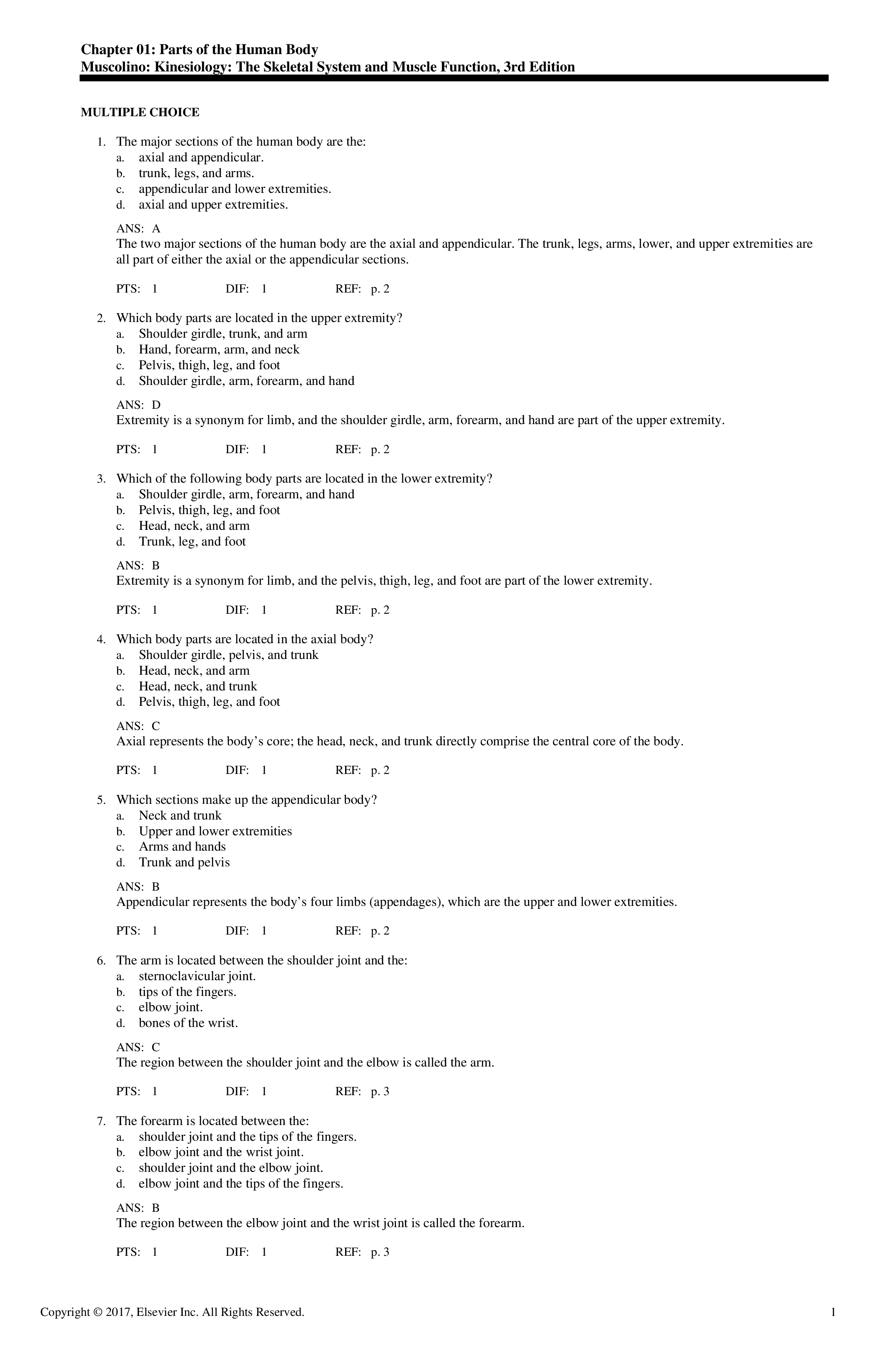
Chapter 01: Parts of the Human Body Test Bank

Muscolino: Kinesiology: The Skeletal System and Muscle Function, 3rd Edition

MULTIPLE CHOICE

1.         The major sections of the human body are the:

a.        axial and appendicular.

b.        trunk, legs, and arms.

c.        appendicular and lower extremities.

d.        axial and upper extremities.

ANS: A

The two major sections of the human body are the axial and appendicular. The trunk, legs, arms, lower, and upper extremities are all part of either the axial or the appendicular sections.

                PTS: 1                      DIF: 1                      REF: p. 2

2.         Which body parts are located in the upper extremity?

a.        Shoulder girdle, trunk, and arm

b.        Hand, forearm, arm, and neck

c.        Pelvis, thigh, leg, and foot

d.        Shoulder girdle, arm, forearm, and hand

ANS: D

Extremity is a synonym for limb, and the shoulder girdle, arm, forearm, and hand are part of the upper extremity.

                PTS: 1                      DIF: 1                      REF: p. 2

3.         Which of the following body parts are located in the lower extremity?

a.        Shoulder girdle, arm, forearm, and hand

b.        Pelvis, thigh, leg, and foot

c.        Head, neck, and arm

d.        Trunk, leg, and foot

ANS: B

Extremity is a synonym for limb, and the pelvis, thigh, leg, and foot are part of the lower extremity.

                PTS: 1                      DIF: 1                      REF: p. 2

4.         Which body parts are located in the axial body?

a.        Shoulder girdle, pelvis, and trunk

b.        Head, neck, and arm

c.        Head, neck, and trunk

d.        Pelvis, thigh, leg, and foot

ANS: C

Axial represents the body’s core; the head, neck, and trunk directly comprise the central core of the body.

                PTS: 1                      DIF: 1                      REF: p. 2

5.         Which sections make up the appendicular body?

a.        Neck and trunk

b.        Upper and lower extremities

c.        Arms and hands

d.        Trunk and pelvis

ANS: B

Appendicular represents the body’s four limbs (appendages), which are the upper and lower extremities.

                PTS: 1                      DIF: 1                      REF: p. 2

6.         The arm is located between the shoulder joint and the:

a.        sternoclavicular joint.

b.        tips of the fingers.

c.        elbow joint.

d.        bones of the wrist.

ANS: C

The region between the shoulder joint and the elbow is called the arm.

                PTS: 1                      DIF: 1                      REF: p. 3

7.         The forearm is located between the:

a.        shoulder joint and the tips of the fingers.

b.        elbow joint and the wrist joint.

c.        shoulder joint and the elbow joint.

d.        elbow joint and the tips of the fingers.

ANS: B

The region between the elbow joint and the wrist joint is called the forearm.

                PTS: 1                      DIF: 1                      REF: p. 3

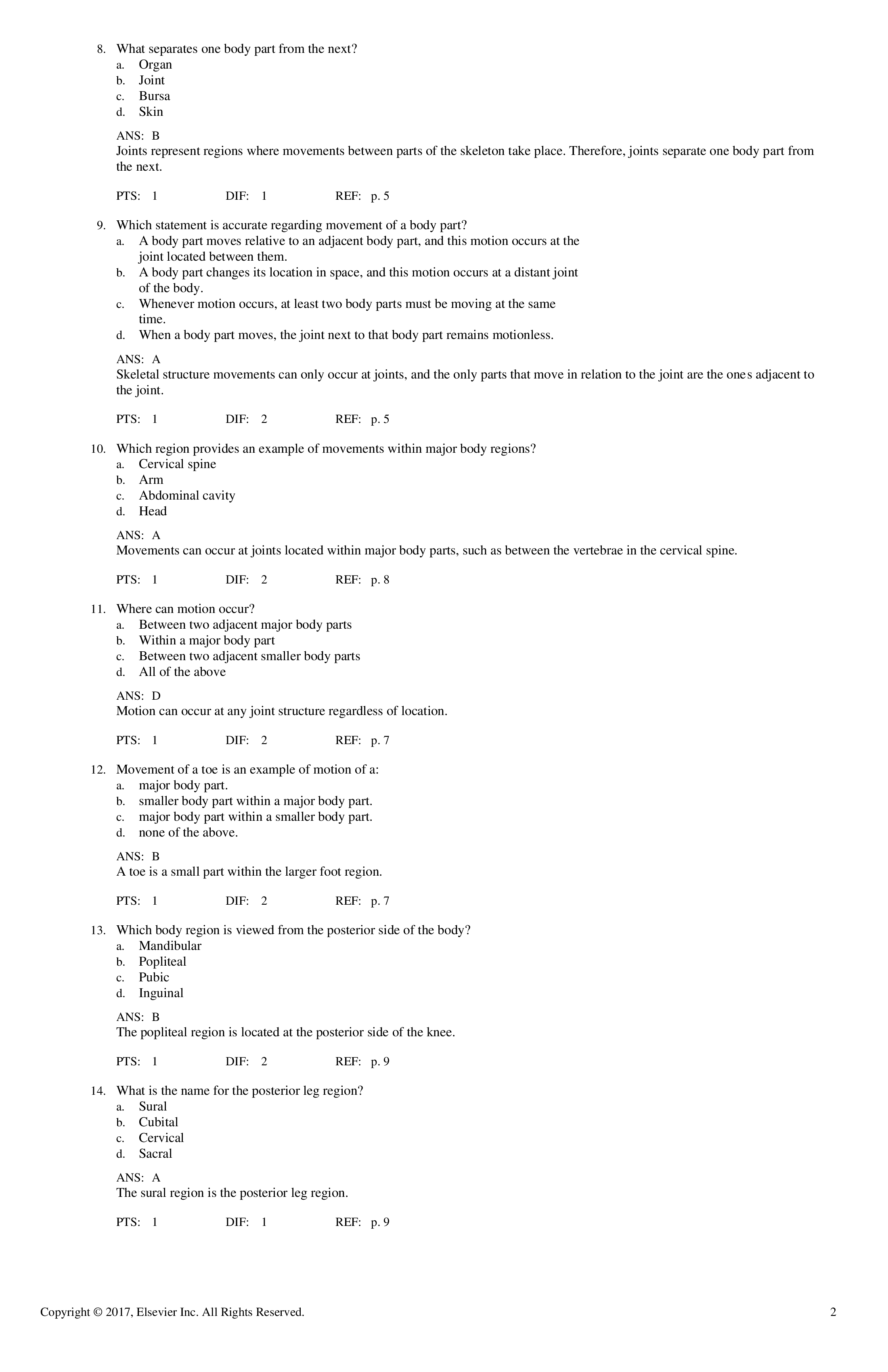
8.         What separates one body part from the next?

a.        Organ

b.        Joint

c.        Bursa

d.        Skin

ANS: B

Joints represent regions where movements between parts of the skeleton take place. Therefore, joints separate one body part from the next.

                PTS: 1                      DIF: 1                      REF: p. 5

9.         Which statement is accurate regarding movement of a body part?

a.        A body part moves relative to an adjacent body part, and this motion occurs at the joint located between them.

b.        A body part changes its location in space, and this motion occurs at a distant joint of the body.

c.        Whenever motion occurs, at least two body parts must be moving at the same time.

d.        When a body part moves, the joint next to that body part remains motionless.

ANS: A

Skeletal structure movements can only occur at joints, and the only parts that move in relation to the joint are the ones adjacent to the joint.

                PTS: 1                      DIF: 2                      REF: p. 5

10.     Which region provides an example of movements within major body regions? a.         Cervical spine

b.        Arm

c.        Abdominal cavity

d.        Head

ANS: A

Movements can occur at joints located within major body parts, such as between the vertebrae in the cervical spine.

                PTS: 1                      DIF: 2                      REF: p. 8

11.     Where can motion occur?

a.        Between two adjacent major body parts

b.        Within a major body part

c.        Between two adjacent smaller body parts

d.        All of the above

ANS: D

Motion can occur at any joint structure regardless of location.

                PTS: 1                      DIF: 2                      REF: p. 7

12.     Movement of a toe is an example of motion of a:

a.        major body part.

b.        smaller body part within a major body part.

c.        major body part within a smaller body part.

d.        none of the above.

ANS: B

A toe is a small part within the larger foot region.

                PTS: 1                      DIF: 2                      REF: p. 7

13.     Which body region is viewed from the posterior side of the body?

a.        Mandibular

b.        Popliteal

c.        Pubic

d.        Inguinal

ANS: B

The popliteal region is located at the posterior side of the knee.

                PTS: 1                      DIF: 2                      REF: p. 9

14.     What is the name for the posterior leg region?

a.        Sural

b.        Cubital

c.        Cervical

d.        Sacral

ANS: A

The sural region is the posterior leg region.

                PTS: 1                      DIF: 1                      REF: p. 9

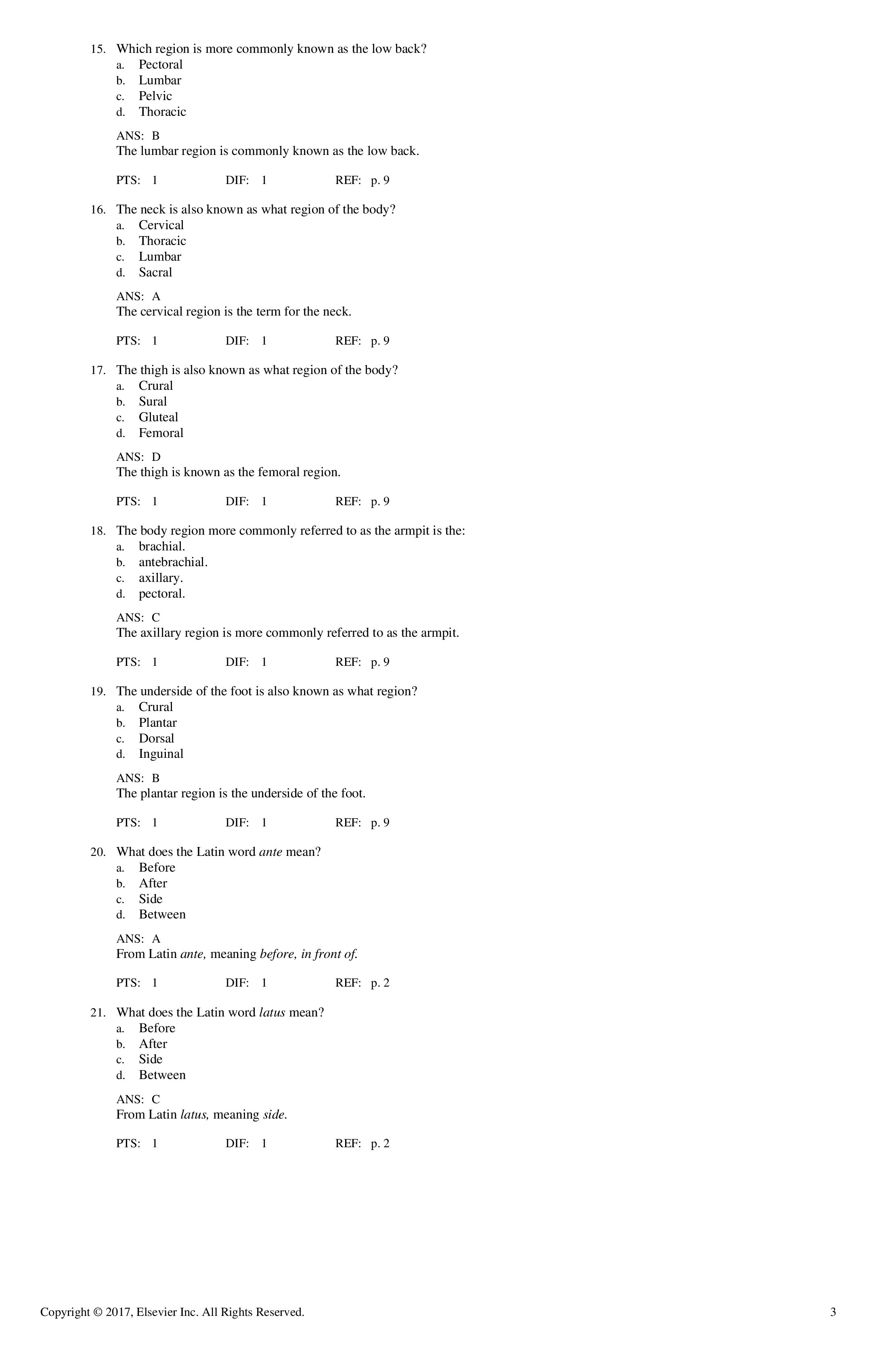
15.     Which region is more commonly known as the low back?

a.        Pectoral

b.        Lumbar

c.        Pelvic

d.        Thoracic

ANS: B

The lumbar region is commonly known as the low back.

                PTS: 1                      DIF: 1                      REF: p. 9

16.     The neck is also known as what region of the body?

a.        Cervical

b.        Thoracic

c.        Lumbar

d.        Sacral

ANS: A

The cervical region is the term for the neck.

                PTS: 1                      DIF: 1                      REF: p. 9

17.     The thigh is also known as what region of the body?

a.        Crural

b.        Sural

c.        Gluteal

d.        Femoral

ANS: D

The thigh is known as the femoral region.

                PTS: 1                      DIF: 1                      REF: p. 9

18.     The body region more commonly referred to as the armpit is the:

a.        brachial.

b.        antebrachial.

c.        axillary.

d.        pectoral.

ANS: C

The axillary region is more commonly referred to as the armpit.

                PTS: 1                      DIF: 1                      REF: p. 9

19.     The underside of the foot is also known as what region?

a.        Crural

b.        Plantar

c.        Dorsal

d.        Inguinal

ANS: B

The plantar region is the underside of the foot.

                PTS: 1                      DIF: 1                      REF: p. 9

20.     What does the Latin word ante mean?

a.        Before

b.        After

c.        Side

d.        Between

ANS: A

From Latin ante, meaning before, in front of.

                PTS: 1                      DIF: 1                      REF: p. 2

21.     What does the Latin word latus mean?

a.        Before

b.        After

c.        Side

d.        Between

ANS: C

From Latin latus, meaning side.

                PTS: 1                      DIF: 1                      REF: p. 2

22.     What does the Latin word post mean?

a.        Before

b.        After

c.        Side

d.        Above

ANS: B

From Latin post, meaning behind, in the rear, after.

                PTS: 1                      DIF: 1                      REF: p. 2

23.     Generally speaking, the presence of a(n) _______ defines a body part.

a.        cavity

b.        organ

c.        muscle

d.        bone

ANS: D

Generally, the presence of a bone, or more than one bone, within a body part that defines the body part. For example, the humerus defines the arm; the radius and ulna define the forearm.

                PTS: 1                      DIF: 2                      REF: p. 3

24.     If a person lifts the arm into the air by moving the shoulder joint, the hand is:

a.        exhibiting true movement.

b.        remaining unchanged in position or location.

c.        “going along for the ride.”

d.        moving independently of the arm.

ANS: C

The hand is “going along for the ride” because it is not actually moving. The position of the hand relative to the forearm is not changing; the right hand is not moving relative to the forearm, and motion is not occurring within the hand.

                PTS: 1                      DIF: 2                      REF: pp. 8-9

Contact the Seller

Please Sign In to contact this seller.


  • 👎  Report Copyright Violation

Frequently Asked Questions

What Do I Get When I Buy This Study Material?

+

When you buy a study material on Passing Grades, an instant download link will be sent directly to your email, giving you access to the file anytime after payment is completed.

Is Passing Grades a Trusted Platform?

+

Yes, Passing Grades is a reputable students’ marketplace with a secure payment system and reliable customer support. You can trust us to ensure a safe and seamless transaction experience.

Will I Be Stuck with a Subscription?

+

No, all purchases on Passing Grades are one-time transactions. You only pay for the notes you choose to buy, with no subscriptions or hidden fees attached.

Who Am I Buying These Study Materials From?

+

Passing Grades is a marketplace, which means you are purchasing the document from an individual vendor, not directly from us. We facilitate the payment and delivery process between you and the vendor.

Does Passing Grades Offer Free Study Materials?

+

Yes, sellers on Passing Grades have uploaded numerous free test banks, exams, practice questions, and class notes that can be downloaded at no cost.


Pasinggrades - Quality Study Materials

USD 15

    • Quality checked by Pasing Grades
    • 100% satisfaction guarantee
    • Seller: mentor2000
Buy PDF $15

Seller Information

mentor2000

Member since April 2021

  • icon
  • icon
View Profile
  • total sales

    0
  • Favourites

    0
  • Comments

    0
    ( 0 Ratings )

Item Information

  • Uploaded

    22 May 2022

  • Updated

    18 May 2025

  • Category

    Nursing

  • Item Type

    test bank

  • Tags

    Test Bank for Kinesiology 3rd Edition by Muscolino

Related Exam Prep Guides by mentor2000

Test Bank for Essentials for Nursing Practice 8th Edition by Potter | All Chapters
View Document

Test Bank for Essent...

  • mentor2000

    mentor2000

  • test bank

Master nursing concepts with this study material; Test Bank for Essentials for Nursing Practice, 8th...

15 USD

0

0

A &P 1 MA278 BSC2 Final Module II Questions & Answers 2026 Update
View Document

A &P 1 MA278 BSC2 Fi...

  • mentor2000

    mentor2000

  • test bank

Prepare for success with A&P 1 MA278 BSC2 Final Module II 2024 Q&A. Boost your grades with this comp...

15 USD

0

0

ATI Comprehensive Predictor Exam 2026
View Document

ATI Comprehensive Pr...

  • mentor2000

    mentor2000

  • test bank

Prepare for success with the ATI Comprehensive Predictor Exam 2026. Access key practice questions to...

15 USD

0

0

Purchase

Download link will be sent to this email immediately after purchase.

IMPORTANT LINKS

  • How To Upload Class Notes
  • Selling Tips
  • Passing Grades's Study Materials
  • Scholarships for International Students 2025

POPULAR CATEGORIES

  • Law
  • Accounting
  • English
  • Psychology
  • Business
  • Nursing
  • Computer Science
  • General

View Document

  • Blog
  • Contact
  • Delivery Policy
  • Latest Scholarships Around the World
  • How to Pass Bar Exams: Passing Grades’ Strategies
  • How to Study and Pass the CPA Exam
  • All Test Banks
  • Faq
  • Copyright Claims
  • Privacy Policy
  • Terms of Use

KNOWLEDGE BASE

  • How to Write A+ Grade Good Research Paper
  • How to Manage Stress During Exam Period
  • Best Time to Study
  • How to Pass NCLEX-RN Exam
  • How To Effectively Utilize Test Banks
  • Popular Shadow Health Exam Assessments
  • Popular HESI Case Studies
  • How to Prepare for a Nursing Career
  • The Importance Of Summaries in Exam Revisvion

© 2026 Pasing Grades. All rights reserved.