Pasing Grades
  • Start Selling
  • Blog
  • Contact
  • 0

    Your cart is empty!

English

  • English
  • Spanish
  • Arabic
Create Account Sign In
  • Library
    • New Prep Guides
    • Featured Prep Guides
    • Free Exam Prep Guides
    • Best sellers
  • General
  • Nursing
    • Research Paper
    • Case Study
    • Discussion Post
    • Assignment
    • Exam
    • Practice Questions and Answers
    • Test Bank
    • solutions manual
  • Accounting
    • Case Study
    • Thesis
    • Study Guide
    • Summary
    • Research Paper
    • test bank
  • English
    • Creative Writing
    • Research Paper
    • Summary
    • Rhetorics
    • Literature
    • Journal
    • Exam
    • Grammar
    • Discussion Post
    • Essay
  • Psychology
    • Hesi
    • Presentation
    • Essay
    • Summary
    • Study Guide
    • Essay
    • Solution Manual
    • Final Exam Review
    • Class Notes
    • test bank
  • Business
    • Lecture Notes
    • Solution Manual
    • Presentation
    • Business Plan
    • Class Notes
    • Experiment
    • Summary
    • Practice Questions
    • Study Guide
    • Case Study
    • test bank
    • Exam
  • More
    • Computer Science
    • Economics
    • Statistics
    • Engineering
    • Biology
    • Religious Studies
    • Physics
    • Chemistry
    • Mathematics
    • History
    • Sociology
    • Science
    • Philosophy
    • Law
  • Pages
    • About Us
    • Selling Tips
    • Delivery Policy
    • Faq
    • Privacy Policy
  • Flash Sale
  • Home
  • Test Bank for Karp’s Cell and Molecular Biology 9th Edition Karp

Test Bank for Karp’s Cell and Molecular Biology 9th Edition Karp

Preview page 1 Preview page 2 Preview page 3
Add To Favorites

Share this item Share this item

  • Item Details
  • Comments (0)
  • Reviews (0)
  • Contact Seller

Test Bank: Karp’s Cell and Molecular Biology, 9th Edition, Gerald Karp, Janet Iwasa, Wallace Marshall

Table of Contents 

1 Introduction to the Study of Cell and Molecular Biology
2 The Chemical Basis of Life
3 Bioenergetics, Enzymes, and Metabolism
4 The Structure and Function of the Plasma Membrane
5 Aerobic Respiration and the Mitochondrion
6 Photosynthesis and the Chloroplast
7 Interactions Between Cells and Their Environment
8 Cytoplasmic Membrane Systems: Structure, Function, and Membrane Trafficking
9 The Cytoskeleton and Cell Motility
10 The Nature of the Gene and the Genome
11 The Central Dogma: DNA to RNA to Protein 
12 Control of Gene Expression
13 DNA Replication and Repair
14 Cell Division
15 Cell Signaling and Signal Transduction: Communication between Cells
16 Cancer 
17 The Immune Response
18 Techniques in Cell and Molecular Biology

Ch. 1 Sample 

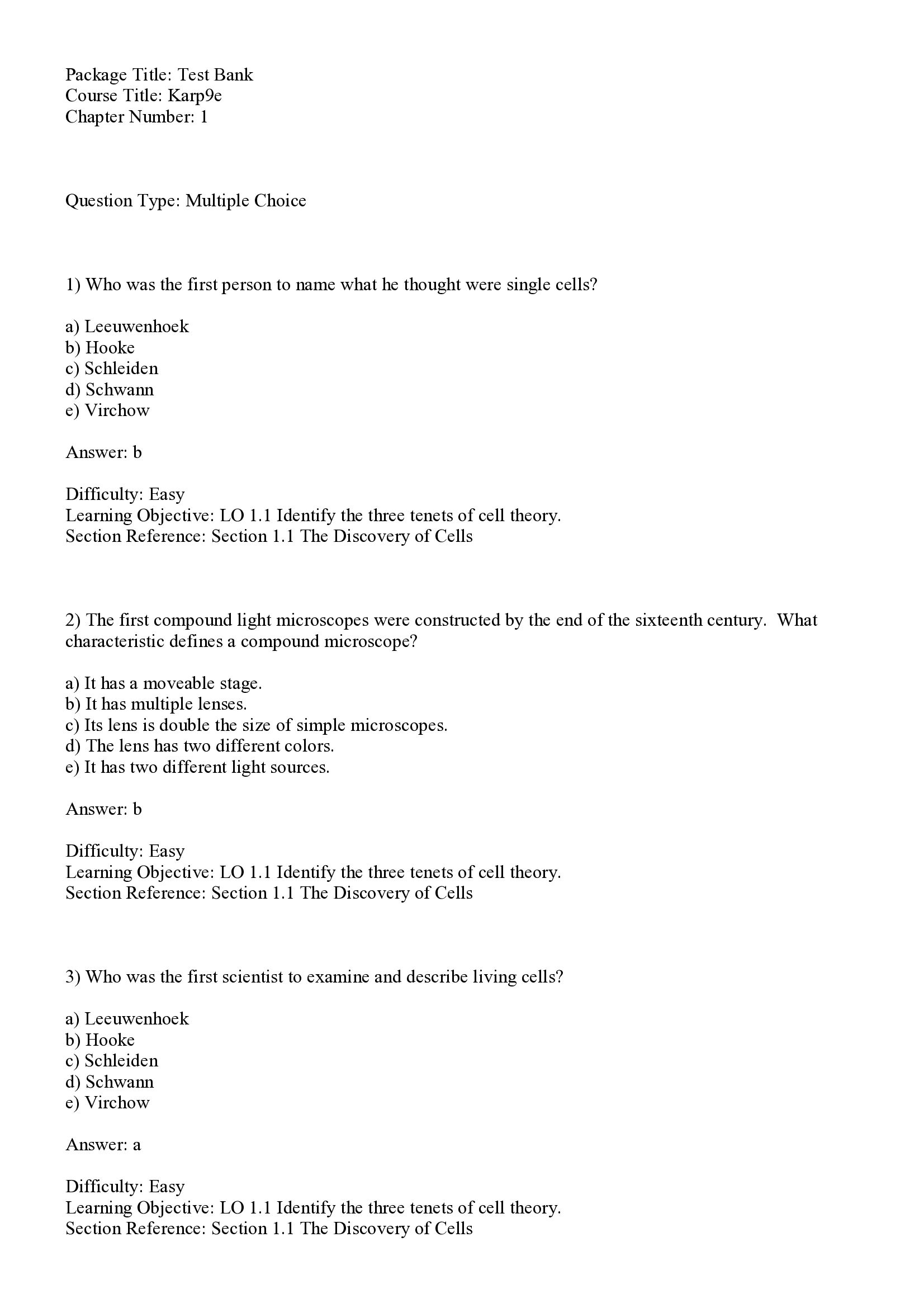
Package Title: Test Bank

Course Title: Karp9e

Chapter Number: 1


Question Type: Multiple Choice


1) Who was the first person to name what he thought were single cells?


a)   Leeuwenhoek

b)  Hooke

c)   Schleiden

d)  Schwann

e)   Virchow


Answer: b


Difficulty: Easy

Learning Objective: LO 1.1 Identify the three tenets of cell theory.

Section Reference: Section 1.1 The Discovery of Cells


2) The first compound light microscopes were constructed by the end of the sixteenth century.  What characteristic defines a compound microscope?


a)   It has a moveable stage.

b)  It has multiple lenses.

c)   Its lens is double the size of simple microscopes.

d)  The lens has two different colors.

e)   It has two different light sources.


Answer: b


Difficulty: Easy

Learning Objective: LO 1.1 Identify the three tenets of cell theory.

Section Reference: Section 1.1 The Discovery of Cells


3) Who was the first scientist to examine and describe living cells?


a)   Leeuwenhoek

b)  Hooke

c)   Schleiden

d)  Schwann

e)   Virchow


Answer: a


Difficulty: Easy

Learning Objective: LO 1.1 Identify the three tenets of cell theory. Section Reference: Section 1.1 The Discovery of Cells


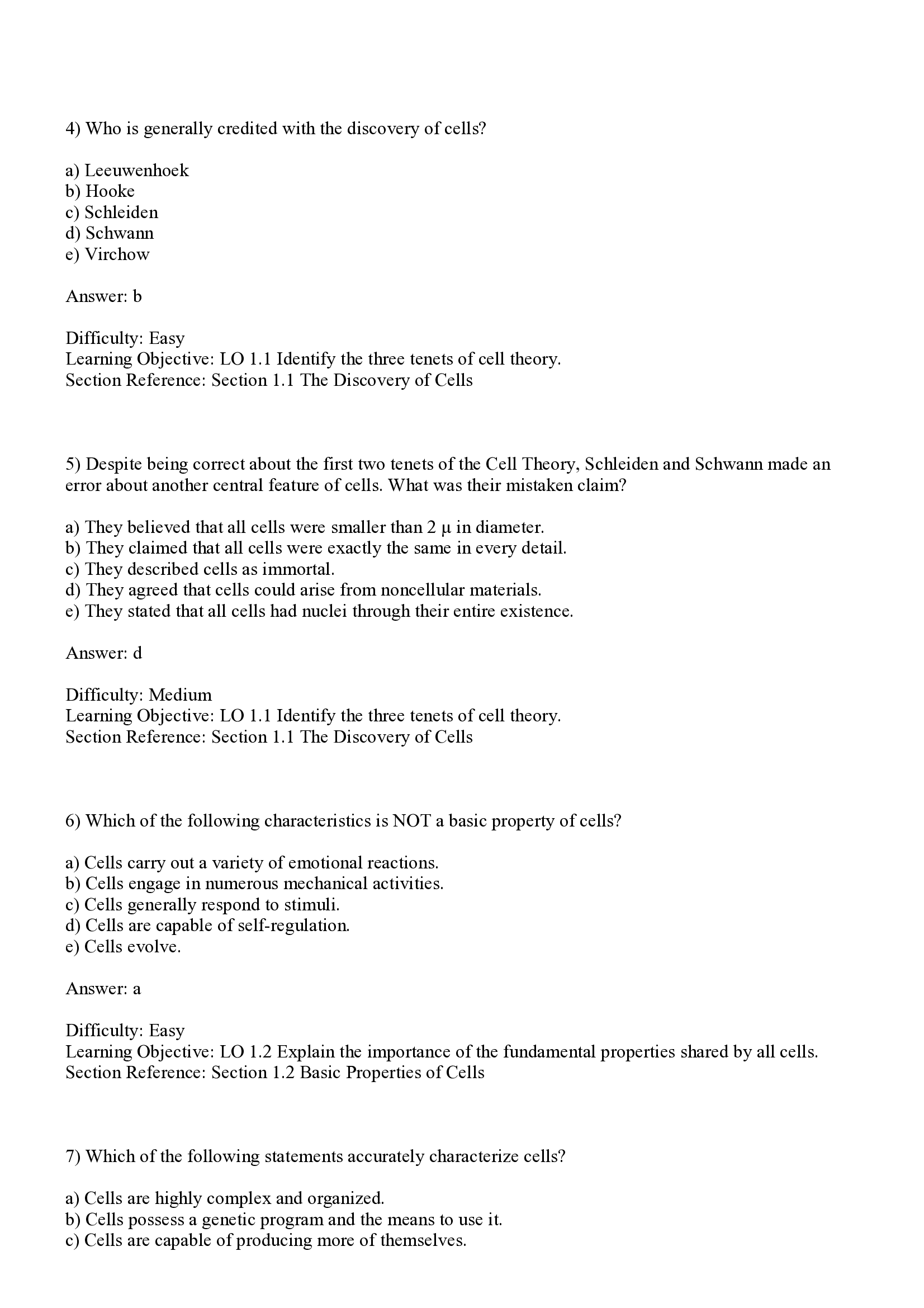
4) Who is generally credited with the discovery of cells?


a)   Leeuwenhoek

b)  Hooke

c)   Schleiden

d)  Schwann

e)   Virchow


Answer: b


Difficulty: Easy

Learning Objective: LO 1.1 Identify the three tenets of cell theory. Section Reference: Section 1.1 The Discovery of Cells


5) Despite being correct about the first two tenets of the Cell Theory, Schleiden and Schwann made an error about another central feature of cells. What was their mistaken claim?


a)   They believed that all cells were smaller than 2 µ in diameter.

b)  They claimed that all cells were exactly the same in every detail.

c)   They described cells as immortal.

d)  They agreed that cells could arise from noncellular materials.

e)   They stated that all cells had nuclei through their entire existence.


Answer: d


Difficulty: Medium

Learning Objective: LO 1.1 Identify the three tenets of cell theory. Section Reference: Section 1.1 The Discovery of Cells


6) Which of the following characteristics is NOT a basic property of cells?


a)   Cells carry out a variety of emotional reactions.

b)  Cells engage in numerous mechanical activities.

c)   Cells generally respond to stimuli.

d)  Cells are capable of self-regulation.

e)   Cells evolve.


Answer: a


Difficulty: Easy

Learning Objective: LO 1.2 Explain the importance of the fundamental properties shared by all cells. Section Reference: Section 1.2 Basic Properties of Cells


7) Which of the following statements accurately characterize cells?


a)   Cells are highly complex and organized.

b)  Cells possess a genetic program and the means to use it.

c)   Cells are capable of producing more of themselves.

d)  Cells acquire and utilize energy.

e)   All choices are correct.


Answer: e


Difficulty: Easy

Learning Objective: LO 1.2 Explain the importance of the fundamental properties shared by all cells. Section Reference: Section 1.2 Basic Properties of Cells


8) The first culture of human cells was begun by George and Martha Gey of Johns Hopkins University in 1951. The cells were obtained from a malignant tumor and named ______ cells after the donor, _________.


a)   MaLe, Mary Leeds

b)  HeLa, Henrietta Lacks

c)   Roberts, John Roberts

d)  MaLe, Martin Lewis

e)   HeLa, Helen Lassiter


Answer: b


Difficulty: Medium

Learning Objective: LO 1.2 Explain the importance of the fundamental properties shared by all cells. Section Reference: Section 1.2 Basic Properties of Cells


9) Cells grown in culture, outside the body are described as cells grown ________.


a)   in vivo

b)  live

c)   in vitro

d)  in culturo

e)   vivacious


Answer: c


Difficulty: Medium

Learning Objective: LO 1.2 Explain the importance of the fundamental properties shared by all cells. Section Reference: Section 1.2 Basic Properties of Cells


Answer: a, b


Difficulty: Hard

Learning Objective: LO 1.4 Distinguish the structures and functions of viruses and viroids. Section Reference: Section 1.4 Viruses and Viroids


87) Which abilities/characteristics are thought to have been possessed by LECA (last eukaryotic common ancestor) but NOT by FECA (first eukaryotic common ancestor)? (Select all correct choices)


a)   ability to synthesize internal membranes

b)  phagocytic ability

c)   ability to splice introns

d)  development of meiosis

e)   possession of mitochondria


Answer: c, d, e


Difficulty: Medium

Learning Objective: LO 1.4 Distinguish the structures and functions of viruses and viroids. Section Reference: Section 1.4 Viruses and Viroids


88) Which abilities/characteristics are thought to have been possessed by both LECA (last eukaryotic common ancestor) and by FECA (first eukaryotic common ancestor)? (Select all correct choices)


a)   ability to synthesize internal membranes

b)  phagocytic ability

c)   ability to splice introns

d)  development of meiosis

e)   possession of mitochondria


Answer: a, b


Difficulty: Medium

Learning Objective: LO 1.4 Distinguish the structures and functions of viruses and viroids. Section Reference: Section 1.4 Viruses and Viroids


89) Gene transfer from one organism to another within the same generation of cells is termed _____________.  (Select all correct choices)


a)   parental gene transfer

b)  horizontal gene transfer

c)   vertical gene transfer

d)  lateral gene transfer

e)   endosymbiont gene transfer


Answer: b, d


Difficulty: Medium

Learning Objective: LO 1.4 Distinguish the structures and functions of viruses and viroids. Section Reference: Section 1.4 Viruses and Viroids


90) Examples of the types of informational gene which provide accurate phylogenetic relationship determinations include: (Select all correct choices)


a)   ribosomal RNA genes

b)  genes encoding cell membrane signal proteins

c)   DNA polymerase genes

d)  transfer RNA genes

e)   genes encoding metabolic activities


Answer: a, c, d


Difficulty: Hard

Learning Objective: LO 1.4 Distinguish the structures and functions of viruses and viroids. Section Reference: Section 1.4 Viruses and Viroids


91) Which of these are viable suggestions to explain the mixed character of the eukaryotic genome? (Select all correct choices)


a)   an archaebacterial cell fused with a eubacterial cell and the genomes integrated

b)  eubacterial genes migrated from chloroplasts and mitochondria to become nuclear genes

c)   eukaryotic genes migrated from chloroplasts and mitochondria to become nuclear genes

d)  eukaryotic cells evolved from archaebacterial ancestors and then picked up eubacterial genes

e)   archaebacterial genes migrated from chloroplasts and mitochondria to become nuclear genes


Answer: a, b, d


Difficulty: Hard

Learning Objective: LO 1.4 Distinguish the structures and functions of viruses and viroids.

Section Reference: Section 1.4 Viruses and Viroids


92) A typical example of a colonial organism is: (Select all correct choices)


a)   plasmodial slime mold

b)  Volvox

c)   Dictyostelium

d)  Gonium

e)   Pleodornium


Answer: a, c


Difficulty: Easy

Learning Objective: LO 1.5 Differentiate a colony of individual single-celled organisms from a multicellular organism.

Section Reference: Section 1.5 Green Cells: Volvox, an Experiment in Multicellularity


93) What materials are found in fully artificial organs? (Select all correct choices)


a)   plastics

b)  ceramics

c)   electronics

d)  heavy metals

e)   recombinant cells


Answer: a, c


Difficulty: Easy

Learning Objective: LO 1.6 Describe how tissue engineering can create cell-based replacement organs. Section Reference: Section 1.6 Engineering Linkage: Tissue Engineering


94) What materials are being researched in constructing cell-based replacement organs? (Select all correct choices)


a)  plastic 3-D scaffolds

b)  tissue cells from the patient requiring the organ replacementc) collagen fibrils

d)  electronics

e)   blood cells from the patient requiring the organ replacement


Answer: a, b, c, e


Difficulty: Easy

Learning Objective: LO 1.6 Describe how tissue engineering can create cell-based replacement organs. Section Reference: Section 1.6 Engineering Linkage: Tissue Engineering


95) Scaffolds for tissue engineering need to be porous because: (Select all correct choices)


a)   this creates more surface area for cell adhesion

b)  this will allow access for electronic circuitry to be connected to cells in the replacement organ

c)   nutrient and waste diffusion will be more effective

d)  the scaffold will be more rigid and strong

e)   the scaffold will be more likely to be accepted by the immune defenses of the body


Answer: a, c


Difficulty: Medium

Learning Objective: LO 1.6 Describe how tissue engineering can create cell-based replacement organs. Section Reference: Section 1.6 Engineering Linkage: Tissue Engineering


96) How have scientists attempted to create a porous scaffold for tissue engineering? (Select all correct choices)


a)   through a process known as electrospinning

b)  by using spider web silk

c)   by use of ultraviolet light-induced degradation of plastics

d)  by electron bombardment of plastics

e)   by forcing gases through a liquid matrix material


Answer: a, e


Difficulty: Easy

Learning Objective: LO 1.6 Describe how tissue engineering can create cell-based replacement organs. Section Reference: Section 1.6 Engineering Linkage: Tissue Engineering


97) Viable adult stem cells have been located in _________________ tissue. (Select all correct choices)


a)   muscle

b)  nervous

c)   bone marrow

d)  fat

e)   dead


Answer: a, b, c, d


Difficulty: Easy

Learning Objective: LO 1.3 Compare the structures and functions of prokaryotic and eukaryotic cells. Section Reference: Section 1.3 Two Fundamentally Different Classes of Cells


98) Types of stem cells include: (Select all correct choices)


a)   adult stem cells

b)  undifferentiated embryonic stem cells

c)   induced pluripotent stem cells

d)  undifferentiated pluripotent stem cells

e)   induced adult stem cells


Answer: a, b, c


Difficulty: Medium

Learning Objective: LO 1.3 Compare the structures and functions of prokaryotic and eukaryotic cells. Section Reference: Section 1.3 Two Fundamentally Different Classes of Cells


99) Likely potential benefits from research using induced pluripotent stem cells include: (Select all correct choices)


a)  advances in individualized cell replacement therapies

b)  creating cells with disease specific phenotypes to better understand some clinical conditionsc) creating designer drugs for treating disease

d)  advances in gene therapy

e)   advances in bacteriophage therapy


Answer: a, b


Difficulty: Medium

Learning Objective: LO 1.3 Compare the structures and functions of prokaryotic and eukaryotic cells. Section Reference: Section 1.3 Two Fundamentally Different Classes of Cells


100) Risks associated with embryonic stem cell therapies include: (Select all correct choices)


a)   development of cancer

b)  immunological rejection of transplants created for unrelated organ recipients

c)   development of teratomas

d)  complications with the use of non-human biological materials

e)   competition with the technology used in employing induced pluripotent stem cell technology


Answer: b, c, d


Difficulty: Medium

Learning Objective: LO 1.3 Compare the structures and functions of prokaryotic and eukaryotic cells. Section Reference: Section 1.3 Two Fundamentally Different Classes of Cells


Contact the Seller

Please Sign In to contact this seller.


  • 👎  Report Copyright Violation

Frequently Asked Questions

What Do I Get When I Buy This Study Material?

+

When you buy a study material on Passing Grades, an instant download link will be sent directly to your email, giving you access to the file anytime after payment is completed.

Is Passing Grades a Trusted Platform?

+

Yes, Passing Grades is a reputable students’ marketplace with a secure payment system and reliable customer support. You can trust us to ensure a safe and seamless transaction experience.

Will I Be Stuck with a Subscription?

+

No, all purchases on Passing Grades are one-time transactions. You only pay for the notes you choose to buy, with no subscriptions or hidden fees attached.

Who Am I Buying These Study Materials From?

+

Passing Grades is a marketplace, which means you are purchasing the document from an individual vendor, not directly from us. We facilitate the payment and delivery process between you and the vendor.

Does Passing Grades Offer Free Study Materials?

+

Yes, sellers on Passing Grades have uploaded numerous free test banks, exams, practice questions, and class notes that can be downloaded at no cost.

Pasinggrades - Quality Study Materials

USD 15

    • Quality checked by Pasing Grades
    • 100% satisfaction guarantee
    • Seller: mentor2000
Buy PDF $15

Seller Information

mentor2000

Member since April 2021

  • icon
  • icon
View Profile
  • total sales

    0
  • Favourites

    0
  • Comments

    0
    ( 0 Ratings )

Item Information

  • Uploaded

    22 May 2022

  • Updated

    14 May 2025

  • Category

    Nursing

  • Item Type

    test bank

  • Tags

    test bank karp cell and molecular biology 9th Edition Gerald Karp Janet Iwasa Wallace Marshall

Related Exam Prep Guides by mentor2000

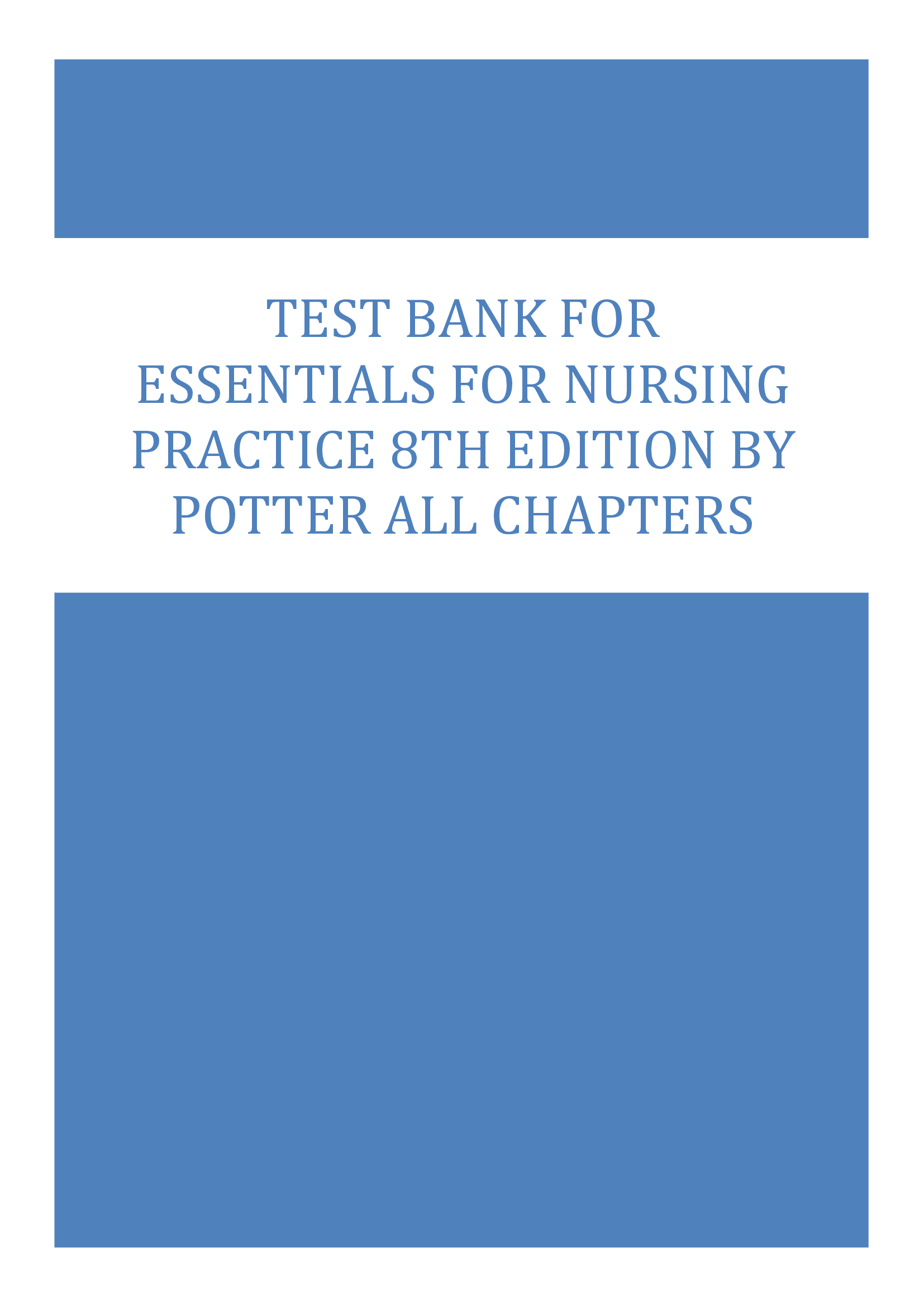
Test Bank for Essentials for Nursing Practice 8th Edition by Potter | All Chapters
View Document

Test Bank for Essent...

  • mentor2000

    mentor2000

  • test bank

Master nursing concepts with this study material; Test Bank for Essentials for Nursing Practice, 8th...

15 USD

0

0

A &P 1 MA278 BSC2 Final Module II Questions & Answers 2026 Update
View Document

A &P 1 MA278 BSC2 Fi...

  • mentor2000

    mentor2000

  • test bank

Prepare for success with A&P 1 MA278 BSC2 Final Module II 2024 Q&A. Boost your grades with this comp...

15 USD

0

0

ATI Comprehensive Predictor Exam 2026
View Document

ATI Comprehensive Pr...

  • mentor2000

    mentor2000

  • test bank

Prepare for success with the ATI Comprehensive Predictor Exam 2026. Access key practice questions to...

15 USD

0

0

Purchase

Download link will be sent to this email immediately after purchase.

IMPORTANT LINKS

  • How To Upload Class Notes
  • Selling Tips
  • Passing Grades's Study Materials
  • Scholarships for International Students 2025

POPULAR CATEGORIES

  • Law
  • Accounting
  • English
  • Psychology
  • Business
  • Nursing
  • Computer Science
  • General

View Document

  • Blog
  • Contact
  • Delivery Policy
  • Latest Scholarships Around the World
  • How to Pass Bar Exams: Passing Grades’ Strategies
  • How to Study and Pass the CPA Exam
  • All Test Banks
  • Faq
  • Copyright Claims
  • Privacy Policy
  • Terms of Use

KNOWLEDGE BASE

  • How to Write A+ Grade Good Research Paper
  • How to Manage Stress During Exam Period
  • Best Time to Study
  • How to Pass NCLEX-RN Exam
  • How To Effectively Utilize Test Banks
  • Popular Shadow Health Exam Assessments
  • Popular HESI Case Studies
  • How to Prepare for a Nursing Career
  • The Importance Of Summaries in Exam Revisvion

© 2026 Pasing Grades. All rights reserved.