Pasing Grades
  • Start Selling
  • Blog
  • Contact
  • 0

    Your cart is empty!

English

  • English
  • Spanish
  • Arabic
Create Account Sign In
  • Library
    • New Prep Guides
    • Featured Prep Guides
    • Free Exam Prep Guides
    • Best sellers
  • General
  • Nursing
    • Research Paper
    • Case Study
    • Discussion Post
    • Assignment
    • Exam
    • Practice Questions and Answers
    • Test Bank
    • solutions manual
  • Accounting
    • Case Study
    • Thesis
    • Study Guide
    • Summary
    • Research Paper
    • test bank
  • English
    • Creative Writing
    • Research Paper
    • Summary
    • Rhetorics
    • Literature
    • Journal
    • Exam
    • Grammar
    • Discussion Post
    • Essay
  • Psychology
    • Hesi
    • Presentation
    • Essay
    • Summary
    • Study Guide
    • Essay
    • Solution Manual
    • Final Exam Review
    • Class Notes
    • test bank
  • Business
    • Lecture Notes
    • Solution Manual
    • Presentation
    • Business Plan
    • Class Notes
    • Experiment
    • Summary
    • Practice Questions
    • Study Guide
    • Case Study
    • test bank
    • Exam
  • More
    • Computer Science
    • Economics
    • Statistics
    • Engineering
    • Biology
    • Religious Studies
    • Physics
    • Chemistry
    • Mathematics
    • History
    • Sociology
    • Science
    • Philosophy
    • Law
  • Pages
    • About Us
    • Selling Tips
    • Delivery Policy
    • Faq
    • Privacy Policy
  • Flash Sale
  • Home
  • Test Bank for Introduction to Corrections 3rd Edition by Hanser

Test Bank for Introduction to Corrections 3rd Edition by Hanser

Preview page 1 Preview page 2 Preview page 3
Add To Favorites

Share this item Share this item

  • Item Details
  • Comments (0)
  • Reviews (0)
  • Contact Seller

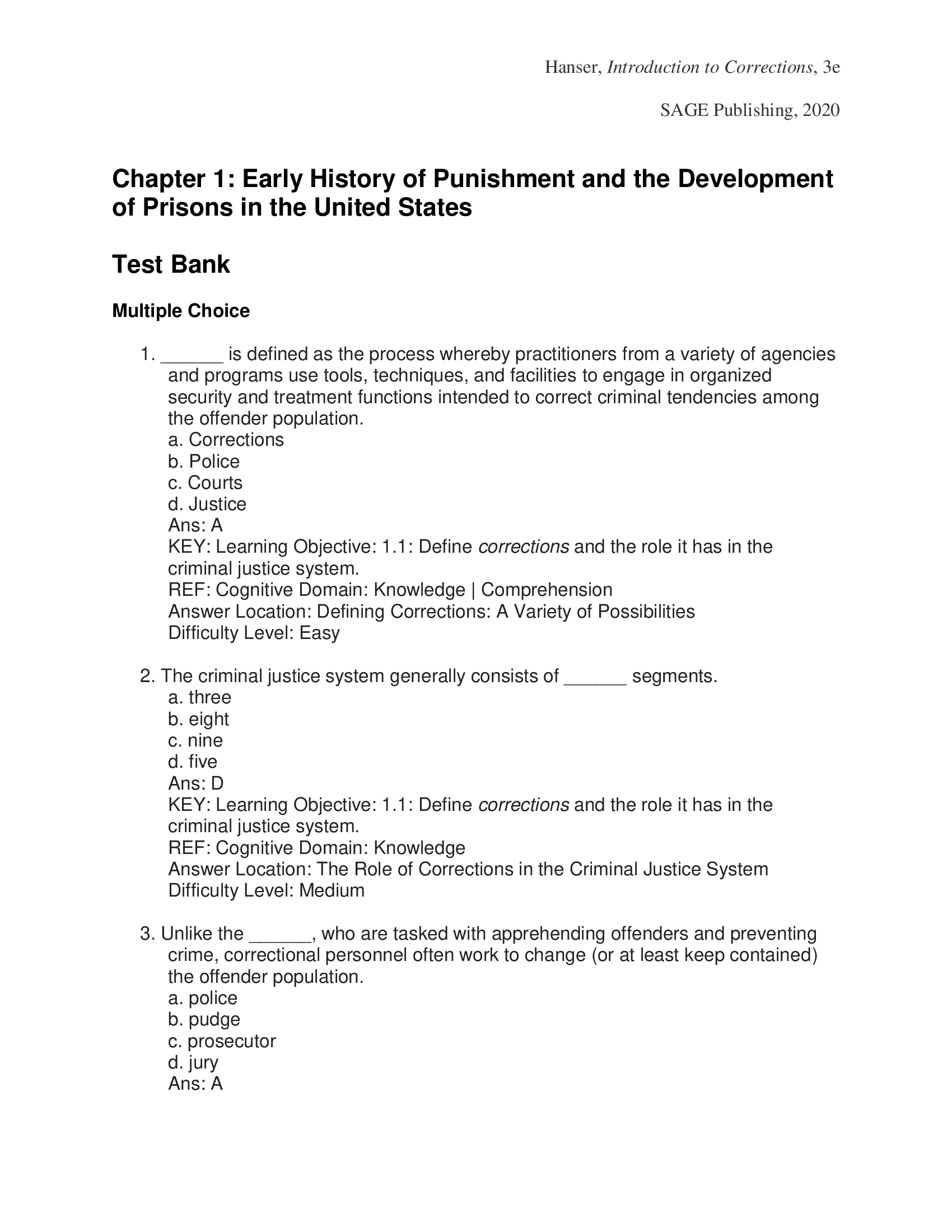
1.            ______ is defined as the process whereby practitioners from a variety of agencies and programs use tools, techniques, and facilities to engage in organized security and treatment functions intended to correct criminal tendencies among the offender population. a. Corrections

b.            Police

c.            Courts

d.            Justice

Ans: A

KEY: Learning Objective: 1.1: Define corrections and the role it has in the criminal justice system.

REF: Cognitive Domain: Knowledge | Comprehension

Answer Location: Defining Corrections: A Variety of Possibilities Difficulty Level: Easy


2.            The criminal justice system generally consists of ______ segments. a. three

b.            eight

c.            nine

d.            five

Ans: D

KEY: Learning Objective: 1.1: Define corrections and the role it has in the criminal justice system.

REF: Cognitive Domain: Knowledge

Answer Location: The Role of Corrections in the Criminal Justice System Difficulty Level: Medium


3.            Unlike the ______, who are tasked with apprehending offenders and preventing crime, correctional personnel often work to change (or at least keep contained) the offender population. a. police

b.            pudge

c.            prosecutor

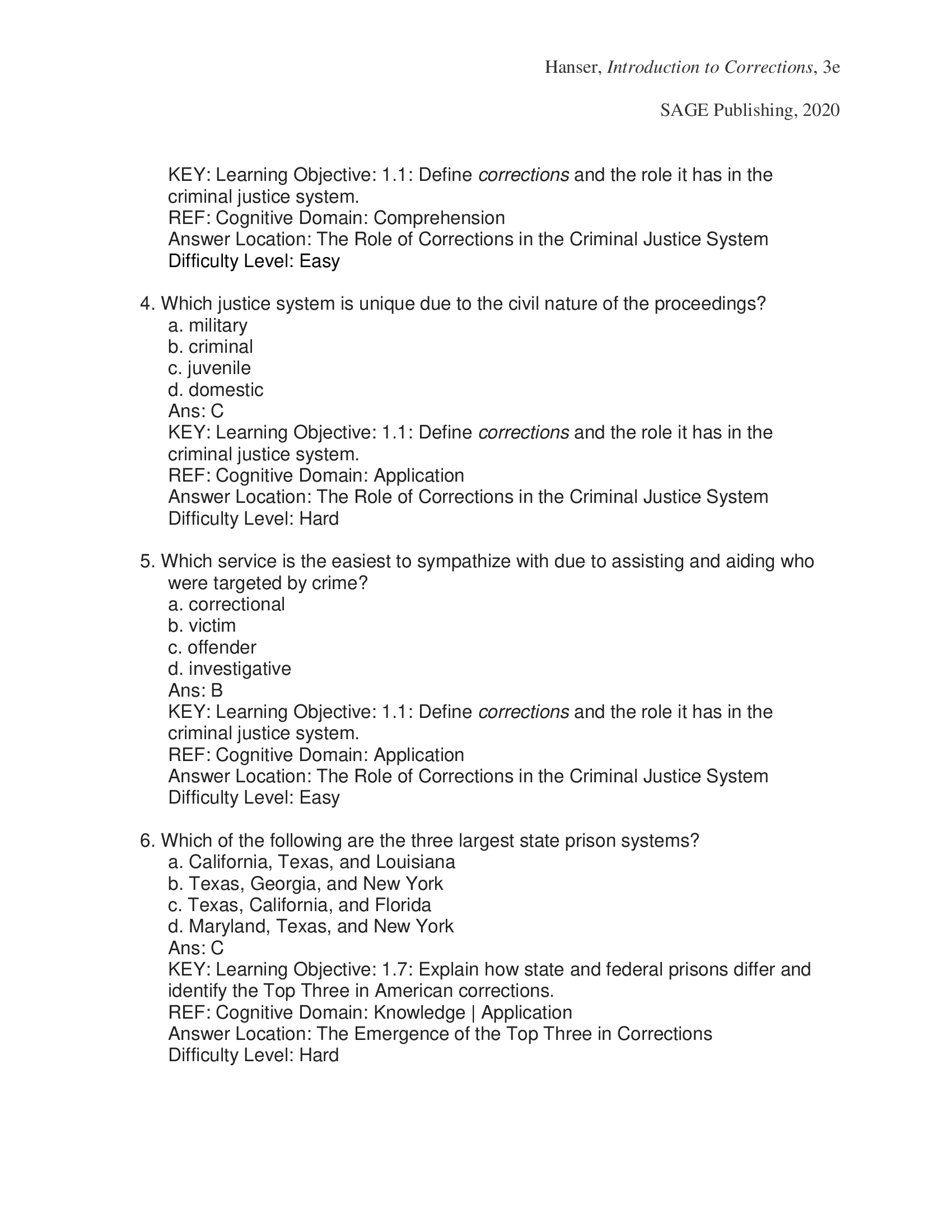
d.            jury Ans: A KEY: Learning Objective: 1.1: Define corrections and the role it has in the criminal justice system.

REF: Cognitive Domain: Comprehension

Answer Location: The Role of Corrections in the Criminal Justice System Difficulty Level: Easy


4.            Which justice system is unique due to the civil nature of the proceedings? a. military

b.            criminal

c.            juvenile

d.            domestic

Ans: C

KEY: Learning Objective: 1.1: Define corrections and the role it has in the criminal justice system.

REF: Cognitive Domain: Application

Answer Location: The Role of Corrections in the Criminal Justice System Difficulty Level: Hard


5.            Which service is the easiest to sympathize with due to assisting and aiding who were targeted by crime? a. correctional

b.            victim

c.            offender

d.            investigative

Ans: B

KEY: Learning Objective: 1.1: Define corrections and the role it has in the criminal justice system.

REF: Cognitive Domain: Application

Answer Location: The Role of Corrections in the Criminal Justice System Difficulty Level: Easy


6.            Which of the following are the three largest state prison systems?

a.            California, Texas, and Louisiana

b.            Texas, Georgia, and New York

c.            Texas, California, and Florida

d.            Maryland, Texas, and New York

Ans: C

KEY: Learning Objective: 1.7: Explain how state and federal prisons differ and identify the Top Three in American corrections. REF: Cognitive Domain: Knowledge | Application

Answer Location: The Emergence of the Top Three in Corrections Difficulty Level: Hard


7.            Prior to the Civil War, ______ Codes required White inmates to be separated from slaves. Frequently slaves were given harsher punishments for crimes. a. White

b.            Slave

c.            Black

d.            Southern

Ans: C

KEY: Learning Objective: 1.5:  Describe the changes to prison systems brought about by the Age of the Reformatory in America. REF: Cognitive Domain: Comprehension | Application

Answer Location: The Southern System of Penology: Before and After the Civil War

Difficulty Level: Easy


8.            Who created the concept of the “hedonistic calculus,” which involves individuals maximizing pleasure and reducing pain? a. Cesare Beccaria

b.            William Penn

c.            Jeremy Bentham

d.            Samuel Wood

Ans: C

KEY: Learning Objective: 1.5:  Describe the changes to prison systems brought about by the Age of the Reformatory in America. | 6. Identify the various prison systems, eras, and models that developed in the early and mid-1900s in America.

REF: Cognitive Domain: Comprehension | Knowledge

Answer Location: Jeremy Bentham: Hedonistic Calculus Difficulty Level: Medium


9.            Who was an advocate of religious freedom and instrumental in spreading the concept of humane treatment of prisoners, specifically in Pennsylvania? a. William Howard

b.            Cesare Beccaria

c.            William Penn

d.            James Regal

Ans: C

KEY: Learning Objective: 1.3: Discuss the influence of the Enlightenment and key persons on correctional reform.

REF: Cognitive Domain: Comprehension | Knowledge

Answer Location: William Penn, the Quakers, and the Great Law Difficulty Level: Medium


10.         Who published an influential treatise in 1764 titled An Essay on Crimes and Punishment, which argued against the death penalty and for the certainty rather than the severity of punishment? a. John Howard

b.            Jeremy Bentham

c.            William Penn

d.            Cesare Beccaria

Ans: D

KEY: Learning Objective: 1.3: Discuss the influence of the Enlightenment and key persons on correctional reform.

REF: Cognitive Domain: Knowledge | Comprehension

Answer Location: Charles Montesquieu, Francois Voltarie, and Cesare Beccaria Difficulty Level: Medium


11.         In what year did the Eastern State Penitentiary open in Pennsylvania? a. 1903

b.            1829

c.            1899

d.            1778

Ans: B

KEY: Learning Objective: 1.4: Discuss the development of punishment in early American history. | 6. Identify the various prison systems, eras, and models that developed in the early and mid-1900s in America.

REF: Cognitive Domain: Knowledge

Answer Location: The Pennsylvania System Difficulty Level: Hard


12.         What are crimes against society or a social group, which historically tended to include sacrilege as well as other crimes against religion, treason, witchcraft, incest, sex offenses of any sort, and even violations of hunting rules? a. public transcreations

b.            public biases

c.            public injustices

d.            public wrongs

Ans: D

KEY: Learning Objective: 1.3: Discuss the influence of the Enlightenment and key persons on correctional reform.

REF: Cognitive Domain: Knowledge | Application

Answer Location: Public and Private Wrongs

Difficulty Level: Medium


13.         During the American Revolution, British officials housed prisoners in brokendown or decommissioned vessels known as ______. a. hulks

b.            prison ships

c.            floating prisons

d.            bars on sea

Ans: A

KEY: Learning Objective: 1.4: Discuss the development of punishment in early American history.

REF: Cognitive Domain: Comprehension | Application

Answer Location: Hulks and Floating Prisons Difficulty Level: Hard


14.         The earliest written code of punishment was known as the ______.

a.            Egyptian Code

b.            Babylonian Code

c.            Hammurabi’s Code

d.            Caesar’s Code

Ans: C

KEY: Learning Objective: 1.2: Identify early historical developments and justifications in the use of punishment and corrections.

REF: Cognitive Domain: Knowledge

Answer Location: Babylonian and Sumerian Codes Difficulty Level: Medium 


15.         Which of the following was not an early form of punishment in correctional history?

a.            trial by ordeal

b.            branding

c.            whipping

d.            all of these

Ans: D

KEY: Learning Objective: 1.2: Identify early historical developments and justifications in the use of punishment and corrections. | 4. Discuss the development of punishment in early American history.

REF: Cognitive Domain: Application

Answer Location: Table 1.1: Types of Punishment in Early Correctional History Difficulty Level: Easy


16.         Which early prison system kept inmates in solitary confinement during the evening but permitted inmates to work together during the day? a. Pennsylvania

b.            New York

c.            Auburn

d.            Alabama Ans: C KEY: Learning Objective: 1.6: Identify the various prison systems, eras, and models that developed in the early and mid-1900s in America.

REF: Cognitive Domain: Knowledge

Answer Location: The Auburn System

Difficulty Level: Easy


17.         Besides the death penalty, ______ was another useful punishment between 1100 and 1700—at times this meant being exiled to another country. a. whipping

b.            banishment

c.            branding

d.            stocks

Ans: B

KEY: Learning Objective: 1.2: Identify early historical developments and justifications in the use of punishment and corrections. | 1.4 Discuss the development of punishment in early American history.

REF: Cognitive Domain: Comprehension

Answer Location: Banishment

Difficulty Level: Hard


18.         In 1790, the first American jail opened called the ______ in Philadelphia, Pennsylvania.

a.            Walnut Street Jail

b.            Coconut Grove Jail

c.            Main Street Jail

d.            Almond Court Jail

Ans: A

KEY: Learning Objective: 1.4: Discuss the development of punishment in early American history.

REF: Cognitive Domain: Knowledge

Answer Location: The Walnut Street Jail

Difficulty Level: Easy


19.         Which of the following is an example of branding in early American society?

a.            marked on their thumb with the letter “T” for thief

b.            marked on their thumb with the letter “M” for murderer

c.            none of these

d.            all of these

Ans: D

KEY: Learning Objective: 1.4: Discuss the development of punishment in early American history.

REF: Cognitive Domain: Application | Analysis

Answer Location: Retaliation Through Humiliation

Difficulty Level: Medium


20.         The ______ followed a body of laws called the Great Law, which was more humane in approach than the typical English response to crime. a. Buddhists

b.            Catholics

c.            Quakers

d.            Mormons

Ans: C

KEY: Learning Objective: 1.3: Discuss the influence of the Enlightenment and key persons on correctional reform. REF: Cognitive Domain: Comprehension

Answer Location: William Penn, the Quakers, and the Great Law Difficulty Level: Easy


21.         What was the name of the first reformatory, which opened in 1876? a. Elmira

b.            Auburn

c.            Pennsylvania

d.            Attica

Ans: A

KEY: Learning Objective: 1.5:  Describe the changes to prison systems brought about by the Age of the Reformatory in America.

REF: Cognitive Domain: Knowledge

Answer Location: The Age of the Reformatory in America Difficulty Level: Easy


22.         When examining early forms of punishment and corrections, it was clearly ______ compared with punishments today. a. barbaric

b.            simplistic

c.            compassionate

d.            humane

Ans: A

KEY: Learning Objective: 1.1:Define corrections and the role it has in the criminal justice system. | 1.4 Discuss the development of punishment in early American history.

REF: Cognitive Domain: Analysis

Answer Location: Conclusion

Difficulty Level: Medium


23.         The rise of the ______ and the writings of a variety of scholars and philosophers helped shape the use of simple punishments from barbaric cruelty to corrective mechanisms indeed to reduce problematic behaviors. a. Illumination

b.            Enlightenment

c.            Brilliance

d.            Wisdom

Ans: B

KEY: Learning Objective: 1.3: Discuss the influence of the Enlightenment and key persons on correctional reform. REF: Cognitive Domain: Comprehension

Answer Location: Conclusion

Difficulty Level: Hard


24.         What was the name of the first official prison in the United States of America? a. Walnut Street Jail

b.            Old Newgate Prison

c.            Old State Prison

d.            Jackson Street Prison

Ans: B

KEY: Learning Objective: 1.4: Discuss the development of punishment in early American history.

REF: Cognitive Domain: Knowledge

Answer Location: Punishment During Early American History: 1700s–1800s Difficulty Level: Easy


25.         ______ sentences include a range of years that will be potentially served by the offender. The offender is released at some point during the assigned years by the sentencing judge. a. Determinate

b.            Truth-in

c.            Indeterminate

d.            Representative

Ans: C

KEY: Learning Objective: 1.5:  Describe the changes to prison systems brought about by the Age of the Reformatory in America. | 6. Identify the various prison systems, eras, and models that developed in the early and mid-1900s in America.

REF: Cognitive Domain: Application

Answer Location: The Age of the Reformatory in America Difficulty Level: Hard


26.         Which type of sentencing consists of fixed periods of incarceration with no flexibility in terms of time served? a. determinate

b.            truth-in

c.            indeterminate

d.            representative

Ans: A

KEY: Learning Objective: 1.5:  Describe the changes to prison systems brought about by the Age of the Reformatory in America. | 6. Identify the various prison systems, eras, and models that developed in the early and mid-1900s in America.

REF: Cognitive Domain: Application | Analysis

Answer Location: The Age of the Reformatory in America Difficulty Level: Hard


27.         Which type of prison was typically made of large stones with brick walls, guard towers, and checkpoints within the facility? a. minimum security

b.            Big House

c.            intermediate

d.            medium security

Ans: B

KEY: Learning Objective: 1.6: Identify the various prison systems, eras, and models that developed in the early and mid-1900s in America.

REF: Cognitive Domain: Knowledge

Answer Location: The Era of the “Big House” Difficulty Level: Easy


28.         Which model can be described as a correctional treatment that utilizes a mental health approach incorporating psychology, biology, and criminology to treat the offender?

a.            reintegration

b.            restorative

c.            medical

d.            scientific

Ans: C

KEY: Learning Objective: 1.6: Identify the various prison systems, eras, and models that developed in the early and mid-1900s in America.

REF: Cognitive Domain: Knowledge

Answer Location: The Medical Model

Difficulty Level: Easy


29.         Which model evolved during the last few years to include identifying programs that examined external environment causes of crime? a. medical

b.            crime control

c.            restorative

d.            reintegration

Ans: D

KEY: Learning Objective: 1.6: Identify the various prison systems, eras, and models that developed in the early and mid-1900s in America.

REF: Cognitive Domain: Knowledge

Answer Location: The Reintegration Model Difficulty Level: Easy

30.         Which model emerged during the “get-tough movement” and incorporated longer sentences and an increased use of intensive supervised probation? a. reintegration

b.            crime control

c.            medical

d.            restorative

Ans: B

KEY: Learning Objective: 1.6: Identify the various prison systems, eras, and models that developed in the early and mid-1900s in America.

REF: Cognitive Domain: Knowledge

Answer Location: The Crime Control Model Difficulty Level: Easy

Contact the Seller

Please Sign In to contact this seller.


  • 👎  Report Copyright Violation

Frequently Asked Questions

What Do I Get When I Buy This Study Material?

+

When you buy a study material on Passing Grades, an instant download link will be sent directly to your email, giving you access to the file anytime after payment is completed.

Is Passing Grades a Trusted Platform?

+

Yes, Passing Grades is a reputable students’ marketplace with a secure payment system and reliable customer support. You can trust us to ensure a safe and seamless transaction experience.

Will I Be Stuck with a Subscription?

+

No, all purchases on Passing Grades are one-time transactions. You only pay for the notes you choose to buy, with no subscriptions or hidden fees attached.

Who Am I Buying These Study Materials From?

+

Passing Grades is a marketplace, which means you are purchasing the document from an individual vendor, not directly from us. We facilitate the payment and delivery process between you and the vendor.

Does Passing Grades Offer Free Study Materials?

+

Yes, sellers on Passing Grades have uploaded numerous free test banks, exams, practice questions, and class notes that can be downloaded at no cost.

Pasinggrades - Quality Study Materials

USD 13

    • Quality checked by Pasing Grades
    • 100% satisfaction guarantee
    • Seller: mentor2000
Buy PDF $13

Seller Information

mentor2000

Member since April 2021

  • icon
  • icon
View Profile
  • total sales

    0
  • Favourites

    0
  • Comments

    0
    ( 0 Ratings )

Item Information

  • Uploaded

    09 February 2025

  • Updated

    01 July 2025

  • Category

    Law

  • Item Type

    test bank

  • Tags

    Test Bank for Introduction to Corrections 3rd Edition by Hanser

Related Exam Prep Guides by mentor2000

Test Bank for Essentials for Nursing Practice 8th Edition by Potter | All Chapters
View Document

Test Bank for Essent...

  • mentor2000

    mentor2000

  • test bank

Master nursing concepts with this study material; Test Bank for Essentials for Nursing Practice, 8th...

13 USD

0

0

A &P 1 MA278 BSC2 Final Module II Questions & Answers 2026 Update
View Document

A &P 1 MA278 BSC2 Fi...

  • mentor2000

    mentor2000

  • test bank

Prepare for success with A&P 1 MA278 BSC2 Final Module II 2024 Q&A. Boost your grades with this comp...

13 USD

0

0

ATI Comprehensive Predictor Exam 2026
View Document

ATI Comprehensive Pr...

  • mentor2000

    mentor2000

  • test bank

Prepare for success with the ATI Comprehensive Predictor Exam 2026. Access key practice questions to...

13 USD

0

0

Purchase

Download link will be sent to this email immediately after purchase.

IMPORTANT LINKS

  • How To Upload Class Notes
  • Selling Tips
  • Passing Grades's Study Materials
  • Scholarships for International Students 2025

POPULAR CATEGORIES

  • Law
  • Accounting
  • English
  • Psychology
  • Business
  • Nursing
  • Computer Science
  • General

View Document

  • Blog
  • Contact
  • Delivery Policy
  • Latest Scholarships Around the World
  • How to Pass Bar Exams: Passing Grades’ Strategies
  • How to Study and Pass the CPA Exam
  • All Test Banks
  • Faq
  • Copyright Claims
  • Privacy Policy
  • Terms of Use

KNOWLEDGE BASE

  • How to Write A+ Grade Good Research Paper
  • How to Manage Stress During Exam Period
  • Best Time to Study
  • How to Pass NCLEX-RN Exam
  • How To Effectively Utilize Test Banks
  • Popular Shadow Health Exam Assessments
  • Popular HESI Case Studies
  • How to Prepare for a Nursing Career
  • The Importance Of Summaries in Exam Revisvion

© 2026 Pasing Grades. All rights reserved.