Pasing Grades
  • Start Selling
  • Blog
  • Contact
  • 0

    Your cart is empty!

English

  • English
  • Spanish
  • Arabic
Create Account Sign In
  • Library
    • New Prep Guides
    • Featured Prep Guides
    • Free Exam Prep Guides
    • Best sellers
  • General
  • Nursing
    • Research Paper
    • Case Study
    • Discussion Post
    • Assignment
    • Exam
    • Practice Questions and Answers
    • Test Bank
    • solutions manual
  • Accounting
    • Case Study
    • Thesis
    • Study Guide
    • Summary
    • Research Paper
    • test bank
  • English
    • Creative Writing
    • Research Paper
    • Summary
    • Rhetorics
    • Literature
    • Journal
    • Exam
    • Grammar
    • Discussion Post
    • Essay
  • Psychology
    • Hesi
    • Presentation
    • Essay
    • Summary
    • Study Guide
    • Essay
    • Solution Manual
    • Final Exam Review
    • Class Notes
    • test bank
  • Business
    • Lecture Notes
    • Solution Manual
    • Presentation
    • Business Plan
    • Class Notes
    • Experiment
    • Summary
    • Practice Questions
    • Study Guide
    • Case Study
    • test bank
    • Exam
  • More
    • Computer Science
    • Economics
    • Statistics
    • Engineering
    • Biology
    • Religious Studies
    • Physics
    • Chemistry
    • Mathematics
    • History
    • Sociology
    • Science
    • Philosophy
    • Law
  • Pages
    • About Us
    • Selling Tips
    • Delivery Policy
    • Faq
    • Privacy Policy
  • Flash Sale
  • Home
  • Test Bank For Human Geography: People, Place, and Culture, 11th Edition, Erin H. Fouberg, Alexander B. Murphy, Harm J. de Blij

Test Bank For Human Geography: People, Place, and Culture, 11th Edition, Erin H. Fouberg, Alexander B. Murphy, Harm J. de Blij

Preview page 1 Preview page 2 Preview page 3
Add To Favorites

Share this item Share this item

  • Item Details
  • Comments (0)
  • Reviews (0)
  • Contact Seller

Test Bank For Human Geography; People, Place, and Culture, 11th Edition, Erin H. Fouberg, Alexander B. Murphy, Harm J. de Blij

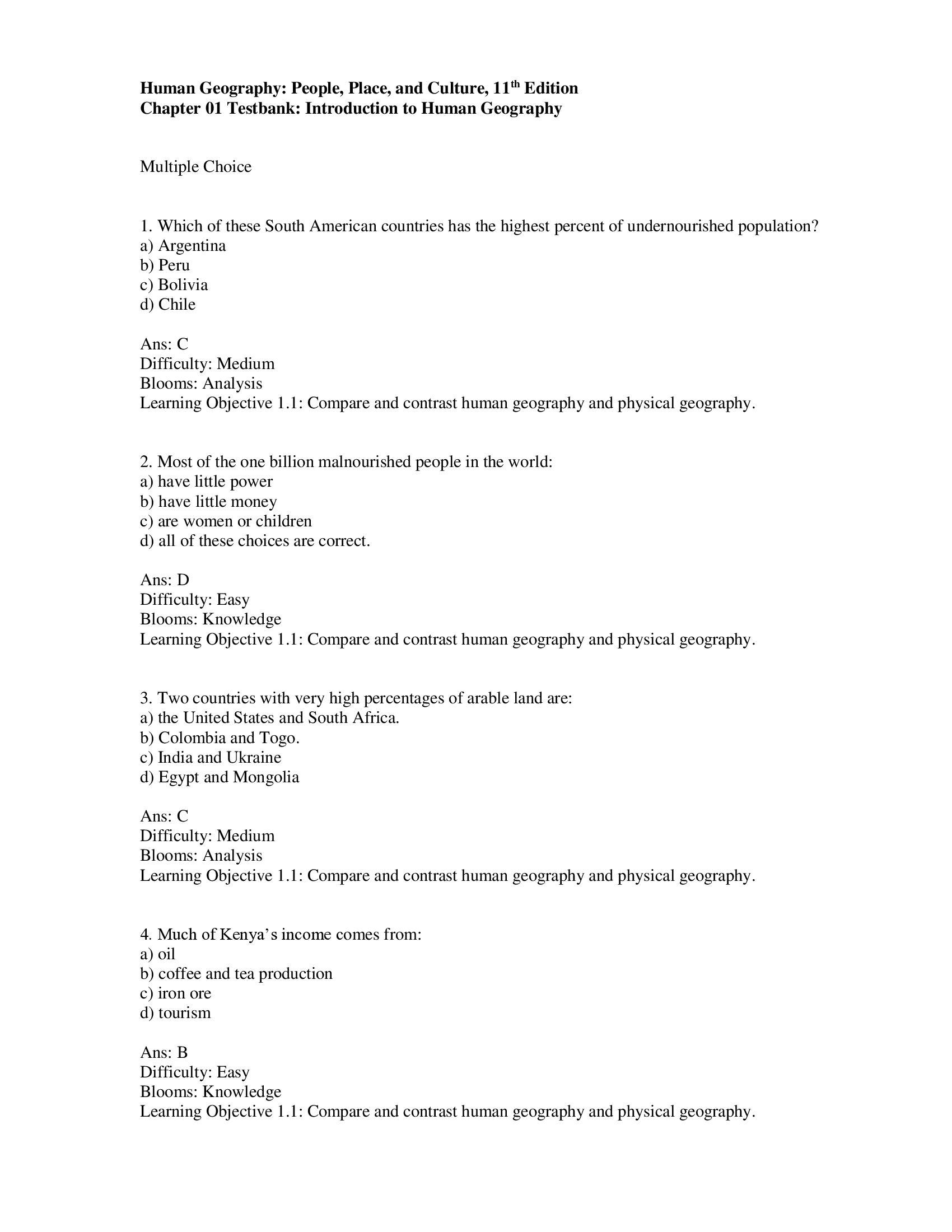
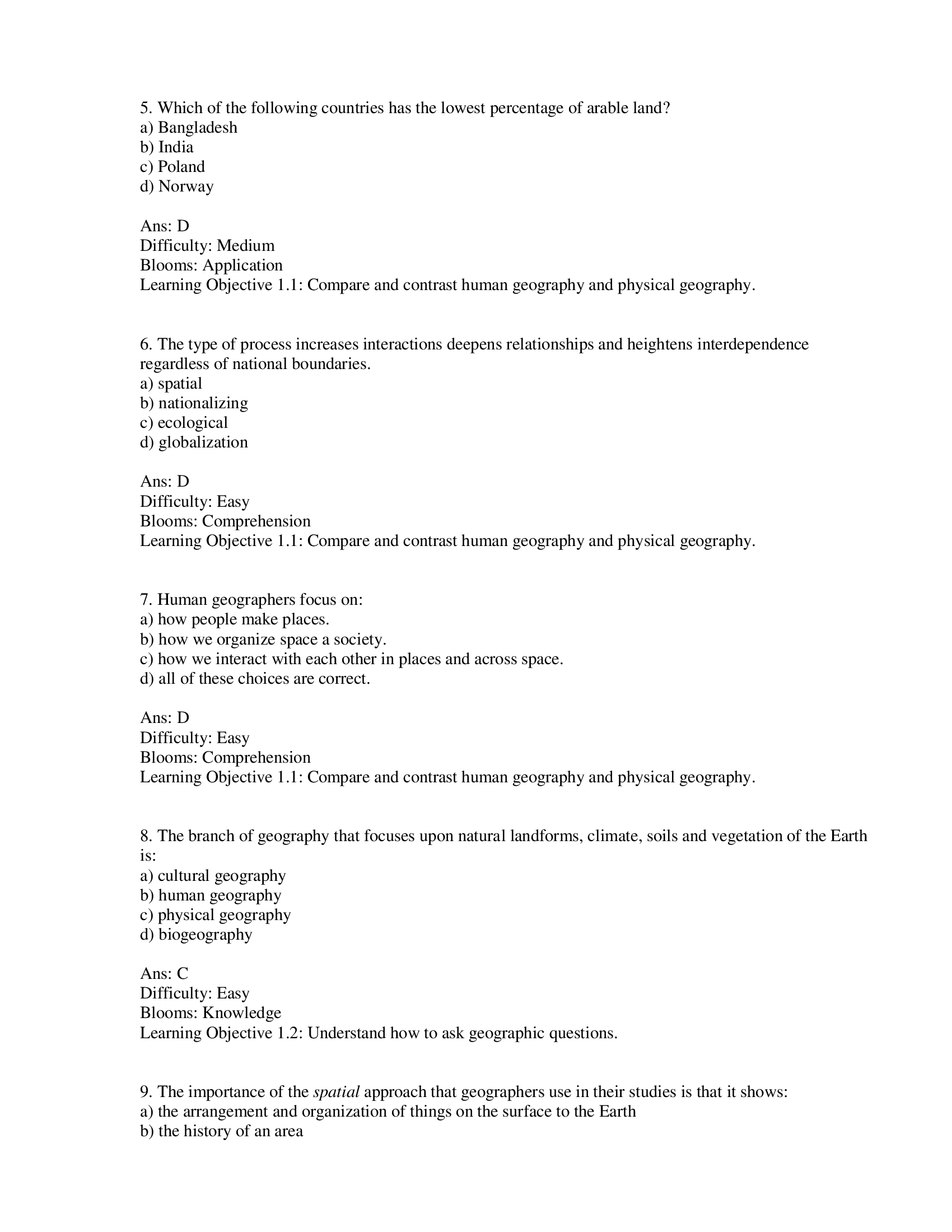
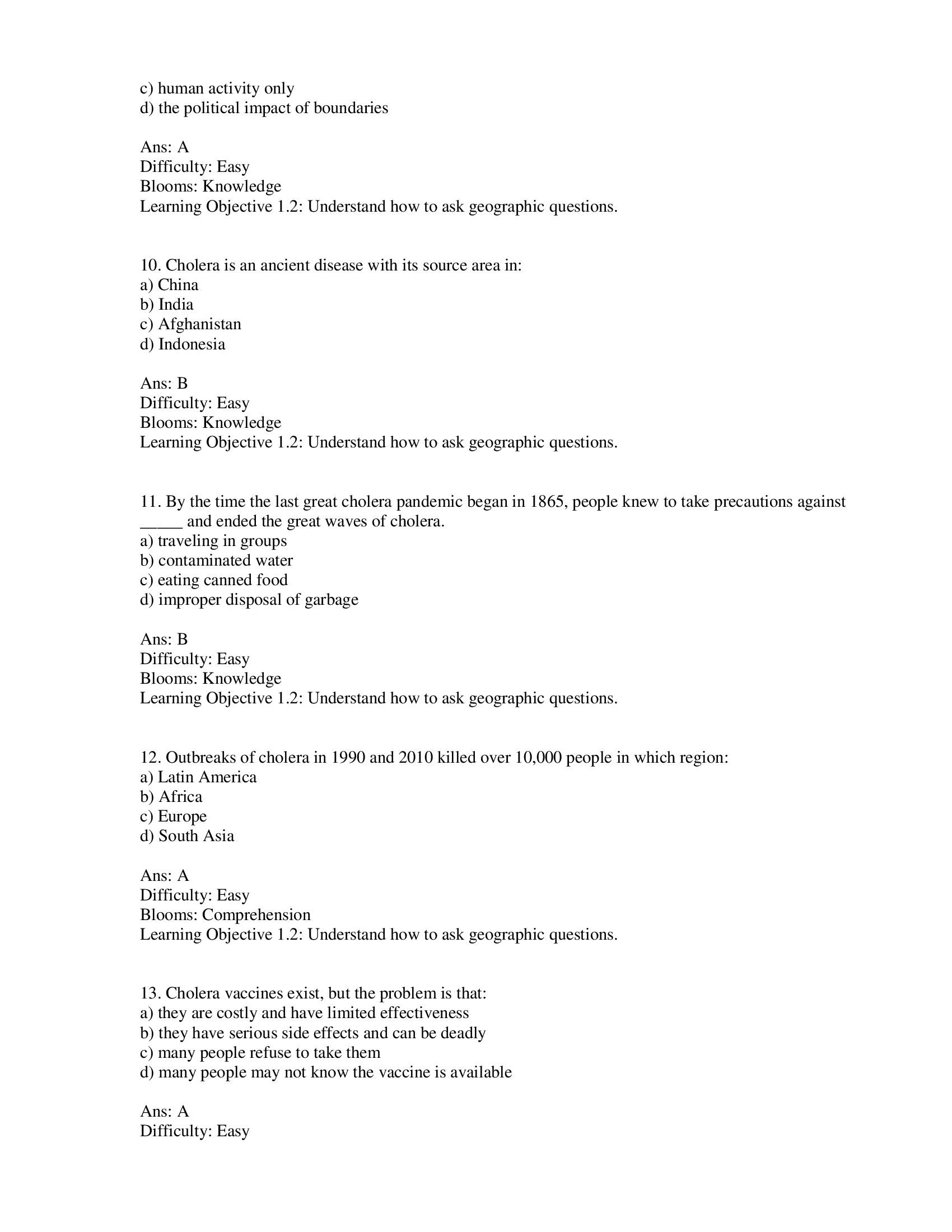
Human Geography: People, Place, and Culture, 11th Edition Chapter 01 Testbank: Introduction to Human Geography Multiple Choice 1. Which of these South American countries has the highest percent of undernourished population? a) Argentina b) Peru c) Bolivia d) Chile Ans: C Difficulty: Medium Blooms: Analysis Learning Objective 1.1: Compare and contrast human geography and physical geography. 2. Most of the one billion malnourished people in the world: a) have little power b) have little money c) are women or children d) all of these choices are correct. Ans: D Difficulty: Easy Blooms: Knowledge Learning Objective 1.1: Compare and contrast human geography and physical geography. 3. Two countries with very high percentages of arable land are: a) the United States and South Africa. b) Colombia and Togo. c) India and Ukraine d) Egypt and Mongolia Ans: C Difficulty: Medium Blooms: Analysis Learning Objective 1.1: Compare and contrast human geography and physical geography. 4. Much of Kenya’s income comes from: a) oil b) coffee and tea production c) iron ore d) tourism Ans: B Difficulty: Easy Blooms: Knowledge Learning Objective 1.1: Compare and contrast human geography and physical geography. 5. Which of the following countries has the lowest percentage of arable land? a) Bangladesh b) India c) Poland d) Norway Ans: D Difficulty: Medium Blooms: Application Learning Objective 1.1: Compare and contrast human geography and physical geography. 6. The type of process increases interactions deepens relationships and heightens interdependence regardless of national boundaries. a) spatial b) nationalizing c) ecological d) globalization Ans: D Difficulty: Easy Blooms: Comprehension Learning Objective 1.1: Compare and contrast human geography and physical geography. 7. Human geographers focus on: a) how people make places. b) how we organize space a society. c) how we interact with each other in places and across space. d) all of these choices are correct. Ans: D Difficulty: Easy Blooms: Comprehension Learning Objective 1.1: Compare and contrast human geography and physical geography. 8. The branch of geography that focuses upon natural landforms, climate, soils and vegetation of the Earth is: a) cultural geography b) human geography c) physical geography d) biogeography Ans: C Difficulty: Easy Blooms: Knowledge Learning Objective 1.2: Understand how to ask geographic questions. 9. The importance of the spatial approach that geographers use in their studies is that it shows: a) the arrangement and organization of things on the surface to the Earth b) the history of an area c) human activity only d) the political impact of boundaries Ans: A Difficulty: Easy Blooms: Knowledge Learning Objective 1.2: Understand how to ask geographic questions. 10. Cholera is an ancient disease with its source area in: a) China b) India c) Afghanistan d) Indonesia Ans: B Difficulty: Easy Blooms: Knowledge Learning Objective 1.2: Understand how to ask geographic questions. 11. By the time the last great cholera pandemic began in 1865, people knew to take precautions against _____ and ended the great waves of cholera. a) traveling in groups b) contaminated water c) eating canned food d) improper disposal of garbage Ans: B Difficulty: Easy Blooms: Knowledge Learning Objective 1.2: Understand how to ask geographic questions. 12. Outbreaks of cholera in 1990 and 2010 killed over 10,000 people in which region: a) Latin America b) Africa c) Europe d) South Asia Ans: A Difficulty: Easy Blooms: Comprehension Learning Objective 1.2: Understand how to ask geographic questions. 13. Cholera vaccines exist, but the problem is that: a) they are costly and have limited effectiveness b) they have serious side effects and can be deadly c) many people refuse to take them d) many people may not know the vaccine is available Ans: A Difficulty: Easy Blooms: Knowledge Learning Objective 1.2: Understand how to ask geographic questions. 14. Which geographical theme would involve the study of the impact of the drainage of part of the Florida Everglades? a) human-environment b) movement c) place d) location Ans: A Difficulty: Easy Blooms: Comprehension Learning Objective 1.2: Understand how to ask geographic questions. 15. _________________ refers to the infusing of a locality with meaning and emotion. a) Regionalization b) Human-environment interaction c) Sense of place d) Location theory Ans: C Difficulty: Easy Blooms: Knowledge Learning Objective 1.2: Understand how to ask geographic questions. 16. The degree of direct linkage between one particular location and other locations in a transport network is referred to as: a) spatial interaction. b) movement. c) landscape. d) connectivity. Ans: D Difficulty: Easy Blooms: Knowledge Learning Objective 1.2: Understand how to ask geographic questions. 17. Geographer Carl O. Sauer is most closely connected with: a) natural landscape b) cultural landscape c) regional geography d) location theory Ans: B Difficulty: Easy Blooms: Knowledge Learning Objective 1.2: Understand how to ask geographic questions. 18. In their study on students’ perceptions of place, Gould and White found that a) students would prefer to live near the Rocky Mountains. b) students would prefer to live in Utah over California. c) students have no place preferences. d) students have a strong bias for their home region. Ans: D Difficulty: Easy Blooms: Knowledge Learning Objective 1.2: Understand how to ask geographic questions. 19. The cultural landscape of Dares Salaam is a composite of several different culture groups which have administered the place. British policy stimulated the development of a district of 3 to 4 story apartments reminiscent of: a) London b) Bombay c) Nairobi d) Paris Ans: B Difficulty: Easy Blooms: Knowledge Learning Objective 1.2: Understand how to ask geographic questions. 20. Latitude and longitude are most useful in determining: a) relative location b) topography c) absolute location d) elevations Ans: C Difficulty: Easy Blooms: Comprehension Learning Objective 1.3: Compare and contrast the use and presentation of data among different types of maps. 21. The location of a place in relationship to other places or features around it is called: a) absolute location b) site c) relative location d) index of placeness Ans: C Difficulty: Medium Blooms: Learning Objective 1.3: Compare and contrast the use and presentation of data among different types of maps. 22. Chicago’s relative location has changed over time with: a) the building of new railroads. b) the opening of O’Hare international airport. c) the construction of Interstate Highways system. d) all of these choices are correct. Ans: D Difficulty: Medium Blooms: Application Learning Objective 1.3: Compare and contrast the use and presentation of data among different types of maps. 23. The mental map you have of places you routinely visit is a map of your: a) neighborhood. b) inner world. c) region. d) activity spaces. Ans: D Difficulty: Easy Blooms: Knowledge Learning Objective 1.3: Compare and contrast the use and presentation of data among different types of maps. 24. Which of the following regions generally receives the most precipitation? a) North Africa b) Southwest Asia c) Eastern Europe d) Southeast Asia Ans: D Difficulty: Medium Blooms: Analysis Learning Objective 1.3: Compare and contrast the use and presentation of data among different types of maps. 25. The concern of geography with space puts _________ at the center of its agenda. a) patterns b) distance c) scale d) places Ans: C Difficulty: Easy Blooms: knowledge Learning Objective 1.4: Explain the importance of scale and connectedness. 26. A good example of a formal region would be a: a) region surrounding a manufacturing complex b) city and its surrounding region c) region of similar language d) region showing the migration to a central location Ans: C Difficulty: Medium Blooms: Application Learning Objective 1.4: Explain the importance of scale and connectedness. 27. A good example of a functional region would be: a) a city and its surrounding region b) region where everyone speaks French c) region where farming practices are the same d) region of a similar climate Ans: A Difficulty: Easy Blooms: Knowledge Learning Objective 1.4: Explain the importance of scale and connectedness. 28. The cultural geographer Wilbur Zelinsky approached the task of defining and delimiting the perceptual regions of the United States and southern Canada by analyzing: a) results from thousands of personal interviews. b) results of census data. c) contents of hundreds of telephone directories of metropolitan areas. d) data of social workers. Ans: C Difficulty: Easy Blooms: Knowledge Learning Objective 1.4: Explain the importance of scale and connectedness. 29. Of the 12 major perceptual regions of the United States and southern Canada identified by Zelinsky, the one that has changed markedly since the Civil Rights era is: a) Southwest. b) New England. c) Middle Atlantic. d) the South. Ans: D Difficulty: Easy Blooms: Knowledge Learning Objective 1.4: Explain the importance of scale and connectedness. 30. Culture is a subject also studied by: a) archaeologists. b) anthropologists. c) geologists. d) psychologists. Ans: B Difficulty: Easy Blooms: Knowledge Learning Objective 1.4: Explain the importance of scale and connectedness. 31. Cultural geographers identify a single element of normal practice (e.g. cattle herding) as: a) a culture trait. b) a cultural peculiarity. c) a culture region. d) a cultural heritage. Ans: A Difficulty: Easy Blooms: Knowledge Learning Objective 1.4: Explain the importance of scale and connectedness. 32. A cultural complex is defined as: a) a single trait spread over a geographic region. b) a discrete combination of traits, for example Masaai cattle herding. c) several groups sharing the same trait. d) several groups occupying the same region. Ans: B Difficulty: Easy Blooms: Knowledge Learning Objective 1.4: Explain the importance of scale and connectedness. 33. The spread of ideas, cultural traits, knowledge and skills from their place of origin to other areas where they are adopted is called: a) diffusion. b) adjustment. c) spreading. d) cultural invasion. Ans: A Difficulty: Easy Blooms: Knowledge Learning Objective 1.4: Explain the importance of scale and connectedness. 34. Hagerstrand emphasized that culture hearths should be viewed in the context of space and: a) time. b) location. c) innovations. d) population. Ans: A Difficulty: Easy Blooms: Knowledge Learning Objective 1.4: Explain the importance of scale and connectedness. 35. The greater the distance from the hearth the less likely an innovation will be adopted. This is referred to as: a) inverse innovation rule. b) adoption avoidance. c) time-distance decay. d) cultural repulsion. Ans: C Difficulty: Easy Blooms: Comprehension Learning Objective 1.4: Explain the importance of scale and connectedness. 36. The lack of penetration of alcoholic beverages in Islamic regions illustrates the effect of what on cultural diffusion? a) cultural taste b) poor transport systems c) cultural barriers d) psychological barriers Ans: C Difficulty: Easy Blooms: Knowledge Learning Objective 1.4: Explain the importance of scale and connectedness. 37. The diffusion of the idea of the hamburger to India but with a vegetable patty instead of the religiously prohibited beef is an example of: a) cultural mimicry. b) cultural barrier. c) stimulus diffusion. d) independent invention. Ans: C Difficulty: Easy Blooms: Knowledge Learning Objective 1.4: Explain the importance of scale and connectedness. 38. Which of the following is not an example of a form of expansion diffusion? a) hierarchical b) stimulus c) contagions d) independent invention (ancient agricultural hearths) Ans: D Difficulty: Medium Blooms: Application Learning Objective 1.4: Explain the importance of scale and connectedness. 39. The spread of disease where nearly all adjacent individuals are affected is an example of: a) relocation diffusion. b) independent infection. c) contagious diffusion. d) stimulus diffusion. Ans: C Difficulty: Easy Blooms: Knowledge Learning Objective 1.4: Explain the importance of scale and connectedness. 40. The diffusion of Under Armour is an example of: a) independent adoption. b) contagious diffusion. c) hierarchical diffusion. d) stimulus invention. Ans: C Difficulty: Easy Blooms: Knowledge Learning Objective 1.4: Explain the importance of scale and connectedness. 41. Which form of diffusion cannot be transmitted by media (television, internet, radio)? a) relocation diffusion b) hierarchical diffusion c) stimulus diffusion d) expansion diffusion Ans: A Difficulty: Easy Blooms: Comprehension Learning Objective 1.4: Explain the importance of scale and connectedness. 42. Nineteenth Century American English contains words that are Dutch, Native American, Spanish, French and German. Most of this growth of the language was the product of: a) multi-cultural curriculum in the schools. b) international broadcast media. c) a fashion for including exotic words. d) relocation diffusion of various groups. Ans: D Difficulty: Hard Blooms: Synthesis Learning Objective 1.4: Explain the importance of scale and connectedness. 43. The notion that cultural factors are the product of environmental conditions (e.g. the ancient Greek idea that Europeans were fierce and brutish because of the cold climate), is an example of: a) environmental prejudice. b) modern environmental psychology. c) environmental determinism. d) environmental possibilism. Ans: C Difficulty: Easy Blooms: Knowledge Learning Objective 1.5: Identify and explain how geographic concepts are used to answer geographic questions. 44. The study of human cultures and their ability to adapt and exist within a particular physical environment is called: a) possibilism. b) cultural ecology. c) culture history. d) cultural determinism. Ans: B Difficulty: Easy Blooms: Comprehension Learning Objective 1.5: Identify and explain how geographic concepts are used to answer geographic questions. True/False 45. The world’s cultures live in spatial isolation and show little change that is the result of interaction and diffusion. Ans: False Difficulty: Medium Blooms: Application Learning Objective 1.4: Explain the importance of scale and connectedness. 46. Geographers study the spatial aspects of phenomena. Ans: True Difficulty: Easy Blooms: Knowledge Learning Objective 1.2: Understand how to ask geographic questions. 47. The study of landforms, climates, and environmental change is referred to as physical geography. Ans: True Difficulty: Easy Blooms: Knowledge Learning Objective 1.2: Understand how to ask geographic questions. 48. The cause of cholera was deduced by mapping the spatial relationship between the use of particular London public wells and the incidence of cholera infection. Ans: True Difficulty: Easy Blooms: Comprehension Learning Objective 1.2: Understand how to ask geographic questions. 49. Cholera outbreaks have not occurred in the Twentieth Century and never in the Western Hemisphere. Ans: False Difficulty: Easy Blooms: Comprehension Learning Objective 1.2: Understand how to ask geographic questions. 50. A city’s relative location can change over time. Ans: True Difficulty: Easy Blooms: Knowledge Learning Objective 1.3: Compare and contrast the use and presentation of data among different types of maps. 51. Activity spaces refer to neighborhood playgrounds in large cities. Ans: False Difficulty: Medium Blooms: Application Learning Objective 1.3: Compare and contrast the use and presentation of data among different types of maps. 52. A world map of Gross National Product would show details of wealth distribution across the United States. Ans: False Difficulty: Medium Blooms: Application Learning Objective 1.4: Explain the importance of scale and connectedness. 53. Functional regions are the product of interaction and movement. Ans: True Difficulty: Easy Blooms: Knowledge Learning Objective 1.4: Explain the importance of scale and connectedness. 54. Baseball is a cultural trait adopted by the Japanese. Ans: True Difficulty: Medium Blooms: Application Learning Objective 1.4: Explain the importance of scale and connectedness. 55. Diffusion which proceeds through the levels of an urban hierarchy, from largest to smallest places, is hierarchical diffusion. Ans: True Section Reference: Explain the importance of scale and connectedness. Difficulty: Easy Blooms: Comprehension Learning Objective 1.4: Explain the importance of scale and connectedness. 56. Migration of individuals is a form of diffusion. Ans: True Difficulty: Medium Blooms: Application Learning Objective 1.4: Explain the importance of scale and connectedness. Essay 57. Identify and explain problems that “geographic illiteracy” can present to a country such as the United States in the Twenty-First Century. Illustrate examples of the need for geographic knowledge in diverse areas such as international politics, domestic politics, economics, and popular culture. Ans: Geography involves the use of spatial thinking and involves concepts and skills needed by everyone. Examples would include voters not understanding local, state and international issues. Similarly, policy maker need to understand connections between countries as well as domestic problems using spatial thinking. Business leaders need to understand other cultures in any globalizing industry. Examples: water rights, territorial disputes, climate change (policy makers) Difficulty: Medium Blooms: Application Learning Objective 1.5: Identify and explain how geographic concepts are used to answer geographic questions. 58. Examine the difference between absolute and relative location. Identify the absolute location of your school? How would you describe the relative location of the town or city where your school is located? Ans: Absolute location uses latitude and longitude and is the exact spot that something is located. Relative location is where something is in relation to something else (human and physical features, landmarks, etc.). Central High School is located on Highway 50 west of Kenosha and East of Lake Geneva, Wisconsin. The school is located across the street from a grocery store. Difficulty: Medium Blooms: Application Learning Objective 1.2: Understand how to ask geographic questions. 59. Analyze and explain perceptual geography from two personal perspectives: the mental map of your activity spaces and the map of your preferred place of residence in the United States. Ans: Perceptual geography is how a place is perceived rather than reality. Your mental map of your school and neighborhood would be mostly accurate but it is not exact or factual. You may perceive places positively or negatively, based upon your connections or even the media, and that may impact whether or not you would want to live there. People are often biased in favor of their home region. Difficulty: Medium Blooms: Analysis Learning Objective 1.3: Compare and contrast the use and presentation of data among different types of maps. 60. Describe the use of spatial analysis in the discovery of the cause of cholera. Give one or two examples of the spatial aspects of diseases, which are commonly in the news (e.g. AIDS, flu, etc.). Ans: In the 1850’s Dr. Snow mapped out the location of water pumps and deaths in the Soho neighborhood of London to help prove the case that cholera was waterborne. Diseases such as Ebola originate in areas outside of the United States and can still travel to its citizens because of globalization (transportation). Similarly, AIDS started in one area and has traveled worldwide. Difficulty: Medium Blooms: Application Learning Objective 1.2: Understand how to ask geographic questions. 61. Differentiate between a formal and functional region. Describe the functional region associated with a nearby metropolitan center. Ans: A formal region is one that has visible uniformity or a selected uniform feature. An example would be a region such as Quebec where the population is mainly French speaking. A functional region involves interactions or connections between nodes or places. For example, a functional region of Chicago could be expressed as commuters from the suburbs (metro area) to the city. Difficulty: Medium Blooms: Analysis Learning Objective 1.4: Explain the importance of scale and connectedness. 62. Contrast expansion and relocation diffusion, giving several examples of each. Ans: Expansion diffusion involves an innovation or idea remaining strong in a hearth while spreading outward. There are three types of expansion diffusion: contagious, hierarchical and stimulus. Contagious diffusion is when individuals near the place are impacted, such as someone with a cough or flu symptoms. Hierarchical involves a pattern of diffusion rather than everyone being impacted. An example of this type of diffusion includes fashion, where Milan and Paris are the hearths and fashion flows to other large cities and then smaller cities. Stimulus diffusion is when an innovation is adopted but changed for a reason such as cultural differences. An example is the veggie burger in India. The second type of diffusion is relocation diffusion. This involves people who have adopted the idea, and then taking their ideas with them when moving to a new location. Difficulty: Medium Blooms: Analysis Learning Objective 1.4: Explain the importance of scale and connectedness. 63. The South has unique characteristics that differ from the rest of the United States. Identify some of the material and nonmaterial cultural attributes associated with this region. Discuss possible boundaries of the region and distinguish what you would use to establish the boundaries. In your opinion, is the South becoming more or less like the rest of the country? Give evidence for your opinion. Ans: Material aspects of the South include important culture landscape elements such as the increased presence of Baptist Churches, restaurants such as Waffle House, and southern foods such as grits on the menu. Nonmaterial aspects of the south could include music heard on radio stations, differences in English dialect and Southern hospitality. Boundaries vary depending on the person, with most people perceiving states such as Mississippi and Louisiana as the South while states like New Mexico and Arizona had less consensus. Difficulty: Hard Blooms: Evaluation Learning Objective 1.4: Explain the importance of scale and connectedness.

Contact the Seller

Please Sign In to contact this seller.


  • 👎  Report Copyright Violation

Frequently Asked Questions

What Do I Get When I Buy This Study Material?

+

When you buy a study material on Passing Grades, an instant download link will be sent directly to your email, giving you access to the file anytime after payment is completed.

Is Passing Grades a Trusted Platform?

+

Yes, Passing Grades is a reputable students’ marketplace with a secure payment system and reliable customer support. You can trust us to ensure a safe and seamless transaction experience.

Will I Be Stuck with a Subscription?

+

No, all purchases on Passing Grades are one-time transactions. You only pay for the notes you choose to buy, with no subscriptions or hidden fees attached.

Who Am I Buying These Study Materials From?

+

Passing Grades is a marketplace, which means you are purchasing the document from an individual vendor, not directly from us. We facilitate the payment and delivery process between you and the vendor.

Does Passing Grades Offer Free Study Materials?

+

Yes, sellers on Passing Grades have uploaded numerous free test banks, exams, practice questions, and class notes that can be downloaded at no cost.


Pasinggrades - Quality Study Materials

USD 15

    • Quality checked by Pasing Grades
    • 100% satisfaction guarantee
    • Seller: GradeA
Buy PDF $15

Seller Information

GradeA

Member since April 2021

  • icon
  • icon
  • icon
View Profile
  • total sales

    0
  • Favourites

    0
  • Comments

    0
    ( 0 Ratings )

Item Information

  • Uploaded

    22 May 2022

  • Updated

    01 October 2025

  • Category

    Psychology

  • Item Type

    test bank

  • Tags

    Test Bank Human Geography study material

Related Exam Prep Guides by GradeA

Test Bank for Fundamentals of Corporate Finance 12th Edition By Stephen Ross and Randolph Westerfield and Bradford Jordan
View Document

Test Bank for Fundam...

  • GradeA

    GradeA

  • test bank

Test Bank for Fundamentals of Corporate Finance 12th Edition By Stephen Ross and Randolph Westerfiel...

15 USD

0

0

[SOLUTION MANUAL) Fundamentals of Corporate Finance 12th Edition By Stephen Ross and Randolph Westerfield and Bradford Jordan
View Document

[SOLUTION MANUAL) Fu...

  • GradeA

    GradeA

  • test bank

[SOLUTION MANUAL) Fundamentals of Corporate Finance 12th Edition By Stephen Ross and Randolph Wester...

15 USD

0

0

QMI1500 Assignment 02 2021 AS PER UPDATED TUTORIAL LETTER
View Document

QMI1500 Assignment 0...

  • GradeA

    GradeA

  • test bank

QMI1500 Assignment 02 2021 AS PER UPDATED TUTORIAL LETTER...

15 USD

0

0

Purchase

Download link will be sent to this email immediately after purchase.

IMPORTANT LINKS

  • How To Upload Class Notes
  • Selling Tips
  • Passing Grades's Study Materials
  • Scholarships for International Students 2025

POPULAR CATEGORIES

  • Law
  • Accounting
  • English
  • Psychology
  • Business
  • Nursing
  • Computer Science
  • General

View Document

  • Blog
  • Contact
  • Delivery Policy
  • Latest Scholarships Around the World
  • How to Pass Bar Exams: Passing Grades’ Strategies
  • How to Study and Pass the CPA Exam
  • All Test Banks
  • Faq
  • Copyright Claims
  • Privacy Policy
  • Terms of Use

KNOWLEDGE BASE

  • How to Write A+ Grade Good Research Paper
  • How to Manage Stress During Exam Period
  • Best Time to Study
  • How to Pass NCLEX-RN Exam
  • How To Effectively Utilize Test Banks
  • Popular Shadow Health Exam Assessments
  • Popular HESI Case Studies
  • How to Prepare for a Nursing Career
  • The Importance Of Summaries in Exam Revisvion

© 2026 Pasing Grades. All rights reserved.