Pasing Grades
  • Start Selling
  • Blog
  • Contact
  • 0

    Your cart is empty!

English

  • English
  • Spanish
  • Arabic
Create Account Sign In
  • Library
    • New Prep Guides
    • Featured Prep Guides
    • Free Exam Prep Guides
    • Best sellers
  • General
  • Nursing
    • Research Paper
    • Case Study
    • Discussion Post
    • Assignment
    • Exam
    • Practice Questions and Answers
    • Test Bank
    • solutions manual
  • Accounting
    • Case Study
    • Thesis
    • Study Guide
    • Summary
    • Research Paper
    • test bank
  • English
    • Creative Writing
    • Research Paper
    • Summary
    • Rhetorics
    • Literature
    • Journal
    • Exam
    • Grammar
    • Discussion Post
    • Essay
  • Psychology
    • Hesi
    • Presentation
    • Essay
    • Summary
    • Study Guide
    • Essay
    • Solution Manual
    • Final Exam Review
    • Class Notes
    • test bank
  • Business
    • Lecture Notes
    • Solution Manual
    • Presentation
    • Business Plan
    • Class Notes
    • Experiment
    • Summary
    • Practice Questions
    • Study Guide
    • Case Study
    • test bank
    • Exam
  • More
    • Computer Science
    • Economics
    • Statistics
    • Engineering
    • Biology
    • Religious Studies
    • Physics
    • Chemistry
    • Mathematics
    • History
    • Sociology
    • Science
    • Philosophy
    • Law
  • Pages
    • About Us
    • Selling Tips
    • Delivery Policy
    • Faq
    • Privacy Policy
  • Flash Sale
  • Home
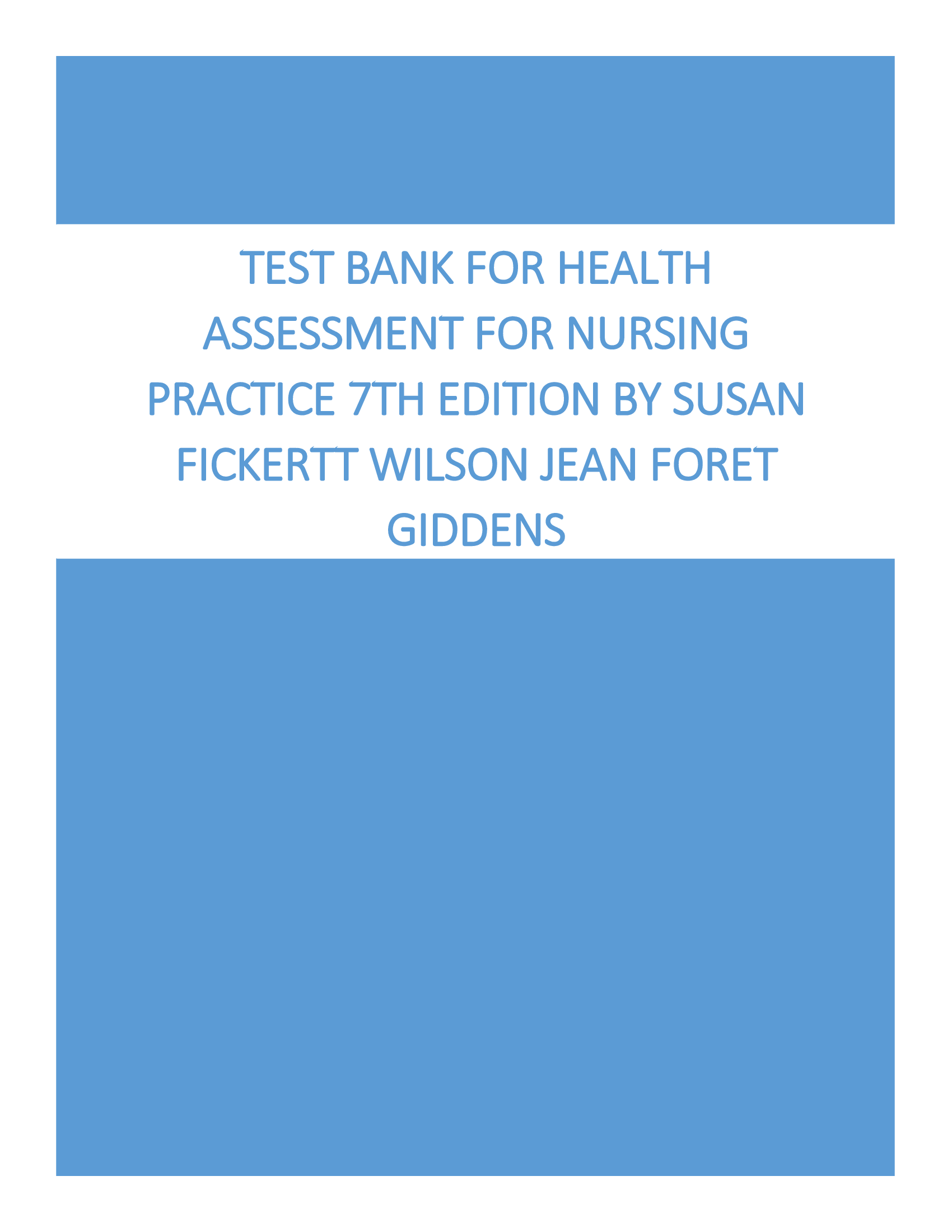
  • Test Bank For Health Assessment for Nursing Practice 7th Edition By Susan Fickertt Wilson All Chapters

Test Bank For Health Assessment for Nursing Practice 7th Edition By Susan Fickertt Wilson All Chapters

Preview page 1 Preview page 2 Preview page 3
Add To Favorites

Share this item Share this item

  • Item Details
  • Comments (0)
  • Reviews (0)
  • Contact Seller
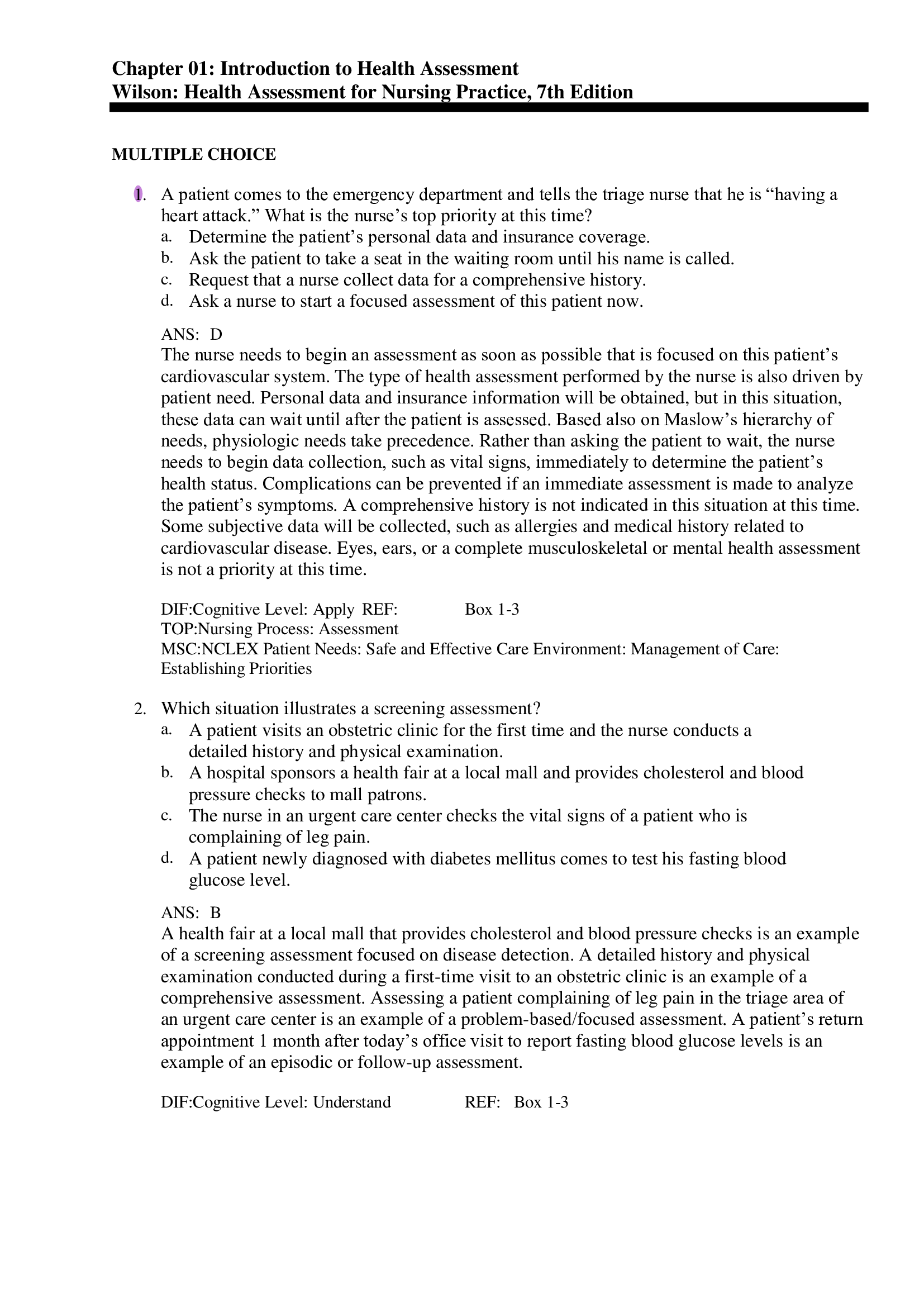
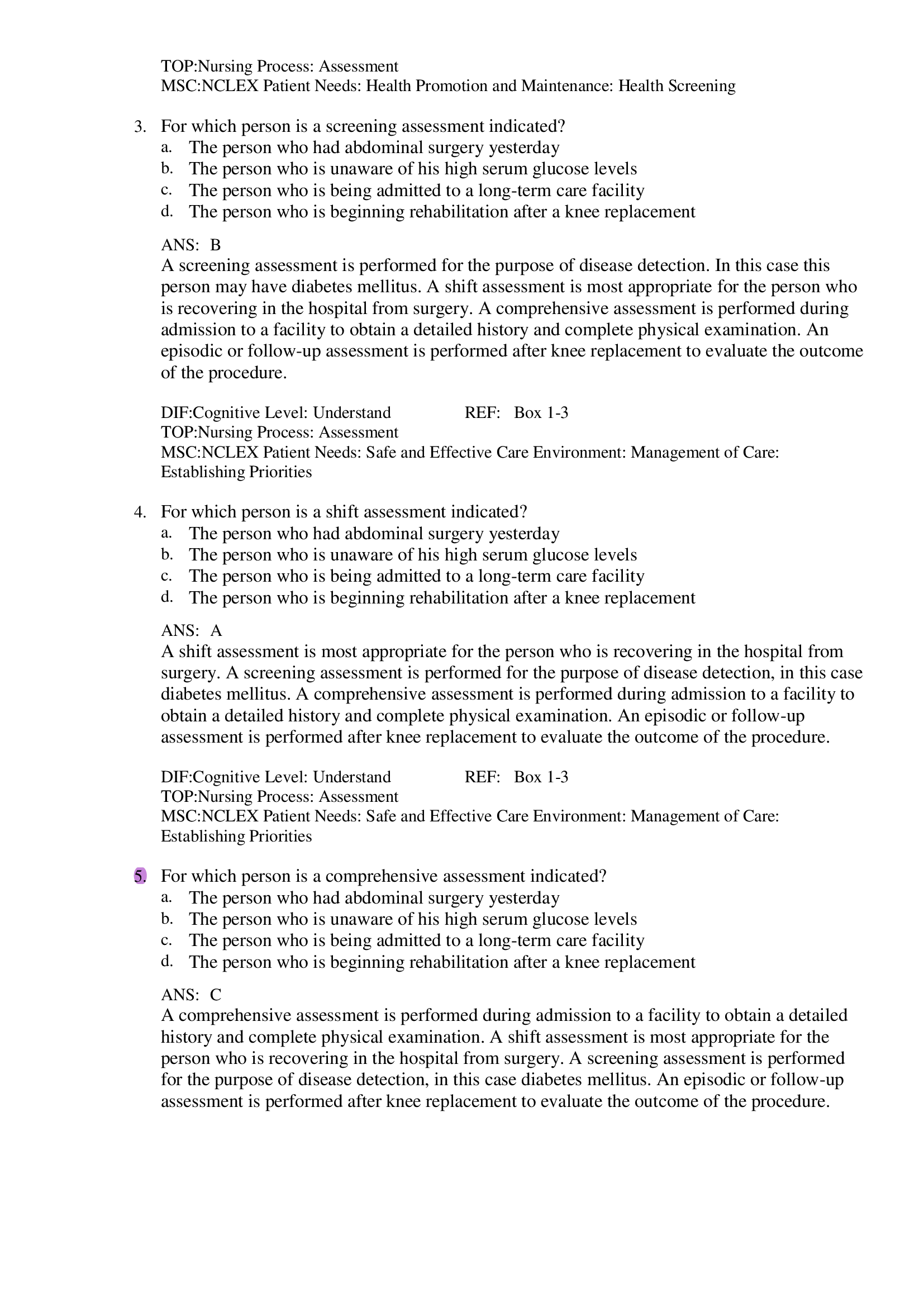
Test Bank For Health Assessment for Nursing Practice 7th Edition By Susan Fickertt Wilson Jean Foret Giddens Chapter 01: Introduction to Health Assessment Wilson: Health Assessment for Nursing Practice, 7th Edition MULTIPLE CHOICE 1. A patient comes to the emergency department and tells the triage nurse that he is ―having a heart attack.‖ What is the nurse‘s top priority at this time? a. Determine the patient‘s personal data and insurance coverage. b. Ask the patient to take a seat in the waiting room until his name is called. c. Request that a nurse collect data for a comprehensive history. d. Ask a nurse to start a focused assessment of this patient now. ANS: D The nurse needs to begin an assessment as soon as possible that is focused on this patient‘s cardiovascular system. The type of health assessment performed by the nurse is also driven by patient need. Personal data and insurance information will be obtained, but in this situation, these data can wait until after the patient is assessed. Based also on Maslow‘s hierarchy of needs, physiologic needs take precedence. Rather than asking the patient to wait, the nurse needs to begin data collection, such as vital signs, immediately to determine the patient‘s health status. Complications can be prevented if an immediate assessment is made to analyze the patient‘s symptoms. A comprehensive history is not indicated in this situation at this time. Some subjective data will be collected, such as allergies and medical history related to cardiovascular disease. Eyes, ears, or a complete musculoskeletal or mental health assessment is not a priority at this time. DIF:Cognitive Level: Apply REF: Box 1-3 TOP:Nursing Process: Assessment MSC:NCLEX Patient Needs: Safe and Effective Care Environment: Management of Care: Establishing Priorities 2. Which situation illustrates a screening assessment? a. A patient visits an obstetric clinic for the first time and the nurse conducts a detailed history and physical examination. b. A hospital sponsors a health fair at a local mall and provides cholesterol and blood pressure checks to mall patrons. c. The nurse in an urgent care center checks the vital signs of a patient who is complaining of leg pain. d. A patient newly diagnosed with diabetes mellitus comes to test his fasting blood glucose level. ANS: B A health fair at a local mall that provides cholesterol and blood pressure checks is an example of a screening assessment focused on disease detection. A detailed history and physical examination conducted during a first-time visit to an obstetric clinic is an example of a comprehensive assessment. Assessing a patient complaining of leg pain in the triage area of an urgent care center is an example of a problem-based/focused assessment. A patient‘s return appointment 1 month after today‘s office visit to report fasting blood glucose levels is an example of an episodic or follow-up assessment. DIF:Cognitive Level: Understand REF: Box 1-3 TOP:Nursing Process: Assessment MSC:NCLEX Patient Needs: Health Promotion and Maintenance: Health Screening 3. For which person is a screening assessment indicated? a. The person who had abdominal surgery yesterday b. The person who is unaware of his high serum glucose levels c. The person who is being admitted to a long-term care facility d. The person who is beginning rehabilitation after a knee replacement ANS: B A screening assessment is performed for the purpose of disease detection. In this case this person may have diabetes mellitus. A shift assessment is most appropriate for the person who is recovering in the hospital from surgery. A comprehensive assessment is performed during admission to a facility to obtain a detailed history and complete physical examination. An episodic or follow-up assessment is performed after knee replacement to evaluate the outcome of the procedure. DIF:Cognitive Level: Understand REF: Box 1-3 TOP:Nursing Process: Assessment MSC:NCLEX Patient Needs: Safe and Effective Care Environment: Management of Care: Establishing Priorities 4. For which person is a shift assessment indicated? a. The person who had abdominal surgery yesterday b. The person who is unaware of his high serum glucose levels c. The person who is being admitted to a long-term care facility d. The person who is beginning rehabilitation after a knee replacement ANS: A A shift assessment is most appropriate for the person who is recovering in the hospital from surgery. A screening assessment is performed for the purpose of disease detection, in this case diabetes mellitus. A comprehensive assessment is performed during admission to a facility to obtain a detailed history and complete physical examination. An episodic or follow-up assessment is performed after knee replacement to evaluate the outcome of the procedure. DIF:Cognitive Level: Understand REF: Box 1-3 TOP:Nursing Process: Assessment MSC:NCLEX Patient Needs: Safe and Effective Care Environment: Management of Care: Establishing Priorities 5. For which person is a comprehensive assessment indicated? a. The person who had abdominal surgery yesterday b. The person who is unaware of his high serum glucose levels c. The person who is being admitted to a long-term care facility d. The person who is beginning rehabilitation after a knee replacement ANS: C A comprehensive assessment is performed during admission to a facility to obtain a detailed history and complete physical examination. A shift assessment is most appropriate for the person who is recovering in the hospital from surgery. A screening assessment is performed for the purpose of disease detection, in this case diabetes mellitus. An episodic or follow-up assessment is performed after knee replacement to evaluate the outcome of the procedure. DIF:Cognitive Level: Understand REF: Box 1-3 TOP:Nursing Process: Assessment MSC:NCLEX Patient Needs: Safe and Effective Care Environment: Management of Care: Establishing Priorities 6. For which person is an episodic or follow-up assessment indicated? a. The person who had abdominal surgery yesterday b. The person who is unaware of his high serum glucose levels c. The person who is being admitted to a long-term care facility d. The person who is beginning rehabilitation after a knee replacement ANS: D An episodic or follow-up assessment is performed after the knee replacement to evaluate the outcome of the procedure. A shift assessment is most appropriate for the person who is recovering in the hospital from surgery. A screening assessment is performed for the purpose of disease detection, in this case diabetes mellitus. A comprehensive assessment is performed during admission to a facility to obtain a detailed history and complete physical examination. DIF:Cognitive Level: Understand REF: Box 1-3 TOP:Nursing Process: Assessment MSC:NCLEX Patient Needs: Safe and Effective Care Environment: Management of Care: Establishing Priorities 7. Which is an example of data a nurse collects during a physical examination? a. The patient‘s lack of hair and shiny skin over both shins b. The patient‘s stated concern about lack of money for prescriptions c. The patient‘s complaints of tingling sensations in the feet d. The patient‘s mother‘s statements that the patient is very nervous lately ANS: A The lack of hair and shiny skin over both shins are objective data or signs that are part of the physical examination. A patient‘s concerns about lack of money are subjective data and are part of the health history. A patient‘s complaints of tingling sensations in the feet are subjective data and are part of the health history. A patient‘s family statements are considered secondary data, are subjective data, and are part of the health history. DIF:Cognitive Level: Apply REF: Box 1-3 TOP:Nursing Process: Assessment MSC:NCLEX Patient Needs: Physiological Integrity: Reduction of Risk Potential: System Specific Assessments 8. The nurse documents which information in the patient‘s history? a. The patient‘s skin feels warm to the touch. b. The patient is scratching his arm. c. The patient‘s temperature is 100 F. d. The patient complains of itching. ANS: D A patient‘s complaint of itching is subjective information, which means it is a symptom and is documented in the history. The patient‘s warm skin is objective information gathered by the nurse through palpation, is also a sign, and is documented in the physical examination. The patient‘s scratching is objective information gathered by the nurse through observation, is also a sign, and is documented in the physical examination. The patient‘s elevated temperature is objective information gathered by the nurse through measurement, is also a sign, and is documented in the physical examination. DIF:Cognitive Level: Apply REF: Box 1-2 TOP:Nursing Process: Assessment MSC:NCLEX Patient Needs: Safe and Effective Care Environment: Management of Care: Establishing Priorities 9. Which patient information does the nurse document in the patient‘s physical assessment? a. Slurred speech b. Immunizations c. Smoking habit d. Allergies ANS: A Slurred speech should be noticed by the nurse and documented as objective data in the physical assessment. Data on immunizations are collected from the patient, are subjective, and documented in the history. A smoking habit is information that comes from the patient, making it subjective data that is documented in the history. Allergies are information that come from the patient, making it subjective data that is documented in the history. DIF:Cognitive Level: Apply REF: Box 1-2 TOP:Nursing Process: Assessment MSC:NCLEX Patient Needs: Safe and Effective Care Environment: Management of Care: Establishing Priorities 10. After collecting the data, the nurse begins data analysis with which action? a. Clustering data b. Documenting subjective data c. Reporting information to other health team members d. Documenting objective information ANS: A After collecting data, the nurse organizes or clusters the data so that the problems appear more clearly. To cluster data, the nurse interprets the assessment data collected. Documenting subjective data is necessary for the medical record, but does not provide analysis. Before reporting data to health team members, the nurse clusters and interprets data. Documenting objective data is necessary for the medical record, but does not provide analysis. DIF:Cognitive Level: Understand TOP:Nursing Process: Assessment MSC:NCLEX Patient Needs: Safe and Effective Care Environment: Management of Care: Establishing Priorities 11. Which activity illustrates the concept of primary prevention? a. Monthly breast self-examination b. Annual cervical (Papanicolaou test) examination

Contact the Seller

Please Sign In to contact this seller.


  • 👎  Report Copyright Violation

Frequently Asked Questions

What Do I Get When I Buy This Study Material?

+

When you buy a study material on Passing Grades, an instant download link will be sent directly to your email, giving you access to the file anytime after payment is completed.

Is Passing Grades a Trusted Platform?

+

Yes, Passing Grades is a reputable students’ marketplace with a secure payment system and reliable customer support. You can trust us to ensure a safe and seamless transaction experience.

Will I Be Stuck with a Subscription?

+

No, all purchases on Passing Grades are one-time transactions. You only pay for the notes you choose to buy, with no subscriptions or hidden fees attached.

Who Am I Buying These Study Materials From?

+

Passing Grades is a marketplace, which means you are purchasing the document from an individual vendor, not directly from us. We facilitate the payment and delivery process between you and the vendor.

Does Passing Grades Offer Free Study Materials?

+

Yes, sellers on Passing Grades have uploaded numerous free test banks, exams, practice questions, and class notes that can be downloaded at no cost.

Pasinggrades - Quality Study Materials

USD 17

    • Quality checked by Pasing Grades
    • 100% satisfaction guarantee
    • Seller: K
Buy PDF $17

Seller Information

K

Member since December 2023

  • icon
View Profile
  • total sales

    0
  • Favourites

    0
  • Comments

    0
    ( 0 Ratings )

Item Information

  • Uploaded

    29 December 2023

  • Updated

    21 April 2025

  • Category

    No category

  • Item Type

    test bank

  • Tags

    Test Bank For Health Assessment for Nursing Practice 7th Edition By Susan Fickertt Wilson Jean Foret Giddens

Related Exam Prep Guides by K

NR 509 Week 1-8 Quizzes 2026 Real Test
View Document

NR 509 Week 1-8 Quiz...

  • K

    K

  • test bank

NR 509 Week 1-8 Quizzes 2026: Access real test questions and answers on holistic health, assessment ...

17 USD

0

0

HESI RN Exit Exam 2024 All Versions with Complete Solutions
View Document

HESI RN Exit Exam 20...

  • K

    K

  • test bank

HESI RN Exit Exam 2024 All Versions with Complete Solutions...

17 USD

0

0

Test Bank for Clinical Chemistry Principles, Techniques, and Correlations 9th Edition by Bishop Fody
View Document

Test Bank for Clinic...

  • K

    K

  • test bank

Test Bank for Clinical Chemistry Principles, Techniques, and Correlations 9th Edition by Bishop Fody...

17 USD

0

0

Purchase

Download link will be sent to this email immediately after purchase.

IMPORTANT LINKS

  • How To Upload Class Notes
  • Selling Tips
  • Passing Grades's Study Materials
  • Scholarships for International Students 2025

POPULAR CATEGORIES

  • Law
  • Accounting
  • English
  • Psychology
  • Business
  • Nursing
  • Computer Science
  • General

View Document

  • Blog
  • Contact
  • Delivery Policy
  • Latest Scholarships Around the World
  • How to Pass Bar Exams: Passing Grades’ Strategies
  • How to Study and Pass the CPA Exam
  • All Test Banks
  • Faq
  • Copyright Claims
  • Privacy Policy
  • Terms of Use

KNOWLEDGE BASE

  • How to Write A+ Grade Good Research Paper
  • How to Manage Stress During Exam Period
  • Best Time to Study
  • How to Pass NCLEX-RN Exam
  • How To Effectively Utilize Test Banks
  • Popular Shadow Health Exam Assessments
  • Popular HESI Case Studies
  • How to Prepare for a Nursing Career
  • The Importance Of Summaries in Exam Revisvion

© 2026 Pasing Grades. All rights reserved.