Pasing Grades
  • Start Selling
  • Blog
  • Contact
  • 0

    Your cart is empty!

English

  • English
  • Spanish
  • Arabic
Create Account Sign In
  • Library
    • New Prep Guides
    • Featured Prep Guides
    • Free Exam Prep Guides
    • Best sellers
  • General
  • Nursing
    • Research Paper
    • Case Study
    • Discussion Post
    • Assignment
    • Exam
    • Practice Questions and Answers
    • Test Bank
    • solutions manual
  • Accounting
    • Case Study
    • Thesis
    • Study Guide
    • Summary
    • Research Paper
    • test bank
  • English
    • Creative Writing
    • Research Paper
    • Summary
    • Rhetorics
    • Literature
    • Journal
    • Exam
    • Grammar
    • Discussion Post
    • Essay
  • Psychology
    • Hesi
    • Presentation
    • Essay
    • Summary
    • Study Guide
    • Essay
    • Solution Manual
    • Final Exam Review
    • Class Notes
    • test bank
  • Business
    • Lecture Notes
    • Solution Manual
    • Presentation
    • Business Plan
    • Class Notes
    • Experiment
    • Summary
    • Practice Questions
    • Study Guide
    • Case Study
    • test bank
    • Exam
  • More
    • Computer Science
    • Economics
    • Statistics
    • Engineering
    • Biology
    • Religious Studies
    • Physics
    • Chemistry
    • Mathematics
    • History
    • Sociology
    • Science
    • Philosophy
    • Law
  • Pages
    • About Us
    • Selling Tips
    • Delivery Policy
    • Faq
    • Privacy Policy
  • Flash Sale
  • Home
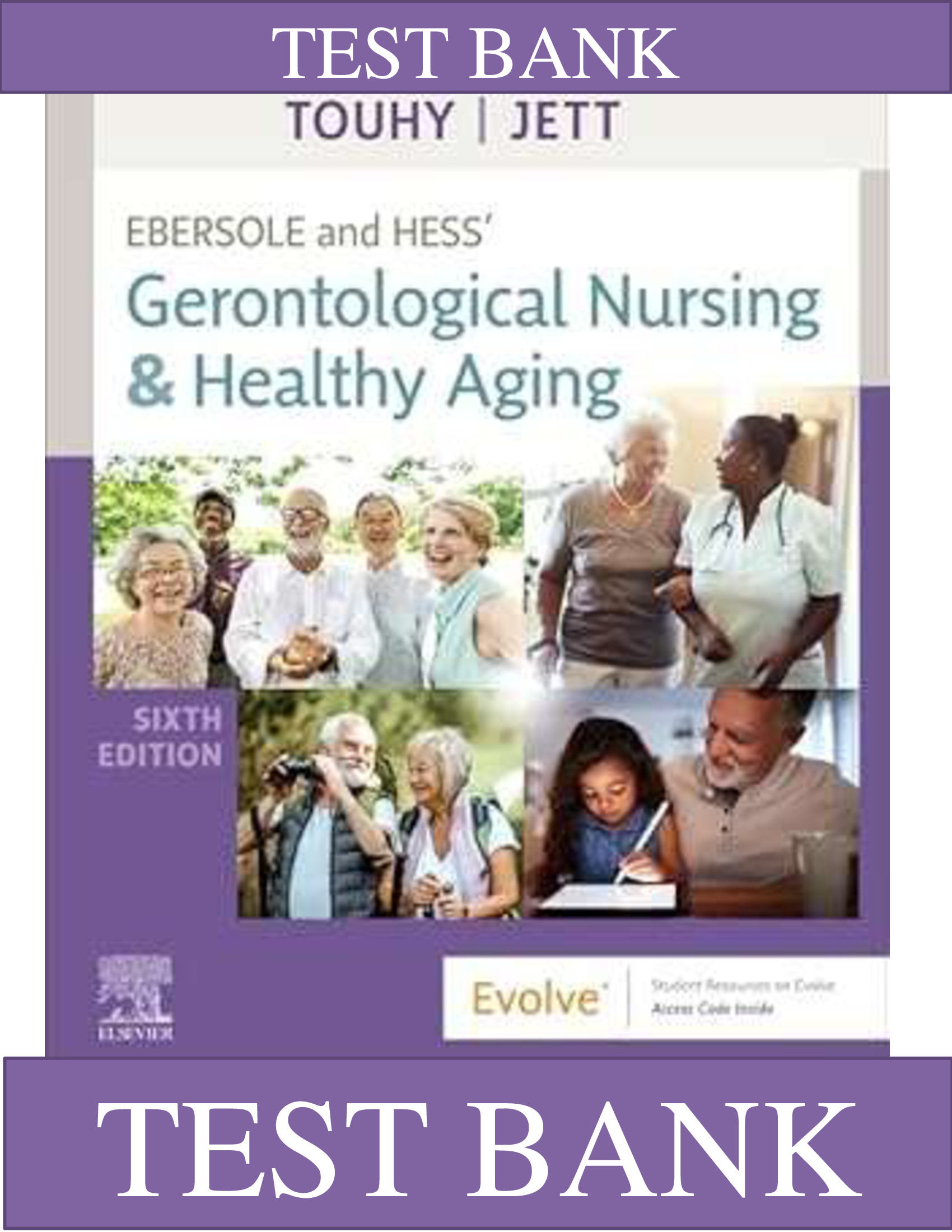
  • Test Bank for Ebersole and Hess Gerontological Nursing and Healthy Aging 6th Edition Latest Update

Test Bank for Ebersole and Hess Gerontological Nursing and Healthy Aging 6th Edition Latest Update

Preview page 1 Preview page 2 Preview page 3
Add To Favorites

Share this item Share this item

  • Item Details
  • Comments (0)
  • Reviews (0)
  • Contact Seller

Test bank for ebersole and hess gerontological nursing and healthy aging 6th ed

This document contains the complete test bank for Ebersole and Hess’ Gerontological Nursing and Healthy Aging (5th Edition) by Theris A. Touhy and Kathleen F. Jett. It includes a wide range of multiple-choice and multiple-response questions with correct answers and rationales, organized by chapters 1 through 28. Topics include cultural competence, biological and psychosocial aging, chronic diseases, gerontological nursing interventions, and ethical-legal issues. This is a comprehensive resource designed for nursing students and educators preparing for exams or creating assessments.

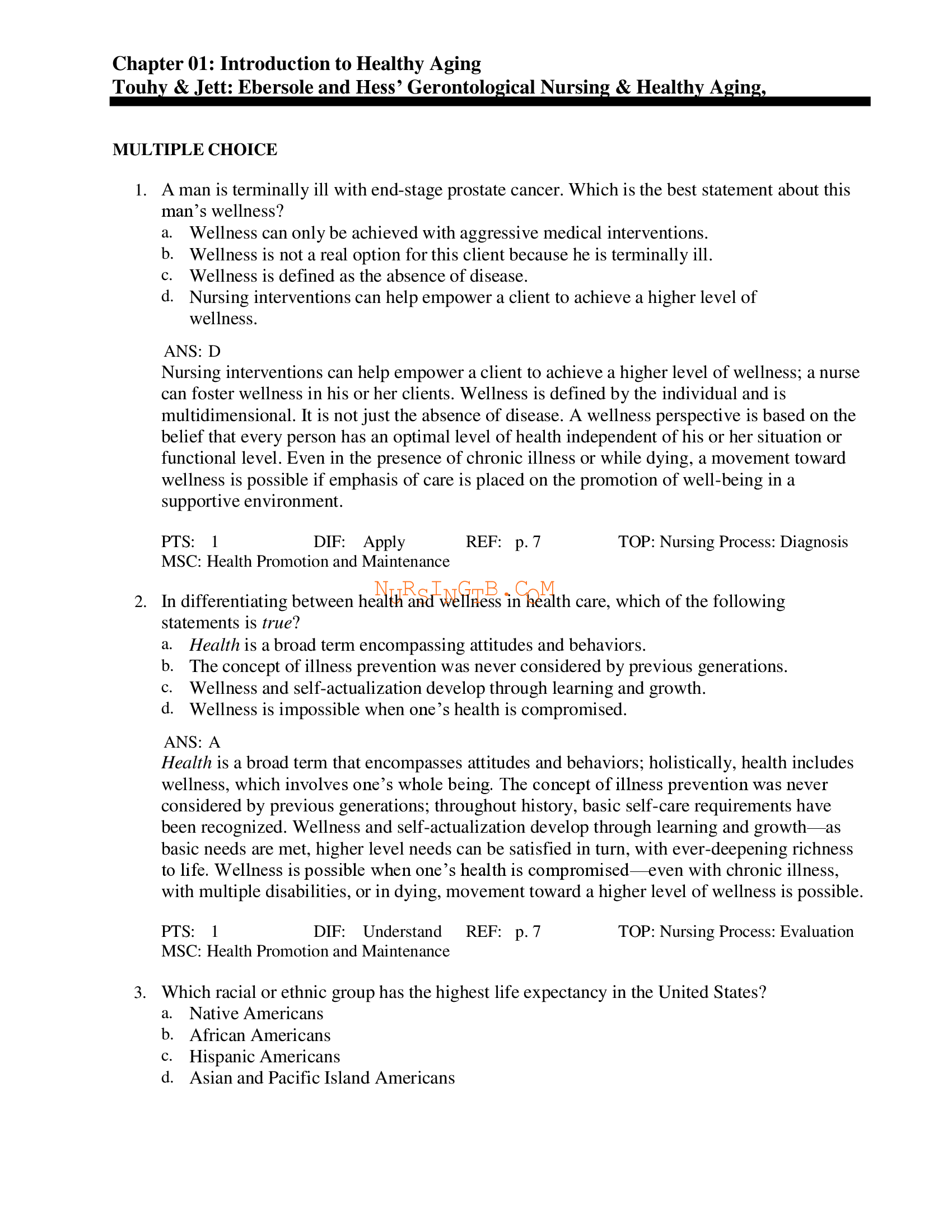
Sample Gerontolical and Healthy Aging Questions

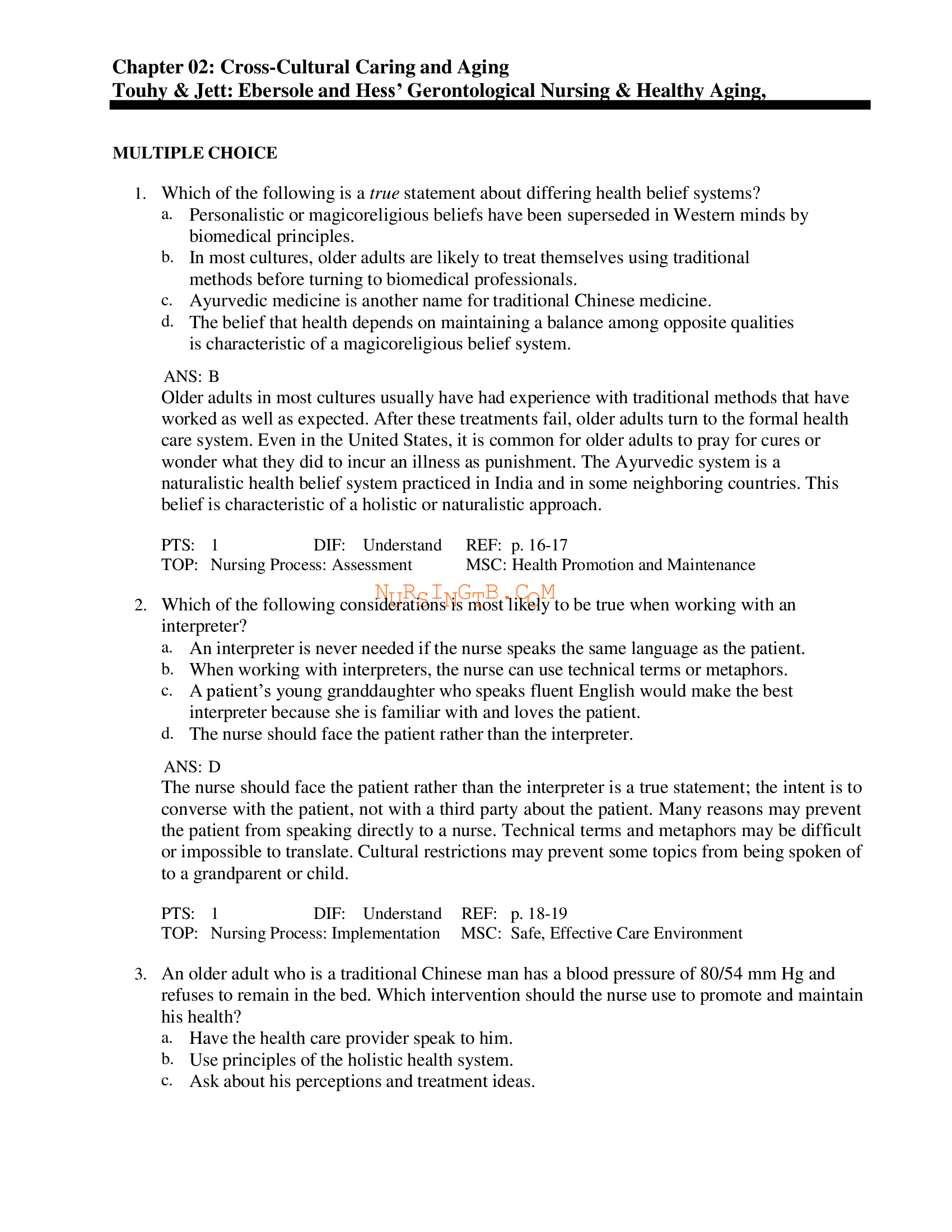
1. Which of the following is a true statement about differing health belief systems?

a.       Personalistic or magicoreligious beliefs have been superseded in Western minds by biomedical principles.

b.      In most cultures, older adults are likely to treat themselves using traditional methods before turning to biomedical professionals.

c.       Ayurvedic medicine is another name for traditional Chinese medicine.

d.      The belief that health depends on maintaining a balance among opposite qualities is characteristic of a magicoreligious belief system.

ANS: B

Older adults in most cultures usually have had experience with traditional methods that have worked as well as expected. After these treatments fail, older adults turn to the formal health care system. Even in the United States, it is common for older adults to pray for cures or wonder what they did to incur an illness as punishment. The Ayurvedic system is a naturalistic health belief system practiced in India and in some neighboring countries. This belief is characteristic of a holistic or naturalistic approach.

2.      Which of the following consiNdeUrRatiSoInsNisGmToBst.liCkOelMy to be true when working with an interpreter?

a.       An interpreter is never needed if the nurse speaks the same language as the patient.

b.      When working with interpreters, the nurse can use technical terms or metaphors.

c.       A patient’s young granddaughter who speaks fluent English would make the best interpreter because she is familiar with and loves the patient.

d.      The nurse should face the patient rather than the interpreter.

ANS: D

The nurse should face the patient rather than the interpreter is a true statement; the intent is to converse with the patient, not with a third party about the patient. Many reasons may prevent the patient from speaking directly to a nurse. Technical terms and metaphors may be difficult or impossible to translate. Cultural restrictions may prevent some topics from being spoken of to a grandparent or child.

3.      An older adult who is a traditional Chinese man has a blood pressure of 80/54 mm Hg and refuses to remain in the bed. Which intervention should the nurse use to promote and maintain his health?

a.       Have the health care provider speak to him.

b.      Use principles of the holistic health system.

c.       Ask about his perceptions and treatment ideas.

d.      Consult with a practitioner of Chinese medicine.

ANS: C

Using the LEARN model (listen with sympathy to the patient’s perception of the problem, explain your perception of the problem, acknowledge the differences and similarities, recommend treatment, and negotiate agreement), the nurse gathers information from the patient about cultural beliefs concerning health care and avoids stereotyping the patient. In the assessment, the nurse determines what the patient believes about caregiving, decision making, treatment, and other pertinent health-related information. Speaking with the health care provider is premature until the assessment is complete. Unless he accepts the beliefs, principles of the holistic health system can be potentially unsuitable and insulting for this patient. Unless he accepts the treatments, consulting with a practitioner of Chinese medicine can also be unsuitable and insulting for this patient.

4.      Which action should the nurse take when addressing older adults?

a.       Speak in an exaggerated pitch.

b.      Use a lower quality of speech.

c.       Use endearing terms such as “honey.”

d.      Speak clearly.

ANS: D

Some health professionals demonstrate ageism, in part because providers tend to see many frail, older persons and fewer of those who are healthy and active. Providers should not assume that all older adults are hearing or mentally impaired. The most appropriate action

when addressing an older aduNltUwRoSulIdNbeGtTo Bsp.eaCkOcMlearly. Examples of unintentional ageism in language are an exaggerated pitch, a demeaning emotional tone, and a lower quality of

speech.


5.      The nurse prepares an older woman, who is Polish, for discharge through an interpreter and notes that she becomes tense during the instructions about elimination. Which intervention should the nurse implement?

a.       Move on to the discussion about medication.

b.      Ask the older woman how she feels about this topic.

c.       Instruct the interpreter to repeat the instructions.

d.      Have the older woman repeat the instructions for clarity.

ANS: B

When working with an interpreter, the nurse closely watches the older adult for nonverbal communication and emotion regarding a specific topic and therefore validates the assessment about the older adult’s tension before proceeding. Because the nurse notices her tension, the nurse temporarily suspends the preparation to validate her assessment. If the nurse proceeds and the older adult is uncomfortable discussing elimination, then important instructions can be missed, leading to adverse effects for the older adult. Repeating the instructions can aggravate the older adult’s discomfort. Instructing the older adult to repeat the nurse’s instruction ignores her needs.

6.      The nurse plans care for an older African American man who is from Jamaica and resides in New York City. Which should the nurse include in planning care?

a.       Attribute his illness to breaking a voodoo.

b.      Help him improve social relationships.

c.       Maintain blood pressure below 120/70 mm Hg.

d.      Review the principles of the magicoreligious system.

ANS: C

Because African Americans tend to be at risk for cardiovascular disease and hypertension, the nurse plans to maintain the patient’s blood pressure at or below the current recommendation by the American Heart Association. The nurse can be incorrectly assuming that he practices and believes in the magicoreligious system. The nurse should assess his spiritual beliefs and determine how much they influence his attitudes toward Western health care. The magicoreligious system maintains social relationships in good condition to prevent illness; however, if the older adult does not follow this cultural practice, then this goal can be unsuitable. The older adult may not believe in this system; therefore, the information can be irrelevant.

7.      Which health belief system uses treatments to repair a body part?


a.       Holistic

b.      Biomedical

c.       Personalistic

d.      Magicoreligious

ANS: B

Because dysfunction or a structural abnormality is thought to cause disease, the biomedical system believes in repairing the structural abnormality. The holistic system holds that health is attained through balance. The personalistic system uses treatments such as meditation, fasting, and praying. The magicoreligious system is the same as the personalistic system.

8.      A nurse is caring for a culturally diverse patient who has missed follow-up appointments with the primary care provider three times over the past year. The patient has a chronic illness that requires periodic monitoring of blood test values. The patient tells the nurse: “You don’t understand—in my culture, we don’t do things like that. I cannot be troubled with worrying about appointments in the future; I deal with each day as it comes.” The nurse understands which of the following about the patient’s culture?

a.       The culture does not value Western medicine.

b.      The culture has a different orientation to time than Western medicine.

c.       The culture is an interdependent culture.

d.      The culture does not believe in preventative care.

ANS: B

Time orientation is a culturally constructed factor. Westernized medical care is future oriented. Conflicts between future oriented Westernized medical care and those with a present or past time orientation may arise. Patients are likely to be labeled as noncompliant for failing to keep appointments.

9.      A paper on culture and illness would be likely to include the statement that

a.       culture is the same as ethnicity.

b.      ethnic groups always share common geographic origin and religion.

c.       ethnicity involves recognized traditions, symbols, and literature.

d.      most members of an ethnic group exhibit identical cultural traits.

ANS: C

Ethnicity is a complex phenomenon that includes traditions, symbols, literature, folklore, food preferences, and dress. It is a shared identity. Ethnicity is more than just culture. It is social differentiation based on culture. Even within ethnic groups, there is considerable diversity.

10.  A home care nurse is caring for an older patient from a different culture who is bedbound and high risk for development of a pressure ulcer. The nurse discusses the plan of care with the patient’s daughter, emphasizing the importance of turning every 2 hours, and posts a turning

clock on the wall. When the nurse returns later in the week, the turning clock has been removed, and the patient’s daNuUghRteSr IreNpoGrtTs Bth.atCsOheMturns her mother occasionally. She states, “I am taking very good care of my mother. You just don’t understand—our ways do not

involve doing things on schedules.” The best response by the nurse is:

a.       “You must follow my guidelines and turn her every 2 hours, or I will not be able to take care of her.”

b.      “I understand that you value your culture, but culture cannot stop you from providing good care to your mother.”

c.       ‘I understand that you care very much for your mother. Perhaps caring for her is too much for you.”

d.      “How can we best work together to provide the best care for your mother?”

ANS: D

In providing cross-cultural care, it is important that the nurse work with the patient and family and listen carefully and find a way to include the values and beliefs of the patient in the plan of care.

Contact the Seller

Please Sign In to contact this seller.


  • 👎  Report Copyright Violation

Frequently Asked Questions

What Do I Get When I Buy This Study Material?

+

When you buy a study material on Passing Grades, an instant download link will be sent directly to your email, giving you access to the file anytime after payment is completed.

Is Passing Grades a Trusted Platform?

+

Yes, Passing Grades is a reputable students’ marketplace with a secure payment system and reliable customer support. You can trust us to ensure a safe and seamless transaction experience.

Will I Be Stuck with a Subscription?

+

No, all purchases on Passing Grades are one-time transactions. You only pay for the notes you choose to buy, with no subscriptions or hidden fees attached.

Who Am I Buying These Study Materials From?

+

Passing Grades is a marketplace, which means you are purchasing the document from an individual vendor, not directly from us. We facilitate the payment and delivery process between you and the vendor.

Does Passing Grades Offer Free Study Materials?

+

Yes, sellers on Passing Grades have uploaded numerous free test banks, exams, practice questions, and class notes that can be downloaded at no cost.

Pasinggrades - Quality Study Materials

USD 15

    • Quality checked by Pasing Grades
    • 100% satisfaction guarantee
    • Seller: PHARMACIA
Buy PDF $15

Seller Information

PHARMACIA

Member since January 2024

  • icon
View Profile
  • total sales

    0
  • Favourites

    0
  • Comments

    0
    ( 0 Ratings )

Item Information

  • Uploaded

    22 January 2024

  • Updated

    17 October 2025

  • Category

    Nursing

  • Item Type

    test bank

  • Tags

    Test bank for ebersole and hess gerontological nursing and healthy aging gerontological nursing healthy aging nursing test bank aging theories Touhy Jett cultural competence nursing elder care practice questions nursing exam prep chronic illness management cognitive aging nursing interventions elderly psychosocial health aging nursing school resources geriatrics evidence based care older adults

Related Exam Prep Guides by PHARMACIA

ATI TEAS MATH - TEAS 6 2023-2024
View Document

ATI TEAS MATH - TEAS...

  • PHARMACIA

    PHARMACIA

  • test bank

ATI TEAS MATH - TEAS 6 2023-2024...

15 USD

0

0

Adult health hesi EXAM QUESTIONS & ANSWERS, LATEST UPDATE 2023-2024 RATED A+
View Document

Adult health hesi EX...

  • PHARMACIA

    PHARMACIA

  • test bank

Adult health hesi EXAM QUESTIONS & ANSWERS, LATEST UPDATE 2023-2024 RATED A+ – Download PDF...

15 USD

0

0

Adult health hesi test bank EXAM QUESTIONS & ANSWERS LATEST UPDATE 2023-2024 RATED A+
View Document

Adult health hesi te...

  • PHARMACIA

    PHARMACIA

  • test bank

Adult health hesi test bank EXAM QUESTIONS & ANSWERS LATEST UPDATE 2023-2024 RATED A+ – Download P...

15 USD

0

0

Purchase

Download link will be sent to this email immediately after purchase.

IMPORTANT LINKS

  • How To Upload Class Notes
  • Selling Tips
  • Passing Grades's Study Materials
  • Scholarships for International Students 2025

POPULAR CATEGORIES

  • Law
  • Accounting
  • English
  • Psychology
  • Business
  • Nursing
  • Computer Science
  • General

View Document

  • Blog
  • Contact
  • Delivery Policy
  • Latest Scholarships Around the World
  • How to Pass Bar Exams: Passing Grades’ Strategies
  • How to Study and Pass the CPA Exam
  • All Test Banks
  • Faq
  • Copyright Claims
  • Privacy Policy
  • Terms of Use

KNOWLEDGE BASE

  • How to Write A+ Grade Good Research Paper
  • How to Manage Stress During Exam Period
  • Best Time to Study
  • How to Pass NCLEX-RN Exam
  • How To Effectively Utilize Test Banks
  • Popular Shadow Health Exam Assessments
  • Popular HESI Case Studies
  • How to Prepare for a Nursing Career
  • The Importance Of Summaries in Exam Revisvion

© 2026 Pasing Grades. All rights reserved.