Pasing Grades
  • Start Selling
  • Blog
  • Contact
  • 0

    Your cart is empty!

English

  • English
  • Spanish
  • Arabic
Create Account Sign In
  • Library
    • New Prep Guides
    • Featured Prep Guides
    • Free Exam Prep Guides
    • Best sellers
  • General
  • Nursing
    • Research Paper
    • Case Study
    • Discussion Post
    • Assignment
    • Exam
    • Practice Questions and Answers
    • Test Bank
    • solutions manual
  • Accounting
    • Case Study
    • Thesis
    • Study Guide
    • Summary
    • Research Paper
    • test bank
  • English
    • Creative Writing
    • Research Paper
    • Summary
    • Rhetorics
    • Literature
    • Journal
    • Exam
    • Grammar
    • Discussion Post
    • Essay
  • Psychology
    • Hesi
    • Presentation
    • Essay
    • Summary
    • Study Guide
    • Essay
    • Solution Manual
    • Final Exam Review
    • Class Notes
    • test bank
  • Business
    • Lecture Notes
    • Solution Manual
    • Presentation
    • Business Plan
    • Class Notes
    • Experiment
    • Summary
    • Practice Questions
    • Study Guide
    • Case Study
    • test bank
    • Exam
  • More
    • Computer Science
    • Economics
    • Statistics
    • Engineering
    • Biology
    • Religious Studies
    • Physics
    • Chemistry
    • Mathematics
    • History
    • Sociology
    • Science
    • Philosophy
    • Law
  • Pages
    • About Us
    • Selling Tips
    • Delivery Policy
    • Faq
    • Privacy Policy
  • Flash Sale
  • Home
  • Test Bank For Digital Radiography And Pacs 3rd Edition By Carter

Test Bank For Digital Radiography And Pacs 3rd Edition By Carter

Preview page 1 Preview page 2 Preview page 3
Add To Favorites

Share this item Share this item

  • Item Details
  • Comments (0)
  • Reviews (0)
  • Contact Seller

TEST BANK FOR DIGITAL RADIOGRAPHY AND PACS 3RD EDITION BY CARTER

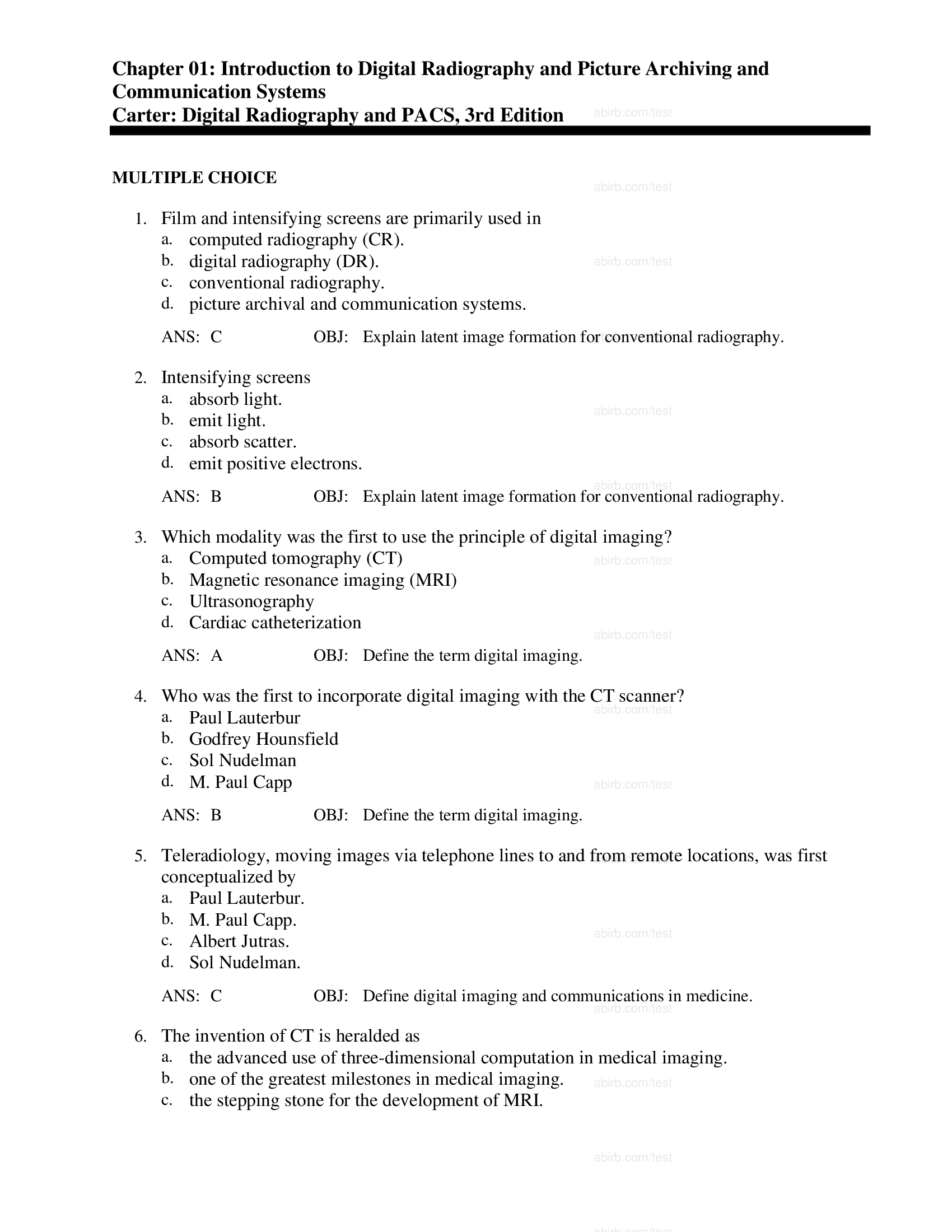
Chapter 03: Digital Radiographic Image Processing and Manipulation

Best test bank website offers Carter: Digital Radiography and PACS, 3rd Edition Test Bank

MULTIPLE CHOICE


1.   Failure of the reader to find the collimation edges of an imaabgirbe.com/test

a.   will result in image cutoff.

b.   may cause the image to be too bright or too dark.


c.   will eliminate all scatter.

d.   will have no effect on the resultant image.

ANS:  B                     OBJ:   Describe the formation of an image histogram.


 2.   If the entire range of exposure were digitized, pixel values representing digitized.

a.   scatter

would be

b.   only diagnostic values

c.   only the extreme values

d.   all values

ANS:  D                     OBJ:   Describe the formation of an image histogram.


3.   Data collected within the collimator are represented by a

a.   histogram.

b.   characteristic curve.

c.   pixel graph.

d.   matrix graph.

ANS:  A                     OBJ:   Describe the formation of an image histogram.


4.   A histogram displays the useful signal by locating

a.   all pixel values.

b.   maximum and minimum signal.

c.   maximum signal only.

d.   minimum signal only.


ANS:  B                     OBJ:   Describe the formation of an image histogram.


5.   The higher the kilovoltage peak, the

a.   wider the histogram.

b.   narrower the histogram.

c.   higher the frequency.

d.   lower the frequency.

ANS:  B                     OBJ:   Describe the formation of an image histogram.


6.   The Nyquist theorem states that thea.   sampling frequency must be equal to the input signal bandwidth.

b.   input signal bandwidth must be twice the sampling frequency.

c.   sampling frequency must be twice the input signal banadbwirbi.dcotmh/.test

d.   input signal bandwidth must be sampled twice.


ANS:  C                     OBJ:   State the Nyquist theorem.


7.   If too few pixels are sampled, the result will be

a.   high resolution. b.   low resolution. c.   high contrast.

d.   low contrast.


ANS:  B                     OBJ:   State the Nyquist theorem.


8.   Raw data used to form the image histogram are compared with

a.   a normal histogram referenced by the computer.

b.   all histograms stored for that anatomic part.


c.   the last histogram of that anatomic part.

d.   None of these


ANS:  A                     OBJ:   Describe the formation of an image histogram.


9.   Loss of detail in a digitally processed image

a.   occurs because of the number of conversions.

b.   is extremely minimal compared with film/screen.

c.   is equal to film/screen.

d.   has almost no impact on the image.


ANS:  A                     OBJ:   State the Nyquist theorem.


10.   The longer an image is stored in the computed radiography (CR) cassette, the

a.   more detailed the processed image.


b.   more energy is lost by the electrons.

c.   easier the image is to process.

d.   slower the processing time.


ANS:  B                     OBJ:   State the Nyquist theorem.


11.   A wraparound image or image aliasing occurs when

a.   sampling occurs twice per cycle.

b.   spatial frequency is less than the Nyquist frequency.

c.   sampling occurs less than twice per cycle.

d.   spatial frequency is equal to the Nyquist frequency.


ANS:  C                     OBJ:   State the Nyquist theorem.


12.   In an effort to display the pixels for the area of interest when exposure is greater or less than


what is needed to produce an image,              occurs.

a.   overexposure

b.   underexposure

c.   automatic collimation

d.   automatic rescaling


ANS:  D                     OBJ:   Discuss automatic rescaling.


13.   Automatic rescaling means that images are produced, regardless of the amount of exposure, with


a.   uniform size and shape.

b.   uniform contrast and density.

c.   variable size and shape.

d.   variable contrast and density.


ANS:  B                     OBJ:   Discuss automatic rescaling.


14.   A look-up table is not used as a reference to

a.   set appropriate kilovoltage peak and milliampere-seconabdirsb.vcoamlu/tesst.

b.   evaluate raw luminance values.

c.   correct luminance values.


d.   provide appropriate brightness and contrast.


ANS:  A                     OBJ:   List the functions of contrast enhancement parameters.


15.   Changing the slope of the look-up table graph will increasaeboirbr.cdoemc/treesat se

a.   density.

b.   the number of pixels.

c.   the matrix size.


d.   contrast.


ANS:  D                     OBJ:   List the functions of contrast enhancement parameters.


16.   If all of the shades were left in an image after processing, athbierbc.comt/treasst t would be

a.   too low.

b.   too high.


c.   sufficient.

d.   unaffected.


ANS:  A                     OBJ:   List the functions of contrast enhancement parameters.


17.   Changing the steepness of the exposure gradient

a.   varies density.

b.   determines spatial frequency.

c.   controls image contrast.

d.   has no effect on the image.


ANS:  C                     OBJ:   List the functions of contrast enhancement parameters.


18.   Focal spot and OID affect image sharpness            imaging.

a.   only in film/screen


b.   only in digital

c.   in both film/screen and digital

d.   in neither film/screen nor digital


ANS:  C                     OBJ:   List the functions of contrast enhaanbcirebm.coemn/ttepsat rameters.


19.   The improper algorithm application may result in

a.   enhanced contrast.

b.   improved resolution.

c.   repeat examinations.


d.   degradation of the image.


ANS:  D                     OBJ:   List the functions of contrast enhancement parameters.


20.   The more manipulation of the image, the greater the

a.   amount of resolution.

b.   loss of information.

c.   quality of the image.

d.   radiologist manipulation.


ANS:  B                     OBJ:   List the functions of contrast enhaanbcirebm.coemn/ttepsat rameters.


21.   Amplification of the frequencies of the areas of interest is known as

a.   algorithm application.


b.   center enhancement.

c.   edge enhancement.

d.   masking.


ANS:  C                     OBJ:   Describe the effects of improper aalbgiorbr.ictohmm/teaspt plication.


22.   Suppressing frequencies in the areas of interest is known as


a.   algorithm application.

b.   center enhancement.

c.   edge enhancement.

d.   masking.


ANS:  D                     OBJ:   Describe the effects of improper algorithm application.


23.   Low-pass filtering is also known as

a.   evening.

b.   smoothing.

c.   masking.

d.   marking.


ANS:  B                     OBJ:   Discuss the purpose and function of image manipulation factors.


24.   High-pass filtering is useful for enhancing

a.   small structures.

b.   fine bone tissues.

c.   large bony structures.

d.   organs and soft tissue.


ANS:  D                     OBJ:   Discuss the purpose and function of image manipulation factors.


25.   Averaging the frequency of each pixel with surrounding paixbierbl.cvoaml/uteesst  to remove high-frequency noise is called

a.   high-pass filtering.


b.   low-pass filtering. c.    edge enhancement. d.   noise enhancement.


ANS:  B                     OBJ:   Discuss the purpose and function aobfiribm.caomge/temstanipulation factors.


26.   Image level parameters control image

a.   brightness.

b.   darkness. c.   contrast. d.   density.


ANS:  A                     OBJ:   Discuss the purpose and function aobfiribm.caomge/temstanipulation factors.


27.   Window width controls the ratio of black and white, also known as

a.   window.


b.   level.

c.   contrast.

d.   matrix.


ANS:  C                     OBJ:   Discuss the purpose and function of image manipulation factors.


28.   Excessive light entering the eye when viewing an image is known as           _ glare.


a.   veil

b.   window

c.   level

d.   None of these


ANS:  A                     OBJ:   Discuss the purpose and function of image manipulation factors.


29.   An image manipulation process that fills in the background so that it is darkened is known as


a.   window.

b.   level.

c.   shuttering.

d.   collimation.


ANS:  C                     OBJ:   Discuss the purpose and function of image manipulation factors.


30.   The image reader scans and reads the image from the

a.   back edge of the imaging plate to the opposite end.

b.   leading edge of the imaging plate to the opposite end.

c.   right to left side.

d.   left to right side.


ANS:  B                     OBJ:   Describe the formation of the CR image reader.


31.   The process of joining two or more images into one continaubiorbu.csomim/teasgt e is known as image

a.   connection.

b.   annotation.


c.   stitching.

d.   lacing.


ANS:  C                     OBJ:   Discuss the purpose and function of image manipulation factors.


32.   The workstation function that allows selection of preset terms or manual text input is termed

image

a.   connection.


b.   annotation.

c.   stitching.


d.   lacing.


ANS:  B                     OBJ:   Discuss the purpose and function of image manipulation factors.


33.   Input of annotation for identification of the patient’s left or right side

a.   should take the place of the technologist’s anatomy markers.

b.   should be used in conjunction with the technologist’s mabairrbk.ceorms/.test

c.   eliminates the need for any other type of anatomy markers.

d.   None of the above


ANS:  B                     OBJ:   Discuss the purpose and function aobfiribm.caomge/temstanipulation factors.


34.   Magnification of the entire image at the workstation is termed

a.   image intensification.


b.   macroradiography.

c.   enlargement.

d.   zoom.


ANS:  D                     OBJ:   Discuss the purpose and function aobfiribm.caomge/temstanipulation factors.


35.   Proper patient demographic input ensures

a.   multiple records on each patient.

b.   linking of all the patient’s files.

c.   multiple versions of the patient’s name.

d.   an increase in the amount of data tracking.


ANS:  B                     OBJ:   Describe the major factors in image management.


36.   The ability to send images to local network stations can be accomplished using the


a.   archive query.

b.   patient demographic input.

c.   QC query.

d.   manual send function.


ANS:  D                     OBJ:   Describe the major factors in image management.


37.   Proper patient demographic input is the responsibility of thabeirb.com/test

a.   technologist.

b.   QC manager.

c.   radiologist.


d.   transporter.


ANS:  A                     OBJ:   Describe the major factors in image management.


38.   An archive query retrieves images from the PACS based oanbirabn.cyomo/tfestthe following except

a.   patient name.

b.   examination date.


c.   anatomical area.

d.   technologist anatomical number.


ANS:  D                     OBJ:   Describe the major factors in image management.


TRUE/FALSE


1.   The shape of the histogram is anatomy specific.


ANS:  T                     OBJ:   Describe the formation of an image histogram.


2.   Image aliasing is similar to the moiré effect caused by grid error.


ANS:  F                     OBJ:   State the Nyquist theorem.


3.   Automatic rescaling can be substituted for appropriate technical factors.


ANS:  F                     OBJ:   Discuss automatic rescaling.


4.   Basic workstation functions include contrast manipulationa,beirdb.gcoeme/tneshtancement, and smoothing.


ANS:  T                     OBJ:   List the functions of contrast enhancement parameters.


5.   Shuttering removes the dark exposed border, reducing the amount of information to be stored.


ANS:  F                     OBJ:   Discuss the purpose and function of image manipulation factors.


6.   Historical study of patient examinations can be accomplished through the manual send function.


ANS:  F                     OBJ:   Describe the major factors in image management.


7.   No matter where the orientation stickers or labels exist on a digital cassette, the image will


display correctly.

ANS:  F                     OBJ:   Describe the major factors in image management.


Contact the Seller

Please Sign In to contact this seller.


  • 👎  Report Copyright Violation

Frequently Asked Questions

What Do I Get When I Buy This Study Material?

+

When you buy a study material on Passing Grades, an instant download link will be sent directly to your email, giving you access to the file anytime after payment is completed.

Is Passing Grades a Trusted Platform?

+

Yes, Passing Grades is a reputable students’ marketplace with a secure payment system and reliable customer support. You can trust us to ensure a safe and seamless transaction experience.

Will I Be Stuck with a Subscription?

+

No, all purchases on Passing Grades are one-time transactions. You only pay for the notes you choose to buy, with no subscriptions or hidden fees attached.

Who Am I Buying These Study Materials From?

+

Passing Grades is a marketplace, which means you are purchasing the document from an individual vendor, not directly from us. We facilitate the payment and delivery process between you and the vendor.

Does Passing Grades Offer Free Study Materials?

+

Yes, sellers on Passing Grades have uploaded numerous free test banks, exams, practice questions, and class notes that can be downloaded at no cost.


Pasinggrades - Quality Study Materials

USD 15

    • Quality checked by Pasing Grades
    • 100% satisfaction guarantee
    • Seller: Angelicer
Buy PDF $15

Seller Information

Angelicer

Member since April 2021

  • icon
  • icon
View Profile
  • total sales

    0
  • Favourites

    0
  • Comments

    0
    ( 0 Ratings )

Item Information

  • Uploaded

    03 April 2023

  • Updated

    09 February 2025

  • Category

    Nursing

  • Item Type

    test bank

  • Tags

    TEST BANK FOR DIGITAL RADIOGRAPHY AND PACS 3RD EDITION BY CARTER

Related Exam Prep Guides by Angelicer

Test Bank for Success in Practical Vocational Nursing 8th Edition by Knecht
View Document

Test Bank for Succes...

  • Angelicer

    Angelicer

  • test bank

Enhance your study with the Test Bank for Success in Practical Vocational Nursing 8th Edition by Kne...

15 USD

0

0

Test Bank for Illustrated Anatomy of the Head and Neck 5th Edition by Fehrenbach
View Document

Test Bank for Illust...

  • Angelicer

    Angelicer

  • test bank

Boost your understanding with the Test Bank for Illustrated Anatomy of the Head and Neck 5th Edition...

15 USD

0

0

ATI PEDS Proctored Exam Questions and Answers 2026 | Comprehensive Study Guide
View Document

ATI PEDS Proctored E...

  • Angelicer

    Angelicer

  • test bank

Get the ATI PEDS Proctored Exam Questions and Answers for 2025. This comprehensive study guide offer...

15 USD

0

0

Purchase

Download link will be sent to this email immediately after purchase.

IMPORTANT LINKS

  • How To Upload Class Notes
  • Selling Tips
  • Passing Grades's Study Materials
  • Scholarships for International Students 2025

POPULAR CATEGORIES

  • Law
  • Accounting
  • English
  • Psychology
  • Business
  • Nursing
  • Computer Science
  • General

View Document

  • Blog
  • Contact
  • Delivery Policy
  • Latest Scholarships Around the World
  • How to Pass Bar Exams: Passing Grades’ Strategies
  • How to Study and Pass the CPA Exam
  • All Test Banks
  • Faq
  • Copyright Claims
  • Privacy Policy
  • Terms of Use

KNOWLEDGE BASE

  • How to Write A+ Grade Good Research Paper
  • How to Manage Stress During Exam Period
  • Best Time to Study
  • How to Pass NCLEX-RN Exam
  • How To Effectively Utilize Test Banks
  • Popular Shadow Health Exam Assessments
  • Popular HESI Case Studies
  • How to Prepare for a Nursing Career
  • The Importance Of Summaries in Exam Revisvion

© 2026 Pasing Grades. All rights reserved.