Pasing Grades
  • Start Selling
  • Blog
  • Contact
  • 0

    Your cart is empty!

English

  • English
  • Spanish
  • Arabic
Create Account Sign In
  • Library
    • New Prep Guides
    • Featured Prep Guides
    • Free Exam Prep Guides
    • Best sellers
  • General
  • Nursing
    • Research Paper
    • Case Study
    • Discussion Post
    • Assignment
    • Exam
    • Practice Questions and Answers
    • Test Bank
    • solutions manual
  • Accounting
    • Case Study
    • Thesis
    • Study Guide
    • Summary
    • Research Paper
    • test bank
  • English
    • Creative Writing
    • Research Paper
    • Summary
    • Rhetorics
    • Literature
    • Journal
    • Exam
    • Grammar
    • Discussion Post
    • Essay
  • Psychology
    • Hesi
    • Presentation
    • Essay
    • Summary
    • Study Guide
    • Essay
    • Solution Manual
    • Final Exam Review
    • Class Notes
    • test bank
  • Business
    • Lecture Notes
    • Solution Manual
    • Presentation
    • Business Plan
    • Class Notes
    • Experiment
    • Summary
    • Practice Questions
    • Study Guide
    • Case Study
    • test bank
    • Exam
  • More
    • Computer Science
    • Economics
    • Statistics
    • Engineering
    • Biology
    • Religious Studies
    • Physics
    • Chemistry
    • Mathematics
    • History
    • Sociology
    • Science
    • Philosophy
    • Law
  • Pages
    • About Us
    • Selling Tips
    • Delivery Policy
    • Faq
    • Privacy Policy
  • Flash Sale
  • Home
  • Test Bank for Cost Management Measuring, Monitoring, and Motivating Performance, 3rd Canadian Edition, Leslie G. Eldenburg, Susan K. Wolcott, Liang-Hsuan Chen, Gail Cook

Test Bank for Cost Management Measuring, Monitoring, and Motivating Performance, 3rd Canadian Edition, Leslie G. Eldenburg, Susan K. Wolcott, Liang-Hsuan Chen, Gail Cook

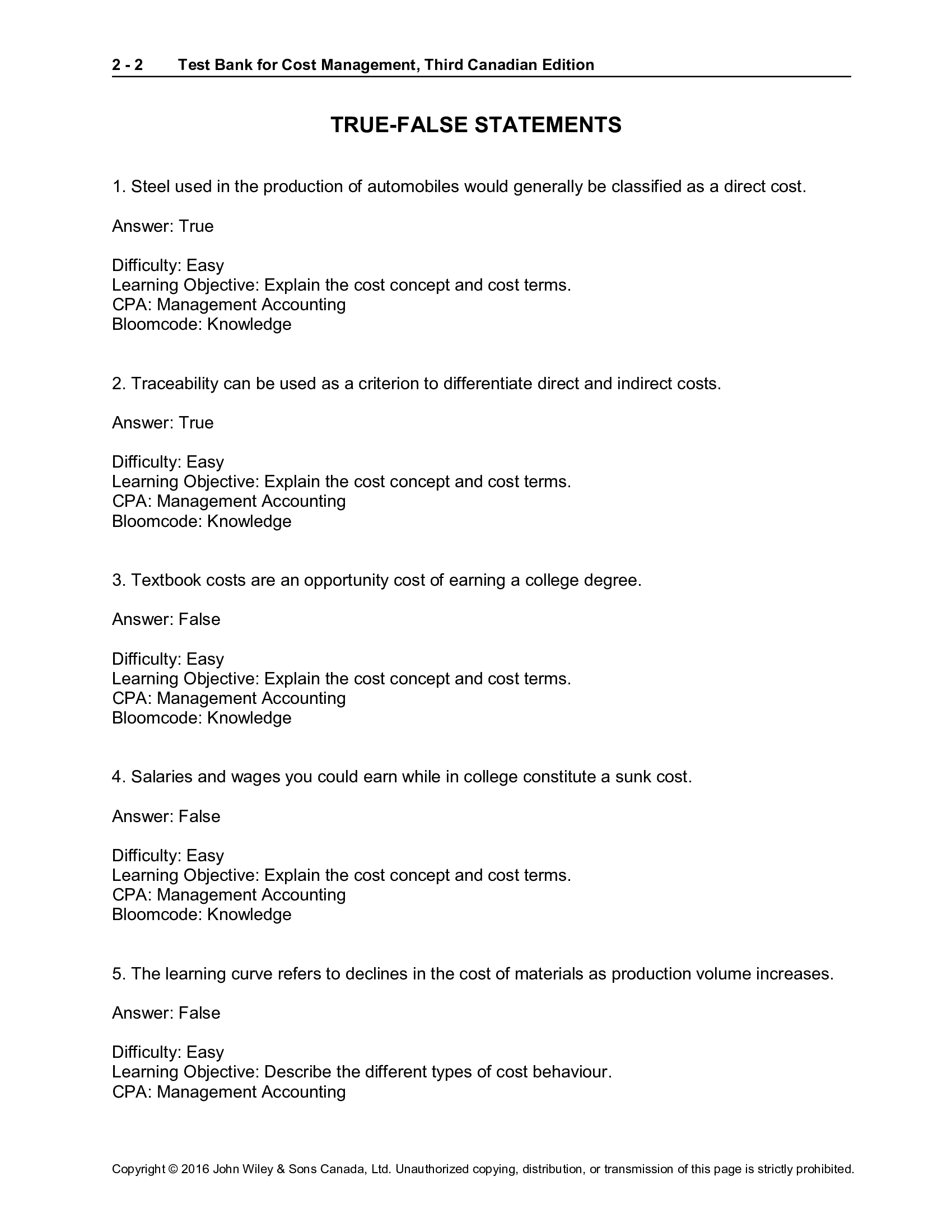
Preview page 1 Preview page 2 Preview page 3
Add To Favorites

Share this item Share this item

  • Item Details
  • Comments (0)
  • Reviews (0)
  • Contact Seller

Test Bank for Cost Management Measuring, Monitoring, and Motivating Performance, 3rd Canadian Edition, Leslie G. Eldenburg, Susan K. Wolcott, Liang-Hsuan Chen, Gail Cook TEST BANK FOR COST MANAGEMENT MEASURING, MONITORING, AND MOTIVATING PERFORMANCE, 3RD CANADIAN EDITION, LESLIE G. ELDENBURG, SUSAN K. WOLCOTT, LIANG-HSUAN CHEN, GAIL COOK Susan K. Wolcott GRIZLI777 [Company address] Copyright © 2016 John Wiley & Sons Canada, Ltd. Unauthorized copying, distribution, or transmission of this page is strictly prohibited. Cost Concepts, Behaviour, and Estimation 2 - 1 CHAPTER 2 Cost Concepts, Behaviour, and Estimation CHAPTER LEARNING OBJECTIVES 1. Explain cost concepts and cost terms. 2. Describe the different types of cost behaviour. 3. Describe cost estimation techniques. 4. Apply cost estimation techniques to determine future costs. 5. Utilize regression analysis in cost estimation. 6. Appreciate the uses and limitations of cost estimates. Copyright © 2016 John Wiley & Sons Canada, Ltd. Unauthorized copying, distribution, or transmission of this page is strictly prohibited. 2 - 2 Test Bank for Cost Management, Third Canadian Edition TRUE-FALSE STATEMENTS 1. Steel used in the production of automobiles would generally be classified as a direct cost. Answer: True Difficulty: Easy Learning Objective: Explain the cost concept and cost terms. CPA: Management Accounting Bloomcode: Knowledge 2. Traceability can be used as a criterion to differentiate direct and indirect costs. Answer: True Difficulty: Easy Learning Objective: Explain the cost concept and cost terms. CPA: Management Accounting Bloomcode: Knowledge 3. Textbook costs are an opportunity cost of earning a college degree. Answer: False Difficulty: Easy Learning Objective: Explain the cost concept and cost terms. CPA: Management Accounting Bloomcode: Knowledge 4. Salaries and wages you could earn while in college constitute a sunk cost. Answer: False Difficulty: Easy Learning Objective: Explain the cost concept and cost terms. CPA: Management Accounting Bloomcode: Knowledge 5. The learning curve refers to declines in the cost of materials as production volume increases. Answer: False Difficulty: Easy Learning Objective: Describe the different types of cost behaviour. CPA: Management Accounting Copyright © 2016 John Wiley & Sons Canada, Ltd. Unauthorized copying, distribution, or transmission of this page is strictly prohibited. Cost Concepts, Behaviour, and Estimation 2 - 3 Bloomcode: Knowledge 6. The learning curve refers to increases in sunk costs as production volume decreases. Answer: False Difficulty: Easy Learning Objective: Describe the different types of cost behaviour. CPA: Management Accounting Bloomcode: Knowledge 7. A new product’s learning curve rate can be expressed as (direct material cost/total cost). Answer: False Difficulty: Easy Learning Objective: Describe the different types of cost behaviour. CPA: Management Accounting Bloomcode: Knowledge 8. Learning curves lead to greater productivity over time. Answer: True Difficulty: Easy Learning Objective: Describe the different types of cost behaviour. CPA: Management Accounting Bloomcode: Knowledge 9. Past costs are irrelevant for decision-making and possibly relevant for predicting future costs. Answer: True Difficulty: Easy Learning Objective: Describe cost estimation techniques. CPA: Management Accounting Bloomcode: Comprehension 10. Past costs are relevant for decision-making, but irrelevant for predicting future costs. Answer: False Difficulty: Easy Learning Objective: Describe cost estimation techniques. CPA: Management Accounting Bloomcode: Comprehension Copyright © 2016 John Wiley & Sons Canada, Ltd. Unauthorized copying, distribution, or transmission of this page is strictly prohibited. 2 - 4 Test Bank for Cost Management, Third Canadian Edition 11. Past costs are irrelevant for decision-making, but may be relevant for predicting future costs. Answer: True Difficulty: Easy Learning Objective: Describe cost estimation techniques. CPA: Management Accounting Bloomcode: Comprehension 12. Managers should be trained in engineering to calculate an engineered cost estimate. Answer: True Difficulty: Easy Learning Objective: Describe cost estimation techniques. CPA: Management Accounting Bloomcode: Knowledge 13. Reviewing the pattern of a cost over time is a critical step in determining an engineered cost estimate. Answer: False Difficulty: Easy Learning Objective: Describe cost estimation techniques. CPA: Management Accounting Bloomcode: Knowledge 14. A scatter plot provides helpful information about the relationship between a cost and a potential cost driver. Answer: True Difficulty: Easy Learning Objective: Describe cost estimation techniques. CPA: Management Accounting Bloomcode: Knowledge 15. Preparing a scatter plot is a requirement before applying the two-point method of cost estimation. Answer: True Difficulty: Easy Learning Objective: Describe cost estimation techniques. Copyright © 2016 John Wiley & Sons Canada, Ltd. Unauthorized copying, distribution, or transmission of this page is strictly prohibited. Cost Concepts, Behaviour, and Estimation 2 - 5 CPA: Management Accounting Bloomcode: Knowledge 16. The high-low method is a specific application of the two-point method of cost estimation. Answer: True Difficulty: Easy Learning Objective: Describe cost estimation techniques. CPA: Management Accounting Bloomcode: Knowledge 17. The high-low method frequently distorts a cost function because it uses too many data points to make an estimate. Answer: False Difficulty: Easy Learning Objective: Describe cost estimation techniques. CPA: Management Accounting Bloomcode: Knowledge 18. The first step in estimating a cost function for relevant costs is to select a cost estimation technique. Answer: False Difficulty: Easy Learning Objective: Apply cost estimation techniques to determine the future costs. CPA: Management Accounting Bloomcode: Knowledge 19. Categorizing costs by their behaviour is one step in estimating relevant costs for a cost object. Answer: True Difficulty: Easy Learning Objective: Apply cost estimation techniques to determine the future costs. CPA: Management Accounting Bloomcode: Knowledge 20. Uncertainties and information quality are evaluated when determining relevant costs, then not considered again. Answer: False Copyright © 2016 John Wiley & Sons Canada, Ltd. Unauthorized copying, distribution, or transmission of this page is strictly prohibited. 2 - 6 Test Bank for Cost Management, Third Canadian Edition Difficulty: Easy Learning Objective: Apply cost estimation techniques to determine the future costs. CPA: Management Accounting Bloomcode: Knowledge 21. Regression analysis is classified as simple or multiple, depending upon the number of dependent variables to be estimated. Answer: False Difficulty: Easy Learning Objective: Apply cost estimation techniques to determine the future costs. Learning Objective: Utilize regression analysis in cost estimation. CPA: Management Accounting Bloomcode: Knowledge 22. Simple regression analysis produces an equation of the form: Y =  + X + . Answer: False Difficulty: Easy Learning Objective: Utilize regression analysis in cost estimation. CPA: Management Accounting Bloomcode: Knowledge 23. In regression analysis, the Adjusted R-square statistic is used to evaluate how well the cost driver explains the behaviour in the cost. Answer: True Difficulty: Easy Learning Objective: Utilize regression analysis in cost estimation. CPA: Management Accounting Bloomcode: Knowledge 24. Estimates of future costs can be used in budgeting. Answer: True Difficulty: Easy Learning Objective: Appreciate the uses and limitations of cost estimates. CPA: Management Accounting Bloomcode: Knowledge Copyright © 2016 John Wiley & Sons Canada, Ltd. Unauthorized copying, distribution, or transmission of this page is strictly prohibited. Cost Concepts, Behaviour, and Estimation 2 - 7 25. Regression analysis usually provides a higher quality cost function than the high-low method. Answer: True Difficulty: Easy Learning Objective: Appreciate the uses and limitations of cost estimates. CPA: Management Accounting Bloomcode: Knowledge 26. Changes in cost behaviour over time are one source of uncertainty in estimating future costs. Answer: True Difficulty: Easy Learning Objective: Appreciate the uses and limitations of cost estimates. CPA: Management Accounting Bloomcode: Knowledge Copyright © 2016 John Wiley & Sons Canada, Ltd. Unauthorized copying, distribution, or transmission of this page is strictly prohibited. 2 - 8 Test Bank for Cost Management, Third Canadian Edition MULTIPLE CHOICE QUESTIONS 27. When the cost object is a unit produced, lubricating oil for production machines would be a(n): a) Direct cost b) Indirect cost c) Sunk cost d) Opportunity cost Answer: b Difficulty: Easy Learning Objective: Explain the cost concept and cost terms. CPA: Management Accounting Bloomcode: Knowledge 28. When the cost object is a unit produced, straight-line depreciation on manufacturing equipment would be a: Variable Cost Fixed Cost Direct Cost a) No Yes No b) Yes No No c) Yes No Yes d) No Yes Yes Answer: a Difficulty: Easy Learning Objective: Explain the cost concept and cost terms. CPA: Management Accounting Bloomcode: Knowledge 29. Fixed costs per unit: a) Vary inversely with changes in volume b) Change regardless of changes in volume c) Will not change over the relevant range d) Increase with an increase in volume Answer: a Difficulty: Easy Learning Objective: Describe the different types of cost behaviour. CPA: Management Accounting Bloomcode: Knowledge Copyright © 2016 John Wiley & Sons Canada, Ltd. Unauthorized copying, distribution, or transmission of this page is strictly prohibited. Cost Concepts, Behaviour, and Estimation 2 - 9 30. Mixed costs: a) Consist of fixed and variable costs b) Are constant in total c) Consist of the variable portion of all costs d) Have a constant per-unit value Answer: a Difficulty: Easy Learning Objective: Describe the different types of cost behaviour. CPA: Management Accounting Bloomcode: Knowledge 31. Mixed costs: a) Vary with production in direct proportion to volume b) Vary with production but not in direct proportion to volume c) Do not vary with production d) Include only different types of fixed costs Answer: b Difficulty: Easy Learning Objective: Describe the different types of cost behaviour. CPA: Management Accounting Bloomcode: Knowledge 32. The relevant range is defined as: a) The period of time over which costs do not change b) The volume of production over which the cost assumptions hold c) The volume of production over which step-wise fixed costs increase d) The time period in which the level of production does not change Answer: b Difficulty: Easy Learning Objective: Explain the cost concept and cost terms. Learning Objective: Describe the different types of cost behaviour. CPA: Management Accounting Bloomcode: Knowledge 33. Which of the following is not an assumption when estimating a cost function over the relevant range of activity? a) Mixed costs will change in total Copyright © 2016 John Wiley & Sons Canada, Ltd. Unauthorized copying, distribution, or transmission of this page is strictly prohibited. 2 - 10 Test Bank for Cost Management, Third Canadian Edition b) Mixed costs will change per unit c) Variable costs will be constant in total d) Fixed costs will be constant in total. Answer: c Difficulty: Easy Learning Objective: Describe the different types of cost behaviour. CPA: Management Accounting Bloomcode: Knowledge 34. Paula’s Kennels is located in a small city in Nova Scotia. The company employs three pet attendants, four pet groomers, and two front office staff who book appointments and keep records. The Kennel provides a range of services for dogs and cats including boarding, grooming, and obedience training. The grooming area includes a small retail section that carries dog and cat food, pet supplies, and toys. If the cost object is cost per day of boarding, which of the following is a direct cost? a) Pet food b) Front office staff salaries c) Grooming supplies d) Depreciation on shelving and equipment used in the grooming and retail area Answer: a Difficulty: Easy Learning Objective: Explain the cost concept and cost terms. Learning Objective: Describe the different types of cost behaviour. CPA: Management Accounting/Problem-Solving and Decision-Making Bloomcode: Application 35. Paula’s Kennels is located in a small city in Nova Scotia. The company employs three pet attendants, four pet groomers, and two front office staff who book appointments and keep records. The Kennel provides a range of services for dogs and cats including boarding, grooming, and obedience training. The grooming area includes a small retail section that carries dog and cat food, pet supplies, and toys. If the cost object is the total cost of the grooming product line, which of the following is an indirect cost? a) Front office staff salaries b) Labour cost of employees who groom pets c) Cost of grooming supplies d) Depreciation on grooming tables Answer: a Difficulty: Easy Learning Objective: Explain the cost concept and cost terms. Learning Objective: Describe the different types of cost behaviour. CPA: Management Accounting/Problem-Solving and Decision-Making Copyright © 2016 John Wiley & Sons Canada, Ltd. Unauthorized copying, distribution, or transmission of this page is strictly prohibited. Cost Concepts, Behaviour, and Estimation 2 - 11 Bloomcode: Application 36. Paula’s Kennels is located in a small city in Nova Scotia. The company employs three pet attendants, four pet groomers, and two front office staff who book appointments and keep records. The Kennel provides a range of services for dogs and cats including boarding, grooming, and obedience training. The grooming area includes a small retail section that carries dog and cat food, pet supplies, and toys. Which of the following is a sunk cost for any cost object related to Jackie’s Kennels? a) Cost of the automobile Paula is planning to buy for pet transportation b) Cost of existing computer equipment used to keep company records c) Cost of annual wages for full-time employees d) Cost of rent for the next period Answer: b Difficulty: Easy Learning Objective: Explain the cost concept and cost terms. Learning Objective: Describe the different types of cost behaviour. CPA: Management Accounting/Problem-Solving and Decision-Making Bloomcode: Application 37. Paula’s Kennels is located in a small city in Nova Scotia. The company employs three pet attendants, four pet groomers, and two front office staff who book appointments and keep records. The Kennel provides a range of services for dogs and cats including boarding, grooming, and obedience training. The grooming area includes a small retail section that carries dog and cat food, pet supplies, and toys. Assume Paula’s Kennels is currently boarding ten pets. The cost of food to board one more pet is best described as a: a) Fixed cost b) Marginal cost c) Sunk cost d) Mixed cost Answer: b Difficulty: Easy Learning Objective: Explain the cost concept and cost terms. Learning Objective: Describe the different types of cost behaviour. CPA: Management Accounting/Problem-Solving and Decision-Making Bloomcode: Application 38. Paula’s Kennels is located in a small city in Nova Scotia. The company employs three pet attendants, four pet groomers, and two front office staff who book appointments and keep records. The Kennel provides a range of services for dogs and cats including boarding, grooming, and obedience training. The grooming area includes a small retail section that carries dog and cat food, pet supplies, and toys. Which of the following is the best example of a discretionary cost for Paula’s Kennels? Copyright © 2016 John Wiley & Sons Canada, Ltd. Unauthorized copying, distribution, or transmission of this page is strictly prohibited. 2 - 12 Test Bank for Cost Management, Third Canadian Edition a) Pet food b) Facility rent c) Wages of pet groomers d) Professional travel for Paula Answer: d Difficulty: Easy Learning Objective: Describe the different types of cost behaviour. CPA: Management Accounting/Problem-Solving and Decision-Making Bloomcode: Comprehension 39. Paula’s Kennels is located in a small city in Nova Scotia. The company employs three pet attendants, four pet groomers, and two front office staff who book appointments and keep records. The Kennel provides a range of services for dogs and cats including boarding, grooming, and obedience training. The grooming area includes a small retail section that carries dog and cat food, pet supplies, and toys. Paula’s relevant range of activity would best be measured in terms of: a) The number of staff she employs b) The number of pets she services c) The maximum amount of pet food she can buy each month based on the current budget d) The number of parking spaces available in the parking lot Answer: b Difficulty: Easy Learning Objective: Explain the cost concept and cost terms. Learning Objective: Describe the different types of cost behaviour. CPA: Management Accounting/Problem-Solving and Decision-Making Bloomcode: Application 40. The labour cost to construct the first unit of a special piece of equipment was $126,000. If labour costs are subject to a 90% learning curve, what will be the cost to build the second unit? Use the following values as needed to respond: ln(95%) / ln(2) = –0.074 ln(90%) / ln(2) = –0.152 ln(85%) / ln(2) = –0.234 ln(80%) / ln(2) = –0.322 ln(75%) / ln(2) = –0.415 ln(70%) / ln(2) = –0.515 a) $126,000 b) $113,000 c) $100,800 d) $113,400 Answer: d Copyright © 2016 John Wiley & Sons Canada, Ltd. Unauthorized copying, distribution, or transmission of this page is strictly prohibited. Cost Concepts, Behaviour, and Estimation 2 - 13 Difficulty: Easy Learning Objective: Describe cost estimation techniques. CPA: Management Accounting/Problem-Solving and Decision-Making Bloomcode: Application 41. A firm will build 8 units of a product. All costs are subject to an 85% learning curve. The first unit cost $75,000 to build. If the firm values inventory and cost of goods sold at the average cost for all units in the production run, what will be the cost to produce the second unit? Use the following values as needed to respond: ln(95%) / ln(2) = –0.074 ln(90%) / ln(2) = –0.152 ln(85%) / ln(2) = –0.234 ln(80%) / ln(2) = –0.322 ln(75%) / ln(2) = –0.415 ln(70%) / ln(2) = –0.515 a) $63,750 b) $69,375 c) $75,000 d) Some other amount Answer: b Difficulty: Easy Learning Objective: Describe cost estimation techniques. CPA: Management Accounting/Problem-Solving and Decision-Making Bloomcode: Application 42. Assume an 80% learning curve and that the first unit takes 6 hours. How long does it take to produce the second unit? Use the following values as needed to respond: ln(95%) / ln(2) = –0.074 ln(90%) / ln(2) = –0.152 ln(85%) / ln(2) = –0.234 ln(80%) / ln(2) = –0.322 ln(75%) / ln(2) = –0.415 ln(70%) / ln(2) = –0.515 a) 4.1 hours b) 3.6 hours c) 4.8 hours d) Some other amount Answer: c Difficulty: Easy Learning Objective: Describe cost estimation techniques. CPA: Management Accounting/Problem-Solving and Decision-Making Copyright © 2016 John Wiley & Sons Canada, Ltd. Unauthorized copying, distribution, or transmission of this page is strictly prohibited. 2 - 14 Test Bank for Cost Management, Third Canadian Edition Bloomcode: Application 43. Managers at Bob’s Custom Saddle Manufacturers believe that the learning rate for new employees is about 90%. If it takes a new employee 10 hours to make the first saddle, estimate the cumulative average time per saddle for a new employee to make four saddles. Use the following values as needed to respond: ln(95%) / ln(2) = –0.074 ln(90%) / ln(2) = –0.152 ln(85%) / ln(2) = –0.234 ln(80%) / ln(2) = –0.322 ln(75%) / ln(2) = –0.415 ln(70%) / ln(2) = –0.515 a) 8.1 hours per saddle b) 5.3 hours per saddle c) 7.6 hours per saddle d) Cannot be determined Answer: a Difficulty: Easy Learning Objective: Describe cost estimation techniques. CPA: Management Accounting/Problem-Solving and Decision-Making Bloomcode: Application 44. The cumulative average-time learning curve can be represented mathematically as: a) ln(percent learning) / ln(2) b) Y = αX c) Y = αXr d) α = YX r Answer: b r Difficulty: Easy Learning Objective: Describe cost estimation techniques CPA: Management Accounting Bloomcode: Knowledge 45. A learning curve is the rate at which: a) Students learn material for an exam b) Direct labour employees are provided training by their organizations c) Labour hours decrease as production increases when a new product is manufactured d) Profitability decreases because employees have become less efficient. Answer: c Copyright © 2016 John Wiley & Sons Canada, Ltd. Unauthorized copying, distribution, or transmission of this page is strictly prohibited. Cost Concepts, Behaviour, and Estimation 2 - 15 Difficulty: Easy Learning Objective: Describe cost estimation techniques. CPA: Management Accounting Bloomcode: Knowledge 46. Tom and Mike are installing new flooring in their home. The house has 5 rooms of approximately equal size where the flooring will be replaced. Tom and Mike spent 3 hours removing the old flooring from the first room. If Tom and Mike are operating with an 85% learning curve, what is the estimated average time to remove the flooring from all 5 rooms? Note: ln(85%) / ln(2) = –0.234. a) 2.05 hours total b) 2.05 hours per room c) 2.55 hours total d) 2.55 hours per room Answer: b Difficulty: Easy Learning Objective: Describe cost estimation techniques. CPA: Management Accounting/Problem-Solving and Decision-Making Bloomcode: Application 47. Discretionary costs reflect: a) The costs that managers incur to purchase new production machines when the old machines need replacing. b) Decisions about the maximum amount that will be spent next period for activities such as travel and marketing. c) Decisions about the amount of variable costs that will be incurred next period. d) The costs that managers incur to pay overtime when production levels are high. Answer: b Difficulty: Easy Learning Objective: Describe the different types of cost behaviour. Learning Objective: Describe cost estimation techniques. CPA: Management Accounting Bloomcode: Knowledge 48. Which of the following statements is true? a) Past costs are always relevant for decisions and are often useful in estimating future cost behaviour. b) Past costs are always relevant for decisions, but are rarely useful in estimating future cost behaviour. c) Past costs are never relevant for decisions, nor are they useful in estimating future cost behaviour. Copyright © 2016 John Wiley & Sons Canada, Ltd. Unauthorized copying, distribution, or transmission of this page is strictly prohibited. 2 - 16 Test Bank for Cost Management, Third Canadian Edition d) Past costs are never relevant for decisions, but are often useful in estimating future cost behaviour. Answer: d Difficulty: EasyLearning Objective: Describe cost estimation techniques. Bloomcode: Knowledge CPA: Management Accounting Bloomcode: Knowledge 49. The best source for determining historical costs is usually: a) The Internet b) Interviews with managers c) The company’s accounting information system d) Financial statements Answer: c Difficulty: Easy Learning Objective: Describe cost estimation techniques. CPA: Management Accounting Bloomcode: Comprehension 50. Which of the following statements is false? a) Information for some costs cannot easily be obtained from the accounting information system. b) Useful cost information is rarely available from the accounting information system. c) The accounting system design affects the availability of useful cost information. d) The nature of cost information affects its usefulness for decision-making. Answer: b Difficulty: Easy Learning Objective: Describe the different types of cost behaviour. CPA: Management Accounting Bloomcode: Comprehension 51. In most accounting information systems, costs are often recorded and coded so they can be summarized based on different: a) Cost drivers b) Cost objects c) Volumes of activity d) Independent variables Answer: b Copyright © 2016 John Wiley & Sons Canada, Ltd. Unauthorized copying, distribution, or transmission of this page is strictly prohibited. Cost Concepts, Behaviour, and Estimation 2 - 17 Difficulty: Easy Learning Objective: Describe the different types of cost behaviour. CPA: Management Accounting Bloomcode: Knowledge 52. Past cost information, although accurate in predicting future costs, may be: I. Unavailable II. Irrelevant III. Outdated a) I and II only b) II and III only c) II only d) I, II, and III Answer: d Difficulty: Easy Learning Objective: Describe cost estimation techniques. CPA: Management Accounting Bloomcode: Comprehension 53. Managers go through a series of questions to decide whether to use past costs to estimate future costs. Which of the following questions is least likely to be one of them? a) Is the cost relevant to the decision? b) Is the cost highly discretionary? c) Is the cost an engineered estimate? d) Is the cost expected to change? Answer: c Difficulty: Easy Learning Objective: Describe cost estimation techniques. CPA: Management Accounting Bloomcode: Comprehension 54. Estimating a cost function using past cost data to help determine future costs is useful if: a) Past costs are irrelevant and highly discretionary b) Past costs are irrelevant and not discretionary c) Past costs are relevant and highly discretionary d) Past costs are relevant and not discretionary Answer: d Difficulty: Easy Copyright © 2016 John Wiley & Sons Canada, Ltd. Unauthorized copying, distribution, or transmission of this page is strictly prohibited. 2 - 18 Test Bank for Cost Management, Third Canadian Edition Learning Objective: Describe cost estimation techniques. CPA: Management Accounting Bloomcode: Comprehension 55. After estimating a past cost function, managers: I. May need to update it for future changes. II. Have all of the information they need to predict future costs III. May or may not use it to estimate future costs. a) I only b) II only c) II and III only d) I and III only Answer: d Difficulty: Easy Learning Objective: Describe cost estimation techniques. CPA: Management Accounting Bloomcode: Comprehension 56. Bava Company wants to develop a cost function for its maintenance costs to estimate such costs for the coming year. The following data are available: Direct Maintenance Month Labour Hours Costs Incurred June 4,000 $ 900 July 6,500 1,325 August 7,000 1,500 September 5,500 1,150 Using the high-low method, what is the variable maintenance cost per direct labour hour? a) $1.00 b) $0.10 c) $0.20 d) $1.50 Answer: c Difficulty: Easy Learning Objective: Describe cost estimation techniques. CPA: Management Accounting/Problem-Solving and Decision-Making Bloomcode: Application 57. Bava Company wants to develop a cost function for its maintenance costs to estimate such costs for the coming year. The following data are available: Direct Maintenance Month Labour Hours Costs Incurred June 4,000 $ 900 Copyright © 2016 John Wiley & Sons Canada, Ltd. Unauthorized copying, distribution, or transmission of this page is strictly prohibited. Cost Concepts, Behaviour, and Estimation 2 - 19 July 6,500 1,325 August 7,000 1,500 September 5,500 1,150 Using the high-low method, what is the fixed maintenance cost? a) $500 b) $300 c) $200 d) $100 Answer: d Difficulty: Easy Learning Objective: Describe cost estimation techniques. CPA: Management Accounting/Problem-Solving and Decision-Making Bloomcode: Application 58. Bava Company wants to develop a cost function for its maintenance costs to estimate such costs for the coming year. The following data are available: Direct Maintenance Month Labour Hours Costs Incurred June 4,000 $ 900 July 6,500 1,325 August 7,000 1,500 September 5,500 1,150 Using the high-low method, what is the cost function for maintenance costs? a) $500 + $1.00 per direct labour hour b) $300 + $1.50 per direct labour hour c) $100 + $0.20 per direct labour hour d) $200 + $0.10 per direct labour hour Answer: c Difficulty: Easy Learning Objective: Describe cost estimation techniques. CPA: Management Accounting/Problem-Solving and Decision-Making Bloomcode: Application 59. The major disadvantage of the high-low method is that: a) It uses the two most extreme data points in determining a cost function b) It is difficult to calculate c) It is difficult to understand d) It involves more judgmental factors than do other methods Answer: a Difficulty: Easy Copyright © 2016 John Wiley & Sons Canada, Ltd. Unauthorized copying, distribution, or transmission of this page is strictly prohibited. 2 - 20 Test Bank for Cost Management, Third Canadian Edition Learning Objective: Describe cost estimation techniques. CPA: Management Accounting Bloomcode: Knowledge 60. Smith Company is attempting to develop the cost function for repair costs. The following past data are available: Machine Hours Repair Costs 4,800 $6,385 3,400 4,585 4,000 5,285 5,900 7,085 Using the high-low method, what is the variable repair cost per machine hour? a) $0.15 b) $1.00 c) $4.00 d) $5.00 Answer: b Difficulty: Easy Learning Objective: Describe cost estimation techniques. CPA: Management Accounting/Problem-Solving and Decision-Making Bloomcode: Application 61. Smith Company is attempting to develop the cost function for repair costs. The following past data are available: Machine Hours Repair Costs 4,800 $6,385 3,400 4,585 4,000 5,285 5,900 7,085 Using the high-low method, what is the fixed repair cost? a) $1,185 b) $850 c) $475 d) $565 Answer: a Difficulty: Easy Learning Objective: Describe cost estimation techniques. CPA: Management Accounting/Problem-Solving and Decision-Making Bloomcode: Application 62. Smith Company is attempting to develop the cost function for repair costs. The following past data are available: Copyright © 2016 John Wiley & Sons Canada, Ltd. Unauthorized copying, distribution, or transmission of this page is strictly prohibited. Cost Concepts, Behaviour, and Estimation 2 - 21 Machine Hours Repair Costs 4,800 $6,385 3,400 4,585 4,000 5,285 5,900 7,085 Using the high-low method, what is the estimated repair cost for 4,500 machine hours? a) $5,785 b) $5,585 c) $5,685 d) $5,985 Answer: c Difficulty: Medium Learning Objective: Describe cost estimation techniques. CPA: Management Accounting/Problem-Solving and Decision-Making Bloomcode: Application 63. Milano Company has an average overhead cost per hour of $10.50 at 3,500 machine hours, and at 3,000 hours it is $11.25. The company managers wish to estimate the overhead cost function. What is the variable overhead cost per machine hour? a) $1.00 b) $2.00 c) $6.00 d) $8.00 Answer: c Difficulty: Easy Learning Objective: Describe cost estimation techniques. CPA: Management Accounting/Problem-Solving and Decision-Making Bloomcode: Application 64. Milano Company has an average overhead cost per hour of $10.50 at 3,500 machine hours, and at 3,000 hours it is $11.25. The company managers wish to estimate the overhead cost function. What is the fixed overhead cost? a) $15,750 b) $36,750 c) $21,000 d) $18,000 Answer: a Difficulty: Easy Learning Objective: Describe cost estimation techniques. CPA: Management Accounting/Problem-Solving and Decision-Making Copyright © 2016 John Wiley & Sons Canada, Ltd. Unauthorized copying, distribution, or transmission of this page is strictly prohibited. 2 - 22 Test Bank for Cost Management, Third Canadian Edition Bloomcode: Application 65. Assuming that a cost is mixed and linear, and that past cost behaviour is expected to continue into the future, which of the following is mostly likely the best technique for estimating future costs? a) Engineered estimate of cost b) Two-point method c) Scatter plot d) Regression analysis Answer: d Difficulty: Easy Learning Objective: Describe cost estimation techniques. CPA: Management Accounting Bloomcode: Comprehension 66. Managers analyze production activities and assign costs based on the estimated amount of resources used when they use this method: a) A scatter plot b) The high-low method c) Regression analysis d) Engineered estimate of cost Answer: d Difficulty: Easy Learning Objective: Describe cost estimation techniques. CPA: Management Accounting Bloomcode: Comprehension 67. Reviewing cost behaviour patterns over time from the accounting records and using that review to predict future costs best describes: a) Regression analysis b) Scatter plots c) Analysis at the account level d) Two-point methods Answer: c Difficulty: Easy Learning Objective: Describe cost estimation techniques. CPA: Management Accounting Bloomcode: Knowledge Copyright © 2016 John Wiley & Sons Canada, Ltd. Unauthorized copying, distribution, or transmission of this page is strictly prohibited. Cost Concepts, Behaviour, and Estimation 2 - 23 68. Which of the following techniques relies on visual analysis? a) Scatter plots b) Analysis at the account level c) High-low method d) Engineered estimate of cost Answer: a Difficulty: Easy Learning Objective: Describe cost estimation techniques. CPA: Management Accounting Bloomcode: Knowledge 69. A scatter plot is especially useful when managers wish to: a) Compute a cost function b) Update a past cost function for future changes c) Study the relationship between a cost and a potential cost driver d) Analyze cost behaviour when only one period of data is available Answer: c Difficulty: Easy Learning Objective: Describe cost estimation techniques. CPA: Management Accounting Bloomcode: Comprehension 70. The trend line from a scatter plot can be used to identify data points for: a) The two-point method b) Analysis at the account level c) Engineered estimate of cost d) Regression analysis Answer: a Difficulty: Easy Learning Objective: Describe cost estimation techniques. CPA: Management Accounting Bloomcode: Knowledge 71. The high-low method is a specific application of this method of cost estimation: a) Two-point b) Scatter plot c) Engineered estimate of cost Copyright © 2016 John Wiley & Sons Canada, Ltd. Unauthorized copying, distribution, or transmission of this page is strictly prohibited. 2 - 24 Test Bank for Cost Management, Third Canadian Edition d) Analysis at the account level Answer: a Difficulty: Easy Learning Objective: Describe cost estimation techniques. CPA: Management Accounting Bloomcode: Knowledge 72. Which of the following is the most valid criticism of the high-low method? a) It never produces accurate results b) It is mathematically too complex for most managers to comprehend c) It is a specialized case of the two-point method d) Data points might be outside the normal range of activity Answer: d Difficulty: Easy Learning Objective: Describe cost estimation techniques. Learning Objective: Appreciate the uses and limitations of cost estimates. CPA: Management Accounting Bloomcode: Comprehension 73. A manager might use this method to create a graph of cost behaviour without any statistical techniques. a) Engineered estimate of cost b) High-low method c) Scatter plot d) Regression analysis Answer: c Difficulty: Easy Learning Objective: Describe cost estimation techniques. CPA: Management Accounting Bloomcode: Comprehension 74. Which of the following cost estimation techniques makes assumptions about the data being analyzed? I. Analysis at the account level II. Two-point method III. Regression analysis a) I only b) I and II only c) II and III only Copyright © 2016 John Wiley & Sons Canada, Ltd. Unauthorized copying, distribution, or transmission of this page is strictly prohibited. Cost Concepts, Behaviour, and Estimation 2 - 25 d) I, II, and III Answer: d Difficulty: Easy Learning Objective: Describe cost estimation techniques. CPA: Management Accounting Bloomcode: Comprehension 75. Which cost estimation technique is useful in all situations? a) Analysis at the account level b) Regression analysis c) Two-point method d) No one method is useful in all situations Answer: d Difficulty: Easy Learning Objective: Describe cost estimation techniques. CPA: Management Accounting Bloomcode: Comprehension 76. An organization’s accountant is estimating next period’s total overhead costs. She performed two regression analyses, one based on direct labour hours and the other based upon machine hours. The results were: Total overhead = $150,000 + $4 x direct labour hours Adjusted R-square = 0.65 Total overhead = $130,000 + $5 x machine hours Adjusted R-square = 0.77 For the next period, the accountant anticipates using 28,000 direct labour hours and 26,000 machine hours. Based upon this information, what is the best estimate for overhead for the next period? a) $262,000 b) $260,000 c) $254,000 d) $270,000 Answer: b Difficulty: Easy Learning Objective: Apply cost estimation techniques to determine the future costs. CPA: Management Accounting/Problem-Solving and Decision-Making Bloomcode: Application 77. Which of the following is not an assumption of linear regression analysis? Copyright © 2016 John Wiley & Sons Canada, Ltd. Unauthorized copying, distribution, or transmission of this page is strictly prohibited. 2 - 26 Test Bank for Cost Management, Third Canadian Edition a) The error terms have a constant variance b) The error terms are independent c) A linear relationship exists between the dependent and independent variables d) There is a cause and effect relationship between the dependent and independent variables Answer: d Difficulty: Easy Learning Objective: Utilize regression analysis in cost estimation. CPA: Management Accounting Bloomcode: Comprehension 78. Which of the following are forms of regression analysis? a) Quantitative and qualitative b) Fixed and variable c) Simple and multiple d) Financial and managerial Answer: c Difficulty: Easy Learning Objective: Utilize regression analysis in cost estimation. CPA: Management Accounting Bloomcode: Comprehension 79. Simple regression analysis differs from multiple regression analysis based on the number of: a) Cost drivers used b) Costs predicted c) Data points incorporated d) Personnel analyzing the data Answer: a Difficulty: Easy Learning Objective: Utilize regression analysis in cost estimation. CPA: Management Accounting Bloomcode: Knowledge 80. Simple regression minimizes the distance from each data point to: a) A trend line b) The y-intercept c) The error term d) The x-axis Answer: a Copyright © 2016 John Wiley & Sons Canada, Ltd. Unauthorized copying, distribution, or transmission of this page is strictly prohibited. Cost Concepts, Behaviour, and Estimation 2 - 27 Difficulty: Easy Learning Objective: Utilize regression analysis in cost estimation. CPA: Management Accounting Bloomcode: Knowledge 81. Which of the following is an alternative name for a cost driver in a regression analysis? a) Dependent variable b) Independent variable c) Beta d) Error term Answer: b Difficulty: Easy Learning Objective: Utilize regression analysis in cost estimation. CPA: Management Accounting Bloomcode: Knowledge 82. Which of the following is an alternative name for the cost being predicted in a regression analysis? a) Dependent variable b) Independent variable c) Beta d) Slope Answer: a Difficulty: Easy Learning Objective: Utilize regression analysis in cost estimation. CPA: Management Accounting Bloomcode: Knowledge 83. Regression analysis works best when the relationship between costs and cost drivers is: a) Positive and linear b) Linear and direct c) Positive and indirect d) Positive, linear, and indirect Answer: a Difficulty: Easy Learning Objective: Utilize regression analysis in cost estimation. CPA: Management Accounting Bloomcode: Knowledge Copyright © 2016 John Wiley & Sons Canada, Ltd. Unauthorized copying, distribution, or transmission of this page is strictly prohibited. 2 - 28 Test Bank for Cost Management, Third Canadian Edition 84. In a regression equation, fixed costs are represented by the: a) Slope b) Intercept c) Error term d) Adjusted R-square coefficient Answer: b Difficulty: Easy Learning Objective: Utilize regression analysis in cost estimation. CPA: Management Accounting Bloomcode: Knowledge 85. In a regression equation, variable costs are represented by the: a) Slope b) Intercept c) Adjusted R-square coefficient d) t-statistic Answer: a Difficulty: Easy Learning Objective: Utilize regression analysis in cost estimation. CPA: Management Accounting Bloomcode: Knowledge 86. Which graph shows data that are more suitable for regression analysis? Graph A Graph B 160 160 140 140 120 120 100 100 80 80 60 60 40 40 20 20 0 0 0 20 40 60 80 100 0 20 40 60 80 100 a) Graph A b) Graph B c) Neither Graph A nor Graph B d) Cannot be determined Answer: a Copyright © 2016 John Wiley & Sons Canada, Ltd. Unauthorized copying, distribution, or transmission of this page is strictly prohibited. Cost Concepts, Behaviour, and Estimation 2 - 29 Difficulty: Easy Learning Objective: Utilize regression analysis in cost estimation. CPA: Management Accounting Bloomcode: Comprehension 87. Simple regression analysis output produces a variety of information and statistics. Which of the following statistics provides information for fixed costs? a) T-statistic and p-value for the alpha coefficient b) T-statistics for alpha and beta coefficients c) Adjusted R-square d) P-values for alpha and beta coefficients Answer: a Difficulty: Easy Learning Objective: Utilize regression analysis in cost estimation. CPA: Management Accounting Bloomcode: Comprehension 88. Simple regression analysis output produces a variety of statistics. Which of the following statistics provides information for variable costs? a) Adjusted R-square b) P-values for alpha and beta coefficients c) T-statistic and p-value for the beta coefficient d) T-statistics for alpha and beta coefficients Answer: c Difficulty: Easy Learning Objective: Utilize regression analysis in cost estimation. CPA: Management Accounting Bloomcode: Comprehension 89. Simple regression analysis output produces a variety of statistics. Which of the following statistics best summarizes how well the cost driver explains the behaviour of the cost? a) T-statistics for alpha and beta coefficients b) T-statistic and p-value for the alpha coefficient c) P-values for alpha and beta coefficients d) Adjusted R-square Answer: d Difficulty: Easy Learning Objective: Utilize regression analysis in cost estimation. CPA: Management Accounting Copyright © 2016 John Wiley & Sons Canada, Ltd. Unauthorized copying, distribution, or transmission of this page is strictly prohibited. 2 - 30 Test Bank for Cost Management, Third Canadian Edition Bloomcode: Comprehension 90. When estimating future costs, information quality is higher when: a) Costs must be allocated b) The accounting system can trace relevant costs to a cost object c) The regression Adjusted R-square is near zero d) Most costs are fixed, rather than variable Answer: b Difficulty: Easy Learning Objective: Apply cost estimation techniques to determine the future costs. CPA: Management Accounting Bloomcode: Comprehension 91. Past cost information might be too unreliable for future cost estimation because: a) An organization has been operating too long in a stable environment b) The costs are primarily mixed c) A company has added a new product line d) Managers expect no changes in the cost function Answer: c Difficulty: Easy Learning Objective: Apply cost estimation techniques to determine the future costs. CPA: Management Accounting Bloomcode: Comprehension 92. Which of the following methods of estimating future costs can be used when only one period of data is available? a) Scatter plot b) High-low method c) Analysis at the account level d) Regression analysis Answer: c Difficulty: Easy Learning Objective: Apply cost estimation techniques to determine the future costs. CPA: Management Accounting Bloomcode: Comprehension 93. Tom and Mike are installing new flooring in their home. The house has 5 rooms of approximately equal size where the flooring will be replaced. Tom and Mike spent 3 hours Copyright © 2016 John Wiley & Sons Canada, Ltd. Unauthorized copying, distribution, or transmission of this page is strictly prohibited. Cost Concepts, Behaviour, and Estimation 2 - 31 removing the old flooring from the first room. The average time to remove the flooring from 2 rooms is 2.25 hours per room. Determine the learning curve percentage experienced by Tom and Mike. Below are values that may be useful in answering this question. ln(95%) / ln(2) = –0.074 ln(90%) / ln(2) = –0.152 ln(85%) / ln(2) = –0.234 ln(80%) / ln(2) = –0.322 ln(75%) / ln(2) = –0.415 ln(70%) / ln(2) = –0.515 a) 70% b) 75% c) 80% d) Some other percentage Answer: b Difficulty: Medium Learning Objective: Describe cost estimation techniques. CPA: Management Accounting/Problem-Solving and Decision-Making Bloomcode: Application 94. Consider the following cost data for the cost object; number of machine setups. Each set of costs (A, B, and C) is from a different type of manufacturing operation and represents the cost behaviour for the cost of that company’s machine setups. Number of Machine Setups Cost A Cost B Cost C 0 $ 0 $80 $ 5 10 20 79 37 20 40 82 66 30 60 78 91 40 80 81 123 50 100 79 154 Cost A is best described as: a) Fixed b) Variable c) Mixed d) Direct Answer: b Difficulty: Easy Learning Objective: Describe the different types of cost behaviour. CPA: Management Accounting/Problem-Solving and Decision-Making Bloomcode: Application Copyright © 2016 John Wiley & Sons Canada, Ltd. Unauthorized copying, distribution, or transmission of this page is strictly prohibited. 2 - 32 Test Bank for Cost Management, Third Canadian Edition 95. Consider the following cost data for the cost object; number of machine setups. Each set of costs (A, B, and C) is from a different type of manufacturing operation and represents the cost behaviour for the cost of that company’s machine setups. Number of Machine Setups Cost A Cost B Cost C 0 $ 0 $80 $ 5 10 20 79 37 20 40 82 66 30 60 78 91 40 80 81 123 50 100 79 154 Cost B is best described as: a) Fixed b) Variable c) Mixed d) Discretionary Answer: a Difficulty: Easy Learning Objective: Describe the different types of cost behaviour. CPA: Management Accounting/Problem-Solving and Decision-Making Bloomcode: Application 96. Consider the following cost data for the cost object; number of machine setups. Each set of costs (A, B, and C) is from a different type of manufacturing operation and represents the cost behaviour for the cost of that company’s machine setups. Number of Machine Setups Cost A Cost B Cost C 0 $ 0 $80 $ 5 10 20 79 37 20 40 82 66 30 60 78 91 40 80 81 123 50 100 79 154 Cost C is best described as: a) Fixed b) Variable c) Mixed d) Indirect Answer: c Difficulty: Easy Learning Objective: Describe the different types of cost behaviour. CPA: Management Accounting/Problem-Solving and Decision-Making Bloomcode: Application Copyright © 2016 John Wiley & Sons Canada, Ltd. Unauthorized copying, distribution, or transmission of this page is strictly prohibited. Cost Concepts, Behaviour, and Estimation 2 - 33 97. Three different divisions of a footwear manufacturing company are estimating costs for their human resources departments. Each division has a cost structure that is different from the other divisions’ and those structures are represented by the following cost behaviour patterns (A, B, and C). Number of Employees Cost A Cost B Cost C 0 $ 0 $120 $118 25 50 118 180 50 100 123 245 75 125 124 296 100 200 119 360 Which cost is best described as fixed? a) Cost A b) Cost B c) Cost C d) Cost B and Cost C Answer: b Difficulty: Easy Learning Objective: Describe the different types of cost behaviour. CPA: Management Accounting/Problem-Solving and Decision-Making Bloomcode: Application 98. Three different divisions of a footwear manufacturing company are estimating costs for their human resources departments. Each division has a cost structure that is different from the other divisions’ and those structures are represented by the following cost behaviour patterns (A, B, and C). Number of Employees Cost A Cost B Cost C 0 $ 0 $120 $118 25 50 118 180 50 100 123 245 75 125 124 296 100 200 119 360 Which cost is best described as variable? a) Cost A b) Cost B c) Cost C d) Cost A and Cost C Answer: a Difficulty: Easy Learning Objective: Describe the different types of cost behaviour. CPA: Management Accounting/Problem-Solving and Decision-Making Bloomcode: Application Copyright © 2016 John Wiley & Sons Canada, Ltd. Unauthorized copying, distribution, or transmission of this page is strictly prohibited. 2 - 34 Test Bank for Cost Management, Third Canadian Edition 99. Three different divisions of a footwear manufacturing company are estimating costs for their human resources departments. Each division has a cost structure that is different from the other divisions’ and those structures are represented by the following cost behaviour patterns (A, B, and C). Number of Employees Cost A Cost B Cost C 0 $ 0 $120 $118 25 50 118 180 50 100 123 245 75 125 124 296 100 200 119 360 Which cost is best described as mixed? a) Cost A b) Cost B c) Cost C d) Cost B and Cost C Answer: c Difficulty: Easy Learning Objective: Describe the different types of cost behaviour. CPA: Management Accounting/Problem-Solving and Decision-Making Bloomcode: Application 100. A firm has the capacity to produce 3,100 units per week. At 80% capacity, the average total cost per unit is $12.50 and the average variable cost per unit is $7.50. What is the total fixed cost per week, assuming the firm is still operating within its relevant range? a) $10,400 b) $14,400 c) $ 8,400 d) $12,400 Answer: d Difficulty: Medium Learning Objective: Describe the different types of cost behaviour. CPA: Management Accounting/Problem-Solving and Decision-Making Bloomcode: Application 101. Fixed costs: a) Do not vary in total within the relevant range b) Do not vary on a per-unit basis within the relevant range c) Vary on a per-unit basis in direct proportion to changes in the cost driver within the relevant range. Copyright © 2016 John Wiley & Sons Canada, Ltd. Unauthorized copying, distribution, or transmission of this page is strictly prohibited. Cost Concepts, Behaviour, and Estimation 2 - 35 d) Vary in total as the cost driver changes within the relevant range Answer: a Difficulty: Easy Learning Objective: Describe the different types of cost behaviour. CPA: Management Accounting Bloomcode: Knowledge 102. Variable costs: a) Do not vary in total within the relevant range b) Do not vary on a per-unit basis within the relevant range c) Vary on a per-unit basis within the relevant range d) Both (a) and (c) Answer: b Difficulty: Easy Learning Objective: Describe the different types of cost behaviour. CPA: Management Accounting Bloomcode: Knowledge 103. Which of the following could be defined as a cost object? a) A single unit of product in a manufacturing process b) A batch of products in a manufacturing process c) A business process, such as managing accounts receivable d) All of the above Answer: d Difficulty: Easy Learning Objective: Describe the different types of cost behaviour. CPA: Management Accounting Bloomcode: Comprehension 104. Which of the following statements is false? a) A cost can be defined as a direct cost if the bookkeeping system can keep track of how much of the cost was consumed by the cost object b) Whether a cost is direct or indirect cannot be determined until the cost object has been defined c) If the cost object is a batch of 1000 units of production, then factory property taxes could be a direct cost if the bookkeeping system is detailed enough d) Some indirect costs might have been considered direct costs if a company had better technology for capturing information Copyright © 2016 John Wiley & Sons Canada, Ltd. Unauthorized copying, distribution, or transmission of this page is strictly prohibited. 2 - 36 Test Bank for Cost Management, Third Canadian Edition Answer: c Difficulty: Easy Learning Objective: Explain the cost concept and cost terms. CPA: Management Accounting Bloomcode: Comprehension 105. The total cost of salaries of production supervisors, where 2 supervisors are needed for each 8-hour shift, and the relevant range is 0 units to the number of units that can be produced at full capacity using 2 8-hour shifts is a: a) Fixed cost b) Variable cost c) Mixed cost d) Stepwise linear cost Answer: d Difficulty: Easy Learning Objective: Describe the different types of cost behaviour. CPA: Management Accounting Bloomcode: Comprehension 106. The total cost of materials, where the supplier charges $9/kg if 0-1000 kilograms are purchased, $8/kg if 1001-2000 kilograms are purchased, and $7/kg if 2001 or more kilograms are purchased, is a: a) Fixed cost b) Variable cost c) Mixed cost d) Stepwise linear cost Answer: c Difficulty: Easy Learning Objective: Describe the different types of cost behaviour. CPA: Management Accounting Bloomcode: Comprehension 107. The rent on a store, where the landlord charges $1,200 per month plus a percentage of sales revenue, is a: a) Fixed cost b) Variable cost c) Mixed cost d) Stepwise linear cost Answer: c Copyright © 2016 John Wiley & Sons Canada, Ltd. Unauthorized copying, distribution, or transmission of this page is strictly prohibited. Cost Concepts, Behaviour, and Estimation 2 - 37 Difficulty: Easy Learning Objective: Describe the different types of cost behaviour. CPA: Management Accounting Bloomcode: Comprehension 108. The depreciation on a factory machine is a: a) Fixed cost b) Variable cost c) Mixed cost d) Stepwise linear cost Answer: a Difficulty: Easy Learning Objective: Describe the different types of cost behaviour. CPA: Management Accounting Bloomcode: Knowledge 109. Which of the following statements is true? a) Opportunity costs are never relevant for decision-making b) Discretionary costs are never relevant for decision-making c) Marginal costs are never relevant for decision-making d) Sunk costs are never relevant for decision-making Answer: d Difficulty: Easy Learning Objective: Explain the cost concept and cost terms. CPA: Management Accounting Bloomcode: Comprehension 110. If firm A has a learning curve with 90% learning and firm B has a learning curve with 80% learning, then: a) Firm A has more experienced workers b) Firm B will be more cost efficient over time c) Firm A workers learn more quickly d) Firm B has less experienced workers Answer: b Difficulty: Medium Learning Objective: Describe cost estimation techniques. CPA: Management Accounting Bloomcode: Comprehension Copyright © 2016 John Wiley & Sons Canada, Ltd. Unauthorized copying, distribution, or transmission of this page is strictly prohibited. 2 - 38 Test Bank for Cost Management, Third Canadian Edition 111. A firm’s production is expected to show an 85% learning rate. The first unit took 200 hours to produce. The second unit will take: a) 170 hours b) 140 hours c) 200 hours d) 289 hours Answer: a Difficulty: Easy Learning Objective: Describe cost estimation techniques. CPA: Management Accounting Bloomcode: Comprehension 112. A high adjusted R-square for the regression of a cost against a cost driver indicates: a) The predicted linear relationship between the cost and the cost driver is probably correct b) The relationship between the cost and the cost driver is probably linear c) The cost driver explains a high percentage of the variation of the cost d) The cost driver is statistically significant Answer: c Difficulty: Easy Learning Objective: Utilize regression analysis in cost estimation. CPA: Management Accounting Bloomcode: Comprehension 113. A p-value of 1% for the intercept term in a regression of a cost driver against a cost indicates: a) The true fixed costs are statistically significantly different from zero b) There is only a 1% chance the true fixed costs are zero c) The variable costs are immaterial in this cost function d) Both (a) and (b) Answer: d Difficulty: Medium Learning Objective: Utilize regression analysis in cost estimation. CPA: Management Accounting Bloomcode: Comprehension 114. A p-value of 89% for the slope coefficient in a regression of a cost driver against a cost indicates: Copyright © 2016 John Wiley & Sons Canada, Ltd. Unauthorized copying, distribution, or transmission of this page is strictly prohibited. Cost Concepts, Behaviour, and Estimation 2 - 39 a) The true variable costs are statistically significantly different from zero b) There is only an 11% chance the true variable costs are zero c) The relationship between the cost and the cost driver is nonlinear d) None of the above Answer: d Difficulty: Medium Learning Objective: Utilize regression analysis in cost estimation. CPA: Management Accounting Bloomcode: Comprehension 115. The difference between simple regression and multiple regression is that: a) Simple regression is easier to perform in Excel than multiple regression b) Simple regression is only performed once when estimating a cost function, whereas multiple regression is performed more than once c) Simple regression uses only one cost driver, whereas multiple regression uses more than one cost driver d) Simple regression is for estimating only one cost, and multiple regression is for estimating more than one cost Answer: c Difficulty: Easy Learning Objective: Utilize regression analysis in cost estimation. CPA: Management Accounting Bloomcode: Knowledge 116. A regression of total selling expenses against number of units sold yields an intercept of 178,024 and a slope of 12.3. This indicates that: a) Total fixed selling expenses are predicted to be $178,024 b) Variable selling expenses are predicted to be $12.30/unit c) Total selling expenses are predicted to be $190,324 when 1000 units are sold d) All of the above Answer: d Difficulty: Easy Learning Objective: Utilize regression analysis in cost estimation. CPA: Management Accounting Bloomcode: Comprehension 117. If we are determining costs for a particular case at a law office, the cost of rent for the office would be: Copyright © 2016 John Wiley & Sons Canada, Ltd. Unauthorized copying, distribution, or transmission of this page is strictly prohibited. 2 - 40 Test Bank for Cost Management, Third Canadian Edition a) A direct cost b) An indirect cost c) A mixed cost d) An irrelevant cost Answer: b Difficulty: Easy Learning Objective: Explain the cost concept and cost terms. Learning Objective: Describe the different types of cost behaviour. CPA: Management Accounting Bloomcode: Comprehension 118. If we want to estimate the cost of lumber for manufacturing chairs, the cost function most likely reflects: a) Only a variable cost b) Only a fixed cost c) A mixed cost d) An irrelevant cost Answer: a Difficulty: Easy Learning Objective: Explain the cost concept and cost terms. Learning Objective: Describe the different types of cost behaviour. CPA: Management Accounting Bloomcode: Comprehension 119. Which one of following is not a reason to take into account the relevant range when estimating a cost? a) The cost function is nearly linear within a relevant range b) It is reasonable to assume that fixed costs remain fixed in this range c) It is reasonable to assume that variable costs remain constant in this range d) We cannot make assumptions about linearity within a relevant range Answer: d Difficulty: Easy Learning Objective: Describe cost estimation techniques. CPA: Management Accounting Bloomcode: Comprehension 120. If you create a scatter plot of a cost against a cost driver: a) You gain information about whether there is a seeming relation between the cost and cost driver Copyright © 2016 John Wiley & Sons Canada, Ltd. Unauthorized copying, distribution, or transmission of this page is strictly prohibited. Cost Concepts, Behaviour, and Estimation 2 - 41 b) For all costs, you will have completed your analysis c) You gain no new information about the relationship between the cost and cost driver d) You will not need to perform regression analysis to estimate the cost function Answer: a Difficulty: Easy Learning Objective: Describe cost estimation techniques. CPA: Management Accounting Bloomcode: Comprehension 121. In a regression analysis for estimating a cost function, t-statistics and their p-values do not provide information about: a) Whether the cost and cost drivers are related b) How confident we can be that the intercept or slope coefficients are different from zero c) The amount of variation in cost that is explained by variation in the cost driver d) Whether the cost is totally fixed, totally variable, or mixed Answer: c Difficulty: Medium Learning Objective: Utilize regression analysis in cost estimation. CPA: Management Accounting Bloomcode: Comprehension 122. In a regression analysis for estimating a cost function, the adjusted R-Square statistic provides information about: a) The amount of variation in cost that is explained by variation in the cost driver b) The size of the slope coefficient c) Whether the cost is a fixed, variable, or mixed cost d) How confident we can be that the intercept or slope coefficients are different from zero Answer: a Difficulty: Easy Learning Objective: Utilize regression analysis in cost estimation. CPA: Management Accounting Bloomcode: Knowledge 123. Marginal cost is: a) The average cost per unit b) The incremental cost of the next unit c) Not relevant for decision-making d) Constant even if the relevant range changes Copyright © 2016 John Wiley & Sons Canada, Ltd. Unauthorized copying, distribution, or transmission of this page is strictly prohibited. 2 - 42 Test Bank for Cost Management, Third Canadian Edition Answer: b Difficulty: Easy Learning Objective: Explain the cost concept and cost terms. CPA: Management Accounting Bloomcode: Knowledge 124. All of the following are true about average cost per unit except: a) Average cost equals variable cost per unit plus average fixed cost per unit b) Average costs are used in financial statements c) Average costs are usually irrelevant for decision-making because they include a portion of fixed cost. d) Average costs are usually good estimates of future costs Answer: d Difficulty: Easy Learning Objective: Appreciate the uses and limitations of cost estimates. CPA: Management Accounting Bloomcode: Comprehension 125. Opportunity costs are: a) Benefits foregone from one project because another project is chosen b) Irrelevant c) The same as sunk costs d) Easy to value Answer: a Difficulty: Easy Learning Objective: Explain the cost concept and cost terms. CPA: Management Accounting Bloomcode: Knowledge 126. Sunk costs are: a) The same as opportunity costs b) Expenditures made in the past c) Relevant to decisions d) Difficult to value Answer: b Difficulty: Easy Learning Objective: Explain the cost concept and cost terms. CPA: Management Accounting Copyright © 2016 John Wiley & Sons Canada, Ltd. Unauthorized copying, distribution, or transmission of this page is strictly prohibited. Cost Concepts, Behaviour, and Estimation 2 - 43 Bloomcode: Knowledge 127. Direct costs are: a) Costs that need to be assigned but cannot be traced easily to cost objects b) Only variable costs c) Costs that can easily be traced to cost objects d) Only fixed costs Answer: c Difficulty: Easy Learning Objective: Explain the cost concept and cost terms. CPA: Management Accounting Bloomcode: Knowledge 128. Indirect costs are: a) Costs that need to be assigned but cannot easily be traced to cost objects b) Only variable costs c) Costs that can easily be traced to cost objects d) Only fixed costs Answer: a Difficulty: Easy Learning Objective: Explain the cost concept and cost terms. CPA: Management Accounting Bloomcode: Knowledge 129. All of the following are examples of variable costs except: a) The cost of tires if the cost object is the number of automobiles produced b) Professional labour cost if the cost object is the audit of a business c) The cost for wood in a baseball bat manufacturing company if the cost object is bats produced d) The cost to lease a manufacturing plant if the cost object is the product manufactured Answer: d Difficulty: Easy Learning Objective: Explain the cost concept and cost terms. Learning Objective: Describe the different types of cost behaviour. CPA: Management Accounting Bloomcode: Comprehension 130. All of the following are true about analysis at the account level except: Copyright © 2016 John Wiley & Sons Canada, Ltd. Unauthorized copying, distribution, or transmission of this page is strictly prohibited. 2 - 44 Test Bank for Cost Management, Third Canadian Edition a) It is a method for separating fixed and variable costs b) It uses information from the general ledger c) It is a quantitative method for separating costs d) It requires very little judgment to determine cost behaviour Answer: d Difficulty: Easy Learning Objective: Describe cost estimation techniques. CPA: Management Accounting Bloomcode: Comprehension 131. All of the following are assumptions for developing and using a cost linear function except: a) Past costs rarely need updating to be good predictors of future costs b) Operations are within the relevant range c) Variable costs per unit remain constant within the relevant range d) Fixed costs remain fixed within the relevant range Answer: a Difficulty: Easy Learning Objective: Describe the different types of cost behaviour. CPA: Management Accounting Bloomcode: Comprehension 132. The relevant range in cost accounting is the range over which: a) Costs may fluctuate b) Cost relationships are valid c) Production may vary d) Relevant costs are incurred Answer: b Difficulty: Easy Learning Objective: Explain the cost concept and cost terms. CPA: Management Accounting Bloomcode: Knowledge 133. Cost drivers are: a) Activities that cause costs to increase as the activity increases b) Accounting techniques used to control costs c) Accounting measurements used to evaluate whether or not performance is proceeding according to plan Copyright © 2016 John Wiley & Sons Canada, Ltd. Unauthorized copying, distribution, or transmission of this page is strictly prohibited. Cost Concepts, Behaviour, and Estimation 2 - 45 d) A mechanical basis, such as machine hours, computer time, size of equipment, or square meters used to assign costs to activities Answer: a Difficulty: Easy Learning Objective: Describe the different types of cost behaviour. CPA: Management Accounting Bloomcode: Knowledge Copyright © 2016 John Wiley & Sons Canada, Ltd. Unauthorized copying, distribution, or transmission of this page is strictly prohibited. 2 - 46 Test Bank for Cost Management, Third Canadian Edition MATCHING QUESTIONS 134. Sampson Manufacturing wants to determine whether its various product costs are direct or indirect and variable or fixed. This information will be used to determine product unit costs. All employees are guaranteed a 40 hour work-week except factory employees, who are paid an hourly wage and can be sent home when there is no work. The following classification scheme has been developed: A. Direct variable cost B. Indirect variable cost C. Direct fixed cost D. Indirect fixed cost Using the categories shown above, indicate how each of the following costs should be classified if the cost object is a single unit of product: ____ 1. Labour in the maintenance department ____ 2. Glue and tacks used in production ____ 3. Lubricating oil for production machines ____ 4. Salary of the plant accountant ____ 5. Oil used for monthly preventive maintenance on production machines ____ 6. Insurance on the plant machinery ____ 7. Hourly factory wages ____ 8. Wages for factory employees in the materials receiving and handling department ____ 9. Taxes on plant equipment ____ 10. Shipping costs for direct materials Answer: 1. D 2. B 3. B 4. D 5. D 6. D 7. A 8. B 9. D 10. A Difficulty: Easy Learning Objective: Explain the cost concept and cost terms. CPA: Management Accounting Bloomcode: Comprehension 135. Various terms are listed in the right-hand column below; several definitions are listed on the left. Match the appropriate term with each definition. Some of the lettered terms may be used more than once, while others may not be used at all. Each numbered definition has only one best response. Copyright © 2016 John Wiley & Sons Canada, Ltd. Unauthorized copying, distribution, or transmission of this page is strictly prohibited. Cost Concepts, Behaviour, and Estimation 2 - 47 ____ 1. A thing or activity for which managers measure costs ____ 2. Input or activity that causes changes in costs A. Cost driver B. Cost estimation method C. Cost object D. Direct cost E. Fixed cost F. Indirect cost G. Opportunity cost H. Mixed cost I. Discretionary cost J. R-square statistic K. Relevant range L. Sunk cost ____ 3. Analysis at the account level ____ 4. Cost incurred in the past ____ 5. Easily traced to individual cost objects ____ 6. Has a cause-and-effect relationship with costs ____ 7. Often estimated based on a budget established by management ____ 8. Often increase in a stepwise manner ____ 9. Benefits of the next best alternative that we forego when we make a decisions ____ 10. Represented mathematically as TC = F + V x Q ____ 11. Scatter plots ____ 12. Span of activity for which cost behaviour can be reliably predicted Answer: 1. C 2. A 3. B 4. L 5. D 6. A 7. I 8. E 9. G 10. H 11. B 12. K Difficulty: Easy Learning Objective: Explain the cost concept and cost terms. Learning Objective: Describe the different types of cost behaviour. Learning Objective: Describe cost estimation techniques. Learning Objective: Utilize regression analysis in cost estimation. CPA: Management Accounting Bloomcode: Comprehension 136. The steps for using regression analysis to estimate a cost function are listed below in random order. Correctly number the steps from 1 to 8. ____ Write the cost function. ____ Plot the cost for each potential cost driver. ____ Perform the regression analysis. Copyright © 2016 John Wiley & Sons Canada, Ltd. Unauthorized copying, distribution, or transmission of this page is strictly prohibited. 2 - 48 Test Bank for Cost Management, Third Canadian Edition ____ Generate a list of possible cost drivers. ____ Gather cost and cost driver data. ____ Evaluate the sign and significance of the cost function’s components. ____ Discard potential cost drivers that fail to explain a high proportion of variability in the cost. ____ Consider the behaviour of the cost. Answer: 8 Write the cost function. 4 Plot the cost for each potential cost driver. 5 Perform the regression analysis. 2 Generate a list of possible cost drivers. 3 Gather data. 6 Evaluate the sign and significance of the cost function’s components. 7 Discard potential cost drivers that fail to explain a high proportion of variability in the cost. 1 Consider the behaviour of the cost. Difficulty: Easy Learning Objective: Utilize regression analysis in cost estimation. CPA: Management Accounting Bloomcode: Comprehension Copyright © 2016 John Wiley & Sons Canada, Ltd. Unauthorized copying, distribution, or transmission of this page is strictly prohibited. Cost Concepts, Behaviour, and Estimation 2 - 49 EXERCISES 137. The average cost of producing 200 units is $82 for Commercial Company. If production increases by 100 units, the average cost falls to $61. a) What is the variable cost per unit? b) What is the fixed cost? c) What is the average cost of producing 250 units? Solution to Exercise 137 Two-point method: Units Cost per unit Total cost 300 $ 61 $ 18,300 200 82 16,400 100 $ 1,900 VC per unit $ Part a 19 Total FC $ 12,600 Part b Total cost of 250 units $ 17,350 Average unit cost for 250 units $ 69.40 Part c Difficulty: Easy Learning Objective: Describe cost estimation techniques. CPA: Management Accounting/Problem-Solving and Decision-Making Bloomcode: Application 138. Total fixed costs are $15,000 per month and last month, total variable costs were $5,000 when total revenue was $25,000. a) Write the algebraic expression for this flexible budget for total cost. b) What assumptions are made for a linear cost function like this? Solution to Exercise 138 Total cost = $15,000 + $5,000/$25,000 x total revenue = $15,000 + 0.20 x total revenue Assumptions: Sales mix, price, and variable cost remain constant, fixed costs remain fixed, and operations are in the relevant range. (Note: The assumption of constant sales mix is not introduced until chapter 3 of the textbook.) Difficulty: Easy Learning Objective: Describe cost estimation techniques. CPA: Management Accounting/Problem-Solving and Decision-Making Bloomcode: Application Copyright © 2016 John Wiley & Sons Canada, Ltd. Unauthorized copying, distribution, or transmission of this page is strictly prohibited. 2 - 50 Test Bank for Cost Management, Third Canadian Edition 139. The average cost to produce 10,000 units is $88, and the average cost to produce 15,000 units is $84. a) Develop a cost function for this cost. b) Estimate the average cost to produce 18,000 units. Solution to Exercise 139 a) Total cost for 10,000 units = $880,000 Total cost for 15,000 units = $1,260,000 VC = ($1,260,000 - $880,000)/(15,000 – 10,000) = $76 Fixed cost for 15,000 units = $1,260,000 - $1,140,000 = $120,000 Total cost = $120,000 + $76Q. b) Total cost for 18,000 units = $1,488,000 Average cost = $82.67 Difficulty: Easy Learning Objective: Describe cost estimation techniques. CPA: Management Accounting/Problem-Solving and Decision-Making Bloomcode: Application 140. Total fixed costs are $20,000 per year. The variable cost per unit is $10 per unit up to 5,000 units per year and $6.50 per unit thereafter. a) Develop a cost function for this cost. b) What could cause the change in variable costs shown above? Explain. c) List three assumptions that are made when developing these types of cost functions and give one reason that each assumption might not hold. Solution to Exercise 140 a) For production levels between 0 and 5,000 units, TC = $20,000 + $10Q For production levels above 5,000 units, TC = $20,000 + ($10 x 5,000) + $6.50(Q-5,000) TC = $37,500 + $6.50Q b) Often raw materials are discounted with volume purchases. c) Below are the three assumptions of this cost function, with examples of reasons why each assumption might not hold. Students may think of other examples. Fixed costs remain fixed. Utilities and other types of fixed cost vary each month, but often not based on volume of production. There can also be unanticipated price changes or changes in discretionary spending. Variable costs remain constant per unit. Volume discounts are often given, reducing variable costs after a certain level of purchases. There can also be unanticipated price changes. Operations are in the relevant range. At the extremes of the range, that is very high or very low production levels, costs might be a little different than within those areas of the range where the organization has most experience. In addition, the relevant may be mis-specified; operation volumes may increase or decrease to a level of activity in a different relevant range; or managers may make changes to operations or the cost structure. Difficulty: Easy Learning Objective: Describe cost estimation techniques. CPA: Management Accounting/Problem-Solving and Decision-Making Bloomcode: Application Copyright © 2016 John Wiley & Sons Canada, Ltd. Unauthorized copying, distribution, or transmission of this page is strictly prohibited. Cost Concepts, Behaviour, and Estimation 2 - 51 141. LeBlanc Company is developing a cost function for its maintenance costs using the highlow method. The following data have been collected for the past year: Direct Labour Maintenance Quarter Hours Costs Incurred 1 5,000 $ 745 2 6,500 820 3 7,000 850 4 8,000 1,000 Calculate the following amounts: a) The variable cost per direct labour hour b) The fixed cost c) The estimated total cost for 9,000 direct labour hours d) The estimated total cost for 6,000 direct labour hours Solution to Exercise 141 High-low method (Student answers may vary depending on rounding choices.) Units Total cost 8,000 $ 1,000 5,000 745 3,000 $ 255 VC per unit $ Question A 0.085 Total FC $ 320.00 Question B Estimated cost for 9,000 DLH $ 1,085.00 Question C Estimated cost for 6,000 DLH $ 830.00 Question D Difficulty: Easy Learning Objective: Describe cost estimation techniques. CPA: Management Accounting/Problem-Solving and Decision-Making Bloomcode: Application 142. During 20x5, Advanced Systems introduced complex oil well monitoring equipment and produced 100 units in anticipation of selling to the major oil-producing companies. The first unit produced cost $120,000, and production costs are subject to a 90% learning curve. Note: ln(90%) / ln(2) = –0.152. During 20x5, the company sold 20 units and during 20x6, the company sold 40 units. Each unit sells for $100,000. If costs are assigned to cost of goods sold based on the average expected cost for all units in the 20x5 production run, what is the company’s gross profit during 20x6? Copyright © 2016 John Wiley & Sons Canada, Ltd. Unauthorized copying, distribution, or transmission of this page is strictly prohibited. 2 - 52 Test Bank for Cost Management, Third Canadian Edition Solution to Exercise 142 Learning curve Average cost per unit to produce 100 units -0.152 $120,000 * 100 $ 59,591 Total unit sales 60 Units sold in 20x5 20 Unit sales for 20x6 40 Sales for 20x6 $ 4,000,000 COGS for 20x6 (2,383,643) Gross profit for 20x6 $ 1,616,357 Difficulty: Medium Learning Objective: Describe cost estimation techniques. CPA: Management Accounting/Problem-Solving and Decision-Making Bloomcode: Application 143. Simpson’s managerial accountant, Yi-Fan, is classifying the company’s costs according to their behaviour to prepare next year’s budget. Therefore, the cost object is the entire company. Simpson produces and sells aluminum beverage cans, such as those used for soft drinks. You may find the following facts about Simpson’s operation useful in responding to this problem:  Production machines must be cleaned monthly, regardless of the amount of use.  The more cans produced, the more lubrication is needed.  Simpson’s monthly production and sales volume is usually at least 1,000 cans, but can be as much as 5,000 cans depending on demand.  Material handling costs include depreciation on equipment and fuel for loaders.  Cans are packaged into 100-unit groups prior to sale.  Research and development costs vary between $10,000 and $10,500 per month  The factory maintenance costs vary between $6,000 and $6,500 monthly.  Simpson’s staff level is constant at 25 people, who are all paid salaries.  Raw materials are purchased based on expected production levels.  Sales commissions (based on a per-case amount) are included in marketing department costs. Yi-Fan has classified the costs into three categories: fixed, variable, and mixed. Place an X in the appropriate column of the table below to indicate the most likely behaviour of each cost: Fixed Variable Mixed Oil to lubricate the machines Salary of the plant manager Annual subscription to a trade journal Vacation pay for salaried production employees Packaging materials Research and development Raw materials Material handling costs Copyright © 2016 John Wiley & Sons Canada, Ltd. Unauthorized copying, distribution, or transmission of this page is strictly prohibited. Cost Concepts, Behaviour, and Estimation 2 - 53 Marketing department costs Factory maintenance Solution to Exercise 143 Cost classification Fixed Variable Mixed Oil to lubricate the machines X Salary of the plant manager X Annual subscription to a trade journal X Vacation pay for salaried production employees X Packaging materials X Research and development X Raw materials X Material handling costs X Marketing department costs X Factory maintenance X Difficulty: Easy Learning Objective: Describe cost estimation techniques. CPA: Management Accounting/Problem-Solving and Decision-Making Bloomcode: Application 144. The following data were obtained from the accounting information system of POC Corporation: Production Units Raw Materials Factory Manager Month Produced Used Supplies Salary January 60 $1,560 $550 $3,000 February 80 2,000 700 3,000 March 50 1,300 475 3,000 April 30 775 325 3,000 a) Describe the behaviour of each of the costs shown above as fixed, variable, or mixed. You may wish to draw scatter plots or analyze the cost using your knowledge of costs and the actual variation in cost pattern from above (in other words, perform an informal analysis at the account level). b) Use the data for February and March and the two-point method to determine a cost function for any mixed cost(s). c) Use the high-low method to determine a cost function for any mixed cost(s). Solution to Exercise 144 Cost estimation methods a) Scatter plots Copyright © 2016 John Wiley & Sons Canada, Ltd. Unauthorized copying, distribution, or transmission of this page is strictly prohibited. 2 - 54 Test Bank for Cost Management, Third Canadian Edition $3,500 $3,000 $2,500 $2,000 $1,500 $1,000 $500 $- 0 20 40 60 80 100 Raw materials purchased Factory supplies VP of Production salary Description of cost behaviour: Cost of raw materials purchased is variable; total cost at zero volume appears to be zero, and the total cost appears to increase at a constant rate. The cost of raw materials most likely varies proportionately with the volume of production. Cost of factory supplies is most likely mixed. Although the cost behaviour is not visually obvious in the above scatter plot, the data for the cost indicate that the cost is higher at higher levels of production. Also, the cost appears to have a fixed component. Factory supplies often include a combination of fixed costs, such as janitorial supplies and light bulbs, and variable costs, such as lubrication for machinery. Production manager salary is a fixed cost; it is constant across all levels of production. Production manager salaries usually do not vary with volume of production. b) Two-point method analysis for factory supplies Units Cost 80 $700 50 $475 30 $225 VC per unit $7.50 Total FC $100 Cost function $100 + $7.50 x units produced c) High-low method analysis for factory supplies Units Cost 80 $700 30 $325 50 $375 VC per unit $7.50 Total FC $100 Cost function $100 + $7.50 x units produced Copyright © 2016 John Wiley & Sons Canada, Ltd. Unauthorized copying, distribution, or transmission of this page is strictly prohibited. Cost Concepts, Behaviour, and Estimation 2 - 55 Difficulty: Medium Learning Objective: Describe cost estimation techniques. CPA: Management Accounting/Problem-Solving and Decision-Making Bloomcode: Application 145. Consider the pairs of data presented below for 3 costs of Alpha Corporation: Cost Driver A Cost A Cost Driver B Cost B Cost Driver C Cost C 0 1,200 0 0 0 600 80 1,380 130 1,735 110 890 175 1,495 130 1,735 209 1,200 244 1,475 314 5,488 325 1,500 377 1,390 422 6,987 457 1,700 462 1,500 507 8,723 560 2,000 a) Using scatter plots or other informal methods such as studying the variation in cost compared to the variation in cost driver, describe the behaviour of each cost. b) For each cost that you described above, give one example of a cost that would behave similarly. For variable and mixed costs, also identify the cost driver. Solution to Exercise 145 Scatter plots a) Graphs 10000 9000 8000 7000 6000 5000 4000 3000 2000 1000 0 0 100 200 300 400 500 600 Cost A Cost B Cost C Cost A varies in total amount, but the variation does not appear to be related to variation in volume of the cost driver. In addition, total cost is fairly high when volume of the cost driver is zero. It is most likely a fixed cost. Cost B appears to vary proportionately with volume of the cost driver, and total cost is zero when volume of the cost driver is zero. It is most likely a variable cost. Cost C appears to be higher for higher volumes of the cost driver, but total cost is not zero when volume of the cost driver is zero. It is most likely a mixed cost. b) Here are possible examples of each cost; students may think of other examples. Cost A could be utilities, which are a fixed cost but vary due to factors such as weather that are unrelated to a cost driver. Cost B could be direct labour or direct materials costs, which are driven by production volume. Copyright © 2016 John Wiley & Sons Canada, Ltd. Unauthorized copying, distribution, or transmission of this page is strictly prohibited. 2 - 56 Test Bank for Cost Management, Third Canadian Edition Cost C could be factory maintenance costs, which are not zero when activity is zero, but increases with volume production or with machine hours. Difficulty: Medium Learning Objective: Describe cost estimation techniques. CPA: Management Accounting/Problem-Solving and Decision-Making Bloomcode: Application 146. The managers of Web Design Services Company hired three recent college graduates. When they began preparing simple web pages, it took about ten hours to complete the first page. The supervisor believes a 90% learning rate is typical for this type of work. Note: ln(90%) / ln(2) = –0.152. a) Estimate the cumulative average time per page to prepare six web pages. b) Estimate the total time to prepare twelve web pages. Solution to Exercise 146 Learning curves a) 10 * 6 = 7.6 hours per page b) 10 * 12 -0.152 = 6.85 hours per page 6.85 hours per page * 12 pages = 82.2 hours Difficulty: Easy Learning Objective: Describe cost estimation techniques. CPA: Management Accounting/Problem-Solving and Decision-Making Bloomcode: Application 147. Stacy Kuh, the manager of the Ice Cream Igloo, has been told that to earn a reasonable profit she should price her products at 200% of the cost of ingredients. Ms. Kuh has gathered the following data on the cost of ingredients used to make a banana split:  The distributor charges $12 for a dozen bananas; each banana split uses one banana.  -0.152 Ice cream costs $2.40 per litre; each banana split uses two scoops of ice cream.  One litre of ice cream equals eight scoops of ice cream.  Stacy makes her own fruit toppings at a cost of $0.20 per tablespoon; each banana split uses six tablespoons of fruit toppings.  Each banana split uses three tablespoons of premium chocolate sauce, which costs $0.25 per tablespoon.  The cost of other miscellaneous ingredients, such as whipped cream and nuts, totals $0.10 per banana split. a) Calculate the cost of a banana split. b) List two factors that could cause these estimated costs to be inaccurate. Solution to Exercise 147 a) Engineered cost estimates Bananas $1.00 Ice cream 0.60 Fruit toppings 1.20 Copyright © 2016 John Wiley & Sons Canada, Ltd. Unauthorized copying, distribution, or transmission of this page is strictly prohibited. Cost Concepts, Behaviour, and Estimation 2 - 57 Chocolate sauce 0.75 Miscellaneous 0.10 Total cost $3.65 b) Here are several factors that could cause these estimated costs to be inaccurate; students will think of other factors. Employees could eat product, increasing costs. Any of the ingredient prices could change. Employees may not use the estimated portions, but include more or less of each ingredient. Consumer preferences could change so that no fruit toppings are used, or more chocolate sauce is requested. Difficulty: Easy Learning Objective: Describe cost estimation techniques. CPA: Management Accounting/Problem-Solving and Decision-Making Bloomcode: Application 148. Following are the results from two different simple regression analyses, estimating the costs of the purchasing department using number of purchase orders and number of vendors as potential cost drivers. Purchasing costs vs. Number of purchase orders Variable Coefficient t-statistic p-value Intercept 497.25 3.39 0.04 Number of purchase orders 18.72 5.48 0.001 Adjusted R-square = 0.79 Purchasing costs vs. Number of vendors Variable Coefficient t-statistic p-value Intercept 691.15 1.45 0.25 Number of vendors 115.88 2.75 0.15 Adjusted R-square = 0.53 a) Which independent variable explains more of the variation in purchasing costs? Explain your choice. b) Choose the most appropriate cost driver and write the cost function. c) For an upcoming month, the number of vendors is estimated to be 150, while the number of purchase orders is estimated to be 380. Using the most appropriate cost driver, estimate the total cost for that month. d) List several uncertainties that could affect the accuracy of the cost function in estimating the cost for the upcoming month. Solution to Exercise 148 Regression analysis a) Number of purchase orders is the better independent variable, based on the higher Adjusted R square statistic. b) Purchasing costs = $497.25 + $18.72 x number of purchase orders c) $497.25 + $18.72 (380) = $7,610.85 d) Here are several uncertainties that could affect accuracy of the cost function; students will think of other uncertainties. Normal variations could occur in the amount of resources devoted to purchases orders issued. An unanticipated salary increase could take place for purchasing Copyright © 2016 John Wiley & Sons Canada, Ltd. Unauthorized copying, distribution, or transmission of this page is strictly prohibited. 2 - 58 Test Bank for Cost Management, Third Canadian Edition employees. A new employee could be hired who cannot keep up with the work, so a temporary worker is brought in until the new worker is trained. Difficulty: Medium Learning Objective: Describe cost estimation techniques. Learning Objective: Utilize regression analysis in cost estimation. CPA: Management Accounting/Problem-Solving and Decision-Making Bloomcode: Application 149. Bravo Corporation manufactures and sells compact discs with music and nature sounds as relaxation and concentration tools. a) Describe why there is no single “correct” way to determine the cost of a compact disc. b) Identify three reasons why the cost of a compact disc might change or vary over time. Solution to Exercise 149 Bravo Corporation a) Costs can be determined in a variety of ways, depending upon the purpose of the calculation. In addition, because biases, uncertainties, and management judgments come into play in cost determination, there is no single “correct” way to calculate the cost of a compact disc. b) The cost of a compact disc might change or vary because of: Changes in raw material costs from bulk purchases, quality changes, or other factors Degree of automation vs. labour employed in the production process Changes in plant layout which reduce overhead costs Changes in wage rates due to union negotiations and/or outsourcing jobs Changes in type or cost of packaging materials Changes in artists’ royalties Difficulty: Medium Learning Objective: Appreciate the uses and limitations of cost estimates. CPA: Management Accounting Bloomcode: Comprehension 150. Luxury Soap Manufacturer Inc. is attempting to understand the impact of the behavior of their costs on overall profitability. Their operation has a mix of fixed and variable costs in the manufacture of luxury soaps which are distributed to various hotels. The costs for the month of May 2016 were as follows: 10,000 Bars of Soap Costs: Ingredients $5,000.00 Packaging 2,000.00 Labour Cost 12,000.00 In their analysis of costs, ingredients and packaging demonstrated variable cost behaviour while labour cost exhibited fixed cost behaviour. a) What is a cost driver? Copyright © 2016 John Wiley & Sons Canada, Ltd. Unauthorized copying, distribution, or transmission of this page is strictly prohibited. Cost Concepts, Behaviour, and Estimation 2 - 59 b) What might be a potential cost driver for ingredients and packaging (assume the same cost driver) for both? c) Why might labour cost exhibit fixed cost behaviour? Solution to Exercise 150 a) A cost driver is some input or activity that causes changes in total cost for a cost object. In the cost function, Q represents the cost driver. b) Identifying potential cost drivers is a process which depends on the cost object and the context. A potential cost driver should be associated with the cost it is predicting. A potential cost driver for the cost of ingredients and packaging is the number of bars of soap produced. For example, the amount and cost of both ingredients and packaging should increase with the number of bars of soap manufactured. c) A fixed cost is a cost that does not vary with the level of activity (e.g., number of bars of soap manufactured). Labour costs are often fixed if employees are paid a salary instead of an hourly wage based on number of hours worked. If an organization pays employees a salary then the labour costs will not vary with the number of bars of soap produced (within the relevant range). Difficulty: Easy Learning Objective: Describe the different types of cost behaviour. CPA: Management Accounting Bloomcode: Comprehension 151. Bob and Andrea were recently hired as accountants for PTR Corporation. PTR uses an enterprise resource planning (ERP) system to coordinate its accounting, sales, and manufacturing operations. Bob and Andrea must learn to use the ERP system effectively to perform their job duties. Their supervisor expects a 70% learning curve to apply to that task. a) Define the concept of a “learning curve” in your own words. b) Identify two reasons why the rate of learning might be different than 70%. Solution to Exercise 151 Learning curves a) A learning curve explains how costs and/or time can change as workers gain experience in performing a specific task, such as using computer software or building a bridge. b) The learning curve rate might change or vary for several reasons, including: an incorrect initial estimate, a process being easier / more difficult to master than expected, workers “catching on” more quickly / more slowly than expected. External factors, such as documentation or conflicting priorities, may also impact a learning curve rate. Students may think of other reasons. Difficulty: Easy Learning Objective: Describe cost estimation techniques. CPA: Management Accounting Bloomcode: Comprehension 152. Eastwood Consulting rents a photocopy machine for a monthly rental of $100 plus $0.02 per copy. Photocopier usage varies from month to month depending primarily on the type and volume of consulting reports completed each month. Photocopier usage and cost data for the Copyright © 2016 John Wiley & Sons Canada, Ltd. Unauthorized copying, distribution, or transmission of this page is strictly prohibited. 2 - 60 Test Bank for Cost Management, Third Canadian Edition past several months are as follows: Month Number of Copies Rental Cost January 11,498 $330 February 14,649 392 March 12,719 354 April 10,347 307 May 16,114 422 June 12,648 353 The accountant for Eastwood Consulting would like to develop a budget for July’s photocopier Rental cost. Would regression analysis be an appropriate technique for estimating the cost function? Why or why not? Solution to Exercise 152 Regression is useful for estimating a cost function when fixed and variable costs are unknown. In this problem, the accountant already knows the cost function (TC = $100 + $0.02*Number of copies), so there is no need to estimate the cost function using regression or any other estimation technique. Difficulty: Easy Learning Objective: Utilize regression analysis in cost estimation. CPA: Management Accounting/Problem-Solving and Decision-Making Bloomcode: Application 153. Total revenues for the month were $75,000. Total fixed costs were $35,000. Total variable costs were $15,000. a) Write the algebraic expression for the cost function. b) Describe the general assumptions of the cost function. c) Discuss reasons why a cost function might provide poor estimates of future costs. Solution to Exercise 153 a) TC = $35,000 + $15,000/$75,000 x total revenues = $35,000 + .20 x total revenues b) Fixed costs remain fixed, variable costs remain constant, operations are in the relevant range and sales mix remains constant. (Note: The assumption of constant sales mix is not introduced until chapter 2 of the textbook.) c) A cost function might provide poor estimates of future costs for the following reasons; students may think of others. The behaviour of costs could change after a cost function is developed. For example, the cost of direct and indirect materials could change, labour rates could change, or operations could move out of the relevant range. The cost function may be mis-specified because inappropriate estimation techniques were used. For example, a stepwise linear cost function might have been inappropriately estimated using regression analysis or the high low method might have been applied to usually high or low (i.e., outlier) data points. Difficulty: Easy Learning Objective: Describe cost estimation techniques. CPA: Management Accounting Bloomcode: Comprehension Copyright © 2016 John Wiley & Sons Canada, Ltd. Unauthorized copying, distribution, or transmission of this page is strictly prohibited. Cost Concepts, Behaviour, and Estimation 2 - 61 154. The cost function can be written as TC=F+VQ. Explain what each of TC, F, V, and Q represent. Solution to Exercise 154 The cost function TC=F+VQ represents: TC – Total Cost F – Total Fixed Cost (is the intercept of the Cost axis of the linear cost function) V – Variable Cost per unit of activity (is the slope of the linear cost function) Q – Quantity of the activity or Cost Driver) Difficulty: Easy Learning Objective: Describe cost estimation techniques. CPA: Management Accounting Bloomcode: Comprehension Copyright © 2016 John Wiley & Sons Canada, Ltd. Unauthorized copying, distribution, or transmission of this page is strictly prohibited. 2 - 62 Test Bank for Cost Management, Third Canadian Edition SHORT ANSWER QUESTIONS 155. Costs can be classified into five broad categories including relevance and behaviour. a) Describe the concept of relevance and the concept’s importance to managers. b) Describe the concept of behaviour and why the classification of cost behaviors is useful to managers. Solution to Question 155 a) Relevant revenues and costs are the revenues and costs that differ between alternatives that will occur in the future. The concept of relevance is important to managers because managers need relevant information to make decisions about future operations, purchases, etc. b) Cost behavior is the variation in costs relative to an organization’s activity. Costs often behave in predictable ways and their classification is useful to managers because it allows managers to estimate future costs. Managers need to anticipate changes in costs as decisions are made about production, merchandise sales and services. Difficulty: Easy Learning Objective: Explain the cost concept and cost terms. CPA: Management Accounting Bloomcode: Comprehension 156. Write out the algebraic formula that represents a cost function and explain each item in the equation. Solution to Question 156 TC = F + V*Q. TC is total cost, that is, the total amount of cost that is being explained. F is fixed costs, which do not change with small changes in volumes of the cost driver. V is variable cost per unit of the cost driver, and that cost remains constant within the relevant range, but its total cost increases proportionately with increases in cost driver volumes. Q is the quantity of cost driver. Difficulty: Easy Learning Objective: Describe cost estimation techniques. CPA: Management Accounting Bloomcode: Comprehension 157. List the assumptions made when a linear cost function is developed. Solution to Question 157 Assumptions: Fixed costs remain constant in total Variable costs remain constant per unit of the cost driver Operations in the relevant range Difficulty: Easy Copyright © 2016 John Wiley & Sons Canada, Ltd. Unauthorized copying, distribution, or transmission of this page is strictly prohibited. Cost Concepts, Behaviour, and Estimation 2 - 63 Learning Objective: Describe cost estimation techniques. CPA: Management Accounting Bloomcode: Knowledge 158. List one assumption made when a linear cost function is developed and describe a circumstance in which that assumption would not hold. Solution to Question 158 Students are asked to list only one assumption and to describe a circumstance in which that assumption will not hold. Below are examples of circumstances for all 3 assumptions; students will think of other circumstances. Fixed costs remain constant in total: Fixed costs change because they include utilities and so vary with weather or other factors that are unrelated to production volumes. Variable costs remain constant per unit of the cost driver: Variable costs often decrease with volume because of discounts. Operations in the relevant range: Business volumes might become unusually high or low due to changes in economic conditions, moving operations into a new relevant range. Difficulty: Medium Learning Objective: Describe cost estimation techniques. CPA: Management Accounting Bloomcode: Comprehension 159. A cost function estimated using regression analysis is more accurate than a cost function estimated using either the high-low method or the two-point method, explain the differences among the three methods. As you discuss these differences, explain why regression analysis provides higher quality information. Solution to Question 159 Regression analysis is a mathematical technique that incorporates all of the observations of cost and cost driver. The high low and two-point methods use only two data points for cost with their corresponding data points for volume. Because regression incorporates many more data points, the trend line developed is likely to be a more accurate representation of cost. In addition, regression output allows one to evaluate the goodness of fit for different cost drivers, and that information is lacking with the other two methods. The high-low method is a special case of the two-point method and uses only the highest and lowest points, which may not be representative of ordinary operations, so it is the least accurate of the three methods. Difficulty: Easy Learning Objective: Utilize regression analysis in cost estimation. CPA: Management Accounting Bloomcode: Comprehension 160. List and describe three methods for developing a cost function. List one pro and one con for each method. Solution to Question 160 Copyright © 2016 John Wiley & Sons Canada, Ltd. Unauthorized copying, distribution, or transmission of this page is strictly prohibited. 2 - 64 Test Bank for Cost Management, Third Canadian Edition Below are examples of answers for this question; students will think of other pros and cons. Also see Exhibit 2.17. Analysis at the account level is an examination of the accounting records to determine whether costs are fixed or variable. An advantage is that information is in the accounting system and can be accessed without further effort. A disadvantage is that is does not reflect anticipated changes in cost that would improve the cost function. Engineering estimates of cost analyze the underlying activities and materials used to produce a good or service to develop the cost function. Engineering estimates can be very accurate because they consider current period resource use. However, it is time consuming and may overlook some fixed costs that need to be included in the cost function. Regression analysis uses past cost data and a statistical method to develop a cost function. It is often used in conjunction with the analysis at the account level to specify mixed costs. Regression analysis provides the highest quality information, but it is more complex and requires knowledge of the spreadsheet program to perform. Students may have used the twopoint method or high-low method as well. Difficulty: Easy Learning Objective: Describe cost estimation techniques. CPA: Management Accounting Bloomcode: Comprehension 161. If the average cost decreases as volume of production increases, what kinds of costs are included in the cost function? Explain your reasoning. Solution to Question 161 When average cost decreases, the cost function includes at least some fixed costs. As the fixed costs are spread over more units, the average cost per unit decreases. The cost function may or may not include variable costs. Difficulty: Medium Learning Objective: Describe cost estimation techniques. CPA: Management Accounting Bloomcode: Comprehension 162. Explain how scatter plots are used in the process of developing cost functions. Solution to Question 162 A scatter plot is used to increase understanding of cost behaviour. For some data, scatter plots provide enough information so that the cost can be categorized. This would occur when the scatter plot shows that the cost is fixed, that is, either there is very little slope, or there is no apparent trend. However, if the scatter plot shows a trend line, then further analysis is needed to develop the cost function. This analysis could include regression or a two-point method. Difficulty: Easy Learning Objective: Describe cost estimation techniques. CPA: Management Accounting Bloomcode: Knowledge Copyright © 2016 John Wiley & Sons Canada, Ltd. Unauthorized copying, distribution, or transmission of this page is strictly prohibited. Cost Concepts, Behaviour, and Estimation 2 - 65 163. One of the questions that needs to be asked before data from regression analysis is used to develop a cost function is whether the relationship between the cost and the cost driver is economically plausible. Explain what this means. In addition, give an example of a cost with one cost driver that would be economically plausible and an example of one cost driver that would not be economically plausible. Solution to Question 163 Economic plausibility means that there is an economic explanation for the relationship. For example, the cost of gasoline increases as more kms are driven. It is economically plausible, then, that kms driven would be an appropriate cost driver for transportation costs. Alternatively, number of employees is unlikely to be economically related to transportation costs because we do not know if all of the employees drive the cars, or what the relationship is between employees and transportation. Number of employees is much less likely than kms driven to have an economically plausible relationship with cost of gasoline. Difficulty: Easy Learning Objective: Utilize regression analysis in cost estimation. CPA: Management Accounting Bloomcode: Comprehension 164. When estimating a cost function, accountants often begin with past cost information if it is available. Explain why accountants cannot be certain that past costs will provide a good estimate of future costs. Solution to Question 164 Using past cost information cannot completely eliminate the risk of errors in predicting future costs. Managers may be inexperienced or otherwise biased in their use and interpretation of past cost information. They may employ less-than-suitable cost estimation methods. Further, economic/human/production factors could change significantly, making past costs unrepresentative of future costs. Students may think of other factors. Difficulty: Easy Learning Objective: Appreciate the uses and limitations of cost estimates. CPA: Management Accounting Bloomcode: Comprehension 165. Frank is a cost analyst for FLEX Corporation. As part of his job, he must estimate the cost to manufacture wooden and metal computer desks. A recent cost analysis showed the cost of a wooden desk to be $130, while the cost of a metal desk was $107. Can Frank be confident that the cost to produce a wooden desk next period will be $130? Why or why not? Solution to Question 165 Frank cannot know for certain whether the costs of direct materials and labour have changed since the cost estimates were developed. In addition, overhead costs may have changed. It is possible, although unlikely, that the method of estimating costs could have changed. In addition, the volume of production affects the average cost, and if this cost is an average, it is based on Copyright © 2016 John Wiley & Sons Canada, Ltd. Unauthorized copying, distribution, or transmission of this page is strictly prohibited. 2 - 66 Test Bank for Cost Management, Third Canadian Edition an estimate of production for the period, and the exact amount of production will not be known until the end of the period. Students may think of other reasons. Difficulty: Easy Learning Objective: Appreciate the uses and limitations of cost estimates. CPA: Management Accounting Bloomcode: Comprehension 166. Suppose you are a newly hired accountant for a television production studio. One of your first tasks is to estimate the costs of an upcoming episode of the studio’s hit unscripted show, “Who Wants to Be an Accountant?” Identify three potential methods for estimating the costs and describe them. Solution to Question 166 Cost estimation methods (students are required to identify only 3). Analysis at the account level requires examination of accounting records and categorization of costs into fixed, variable, and mixed. Past costs are then used to predict future costs; however, the costs can easily be updated with expected input price changes. The two point method requires a scatter plot of data, or at least two years’ observations. From the data, two points that are representative of normal operations are chosen, the slope (variable cost) is calculated, and then fixed cost is found. The high-low method is a specific type of the two-point method in which the highest and lowest data points are chosen for the slope and intercept calculations. Engineered estimates require an analysis of the underlying use of resources (direct materials and direct labour) to predict future costs. Regression analysis is usually used with the analysis at the account level method, specifically for those costs that are not definitely identified as fixed or variable. This method uses many data points to fit a trend line with a mathematical calculation that minimizes the squared error of each observation. Difficulty: Easy Learning Objective: Describe cost estimation techniques. Bloomcode: Comprehension CPA: Management Accounting 167. Estimating future costs requires some understanding of the behavior of those costs. Identify two common errors in estimating cost behavior and ultimately future costs. Solution to Question 167 Some common errors in estimating cost behaviour are: 1. Using averages to determine cost behaviour and future costs often results in treating fixed costs as variable costs 2. Using supply purchases instead of usage may lead to estimates as purchases and usage may differ from period to period. 3. Errors in the data. Difficulty: Easy Learning Objective: Appreciate the uses and limitations of cost estimates. CPA: Management Accounting Bloomcode: Comprehension Copyright © 2016 John Wiley & Sons Canada, Ltd. Unauthorized copying, distribution, or transmission of this page is strictly prohibited. Cost Concepts, Behaviour, and Estimation 2 - 67 Copyright © 2016 John Wiley & Sons Canada, Ltd. Unauthorized copying, distribution, or transmission of this page is strictly prohibited. 2 - 68 Test Bank for Cost Management, Third Canadian Edition Copyright © 2016 John Wiley & Sons Canada, Ltd. Unauthorized copying, distribution, or transmission of this page is strictly prohibited. Cost Concepts, Behaviour, and Estimation 2 - 69 PROBLEMS 168. Here is the output from two regression models for overhead costs at a university using number of academic programs and number of students as potential cost drivers. Number of academic programs Adjusted R-square = 0.72 Intercept = 7,127.75 t-statistic = 2.14 p-value = .05 X1 variable = 240.64 t-statistic = 5.08 p-value = .001 Number of students Adjusted R-square = 0.55 Intercept = 5,991.75 t-statistic = 1.18 p-value = .35 X1 variable = 3.78 t-statistic = 3.53 p-value = 0.01 a) Develop a cost function for each potential cost driver. b) Compare the output for the two drivers. Choose the best cost driver for overhead costs and explain how you made that choice. c) Suppose you use the best cost function from part (b) to estimate overhead cost for the next semester. Why is it highly unlikely that the actual cost will be exactly the same as the cost you estimated? Solution to Problem 168 a) TC = $7,128 + $241 × number of academic programs. TC = $3.78 x number of students. (T-statistic on the coefficient reflecting fixed costs (intercept) is not statistically significant, so we assume fixed cost is zero.) b) The R-square statistic is the highest for number of academic programs, so the cost function using its data would be the most accurate. c) Costs normally vary due to unpredictable changes in costs. For example, overhead costs probably include the costs of heating and cooling, which change with weather and utility rates, rather than with programs or students. In addition, historical cost information about university overhead may not be appropriate for predicting future costs. There is a high proportion of fixed costs that probably change over time, such as professors’ salaries, staff, and clerical salaries. In addition, universities sometimes have budget cut-backs, and professor and staff levels may be reduced. The regression analysis does not take these into consideration. Students will have thought of others. Difficulty: Medium Learning Objective: Utilize regression analysis in cost estimation. CPA: Management Accounting/Problem-Solving and Decision-Making Bloomcode: Application 169. The new cost analyst in your accounting department has just received a computergenerated report that contains the results from a simple regression analysis. He was estimating the marketing department costs using volume of units sold as the cost driver. The summary results of the report appeared as follows: Variable Coefficient t-statistic p-value intercept 1,935.21 2.48 p

Contact the Seller

Please Sign In to contact this seller.


  • 👎  Report Copyright Violation

Frequently Asked Questions

What Do I Get When I Buy This Study Material?

+

When you buy a study material on Passing Grades, an instant download link will be sent directly to your email, giving you access to the file anytime after payment is completed.

Is Passing Grades a Trusted Platform?

+

Yes, Passing Grades is a reputable students’ marketplace with a secure payment system and reliable customer support. You can trust us to ensure a safe and seamless transaction experience.

Will I Be Stuck with a Subscription?

+

No, all purchases on Passing Grades are one-time transactions. You only pay for the notes you choose to buy, with no subscriptions or hidden fees attached.

Who Am I Buying These Study Materials From?

+

Passing Grades is a marketplace, which means you are purchasing the document from an individual vendor, not directly from us. We facilitate the payment and delivery process between you and the vendor.

Does Passing Grades Offer Free Study Materials?

+

Yes, sellers on Passing Grades have uploaded numerous free test banks, exams, practice questions, and class notes that can be downloaded at no cost.

Pasinggrades - Quality Study Materials

USD 15

    • Quality checked by Pasing Grades
    • 100% satisfaction guarantee
    • Seller: tutorvalentine
Buy PDF $15

Seller Information

tutorvalentine

Member since October 2021

  • icon
  • icon
View Profile
  • total sales

    0
  • Favourites

    0
  • Comments

    0
    ( 0 Ratings )

Item Information

  • Uploaded

    22 May 2022

  • Updated

    24 October 2025

  • Category

    Business

  • Item Type

    test bank

  • Tags

    test bank cost management business

Related Exam Prep Guides by tutorvalentine

BIOLOGY 145 HESI Case Studies Medical Surgical-Traumatic Brain Injury (Jeff Dickson)
View Document

BIOLOGY 145 HESI Cas...

  • tutorvalentine

    tutorvalentine

  • test bank

BIOLOGY 145 HESI Case Studies Medical Surgical-Traumatic Brain Injury (Jeff Dickson)...

15 USD

0

0

BUSINESS 501 corporate communication Assessments 8-15
View Document

BUSINESS 501 corpora...

  • tutorvalentine

    tutorvalentine

  • test bank

BUSINESS 501 corporate communication Assessments 8-15...

15 USD

0

0

CS 31 Worksheet Week 4 Concepts While Loops, Do While Loops, String Traversal, Functions
View Document

CS 31 Worksheet Week...

  • tutorvalentine

    tutorvalentine

  • test bank

CS 31 Worksheet Week 4 Concepts While Loops, Do While Loops, String Traversal, Functions...

15 USD

0

0

Purchase

Download link will be sent to this email immediately after purchase.

IMPORTANT LINKS

  • How To Upload Class Notes
  • Selling Tips
  • Passing Grades's Study Materials
  • Scholarships for International Students 2025

POPULAR CATEGORIES

  • Law
  • Accounting
  • English
  • Psychology
  • Business
  • Nursing
  • Computer Science
  • General

View Document

  • Blog
  • Contact
  • Delivery Policy
  • Latest Scholarships Around the World
  • How to Pass Bar Exams: Passing Grades’ Strategies
  • How to Study and Pass the CPA Exam
  • All Test Banks
  • Faq
  • Copyright Claims
  • Privacy Policy
  • Terms of Use

KNOWLEDGE BASE

  • How to Write A+ Grade Good Research Paper
  • How to Manage Stress During Exam Period
  • Best Time to Study
  • How to Pass NCLEX-RN Exam
  • How To Effectively Utilize Test Banks
  • Popular Shadow Health Exam Assessments
  • Popular HESI Case Studies
  • How to Prepare for a Nursing Career
  • The Importance Of Summaries in Exam Revisvion

© 2026 Pasing Grades. All rights reserved.