Pasing Grades
  • Start Selling
  • Blog
  • Contact
  • 0

    Your cart is empty!

English

  • English
  • Spanish
  • Arabic
Create Account Sign In
  • Library
    • New Prep Guides
    • Featured Prep Guides
    • Free Exam Prep Guides
    • Best sellers
  • General
  • Nursing
    • Research Paper
    • Case Study
    • Discussion Post
    • Assignment
    • Exam
    • Practice Questions and Answers
    • Test Bank
    • solutions manual
  • Accounting
    • Case Study
    • Thesis
    • Study Guide
    • Summary
    • Research Paper
    • test bank
  • English
    • Creative Writing
    • Research Paper
    • Summary
    • Rhetorics
    • Literature
    • Journal
    • Exam
    • Grammar
    • Discussion Post
    • Essay
  • Psychology
    • Hesi
    • Presentation
    • Essay
    • Summary
    • Study Guide
    • Essay
    • Solution Manual
    • Final Exam Review
    • Class Notes
    • test bank
  • Business
    • Lecture Notes
    • Solution Manual
    • Presentation
    • Business Plan
    • Class Notes
    • Experiment
    • Summary
    • Practice Questions
    • Study Guide
    • Case Study
    • test bank
    • Exam
  • More
    • Computer Science
    • Economics
    • Statistics
    • Engineering
    • Biology
    • Religious Studies
    • Physics
    • Chemistry
    • Mathematics
    • History
    • Sociology
    • Science
    • Philosophy
    • Law
  • Pages
    • About Us
    • Selling Tips
    • Delivery Policy
    • Faq
    • Privacy Policy
  • Flash Sale
  • Home
  • Test Bank for Communication in Nursing, 8th Edition, Julia Balzer Riley Latest Update 2024

Test Bank for Communication in Nursing, 8th Edition, Julia Balzer Riley Latest Update 2024

Preview page 1 Preview page 2 Preview page 3
Add To Favorites

Share this item Share this item

  • Item Details
  • Comments (0)
  • Reviews (0)
  • Contact Seller

Test Bank for Communication in Nursing, 8th Edition, Julia Balzer Riley

TOC/ Part 1: Packing Your Bags for the Journey of Caring, Assertive, Responsible Communication

1. Responsible, Assertive, Caring Communication in Nursing
2. The Client-Nurse Relationship: A Helping Relationship
3. Solving Problems Together
4. Understanding Each Other: Communication and Culture
Part Two: Honoring Your Fellow Travelers Along the Journey
5. Demonstrating Warmth
6. Showing Respect
7. Being Genuine
8. Being Empathetic
9. Using Self-Disclosure
10. Being Specificity
11. Asking Questions
12. Expressing Opinions
13. Using Humor
14. Embracing the Spiritual Journey Of Health Caring…Meaning Making
Part Three: Developing Road-Worthy Practices Along the Journey
15. Requesting Support
16. Overcoming Evaluation Anxiety
17. Working With Feedback
18. Using Relaxation Techniques
19. Incorporating Imagery in Professional Practice and Self-Care
20. Incorporating Positive Self-Talk
21. Learning to Work Together in Groups
22. Navigating the Changing World of Electronic Communication
Part Four: Embracing the Transformative Process of the Journey
23. Learning Confrontation Skills
24. Refusing Unreasonable Requests
25. Communicating Assertively and Responsibly With Distressed Clients and Colleagues
26. Communicating Assertively and Responsibly With Aggressive Clients and Colleagues
27. Communicating Assertively and Responsibly With Unpopular Clients
28. Managing Team Conflict Assertively and Responsibly
29. Communicating at the End of Life
30. Continuing the Commitment to the Journey

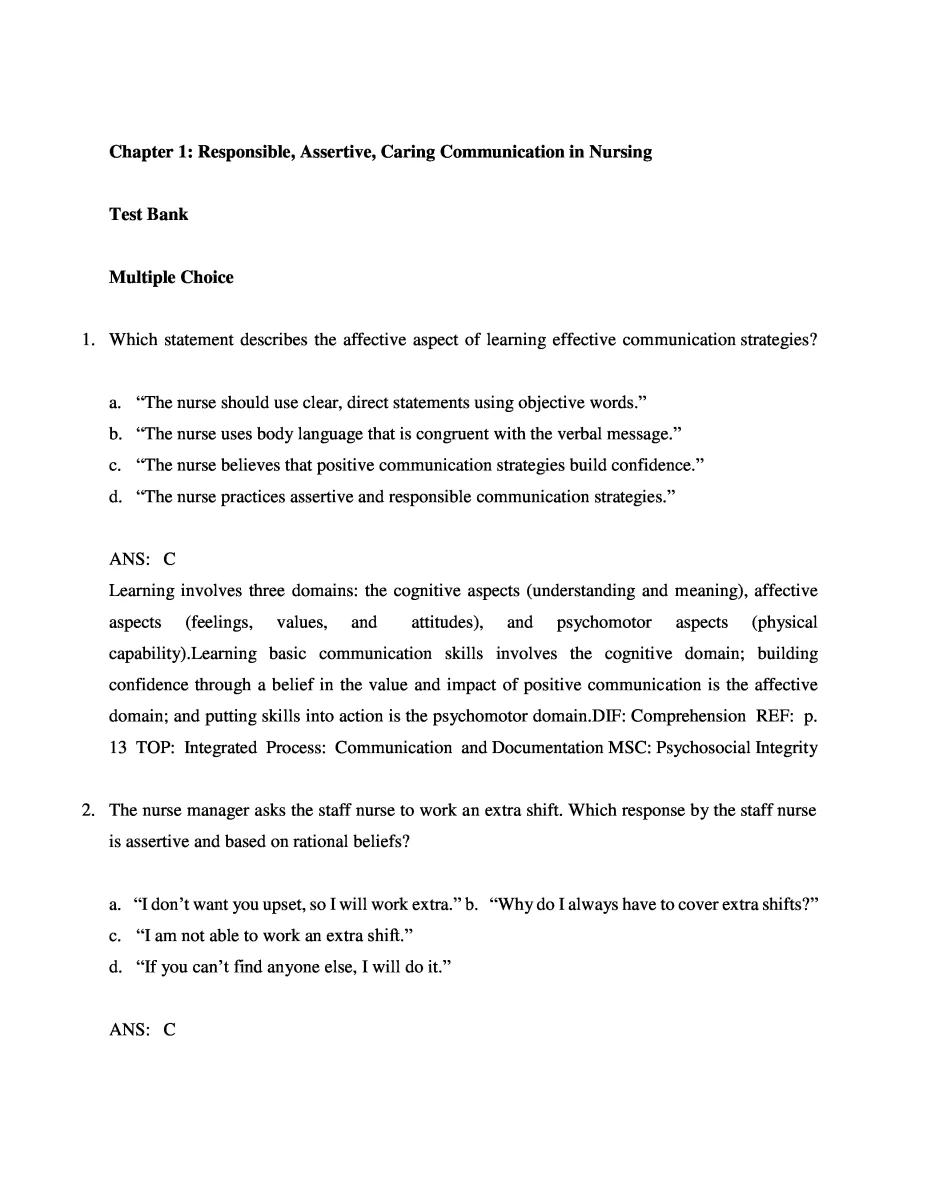
Chapter 1: Responsible, Assertive, Caring Communication in Nursing

Multiple Choice

1. Which statement describes the affective aspect of learning effective communication strategies?

a. “The nurse should use clear, direct statements using objective words.”

b. “The nurse uses body language that is congruent with the verbal message.”

c. “The nurse believes that positive communication strategies build confidence.”

d. “The nurse practices assertive and responsible communication strategies.”

ANS: C

Learning involves three domains: the cognitive aspects (understanding and meaning), affective aspects (feelings, values, and

attitudes), and psychomotor aspects (physical capability).Learning basic communication skills involves the cognitive domain;

building confidence through a belief in the value and impact of positive communication is the affective domain; and putting skills

into action is the psychomotor domain.

2. The nurse manager asks the staff nurse to work an extra shift. Which response by the staff nurse is assertive and based on rational

beliefs?

a. “I don’t want you upset, so I will work extra.”

b. “Why do I always have to cover extra shifts?”

c. “I am not able to work an extra shift.”

d. “If you can’t find anyone else, I will do it.”

ANS: C

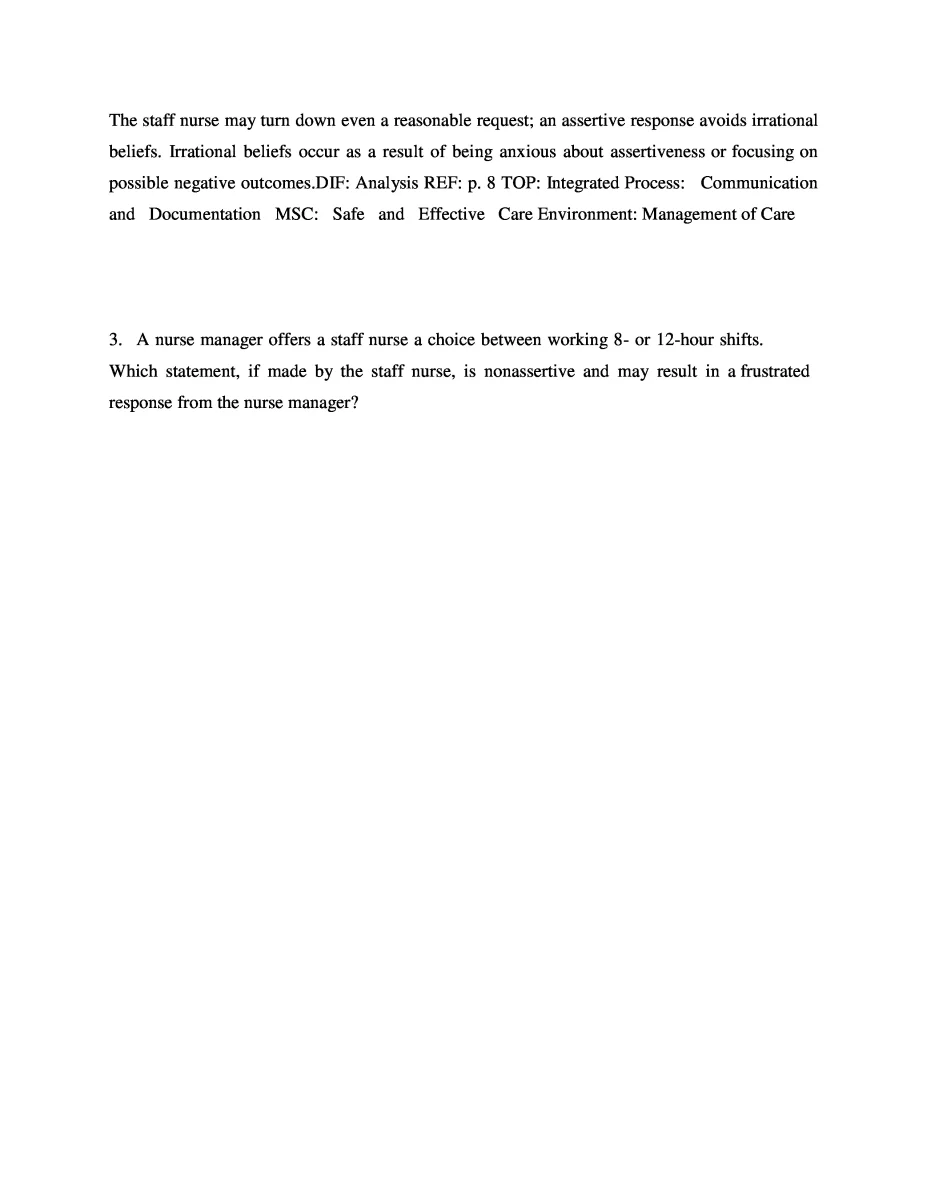
The staff nurse may turn down even a reasonable request; an assertive response avoids irrational beliefs. Irrational beliefs occur as

a result of being anxious about assertiveness or focusing on possible negative outcomes.

3. A nurse manager offers a staff nurse a choice between working 8- or 12-hour shifts. Which statement, if made by the staff nurse,

is nonassertive and may result in a frustrated response from the nurse manager?

a. “I want to decide the shifts for all of the other staff nurses.”

b. “Do whatever you want. It doesn’t really matter to me.”

c. “Thank you for offering me a choice. I prefer 12-hour shifts.”

d. “You will never be able to give me what I really want to work.”

ANS: B

A statement that allows others to make decisions for a person is an example of a nonassertive style of communication; the

response of others to a nonassertive statement may include disrespect, guilt, anger, or frustration. Statements that make choices

for others or that are accusations are examples of aggressive styles of communication; the response of others to an aggressive

statement may include hurt, defensiveness, or humiliation. A statement that allows making one’s own decisions is an example of

assertive style of communication; the response of others to an assertive statement may include mutual respect.

4. The nurse is providing care to a patient who was admitted with heart failure. The patient has not been following the prescribed

diet or taking the prescribed medications. Which type of communication approach is most important for the nurse to use with this

patient to facilitate a change in self-care behavior?

a. Authoritative, honest, and outright communication

b. Assertive, responsible, and caring communication

c. Aggressive, sympathetic, and realistic communication

d. Positive, expert, and focused communication

ANS: B

Communication must be technically responsible, assertive, and caring to facilitate a change in behavior.

5. Which are examples of a nurse who is communicating responsibly? (Select all that apply)

a. The nurse uses profanity to respond to a client who is intoxicated and verbally abusive.

b. The nurse helps a client talk to family members about discontinuing chemotherapy.

c. The nurse uses interpersonal strategies to help a client develop methods of coping.

d. The nurse provides a client’s health information to a close relative who is visiting.

e. The nurse listens carefully to the client’s concern about inadequate pain relief.

ANS: B, C, E

A nurse who communicates responsibly will perform the role of a client advocate, will consider the world of the client and the

client’s family, and will naturally focus on the nursing process and problem-solving process. The nurse is responsible for

maintaining the professional conduct of the relationship. Examples of unprofessional conduct would include breaching client

confidentiality or verbally abusing a client.

6. According to Swanson’s theory, there are five caring processes, one of which is “being with.” Which of the responses by the nurse

portrays an understanding of the concept of “being with” a client?

a. The nurse charting in the room to spend more time with the client

b. The nurse wearing locator badge so you can quickly respond any time patient would call front desk and ask to page you

c. The nurse requesting one-on-one nurse staffing

d. The nurse being emotionally present to the client

ANS: D

Caring is an essential ingredient in life and must characterize the nurse–client relationship…. Consider Swanson’s five caring

processes (Swanson, 1993):1) Maintaining belief—sustaining faith in the capacity of others to transition and have meaningful

lives2) Knowing—striving to understand events as they have meaning in the life of the other3) Being with—being emotionally

present to the other4) Doing for—doing for others what they would do for themselves if possible5) Enabling—facilitating the

capacity of others to care for themselves and family members (Tonges and Ray, 2011, p. 375)

7. According to Swanson’s theory, there are five caring processes, one of which is “knowing.” What are the other four?

a. Communication, assertiveness, responsibility, and caring

b. Maintaining belief, being with, doing for, and enabling

c. Understanding, action, information, and comfort

d. Maintaining belief, being with, enabling, and supporting

ANS: B

Caring is an essential ingredient in life and must characterize the nurse–client relationship…. Consider Swanson’s five caring

processes (Swanson, 1993):1) Maintaining belief—sustaining faith in the capacity of others to transition and have meaningful

lives2) Knowing—striving to understand events as they have meaning in the life of the other3) Being with—being emotionally

present to the other4) Doing for—doing for others what they would do for themselves if possible5) Enabling—facilitating the

capacity of others to care for themselves and family members (Tonges and Ray, 2011, p. 375)

8. The charge nurse informs a staff nurse that it is her turn to float to another unit. Which response by the staff nurse is aggressive?

a. “I had such a bad experience last time. Please send another nurse instead of me.”

b. “I will miss working with you today, but I understand that it is my turn to float.”

c. “I will not survive on the other unit. The staff are always too busy to help me.”

d. “I will float, but you’ll be sorry. You cannot handle emergencies without me.”

ANS: D

An aggressive response is forceful and confrontational; the person using an aggressive approach will place his or her needs first

and respect for others is lacking. A nonassertive response is apologetic; the person frequently puts himself or herself down. An

assertive response is clear, direct, confident, and honest.

9. A client has high blood pressure and needs to learn about a low-sodium diet. Which question if asked by the client would be an

indirect request for information?

a. “How should I prepare food without adding salt?”

b. “What will I do to make food taste better?”

c. “What diet changes are needed to control my blood pressure?”

d. “What foods should I avoid that are high in sodium?”

ANS: B

Indirect requests for information are not obvious, and the meaning must be interpreted by the nurse. “What will I do to make food

taste better?” is an indirect request for information; the nurse must interpret this question as a request for information about a lowsodium

diet.

The

other

questions

are

direct

requests

for

information

on a

low-sodium

diet.

10. The nurse plans to delegate a client’s personal hygiene to a nursing assistant. Which statement if made by the nurse to the nursing

assistant is assertive?

Contact the Seller

Please Sign In to contact this seller.


  • 👎  Report Copyright Violation

Frequently Asked Questions

What Do I Get When I Buy This Study Material?

+

When you buy a study material on Passing Grades, an instant download link will be sent directly to your email, giving you access to the file anytime after payment is completed.

Is Passing Grades a Trusted Platform?

+

Yes, Passing Grades is a reputable students’ marketplace with a secure payment system and reliable customer support. You can trust us to ensure a safe and seamless transaction experience.

Will I Be Stuck with a Subscription?

+

No, all purchases on Passing Grades are one-time transactions. You only pay for the notes you choose to buy, with no subscriptions or hidden fees attached.

Who Am I Buying These Study Materials From?

+

Passing Grades is a marketplace, which means you are purchasing the document from an individual vendor, not directly from us. We facilitate the payment and delivery process between you and the vendor.

Does Passing Grades Offer Free Study Materials?

+

Yes, sellers on Passing Grades have uploaded numerous free test banks, exams, practice questions, and class notes that can be downloaded at no cost.


Pasinggrades - Quality Study Materials

USD 17

    • Quality checked by Pasing Grades
    • 100% satisfaction guarantee
    • Seller: Angelicer
Buy PDF $17

Seller Information

Angelicer

Member since April 2021

  • icon
  • icon
View Profile
  • total sales

    0
  • Favourites

    0
  • Comments

    0
    ( 0 Ratings )

Item Information

  • Uploaded

    07 January 2024

  • Updated

    24 October 2025

  • Category

    Nursing

  • Item Type

    exam

  • Tags

    Test Bank for Communication in Nursing 8th Edition Julia Balzer Riley

Related Exam Prep Guides by Angelicer

Test Bank for Success in Practical Vocational Nursing 8th Edition by Knecht
View Document

Test Bank for Succes...

  • Angelicer

    Angelicer

  • exam

Enhance your study with the Test Bank for Success in Practical Vocational Nursing 8th Edition by Kne...

17 USD

0

0

Test Bank for Illustrated Anatomy of the Head and Neck 5th Edition by Fehrenbach
View Document

Test Bank for Illust...

  • Angelicer

    Angelicer

  • exam

Boost your understanding with the Test Bank for Illustrated Anatomy of the Head and Neck 5th Edition...

17 USD

0

0

ATI PEDS Proctored Exam Questions and Answers 2026 | Comprehensive Study Guide
View Document

ATI PEDS Proctored E...

  • Angelicer

    Angelicer

  • exam

Get the ATI PEDS Proctored Exam Questions and Answers for 2025. This comprehensive study guide offer...

17 USD

0

0

Purchase

Download link will be sent to this email immediately after purchase.

IMPORTANT LINKS

  • How To Upload Class Notes
  • Selling Tips
  • Passing Grades's Study Materials
  • Scholarships for International Students 2026

POPULAR CATEGORIES

  • Law
  • Accounting
  • English
  • Psychology
  • Business
  • Nursing
  • Computer Science
  • General

View Document

  • Blog
  • Contact
  • Delivery Policy
  • Latest Scholarships Around the World
  • How to Pass Bar Exams: Passing Grades’ Strategies
  • How to Study and Pass the CPA Exam
  • All Test Banks
  • Faq
  • Copyright Claims
  • Privacy Policy
  • Terms of Use

KNOWLEDGE BASE

  • How to Write A+ Grade Good Research Paper
  • How to Manage Stress During Exam Period
  • Best Time to Study
  • How to Pass NCLEX-RN Exam
  • How To Effectively Utilize Test Banks
  • Popular Shadow Health Exam Assessments
  • Popular HESI Case Studies
  • How to Prepare for a Nursing Career
  • The Importance Of Summaries in Exam Revisvion

© 2026 Pasing Grades. All rights reserved.