Pasing Grades
  • Start Selling
  • Blog
  • Contact
  • 0

    Your cart is empty!

English

  • English
  • Spanish
  • Arabic
Create Account Sign In
  • Library
    • New Prep Guides
    • Featured Prep Guides
    • Free Exam Prep Guides
    • Best sellers
  • General
  • Nursing
    • Research Paper
    • Case Study
    • Discussion Post
    • Assignment
    • Exam
    • Practice Questions and Answers
    • Test Bank
    • solutions manual
  • Accounting
    • Case Study
    • Thesis
    • Study Guide
    • Summary
    • Research Paper
    • test bank
  • English
    • Creative Writing
    • Research Paper
    • Summary
    • Rhetorics
    • Literature
    • Journal
    • Exam
    • Grammar
    • Discussion Post
    • Essay
  • Psychology
    • Hesi
    • Presentation
    • Essay
    • Summary
    • Study Guide
    • Essay
    • Solution Manual
    • Final Exam Review
    • Class Notes
    • test bank
  • Business
    • Lecture Notes
    • Solution Manual
    • Presentation
    • Business Plan
    • Class Notes
    • Experiment
    • Summary
    • Practice Questions
    • Study Guide
    • Case Study
    • test bank
    • Exam
  • More
    • Computer Science
    • Economics
    • Statistics
    • Engineering
    • Biology
    • Religious Studies
    • Physics
    • Chemistry
    • Mathematics
    • History
    • Sociology
    • Science
    • Philosophy
    • Law
  • Pages
    • About Us
    • Selling Tips
    • Delivery Policy
    • Faq
    • Privacy Policy
  • Flash Sale
  • Home
  • Test Bank for Biology Now with Physiology 2nd edition by Anne Houtman, Megan Scudellari, Cindy Malone

Test Bank for Biology Now with Physiology 2nd edition by Anne Houtman, Megan Scudellari, Cindy Malone

Preview page 1 Preview page 2 Preview page 3
Add To Favorites

Share this item Share this item

  • Item Details
  • Comments (0)
  • Reviews (0)
  • Contact Seller

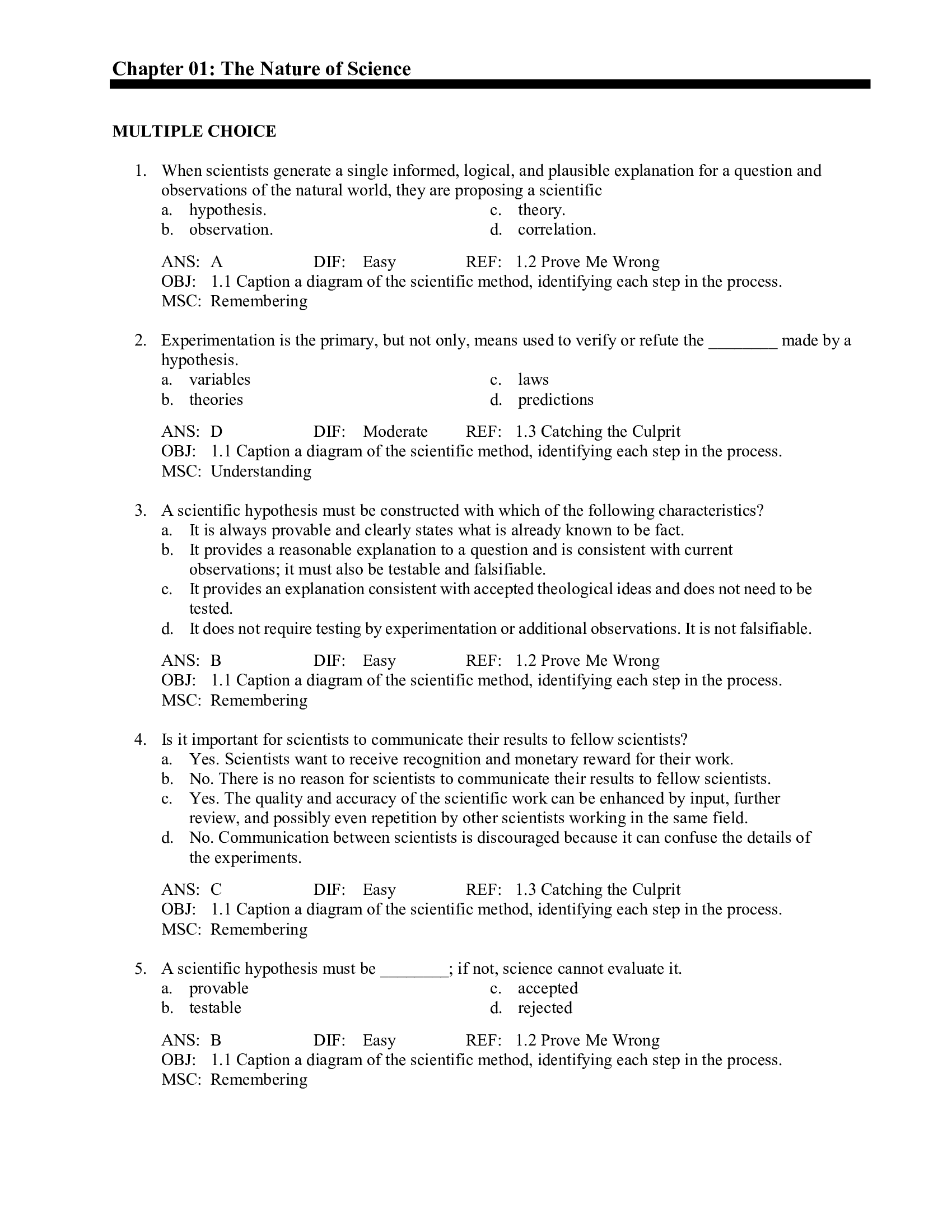
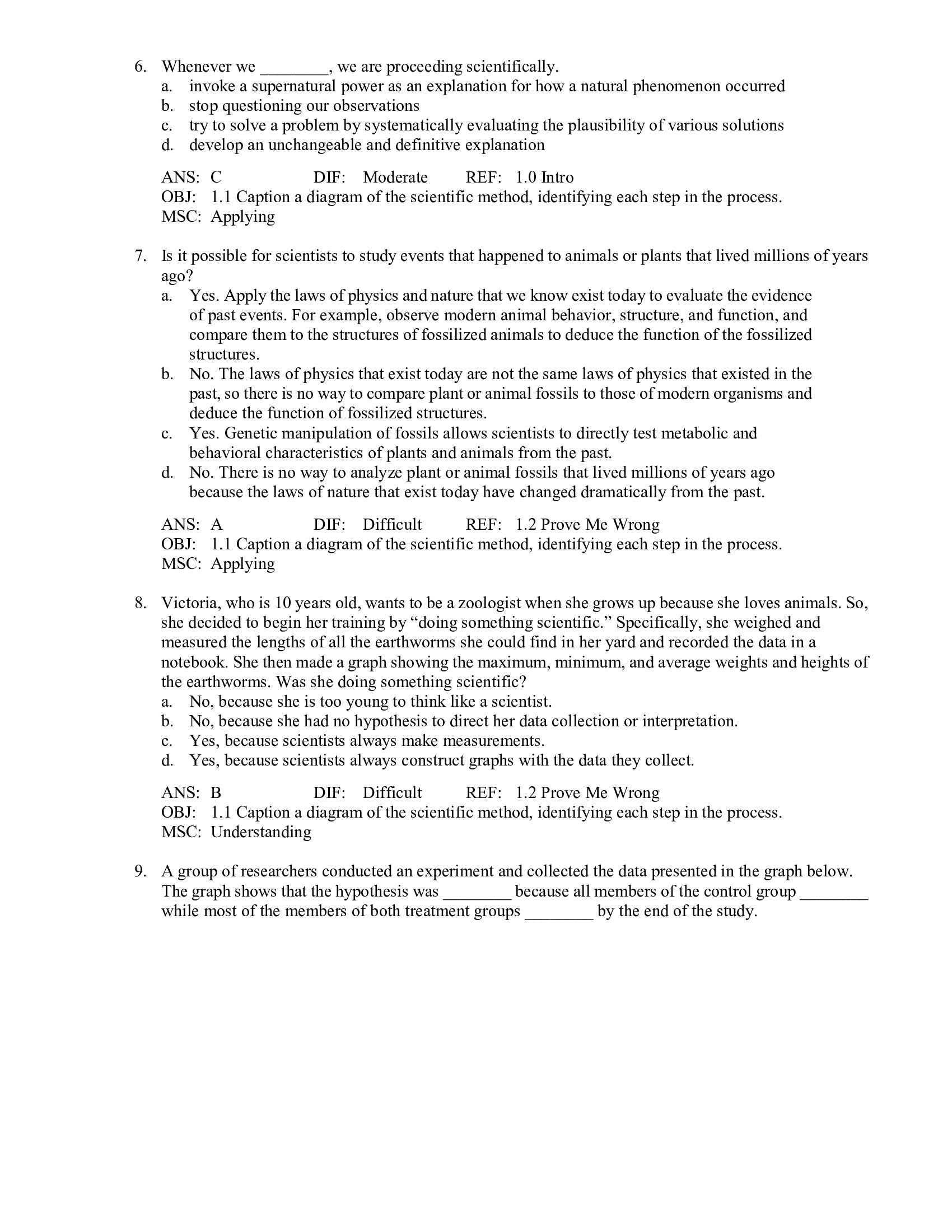
Test Bank for Biology Now with Physiology 2nd edition by Anne Houtman, Megan Scudellari, Cindy Malone TEST BANK FOR BIOLOGY NOW WITH PHYSIOLOGY 2ND EDITION BY ANNE HOUTMAN, MEGAN SCUDELLARI, CINDY MALONE Author [PASSING GRADES] Chapter 01: The Nature of Science MULTIPLE CHOICE 1. When scientists generate a single informed, logical, and plausible explanation for a question and observations of the natural world, they are proposing a scientific a. hypothesis. c. theory. b. observation. d. correlation. ANS: A DIF: Easy REF: 1.2 Prove Me Wrong OBJ: 1.1 Caption a diagram of the scientific method, identifying each step in the process. MSC: Remembering 2. Experimentation is the primary, but not only, means used to verify or refute the ________ made by a hypothesis. a. variables c. laws b. theories d. predictions ANS: D DIF: Moderate REF: 1.3 Catching the Culprit OBJ: 1.1 Caption a diagram of the scientific method, identifying each step in the process. MSC: Understanding 3. A scientific hypothesis must be constructed with which of the following characteristics? a. It is always provable and clearly states what is already known to be fact. b. It provides a reasonable explanation to a question and is consistent with current observations; it must also be testable and falsifiable. c. It provides an explanation consistent with accepted theological ideas and does not need to be tested. d. It does not require testing by experimentation or additional observations. It is not falsifiable. ANS: B DIF: Easy REF: 1.2 Prove Me Wrong OBJ: 1.1 Caption a diagram of the scientific method, identifying each step in the process. MSC: Remembering 4. Is it important for scientists to communicate their results to fellow scientists? a. Yes. Scientists want to receive recognition and monetary reward for their work. b. No. There is no reason for scientists to communicate their results to fellow scientists. c. Yes. The quality and accuracy of the scientific work can be enhanced by input, further review, and possibly even repetition by other scientists working in the same field. d. No. Communication between scientists is discouraged because it can confuse the details of the experiments. ANS: C DIF: Easy REF: 1.3 Catching the Culprit OBJ: 1.1 Caption a diagram of the scientific method, identifying each step in the process. MSC: Remembering 5. A scientific hypothesis must be ________; if not, science cannot evaluate it. a. provable c. accepted b. testable d. rejected ANS: B DIF: Easy REF: 1.2 Prove Me Wrong OBJ: 1.1 Caption a diagram of the scientific method, identifying each step in the process. MSC: Remembering 6. Whenever we ________, we are proceeding scientifically. a. invoke a supernatural power as an explanation for how a natural phenomenon occurred b. stop questioning our observations c. try to solve a problem by systematically evaluating the plausibility of various solutions d. develop an unchangeable and definitive explanation ANS: C DIF: Moderate REF: 1.0 Intro OBJ: 1.1 Caption a diagram of the scientific method, identifying each step in the process. MSC: Applying 7. Is it possible for scientists to study events that happened to animals or plants that lived millions of years ago? a. Yes. Apply the laws of physics and nature that we know exist today to evaluate the evidence of past events. For example, observe modern animal behavior, structure, and function, and compare them to the structures of fossilized animals to deduce the function of the fossilized structures. b. No. The laws of physics that exist today are not the same laws of physics that existed in the past, so there is no way to compare plant or animal fossils to those of modern organisms and deduce the function of fossilized structures. c. Yes. Genetic manipulation of fossils allows scientists to directly test metabolic and behavioral characteristics of plants and animals from the past. d. No. There is no way to analyze plant or animal fossils that lived millions of years ago because the laws of nature that exist today have changed dramatically from the past. ANS: A DIF: Difficult REF: 1.2 Prove Me Wrong OBJ: 1.1 Caption a diagram of the scientific method, identifying each step in the process. MSC: Applying 8. Victoria, who is 10 years old, wants to be a zoologist when she grows up because she loves animals. So, she decided to begin her training by “doing something scientific.” Specifically, she weighed and measured the lengths of all the earthworms she could find in her yard and recorded the data in a notebook. She then made a graph showing the maximum, minimum, and average weights and heights of the earthworms. Was she doing something scientific? a. No, because she is too young to think like a scientist. b. No, because she had no hypothesis to direct her data collection or interpretation. c. Yes, because scientists always make measurements. d. Yes, because scientists always construct graphs with the data they collect. ANS: B DIF: Difficult REF: 1.2 Prove Me Wrong OBJ: 1.1 Caption a diagram of the scientific method, identifying each step in the process. MSC: Understanding 9. A group of researchers conducted an experiment and collected the data presented in the graph below. The graph shows that the hypothesis was ________ because all members of the control group ________ while most of the members of both treatment groups ________ by the end of the study. a. proven beyond a doubt; survived; died b. proven; survived; died c. not supported; died; survived d. supported; survived; died ANS: D DIF: Difficult REF: 1.3 Catching the Culprit OBJ: 1.1 Caption a diagram of the scientific method, identifying each step in the process. MSC: Analyzing 10. A scientist notices that a population of birds has decreased dramatically within one year and suspects that a newly introduced snail population may be affecting the bird population. Some individuals within the bird population eat snails, primarily, while other individuals avoid eating snails. Which of the following statements represents a prediction based on a well-constructed hypothesis for this observation? a. If birds are affected by eating snails, then there will be a difference in the survival rate of birds that eat snails and those that avoid snails. b. If snails live in moist habitats, then snails will be eaten more frequently by birds. c. If birds consume snails, then they will have a higher body mass index than birds that do not eat snails. d. If snails that are sick leave their shells so that birds will consume them, then snail populations are protected from illness. ANS: A DIF: Moderate REF: 1.2 Prove Me Wrong OBJ: 1.1 Caption a diagram of the scientific method, identifying each step in the process. MSC: Analyzing 11. Recently, beekeepers have noticed an alarming and sudden disappearance of honeybees from their hives. Some beekeepers and environmentalists worry that crops genetically engineered to produce Bt insecticidal toxin may be killing the bees. Without data from a scientific experiment, is it reasonable to state that Bt-containing crops are responsible for the loss of honeybees? a. Yes, because it is obviously the Bt crops killing the bees. b. Yes, because there cannot possibly be any other explanation for the loss of the honeybees. c. No, because there is no reason to suspect that an insecticide would kill honeybees. d. No, because there could be some other unknown or unmentioned factor affecting the survival of honeybees. ANS: D DIF: Moderate REF: 1.2 Prove Me Wrong OBJ: 1.2 Develop a hypothesis from a given observation and suggest one or more predictions based on that hypothesis. MSC: Understanding 12. The hypothesis that there is a common ancestor to all living organisms is strengthened by what observation? a. Almost all cells in all living organisms use DNA to direct their structure, function, and behavior. b. All living organisms use energy acquired directly from the environment or from other organisms. c. All living organisms reproduce. d. Each type of living organism adheres to the general principles of the biological hierarchy. ANS: A DIF: Moderate REF: 1.2 Prove Me Wrong OBJ: 1.2 Develop a hypothesis from a given observation and suggest one or more predictions based on that hypothesis. MSC: Applying 13. Which of the following statements is true? a. Once a hypothesis has been proposed, it can never be challenged. b. A valid scientific hypothesis is self-evident and does not need to be tested by experimentation. c. If properly designed, experiments always prove hypotheses to be wrong. d. The scientific method or process can help people make informed medical and environmental decisions. ANS: D DIF: Moderate REF: 1.2 Prove Me Wrong OBJ: 1.2 Develop a hypothesis from a given observation and suggest one or more predictions based on that hypothesis. MSC: Applying 14. Which of the following questions could NOT be used to develop a testable hypothesis? a. Does exposure to secondhand smoke affect the probability of developing lung cancer? b. Do organic vegetables contain harmful substances? c. Should everyone drink bottled water only? d. Does a can of vegetable juice contain more salt than the same size can of iced tea? ANS: C DIF: Moderate REF: 1.2 Prove Me Wrong OBJ: 1.2 Develop a hypothesis from a given observation and suggest one or more predictions based on that hypothesis. MSC: Applying 15. Recently, beekeepers have noticed an alarming and sudden disappearance of honeybees from their hives. Some beekeepers and environmentalists worry that crops genetically engineered to produce Bt insecticidal toxin may be killing the bees. Which of these experiments tests the hypothesis that Bt toxin is killing the bees? a. spraying Bt toxin on a field and counting the number of bees present before and after spraying b. collecting hundreds of bees; half of the bees would be kept in a facility with plants genetically engineered to contain the gene for Bt toxin, while the other half would be kept in a facility with plants not genetically engineered to contain the gene for Bt toxin. The survival rate for both sets of bees would be calculated and compared. c. collecting hundreds of bees and spraying only half of them with Bt toxin; the survival rate for both sets of bees would be calculated and compared d. The number of bees in two adjacent fields would be counted before and after spraying one of the fields with Bt toxin. The survival rate of bees in both fields would be calculated and compared. ANS: B DIF: Difficult REF: 1.2 Prove Me Wrong OBJ: 1.2 Develop a hypothesis from a given observation and suggest one or more predictions based on that hypothesis. MSC: Applying 16. Some questions fall outside the realm of science. Which of the following questions could NOT be answered using the scientific method? a. What is the function of the appendix in human beings? b. Why is it so difficult to quit smoking? c. Why do smokers develop lung cancer more frequently than nonsmokers? d. Why is it unethical to test newly developed drugs in animals? ANS: D DIF: Difficult REF: 1.0 Intro OBJ: 1.2 Develop a hypothesis from a given observation and suggest one or more predictions based on that hypothesis. MSC: Applying 17. Researchers hypothesized that a North American fungus not only caused symptoms of white-nose syndrome (WNS) but also caused death. The results from their experiment are shown in the graph below. Based on this graph, which of the following hypotheses would be the MOST logical hypothesis for further studies? a. “Sham injected” bats have a higher mortality rate than bats that are not injected. b. Bats injected with the North American fungus are less likely to care for their offspring than “sham injected” bats. c. Bats injected with European fungus have a lower mortality rate than “sham injected” bats. d. Other species of bats injected with European fungus will experience death. ANS: D DIF: Moderate REF: 1.3 Catching the Culprit OBJ: 1.2 Develop a hypothesis from a given observation and suggest one or more predictions based on that hypothesis. MSC: Understanding 18. New medications undergo extensive human testing before receiving FDA approval. These tests represent an experiment, and variations in the dosage given to participants represents the a. dependent variable. c. correlation coefficient. b. independent variable. d. invariable. ANS: B DIF: Easy REF: 1.3 Catching the Culprit OBJ: 1.3 Identify the use of appropriate variables, treatments, and controls in the design of an experiment. MSC: Applying 19. The group of 18 bats that were “sham injected” represents a ________ group that experienced ________. a. control; no change in the independent variable b. control; a change in the dependent variable c. treatment; no change in the independent variable d. treatment; no change in the dependent variable ANS: A DIF: Easy REF: 1.3 Catching the Culprit OBJ: 1.3 Identify the use of appropriate variables, treatments, and controls in the design of an experiment. MSC: Understanding 20. Once supported by a predictable experimental outcome, a scientific hypothesis a. is never reexamined. b. still cannot be considered to have been proven true. c. can be used to predict the outcome of all future similar events. d. is elevated to the status of theory. ANS: B DIF: Moderate REF: 1.2 Prove Me Wrong OBJ: 1.3 Identify the use of appropriate variables, treatments, and controls in the design of an experiment. MSC: Understanding 21. David Blehert and his research team captured 117 healthy bats to study in the laboratory and divided them into four groups. Group 1 was housed in an area free from the fungus Geomycesdestructans. Group 2 was housed in an area that shared the same air as bats infected with WNS, but these bats did not have direct contact with the infected bats. Group 3 was housed in direct contact with other bats infected with WNS. Bats in group 4 were directly exposed to Geomycesdestructans when it was applied to their wings. During the study period the bats were monitored for signs of WNS. Which group is the control group? a. group 1 c. group 3 b. group 2 d. group 4 ANS: A DIF: Moderate REF: 1.3 Catching the Culprit OBJ: 1.3 Identify the use of appropriate variables, treatments, and controls in the design of an experiment. MSC: Applying 22. Which of the following represents conducting an experiment? a. dialing a telephone number b. comparing prices of computers c. checking midterm grades online d. predicting the outcome of a basketball game ANS: A DIF: Difficult REF: 1.3 Catching the Culprit OBJ: 1.3 Identify the use of appropriate variables, treatments, and controls in the design of an experiment. MSC: Analyzing 23. David Blehert and his research team captured 117 healthy bats to study in the laboratory and divided them into four groups. Group 1 was housed in an area free from Geomycesdestructans. Group 2 was housed in an area that shared the same air as bats infected with WNS, but these bats did not have direct contact with the infected bats. Group 3 was housed in direct contact with other bats infected with WNS. Bats in group 4 were directly exposed to Geomycesdestructans when researchers applied it to the bats’ wings. During the study period the bats were monitored for signs of WNS. What is the specific hypothesis being tested by the inclusion of group 4 in this experiment? a. Geomycesdestructans causes WNS, and it can be transmitted through the air. b. Geomycesdestructans causes WNS, and it is only transmitted by direct contact with other infected bats. c. Geomycesdestructans causes WNS, and it can be transmitted by direct contact with the fungus; no contact with infected bats is needed for transmission of the fungus. d. Group 4 is the control. ANS: C DIF: Difficult REF: 1.3 Catching the Culprit OBJ: 1.3 Identify the use of appropriate variables, treatments, and controls in the design of an experiment. MSC: Analyzing 24. David Blehert and his research team captured 117 healthy bats to study in the laboratory and divided them into four groups. Group 1 was housed in an area free from Geomycesdestructans. Group 2 was housed in an area that shared the same air as bats infected with WNS, but these bats did not have direct contact with the infected bats. Group 3 was housed in direct contact with other bats infected with WNS. Bats in group 4 were directly exposed to Geomycesdestructans when it was applied to their wings. During the study period the bats were monitored for signs of WNS. In this experiment, the independent was ________ and the dependent variable was ________. a. the type of exposure to Geomycesdestructans; whether the bats became sick with WNS b. whether the bats became sick with WNS; the type of exposure to Geomycesdestructans c. whether the bats became sick with WNS; the number of bats included in the study d. the number of bats included in the study; the type of exposure to Geomycesdestructans ANS: A DIF: Difficult REF: 1.3 Catching the Culprit OBJ: 1.3 Identify the use of appropriate variables, treatments, and controls in the design of an experiment. MSC: Analyzing 25. The information presented in the following figure represents a scientific a. theory. c. observation. b. hypothesis. d. fact. ANS: D DIF: Easy REF: Chapter 1 Infographic OBJ: 1.4 Give specific examples of a scientific fact and a scientific theory. MSC: Understanding 26. Scientists are human beings and, like all human beings, are susceptible to personal and group biases that may influence how they interpret evidence. Before original research work is accepted and added to a growing body of scientific understanding, perhaps even contributing to our understanding of an important scientific theory, it must be scrutinized by experts in the field who have no direct connection to the research under review. The main mechanism for doing this is a. popular magazines. c. peer-reviewed publications. b. the Discovery Channel. d. Wikipedia. ANS: C DIF: Easy REF: 1.3 Catching the Culprit OBJ: 1.4 Give specific examples of a scientific fact and a scientific theory. MSC: Understanding 27. A patient is coughing and producing a wheezing sound as she breathes; she also has a fever. She goes to the doctor who listens to her chest, takes X-rays of her chest, and determines that she probably has something called croup. Which of the following are the facts in this scenario? a. The patient is coughing, wheezing, and has a fever. b. The patient probably has croup. c. The patient probably has whooping cough. d. The patient probably needs antibiotics. ANS: A DIF: Easy REF: 1.3 Catching the Culprit OBJ: 1.4 Give specific examples of a scientific fact and a scientific theory. MSC: Applying 28. In science, when a hypothesis or group of hypotheses supported by repeated experimental evidence holds true through time, it can be developed into a a. law. c. hypothesis. b. mathematical theorem. d. theory. ANS: D DIF: Easy REF: 1.3 Catching the Culprit OBJ: 1.4 Give specific examples of a scientific fact and a scientific theory. MSC: Understanding 29. The human heart pumps blood throughout the blood vessels in the body. This is a scientific a. theory. c. fact. b. hypothesis. d. experiment. ANS: C DIF: Moderate REF: 1.3 Catching the Culprit OBJ: 1.4 Give specific examples of a scientific fact and a scientific theory. MSC: Applying 30. A patient often experiences numbness and pain in the thumb and first two fingers on his right hand. He goes to the doctor, who suspects that carpal tunnel syndrome is the reason for the numbness and pain. The doctor then orders a simple test to see how fast nerve impulses are moving up and down the patient’s arm. The doctor’s preliminary diagnosis of carpal tunnel syndrome is a(n) a. theory. c. experiment. b. fact. d. hypothesis. ANS: D DIF: Moderate REF: 1.3 Catching the Culprit OBJ: 1.4 Give specific examples of a scientific fact and a scientific theory. MSC: Analyzing 31. Which of the following would be a theory? a. Specific pathogens are directly responsible for specific diseases and conditions. b. A fungal infection is responsible for the spread of white noses and associated higher mortality across bat populations and species. c. Bats with white noses have been observed in the wild. d. A fungal infection causes bats to wake up repeatedly during the winter and use up their fat reserves. ANS: A DIF: Moderate REF: 1.3 Catching the Culprit OBJ: 1.4 Give specific examples of a scientific fact and a scientific theory. MSC: Understanding 32. In 1890, Robert Koch developed a hypothesis regarding the cause of communicable diseases. He designed an experiment and collected data that supported his hypothesis. Later, his experiment was repeated by many other scientists who used other pathogens and documented similar results that not only supported their hypotheses but also supported Koch’s original hypothesis. These many experiments that supported multiple hypotheses regarding the cause of communicable diseases contributed to the development of the a. theory of evolution. c. theory of relativity. b. germ theory of disease. d. law of gravity. ANS: B DIF: Moderate REF: 1.3 Catching the Culprit OBJ: 1.4 Give specific examples of a scientific fact and a scientific theory. MSC: Understanding 33. Scientific understanding can always be challenged, and even changed, with new ways of observing and with different interpretations. For example, new tools and techniques have resulted in new observations and the discovery of additional information. This has resulted in revised ways of understanding how molecules are moved across the plasma membrane of cells. Hence, there is no certainty in science, only degrees of probability (likelihood) and potential for change. In light of this understanding, which of the following statements is MOST meaningful? a. Scientific knowledge is absolute knowledge. b. Scientific knowledge is based on current knowledge. c. Scientific knowledge is a static and unchanging collection of facts. d. Scientific knowledge is a rigid collection of invariable facts. ANS: B DIF: Moderate REF: 1.3 Catching the Culprit OBJ: 1.4 Give specific examples of a scientific fact and a scientific theory. MSC: Applying 34. Which of the following would be a fact? a. Specific pathogens are directly responsible for specific diseases and conditions. b. A fungal infection is solely responsible for the spread of white noses and associated higher mortality across bat populations and species. c. Bats with white noses have been observed in the wild. d. A fungal infection causes bats to wake up repeatedly during the winter and use up their fat reserves. ANS: C DIF: Moderate REF: 1.3 Catching the Culprit OBJ: 1.4 Give specific examples of a scientific fact and a scientific theory. MSC: Understanding 35. Which of the following sequences correctly represents the biological hierarchy of a multicellular organism? a. cells  tissues  organs  individual b. tissues  organs  cells  individual c. individual  cells  organ systems  tissues d. organ systems  organs  tissues  individual ANS: A DIF: Easy REF: 1.4 No End in Sight OBJ: 1.5 Create a graphic showing the levels of biological organization. MSC: Applying 36. A tissue is defined as a. a group of cells that performs a unique set of tasks in the body. b. two or more atoms held together by strong chemical bonds. c. the basic unit of life. d. a network of organs that perform a wide range of functions. ANS: A DIF: Easy REF: 1.4 No End in Sight OBJ: 1.5 Create a graphic showing the levels of biological organization. MSC: Remembering 37. A researcher studying a group of individuals of the same species living and interacting in a shared environment is said to be working at the level of a a. biome. c. community. b. biosphere. d. population. ANS: D DIF: Easy REF: 1.4 No End in Sight OBJ: 1.5 Create a graphic showing the levels of biological organization. MSC: Understanding 38. Carbon, hydrogen, and oxygen atoms are held together by chemical bonds to form ________ of sugar. a. organ systems c. cells b. molecules d. atoms ANS: B DIF: Easy REF: 1.4 No End in Sight OBJ: 1.5 Create a graphic showing the levels of biological organization. MSC: Understanding 39. Bats use echolocation to orient themselves and locate objects. Doing this requires special adaptations in their inner ear, midbrain, and auditory cortex of their cerebrum. The echolocation system of bats is an example of a(n) a. cell. c. organ. b. tissue. d. organ system. ANS: D DIF: Easy REF: 1.4 No End in Sight OBJ: 1.5 Create a graphic showing the levels of biological organization. MSC: Understanding 40. The caves in upstate New York, where Alan Hicks’s team first noticed the deaths of thousands of bats, represent the ________ where the bats lived. a. biosphere c. ecosystem b. biome d. community ANS: C DIF: Moderate REF: 1.4 No End in Sight OBJ: 1.5 Create a graphic showing the levels of biological organization. MSC: Applying 41. Which term best describes the temperate deciduous forests that cover the northeastern United States, including the Adirondack Mountains? a. biosphere c. ecosystem b. biome d. community ANS: B DIF: Moderate REF: 1.4 No End in Sight OBJ: 1.5 Create a graphic showing the levels of biological organization. MSC: Analyzing 42. Land biomes are most commonly defined by a. their climate, physical characteristics, and dominant animal life. b. only the dominant plant life in them. c. the dominant plant life that influences the dominant animal life in them. d. their climate and physical characteristics that influence the dominant plant life and, subsequently, animal life in them. ANS: D DIF: Difficult REF: 1.4 No End in Sight OBJ: 1.5 Create a graphic showing the levels of biological organization. MSC: Applying 43. What characteristic is NOT shared by all living organisms? a. They make their own energy. b. They grow and develop. c. They evolve through time. d. They are composed of one or more cells. ANS: A DIF: Easy REF: 1.1 Bat Crazy OBJ: 1.6 Determine whether something is living or nonliving based on the characteristics of living things. MSC: Remembering 44. Living organisms maintain a constant internal environment by sensing and responding to their internal conditions. This stable maintenance of internal conditions is known as a. homeostasis. c. reproduction. b. evolution. d. sensation. ANS: A DIF: Easy REF: 1.1 Bat Crazy OBJ: 1.6 Determine whether something is living or nonliving based on the characteristics of living things. MSC: Remembering 45. DNA is one of the features common to all known forms of life; it a. forms the protective outer membrane of cells. b. is used to transfer information from parents to their offspring. c. is used to obtain energy from the environment. d. is used in sensing changes within the environment. ANS: C DIF: Moderate REF: 1.1 Bat Crazy OBJ: 1.6 Determine whether something is living or nonliving based on the characteristics of living things. MSC: Remembering 46. The roots of a sunflower plant growing downward while the shoot grows upward and the flower turns toward the sun are examples of what characteristic of all living organisms? a. They reproduce using DNA. b. They evolve through time. c. They make their own energy. d. They sense the environment and respond to it. ANS: D DIF: Moderate REF: 1.1 Bat Crazy OBJ: 1.6 Determine whether something is living or nonliving based on the characteristics of living things. MSC: Understanding 47. A species of butterflies gradually becomes darker in color over many generations; this is an example of which characteristic of living organisms? a. They reproduce using DNA. b. They obtain energy from the environment to support metabolism. c. They can evolve as groups. d. They sense the environment and respond to it. ANS: C DIF: Moderate REF: 1.1 Bat Crazy OBJ: 1.6 Determine whether something is living or nonliving based on the characteristics of living things. MSC: Analyzing 48. Which of these characteristics of living organisms are present in viruses? a. composed of one or more cells b. can evolve as groups c. maintain a constant internal environment d. obtain energy from their environment ANS: B DIF: Moderate REF: 1.1 Bat Crazy OBJ: 1.6 Determine whether something is living or nonliving based on the characteristics of living things. MSC: Understanding 49. What is the MOST likely explanation for why all living organisms use the same genetic code stored in DNA? a. DNA is a molecule that was found in the earliest life-form and has been passed on to all offspring. b. DNA is more compact than other molecules and therefore fits more easily into cells. c. DNA is required for organisms to sense and respond to changes in the environment. d. DNA is required for organisms to maintain a stable internal environment when conditions vary. ANS: A DIF: Difficult REF: 1.1 Bat Crazy OBJ: 1.6 Determine whether something is living or nonliving based on the characteristics of living things. MSC: Evaluating 50. A small, potentially living object was found. For this object to be considered alive, the object must a. be composed of tissues. c. have evolved from a known life-form. b. be found with offspring. d. contain one or more cells. ANS: D DIF: Easy REF: 1.1 Bat Crazy OBJ: 1.6 Determine whether something is living or nonliving based on the characteristics of living things. MSC: Applying COMPLETION 1. The first two steps of the scientific process typically include making ________ and forming a ________. ANS: observations; hypothesis DIF: Easy REF: 1.0 Intro OBJ: 1.1 Caption a diagram of the scientific method, identifying each step in the process. MSC: Remembering 2. After observing that students who regularly attend class appear to be making good grades, I propose the hypothesis that regular class attendance increases the probability that students earn higher grades. If I attend classes regularly this semester, I should make higher grades than I did last semester when I often missed class. This is a ________. ANS: prediction DIF: Moderate REF: 1.2 Prove Me Wrong OBJ: 1.1 Caption a diagram of the scientific method, identifying each step in the process. MSC: Applying 3. When a hypothesis is well constructed, a prediction can be made using a(n) “________” statement. ANS: if then DIF: Easy REF: 1.2 Prove Me Wrong OBJ: 1.2 Develop a hypothesis from a given observation and suggest one or more predictions based on that hypothesis. MSC: Remembering 4. When Dr. Blehert and his team set out to determine the cause of death for thousands of bats, they determined that the sick and dead bats had a strange white fuzz on their noses and wings along with depleted fat reserves and damaged wing tissue. After performing observational studies, the researchers used a branch of mathematics called ________ to quantify the reliability of their data. ANS: statistics DIF: Moderate REF: 1.2 Prove Me Wrong OBJ: 1.3 Identify the use of appropriate variables, treatments, and controls in the design of an experiment. MSC: Applying 5. During an experimental study, a control group is maintained under a standard set of conditions with no change in the independent variable. The ________ group is maintained under the same standard set of conditions as the control group, but the independent variable is adjusted. ANS: treatment experimental DIF: Easy REF: 1.3 Catching the Culprit OBJ: 1.3 Identify the use of appropriate variables, treatments, and controls in the design of an experiment. MSC: Remembering 6. A direct and repeatable observation of any aspect of the natural world can be considered a scientific ________. ANS: fact DIF: Easy REF: 1.3 Catching the Culprit OBJ: 1.4 Give specific examples of a scientific fact and a scientific theory. MSC: Remembering 7. A way to visualize the breadth and scope of life, from the smallest structures of atoms and cells to the broadest interactions between living and nonliving systems that we can comprehend, is typically referred to as the biological ________. ANS: hierarchy DIF: Easy REF: 1.4 No End in Sight OBJ: 1.5 Create a graphic showing the levels of biological organization. MSC: Remembering 8. The genetic material used for reproduction by those organisms conventionally considered to be living is ________. ANS: DNA DIF: Moderate REF: 1.1 Bat Crazy OBJ: 1.6 Determine whether something is living or nonliving based on the characteristics of living things. MSC: Applying SHORT ANSWER 1. Explain the self-correcting nature of science. ANS: The process of science is based on evidence that can be demonstrated through observations and experiments. Scientific findings are subject to peer review and independent validation and can, therefore, be challenged by anyone on the basis of evidence. When new evidence demonstrates that current scientific thinking is incorrect, hypotheses are adjusted or discarded and investigation continues. DIF: Moderate REF: 1.1 Bat Crazy | 1.2 Prove Me Wrong OBJ: 1.1 Caption a diagram of the scientific method, identifying each step in the process. MSC: Applying 2. Explain why hypotheses can be supported, but never proven absolutely true. ANS: A hypothesis is based on the best evidence available at a given time. There may be alternative explanations for supported hypotheses. DIF: Moderate REF: 1.2 Prove Me Wrong OBJ: 1.1 Caption a diagram of the scientific method, identifying each step in the process. MSC: Understanding 3. A student complains about the requirement of taking a biology course. She states that she is capable of following the “set recipe” of the scientific method, but she does not believe that science is useful because it cannot answer all questions. Explain to this student the types of questions science can answer. Also address her misunderstanding of the scientific method. ANS: Science provides answers to questions about the natural world. Science cannot provide answers to questions regarding supernatural beings or anything that cannot be detected and measured. Science is often referred to as a process to emphasize that science is more flexible than a “set recipe.” Scientists do not follow a rigid pattern to answer questions. Instead, scientists use evidence-based methods for acquiring knowledge. Evidence is used to support hypotheses and the best evidence at any given time may change previously held ideas. DIF: Moderate REF: 1.0 Intro OBJ: 1.1 Caption a diagram of the scientific method, identifying each step in the process. MSC: Understanding 4. Describe the main mechanism used to reduce researcher bias, or even prevent fraud, in science. ANS: When scientists communicate their results to fellow scientists during the peer-reviewed publication process, reviewers who are subject experts with no direct contact in the study being reviewed scrutinize the submitted work. If there are any concerns about the methodology, results, or analysis, the researcher submitting the work must address those concerns before his or her work is published. DIF: Moderate REF: 1.3 Catching the Culprit OBJ: 1.1 Caption a diagram of the scientific method, identifying each step in the process. MSC: Understanding 5. People who exercise regularly have a lower average resting heart rate and blood pressure than people who do not exercise. Given this observation, develop a hypothesis and provide one prediction relating to that hypothesis. ANS: Hypothesis: Daily exercise reduces average resting heart rate and blood pressure. Prediction: If one group of people exercises for thirty minutes every day and another group does not exercise, the first group will experience a reduction in average resting heart rate and blood pressure. The second group will not experience a change in average resting heart rate and blood pressure. DIF: Difficult REF: 1.2 Prove Me Wrong OBJ: 1.2 Develop a hypothesis from a given observation and suggest one or more predictions based on that hypothesis. MSC: Applying 6. A parent heard a celebrity on television stating there was a study published in 1998 that asserted a connection between the measles-mumps-rubella (MMR) vaccine and the onset of autism in children. The celebrity went on to say that after the MMR vaccine replaced the old simple measles vaccine in 1988 there was a 273 percent increase in autism rates during the next 11 years. The celebrity, however, did not reveal that the study published in 1998 included a sample size of 12 children who were already known to have some form of autism or similar developmental difficulties. He also did not present the evidence from hundreds of studies conducted since 1998 that show no connection between vaccines and the onset of autism. What was the hypothesis, regarding vaccines and autism, implied by the celebrity? State at least two obvious problems with the structure of the 1998 study. ANS: The celebrity’s implied hypothesis was, “Vaccines cause autism.” Two obvious problems with the structure of the 1998 study include the extremely small sample size of 12 children and the bias introduced because all of the children had already been diagnosed with some form of autism or developmental difficulties. It was hardly a random sample. DIF: Difficult REF: 1.2 Prove Me Wrong OBJ: 1.2 Develop a hypothesis from a given observation and suggest one or more predictions based on that hypothesis. MSC: Applying 7. The claim has been made that women may be able to achieve significant improvements in memory by taking Gingko biloba supplements. To determine if the claim is fraudulent and prior to accepting this claim, what type of evidence would you like to see? Provide brief details of an investigative design. ANS: The hypothesis to be examined is, “Taking Gingko biloba supplements significantly improves the memory of women.” The prediction is that if women take Gingko biloba supplements their memory function will improve. This can be tested by setting up an experiment that includes a control group of randomly selected women who receive a placebo and an experimental group of women who will actually receive Gingko biloba supplements. Consuming the Gingko biloba supplement would be the independent variable. The experiment should attempt to control for other possible factors such as age, amount of daily exercise, and other dietary considerations when selecting participants. Both groups of women would be tested before the study begins to determine their average memory capabilities (dependent variable) prior to the experiment. Both groups of women would be retested at the end of the experiment. Statistical analyses should be conducted to determine if any differences in memory function between the two groups are significant and if the data supports the hypothesis. DIF: Difficult REF: 1.3 Catching the Culprit OBJ: 1.3 Identify the use of appropriate variables, treatments, and controls in the design of an experiment. MSC: Evaluating 8. Terrance observes that tomato seeds sprouting in his fresh compost pile seem to grow at a faster rate than tomato seeds that he planted in potting soil that was previously used to grow house plants. Describe an experiment that he could use to test the hypothesis that tomato seeds grown in fresh compost grow faster than those grown in used potting soil. Include information about appropriate variables, treatments, and controls. ANS: A large group of tomato seeds would be randomly assigned to one of two groups. One group, the control group, would be grown in used potting soil. The second group, the experimental group, would be grown in fresh compost. The only difference in the treatment of the groups would be the single independent variable of the compost. The dependent variable would be the measured growth rate. DIF: Moderate REF: 1.3 Catching the Culprit OBJ: 1.3 Identify the use of appropriate variables, treatments, and controls in the design of an experiment. MSC: Applying 9. Your friend says to you, “You do not need to understand evolution to understand biology because evolution is just a theory.” How would you explain to your friend that a “theory” in science is not “just a theory”? ANS: In science, a theory usually consists of a group of well-researched and supported hypotheses that are interrelated. There are so many diverse and independent lines of investigation supporting these related hypotheses that form the theory that we can rely on the theory to help guide our understanding of all related topics. In the nonscience vernacular, the word theory usually refers to an untested explanation. DIF: Moderate REF: 1.3 Catching the Culprit OBJ: 1.4 Give specific examples of a scientific fact and a scientific theory. MSC: Understanding 10. Organize the following concepts in order of broadest interactions between groups to the smallest structure and give a brief explanation of the concepts: biome, biosphere, community, ecosystem, organism, and population. ANS: Organism (an individual), population (a group of individuals of the same species living and interacting in a shared environment), community (the populations of different species that live and interact with one another in a particular place), ecosystem (a particular physical environment and all the communities found there), biome (a large region of the world defined by its physical characteristics, especially climate, and a distinctive community of organisms), biosphere (all the world’s living organisms and the places where they live) DIF: Moderate REF: 1.4 No End in Sight OBJ: 1.5 Create a graphic showing the levels of biological organization. MSC: Remembering 11. Describe how DNA makes it possible for organisms to make new individuals like themselves. ANS: No matter how simple or complex the life-form, the genetic code found in DNA provides the instructions to build new cellular components, carry out cellular metabolism, and dictate cellular behavior, including the initiation of cell reproduction and the transfer of information from one generation to the next. The DNA is read to produce proteins that direct cellular reproduction, produce new cellular components, and initiate cellular reproduction. DIF: Moderate REF: 1.1 Bat Crazy OBJ: 1.6 Determine whether something is living or nonliving based on the characteristics of living things. MSC: Applying 12. Consider the characteristics of living organisms. Would you classify viruses as living or nonliving? Justify your response. ANS: Viruses are typically considered nonliving because they lack most of the characteristics of life. Viruses can evolve as groups, but they do not display any of the other characteristics of life. Viruses are not composed of cells. They are not capable of reproducing without a host cell’s machinery. They also are not capable of capturing energy from their environment, sensing their environment, or maintaining homeostasis. DIF: Moderate REF: 1.1 Bat Crazy OBJ: 1.6 Determine whether something is living or nonliving based on the characteristics of living things. MSC: Evaluating MATCHING Match the correct terms with the sentences below. a. tests b. communicate c. accept, reject, or modify d. observe e. analyze f. hypothesis g. predictions 1. ________and ask questions about the natural world. 2. Suggest a ________ to explain your observations and questions. 3. Generate ________ to test your hypothesis. 4. Design ________ of the predictions of your hypothesis. 5. ________your results to fellow scientists for their review and input. 6. ________your hypothesis, predictions, or test according to the results. 7. ________the results. 1. ANS: D DIF: Easy REF: 1.1 Bat Crazy | 1.2 Prove Me Wrong OBJ: 1.1 Caption a diagram of the scientific method, identifying each step in the process. MSC: Understanding 2. ANS: F DIF: Easy REF: 1.1 Bat Crazy | 1.2 Prove Me Wrong OBJ: 1.1 Caption a diagram of the scientific method, identifying each step in the process. MSC: Understanding 3. ANS: G DIF: Easy REF: 1.1 Bat Crazy | 1.2 Prove Me Wrong OBJ: 1.1 Caption a diagram of the scientific method, identifying each step in the process. MSC: Understanding 4. ANS: A DIF: Easy REF: 1.1 Bat Crazy | 1.2 Prove Me Wrong OBJ: 1.1 Caption a diagram of the scientific method, identifying each step in the process. MSC: Understanding 5. ANS: B DIF: Easy REF: 1.1 Bat Crazy | 1.2 Prove Me Wrong OBJ: 1.1 Caption a diagram of the scientific method, identifying each step in the process. MSC: Understanding 6. ANS: C DIF: Easy REF: 1.1 Bat Crazy | 1.2 Prove Me Wrong OBJ: 1.1 Caption a diagram of the scientific method, identifying each step in the process. MSC: Understanding 7. ANS: E DIF: Easy REF: 1.1 Bat Crazy | 1.2 Prove Me Wrong OBJ: 1.1 Caption a diagram of the scientific method, identifying each step in the process. MSC: Understanding Read the summary of an experiment below. Then match the correct term with each statement. Terms may be used more than once or not at all. Dead mice within a cave where bats are infected with white-nose syndrome (WNS) have white fuzz on their noses that appears to be similar to the white fuzz seen on the noses of bats ill with WNS. A researcher hypothesizes that mice are also susceptible to WNS when they live in close contact with infected bats. To test this hypothesis, the researcher captures 50 healthy mice and randomly separates them into two groups. One group is housed in an area that contains healthy bats. The other group of mice is housed in an enclosure that contains bats that have WNS. The mice in both groups are monitored for signs of WNS. a. independent variable b. dependent variable c. control group d. treatment group 8. Presence or absence of any signs of WNS in the mice. 9. Mice housed in an area with healthy bats. 10. Mice housed in an area with bats that have WNS. 11. Presence or absence of WNS in the bats. 8. ANS: B DIF: Moderate REF: 1.3 Catching the Culprit OBJ: 1.3 Identify the use of appropriate variables, treatments, and controls in the design of an experiment. MSC: Applying 9. ANS: C DIF: Moderate REF: 1.3 Catching the Culprit OBJ: 1.3 Identify the use of appropriate variables, treatments, and controls in the design of an experiment. MSC: Applying 10. ANS: D DIF: Moderate REF: 1.3 Catching the Culprit OBJ: 1.3 Identify the use of appropriate variables, treatments, and controls in the design of an experiment. MSC: Applying 11. ANS: A DIF: Moderate REF: 1.3 Catching the Culprit OBJ: 1.3 Identify the use of appropriate variables, treatments, and controls in the design of an experiment. MSC: Applying Read each statement and identify whether the statement is a scientific fact, a scientific theory, or an opinion. Choices may be used more than once or not at all. a. scientific fact b. scientific theory c. opinion 12. The most beautiful sunsets are those observed in deserts. 13. White-nose syndrome in bats is a disease that is spreading across the United States. 14. Treating human infections and maintaining hygiene is based on substantial knowledge of germs. 15. A disease that affects tomatoes, tomato blight, is caused by a fungus. 12. ANS: C DIF: Moderate REF: 1.3 Catching the Culprit OBJ: 1.4 Give specific examples of a scientific fact and a scientific theory. MSC: Analyzing 13. ANS: A DIF: Moderate REF: 1.3 Catching the Culprit OBJ: 1.4 Give specific examples of a scientific fact and a scientific theory. MSC: Analyzing 14. ANS: B DIF: Moderate REF: 1.3 Catching the Culprit OBJ: 1.4 Give specific examples of a scientific fact and a scientific theory. MSC: Analyzing 15. ANS: A DIF: Moderate REF: 1.3 Catching the Culprit OBJ: 1.4 Give specific examples of a scientific fact and a scientific theory. MSC: Analyzing Match each term describing a level of biological hierarchy with its proper description. Terms may be used more than once or not at all. a. organism b. organ c. molecules d. biome e. ecosystem f. atoms g. biosphere 16. The individual building blocks of life, such as oxygen, are referred to as ________. 17. Chemical bonds hold hydrogen and oxygen atoms together to form ________. 18. The physical environment, especially the climate, and the organisms that live in deserts throughout the world make up a(n) ________. 19. The liver, a body part composed of different tissue types, is considered a(n) ________. 16. ANS: F DIF: Moderate REF: 1.4 No End in Sight OBJ: 1.5 Create a graphic showing the levels of biological organization. MSC: Understanding 17. ANS: C DIF: Moderate REF: 1.4 No End in Sight OBJ: 1.5 Create a graphic showing the levels of biological organization. MSC: Understanding 18. ANS: D DIF: Moderate REF: 1.4 No End in Sight OBJ: 1.5 Create a graphic showing the levels of biological organization. MSC: Understanding 19. ANS: B DIF: Moderate REF: 1.4 No End in Sight OBJ: 1.5 Create a graphic showing the levels of biological organization. MSC: Understanding Match the following terms with the corresponding characteristic of life. a. evolution b. homeostasis c. metabolism d. cell e. DNA 20. maintaining a relatively constant internal environment 21. genetic material used to transfer information from parent to offspring 22. the smallest living unit 23. a change in the characteristics of a group of organisms over time 24. the way organisms capture, store, and use energy from the environment 20. ANS: B DIF: Easy REF: 1.1 Bat Crazy OBJ: 1.6 Determine whether something is living or nonliving based on the characteristics of living things. MSC: Remembering 21. ANS: E DIF: Easy REF: 1.1 Bat Crazy OBJ: 1.6 Determine whether something is living or nonliving based on the characteristics of living things. MSC: Remembering 22. ANS: D DIF: Easy REF: 1.1 Bat Crazy OBJ: 1.6 Determine whether something is living or nonliving based on the characteristics of living things. MSC: Remembering 23. ANS: A DIF: Easy REF: 1.1 Bat Crazy OBJ: 1.6 Determine whether something is living or nonliving based on the characteristics of living things. MSC: Remembering 24. ANS: C DIF: Easy REF: 1.1 Bat Crazy OBJ: 1.6 Determine whether something is living or nonliving based on the characteristics of living things. MSC: Remembering

Contact the Seller

Please Sign In to contact this seller.


  • 👎  Report Copyright Violation

Frequently Asked Questions

What Do I Get When I Buy This Study Material?

+

When you buy a study material on Passing Grades, an instant download link will be sent directly to your email, giving you access to the file anytime after payment is completed.

Is Passing Grades a Trusted Platform?

+

Yes, Passing Grades is a reputable students’ marketplace with a secure payment system and reliable customer support. You can trust us to ensure a safe and seamless transaction experience.

Will I Be Stuck with a Subscription?

+

No, all purchases on Passing Grades are one-time transactions. You only pay for the notes you choose to buy, with no subscriptions or hidden fees attached.

Who Am I Buying These Study Materials From?

+

Passing Grades is a marketplace, which means you are purchasing the document from an individual vendor, not directly from us. We facilitate the payment and delivery process between you and the vendor.

Does Passing Grades Offer Free Study Materials?

+

Yes, sellers on Passing Grades have uploaded numerous free test banks, exams, practice questions, and class notes that can be downloaded at no cost.

Pasinggrades - Quality Study Materials

USD 15

    • Quality checked by Pasing Grades
    • 100% satisfaction guarantee
    • Seller: tutorvalentine
Buy PDF $15

Seller Information

tutorvalentine

Member since October 2021

  • icon
  • icon
View Profile
  • total sales

    0
  • Favourites

    0
  • Comments

    0
    ( 0 Ratings )

Item Information

  • Uploaded

    22 May 2022

  • Updated

    24 October 2025

  • Category

    Nursing

  • Item Type

    test bank

  • Tags

    test bank biology physiology

Related Exam Prep Guides by tutorvalentine

BIOLOGY 145 HESI Case Studies Medical Surgical-Traumatic Brain Injury (Jeff Dickson)
View Document

BIOLOGY 145 HESI Cas...

  • tutorvalentine

    tutorvalentine

  • test bank

BIOLOGY 145 HESI Case Studies Medical Surgical-Traumatic Brain Injury (Jeff Dickson)...

15 USD

0

0

BUSINESS 501 corporate communication Assessments 8-15
View Document

BUSINESS 501 corpora...

  • tutorvalentine

    tutorvalentine

  • test bank

BUSINESS 501 corporate communication Assessments 8-15...

15 USD

0

0

CS 31 Worksheet Week 4 Concepts While Loops, Do While Loops, String Traversal, Functions
View Document

CS 31 Worksheet Week...

  • tutorvalentine

    tutorvalentine

  • test bank

CS 31 Worksheet Week 4 Concepts While Loops, Do While Loops, String Traversal, Functions...

15 USD

0

0

Purchase

Download link will be sent to this email immediately after purchase.

IMPORTANT LINKS

  • How To Upload Class Notes
  • Selling Tips
  • Passing Grades's Study Materials
  • Scholarships for International Students 2025

POPULAR CATEGORIES

  • Law
  • Accounting
  • English
  • Psychology
  • Business
  • Nursing
  • Computer Science
  • General

View Document

  • Blog
  • Contact
  • Delivery Policy
  • Latest Scholarships Around the World
  • How to Pass Bar Exams: Passing Grades’ Strategies
  • How to Study and Pass the CPA Exam
  • All Test Banks
  • Faq
  • Copyright Claims
  • Privacy Policy
  • Terms of Use

KNOWLEDGE BASE

  • How to Write A+ Grade Good Research Paper
  • How to Manage Stress During Exam Period
  • Best Time to Study
  • How to Pass NCLEX-RN Exam
  • How To Effectively Utilize Test Banks
  • Popular Shadow Health Exam Assessments
  • Popular HESI Case Studies
  • How to Prepare for a Nursing Career
  • The Importance Of Summaries in Exam Revisvion

© 2026 Pasing Grades. All rights reserved.