Pasing Grades
  • Start Selling
  • Blog
  • Contact
  • 0

    Your cart is empty!

English

  • English
  • Spanish
  • Arabic
Create Account Sign In
  • Library
    • New Prep Guides
    • Featured Prep Guides
    • Free Exam Prep Guides
    • Best sellers
  • General
  • Nursing
    • Research Paper
    • Case Study
    • Discussion Post
    • Assignment
    • Exam
    • Practice Questions and Answers
    • Test Bank
    • solutions manual
  • Accounting
    • Case Study
    • Thesis
    • Study Guide
    • Summary
    • Research Paper
    • test bank
  • English
    • Creative Writing
    • Research Paper
    • Summary
    • Rhetorics
    • Literature
    • Journal
    • Exam
    • Grammar
    • Discussion Post
    • Essay
  • Psychology
    • Hesi
    • Presentation
    • Essay
    • Summary
    • Study Guide
    • Essay
    • Solution Manual
    • Final Exam Review
    • Class Notes
    • test bank
  • Business
    • Lecture Notes
    • Solution Manual
    • Presentation
    • Business Plan
    • Class Notes
    • Experiment
    • Summary
    • Practice Questions
    • Study Guide
    • Case Study
    • test bank
    • Exam
  • More
    • Computer Science
    • Economics
    • Statistics
    • Engineering
    • Biology
    • Religious Studies
    • Physics
    • Chemistry
    • Mathematics
    • History
    • Sociology
    • Science
    • Philosophy
    • Law
  • Pages
    • About Us
    • Selling Tips
    • Delivery Policy
    • Faq
    • Privacy Policy
  • Flash Sale
  • Home
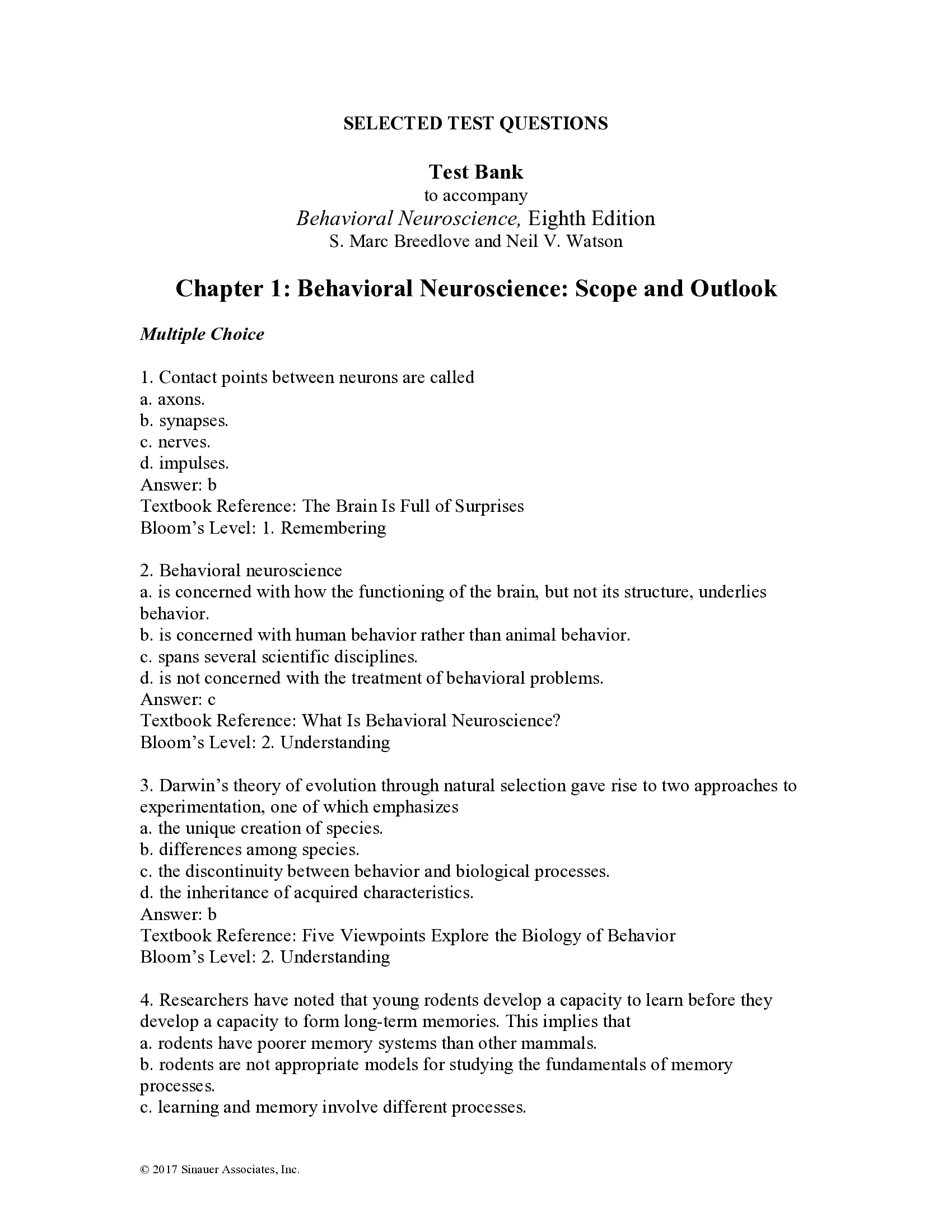
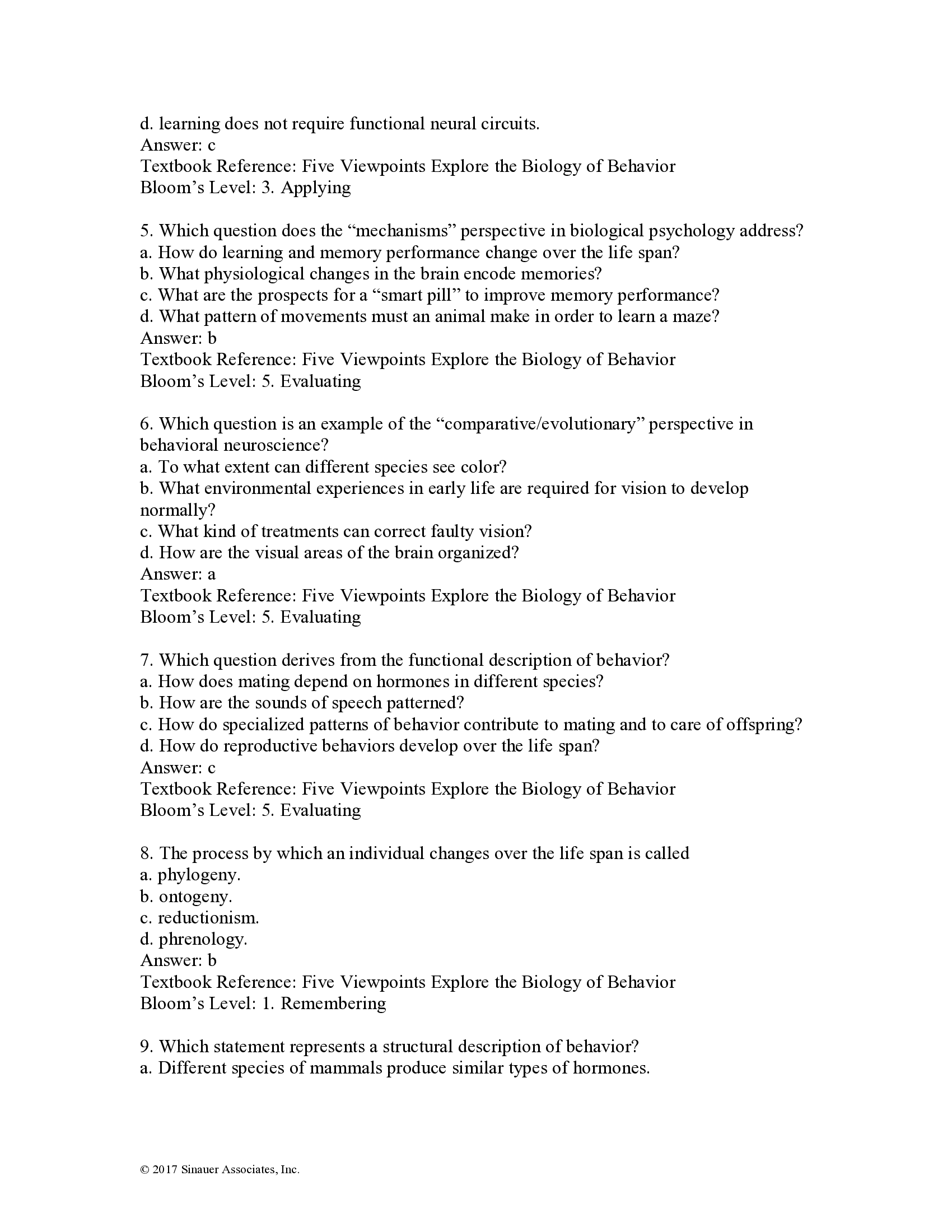
  • Test Bank for Behavioral Neuroscience, 8 Edition by Marc Breedlove, Neil Watson

Test Bank for Behavioral Neuroscience, 8 Edition by Marc Breedlove, Neil Watson

Preview page 1 Preview page 2 Preview page 3
Add To Favorites

Share this item Share this item

  • Item Details
  • Comments (0)
  • Reviews (0)
  • Contact Seller
Test Bank for Behavioral Neuroscience, 8e Marc Breedlove, Neil Watson Chapter 3: Neurophysiology: The Generation, Transmission, and Integration of Neural Signals study test questions pasinggrades Essay/Discussion Prepare a comprehensive discussion for each of the following topics: 1. Discuss the characteristics of temporal and spatial summation in single nerve cells. In what ways are these processes important for information processing by the nervous system? 2. Give a step-by-step description of the generation of an action potential and its transmission along an axon. Describe how the presence or absence of myelin affects this process. 3. Give a detailed explanation of how the resting membrane potential is established, how and why it varies from the predicted value, and how it is maintained. 4. Describe the voltage clamping procedure. Describe and explain what can be learned from two different patch clamping techniques. 5. Describe at least two major classes of seizure disorder; highlight their behavioral and electrophysiological differences. 6. What are event-related potentials, and how are they useful in studying the workings of the normal brain? 7. Compare and contrast electroencephalograms and event-related potentials, describing how each arises and their electrophysiological bases. What abnormal conditions can they be used to diagnose? 8. Ion channels can be disrupted in many ways. Describe three types of toxins that can interfere with normal ion channel function. Explain their origins and how they work. 9. Describe the two types of receptors used to open ion channels. How do these receptors differ from one another? What are the specific components and molecules related to each? 10. Describe the refractory phase and its physiological basis. What is its significance for neuronal activity? 11. Describe the function of four kinds of acetylcholine receptors. Explain how specific exogenous ligands affect each receptor type. 12. Discuss three factors that account for the rapidity of the knee-jerk reflex. 13. Summarize the various mechanisms by which ion channels may change their shape, thereby altering ion flow through the cell membrane. 14. Describe some of the mechanisms by which the actions of neurotransmitters are stopped rapidly. Why is this process important? 15. What is optogenetics? Describe how light-sensitive molecules are used in optogenetics and give an example of what can be observed using this technique. Multiple Choice 1. In general, the action potential is first initiated at the a. synapse. b. outer reaches of the dendrite. c. axon hillock. d. node of Ranvier. Answer: c Textbook Reference: Electrical Signals Are the Vocabulary of the Nervous System Bloom’s Level: 1. Remembering 2. Metabotropic receptors are associated with a. slow synapses. b. electrical synapses. c. ligand-gated ion channels. d. fast synapses. Answer: a Textbook Reference: Synaptic Transmission Requires a Sequence of Events Bloom’s Level: 1. Remembering 3. The substance tetrodotoxin (TTX), found in the ovaries of pufferfish, is useful for studying the ionic mechanisms of the neuron because it a. selectively blocks sodium channels. b. selectively blocks potassium channels. c. prevents ion channels from closing. d. directly stimulates neurons. Textbook Reference: Electrical Signals Are the Vocabulary of the Nervous System Bloom’s Level: 1. Remembering 4. The overall amplitude of the action potential is about a. 70 mV. b. –70 mV. c. 100 mV. d. 1 V. Answer: c Textbook Reference: Electrical Signals Are the Vocabulary of the Nervous System Bloom’s Level: 1. Remembering 5. The sodium-potassium pump is responsible for a. pushing three sodium ions out of the cell for every two potassium ions pumped in. b. initiating the action potential. c. pumping potassium and sodium into the cell. d. creates a positive net charge inside the cell. Answer: a Textbook Reference: Electrical Signals Are the Vocabulary of the Nervous System Bloom’s Level: 3. Applying 6. Myelin increases the speed of conduction because it a. permits the flow of ionic current across the membrane. b. releases special chemicals that aid conduction. c. increases capacitance. d. resists the flow of current across the membrane. Answer: d Textbook Reference: Electrical Signals Are the Vocabulary of the Nervous System Bloom’s Level: 1. Remembering 7. The equilibrium potential for sodium is about _______ mV. a. –65 b. –40 c. +100 d. +40 Answer: d Textbook Reference: Electrical Signals Are the Vocabulary of the Nervous System Bloom’s Level: 1. Remembering 8. Ion channels are made of a. protein. b. polysaccharide. c. lipid. d. carbohydrate. Answer: a Textbook Reference: Electrical Signals Are the Vocabulary of the Nervous System Bloom’s Level: 1. Remembering 9. The giant axons of some invertebrates conduct action potentials at speeds up to _______ m/s. a. 5 b. 120 c. 20 d. 2 Answer: c Textbook Reference: Electrical Signals Are the Vocabulary of the Nervous System Bloom’s Level: 1. Remembering 10. The giant axons of squids have been used in neurophysiological research because they attain diameters of _______ mm. a. 0.5 b. 5 c. 50 d. 500 Answer: a Textbook Reference: Electrical Signals Are the Vocabulary of the Nervous System Bloom’s Level: 1. Remembering 11. The largest-diameter myelinated axons in mammals conduct action potentials at a. 120 mm/s. b. 150 m/s. c. 1 m/s. d. 100 m/s. Answer: b Textbook Reference: Electrical Signals Are the Vocabulary of the Nervous System Bloom’s Level: 1. Remembering 12. Ions are atoms or molecules that carry an electric charge due to the gain or loss of a. protons. b. electrons. c. neutrons. d. positrons. Answer: b Textbook Reference: Electrical Signals Are the Vocabulary of the Nervous System Bloom’s Level: 1. Remembering 13. Much of the energy that the brain expends is used for a. producing action potentials. b. synthesizing and releasing neurotransmitters. c. saltatory conduction. d. maintaining ionic gradients. Answer: d Textbook Reference: Electrical Signals Are the Vocabulary of the Nervous System Bloom’s Level: 1. Remembering 14. When hyperpolarizing or depolarizing electrical stimulation is applied to the cell membrane of a neuron, the resulting change in the membrane potential has a slightly different “shape” from that of the stimulus. This is due to a. conductance of the cell membrane. b. the insulating properties of myelin. c. capacitance of the cell membrane. d. gated ion channels. Answer: c Textbook Reference: Electrical Signals Are the Vocabulary of the Nervous System Bloom’s Level: 4. Analyzing 15. Action potentials generally are not propagated along dendrites because they have a. few voltage-gated ion channels. b. sodium channels. c. no myelin. d. mitochondria. Answer: a Textbook Reference: Electrical Signals Are the Vocabulary of the Nervous System Bloom’s Level: 4. Analyzing 16. An afterpotential is a. a brief hyperpolarization that follows an action potential (“undershoot”). b. a brief depolarization that follows an action potential (“overshoot”). c. a brief hyperpolarization that follows an EPSP (“undershoot”). d. the portion of an action potential between 0 and +30 mV. Answer: a Textbook Reference: Synapses Cause Graded, Local Changes in the Postsynaptic Membrane Potential Bloom’s Level: 2. Understanding 17. Inhibitory postsynaptic potentials differ from excitatory postsynaptic potentials most significantly in their a. direction of membrane polarization. b. degree of capacitance. c. ease of elicitation. d. overall amplitude. Answer: a Textbook Reference: Synapses Cause Graded, Local Changes in the Postsynaptic Membrane Potential Bloom’s Level: 2. Understanding 18. Most IPSPs are attributable to the a. opening of sodium channels. b. closing of potassium channels. c. opening of chloride channels. d. closing of sodium channels. Answer: c Textbook Reference: Synapses Cause Graded, Local Changes in the Postsynaptic Membrane Potential Bloom’s Level: 1. Remembering 19. At chemical synapses, most of the synaptic delay—the time between the arrival of a presynaptic action potential and the appearance of a postsynaptic EPSP or IPSP—is not attributable to the a. process of Ca 2+ influx at the axon terminal. b. rate of diffusion of neurotransmitter molecules across the synapse. c. rate at which vesicles move to the presynaptic membrane and rupture. d. interaction of the transmitter with its receptors. Answer: d Textbook Reference: Synapses Cause Graded, Local Changes in the Postsynaptic Membrane Potential Bloom’s Level: 4. Analyzing 20. The synaptic cleft at electrical synapses is about _______ wide. a. 2‒4 µm b. 20‒30 µm c. 20‒30 nm d. 2‒4 nm Answer: d Textbook Reference: Synaptic Transmission Requires a Sequence of Events Bloom’s Level: 1. Remembering 21. Which statement about retrograde synapses is false? a. The postsynaptic cell releases a gaseous neurotransmitter. b. Transmission starts with axo-dendritic activity. c. A signal from the postsynaptic cell tells the presynaptic cell to release more transmitter. d. They typically involve dendro-dendritic activity. Answer: d Textbook Reference: Synaptic Transmission Requires a Sequence of Events Bloom’s Level: 4. Analyzing 22. When a transmitter binds to a metabotropic receptor that is coupled to a G protein, part of the G protein complex a. becomes larger. b. degrades. c. binds to a transmitter receptor. d. migrates away. Answer: d Textbook Reference: Synaptic Transmission Requires a Sequence of Events Bloom’s Level: 2. Understanding 23. A ligand is a a. specific type of drug. b. type of electrical stimulus. c. cholinergic synapse. d. substance that binds to receptor molecules. Answer: d Textbook Reference: Synaptic Transmission Requires a Sequence of Events Bloom’s Level: 2. Understanding 24. Bungarotoxin is derived from a type of a. mushroom. b. snake. c. spider. d. plant. Answer: b Textbook Reference: Synaptic Transmission Requires a Sequence of Events Bloom’s Level: 1. Remembering 25. Muscarine is derived from a type of a. mushroom. b. snake. c. spider. d. plant. Answer: a Textbook Reference: Synaptic Transmission Requires a Sequence of Events Bloom’s Level: 1. Remembering 26. Which process is not involved in chemical synaptic transmission? a. Electrical conduction across the synaptic cleft b. Binding to autoreceptors c. Influx of calcium at the presynaptic membrane d. Reuptake Answer: a Textbook Reference: Synaptic Transmission Requires a Sequence of Events Bloom’s Level: 3. Applying 27. What percentage of the known transmitters and hormones activates cellular mechanisms through receptors coupled to G proteins? a. Less than 5% b. 20% c. 50% d. 80% Answer: d Textbook Reference: Synaptic Transmission Requires a Sequence of Events Bloom’s Level: 1. Remembering 28. The specialized presynaptic membrane receptors that remove molecules of transmitter from a synapse are called a. translators. b. transponders. c. transporters. d. ligand-gated channels. Answer: c Textbook Reference: Synaptic Transmission Requires a Sequence of Events Bloom’s Level: 1. Remembering 29. Most ACh receptors in the brain are a. nicotinic. b. muscarinic. c. metabotropic. d. unused. Answer: b Textbook Reference: Synaptic Transmission Requires a Sequence of Events Bloom’s Level: 2. Understanding 30. At metabotropic synapses, second messengers are activated in postsynaptic neurons by a. electrical currents. b. specific enzymes. c. mitochondria. d. transmitter–receptor combinations. Answer: d Textbook Reference: Synaptic Transmission Requires a Sequence of Events Bloom’s Level: 2. Understanding 31. The nicotinic ACh receptor is made up of _______ subunits. a. two b. three c. four d. five Answer: d Textbook Reference: Synaptic Transmission Requires a Sequence of Events Bloom’s Level: 1. Remembering 32. Directly controlled ion channels are a. slow and metabotropic. b. slow and ionotropic. c. fast and metabotropic. d. fast and ionotropic. Answer: d Textbook Reference: Synaptic Transmission Requires a Sequence of Events Bloom’s Level: 2. Understanding 33. The lock-and-key analogy is used to describe the a. action of transmitter molecules on receptor proteins. b. activation of the nerve impulse. c. degradation of transmitter molecules by enzymes. d. binding of G proteins to transmitter receptors. Answer: a Textbook Reference: Synaptic Transmission Requires a Sequence of Events Bloom’s Level: 1. Remembering 34. Muscarine and nicotine mimic the action of a. G proteins. b. calcium. c. acetylcholine. d. GABA. Answer: c Textbook Reference: Synaptic Transmission Requires a Sequence of Events Bloom’s Level: 3. Applying 35. Acetylcholine receptors are thought to be in the same family as GABA, glycine, and glutamate receptors because they a. bind the same neurotransmitters. b. have a similar structure. c. are found in the same neurons. d. all cause inhibitory responses. Answer: b Textbook Reference: Synaptic Transmission Requires a Sequence of Events Bloom’s Level: 2. Understanding 36. The quantity of many types of receptors in the brain may vary during the day by a. 1 to 2%. b. 5%. c. 50%. d. 100%. Answer: c Textbook Reference: Synaptic Transmission Requires a Sequence of Events Bloom’s Level: 1. Remembering 37. Whether a synapse is excitatory or inhibitory is determined by the a. number of action potentials arriving at the presynaptic axon terminal. b. size of the calcium current flowing into the presynaptic axon terminal. c. type of transmitter released by the presynaptic neuron and the receptor to which that transmitter binds on the postsynaptic neuron. d. sensitivity of the postsynaptic membrane. Answer: c Textbook Reference: Synaptic Transmission Requires a Sequence of Events Bloom’s Level: 4. Analyzing 38. Substances that bind to receptor proteins and change the permeability of ion channels are called a. neuroregulators. b. blockers. c. transporters. d. neurotransmitters. Answer: d Textbook Reference: Synaptic Transmission Requires a Sequence of Events Bloom’s Level: 1. Remembering 39. The neurotransmitter acetylcholine acts on at least _______ different types of receptors. a. two b. three c. four d. five Answer: c Textbook Reference: Synaptic Transmission Requires a Sequence of Events Bloom’s Level: 1. Remembering 40. Otto Loewi’s experiments showed that the _______ releases acetylcholine, which _______. a. heart; affects the vagus nerve b. vagus nerve; increases heart rate c. vagus nerve; decreases heart rate d. brain; decreases heart rate Answer: c Textbook Reference: Synaptic Transmission Requires a Sequence of Events Bloom’s Level: 2. Understanding 41. Curare and bungarotoxin are similar in that they both a. act on the GABA receptor. b. act as acetylcholine receptor agonists. c. come from animals. d. act as acetylcholine receptor antagonists. Answer: d Textbook Reference: Synaptic Transmission Requires a Sequence of Events Bloom’s Level: 3. Applying 42. The poison extracted from the mushroom Amanita muscaria is a(n) a. GABA receptor agonist. b. GABA receptor antagonist. c. acetylcholine receptor antagonist. d. acetylcholine receptor agonist. Answer: d Textbook Reference: Synaptic Transmission Requires a Sequence of Events Bloom’s Level: 3. Applying 43. The chemical that Loewi initially called Vagusstoff turned out to be a. acetylcholine. b. muscarine. c. GABA. d. calcium. Answer: a Textbook Reference: Synaptic Transmission Requires a Sequence of Events Bloom’s Level: 1. Remembering 44. Which compound would prevent the release of neurotransmitters from stimulated neurons? a. Bungarotoxin because it disables t-SNAREs. b. Tetanus toxin because it disables v-SNAREs. c. Synaptotagmin because it senses Ca 2+ . d. Tetrodotoxin because it blocks exocytosis. Answer: b Textbook Reference: Synaptic Transmission Requires a Sequence of Events Bloom’s Level: 3. Applying 45. G proteins are able to amplify the message from a single receptor because they a. activate second messenger proteins inside the cell. b. are a component of ionotropic receptors. c. affect one ion channel. d. are ligand-gated ion channels. Answer: a Textbook Reference: Synaptic Transmission Requires a Sequence of Events Bloom’s Level: 2. Understanding 46. The phenomenon of convergence is illustrated by the circuits of the visual system, in which about 100 million receptor cells send information to about _______ ganglion cells. a. 100 million b. 1 million c. 100,000 d. 1 billion Answer: b Textbook Reference: Neurons and Synapses Combine to Make Circuits Bloom’s Level: 1. Remembering 47. A stretch of the patellar tendon activates a. the flexion reflex. b. an oscillator circuit. c. the knee-jerk reflex. d. the jaw-jerk reflex. Answer: c Textbook Reference: Neurons and Synapses Combine to Make Circuits Bloom’s Level: 2. Understanding 48. The simplest neural circuit is the a. oscillator circuit. b. feedback circuit. c. neural chain. d. amplifier circuit. Answer: c Textbook Reference: Neurons and Synapses Combine to Make Circuits Bloom’s Level: 1. Remembering 49. In the knee-jerk reflex, the total time between the stimulus and the initiation of the response is about _______ ms. a. 10 b. 40 c. 100 d. 400 Answer: b Textbook Reference: Neurons and Synapses Combine to Make Circuits Bloom’s Level: 1. Remembering 50. The phenomenon of divergence is illustrated by the visual system, in which 1 million axons of the optic nerve communicate with _______ neurons in the cerebral cortex. a. half a million b. a thousand c. 500 million d. over a billion Answer: d Textbook Reference: Neurons and Synapses Combine to Make Circuits Bloom’s Level: 1. Remembering 51. Spontaneous electrical rhythms that can be recorded from the surface of the scalp a. indicate a pathological condition, such as epilepsy. b. demonstrate that neurons are constantly moving. c. are generated by the activity of populations of neurons. d. reflect the brain’s reaction to discrete stimuli. Answer: c Textbook Reference: Gross Electrical Activity of the Human Brain Bloom’s Level: 2. Understanding 52. _______ reflect complex information processing. a. Short-latency auditory-evoked potentials b. Long-latency ERP components c. Changes in potential amplitude due to stimulus strength d. “Rebound” potentials Answer: b Textbook Reference: Gross Electrical Activity of the Human Brain Bloom’s Level: 5. Evaluating 53. The term “kindling” refers to a. the experimental induction of seizures using subthreshold stimuli. b. an experimental procedure for blocking the spread of seizures. c. the application of massive depolarizing stimuli to a brain region. d. the net effect of integrating postsynaptic potentials at the axon hillock. Answer: a Textbook Reference: Gross Electrical Activity of the Human Brain Bloom’s Level: 2. Understanding 54. The short-latency components of event-related potentials appear to be influenced primarily by a. cognitive processing. b. endogenous factors. c. exogenous factors. d. cortical responses. Answer: c Textbook Reference: Gross Electrical Activity of the Human Brain Bloom’s Level: 2. Understanding 55. The alternating muscular jerks and relaxations that accompany some seizures are characteristic of the _______ phase. a. tonic b. clonic c. petit mal d. recovery Answer: b Textbook Reference: Gross Electrical Activity of the Human Brain Bloom’s Level: 2. Understanding 56. In optogenetics, researchers use _______ light to stimulate _______. a. yellow; channelrhodopsin b. red; halorhodopsin c. blue; halorhodopsin d. blue; channelrhodopsin Answer: d Textbook Reference: The Cutting Edge: Optogenetics: Using Light to Probe Brain– Behavior Relationships Bloom’s Level: 1. Remembering 57. In an animal research study, channelrhodopsin is inserted into neurons that make GABA (which inhibits neurons), and halorhodopsin is inserted into neurons that make glutamate (which excites neurons). Both sets of neurons make connections with a set of neurons responsible for eye blinking. If the eye-blink neurons are stimulated by blue light, the animal will _______ because the _______ neurons will be _______. a. blink; glutamate; depolarized b. not blink; GABA; depolarized c. not blink; glutamate; hyperpolarized d. blink; GABA; hyperpolarized Answer: b Textbook Reference: The Cutting Edge: Optogenetics: Using Light to Probe Brain– Behavior Relationships Bloom’s Level: 6. Creating Fill in the Blank 1. The size of an action potential is independent of the stimulus magnitude, a phenomenon that is referred to as the _______ property of action potentials. Answer: all-or-none Textbook Reference: Electrical Signals Are the Vocabulary of the Nervous System Bloom’s Level: 1. Remembering 2. Inside the nerve cell there is a high concentration of _______ ions, while outside the cell there is a high concentration of _______ ions. Answer: potassium; sodium Textbook Reference: Electrical Signals Are the Vocabulary of the Nervous System Bloom’s Level: 1. Remembering 3. The _______ are regularly spaced along the length of myelinated axons. Answer: nodes of Ranvier Textbook Reference: Electrical Signals Are the Vocabulary of the Nervous System Bloom’s Level: 1. Remembering 4. The _______ is the site at which the action potential is initiated. Answer: axon hillock Textbook Reference: Electrical Signals Are the Vocabulary of the Nervous System Bloom’s Level: 1. Remembering 5. The generation of the action potential depends on _______ channels, which are opened through a process of regenerative _______. Answer: sodium; depolarization Textbook Reference: Electrical Signals Are the Vocabulary of the Nervous System Bloom’s Level: 2. Understanding 6. In _______ clamping, the membrane potential of an axon is measured and manipulated; _______ clamping allows the manipulation and analysis of part of a membrane, even a single ion channel. Answer: voltage; patch Textbook Reference: Electrical Signals Are the Vocabulary of the Nervous System Bloom’s Level: 2. Understanding 7. The toxins TTX and STX both block _______ channels, preventing the production of _______. Answer: sodium; action potentials Textbook Reference: Electrical Signals Are the Vocabulary of the Nervous System Bloom’s Level: 2. Understanding 8. The electrical potential across a semipermeable membrane separating different concentrations of ions is most accurately predicted by the _______ equation. Answer: Goldman Textbook Reference: Electrical Signals Are the Vocabulary of the Nervous System Bloom’s Level: 1. Remembering 9. Inhibitory postsynaptic potentials are characterized by _______ of the postsynaptic membrane. Answer: hyperpolarization Textbook Reference: Synapses Cause Graded, Local Changes in the Postsynaptic Membrane Potential Bloom’s Level: 1. Remembering 10. _______ synapses work with practically no time delay, whereas _______ synapses have a delay on the order of about a millisecond. Answer: Electrical; chemical Textbook Reference: Synapses Cause Graded, Local Changes in the Postsynaptic Membrane Potential Bloom’s Level: 2. Understanding 11. The enzyme _______ breaks down molecules of the neurotransmitter acetylcholine, stopping its action at synapses. Answer: acetylcholinesterase Textbook Reference: Synaptic Transmission Requires a Sequence of Events Bloom’s Level: 1. Remembering 12. Any substance that binds to a receptor is known as a(n) _______. Answer: ligand Textbook Reference: Synaptic Transmission Requires a Sequence of Events Bloom’s Level: 1. Remembering 13. The number of receptors for a particular transmitter that are present in the brain may vary as a consequence of _______ factors, biological _______, or the effects of _______. Answer: developmental; rhythms; drugs Textbook Reference: Synaptic Transmission Requires a Sequence of Events Bloom’s Level: 2. Understanding 14. Transporter molecules are involved in the _______ of neurotransmitter from the synapse. Answer: removal Textbook Reference: Synaptic Transmission Requires a Sequence of Events Bloom’s Level: 2. Understanding 15. The amount of transmitter released at an axon terminal is proportional to the amount of _______ that enters the axon terminal. Answer: calcium Textbook Reference: Synaptic Transmission Requires a Sequence of Events Bloom’s Level: 2. Understanding 16. _______ inform the presynaptic neurons about the net concentration of transmitter in the synaptic cleft and help regulate future transmitter release. Answer: Autoreceptors Textbook Reference: Synaptic Transmission Requires a Sequence of Events Bloom’s Level: 2. Understanding 17. Simple partial seizures are characterized by _______-and-_______ EEG activity. Answer: spike; wave Textbook Reference: Gross Electrical Activity of the Human Brain Bloom’s Level: 1. Remembering 18. _______ seizures are characterized by periods of enduring contractions alternating with periods of jerky, rhythmic contraction and relaxation. Answer: Tonic-clonic Textbook Reference: Gross Electrical Activity of the Human Brain Bloom’s Level: 1. Remembering 19. Loss of consciousness and symmetrical involvement of the body are characteristic of _______ seizures. Answer: generalized Textbook Reference: Gross Electrical Activity of the Human Brain Bloom’s Level: 1. Remembering 20. Event-related potentials are particularly useful for diagnosing problems with _______. Answer: hearing Textbook Reference: Gross Electrical Activity of the Human Brain Bloom’s Level: 1. Remembering 21. Halorhodopsin is stimulated by _______ light and allows _______ ions to enter the cell. Answer: yellow; chloride Textbook Reference: The Cutting Edge: Optogenetics: Using Light to Probe Brain– Behavior Relationships Bloom’s Level: 1. Remembering Matching Match each lettered item with an item from the numbered list below. _____ a. Sodium _____ b. Potassium _____ c. Chloride _____ d. Calcium 1. Depolarizes neurons when it crosses cell membrane during an action potential 2. Involved with the binding of neurotransmitter vesicles in the axon terminal 3. Hyperpolarizes neurons when it crosses cell membrane after an action potential 4. Hyperpolarizes neurons when it enters cell Answer: a. 1; b. 3; c. 4; d. 2 Define/Describe/Identify Give a definition or functional description for each of the following terms or concepts: absolute refractory phase acetylcholine (ACh) action potential afterpotential agonist all-or-none property anion antagonist aura autoreceptor axo-axonic axo-dendritic axo-somatic axon hillock batrachotoxin botulinum toxin bungarotoxin calcium ion (Ca ) cation 2+ cell membrane channelrhodopsin cholinergic complex partial seizure concentration gradient conduction velocity connexon convergence curare degradation dendro-dendritic depolarization diffusion divergence down-regulation ectopic transmission electroencephalogram (EEG) electrostatic pressure endogenous ligand epilepsy equilibrium equilibrium potential excitatory postsynaptic potential (EPSP) exocytosis exogenous ligand extracellular fluid G proteins Goldman equation hyperpolarization inhibitory postsynaptic potential (IPSP) intracellular fluid ion ion channel ionotropic receptor kindling knee-jerk reflex ligand ligand-gated ion channel lipid bilayer local potential metabotropic receptor microelectrode millivolt (mV) negative polarity Nernst equation neural chain neurophysiology study material neurotransmitter node of Ranvier nondirected synapse patch clamp postsynaptic potential potassium ion (K + ) receptor molecule refractory relative refractory phase resting membrane potential retrograde synapse reuptake saltatory conduction saxitoxin (STX) second messenger seizure selective permeability simple partial seizure sodium ion (Na + ) sodium-potassium pump spatial summation synaptic delay synaptotagmin t-SNARE temporal summation tetanus toxin tetrodotoxin (TTX) threshold tonic-clonic seizure transporter up-regulation v-SNARE varicosity voltage-gated Na + channel Paragraph Development Write a coherent and informative paragraph incorporating each of the following terms or concepts: 1. Sodium channels; potassium channels; ion flow; equilibrium; resting potential 2. Sodium channels; potassium channels; action potential; absolute refractory phase; relative refractory phase 3. Saltatory conduction; myelin; ion flow; axon diameter 4. Temporal summation; spatial summation; threshold; information processing 5. EEG; normal behavior; abnormal behavior; tonic-clonic and simple partial seizures Companion Passing Grades QUESTIONS Multiple Choice 1. Which element is an anion in the extracellular or intracellular fluid? a. Calcium b. Potassium c. Chloride d. Sodium Answer: c Textbook Reference: Electrical Signals Are the Vocabulary of the Nervous System Bloom’s Level: 1. Remembering 2. The resting membrane potential is a. negative in neurons and positive in glial cells. b. a product of the distribution of ions across the membrane. c. a property unique to multipolar neurons. d. established by the rapid influx of sodium ions. Answer: b Textbook Reference: Electrical Signals Are the Vocabulary of the Nervous System Bloom’s Level: 2. Understanding 3. The _______ predicts the voltage that develops when a semipermeable membrane separates different concentrations of ions. The measured value of the resting membrane potential varies slightly from this predicted value because the cell is somewhat permeable to _______. a. sodium-potassium pump; K b. Nernst equation; Na c. Goldman equation; Cl d. equilibrium potential; Na Answer: b Textbook Reference: Electrical Signals Are the Vocabulary of the Nervous System Bloom’s Level: 2. Understanding 4. At the peak of the action potential, the axonal membrane approaches the equilibrium potential for a. K + . b. Na + . c. Cl – . d. negatively charged proteins. Answer: b Textbook Reference: Electrical Signals Are the Vocabulary of the Nervous System Bloom’s Level: 2. Understanding 5. The absolute refractory period refers to the brief period of time a. during which a postsynaptic receptor cannot bind another neurotransmitter. b. after a neuron has fired an action potential, during which the same neuron cannot fire another action potential. c. after exocytosis and before the release of more neurotransmitter from the presynaptic cleft. d. following a response to any hyperpolarizing input. Answer: b Textbook Reference: Electrical Signals Are the Vocabulary of the Nervous System Bloom’s Level: 2. Understanding 6. Postsynaptic potentials are a type of a. digital event. b. action potential. c. resting potential. d. graded potential. Answer: d Textbook Reference: Synapses Cause Graded, Local Changes in the Postsynaptic Membrane Potential Bloom’s Level: 2. Understanding 7. The size of the gap between the presynaptic membrane and the postsynaptic membrane in a chemical synapse is a. 100 mm. b. 100 nm. c. 20‒40 nm. d. 2‒4 nm. Answer: c Textbook Reference: Synapses Cause Graded, Local Changes in the Postsynaptic Membrane Potential Bloom’s Level: 1. Remembering 8. Norepinephrine and dopamine are examples of transmitters whose synaptic activity is terminated by a. passive diffusion. b. reuptake. c. degradation. d. calcium influx. Answer: b Textbook Reference: Synaptic Transmission Requires a Sequence of Events Bloom’s Level: 1. Remembering 9. The greater the influx of calcium into the presynaptic axon terminal, the greater the a. magnitude of inhibition. b. release of neurotransmitter. c. amplitude of the action potential. d. rate of reuptake. Answer: b Textbook Reference: Synaptic Transmission Requires a Sequence of Events Bloom’s Level: 2. Understanding 10. Which sequence presents presynaptic events in the correct chronological order? a. Calcium ion influx action potential reaches axon terminal vesicle fuses with membrane diffusion of neurotransmitter b. Exocytosis calcium ion influx action potential reaches axon terminal membrane depolarization c. Action potential reaches axon terminal calcium ion channels open exocytosis diffusion of neurotransmitter d. Action potential reaches axon terminal calcium ion channels open neurotransmitter diffusion exocytosis Answer: c Textbook Reference: Synaptic Transmission Requires a Sequence of Events Bloom’s Level: 4. Analyzing 11. Which characteristic is not associated with slow synapses? a. G protein–coupled b. Metabotropic c. Long duration of response d. Ligand-gated Answer: d Textbook Reference: Synaptic Transmission Requires a Sequence of Events Bloom’s Level: 3. Applying 12. In the knee-jerk reflex, a. a muscle stretch receptor is activated by a spinal cord motor neuron. b. there are two synapses from stimulation to muscle contraction. c. the motor neuron releases acetylcholine to stimulate the sensory neuron. d. the stimulus activates a sensory neuron with a cell body in the ventral horn of the spinal cord. Answer: b Textbook Reference: Neurons and Synapses Combine to Make Circuits Bloom’s Level: 4. Analyzing 13. Which of the following is an example of divergence? a. A thalamic cell in the visual system sending information to many cortical cells b. A receptor cell in the eye sending information to a single retinal ganglion cell c. A thalamic cell in the visual system receiving information from many retinal ganglion cells d. The knee-jerk reflex Answer: a Textbook Reference: Neurons and Synapses Combine to Make Circuits Bloom’s Level: 3. Applying 14. A patient has a seizure that does not involve the entire brain. Just before the seizure, the patient had an unusual sensation, and at the height of the seizure the patient was unresponsive. This patient most likely experienced a _______ seizure. a. simple partial b. tonic-clonic c. complex partial d. kindling Answer: c Textbook Reference: Gross Electrical Activity of the Human Brain Bloom’s Level: 3. Applying 15. If you wanted to hyperpolarize a neuron, which opsin would you insert and which color of light would you shine onto the neuron? a. Channelrhodopsin and blue light b. Channelrhodopsin and yellow light c. Falorhodopsin and blue light d. Halorhodopsin and yellow light Answer: d Textbook Reference: The Cutting Edge: Optogenetics: Using Light to Probe Brain– Behavior Relationships Bloom’s Level: 3. Applying Essay 1. Describe the establishment and maintenance of the resting membrane potential. 2. Describe the effects of a hyperpolarizing or depolarizing stimulus on a neural membrane and the membrane events that surround the production of a neural impulse. 3. Describe the forces that influence ion movement across the membrane of a neuron. 4. Give an overview of the movement of action potentials down the axon, and explain why they move in one direction only. 5. Describe in general terms the postsynaptic electrical events (i.e., postsynaptic potentials) associated with the generation of an action potential. Include in your answer the differences between spatial and temporal summation. 6. Summarize the sequence of events that occurs when a synapse is activated, from the arrival of an action potential at the axon terminal to the release of neurotransmitter. 7. Describe the recognition of transmitter molecules by receptors, and the types of effects that transmitters have on ionotropic and metabotropic receptors. 8. Describe information processing within the knee-jerk reflex, giving details of the types of cells involved, their locations, and the neurotransmitters used at each synapse. 9. Discuss the generation of EEG and ERP measures and the defining features of epilepsy. 10. Describe the basis for optogenetics, including the types of light-sensitive proteins used, and how this technique offers an advantage over standard neurophysiological techniques using electrodes.

Contact the Seller

Please Sign In to contact this seller.


  • 👎  Report Copyright Violation

Frequently Asked Questions

What Do I Get When I Buy This Study Material?

+

When you buy a study material on Passing Grades, an instant download link will be sent directly to your email, giving you access to the file anytime after payment is completed.

Is Passing Grades a Trusted Platform?

+

Yes, Passing Grades is a reputable students’ marketplace with a secure payment system and reliable customer support. You can trust us to ensure a safe and seamless transaction experience.

Will I Be Stuck with a Subscription?

+

No, all purchases on Passing Grades are one-time transactions. You only pay for the notes you choose to buy, with no subscriptions or hidden fees attached.

Who Am I Buying These Study Materials From?

+

Passing Grades is a marketplace, which means you are purchasing the document from an individual vendor, not directly from us. We facilitate the payment and delivery process between you and the vendor.

Does Passing Grades Offer Free Study Materials?

+

Yes, sellers on Passing Grades have uploaded numerous free test banks, exams, practice questions, and class notes that can be downloaded at no cost.


Pasinggrades - Quality Study Materials

USD 17

    • Quality checked by Pasing Grades
    • 100% satisfaction guarantee
    • Seller: mentor2000
Buy PDF $17

Seller Information

mentor2000

Member since April 2021

  • icon
  • icon
View Profile
  • total sales

    0
  • Favourites

    0
  • Comments

    0
    ( 0 Ratings )

Item Information

  • Uploaded

    10 October 2023

  • Updated

    01 October 2025

  • Category

    No category

  • Item Type

    test bank

  • Tags

    Test Bank Behavioral Neuroscience 8 edition Passing Grades Study Material

Related Exam Prep Guides by mentor2000

Test Bank for Essentials for Nursing Practice 8th Edition by Potter | All Chapters
View Document

Test Bank for Essent...

  • mentor2000

    mentor2000

  • test bank

Master nursing concepts with this study material; Test Bank for Essentials for Nursing Practice, 8th...

17 USD

0

0

A &P 1 MA278 BSC2 Final Module II Questions & Answers 2026 Update
View Document

A &P 1 MA278 BSC2 Fi...

  • mentor2000

    mentor2000

  • test bank

Prepare for success with A&P 1 MA278 BSC2 Final Module II 2024 Q&A. Boost your grades with this comp...

17 USD

0

0

ATI Comprehensive Predictor Exam 2026
View Document

ATI Comprehensive Pr...

  • mentor2000

    mentor2000

  • test bank

Prepare for success with the ATI Comprehensive Predictor Exam 2026. Access key practice questions to...

17 USD

0

0

Purchase

Download link will be sent to this email immediately after purchase.

IMPORTANT LINKS

  • How To Upload Class Notes
  • Selling Tips
  • Passing Grades's Study Materials
  • Scholarships for International Students 2025

POPULAR CATEGORIES

  • Law
  • Accounting
  • English
  • Psychology
  • Business
  • Nursing
  • Computer Science
  • General

View Document

  • Blog
  • Contact
  • Delivery Policy
  • Latest Scholarships Around the World
  • How to Pass Bar Exams: Passing Grades’ Strategies
  • How to Study and Pass the CPA Exam
  • All Test Banks
  • Faq
  • Copyright Claims
  • Privacy Policy
  • Terms of Use

KNOWLEDGE BASE

  • How to Write A+ Grade Good Research Paper
  • How to Manage Stress During Exam Period
  • Best Time to Study
  • How to Pass NCLEX-RN Exam
  • How To Effectively Utilize Test Banks
  • Popular Shadow Health Exam Assessments
  • Popular HESI Case Studies
  • How to Prepare for a Nursing Career
  • The Importance Of Summaries in Exam Revisvion

© 2026 Pasing Grades. All rights reserved.