Pasing Grades
  • Start Selling
  • Blog
  • Contact
  • 0

    Your cart is empty!

English

  • English
  • Spanish
  • Arabic
Create Account Sign In
  • Library
    • New Prep Guides
    • Featured Prep Guides
    • Free Exam Prep Guides
    • Best sellers
  • General
  • Nursing
    • Research Paper
    • Case Study
    • Discussion Post
    • Assignment
    • Exam
    • Practice Questions and Answers
    • Test Bank
    • solutions manual
  • Accounting
    • Case Study
    • Thesis
    • Study Guide
    • Summary
    • Research Paper
    • test bank
  • English
    • Creative Writing
    • Research Paper
    • Summary
    • Rhetorics
    • Literature
    • Journal
    • Exam
    • Grammar
    • Discussion Post
    • Essay
  • Psychology
    • Hesi
    • Presentation
    • Essay
    • Summary
    • Study Guide
    • Essay
    • Solution Manual
    • Final Exam Review
    • Class Notes
    • test bank
  • Business
    • Lecture Notes
    • Solution Manual
    • Presentation
    • Business Plan
    • Class Notes
    • Experiment
    • Summary
    • Practice Questions
    • Study Guide
    • Case Study
    • test bank
    • Exam
  • More
    • Computer Science
    • Economics
    • Statistics
    • Engineering
    • Biology
    • Religious Studies
    • Physics
    • Chemistry
    • Mathematics
    • History
    • Sociology
    • Science
    • Philosophy
    • Law
  • Pages
    • About Us
    • Selling Tips
    • Delivery Policy
    • Faq
    • Privacy Policy
  • Flash Sale
  • Home
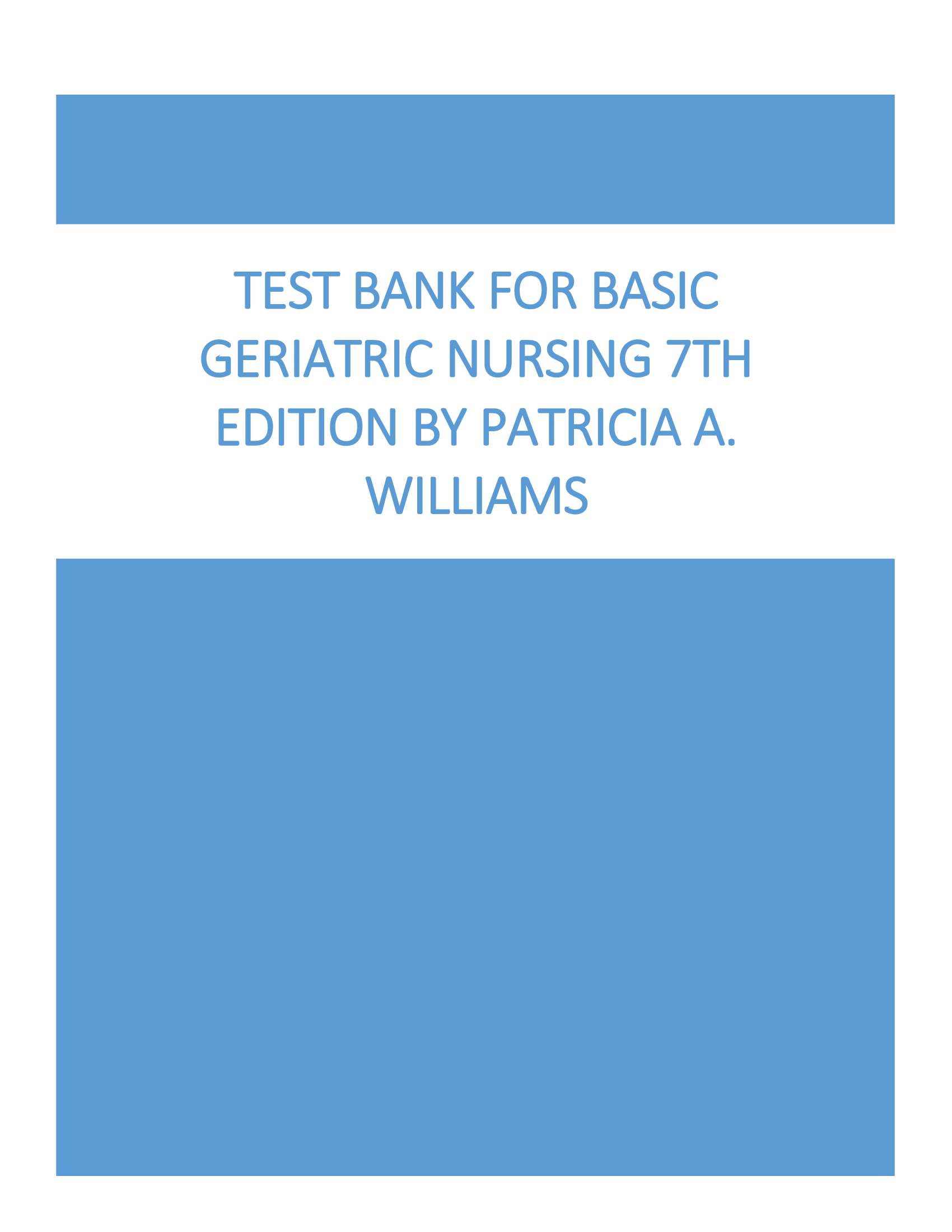
  • Test Bank for Basic Geriatric Nursing 7th Edition By Patricia A. Williams

Test Bank for Basic Geriatric Nursing 7th Edition By Patricia A. Williams

Preview page 1 Preview page 2 Preview page 3
Add To Favorites

Share this item Share this item

  • Item Details
  • Comments (0)
  • Reviews (0)
  • Contact Seller
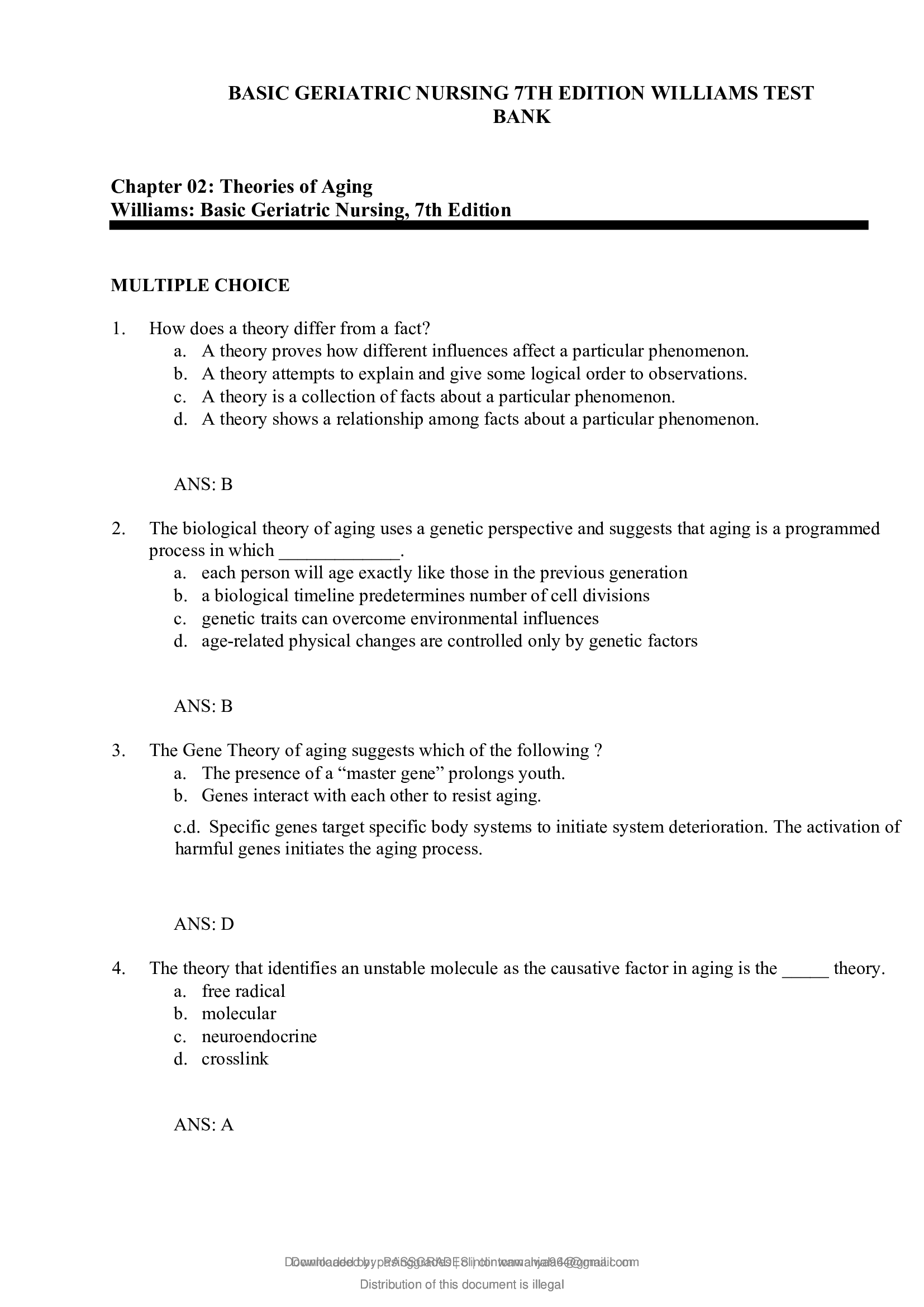
Test Bank for Basic Geriatric Nursing 7th Edition By Patricia A. Williams BASIC GERIATRIC NURSING 7TH EDITION WILLIAMS TEST BANK Chapter 02: Theories of Aging Williams: Basic Geriatric Nursing, 7th Edition MULTIPLE CHOICE 1. How does a theory differ from a fact? a. A theory proves how different influences affect a particular phenomenon. b. A theory attempts to explain and give some logical order to observations. c. A theory is a collection of facts about a particular phenomenon. d. A theory shows a relationship among facts about a particular phenomenon. ANS: B 2. The biological theory of aging uses a genetic perspective and suggests that aging is a programmed process in which _____________. a. each person will age exactly like those in the previous generation b. a biological timeline predetermines number of cell divisions c. genetic traits can overcome environmental influences d. age-related physical changes are controlled only by genetic factors ANS: B 3. The Gene Theory of aging suggests which of the following ? a. The presence of a “master gene” prolongs youth. b. Genes interact with each other to resist aging. c.d. Specific genes target specific body systems to initiate system deterioration. The activation of harmful genes initiates the aging process. ANS: D 4. The theory that identifies an unstable molecule as the causative factor in aging is the _____ theory. a. free radical b. molecular c. neuroendocrine d. crosslink ANS: A Downloaded by: pasinggrades | clintonwamalwa964@gmail.com Distribution of this document is illegal Downloaded by: PASSGRADES | clintonwanjala4@gmail.com Distribution of this document is illegal 5. A patient uses good health maintenance practices. What aging theory most accurately relates to the patient’s practices? a. Wear-and-tear b. Free radical c. Neuroendocrine d. Molecular ANS: A 6. The patient asks the nurse to describe the neuroendocrine theory of aging. What would be an appropriate response by the nurse? a. It relates thyroid function to age-related changes. b. Adrenal corticosteroids inhibit the aging process. c. The stimulation and/or inhibition of the hypothalamus causes age-related changes. d. The adrenal medulla inhibits epinephrine, causing age-related changes. ANS: C 7. What is true of the psychosocial theories of aging? a. They focus on methods to delay the aging process. b. They are directed at decreasing depression in the older adult. c. They are organized to enhance the perception of aging. d. They attempt to explain responses to the aging process. ANS: D 8. What is the major objection to the disengagement theory? a. The theory justifies ageism. b. The theory addresses the diversity of older adults. c. The theory does not clarify the aging process. d. The theory diminishes the self-esteem of the older adult. ANS: A 9. An 80-year-old teaches Sunday school each week and delivers food for Meals on Wheels. What theory of aging would apply? a. Newman’s developmental b. The life course c. The activity d. The disengagement ANS: C 10. The nurse would recognize successful aging according to Jung’s theory when a long-term care facility resident demonstrates which of the following behaviors? a. The resident takes special care to dress for dinner in a manner that pleases his tablemates. b. The resident asks permission to sit on the patio with other residents. c. The resident asks persons in his hall if his television is bothering them. d. The resident wears a large cowboy hat at all times because he likes it. ANS: D 11. How would an elderly female be most likely to reduce the amount of the free radical lipofuscin? a. Avoid animal fat b. Take antioxidants daily c. Build muscle mass d. Perform outdoor exercise three times weekly ANS: B 12. A recently widowed woman moved to an assisted living community because of her hypertension and joined a group to learn how to do water color painting with other women her age. Which theory of aging does the nurse assess the patient to be following? a. Jung b. Havighurst c. Erikson d. Newman ANS: B MULTIPLE RESPONSE 1. What age-related illnesses are thought to cause the accumulation of free radicals? (Select all that apply.) a. Arthritis b. Colon cancer c. Osteoporosis d. Diabetes e. Atherosclerosis ANS: A, D, E 2. The nurse emphasizes that the relatively new theory that correlates restricted caloric intake to slowing of the aging process would probably extend the life span of the person, provided that the person __________. (Select all that apply.) a. consistently eats high-nutrient, low-calorie foods b. maintains a regular exercise program consumes 2000–3000 mL of fluid a day c. supports the diet with adequate fat-soluble vitamins www.pasinggrades.com Basic Geriatric Nursing 7th Edition Williams Test Bank d. eats only organically grown foods ANS: A, B 3. Which would be considered positive outcomes of Erikson’s “life review”? (Select all that apply.) a. Wisdom and integrated self-image b. Comparing self with others c. Understanding self and relationships d. Seeking another’s opinion of his or her achievement e. Acceptance of self ANS: A, C, E 4. Which of the following would be selected for a diet high in antioxidants? (Select all that apply.) a. Fruits b. Vegetables c. Organ meat d. Folic acid e. Atherosclerosis...................................................................................................................................3 ANS: A, B..............................................................................................................................................4 COMPLETION 1. The theory that proposes that defects in ribonucleic acid (RNA) protein production cause a progressive decline in the function of all cells is the __________ theory. ANS: error 2. The nurse clarifies that the biologic theory that proposes that aging is based on the using up of a finite number of breaths or heartbeats is the ______ of ______ theory. ANS: rate living Chapter 04: Health Promotion, Health Maintenance, and Home Health Considerations Test Bank MULTIPLE CHOICE 1. A 70-year-old male patient has been newly diagnosed with hypertension. What would be the most effective health practice to reduce sodium intake? a. Avoid all salty foods. b. Discontinue eating at restaurants. c. Read food labels on food containers carefully. d. Limit the amount of salt added to food. ANS: C Reading labels will prevent the purchase of sodium-laden foods. Sodium-restricted foods are available on most menus. Simply avoiding salty foods does not guarantee less sodium because there are many foods containing sodium that are not salty. Adding salt should be absolutely restricted, not diminished. DIF: Cognitive Level: Analysis REF: p. 74 OBJ: 1 TOP: Sodium Restriction KEY: Nursing Process Step: Implementation MSC: NCLEX: Health Promotion and Maintenance: Prevention and Early Detection of Disease 2. An older adult states that her physician ordered her to drink a glass of wine daily. The nurse understands that alcohol is occasionally recommended for which of the following reasons? a. Memory enchancer b. Appetite stimulant c. Diuretic d. Food source ANS: B Alcohol is occasionally prescribed as an appetite stimulant in certain situations. DIF: Cognitive Level: Comprehension REF: p. 75 OBJ: 7 TOP: Alcohol Abuse KEY: Nursing Process Step: Planning MSC: NCLEX: Health Promotion and Maintenance: Prevention and Early Detection of Disease 3. When the 70-year-old female patient says, “Keeping up with when to take the flu vaccine is a big hassle. I’m not going to add trying to keep up with a pneumonia vaccine as well. It’s too expensive.” Which response by the nurse would be the most helpful? a. “Both vaccines can be taken at the same time every fall.” b. “The pneumonia vaccine needs to be repeated every 10 years.” c. “It is important to begin getting annual pneumonia shots at 80 years of age.” d. “The flu vaccine must be taken every three years to remain effective.” ANS: B The pneumonia vaccine is given to individuals usually between the ages of 65 and 70 years and is repeated every 10 years. The flu vaccine must be received every year in the fall, because the strain of the virus changes frequently. DIF: Cognitive Level: Application REF: p. 75 OBJ: 9 TOP: Pneumonia Vaccine KEY: Nursing Process Step: Implementation GMT -05:00 MSC: NCLEX: Health Promotion and Maintenance: Prevention and Early Detection of Disease 4. How often should a 75-year-old have a visual screening? a. Every 6 months b. Every 12 months c. Every 2 years d. On an as needed basis ANS: B Annual examinations for vision to check for glaucoma are recommended. DIF: Cognitive Level: Knowledge REF: p. 75 OBJ: 1 TOP: Visual and Hearing Evaluations KEY: Nursing Process Step: Implementation MSC: NCLEX: Health Promotion and Maintenance: Prevention and Early Detection of Disease 5. What would be the most important suggestion for the nurse to give her 75-year-old patient in an attempt to prevent a potential drug interaction? a. Seek medical care from only one physician. b. Read up on all drugs that are prescribed. c. Keep a list of drugs that he is currently taking. d. Use only one pharmacy to fill prescriptions. ANS: C Keeping a current drug list as a quick reference for any licensed professional to review before prescribing medication is one method to prevent possible drug-drug interactions. DIF: Cognitive Level: Comprehension REF: p. 76 OBJ: 1 TOP: Preventative Care KEY: Nursing Process Step: Implementation MSC: NCLEX: Health Promotion and Maintenance: Prevention and Early Detection of Disease 6. The 65-year-old overweight, hypertensive male farmer tells the home health nurse that he eats two fried eggs, four pieces of bacon, and biscuits with gravy every morning for breakfast because he believes that a robust breakfast keeps him healthy. What would be the most appropriate response by the nurse? a. “That sort of food is not on your low-sodium diet.” b. “You won’t be healthy long with a diet like that.” c. “One egg and whole wheat toast would be even healthier.” d. “You should eat whole-grain cereal with fruit instead of all that fat and sodium.” ANS: C Health maintenance practices of the older adult are influenced by personal, religious, and cultural beliefs. Using the patient’s beliefs as a basis for changing eating habits will be more successful than radically departing from lifetime habits or suggesting that they are ineffective. DIF: Cognitive Level: Application REF: p. 78 OBJ: 2 TOP: Cultural Beliefs KEY: Nursing Process Step: Implementation MSC: NCLEX: Health Promotion and Maintenance: Prevention and Early Detection of Disease 7. The 60-year-old Asian man tells the home health nurse that he has stopped taking his antihypertensive medication because it causes him to be impotent. He reports that he is using acupuncture to control his hypertension. What would be the most effective response by the nurse? a. “Uncontrolled hypertension is a real health problem.” b. “Does your acupuncturist check your blood pressure?” c. “Let me check your blood pressure to see how acupuncture is working.” d. “You need to talk to your real doctor about stopping this drug.” ANS: C Problems can occur when cultural remedies are used in place of conventional medicine. Assessment of the effectiveness of the alternate therapy for treating hypertension is necessary to encourage further discussion about his treatment choice. Acupuncture can be very effective. DIF: Cognitive Level: Analysis REF: p. 78 OBJ: 2 TOP: Cultural Beliefs KEY: Nursing Process Step: Implementation MSC: NCLEX: Health Promotion and Maintenance: Prevention and Early Detection of Disease 8. The nurse is teaching a newly diagnosed diabetic regarding the diabetic diet. Which of the following factors will have the biggest impact on compliance? a. Clarity of the instructions b. Severity of the disease c. Timing of the instructions d. Motivation of the patient ANS: D Motivation is necessary for mastery of material and compliance with the new health information. DIF: Cognitive Level: Comprehension REF: pp. 78-79 OBJ: 9 TOP: Knowledge and Motivation KEY: Nursing Process Step: Planning MSC: NCLEX: Health Promotion and Maintenance: Prevention and Early Detection of Disease 9. What is the best predictor that a hypertension patient will comply with a newly prescribed low-sodium diet? a. The amount of knowledge about the patient has of the diet. b. The amount of distress the patient has about his illness. c. The patient’s previous ability to lose 15 lbs. through following a weight reduction program. d. The patient’s desire to not suffer from hypertensive complications. ANS: C Previous behavior is a good indicator of future practice. DIF: Cognitive Level: Application REF: p. 79 OBJ: 9 TOP: Predicting Compliance KEY: Nursing Process Step: Planning MSC: NCLEX: Health Promotion and Maintenance: Prevention and Early Detection of Disease 10. An 80-year-old woman injured her foot on a piece of rusty wire. She tells the nurse she had a tetanus booster when she was 75. The nurse’s response will be based on the knowledge that tetanus boosters a. should be repeated every 5 years. b. are not necessary for persons older than 70. c. do little good for the older adult. d. should be repeated with every injury, regardless of the previous booster. ANS: D Tetanus boosters should be repeated every 10 years, unless an injury prompts the need for a booster. The age of the resident is not relevant. Any age group can contract tetanus. DIF: Cognitive Level: Comprehension REF: p. 75 OBJ: 1 TOP: Tetanus Booster KEY: Nursing Process Step: Implementation MSC: NCLEX: Physiological Integrity: Reduction of Risk 11. A 70-year-old male patient taking corticosteroids for rheumatoid arthritis asks the nurse if he should take the vaccination to prevent shingles. What would be the nurse’s most helpful response? a. “No. Persons with impaired immune systems should not take that vaccine.” b. “Yes. It would be a good idea to protect yourself from shingles.” c. “No. That vaccine is only effective in about 10% of the cases.” d. “Yes. The vaccine is very inexpensive and very effective.” ANS: A The shingles vaccine should not be given to anyone with an impaired immune system. Corticosteroids impair the immune system. The vaccine is very expensive and is only effective in about 50% of the cases. DIF: Cognitive Level: Analysis REF: p. 76 OBJ: 1 TOP: Shingles Vaccine KEY: Nursing Process Step: Implementation MSC: NCLEX: Physiological Integrity: Reduction of Risk 12. The home health nurse suggests to the 82-year-old man that he should wear a Medic Alert bracelet. Which of the following health conditions prompted the nurse to make this suggestion? a. Artificial leg b. Congestive heart failure c. Pacemaker d. Eye prosthesis ANS: C Such health information as pacemakers, heparin therapy, and drug allergies should be made available to emergency workers. DIF: Cognitive Level: Application REF: p. 76 OBJ: 9 TOP: Medic Alert Bracelets KEY: Nursing Process Step: Planning MSC: NCLEX: Physiological Integrity: Reduction of Risk 13. The home health nurse observes that there is still about half a month’s supply of Glucophage in the medicine bottle at the end of the month. What question would be the most appropriate for the nurse to ask? a. “Do you know what inadequately treated diabetes can do?” b. “Have you told your physician you are not taking your prescription?” c. “Are you trying to make the medication stretch for 2 months?” d. “Why are you being so noncompliant?” ANS: C Many older adults with limited finances and limited access to a pharmacy will take less of a prescribed drug to conserve money. DIF: Cognitive Level: Application REF: p. 80 OBJ: 5 TOP: Limited Access KEY: Nursing Process Step: Implementation MSC: NCLEX: Health Promotion and Maintenance: Prevention and Early Detection of Disease 14. What does the presence of a caregiver provide for the older adult living at home? a. Assurance of safety b. Service for deep housecleaning c. Source of motivation d. Source of care that is free of charge ANS: C A caregiver can be a potent motivational source for adhering to health maintenance practices. The presence of a caregiver does not guarantee safety and housecleaning. Although many caregivers are family members and do not charge for providing care, other caregivers do require a fee. DIF: Cognitive Level: Comprehension REF: p. 80 OBJ: 10 TOP: Caregiver Assistance KEY: Nursing Process Step: N/A MSC: NCLEX: N/A 15. The caregiver who provides daily meals and attends to the daily needs of the older adult is classified as the _____ caregiver. a. basic b. organizing c. primary d. designated ANS: C The caregiver responsible for the day-to-day needs of the older adult is classified as the primary caregiver. DIF: Cognitive Level: Knowledge REF: p. 80 OBJ: 10 TOP: Caregiver Classifications KEY: Nursing Process Step: N/A MSC: NCLEX: N/A 16. Which of the following tasks could not be performed by an unlicensed home health aide? a. Transfer the patient into a bathtub. b. Measure or dispense medication. c. Contact family members independently. d. Accompany the patient outside the home. ANS: B Unlicensed persons are not allowed to dispense drugs in any setting. DIF: Cognitive Level: Knowledge REF: p. 82 OBJ: 10 TOP: Home Health Aides KEY: Nursing Process Step: Planning MSC: NCLEX: Safe, Effective Care Environment: Coordinated Care 17. What would be the most effective action by the home health coordinator when interacting with an unpaid caregiver? a. Tell him or her to call the agency if he or she needs any further assistance b. Leave him or her entirely on his or her own so as not to interfere with the care he or she provides. c. Critique care to improve its effectiveness. d. Be generous with positive feedback. ANS: D The recognition of a job well done and morale boosting are essential to the unpaid, frequently overworked, and frustrated caregiver. DIF: Cognitive Level: Comprehension REF: p. 81 OBJ: 10 TOP: Nonpaid Caregivers KEY: Nursing Process Step: Implementation MSC: NCLEX: Safe, Effective Care Environment: Coordinated Care 18. When doing exercises such as walking or swimming, how many minutes must the older adult perform the activity in order for it to be considered beneficial? a. 15 b. 30 c. 45 d. 60 ANS: B As little as 30 minutes preserves muscle mass and keeps joints flexible. DIF: Cognitive Level: Knowledge REF: p. 74 OBJ: 1 TOP: Exercise KEY: Nursing Process Step: Implementation MSC: NCLEX: Health Promotion and Maintenance: Prevention and Early Detection of Disease 19. The home health nurse is discussing oral hygiene with the older adult. Which of the following practices would be appropriate to add to the current maintenance plan? a. A dental appointment every 2 years b. Using a fluoride toothpaste c. Thorough flossing every week d. Use of an electric toothbrush ANS: B The use of fluoride toothpaste, daily brushing and flossing, and annual dental care will enhance dental health. An electric toothbrush is not necessary. DIF: Cognitive Level: Knowledge REF: p. 76 OBJ: 1 TOP: Dental Health KEY: Nursing Process Step: Implementation MSC: NCLEX: Health Promotion and Maintenance: Prevention and Early Detection of Disease 20. The 84-year-old male complains of dry mouth. What would be appropriate for the nurse to suggest? a. Keep hard candy in his mouth to stimulate salivation. b. Drink iced cola drinks several times daily for hydration. c. Wash his mouth with an astringent mouthwash. d. Limit alcohol intake. ANS: D The reduction of alcohol will help eliminate dry mouth. Excessive use of hard candies, caffeinated drinks like colas, and astringent mouthwashes will increase the discomfort from dry mouth. DIF: Cognitive Level: Application REF: p. 77 OBJ: 1 TOP: Dry Mouth KEY: Nursing Process Step: Implementation MSC: NCLEX: Physiological Integrity: Physiological Adaptation MULTIPLE RESPONSE 21. The nurse is reviewing recommended health practices with her older patient. What would be included in the teaching? (Select all that apply.) a. Compliance with dietary restrictions b. Performance of regular exercise daily c. Cessation of smoking d. Arrangement for regular medical examinations e. Annual psychological testing ANS: A, B, C, D Psychological testing is not part of the recommended health practices. All of the other options listed are recommended health-seeking behaviors. DIF: Cognitive Level: Knowledge REF: Box 4-6, p. 84 OBJ: 1 TOP: Recommended Health Practices KEY: Nursing Process Step: Implementation MSC: NCLEX: Health Promotion and Maintenance: Prevention and Early Detection of Disease 22. What benefits can the older adult female expect with even a small amount of daily exercise? (Select all that apply.) a. Build muscle mass b. Control weight c. Retard bone loss d. Control the blood glucose level e. Promote a sense of well-being ANS: B, C, D, E Regular mild exercise will maintain, not build, muscle mass; control weight and glucose levels; retard bone loss; and promote a sense of well-being. DIF: Cognitive Level: Application REF: p. 74 OBJ: 1 TOP: Exercise Benefits KEY: Nursing Process Step: Implementation MSC: NCLEX: Health Promotion and Maintenance: Prevention and Early Detection of Disease 23. What evaluations should be conducted during an older adult female’s routine physical examination? (Select all that apply.) a. Measurement of height and weight b. Blood pressure c. Electrocardiography d. Rectal examination e. Mammography ANS: A, B, D, E Electrocardiography is not a routine part of a physical examination. DIF: Cognitive Level: Comprehension REF: p. 75 OBJ: 1 TOP: Physical Examinations KEY: Nursing Process Step: Implementation MSC: NCLEX: Health Promotion and Maintenance: Prevention and Early Detection of Disease 24. When assessing for ineffective health maintenance, what should be assessed? (Select all that apply.) a. Willingness to follow a health maintenance plan b. Possible conflict between a health maintenance plan and culture c. The presence of prohibited items such as sweets, alcohol, and cigarettes d. The family’s perception of effectiveness of a health maintenance plan e. The level of cognitive impairment ANS: A, B, C, E It is the patient’s, not the family’s, perception that the nurse needs to assess. All the other options listed would be a significant barrier to compliance. DIF: Cognitive Level: Comprehension REF: p. 82 OBJ: 6 TOP: Assessing for Noncompliance KEY: Nursing Process Step: Assessment MSC: NCLEX: Health Promotion and Maintenance: Prevention and Early Detection of Disease 25. The 80-year-old woman tells the home health nurse, “I can only eat cereal because I just can’t make those dentures work!” What would be the most appropriate suggestion by the nurse? (Select all that apply.) a. Take only tiny bites of food. b. Chew slowly. c. Use a dental adhesive. d. Select soft, nonsticky foods (e.g., ground meat, boiled carrots). e. Purée all food. ANS: A, B, C, D Puréeing food does not address the inability to eat with dentures. DIF: Cognitive Level: Comprehension REF: p. 77 OBJ: 9 TOP: Impaired Nutrition Related to Dentures KEY: Nursing Process Step: Implementation MSC: NCLEX: Physiological Integrity: Basic Care and Comfort 26. What factors might interfere with the health maintenance activities of a 76-year-old patient? (Select all that apply.) a. A belief that diminished health is part of aging b. Loss of a spouse 3 months ago c. Having a physical examination every year d. Living in an assisted living facility and not driving e. Having no family ANS: A, B, E Belief that age is synonymous with declining health, loss of spouse, and no close family are all impediments to learning new health-seeking behaviors. DIF: Cognitive Level: Comprehension REF: pp. 77-79 OBJ: 7 TOP: Perceptions of Aging KEY: Nursing Process Step: Assessment MSC: NCLEX: Health Promotion and Maintenance: Prevention and Early Detection of Disease Chapter 5 communicating with older adults Verbal communications • Involves sending and receiving messages by means of words • Some is formal, structured, and precise; some is informal, unstructured, and flexible • Formal or therapeutic communications have a specific intent and purpose • Informal or social conversations are less specific and are used for socialization Nonverbal communication • Takes place without words • We are communicating all the time, whether we are aware of it or not The importance of understanding nonverbal communication can be summed up in the statement, “What you are saying (nonverbally) is so loud I can’t hear you Therapeutic communications • A conscious and deliberate process used to gather information related to a patient’s overall health status and to respond with verbal and nonverbal approaches that promote the patient’s well-being or improve the patient’s understanding of ongoing care • Knowledge of the individual’s educational background and interests provides nurses with a starting point for conversation • Effective verbal communication requires the ability to use a variety of techniques when sending and receiving messages Social communication • Small talk, pleasantries, and conversations about the weather, a favorite television show, or the latest news can demonstrate that the nurse thinks of the patient as a real person, not just as a patient • Don’t be afraid to be “human” when communicating with older patients • Remember that it’s okay to laugh at yourself, but never at the other person symbols • Uniform styles and colors help patients distinguish the various caregivers • Although nurses may not place much importance on wearing a uniform, it does play a role in communication • Nurses may not always wear a distinguishing uniform or they may wear scrub suits; this may be confusing to the older adult Tone of voice • Because the nonverbal message is so strong, we typically respond to the emotion we perceive from the tone of voice and may not even hear the words

Contact the Seller

Please Sign In to contact this seller.


  • 👎  Report Copyright Violation

Frequently Asked Questions

What Do I Get When I Buy This Study Material?

+

When you buy a study material on Passing Grades, an instant download link will be sent directly to your email, giving you access to the file anytime after payment is completed.

Is Passing Grades a Trusted Platform?

+

Yes, Passing Grades is a reputable students’ marketplace with a secure payment system and reliable customer support. You can trust us to ensure a safe and seamless transaction experience.

Will I Be Stuck with a Subscription?

+

No, all purchases on Passing Grades are one-time transactions. You only pay for the notes you choose to buy, with no subscriptions or hidden fees attached.

Who Am I Buying These Study Materials From?

+

Passing Grades is a marketplace, which means you are purchasing the document from an individual vendor, not directly from us. We facilitate the payment and delivery process between you and the vendor.

Does Passing Grades Offer Free Study Materials?

+

Yes, sellers on Passing Grades have uploaded numerous free test banks, exams, practice questions, and class notes that can be downloaded at no cost.

Pasinggrades - Quality Study Materials

USD 17

    • Quality checked by Pasing Grades
    • 100% satisfaction guarantee
    • Seller: Daniel-Onyapidi
Buy PDF $17

Seller Information

Daniel-Onyapidi

Member since October 2023

  • icon
View Profile
  • total sales

    0
  • Favourites

    0
  • Comments

    0
    ( 0 Ratings )

Item Information

  • Uploaded

    08 October 2023

  • Updated

    01 October 2025

  • Category

    No category

  • Item Type

    exam

  • Tags

    Test Bank for Basic Geriatric Nursing 7th Edition By Patricia A. Williams

Related Exam Prep Guides by Daniel-Onyapidi

Test Bank for Surgical Technology 9th Edition by Kotcher Fuller
View Document

Test Bank for Surgic...

  • Daniel-Onyapidi

    Daniel-Onyapidi

  • exam

Test Bank for Surgical Technology 9th Edition by Kotcher Fuller...

17 USD

0

0

Test Bank for Genetics A Conceptual Approach, 8th Edition Benjamin Pierce
View Document

Test Bank for Geneti...

  • Daniel-Onyapidi

    Daniel-Onyapidi

  • exam

Instant download pdf of Test Bank for Genetics A Conceptual Approach, 8th Edition Benjamin Pierce...

17 USD

0

0

Test Bank Sociology, A Down-To-Earth Approach, 14th Edition Jim M. Henslin
View Document

Test Bank Sociology,...

  • Daniel-Onyapidi

    Daniel-Onyapidi

  • exam

Test Bank Sociology, A Down-To-Earth Approach, 14th Edition Jim M. Henslin...

17 USD

0

0

Purchase

Download link will be sent to this email immediately after purchase.

IMPORTANT LINKS

  • How To Upload Class Notes
  • Selling Tips
  • Passing Grades's Study Materials
  • Scholarships for International Students 2025

POPULAR CATEGORIES

  • Law
  • Accounting
  • English
  • Psychology
  • Business
  • Nursing
  • Computer Science
  • General

View Document

  • Blog
  • Contact
  • Delivery Policy
  • Latest Scholarships Around the World
  • How to Pass Bar Exams: Passing Grades’ Strategies
  • How to Study and Pass the CPA Exam
  • All Test Banks
  • Faq
  • Copyright Claims
  • Privacy Policy
  • Terms of Use

KNOWLEDGE BASE

  • How to Write A+ Grade Good Research Paper
  • How to Manage Stress During Exam Period
  • Best Time to Study
  • How to Pass NCLEX-RN Exam
  • How To Effectively Utilize Test Banks
  • Popular Shadow Health Exam Assessments
  • Popular HESI Case Studies
  • How to Prepare for a Nursing Career
  • The Importance Of Summaries in Exam Revisvion

© 2026 Pasing Grades. All rights reserved.