Pasing Grades
  • Start Selling
  • Blog
  • Contact
  • 0

    Your cart is empty!

English

  • English
  • Spanish
  • Arabic
Create Account Sign In
  • Library
    • New Prep Guides
    • Featured Prep Guides
    • Free Exam Prep Guides
    • Best sellers
  • General
  • Nursing
    • Research Paper
    • Case Study
    • Discussion Post
    • Assignment
    • Exam
    • Practice Questions and Answers
    • Test Bank
    • solutions manual
  • Accounting
    • Case Study
    • Thesis
    • Study Guide
    • Summary
    • Research Paper
    • test bank
  • English
    • Creative Writing
    • Research Paper
    • Summary
    • Rhetorics
    • Literature
    • Journal
    • Exam
    • Grammar
    • Discussion Post
    • Essay
  • Psychology
    • Hesi
    • Presentation
    • Essay
    • Summary
    • Study Guide
    • Essay
    • Solution Manual
    • Final Exam Review
    • Class Notes
    • test bank
  • Business
    • Lecture Notes
    • Solution Manual
    • Presentation
    • Business Plan
    • Class Notes
    • Experiment
    • Summary
    • Practice Questions
    • Study Guide
    • Case Study
    • test bank
    • Exam
  • More
    • Computer Science
    • Economics
    • Statistics
    • Engineering
    • Biology
    • Religious Studies
    • Physics
    • Chemistry
    • Mathematics
    • History
    • Sociology
    • Science
    • Philosophy
    • Law
  • Pages
    • About Us
    • Selling Tips
    • Delivery Policy
    • Faq
    • Privacy Policy
  • Flash Sale
  • Home
  • Test Bank for Anatomy and Physiology for Health Professions 4th Edition by Colbert

Test Bank for Anatomy and Physiology for Health Professions 4th Edition by Colbert

Preview page 1 Preview page 2 Preview page 3
Add To Favorites

Share this item Share this item

  • Item Details
  • Comments (0)
  • Reviews (0)
  • Contact Seller

Test Bank for Anatomy and Physiology for Health Professions 4th Edition by Colbert

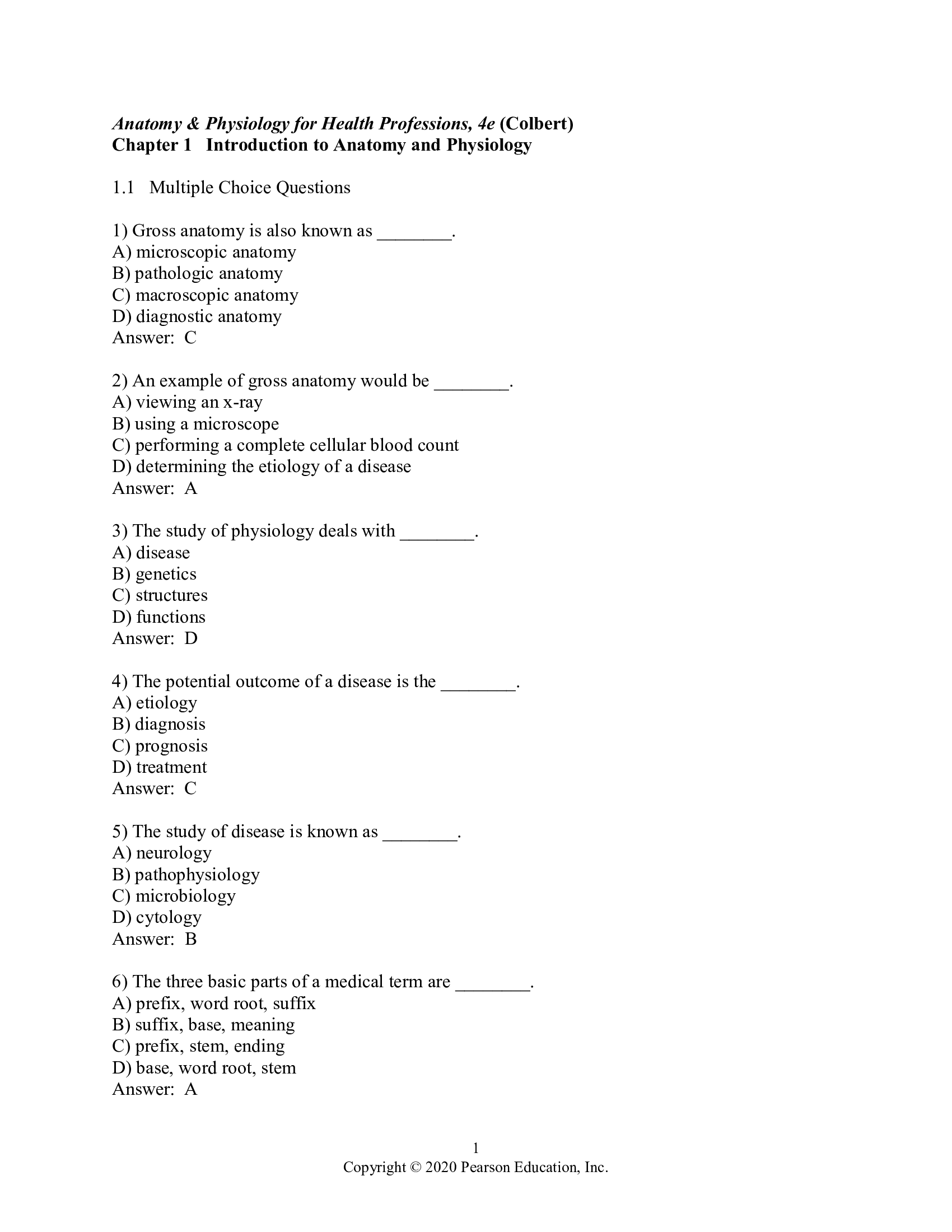
Anatomy & Physiology for Health Professions, 4e (Colbert)

Chapter 1   Introduction to Anatomy and Physiology


1.1   Multiple Choice Questions


1) Gross anatomy is also known as ________.

A)  microscopic anatomy

B)   pathologic anatomy

C)   macroscopic anatomy

D)  diagnostic anatomy

Answer:  C


2) An example of gross anatomy would be ________.

A)  viewing an x-ray

B)   using a microscope

C)   performing a complete cellular blood count

D)  determining the etiology of a disease

Answer:  A


3) The study of physiology deals with ________.

A)  disease

B)   genetics

C)   structures D) functions

Answer:  D


4) The potential outcome of a disease is the ________.

A)  etiology

B)   diagnosis

C)   prognosis D) treatment

Answer:  C


5) The study of disease is known as ________.

A)  neurology

B)   pathophysiology

C)   microbiology D) cytology

Answer:  B


6) The three basic parts of a medical term are ________.

A)  prefix, word root, suffix

B)   suffix, base, meaning

C)   prefix, stem, ending

D)  base, word root, stem

Answer:  A


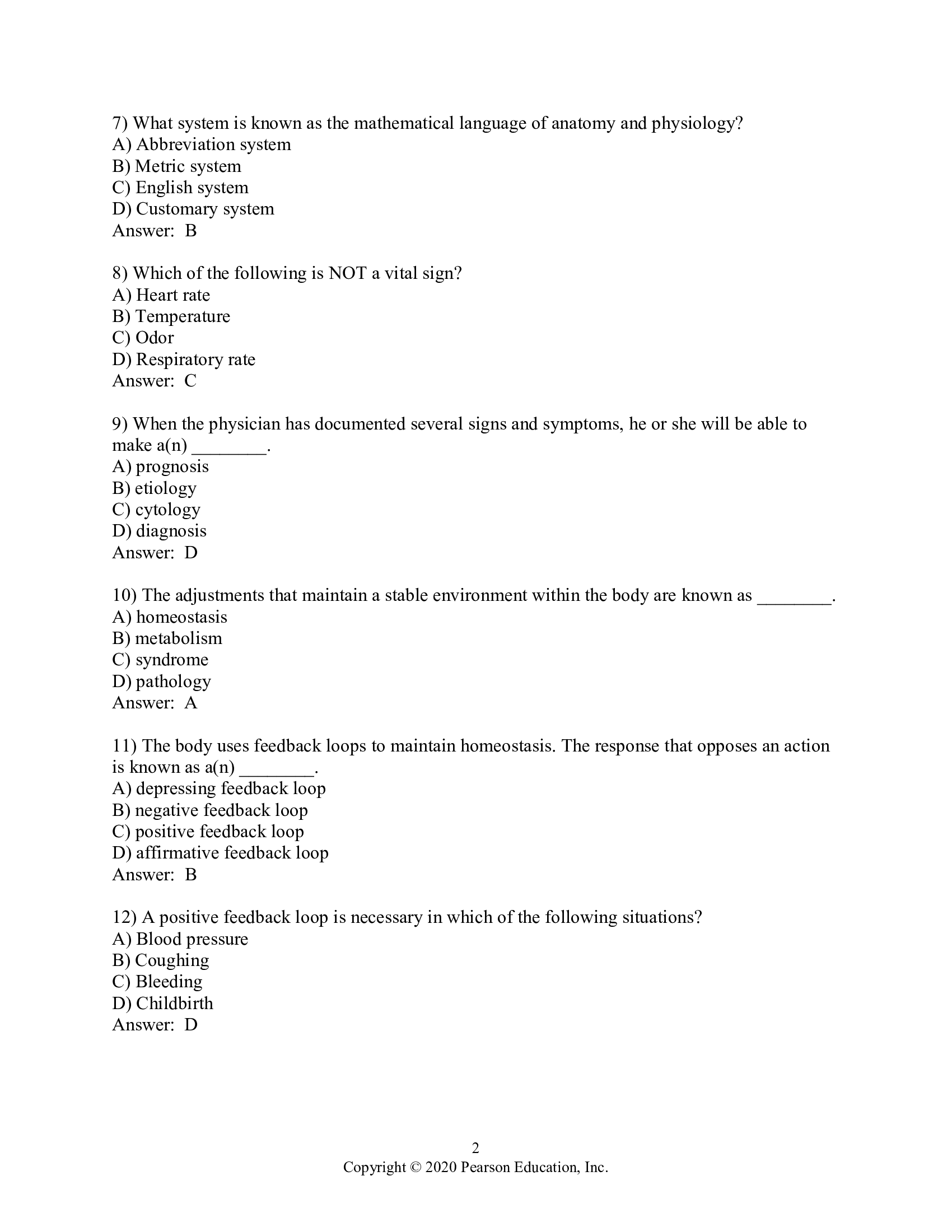
7) What system is known as the mathematical language of anatomy and physiology?

A)  Abbreviation system

B)   Metric system

C)   English system

D)  Customary system

Answer:  B


8) Which of the following is NOT a vital sign?

A)  Heart rate

B)   Temperature

C)   Odor 

D)  Respiratory rate

Answer:  C


9) When the physician has documented several signs and symptoms, he or she will be able to make a(n) ________.

A)  prognosis

B)   etiology

C)   cytology

D)  diagnosis

Answer:  D


10) The adjustments that maintain a stable environment within the body are known as ________. A) homeostasis

B)   metabolism

C)   syndrome

D)  pathology

Answer:  A


11) The body uses feedback loops to maintain homeostasis. The response that opposes an action is known as a(n) ________. A) depressing feedback loop

B)   negative feedback loop

C)   positive feedback loop

D)  affirmative feedback loop

Answer:  B


12) A positive feedback loop is necessary in which of the following situations?

A)  Blood pressure

B)   Coughing

C)   Bleeding

D)  Childbirth 

Answer:  D


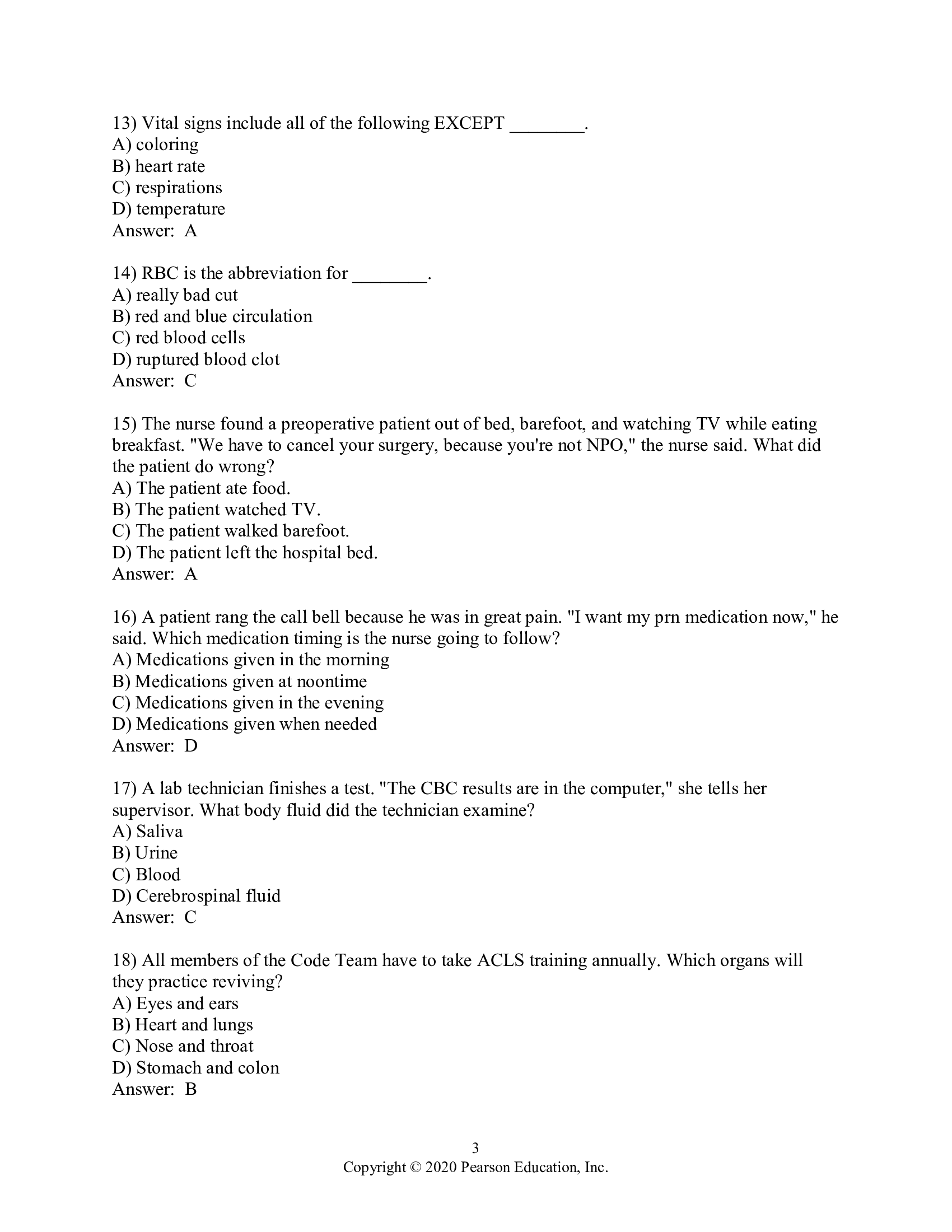
13) Vital signs include all of the following EXCEPT ________.

A)  coloring

B)   heart rate

C)   respirations

D)  temperature

Answer:  A


14) RBC is the abbreviation for ________.

A)  really bad cut

B)   red and blue circulation

C)   red blood cells

D)  ruptured blood clot

Answer:  C


15) The nurse found a preoperative patient out of bed, barefoot, and watching TV while eating breakfast. "We have to cancel your surgery, because you're not NPO," the nurse said. What did the patient do wrong?

A)  The patient ate food.

B)   The patient watched TV.

C)   The patient walked barefoot.

D)  The patient left the hospital bed.

Answer:  A


16) A patient rang the call bell because he was in great pain. "I want my prn medication now," he said. Which medication timing is the nurse going to follow?

A)  Medications given in the morning

B)   Medications given at noontime

C)   Medications given in the evening

D)  Medications given when needed 

Answer:  D


17) A lab technician finishes a test. "The CBC results are in the computer," she tells her supervisor. What body fluid did the technician examine?

A)  Saliva

B)   Urine 

C)   Blood 

D)  Cerebrospinal fluid 

Answer:  C


18) All members of the Code Team have to take ACLS training annually. Which organs will they practice reviving? A) Eyes and ears

B)   Heart and lungs 

C)   Nose and throat

D)  Stomach and colon

Answer:  B


19) If a patient complains of SOB, which body system is having a problem?

A)  Urinary

B)   Neurological

C)   Reproductive D) Respiratory 

Answer:  D


20) The indicators that are essential for human life include all of the following EXCEPT ________. A) coloring

B)   heart rate

C)   respirations

D)  temperature

Answer:  A


21) Which is NOT a definition for disease?

A)  Not at ease

B)   A condition in which the body fails to function normally

C)   Anything that is a normal structure or function

D)  Anything that upsets normal structure or function

Answer:  C


22) The term tachycardia means "________."

A)  fast heart rate

B)   slow heart rate

C)   rhythmic heart rate

D)  study of the heart rate

Answer:  A


23) Which is NOT a symptom of metabolic syndrome?

A)  High triglycerides

B)   Low HDL level

C)   High blood pressure

D)  Vomiting and diarrhea

Answer:  D


24) A sign that could be an indication of diabetes is breath that smells like ________.

A)  fruit-flavored chewing gum

B)   clay or starchy paste

C)   sweat

D)  maple

Answer:  A


25) The prefix hyper- means "________."

A)  small

B)   above normal

C)   below normal D) within

Answer:  B


26) The suffix -oma means "________."

A)  cutting into

B)   enlargement of

C)   surgically forming an opening

D)  tumor

Answer:  D


27) The suffix -algia means "________."

A)  inflammation

B)   cell

C)   pertaining to D) pain

Answer:  D


28) Most fevers are the body's way of ________.

A)  killing all pathogens

B)   breaking up the cells of pathogens

C)   making an inhospitable environment for pathogens to survive

D)  preventing pathogens from reproducing

Answer:  C


29) Sweating at night may indicate ________.

A)  tuberculosis

B)   Hodgkin's disease

C)   riboflavin deficiency

D)  skin cancer

Answer:  A


30) According to the rules of medical terminology, hepatitis is defined as "________."

A)  liver failure

B)   inflammation of the liver

C)   cirrhosis

D)  blood clotting

Answer:  B


31) The abbreviation used for "twice a day" is ________. A) q.i.d.

B)   t.i.d.

C)   prn

D)  b.i.d.

Answer:  D


32) Volumes expressed as ounces, pints, quarts, gallons, pecks, bushels, or cubic feet are examples of the ________.

A)  metric system

B)   English system

C)   scientific notation

D)  International System

Answer:  B


33) A nurse found the vital sign he measured in millimeters of mercury to be highly elevated. What condition does his patient have?

A)  Hypertension 

B)   Fever

C)   Hyperalgia

D)  Heart attack

Answer:  A


34) A student concentrates on moving decimal points in the correct direction while completing her pharmacology homework. Which system of measurement is she using?

A)  English

B)   National

C)   British Imperial

D)  Metric 

Answer:  D


35) Normal adult cardiac output is 6,000 milliliters every 60 seconds. How is this amount of blood being measured? A) Volume in English units

B)   Volume in metric units 

C)   Length in English units

D)  Length in metric units

Answer:  B


36) "I always have to use a conversion table," a student complained. Which system of measurement is the student most likely using?

A)  English 

B)   National

C)   American Imperial

D)  Metric

Answer:  A


37) Which system would most likely be used to calculate the amount of medication to give by weight to a premature infant?

A)  English

B)   National

C)   American Imperial

D)  Metric 

Answer:  D


38) The coroner measures the size of the brain in a patient who died of Alzheimer's disease. Which unit dimension will she likely use to record the diameter?

A)  Milliliters

B)   Centimeters 

C)   Kilograms

D)  Ounces

Answer:  B


39) The diagnostic procedure begins by determining the patient's ________.

A) prognosis B) syndrome

C)   chief complaint

D)  laboratory tests

Answer:  C


40) ________ is the branch of medicine that studies the characteristics, causes, and effects of disease.

A)  Anatomy

B)   Physiology

C)   Pathology D) Pharmacy

Answer:  C


41) The term osteoma can be defined as "________."

A)  cutting of the skin

B)   tumor of the bone

C)   tumor of the eye

D)  cutting into the eye

Answer:  B


42) The normal heart rate for an adult is ________ beats per minute.

A)  10-30

B)   70-120

C)   90-170

D)  60-100

Answer:  D


43) The ________ is the prediction of the outcome of a disease.

A)  prognosis

B)   diagnosis

C)   acute determination

D)  syndrome

Answer:  A


44) A condition in which the body fails to function normally is ________.

A)  disease

B)   physiology

C)   nosocomial

D)  epidemiology

Answer:  A


45) The cause of a disease is called its ________.

A)  prognosis

B)   pathology

C)   nosocomial D) etiology 

Answer:  D


46) A specific group of signs and symptoms that are related to a specific disease is known by which of the following names?

A)  Diagnosis

B)   Chief complaint

C)   Syndrome

D)  Relapse

Answer:  C


47) A patient with Syndrome X can exhibit which of the following common conditions?

A)  High blood sugar levels, low blood pressure, high blood level of HDL

B)   High blood sugar levels, high blood pressure, high triglycerides

C)   Low blood sugar levels, low blood pressure, high triglycerides

D)  Low blood sugar levels, high blood pressure, low blood level of HDL

Answer:  B


48) A patient who has metabolic syndrome is at an increased risk for all of the following EXCEPT ________.

A)  diabetes

B)   heart attack

C)   Hodgkin's disease

D)  stroke

Answer:  C


49) ________ is the physiological process that monitors and maintains a stable internal environment or equilibrium. A) Homeostasis

B)   Negative feedback loop

C)   Positive feedback loop

D)  Metabolism

Answer:  A


50) ________ is a mechanism in the body that continually senses the internal and external environment and makes adjustments to maintain homeostasis.

A)  Homeostasis

B)   A negative feedback loop

C)   A positive feedback loop

D)  Metabolism

Answer:  B


51) ________ is known as a "vicious cycle." In most cases, it is harmful if a vicious cycle cannot be broken. In some cases, however, it is necessary for a process to run to completion.

A)  Homeostasis

B)   Negative feedback 

C)   Positive feedback 

D)  Metabolism

Answer:  C


52) Which of the following is an example of a sign?

A)  Temperature

B)   Nausea

C)   Pain

D)  Weakness

Answer:  A


53) All of the following are symptoms EXCEPT ________.

A)  pain

B)   respiratory rate

C)   dizziness

D)  itchiness

Answer:  B


54) A condition in which the signs and symptoms develop gradually over time is called ________. A) chronic

B)   acute

C)   remission

D)  exacerbation

Answer:  A


55) A measure of the number of deaths attributed to a specific disease over a period of time is ________. A) pandemic

B)   epidemic

C)   morbidity

D)  mortality

Answer:  D


56) Simple compounds are built up and used to manufacture cellular materials in the process of ________.

A)  catabolism

B)   positive feedback

C)   anabolism

D)  negative feedback

Answer:  C


1.2   True/False Questions


1)      In Greek, anatomy means "to cut apart."

Answer:  TRUE


2)      Anatomy focuses on the function and vital processes of the human body.

Answer:  FALSE


Contact the Seller

Please Sign In to contact this seller.


  • 👎  Report Copyright Violation

Frequently Asked Questions

What Do I Get When I Buy This Study Material?

+

When you buy a study material on Passing Grades, an instant download link will be sent directly to your email, giving you access to the file anytime after payment is completed.

Is Passing Grades a Trusted Platform?

+

Yes, Passing Grades is a reputable students’ marketplace with a secure payment system and reliable customer support. You can trust us to ensure a safe and seamless transaction experience.

Will I Be Stuck with a Subscription?

+

No, all purchases on Passing Grades are one-time transactions. You only pay for the notes you choose to buy, with no subscriptions or hidden fees attached.

Who Am I Buying These Study Materials From?

+

Passing Grades is a marketplace, which means you are purchasing the document from an individual vendor, not directly from us. We facilitate the payment and delivery process between you and the vendor.

Does Passing Grades Offer Free Study Materials?

+

Yes, sellers on Passing Grades have uploaded numerous free test banks, exams, practice questions, and class notes that can be downloaded at no cost.

Pasinggrades - Quality Study Materials

USD 17

    • Quality checked by Pasing Grades
    • 100% satisfaction guarantee
    • Seller: mentor2000
Buy PDF $17

Seller Information

mentor2000

Member since April 2021

  • icon
  • icon
View Profile
  • total sales

    0
  • Favourites

    0
  • Comments

    0
    ( 0 Ratings )

Item Information

  • Uploaded

    22 May 2022

  • Updated

    14 May 2025

  • Category

    Nursing

  • Item Type

    test bank

  • Tags

    Test Bank for Anatomy and Physiology for Health Professions 4th Edition by Colbert

Related Exam Prep Guides by mentor2000

Test Bank for Essentials for Nursing Practice 8th Edition by Potter | All Chapters
View Document

Test Bank for Essent...

  • mentor2000

    mentor2000

  • test bank

Master nursing concepts with this study material; Test Bank for Essentials for Nursing Practice, 8th...

17 USD

0

0

A &P 1 MA278 BSC2 Final Module II Questions & Answers 2026 Update
View Document

A &P 1 MA278 BSC2 Fi...

  • mentor2000

    mentor2000

  • test bank

Prepare for success with A&P 1 MA278 BSC2 Final Module II 2024 Q&A. Boost your grades with this comp...

17 USD

0

0

ATI Comprehensive Predictor Exam 2026
View Document

ATI Comprehensive Pr...

  • mentor2000

    mentor2000

  • test bank

Prepare for success with the ATI Comprehensive Predictor Exam 2026. Access key practice questions to...

17 USD

0

0

Purchase

Download link will be sent to this email immediately after purchase.

IMPORTANT LINKS

  • How To Upload Class Notes
  • Selling Tips
  • Passing Grades's Study Materials
  • Scholarships for International Students 2025

POPULAR CATEGORIES

  • Law
  • Accounting
  • English
  • Psychology
  • Business
  • Nursing
  • Computer Science
  • General

View Document

  • Blog
  • Contact
  • Delivery Policy
  • Latest Scholarships Around the World
  • How to Pass Bar Exams: Passing Grades’ Strategies
  • How to Study and Pass the CPA Exam
  • All Test Banks
  • Faq
  • Copyright Claims
  • Privacy Policy
  • Terms of Use

KNOWLEDGE BASE

  • How to Write A+ Grade Good Research Paper
  • How to Manage Stress During Exam Period
  • Best Time to Study
  • How to Pass NCLEX-RN Exam
  • How To Effectively Utilize Test Banks
  • Popular Shadow Health Exam Assessments
  • Popular HESI Case Studies
  • How to Prepare for a Nursing Career
  • The Importance Of Summaries in Exam Revisvion

© 2026 Pasing Grades. All rights reserved.