Pasing Grades
  • Start Selling
  • Blog
  • Contact
  • 0

    Your cart is empty!

English

  • English
  • Spanish
  • Arabic
Create Account Sign In
  • Library
    • New Prep Guides
    • Featured Prep Guides
    • Free Exam Prep Guides
    • Best sellers
  • General
  • Nursing
    • Research Paper
    • Case Study
    • Discussion Post
    • Assignment
    • Exam
    • Practice Questions and Answers
    • Test Bank
    • solutions manual
  • Accounting
    • Case Study
    • Thesis
    • Study Guide
    • Summary
    • Research Paper
    • test bank
  • English
    • Creative Writing
    • Research Paper
    • Summary
    • Rhetorics
    • Literature
    • Journal
    • Exam
    • Grammar
    • Discussion Post
    • Essay
  • Psychology
    • Hesi
    • Presentation
    • Essay
    • Summary
    • Study Guide
    • Essay
    • Solution Manual
    • Final Exam Review
    • Class Notes
    • test bank
  • Business
    • Lecture Notes
    • Solution Manual
    • Presentation
    • Business Plan
    • Class Notes
    • Experiment
    • Summary
    • Practice Questions
    • Study Guide
    • Case Study
    • test bank
    • Exam
  • More
    • Computer Science
    • Economics
    • Statistics
    • Engineering
    • Biology
    • Religious Studies
    • Physics
    • Chemistry
    • Mathematics
    • History
    • Sociology
    • Science
    • Philosophy
    • Law
  • Pages
    • About Us
    • Selling Tips
    • Delivery Policy
    • Faq
    • Privacy Policy
  • Flash Sale
  • Home
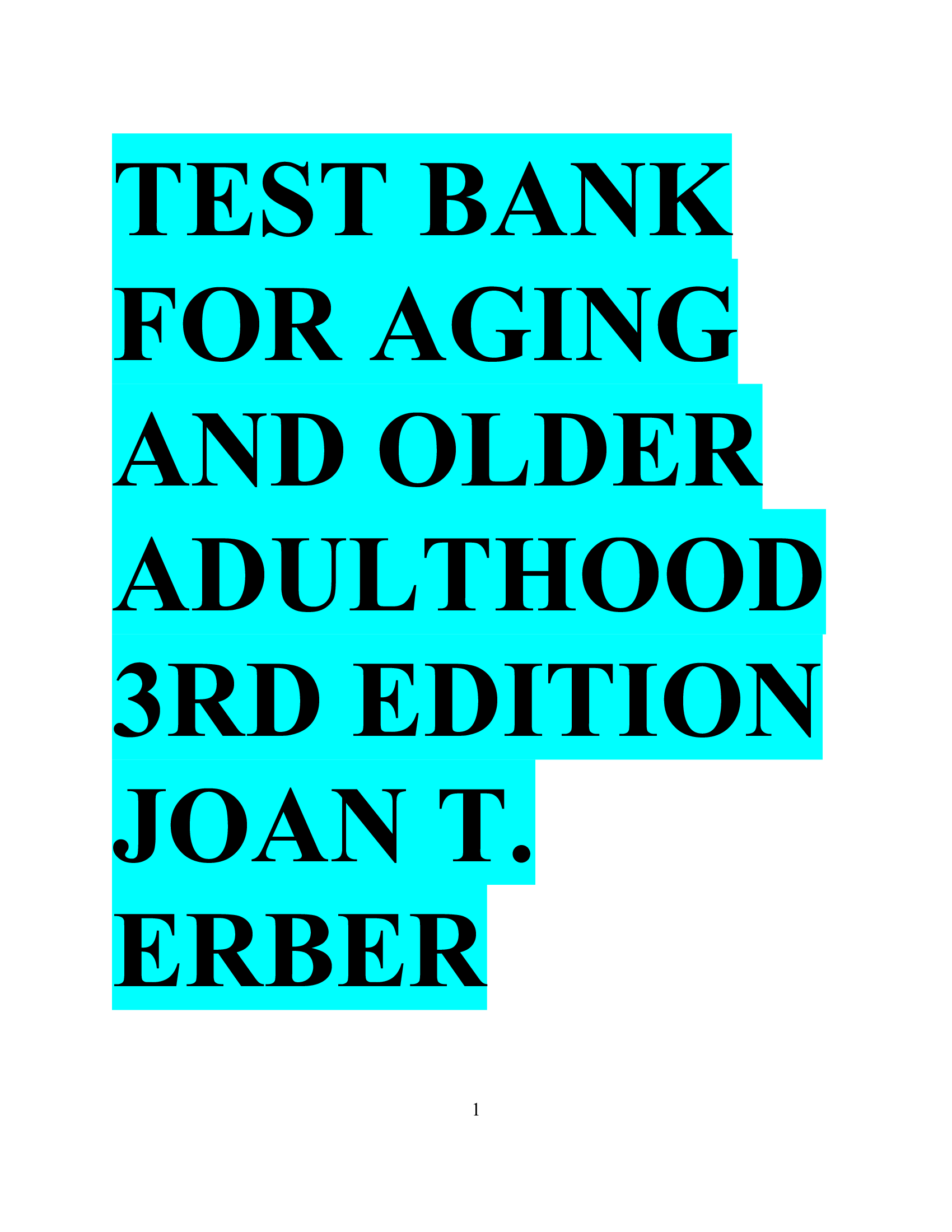
  • Test Bank for Aging and Older Adulthood 3rd Edition Joan T. Erber

Test Bank for Aging and Older Adulthood 3rd Edition Joan T. Erber

Preview page 1 Preview page 2 Preview page 3
Add To Favorites

Share this item Share this item

  • Item Details
  • Comments (0)
  • Reviews (0)
  • Contact Seller

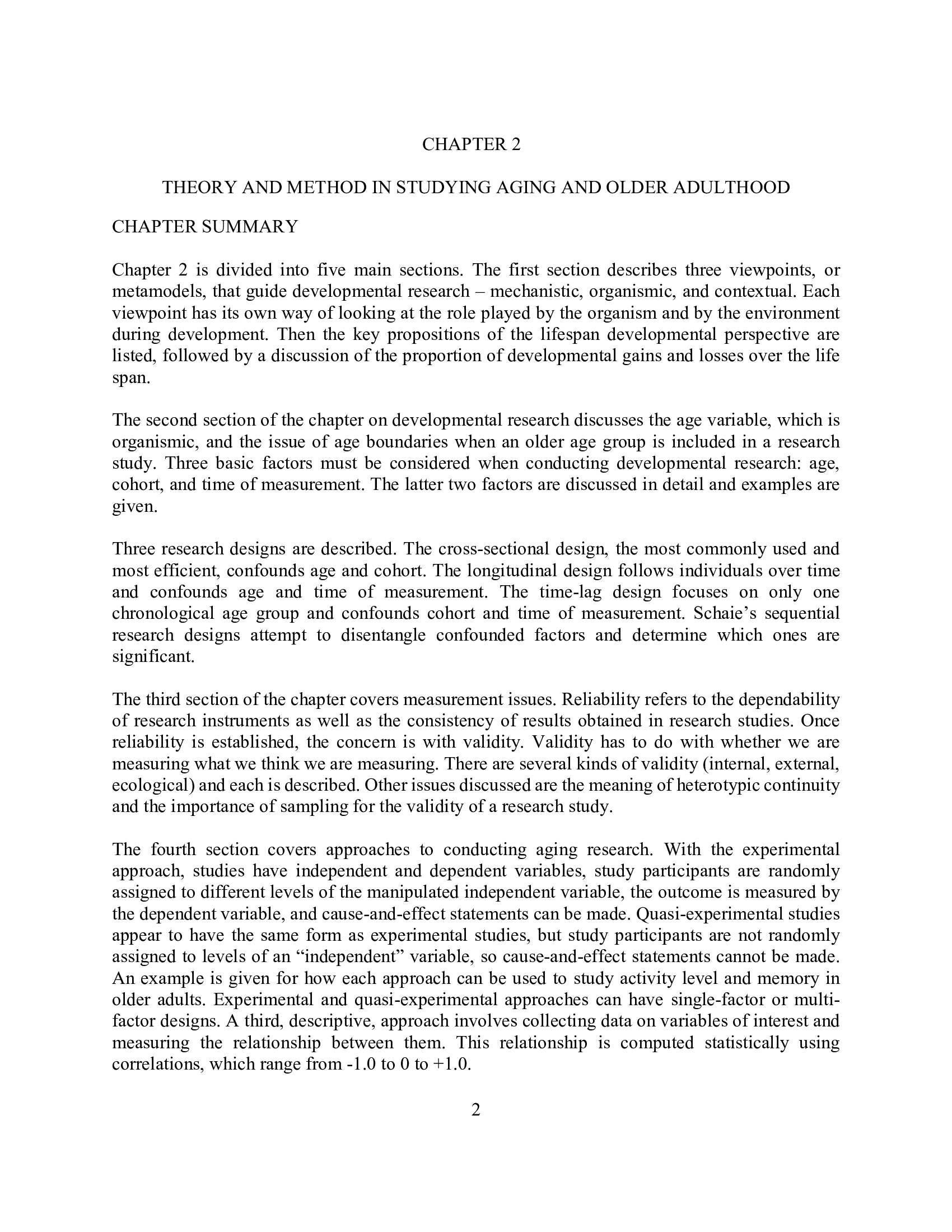
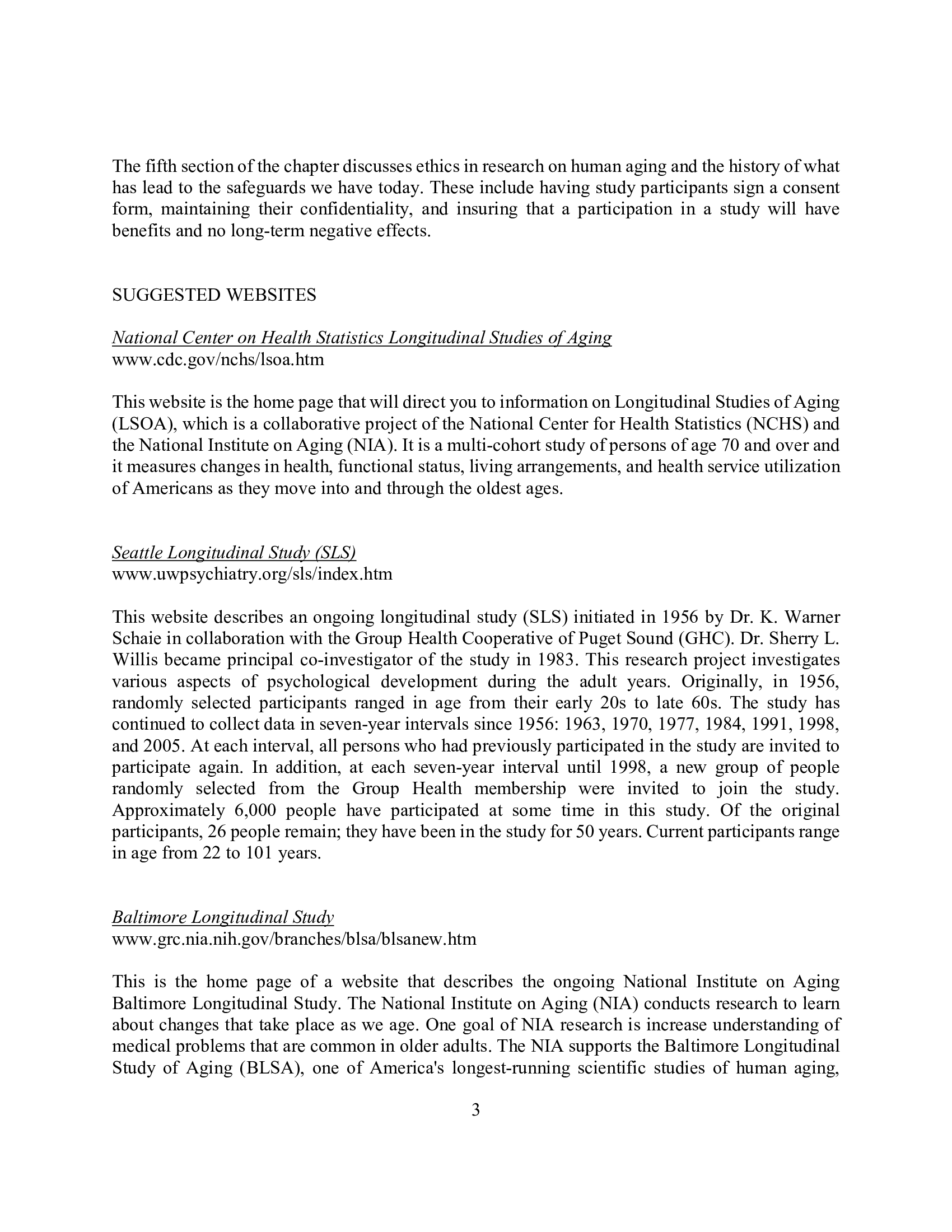
Aging and Older Adulthood 3rd Edition Joan T. Erber CHAPTER 2 THEORY AND METHOD IN STUDYING AGING AND OLDER ADULTHOOD CHAPTER SUMMARY Chapter 2 is divided into five main sections. The first section describes three viewpoints, or metamodels, that guide developmental research – mechanistic, organismic, and contextual. Each viewpoint has its own way of looking at the role played by the organism and by the environment during development. Then the key propositions of the lifespan developmental perspective are listed, followed by a discussion of the proportion of developmental gains and losses over the life span. The second section of the chapter on developmental research discusses the age variable, which is organismic, and the issue of age boundaries when an older age group is included in a research study. Three basic factors must be considered when conducting developmental research: age, cohort, and time of measurement. The latter two factors are discussed in detail and examples are given. Three research designs are described. The cross-sectional design, the most commonly used and most efficient, confounds age and cohort. The longitudinal design follows individuals over time and confounds age and time of measurement. The time-lag design focuses on only one chronological age group and confounds cohort and time of measurement. Schaie’s sequential research designs attempt to disentangle confounded factors and determine which ones are significant. The third section of the chapter covers measurement issues. Reliability refers to the dependability of research instruments as well as the consistency of results obtained in research studies. Once reliability is established, the concern is with validity. Validity has to do with whether we are measuring what we think we are measuring. There are several kinds of validity (internal, external, ecological) and each is described. Other issues discussed are the meaning of heterotypic continuity and the importance of sampling for the validity of a research study. The fourth section covers approaches to conducting aging research. With the experimental approach, studies have independent and dependent variables, study participants are randomly assigned to different levels of the manipulated independent variable, the outcome is measured by the dependent variable, and cause-and-effect statements can be made. Quasi-experimental studies appear to have the same form as experimental studies, but study participants are not randomly assigned to levels of an “independent” variable, so cause-and-effect statements cannot be made. An example is given for how each approach can be used to study activity level and memory in older adults. Experimental and quasi-experimental approaches can have single-factor or multifactor designs. A third, descriptive, approach involves collecting data on variables of interest and measuring the relationship between them. This relationship is computed statistically using correlations, which range from -1.0 to 0 to +1.0. The fifth section of the chapter discusses ethics in research on human aging and the history of what has lead to the safeguards we have today. These include having study participants sign a consent form, maintaining their confidentiality, and insuring that a participation in a study will have benefits and no long-term negative effects. SUGGESTED WEBSITES National Center on Health Statistics Longitudinal Studies of Aging www.cdc.gov/nchs/lsoa.htm This website is the home page that will direct you to information on Longitudinal Studies of Aging (LSOA), which is a collaborative project of the National Center for Health Statistics (NCHS) and the National Institute on Aging (NIA). It is a multi-cohort study of persons of age 70 and over and it measures changes in health, functional status, living arrangements, and health service utilization of Americans as they move into and through the oldest ages. Seattle Longitudinal Study (SLS) www.uwpsychiatry.org/sls/index.htm This website describes an ongoing longitudinal study (SLS) initiated in 1956 by Dr. K. Warner Schaie in collaboration with the Group Health Cooperative of Puget Sound (GHC). Dr. Sherry L. Willis became principal co-investigator of the study in 1983. This research project investigates various aspects of psychological development during the adult years. Originally, in 1956, randomly selected participants ranged in age from their early 20s to late 60s. The study has continued to collect data in seven-year intervals since 1956: 1963, 1970, 1977, 1984, 1991, 1998, and 2005. At each interval, all persons who had previously participated in the study are invited to participate again. In addition, at each seven-year interval until 1998, a new group of people randomly selected from the Group Health membership were invited to join the study. Approximately 6,000 people have participated at some time in this study. Of the original participants, 26 people remain; they have been in the study for 50 years. Current participants range in age from 22 to 101 years. Baltimore Longitudinal Study www.grc.nia.nih.gov/branches/blsa/blsanew.htm This is the home page of a website that describes the ongoing National Institute on Aging Baltimore Longitudinal Study. The National Institute on Aging (NIA) conducts research to learn about changes that take place as we age. One goal of NIA research is increase understanding of medical problems that are common in older adults. The NIA supports the Baltimore Longitudinal Study of Aging (BLSA), one of America's longest-running scientific studies of human aging,

Contact the Seller

Please Sign In to contact this seller.


  • 👎  Report Copyright Violation

Frequently Asked Questions

What Do I Get When I Buy This Study Material?

+

When you buy a study material on Passing Grades, an instant download link will be sent directly to your email, giving you access to the file anytime after payment is completed.

Is Passing Grades a Trusted Platform?

+

Yes, Passing Grades is a reputable students’ marketplace with a secure payment system and reliable customer support. You can trust us to ensure a safe and seamless transaction experience.

Will I Be Stuck with a Subscription?

+

No, all purchases on Passing Grades are one-time transactions. You only pay for the notes you choose to buy, with no subscriptions or hidden fees attached.

Who Am I Buying These Study Materials From?

+

Passing Grades is a marketplace, which means you are purchasing the document from an individual vendor, not directly from us. We facilitate the payment and delivery process between you and the vendor.

Does Passing Grades Offer Free Study Materials?

+

Yes, sellers on Passing Grades have uploaded numerous free test banks, exams, practice questions, and class notes that can be downloaded at no cost.

Pasinggrades - Quality Study Materials

USD 15

    • Quality checked by Pasing Grades
    • 100% satisfaction guarantee
    • Seller: GradeA
Buy PDF $15

Seller Information

GradeA

Member since April 2021

  • icon
  • icon
  • icon
View Profile
  • total sales

    0
  • Favourites

    0
  • Comments

    0
    ( 0 Ratings )

Item Information

  • Uploaded

    22 May 2022

  • Updated

    24 October 2025

  • Category

    Nursing

  • Item Type

    test bank

  • Tags

    test bank nursing aging

Related Exam Prep Guides by GradeA

Test Bank for Fundamentals of Corporate Finance 12th Edition By Stephen Ross and Randolph Westerfield and Bradford Jordan
View Document

Test Bank for Fundam...

  • GradeA

    GradeA

  • test bank

Test Bank for Fundamentals of Corporate Finance 12th Edition By Stephen Ross and Randolph Westerfiel...

15 USD

0

0

[SOLUTION MANUAL) Fundamentals of Corporate Finance 12th Edition By Stephen Ross and Randolph Westerfield and Bradford Jordan
View Document

[SOLUTION MANUAL) Fu...

  • GradeA

    GradeA

  • test bank

[SOLUTION MANUAL) Fundamentals of Corporate Finance 12th Edition By Stephen Ross and Randolph Wester...

15 USD

0

0

QMI1500 Assignment 02 2021 AS PER UPDATED TUTORIAL LETTER
View Document

QMI1500 Assignment 0...

  • GradeA

    GradeA

  • test bank

QMI1500 Assignment 02 2021 AS PER UPDATED TUTORIAL LETTER...

15 USD

0

0

Purchase

Download link will be sent to this email immediately after purchase.

IMPORTANT LINKS

  • How To Upload Class Notes
  • Selling Tips
  • Passing Grades's Study Materials
  • Scholarships for International Students 2025

POPULAR CATEGORIES

  • Law
  • Accounting
  • English
  • Psychology
  • Business
  • Nursing
  • Computer Science
  • General

View Document

  • Blog
  • Contact
  • Delivery Policy
  • Latest Scholarships Around the World
  • How to Pass Bar Exams: Passing Grades’ Strategies
  • How to Study and Pass the CPA Exam
  • All Test Banks
  • Faq
  • Copyright Claims
  • Privacy Policy
  • Terms of Use

KNOWLEDGE BASE

  • How to Write A+ Grade Good Research Paper
  • How to Manage Stress During Exam Period
  • Best Time to Study
  • How to Pass NCLEX-RN Exam
  • How To Effectively Utilize Test Banks
  • Popular Shadow Health Exam Assessments
  • Popular HESI Case Studies
  • How to Prepare for a Nursing Career
  • The Importance Of Summaries in Exam Revisvion

© 2026 Pasing Grades. All rights reserved.