Pasing Grades
  • Start Selling
  • Blog
  • Contact
  • 0

    Your cart is empty!

English

  • English
  • Spanish
  • Arabic
Create Account Sign In
  • Library
    • New Prep Guides
    • Featured Prep Guides
    • Free Exam Prep Guides
    • Best sellers
  • General
  • Nursing
    • Research Paper
    • Case Study
    • Discussion Post
    • Assignment
    • Exam
    • Practice Questions and Answers
    • Test Bank
    • solutions manual
  • Accounting
    • Case Study
    • Thesis
    • Study Guide
    • Summary
    • Research Paper
    • test bank
  • English
    • Creative Writing
    • Research Paper
    • Summary
    • Rhetorics
    • Literature
    • Journal
    • Exam
    • Grammar
    • Discussion Post
    • Essay
  • Psychology
    • Hesi
    • Presentation
    • Essay
    • Summary
    • Study Guide
    • Essay
    • Solution Manual
    • Final Exam Review
    • Class Notes
    • test bank
  • Business
    • Lecture Notes
    • Solution Manual
    • Presentation
    • Business Plan
    • Class Notes
    • Experiment
    • Summary
    • Practice Questions
    • Study Guide
    • Case Study
    • test bank
    • Exam
  • More
    • Computer Science
    • Economics
    • Statistics
    • Engineering
    • Biology
    • Religious Studies
    • Physics
    • Chemistry
    • Mathematics
    • History
    • Sociology
    • Science
    • Philosophy
    • Law
  • Pages
    • About Us
    • Selling Tips
    • Delivery Policy
    • Faq
    • Privacy Policy
  • Flash Sale
  • Home
  • Test Bank – Clinical Laboratory Urinalysis and Body Fluids by Karen R. Stockwin

Test Bank – Clinical Laboratory Urinalysis and Body Fluids by Karen R. Stockwin

Preview page 1 Preview page 2 Preview page 3
Add To Favorites

Share this item Share this item

  • Item Details
  • Comments (0)
  • Reviews (0)
  • Contact Seller

Test Bank for Clinical Laboratory Urinalysis and Body Fluids by Stockwin

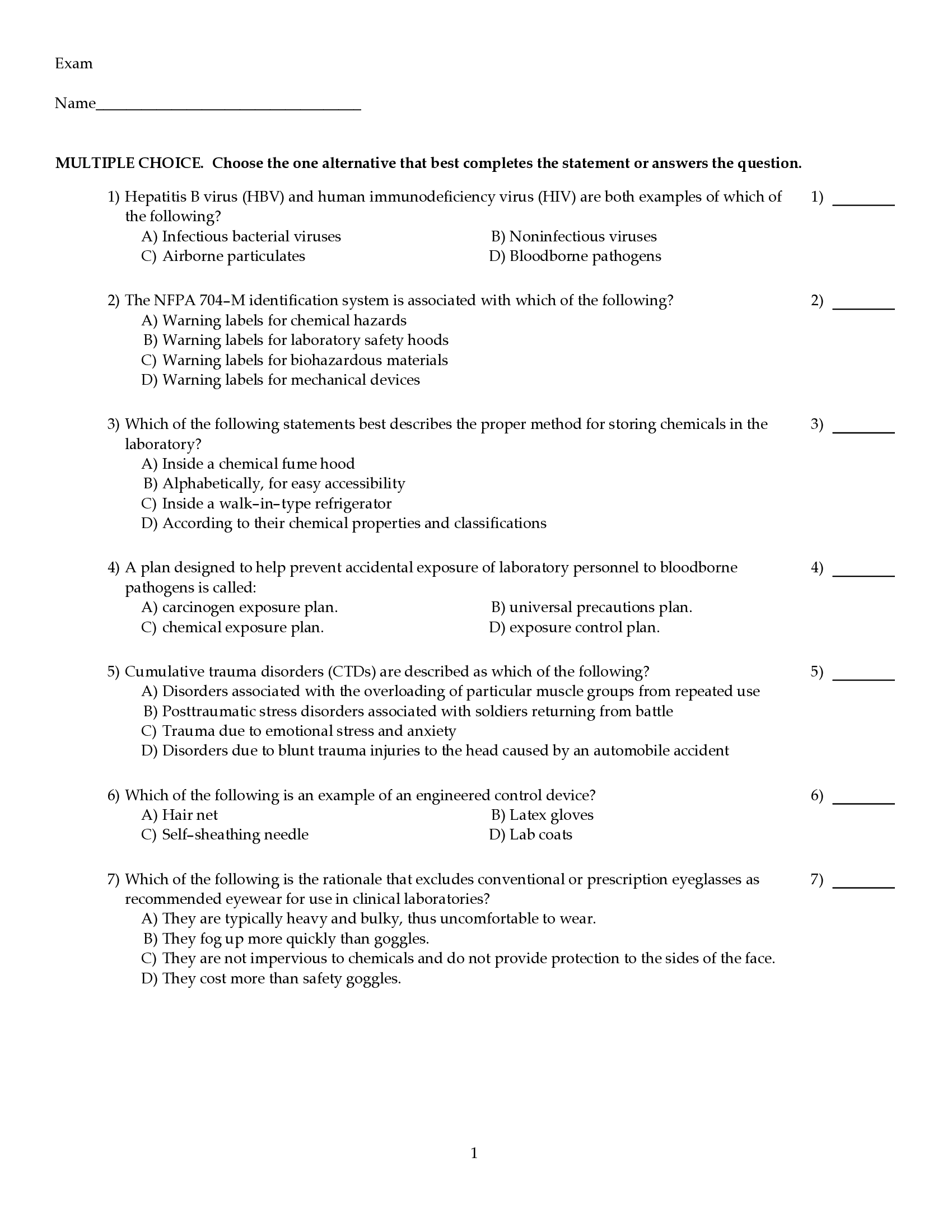
1) Hepatitis B virus (HBV) and human immunodeficiency virus (HIV) are both examples of which of the following?

          A) Infectious bacterial viruses                                           B) Noninfectious viruses

          C) Airborne particulates                                                     D) Bloodborne pathogens

1)

2) The NFPA 704-M identification system is associated with which of the following?

A)  Warning labels for chemical hazards

B)   Warning labels for laboratory safety hoods

C)   Warning labels for biohazardous materials

D)  Warning labels for mechanical devices

2)

3) Which of the following statements best describes the proper method for storing chemicals in the laboratory?

A)  Inside a chemical fume hood

B)   Alphabetically, for easy accessibility

C)   Inside a walk-in-type refrigerator

D)  According to their chemical properties and classifications

3)

4) A plan designed to help prevent accidental exposure of laboratory personnel to bloodborne pathogens is called:

         A) carcinogen exposure plan.                                           B) universal precautions plan.

         C) chemical exposure plan.                                               D) exposure control plan.

4)

5) Cumulative trauma disorders (CTDs) are described as which of the following?

A) Disorders associated with the overloading of particular muscle groups from repeated use B) Posttraumatic stress disorders associated with soldiers returning from battle

C)   Trauma due to emotional stress and anxiety

D)  Disorders due to blunt trauma injuries to the head caused by an automobile accident

5)

6) Which of the following is an example of an engineered control device?

          A) Hair net                                                                              B) Latex gloves

          C) Self-sheathing needle                                                    D) Lab coats

6)

7) Which of the following is the rationale that excludes conventional or prescription eyeglasses as recommended eyewear for use in clinical laboratories?

A)  They are typically heavy and bulky, thus uncomfortable to wear.

B)   They fog up more quickly than goggles.

C)   They are not impervious to chemicals and do not provide protection to the sides of the face.

D)  They cost more than safety goggles.

7)

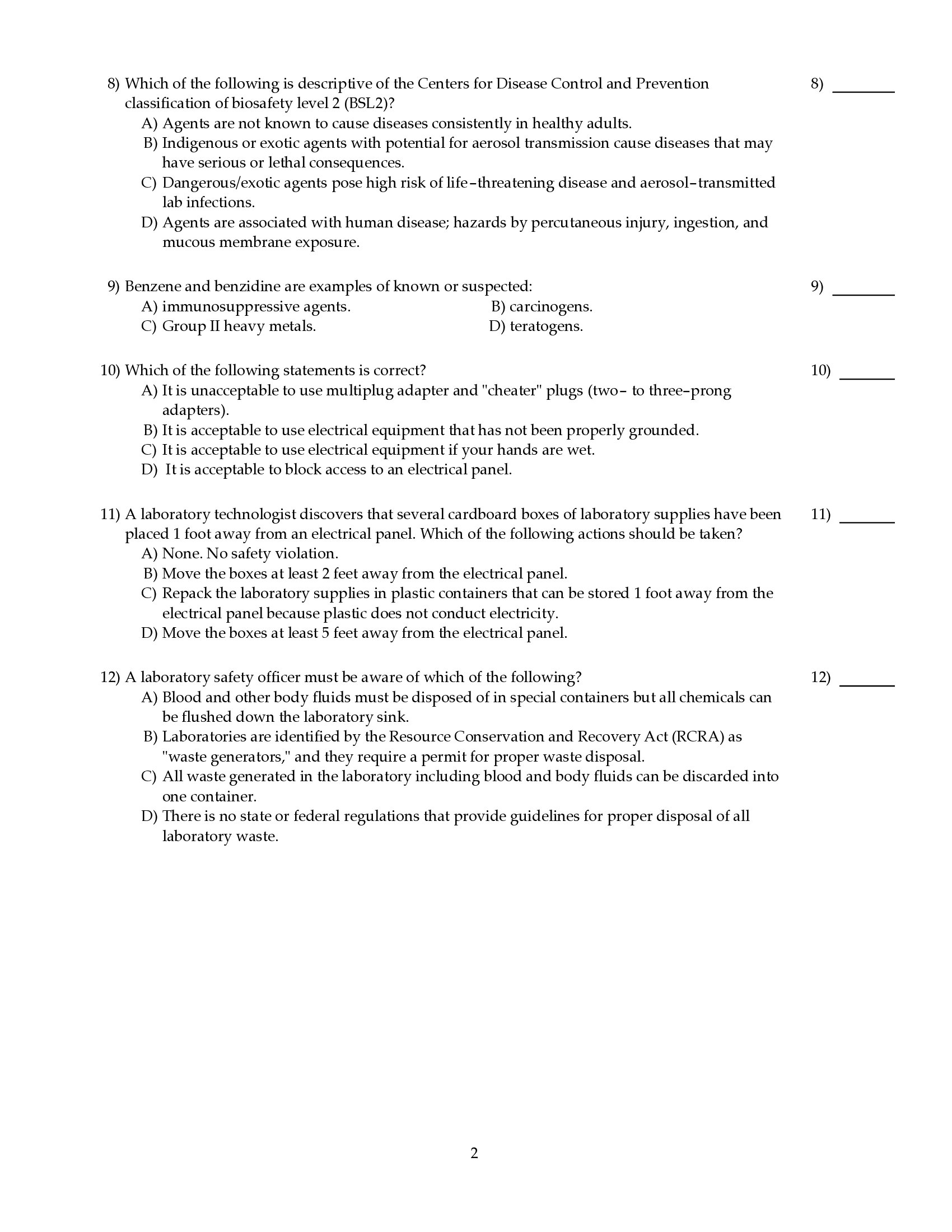
8) Which of the following is descriptive of the Centers for Disease Control and Prevention classification of biosafety level 2 (BSL2)?

A)  Agents are not known to cause diseases consistently in healthy adults.

B)   Indigenous or exotic agents with potential for aerosol transmission cause diseases that mayhave serious or lethal consequences.

C)   Dangerous/exotic agents pose high risk of life-threatening disease and aerosol-transmitted lab infections.

D)  Agents are associated with human disease; hazards by percutaneous injury, ingestion, andmucous membrane exposure.

8)

9) Benzene and benzidine are examples of known or suspected:

           A) immunosuppressive agents.                                        B) carcinogens.

            C) Group II heavy metals.                                                  D) teratogens.

9)

10) Which of the following statements is correct?

A)    It is unacceptable to use multiplug adapter and "cheater" plugs (two- to three-prong adapters).

B)     It is acceptable to use electrical equipment that has not been properly grounded.

C)    It is acceptable to use electrical equipment if your hands are wet.

D)    It is acceptable to block access to an electrical panel.

10)

11) A laboratory technologist discovers that several cardboard boxes of laboratory supplies have been placed 1 foot away from an electrical panel. Which of the following actions should be taken? A) None. No safety violation.

B)   Move the boxes at least 2 feet away from the electrical panel.

C)   Repack the laboratory supplies in plastic containers that can be stored 1 foot away from theelectrical panel because plastic does not conduct electricity.

D)  Move the boxes at least 5 feet away from the electrical panel.

11)

12) A laboratory safety officer must be aware of which of the following?

A)  Blood and other body fluids must be disposed of in special containers but all chemicals canbe flushed down the laboratory sink.

B)   Laboratories are identified by the Resource Conservation and Recovery Act (RCRA) as"waste generators," and they require a permit for proper waste disposal.

C)   All waste generated in the laboratory including blood and body fluids can be discarded intoone container.

D)  There is no state or federal regulations that provide guidelines for proper disposal of alllaboratory waste.

12)


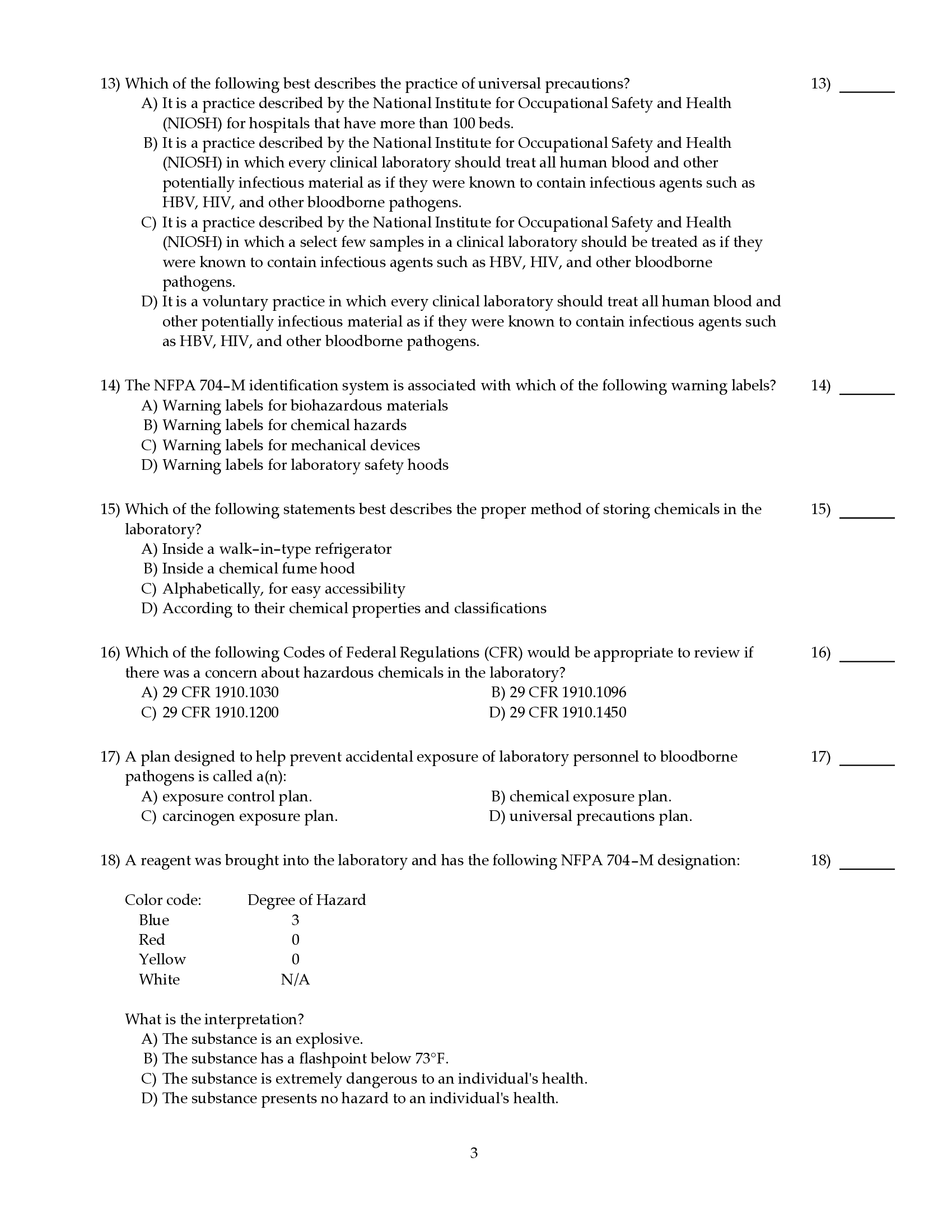
13) Which of the following best describes the practice of universal precautions?

A)  It is a practice described by the National Institute for Occupational Safety and Health(NIOSH) for hospitals that have more than 100 beds.

B)   It is a practice described by the National Institute for Occupational Safety and Health(NIOSH) in which every clinical laboratory should treat all human blood and other potentially infectious material as if they were known to contain infectious agents such as HBV, HIV, and other bloodborne pathogens.

C)   It is a practice described by the National Institute for Occupational Safety and Health(NIOSH) in which a select few samples in a clinical laboratory should be treated as if they were known to contain infectious agents such as HBV, HIV, and other bloodborne pathogens.

D)  It is a voluntary practice in which every clinical laboratory should treat all human blood andother potentially infectious material as if they were known to contain infectious agents such as HBV, HIV, and other bloodborne pathogens.

13)

14) The NFPA 704-M identification system is associated with which of the following warning labels?

A) Warning labels for biohazardous materials B) Warning labels for chemical hazards

C)   Warning labels for mechanical devices

D)  Warning labels for laboratory safety hoods

14)

15) Which of the following statements best describes the proper method of storing chemicals in the laboratory?

A) Inside a walk-in-type refrigerator B) Inside a chemical fume hood

C)   Alphabetically, for easy accessibility

D)  According to their chemical properties and classifications

15)

16) Which of the following Codes of Federal Regulations (CFR) would be appropriate to review if there was a concern about hazardous chemicals in the laboratory?

A) 29 CFR 1910.1030            B) 29 CFR 1910.1096 C) 29 CFR 1910.1200    D) 29 CFR 1910.1450

16)

17) A plan designed to help prevent accidental exposure of laboratory personnel to bloodborne pathogens is called a(n):

            A) exposure control plan.                                                   B) chemical exposure plan.

            C) carcinogen exposure plan.                                           D) universal precautions plan.

17)

18) A reagent was brought into the laboratory and has the following NFPA 704-M designation:

18)

                    Color code:             Degree of Hazard

                        Blue                                   3

                        Red                                    0

                        Yellow                              0


                        White                             N/A


What is the interpretation?

A)  The substance is an explosive.

B)   The substance has a flashpoint below 73°F.

C)   The substance is extremely dangerous to an individual's health.

D)  The substance presents no hazard to an individual's health.

19)  A laboratory supervisor has just completed a presentation of good laboratory safety practices for   19) the staff. The supervisor indicated that the laboratory staff has a responsibility for practicing good laboratory safety techniques. One of the laboratory staff challenged the supervisor's statement that the staff has a responsibility to practice good safety techniques. Which of the following statements is correct?

A)  The staff technician is correct to assume that any accidents in the laboratory are the fault ofmanagement.

B)   Laboratory safety is the responsibility of the pathologist and nobody else.

C)   The supervisor is correct in stating that the practice of laboratory safety is everyone'sresponsibility.

D)  The staff technician is correct and it is only the supervisor's responsibility to see that the stafffollows proper safety procedures.

20)  Which of the following systems is effective in mitigating a large-scale disaster (e.g., mass 20) casualty)?

A) United States weather system

B) Accident command system

C) Emergency codes system

D) Incident command system


Answer Key

Testname: UNTITLED1

1) D 2) A 3) D

4) D 5) A

6)  C

7)  C 8) D

9)     B

10)  D

11)  D

12)  B

13)  B

14)  B

15)  D

16)  D 17) A

18)  C

19)  C

20)  D

Contact the Seller

Please Sign In to contact this seller.


  • 👎  Report Copyright Violation

Frequently Asked Questions

What Do I Get When I Buy This Study Material?

+

When you buy a study material on Passing Grades, an instant download link will be sent directly to your email, giving you access to the file anytime after payment is completed.

Is Passing Grades a Trusted Platform?

+

Yes, Passing Grades is a reputable students’ marketplace with a secure payment system and reliable customer support. You can trust us to ensure a safe and seamless transaction experience.

Will I Be Stuck with a Subscription?

+

No, all purchases on Passing Grades are one-time transactions. You only pay for the notes you choose to buy, with no subscriptions or hidden fees attached.

Who Am I Buying These Study Materials From?

+

Passing Grades is a marketplace, which means you are purchasing the document from an individual vendor, not directly from us. We facilitate the payment and delivery process between you and the vendor.

Does Passing Grades Offer Free Study Materials?

+

Yes, sellers on Passing Grades have uploaded numerous free test banks, exams, practice questions, and class notes that can be downloaded at no cost.

Pasinggrades - Quality Study Materials

USD 15

    • Quality checked by Pasing Grades
    • 100% satisfaction guarantee
    • Seller: mentor2000
Buy PDF $15

Seller Information

mentor2000

Member since April 2021

  • icon
  • icon
View Profile
  • total sales

    0
  • Favourites

    0
  • Comments

    0
    ( 0 Ratings )

Item Information

  • Uploaded

    22 May 2022

  • Updated

    16 May 2025

  • Category

    Nursing

  • Item Type

    test bank

  • Tags

    Test Bank for Clinical Laboratory Urinalysis and Body Fluids by Stockwin

Related Exam Prep Guides by mentor2000

Test Bank for Essentials for Nursing Practice 8th Edition by Potter | All Chapters
View Document

Test Bank for Essent...

  • mentor2000

    mentor2000

  • test bank

Master nursing concepts with this study material; Test Bank for Essentials for Nursing Practice, 8th...

15 USD

0

0

A &P 1 MA278 BSC2 Final Module II Questions & Answers 2026 Update
View Document

A &P 1 MA278 BSC2 Fi...

  • mentor2000

    mentor2000

  • test bank

Prepare for success with A&P 1 MA278 BSC2 Final Module II 2024 Q&A. Boost your grades with this comp...

15 USD

0

0

ATI Comprehensive Predictor Exam 2026
View Document

ATI Comprehensive Pr...

  • mentor2000

    mentor2000

  • test bank

Prepare for success with the ATI Comprehensive Predictor Exam 2026. Access key practice questions to...

15 USD

0

0

Purchase

Download link will be sent to this email immediately after purchase.

IMPORTANT LINKS

  • How To Upload Class Notes
  • Selling Tips
  • Passing Grades's Study Materials
  • Scholarships for International Students 2026

POPULAR CATEGORIES

  • Law
  • Accounting
  • English
  • Psychology
  • Business
  • Nursing
  • Computer Science
  • General

View Document

  • Blog
  • Contact
  • Delivery Policy
  • Latest Scholarships Around the World
  • How to Pass Bar Exams: Passing Grades’ Strategies
  • How to Study and Pass the CPA Exam
  • All Test Banks
  • Faq
  • Copyright Claims
  • Privacy Policy
  • Terms of Use

KNOWLEDGE BASE

  • How to Write A+ Grade Good Research Paper
  • How to Manage Stress During Exam Period
  • Best Time to Study
  • How to Pass NCLEX-RN Exam
  • How To Effectively Utilize Test Banks
  • Popular Shadow Health Exam Assessments
  • Popular HESI Case Studies
  • How to Prepare for a Nursing Career
  • The Importance Of Summaries in Exam Revisvion

© 2026 Pasing Grades. All rights reserved.