Pasing Grades
  • Start Selling
  • Blog
  • Contact
  • 0

    Your cart is empty!

English

  • English
  • Spanish
  • Arabic
Create Account Sign In
  • Library
    • New Prep Guides
    • Featured Prep Guides
    • Free Exam Prep Guides
    • Best sellers
  • General
  • Nursing
    • Research Paper
    • Case Study
    • Discussion Post
    • Assignment
    • Exam
    • Practice Questions and Answers
    • Test Bank
    • solutions manual
  • Accounting
    • Case Study
    • Thesis
    • Study Guide
    • Summary
    • Research Paper
    • test bank
  • English
    • Creative Writing
    • Research Paper
    • Summary
    • Rhetorics
    • Literature
    • Journal
    • Exam
    • Grammar
    • Discussion Post
    • Essay
  • Psychology
    • Hesi
    • Presentation
    • Essay
    • Summary
    • Study Guide
    • Essay
    • Solution Manual
    • Final Exam Review
    • Class Notes
    • test bank
  • Business
    • Lecture Notes
    • Solution Manual
    • Presentation
    • Business Plan
    • Class Notes
    • Experiment
    • Summary
    • Practice Questions
    • Study Guide
    • Case Study
    • test bank
    • Exam
  • More
    • Computer Science
    • Economics
    • Statistics
    • Engineering
    • Biology
    • Religious Studies
    • Physics
    • Chemistry
    • Mathematics
    • History
    • Sociology
    • Science
    • Philosophy
    • Law
  • Pages
    • About Us
    • Selling Tips
    • Delivery Policy
    • Faq
    • Privacy Policy
  • Flash Sale
  • Home
  • Summary MRL2601 STUDY NOTES for 2026

Summary MRL2601 STUDY NOTES for 2026

Preview page 1 Preview page 2 Preview page 3
Add To Favorites

Share this item Share this item

  • Item Details
  • Comments (0)
  • Reviews (0)
  • Contact Seller

Summary MRL2601 Study Notes

Study Unit 1

The impact  of the Constitution and Globalisation on Entrepreneurial law

Importance of infusion of African  leadership philosophies and Constitutional Values

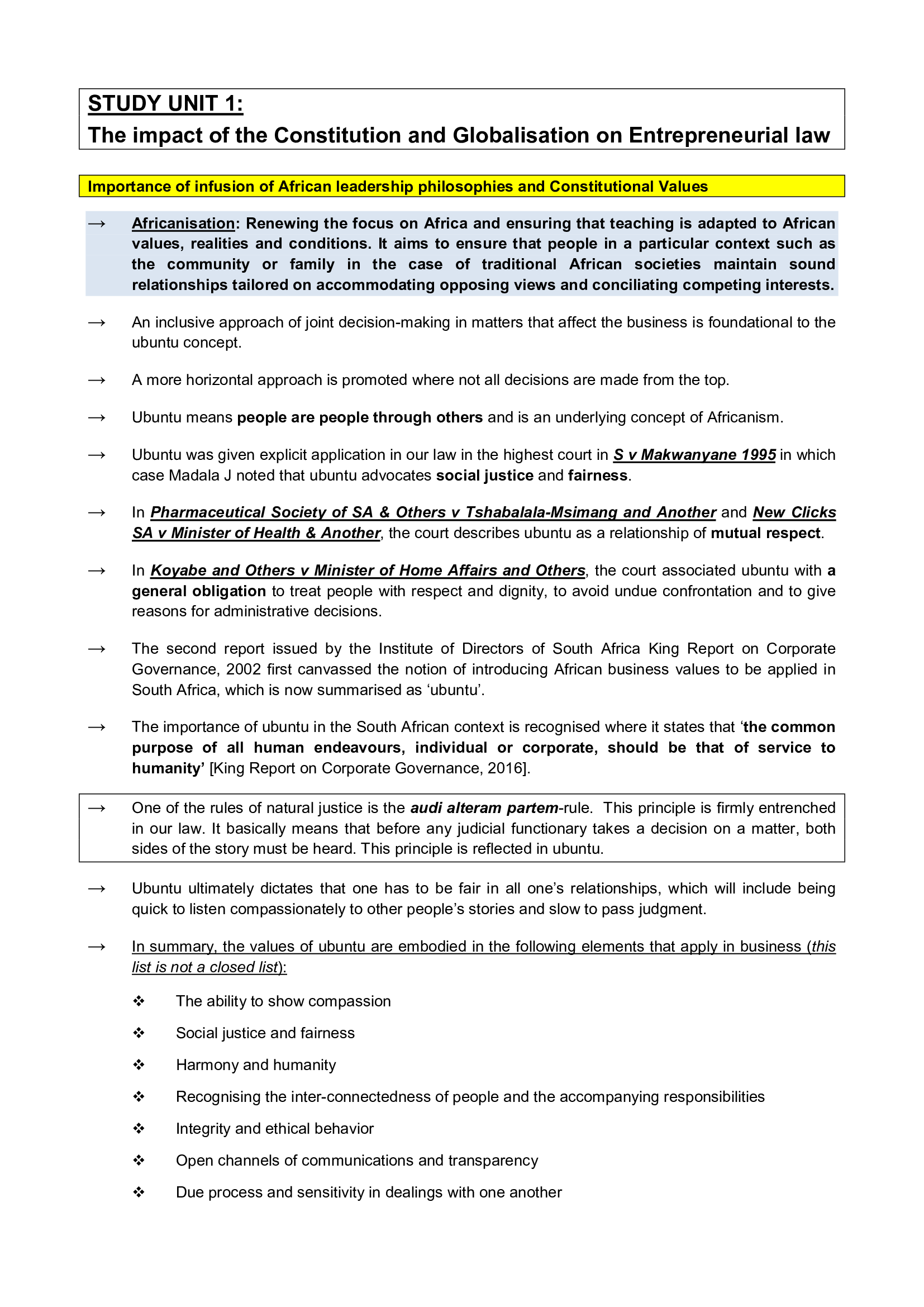
       Africanisation

Renewing  the focus  on Africa  and ensuring that teaching  is adapted to African values,  realities  and conditions. It aims to ensure  that  people  in a particular context  such  as the   community  or   family   in   the   case   of   traditional  African   societies  maintain   sound relationships tailored  on accommodating opposing views and conciliating competing interests.

                An inclusive approach of joint decision-making in matters that affect the business is foundational to the ubuntu concept.

     A more horizontal approach is promoted where not all decisions are made from the top.

     Ubuntu means people are people through others and is an underlying concept of Africanism.

                Ubuntu was given explicit application in our law in the highest court in  S v  Mak w a n y an e 1 99 5  in which case Madala J noted that ubuntu advocates social justice  and fairness.

     In  Ph a r m ac eut ica l  So ciet y  o f  SA  &  Ot h er s  v  T sh a b a lala - Ms im a n g  a nd  A no t he r  and

 e w  C lic k s 

 SA  v  Minis t er  of  H e alt h  &  A n ot he r

the court describes ubuntu as a relationship of mutual respect.

     In  K o yab e  a n d  Ot h er s  v  Min is t e r  o f  H om e  A f f ai rs  a n d  Ot h er s

the court associated ubuntu with a

general obligation to treat people with respect and dignity, to avoid undue confrontation and to give reasons for administrative decisions.

                The second report issued by the Institute of Directors of South Africa King Report on Corporate Governance, 2002 first canvassed the notion of introducing African business values to be applied in South Africa, which is now summarised as ‘ubuntu’.

                The importance of ubuntu in the South African context is recognised where it states that ‘the common purpose   of  all  human  endeavours, individual  or  corporate,  should   be  that  of  service   to humanity’ [King Report on Corporate Governance, 2016].

                One of the rules of natural justice is the audi alteram partem-rule.  This principle is firmly entrenched in our law. It basically means that before any judicial functionary takes a decision on a matter, both sides of the story must be heard. This principle is reflected in ubuntu.


                Ubuntu ultimately dictates that one has to be fair in all one’s relationships, which will include being quick to listen compassionately to other people’s stories and slow to pass judgment.

       In  s um m ar y,  t he  va l ue s  of  ubu n tu  ar e  e m bod i e d  i n  th e  f o l lo w i n g  el e m ents  th a t  a p p l y  i n  bu s i nes s  ( thi s

 l is t  i s  n o t  a  c lo s e d  l is t) :

       The ability to show compassion

       Social justice and fairness

       Harmony and humanity

       Recognising the inter-connectedness of people and the accompanying responsibilities

       Integrity and ethical behavior

       Open channels of communications and transparency

       Due process and sensitivity in dealings with one another

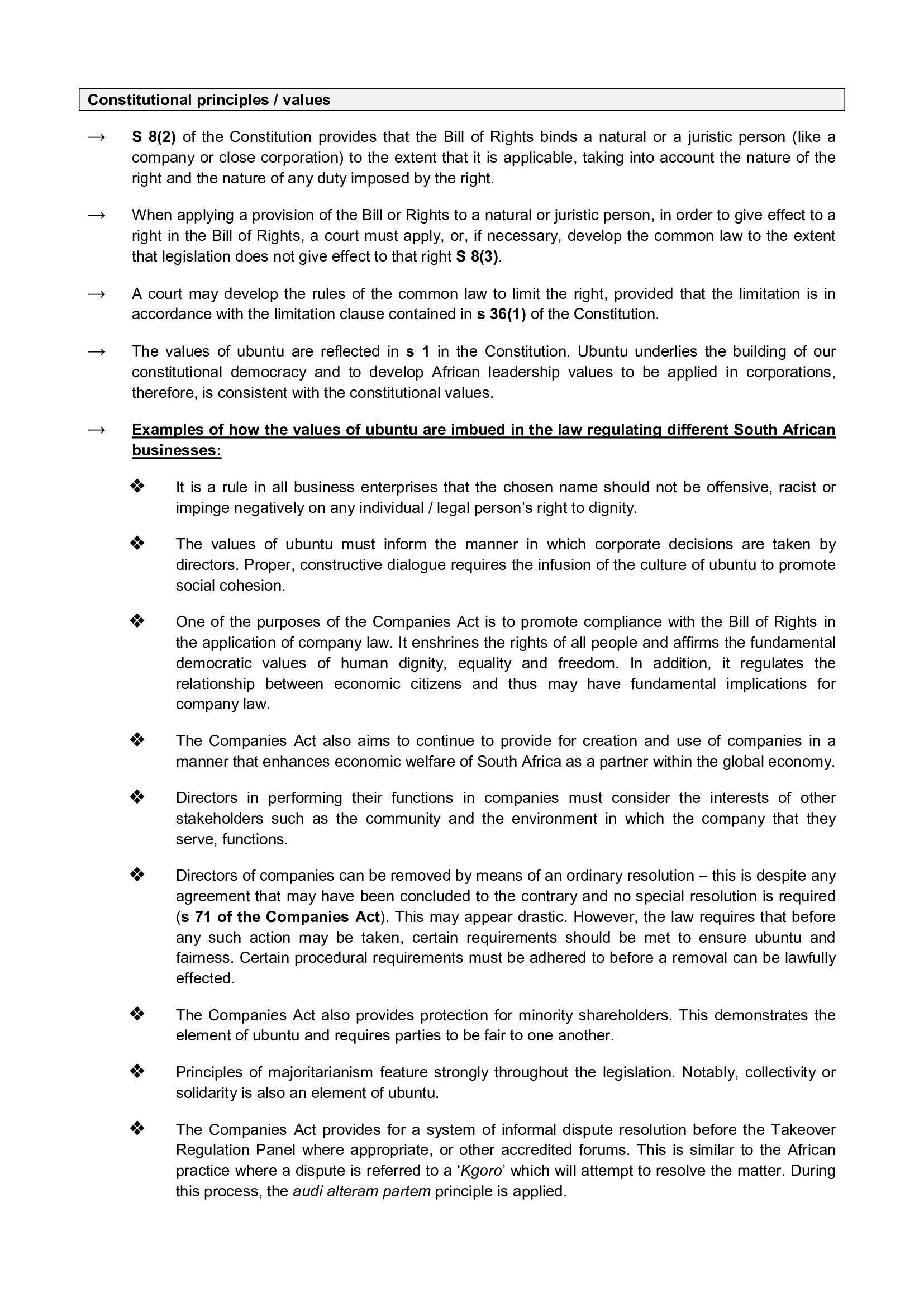
Constitutional principles / values

                S 8(2) of the Constitution provides that the Bill of Rights binds a natural or a juristic person (like a company or close corporation) to the extent that it is applicable, taking into account the nature of the right and the nature of any duty imposed by the right.

                When applying a provision of the Bill or Rights to a natural or juristic person, in order to give effect to a right in the Bill of Rights, a court must apply, or, if necessary, develop the common law to the extent that legislation does not give effect to that right S 8(3).

                A court may develop the rules of the common law to limit the right, provided that the limitation is in accordance with the limitation clause contained in s 36(1) of the Constitution.

                The values of ubuntu are reflected in s 1 in the Constitution. Ubuntu underlies the building of our constitutional democracy and to develop African leadership values to be applied in corporations, therefore, is consistent with the constitutional values.

       Ex am pl es  o f  ho w  the  v alu es  o f  ubu nt u  a r e  im bue d  in  t he  la w  r egu lat ing  differ en t  So ut h  Af r ica n

 bu sin ess es :

                It is a rule in all business enterprises that the chosen name should not be offensive, racist or impinge negatively on any individual / legal person’s right to dignity.

                The values of ubuntu must inform the manner in which corporate decisions are taken by directors. Proper, constructive dialogue requires the infusion of the culture of ubuntu to promote social cohesion.


                One of the purposes of the Companies Act is to promote compliance with the Bill of Rights in the application of company law. It enshrines the rights of all people and affirms the fundamental democratic values of human dignity, equality and freedom. In addition, it regulates the relationship between economic citizens and thus may have fundamental implications for company law.

                The Companies Act also aims to continue to provide for creation and use of companies in a manner that enhances economic welfare of South Africa as a partner within the global economy.

                Directors  in  performing their  functions  in  companies must  consider  the  interests  of  other stakeholders such as the community and the environment in which the company that they serve, functions.

                Directors of companies can be removed by means of an ordinary resolution – this is despite any agreement that may have been concluded to the contrary and no special resolution is required (s 71 of the Companies  Act). This may appear drastic. However, the law requires that before any such action may be taken, certain requirements should be met to ensure ubuntu and fairness. Certain procedural requirements must be adhered to before a removal can be lawfully effected.

                The Companies Act also provides protection for minority shareholders. This demonstrates the element of ubuntu and requires parties to be fair to one another.

                Principles of majoritarianism feature strongly throughout the legislation. Notably, collectivity or solidarity is also an element of ubuntu.

                The Companies Act provides for a system of informal dispute resolution before the Takeover Regulation Panel where appropriate, or other accredited forums. This is similar to the African practice where a dispute is referred to a ‘Kgoro’ which will attempt to resolve the matter. During this process, the audi alteram partem principle is applied.

                Ubuntu is also evident in light of the fact that humanness is promoted in that agreements must be  respected and honoured by those who concluded. This is  evident in  various types  of contracts: partnership agreements, contracts concluded for the formation of trusts, shareholders agreements, etc. Fairness also plays an important role in the interpretation of shareholders’ agreements.

      The disclosure requirements in the Companies Act reflect the value of transparency of ubuntu

                The remedies provided for in the Companies Act also reflects that restorative restitution is promoted rather than imposing criminal sanctions

Constitutional interpretation and development of the common  law:

                The constitutional values play an important role in how the court interprets and applies the legislation, and develops the common law.

                The guidelines for proper interpretation that have been provided by the Constitutional Court dictate that when a section of the legislation is capable of more than one construct - one being more restrictive and the other providing for a wider net of protection – the broader construct be preferred, specifically if a constitution right is at stake.

     One of the golden rules of interpretation – section should be interpreted in context.

                This entails consideration of policy underlying the legislation and taking cognisance of the purpose of the particular section in context of the legislation, ie. where it is placed in the legislation.

                In the SA context, it is likely that restitutive practices of employment equity and broad-based black economic empowerment would be considered, for instance in a scenario where the court is required to evaluate whether or not the board of  directors should be held liable for their actions in certain instances.

                The court has a duty to develop the common law so that the law keeps up, and remains suitable as the needs of the community it aims to serve, change. Section 39 of the Constitution determines that the court must, when developing the common law, promote the spirit, purport, and objects of the Bill of Rights.

                Our common law has evolved through centuries of feudalism, colonialism, discrimination, sexism, exploitation, and apartheid.

      In  Ev e r f r esh  Ma rk et  Vir gi n ia  ( Pt y )  Lt d  v  Sh opr it e  C hec k e rs  ( Pt y)  Lt d  2 01 2

                The CC considered whether the common law should be developed to require that parties to a contract should be legally required to contract with each other in good faith and on reasonable terms.

                Shoprite argued that good faith is too vague a concept, and should not be enforceable. The court disagreed.

                The court noted that the development of our economy and contract law has predominantly been shaped by colonial legal tradition represented by English law, Roman law and Roman Dutch law.

                The common law of contract regulates the environment within which trade and commerce take place. Its development must take into account the values of the vast majority of people who can after democratisation of the country participate in trade and commerce.

                The approach followed by the majority of South Africans places a higher value on negotiating in good faith than would have prevailed under colonial legal tradition. The adaptation of  the

Contact the Seller

Please Sign In to contact this seller.


  • 👎  Report Copyright Violation

Frequently Asked Questions

What Do I Get When I Buy This Study Material?

+

When you buy a study material on Passing Grades, an instant download link will be sent directly to your email, giving you access to the file anytime after payment is completed.

Is Passing Grades a Trusted Platform?

+

Yes, Passing Grades is a reputable students’ marketplace with a secure payment system and reliable customer support. You can trust us to ensure a safe and seamless transaction experience.

Will I Be Stuck with a Subscription?

+

No, all purchases on Passing Grades are one-time transactions. You only pay for the notes you choose to buy, with no subscriptions or hidden fees attached.

Who Am I Buying These Study Materials From?

+

Passing Grades is a marketplace, which means you are purchasing the document from an individual vendor, not directly from us. We facilitate the payment and delivery process between you and the vendor.

Does Passing Grades Offer Free Study Materials?

+

Yes, sellers on Passing Grades have uploaded numerous free test banks, exams, practice questions, and class notes that can be downloaded at no cost.


Pasinggrades - Quality Study Materials

USD 3

    • Quality checked by Pasing Grades
    • 100% satisfaction guarantee
    • Seller: mentor2000
Buy PDF $3

Seller Information

mentor2000

Member since April 2021

  • icon
  • icon
View Profile
  • total sales

    0
  • Favourites

    0
  • Comments

    0
    ( 0 Ratings )

Item Information

  • Uploaded

    05 November 2021

  • Updated

    05 January 2026

  • Category

    General

  • Item Type

    exam

  • Tags

    Summary MRL2601 STUDY NOTES

Related Exam Prep Guides by mentor2000

Test Bank for Essentials for Nursing Practice 8th Edition by Potter | All Chapters
View Document

Test Bank for Essent...

  • mentor2000

    mentor2000

  • exam

Master nursing concepts with this study material; Test Bank for Essentials for Nursing Practice, 8th...

3 USD

0

0

A &P 1 MA278 BSC2 Final Module II Questions & Answers 2026 Update
View Document

A &P 1 MA278 BSC2 Fi...

  • mentor2000

    mentor2000

  • exam

Prepare for success with A&P 1 MA278 BSC2 Final Module II 2024 Q&A. Boost your grades with this comp...

3 USD

0

0

ATI Comprehensive Predictor Exam 2026
View Document

ATI Comprehensive Pr...

  • mentor2000

    mentor2000

  • exam

Prepare for success with the ATI Comprehensive Predictor Exam 2026. Access key practice questions to...

3 USD

0

0

Purchase

Download link will be sent to this email immediately after purchase.

IMPORTANT LINKS

  • How To Upload Class Notes
  • Selling Tips
  • Passing Grades's Study Materials
  • Scholarships for International Students 2025

POPULAR CATEGORIES

  • Law
  • Accounting
  • English
  • Psychology
  • Business
  • Nursing
  • Computer Science
  • General

View Document

  • Blog
  • Contact
  • Delivery Policy
  • Latest Scholarships Around the World
  • How to Pass Bar Exams: Passing Grades’ Strategies
  • How to Study and Pass the CPA Exam
  • All Test Banks
  • Faq
  • Copyright Claims
  • Privacy Policy
  • Terms of Use

KNOWLEDGE BASE

  • How to Write A+ Grade Good Research Paper
  • How to Manage Stress During Exam Period
  • Best Time to Study
  • How to Pass NCLEX-RN Exam
  • How To Effectively Utilize Test Banks
  • Popular Shadow Health Exam Assessments
  • Popular HESI Case Studies
  • How to Prepare for a Nursing Career
  • The Importance Of Summaries in Exam Revisvion

© 2026 Pasing Grades. All rights reserved.