Pasing Grades
  • Start Selling
  • Blog
  • Contact
  • 0

    Your cart is empty!

English

  • English
  • Spanish
  • Arabic
Create Account Sign In
  • Library
    • New Prep Guides
    • Featured Prep Guides
    • Free Exam Prep Guides
    • Best sellers
  • General
  • Nursing
    • Research Paper
    • Case Study
    • Discussion Post
    • Assignment
    • Exam
    • Practice Questions and Answers
    • Test Bank
    • solutions manual
  • Accounting
    • Case Study
    • Thesis
    • Study Guide
    • Summary
    • Research Paper
    • test bank
  • English
    • Creative Writing
    • Research Paper
    • Summary
    • Rhetorics
    • Literature
    • Journal
    • Exam
    • Grammar
    • Discussion Post
    • Essay
  • Psychology
    • Hesi
    • Presentation
    • Essay
    • Summary
    • Study Guide
    • Essay
    • Solution Manual
    • Final Exam Review
    • Class Notes
    • test bank
  • Business
    • Lecture Notes
    • Solution Manual
    • Presentation
    • Business Plan
    • Class Notes
    • Experiment
    • Summary
    • Practice Questions
    • Study Guide
    • Case Study
    • test bank
    • Exam
  • More
    • Computer Science
    • Economics
    • Statistics
    • Engineering
    • Biology
    • Religious Studies
    • Physics
    • Chemistry
    • Mathematics
    • History
    • Sociology
    • Science
    • Philosophy
    • Law
  • Pages
    • About Us
    • Selling Tips
    • Delivery Policy
    • Faq
    • Privacy Policy
  • Flash Sale
  • Home
  • Pharm Midterm exam 2020 with complete solution(100 correct, Graded A)

Pharm Midterm exam 2020 with complete solution(100 correct, Graded A)

Preview page 1 Preview page 2 Preview page 3
Add To Favorites

Share this item Share this item

  • Item Details
  • Comments (0)
  • Reviews (0)
  • Contact Seller

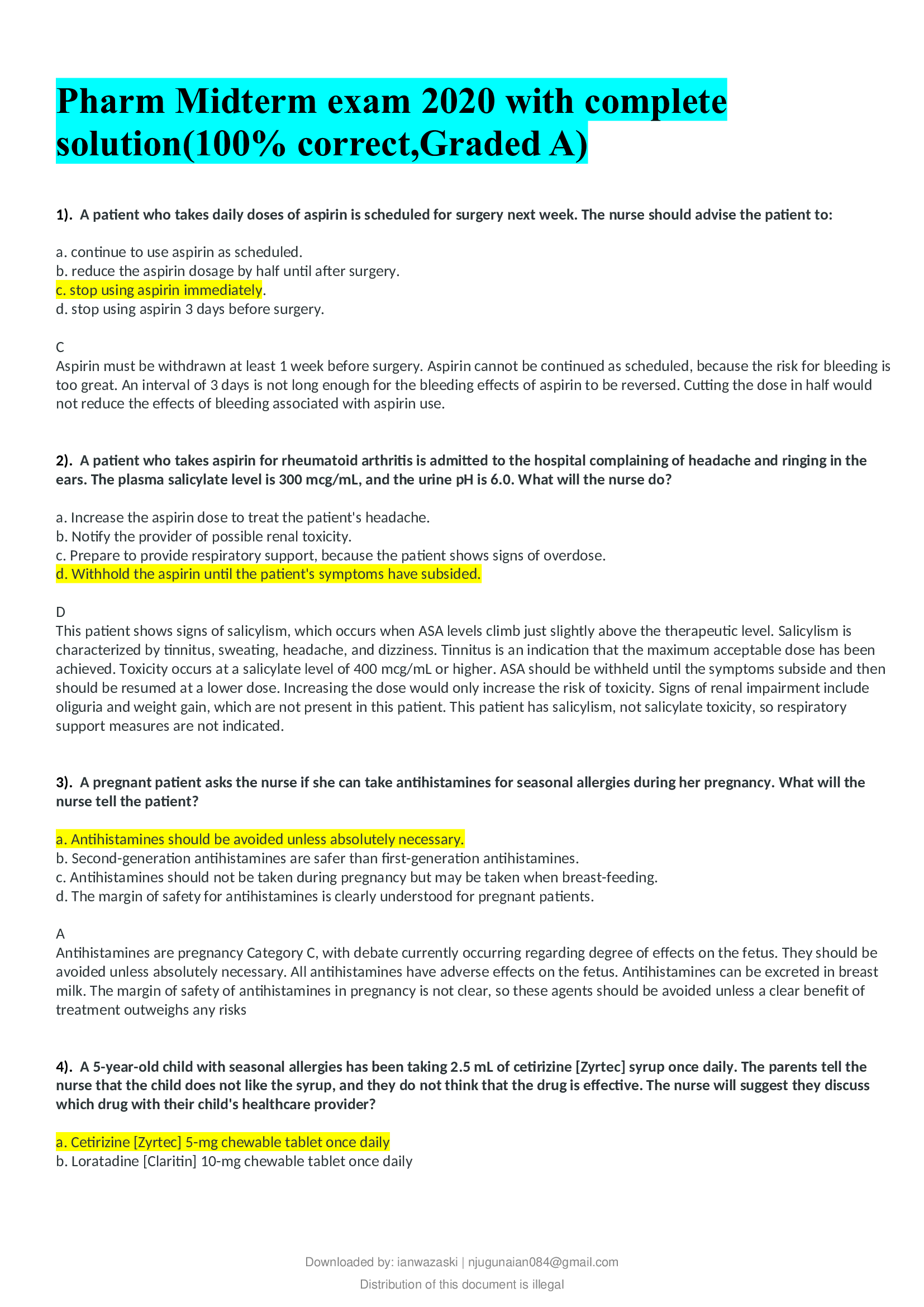
Pharm Midterm exam 2020 with complete solution(100% correct, Graded A)/ Pharm Midterm exam 2020 with complete solution(100% correct,Graded A)

1).  A patient who takes daily doses of aspirin is scheduled for surgery next week. The nurse should advise the patient to: a. continue to use aspirin as scheduled.

b.  reduce the aspirin dosage by half until after surgery.

c.  stop using aspirin immediately.

d.  stop using aspirin 3 days before surgery.

C

Aspirin must be withdrawn at least 1 week before surgery. Aspirin cannot be continued as scheduled, because the risk for bleeding is too great. An interval of 3 days is not long enough for the bleeding effects of aspirin to be reversed. Cutting the dose in half would not reduce the effects of bleeding associated with aspirin use.

2).  A patient who takes aspirin for rheumatoid arthritis is admitted to the hospital complaining of headache and ringing in the ears. The plasma salicylate level is 300 mcg/mL, and the urine pH is 6.0. What will the nurse do?

a.  Increase the aspirin dose to treat the patient's headache.

b.  Notify the provider of possible renal toxicity.

c.  Prepare to provide respiratory support, because the patient shows signs of overdose.

d.  Withhold the aspirin until the patient's symptoms have subsided.

D

This patient shows signs of salicylism, which occurs when ASA levels climb just slightly above the therapeutic level. Salicylism is characterized by tinnitus, sweating, headache, and dizziness. Tinnitus is an indication that the maximum acceptable dose has been achieved. Toxicity occurs at a salicylate level of 400 mcg/mL or higher. ASA should be withheld until the symptoms subside and then should be resumed at a lower dose. Increasing the dose would only increase the risk of toxicity. Signs of renal impairment include oliguria and weight gain, which are not present in this patient. This patient has salicylism, not salicylate toxicity, so respiratory support measures are not indicated.

3).  A pregnant patient asks the nurse if she can take antihistamines for seasonal allergies during her pregnancy. What will the nurse tell the patient?

a.  Antihistamines should be avoided unless absolutely necessary.

b.  Second-generation antihistamines are safer than first-generation antihistamines.

c.  Antihistamines should not be taken during pregnancy but may be taken when breast-feeding.

d.  The margin of safety for antihistamines is clearly understood for pregnant patients.

A

Antihistamines are pregnancy Category C, with debate currently occurring regarding degree of effects on the fetus. They should be avoided unless absolutely necessary. All antihistamines have adverse effects on the fetus. Antihistamines can be excreted in breast milk. The margin of safety of antihistamines in pregnancy is not clear, so these agents should be avoided unless a clear benefit of treatment outweighs any risks

4).  A 5-year-old child with seasonal allergies has been taking 2.5 mL of cetirizine [Zyrtec] syrup once daily. The parents tell the nurse that the child does not like the syrup, and they do not think that the drug is effective. The nurse will suggest they discuss which drug with their child's healthcare provider?

a.  Cetirizine [Zyrtec] 5-mg chewable tablet once daily

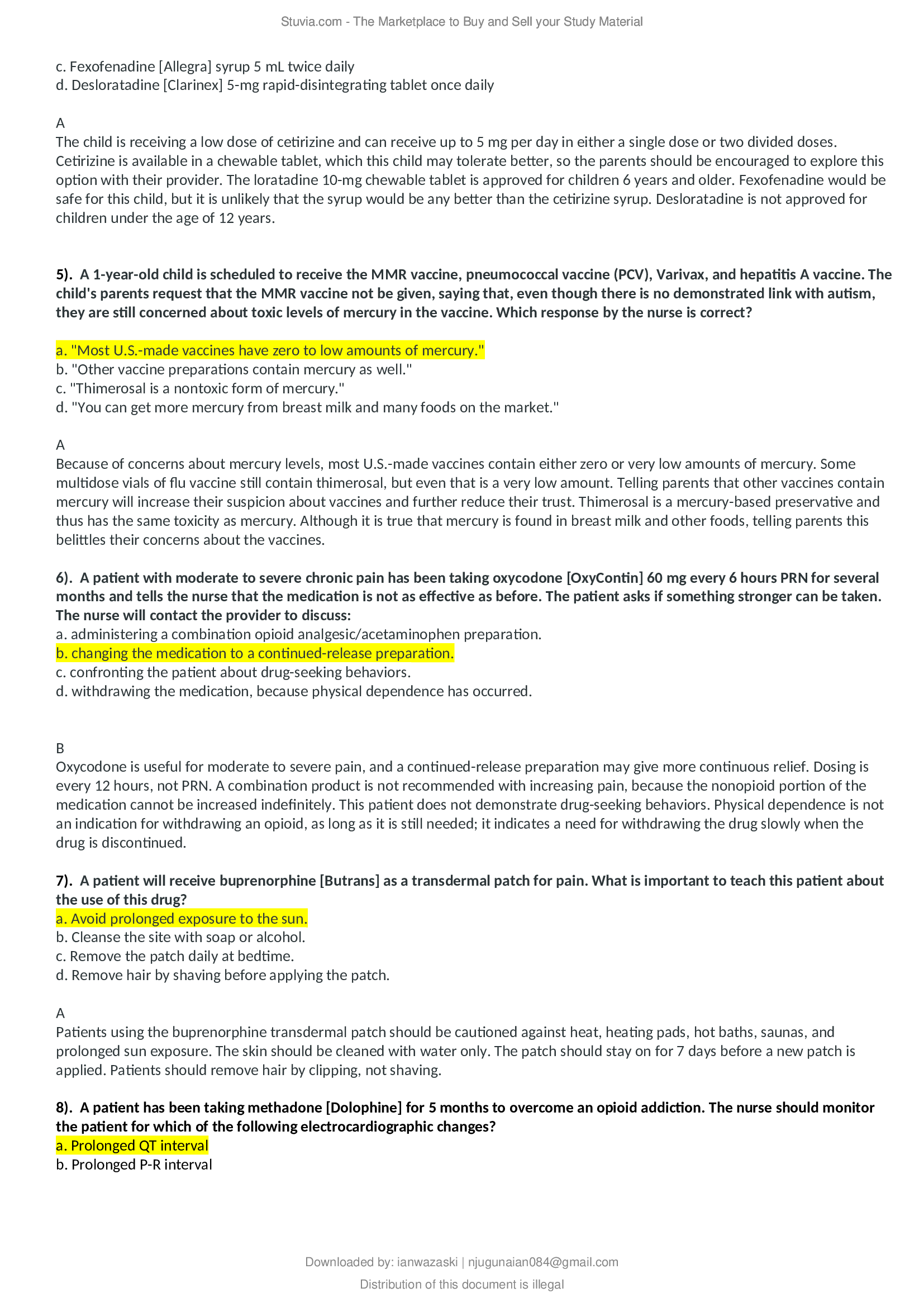
b.  Loratadine [Claritin] 10-mg chewable tablet once daily

c.  Fexofenadine [Allegra] syrup 5 mL twice daily

d.  Desloratadine [Clarinex] 5-mg rapid-disintegrating tablet once daily

A

The child is receiving a low dose of cetirizine and can receive up to 5 mg per day in either a single dose or two divided doses. Cetirizine is available in a chewable tablet, which this child may tolerate better, so the parents should be encouraged to explore this option with their provider. The loratadine 10-mg chewable tablet is approved for children 6 years and older. Fexofenadine would be safe for this child, but it is unlikely that the syrup would be any better than the cetirizine syrup. Desloratadine is not approved for children under the age of 12 years.

5).  A 1-year-old child is scheduled to receive the MMR vaccine, pneumococcal vaccine (PCV), Varivax, and hepatitis A vaccine. The child's parents request that the MMR vaccine not be given, saying that, even though there is no demonstrated link with autism, they are still concerned about toxic levels of mercury in the vaccine. Which response by the nurse is correct?

a. "Most U.S.-made vaccines have zero to low amounts of mercury."

b. "Other vaccine preparations contain mercury as well."


c.  "Thimerosal is a nontoxic form of mercury."

d.  "You can get more mercury from breast milk and many foods on the market."

A

Because of concerns about mercury levels, most U.S.-made vaccines contain either zero or very low amounts of mercury. Some multidose vials of flu vaccine still contain thimerosal, but even that is a very low amount. Telling parents that other vaccines contain mercury will increase their suspicion about vaccines and further reduce their trust. Thimerosal is a mercury-based preservative and thus has the same toxicity as mercury. Although it is true that mercury is found in breast milk and other foods, telling parents this belittles their concerns about the vaccines.

6).  A patient with moderate to severe chronic pain has been taking oxycodone [OxyContin] 60 mg every 6 hours PRN for several months and tells the nurse that the medication is not as effective as before. The patient asks if something stronger can be taken. The nurse will contact the provider to discuss:

a. administering a combination opioid analgesic/acetaminophen preparation.

b. changing the medication to a continued-release preparation.

c. confronting the patient about drug-seeking behaviors.


d. withdrawing the medication, because physical dependence has occurred.

B

Oxycodone is useful for moderate to severe pain, and a continued-release preparation may give more continuous relief. Dosing is every 12 hours, not PRN. A combination product is not recommended with increasing pain, because the nonopioid portion of the medication cannot be increased indefinitely. This patient does not demonstrate drug-seeking behaviors. Physical dependence is not an indication for withdrawing an opioid, as long as it is still needed; it indicates a need for withdrawing the drug slowly when the drug is discontinued.

7).  A patient will receive buprenorphine [Butrans] as a transdermal patch for pain. What is important to teach this patient about the use of this drug?

a.  Avoid prolonged exposure to the sun.

b.  Cleanse the site with soap or alcohol.

c.  Remove the patch daily at bedtime.

d.  Remove hair by shaving before applying the patch.

A

Patients using the buprenorphine transdermal patch should be cautioned against heat, heating pads, hot baths, saunas, and prolonged sun exposure. The skin should be cleaned with water only. The patch should stay on for 7 days before a new patch is applied. Patients should remove hair by clipping, not shaving.

8).  A patient has been taking methadone [Dolophine] for 5 months to overcome an opioid addiction. The nurse should monitor the patient for which of the following electrocardiographic changes? a. Prolonged QT interval

b.  Prolonged P-R interval

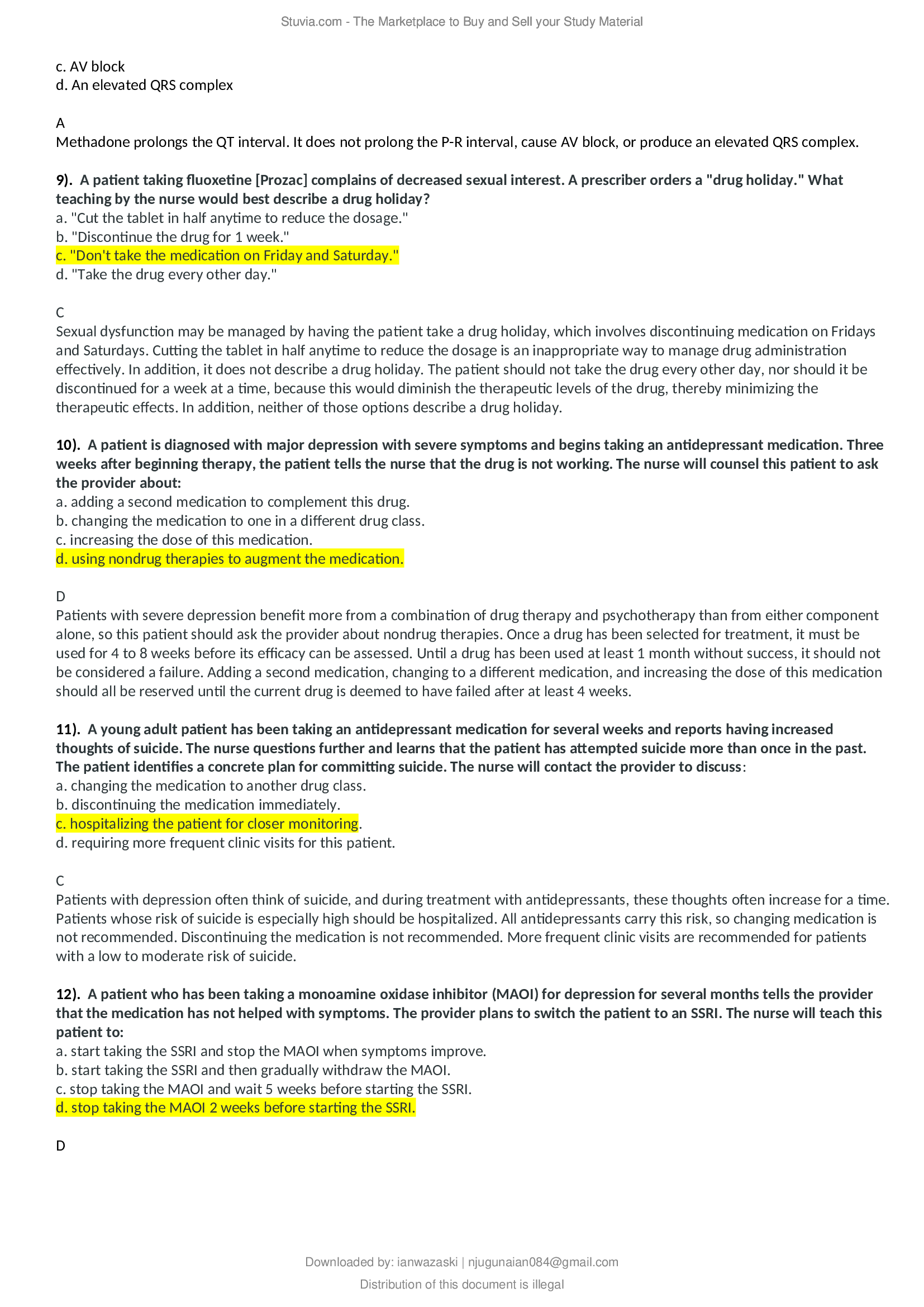
c.  AV block

d.  An elevated QRS complex

A

Methadone prolongs the QT interval. It does not prolong the P-R interval, cause AV block, or produce an elevated QRS complex.

9).  A patient taking fluoxetine [Prozac] complains of decreased sexual interest. A prescriber orders a "drug holiday." What teaching by the nurse would best describe a drug holiday? a. "Cut the tablet in half anytime to reduce the dosage."

b. "Discontinue the drug for 1 week."

c. "Don't take the medication on Friday and Saturday."

d. "Take the drug every other day."


C

Sexual dysfunction may be managed by having the patient take a drug holiday, which involves discontinuing medication on Fridays and Saturdays. Cutting the tablet in half anytime to reduce the dosage is an inappropriate way to manage drug administration effectively. In addition, it does not describe a drug holiday. The patient should not take the drug every other day, nor should it be discontinued for a week at a time, because this would diminish the therapeutic levels of the drug, thereby minimizing the therapeutic effects. In addition, neither of those options describe a drug holiday.

10).  A patient is diagnosed with major depression with severe symptoms and begins taking an antidepressant medication. Three weeks after beginning therapy, the patient tells the nurse that the drug is not working. The nurse will counsel this patient to ask the provider about:

a.  adding a second medication to complement this drug.

b.  changing the medication to one in a different drug class.

c.  increasing the dose of this medication.

d.  using nondrug therapies to augment the medication.

D

Patients with severe depression benefit more from a combination of drug therapy and psychotherapy than from either component alone, so this patient should ask the provider about nondrug therapies. Once a drug has been selected for treatment, it must be used for 4 to 8 weeks before its efficacy can be assessed. Until a drug has been used at least 1 month without success, it should not be considered a failure. Adding a second medication, changing to a different medication, and increasing the dose of this medication should all be reserved until the current drug is deemed to have failed after at least 4 weeks.

11).  A young adult patient has been taking an antidepressant medication for several weeks and reports having increased thoughts of suicide. The nurse questions further and learns that the patient has attempted suicide more than once in the past.

The patient identifies a concrete plan for committing suicide. The nurse will contact the provider to discuss: a. changing the medication to another drug class.

b.  discontinuing the medication immediately.

c.  hospitalizing the patient for closer monitoring.

d.  requiring more frequent clinic visits for this patient.

C

Patients with depression often think of suicide, and during treatment with antidepressants, these thoughts often increase for a time. Patients whose risk of suicide is especially high should be hospitalized. All antidepressants carry this risk, so changing medication is not recommended. Discontinuing the medication is not recommended. More frequent clinic visits are recommended for patients with a low to moderate risk of suicide.

Contact the Seller

Please Sign In to contact this seller.


  • 👎  Report Copyright Violation

Frequently Asked Questions

What Do I Get When I Buy This Study Material?

+

When you buy a study material on Passing Grades, an instant download link will be sent directly to your email, giving you access to the file anytime after payment is completed.

Is Passing Grades a Trusted Platform?

+

Yes, Passing Grades is a reputable students’ marketplace with a secure payment system and reliable customer support. You can trust us to ensure a safe and seamless transaction experience.

Will I Be Stuck with a Subscription?

+

No, all purchases on Passing Grades are one-time transactions. You only pay for the notes you choose to buy, with no subscriptions or hidden fees attached.

Who Am I Buying These Study Materials From?

+

Passing Grades is a marketplace, which means you are purchasing the document from an individual vendor, not directly from us. We facilitate the payment and delivery process between you and the vendor.

Does Passing Grades Offer Free Study Materials?

+

Yes, sellers on Passing Grades have uploaded numerous free test banks, exams, practice questions, and class notes that can be downloaded at no cost.

Pasinggrades - Quality Study Materials

USD 7

    • Quality checked by Pasing Grades
    • 100% satisfaction guarantee
    • Seller: GradeA
Buy PDF $7

Seller Information

GradeA

Member since April 2021

  • icon
  • icon
  • icon
View Profile
  • total sales

    0
  • Favourites

    0
  • Comments

    0
    ( 0 Ratings )

Item Information

  • Uploaded

    24 October 2021

  • Updated

    24 October 2025

  • Category

    Nursing

  • Item Type

    exam

  • Tags

    Pharm Midterm exam

Related Exam Prep Guides by GradeA

Test Bank for Fundamentals of Corporate Finance 12th Edition By Stephen Ross and Randolph Westerfield and Bradford Jordan
View Document

Test Bank for Fundam...

  • GradeA

    GradeA

  • exam

Test Bank for Fundamentals of Corporate Finance 12th Edition By Stephen Ross and Randolph Westerfiel...

7 USD

0

0

[SOLUTION MANUAL) Fundamentals of Corporate Finance 12th Edition By Stephen Ross and Randolph Westerfield and Bradford Jordan
View Document

[SOLUTION MANUAL) Fu...

  • GradeA

    GradeA

  • exam

[SOLUTION MANUAL) Fundamentals of Corporate Finance 12th Edition By Stephen Ross and Randolph Wester...

7 USD

0

0

QMI1500 Assignment 02 2021 AS PER UPDATED TUTORIAL LETTER
View Document

QMI1500 Assignment 0...

  • GradeA

    GradeA

  • exam

QMI1500 Assignment 02 2021 AS PER UPDATED TUTORIAL LETTER...

7 USD

0

0

Purchase

Download link will be sent to this email immediately after purchase.

IMPORTANT LINKS

  • How To Upload Class Notes
  • Selling Tips
  • Passing Grades's Study Materials
  • Scholarships for International Students 2025

POPULAR CATEGORIES

  • Law
  • Accounting
  • English
  • Psychology
  • Business
  • Nursing
  • Computer Science
  • General

View Document

  • Blog
  • Contact
  • Delivery Policy
  • Latest Scholarships Around the World
  • How to Pass Bar Exams: Passing Grades’ Strategies
  • How to Study and Pass the CPA Exam
  • All Test Banks
  • Faq
  • Copyright Claims
  • Privacy Policy
  • Terms of Use

KNOWLEDGE BASE

  • How to Write A+ Grade Good Research Paper
  • How to Manage Stress During Exam Period
  • Best Time to Study
  • How to Pass NCLEX-RN Exam
  • How To Effectively Utilize Test Banks
  • Popular Shadow Health Exam Assessments
  • Popular HESI Case Studies
  • How to Prepare for a Nursing Career
  • The Importance Of Summaries in Exam Revisvion

© 2026 Pasing Grades. All rights reserved.