Pasing Grades
  • Start Selling
  • Blog
  • Contact
  • 0

    Your cart is empty!

English

  • English
  • Spanish
  • Arabic
Create Account Sign In
  • Library
    • New Prep Guides
    • Featured Prep Guides
    • Free Exam Prep Guides
    • Best sellers
  • General
  • Nursing
    • Research Paper
    • Case Study
    • Discussion Post
    • Assignment
    • Exam
    • Practice Questions and Answers
    • Test Bank
    • solutions manual
  • Accounting
    • Case Study
    • Thesis
    • Study Guide
    • Summary
    • Research Paper
    • test bank
  • English
    • Creative Writing
    • Research Paper
    • Summary
    • Rhetorics
    • Literature
    • Journal
    • Exam
    • Grammar
    • Discussion Post
    • Essay
  • Psychology
    • Hesi
    • Presentation
    • Essay
    • Summary
    • Study Guide
    • Essay
    • Solution Manual
    • Final Exam Review
    • Class Notes
    • test bank
  • Business
    • Lecture Notes
    • Solution Manual
    • Presentation
    • Business Plan
    • Class Notes
    • Experiment
    • Summary
    • Practice Questions
    • Study Guide
    • Case Study
    • test bank
    • Exam
  • More
    • Computer Science
    • Economics
    • Statistics
    • Engineering
    • Biology
    • Religious Studies
    • Physics
    • Chemistry
    • Mathematics
    • History
    • Sociology
    • Science
    • Philosophy
    • Law
  • Pages
    • About Us
    • Selling Tips
    • Delivery Policy
    • Faq
    • Privacy Policy
  • Flash Sale
  • Home
  • NURSING 2362 Module 10 Exam with rationale

NURSING 2362 Module 10 Exam with rationale

Preview page 1 Preview page 2 Preview page 3
Add To Favorites

Share this item Share this item

  • Item Details
  • Comments (0)
  • Reviews (0)
  • Contact Seller

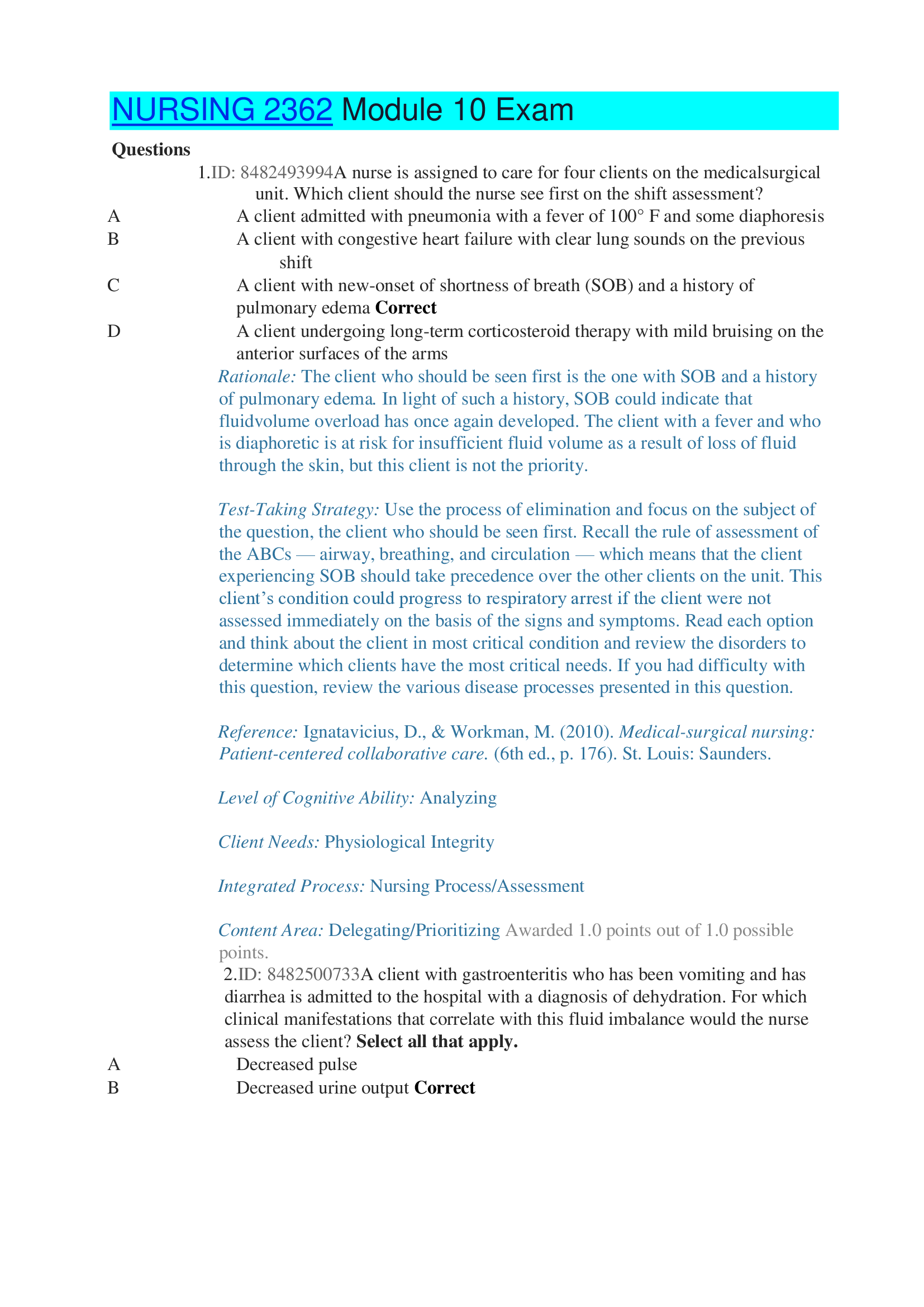
NURSING 2362 Module 10 Exam

Questions

1.ID: 8482493994A nurse is assigned to care for four clients on the medicalsurgical

unit. Which client should the nurse see first on the shift assessment?

A A client admitted with pneumonia with a fever of 100° F and some diaphoresis

B A client with congestive heart failure with clear lung sounds on the previous

shift

C A client with new-onset of shortness of breath (SOB) and a history of

pulmonary edema Correct

D A client undergoing long-term corticosteroid therapy with mild bruising on the

anterior surfaces of the arms

Rationale: The client who should be seen first is the one with SOB and a history

of pulmonary edema. In light of such a history, SOB could indicate that

fluidvolume overload has once again developed. The client with a fever and who

is diaphoretic is at risk for insufficient fluid volume as a result of loss of fluid

through the skin, but this client is not the priority.

Test-Taking Strategy: Use the process of elimination and focus on the subject of

the question, the client who should be seen first. Recall the rule of assessment of

the ABCs — airway, breathing, and circulation — which means that the client

experiencing SOB should take precedence over the other clients on the unit. This

client’s condition could progress to respiratory arrest if the client were not

assessed immediately on the basis of the signs and symptoms. Read each option

and think about the client in most critical condition and review the disorders to

determine which clients have the most critical needs. If you had difficulty with

this question, review the various disease processes presented in this question.

Reference: Ignatavicius, D., & Workman, M. (2010). Medical-surgical nursing:

Patient-centered collaborative care. (6th ed., p. 176). St. Louis: Saunders.

Level of Cognitive Ability: Analyzing

Client Needs: Physiological Integrity

Integrated Process: Nursing Process/Assessment

Content Area: Delegating/Prioritizing Awarded 1.0 points out of 1.0 possible

points.

2.ID: 8482500733A client with gastroenteritis who has been vomiting and has

diarrhea is admitted to the hospital with a diagnosis of dehydration. For which

clinical manifestations that correlate with this fluid imbalance would the nurse

assess the client? Select all that apply.

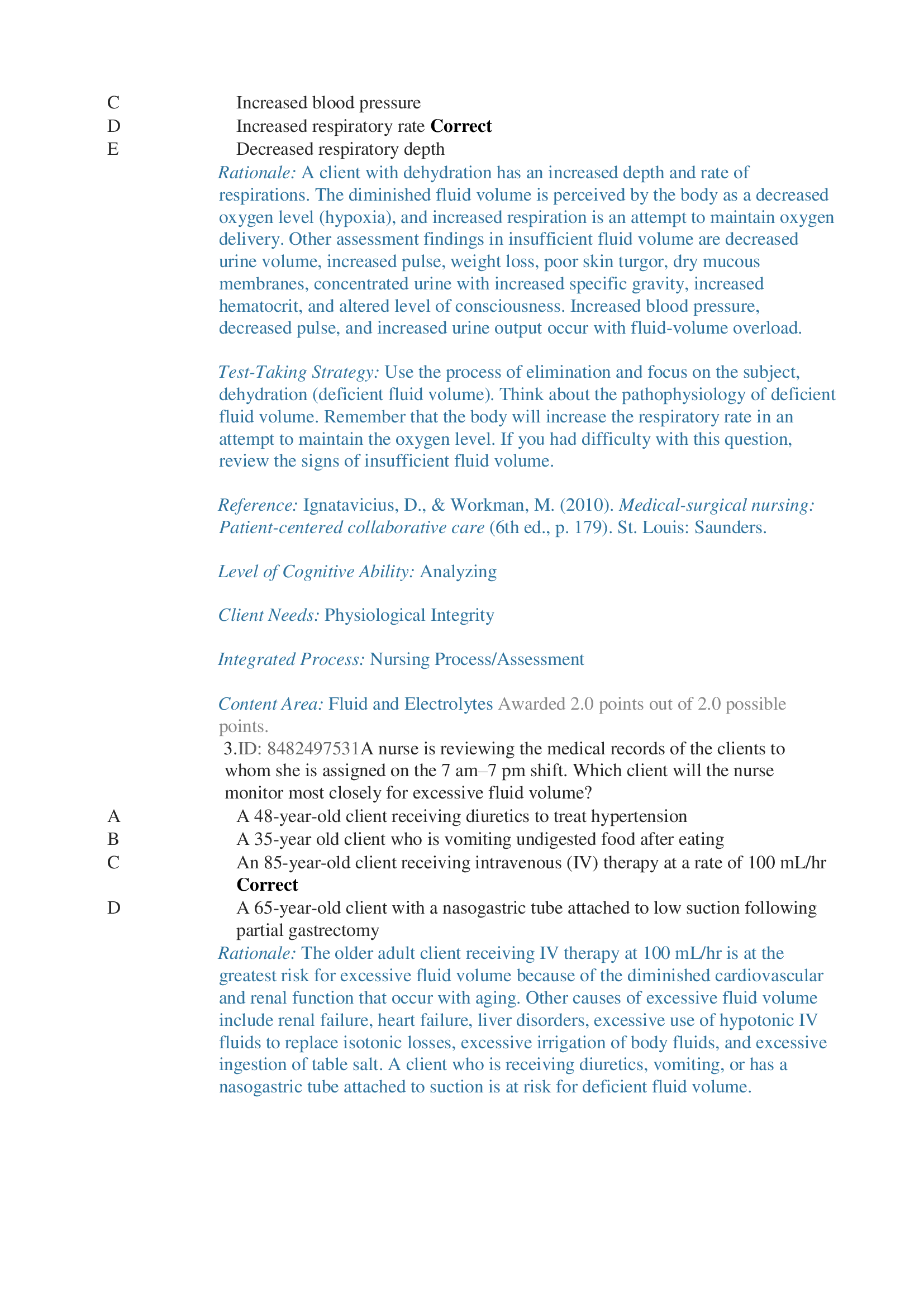
A Decreased pulse

B Decreased urine output Correct

C Increased blood pressure

D Increased respiratory rate Correct

E Decreased respiratory depth

Rationale: A client with dehydration has an increased depth and rate of

respirations. The diminished fluid volume is perceived by the body as a decreased

oxygen level (hypoxia), and increased respiration is an attempt to maintain oxygen

delivery. Other assessment findings in insufficient fluid volume are decreased

urine volume, increased pulse, weight loss, poor skin turgor, dry mucous

membranes, concentrated urine with increased specific gravity, increased

hematocrit, and altered level of consciousness. Increased blood pressure,

decreased pulse, and increased urine output occur with fluid-volume overload.

Test-Taking Strategy: Use the process of elimination and focus on the subject,

dehydration (deficient fluid volume). Think about the pathophysiology of deficient

fluid volume. Remember that the body will increase the respiratory rate in an

attempt to maintain the oxygen level. If you had difficulty with this question,

review the signs of insufficient fluid volume.

Reference: Ignatavicius, D., & Workman, M. (2010). Medical-surgical nursing:

Patient-centered collaborative care (6th ed., p. 179). St. Louis: Saunders.

Level of Cognitive Ability: Analyzing

Client Needs: Physiological Integrity

Integrated Process: Nursing Process/Assessment

Content Area: Fluid and Electrolytes Awarded 2.0 points out of 2.0 possible

points.

3.ID: 8482497531A nurse is reviewing the medical records of the clients to

whom she is assigned on the 7 am–7 pm shift. Which client will the nurse

monitor most closely for excessive fluid volume?

A A 48-year-old client receiving diuretics to treat hypertension

B A 35-year old client who is vomiting undigested food after eating

C An 85-year-old client receiving intravenous (IV) therapy at a rate of 100 mL/hr

Correct

D A 65-year-old client with a nasogastric tube attached to low suction following

partial gastrectomy

Rationale: The older adult client receiving IV therapy at 100 mL/hr is at the

greatest risk for excessive fluid volume because of the diminished cardiovascular

and renal function that occur with aging. Other causes of excessive fluid volume

include renal failure, heart failure, liver disorders, excessive use of hypotonic IV

fluids to replace isotonic losses, excessive irrigation of body fluids, and excessive

ingestion of table salt. A client who is receiving diuretics, vomiting, or has a

nasogastric tube attached to suction is at risk for deficient fluid volume.

Stuvia.com - The Marketplace to Buy and Sell your Study Material

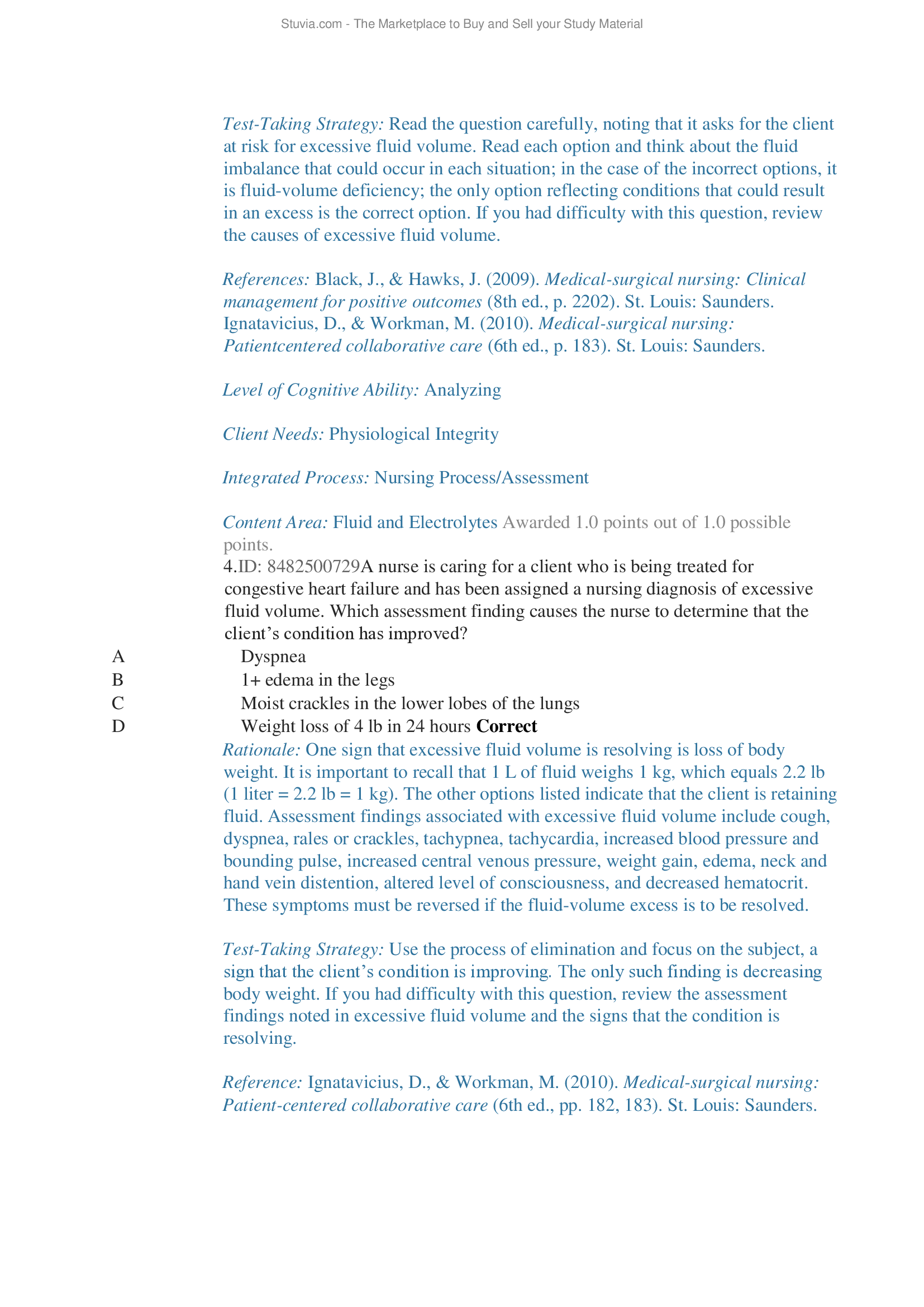
Test-Taking Strategy: Read the question carefully, noting that it asks for the client

at risk for excessive fluid volume. Read each option and think about the fluid

imbalance that could occur in each situation; in the case of the incorrect options, it

is fluid-volume deficiency; the only option reflecting conditions that could result

in an excess is the correct option. If you had difficulty with this question, review

the causes of excessive fluid volume.

References: Black, J., & Hawks, J. (2009). Medical-surgical nursing: Clinical

management for positive outcomes (8th ed., p. 2202). St. Louis: Saunders.

Ignatavicius, D., & Workman, M. (2010). Medical-surgical nursing:

Patientcentered collaborative care (6th ed., p. 183). St. Louis: Saunders.

Level of Cognitive Ability: Analyzing

Client Needs: Physiological Integrity

Integrated Process: Nursing Process/Assessment

Content Area: Fluid and Electrolytes Awarded 1.0 points out of 1.0 possible

points.

4.ID: 8482500729A nurse is caring for a client who is being treated for

congestive heart failure and has been assigned a nursing diagnosis of excessive

fluid volume. Which assessment finding causes the nurse to determine that the

client’s condition has improved?

A Dyspnea

B 1+ edema in the legs

C Moist crackles in the lower lobes of the lungs

D Weight loss of 4 lb in 24 hours Correct

Rationale: One sign that excessive fluid volume is resolving is loss of body

weight. It is important to recall that 1 L of fluid weighs 1 kg, which equals 2.2 lb

(1 liter = 2.2 lb = 1 kg). The other options listed indicate that the client is retaining

fluid. Assessment findings associated with excessive fluid volume include cough,

dyspnea, rales or crackles, tachypnea, tachycardia, increased blood pressure and

bounding pulse, increased central venous pressure, weight gain, edema, neck and

hand vein distention, altered level of consciousness, and decreased hematocrit.

These symptoms must be reversed if the fluid-volume excess is to be resolved.

Test-Taking Strategy: Use the process of elimination and focus on the subject, a

sign that the client’s condition is improving. The only such finding is decreasing

body weight. If you had difficulty with this question, review the assessment

findings noted in excessive fluid volume and the signs that the condition is

resolving.

Reference: Ignatavicius, D., & Workman, M. (2010). Medical-surgical nursing:

Patient-centered collaborative care (6th ed., pp. 182, 183). St. Louis: Saunders.

Stuvia.com - The Marketplace to Buy and Sell your Study Material

Level of Cognitive Ability: Evaluating

Client Needs: Physiological Integrity

Integrated Process: Nursing Process/Evaluation

Content Area: Fluid and Electrolytes Awarded 1.0 points out of 1.0 possible

points.

5.ID: 8482493996A nurse notes that a client has ST-segment depression on the

electrocardiogram (ECG) monitor. With which of the following serum potassium

readings does the nurse associate this finding?

A 3.1 mEq/L Correct

B 4.2 mEq/L

C 4.5 mEq/L

D 5.4 mEq/L

Rationale: A serum potassium level below 3.5 mEq/L is indicative of

hypokalemia, the most common electrolyte imbalance, which is potentially life

threatening. ECG changes in hypokalemia include peaked P waves, flat T waves,

a depressed ST segment, and prominent U waves. Readings of 4.5 mEq/L and 4.2

mEq/L are normal potassium levels; 5.4 mEq/L indicates hyperkalemia.

Test-Taking Strategy: Begin to answer this question by recalling the normal range

of values for serum potassium. Next it is necessary to know that ST-segment

depression occurs in hypokalemia. If you had difficulty with this question, review

the ECG changes that occur in hypokalemia.

Reference: Ignatavicius, D., & Workman, M. (2010). Medical-surgical nursing:

Patient-centered collaborative care (6th ed., pp. 184, 188). St. Louis: Saunders.

Level of Cognitive Ability: Analyzing

Client Needs: Physiological Integrity

Integrated Process: Nursing Process/Analysis

Content Area: Fluid and Electrolytes Awarded 1.0 points out of 1.0 possible

points.

6.ID: 8482500723A healthcare provider writes a prescription for the

administration of intravenous (IV) potassium chloride to a client with

hypokalemia. What does the nurse plan to do when preparing and administering

this medication?

A Insert a Foley catheter in the client

B Prepare the client for insertion of a central IV line

C Administer the medication with the use of a macrodrip IV tubing set

Contact the Seller

Please Sign In to contact this seller.


  • 👎  Report Copyright Violation

Frequently Asked Questions

What Do I Get When I Buy This Study Material?

+

When you buy a study material on Passing Grades, an instant download link will be sent directly to your email, giving you access to the file anytime after payment is completed.

Is Passing Grades a Trusted Platform?

+

Yes, Passing Grades is a reputable students’ marketplace with a secure payment system and reliable customer support. You can trust us to ensure a safe and seamless transaction experience.

Will I Be Stuck with a Subscription?

+

No, all purchases on Passing Grades are one-time transactions. You only pay for the notes you choose to buy, with no subscriptions or hidden fees attached.

Who Am I Buying These Study Materials From?

+

Passing Grades is a marketplace, which means you are purchasing the document from an individual vendor, not directly from us. We facilitate the payment and delivery process between you and the vendor.

Does Passing Grades Offer Free Study Materials?

+

Yes, sellers on Passing Grades have uploaded numerous free test banks, exams, practice questions, and class notes that can be downloaded at no cost.

Pasinggrades - Quality Study Materials

USD 8

    • Quality checked by Pasing Grades
    • 100% satisfaction guarantee
    • Seller: mentor2000
Buy PDF $8

Seller Information

mentor2000

Member since April 2021

  • icon
  • icon
View Profile
  • total sales

    0
  • Favourites

    0
  • Comments

    0
    ( 0 Ratings )

Item Information

  • Uploaded

    11 July 2021

  • Updated

    29 September 2025

  • Category

    Nursing

  • Item Type

    exam

  • Tags

    NURSING 2362 Module 10 Exam with rationale

Related Exam Prep Guides by mentor2000

Test Bank for Essentials for Nursing Practice 8th Edition by Potter | All Chapters
View Document

Test Bank for Essent...

  • mentor2000

    mentor2000

  • exam

Master nursing concepts with this study material; Test Bank for Essentials for Nursing Practice, 8th...

8 USD

0

0

A &P 1 MA278 BSC2 Final Module II Questions & Answers 2026 Update
View Document

A &P 1 MA278 BSC2 Fi...

  • mentor2000

    mentor2000

  • exam

Prepare for success with A&P 1 MA278 BSC2 Final Module II 2024 Q&A. Boost your grades with this comp...

8 USD

0

0

ATI Comprehensive Predictor Exam 2026
View Document

ATI Comprehensive Pr...

  • mentor2000

    mentor2000

  • exam

Prepare for success with the ATI Comprehensive Predictor Exam 2026. Access key practice questions to...

8 USD

0

0

Purchase

Download link will be sent to this email immediately after purchase.

IMPORTANT LINKS

  • How To Upload Class Notes
  • Selling Tips
  • Passing Grades's Study Materials
  • Scholarships for International Students 2026

POPULAR CATEGORIES

  • Law
  • Accounting
  • English
  • Psychology
  • Business
  • Nursing
  • Computer Science
  • General

View Document

  • Blog
  • Contact
  • Delivery Policy
  • Latest Scholarships Around the World
  • How to Pass Bar Exams: Passing Grades’ Strategies
  • How to Study and Pass the CPA Exam
  • All Test Banks
  • Faq
  • Copyright Claims
  • Privacy Policy
  • Terms of Use

KNOWLEDGE BASE

  • How to Write A+ Grade Good Research Paper
  • How to Manage Stress During Exam Period
  • Best Time to Study
  • How to Pass NCLEX-RN Exam
  • How To Effectively Utilize Test Banks
  • Popular Shadow Health Exam Assessments
  • Popular HESI Case Studies
  • How to Prepare for a Nursing Career
  • The Importance Of Summaries in Exam Revisvion

© 2026 Pasing Grades. All rights reserved.