Pasing Grades
  • Start Selling
  • Blog
  • Contact
  • 0

    Your cart is empty!

English

  • English
  • Spanish
  • Arabic
Create Account Sign In
  • Library
    • New Prep Guides
    • Featured Prep Guides
    • Free Exam Prep Guides
    • Best sellers
  • General
  • Nursing
    • Research Paper
    • Case Study
    • Discussion Post
    • Assignment
    • Exam
    • Practice Questions and Answers
    • Test Bank
    • solutions manual
  • Accounting
    • Case Study
    • Thesis
    • Study Guide
    • Summary
    • Research Paper
    • test bank
  • English
    • Creative Writing
    • Research Paper
    • Summary
    • Rhetorics
    • Literature
    • Journal
    • Exam
    • Grammar
    • Discussion Post
    • Essay
  • Psychology
    • Hesi
    • Presentation
    • Essay
    • Summary
    • Study Guide
    • Essay
    • Solution Manual
    • Final Exam Review
    • Class Notes
    • test bank
  • Business
    • Lecture Notes
    • Solution Manual
    • Presentation
    • Business Plan
    • Class Notes
    • Experiment
    • Summary
    • Practice Questions
    • Study Guide
    • Case Study
    • test bank
    • Exam
  • More
    • Computer Science
    • Economics
    • Statistics
    • Engineering
    • Biology
    • Religious Studies
    • Physics
    • Chemistry
    • Mathematics
    • History
    • Sociology
    • Science
    • Philosophy
    • Law
  • Pages
    • About Us
    • Selling Tips
    • Delivery Policy
    • Faq
    • Privacy Policy
  • Flash Sale
  • Home
  • HESI PN Medical Surgical Exam with Answers 2026

HESI PN Medical Surgical Exam with Answers 2026

Preview page 1 Preview page 2 Preview page 3
Add To Favorites

Share this item Share this item

  • Item Details
  • Comments (0)
  • Reviews (0)
  • Contact Seller

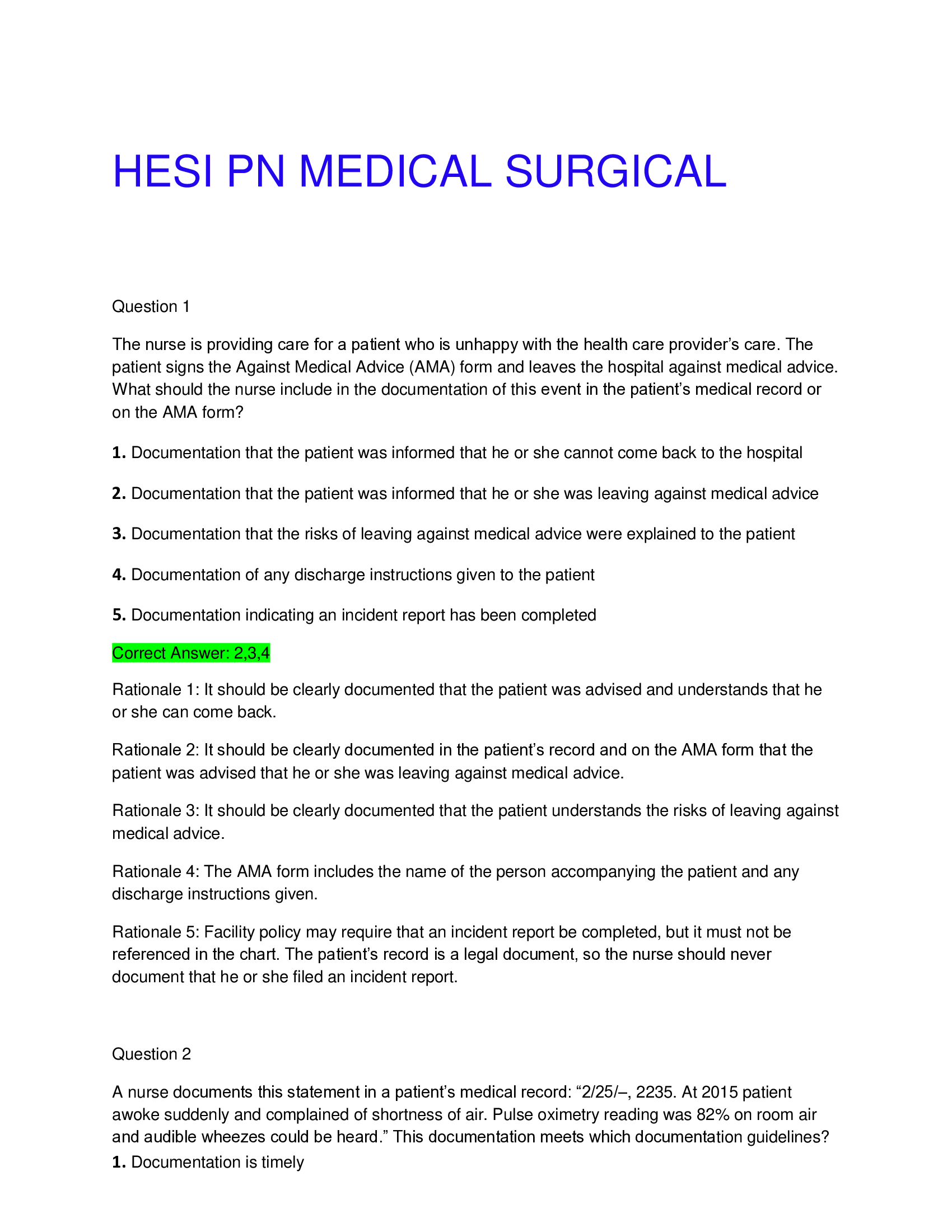
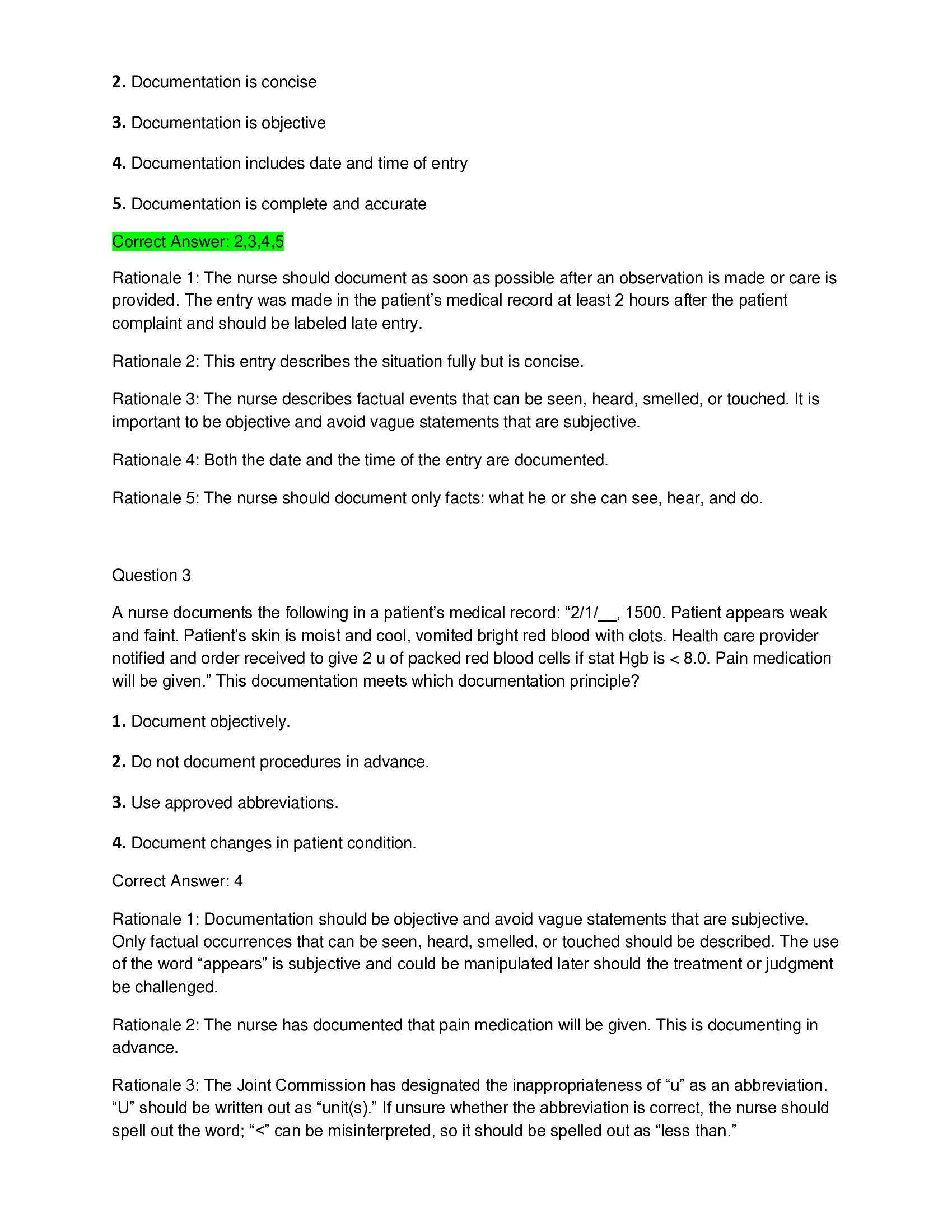
HESI PN MEDICAL SURGICAL (100% CORRECT answers for this study material) Question 1 The nurse is providing care for a patient who is unhappy with the health care provider’s care. The patient signs the Against Medical Advice (AMA) form and leaves the hospital against medical advice. What should the nurse include in the documentation of this event in the patient’s medical record or on the AMA form? 1. Documentation that the patient was informed that he or she cannot come back to the hospital 2. Documentation that the patient was informed that he or she was leaving against medical advice 3. Documentation that the risks of leaving against medical advice were explained to the patient 4. Documentation of any discharge instructions given to the patient 5. Documentation indicating an incident report has been completed Correct Answer: 2,3,4 Rationale 1: It should be clearly documented that the patient was advised and understands that he or she can come back. Rationale 2: It should be clearly documented in the patient’s record and on the AMA form that the patient was advised that he or she was leaving against medical advice. Rationale 3: It should be clearly documented that the patient understands the risks of leaving against medical advice. Rationale 4: The AMA form includes the name of the person accompanying the patient and any discharge instructions given. Rationale 5: Facility policy may require that an incident report be completed, but it must not be referenced in the chart. The patient’s record is a legal document, so the nurse should never document that he or she filed an incident report. Question 2 A nurse documents this statement in a patient’s medical record: “2/25/–, 2235. At 2015 patient awoke suddenly and complained of shortness of air. Pulse oximetry reading was 82% on room air and audible wheezes could be heard.” This documentation meets which documentation guidelines? 1. Documentation is timely 2. Documentation is concise 3. Documentation is objective 4. Documentation includes date and time of entry 5. Documentation is complete and accurate Correct Answer: 2,3,4,5 Rationale 1: The nurse should document as soon as possible after an observation is made or care is provided. The entry was made in the patient’s medical record at least 2 hours after the patient complaint and should be labeled late entry. Rationale 2: This entry describes the situation fully but is concise. Rationale 3: The nurse describes factual events that can be seen, heard, smelled, or touched. It is important to be objective and avoid vague statements that are subjective. Rationale 4: Both the date and the time of the entry are documented. Rationale 5: The nurse should document only facts: what he or she can see, hear, and do. Question 3 A nurse documents the following in a patient’s medical record: “2/1/__, 1500. Patient appears weak and faint. Patient’s skin is moist and cool, vomited bright red blood with clots. Health care provider notified and order received to give 2 u of packed red blood cells if stat Hgb is < 8.0. Pain medication will be given.” This documentation meets which documentation principle? 1. Document objectively. 2. Do not document procedures in advance. 3. Use approved abbreviations. 4. Document changes in patient condition. Correct Answer: 4 Rationale 1: Documentation should be objective and avoid vague statements that are subjective. Only factual occurrences that can be seen, heard, smelled, or touched should be described. The use of the word “appears” is subjective and could be manipulated later should the treatment or judgment be challenged. Rationale 2: The nurse has documented that pain medication will be given. This is documenting in advance. Rationale 3: The Joint Commission has designated the inappropriateness of “u” as an abbreviation. “U” should be written out as “unit(s).” If unsure whether the abbreviation is correct, the nurse should spell out the word; “<” can be misinterpreted, so it should be spelled out as “less than.” Rationale 4: In general, employers as well as state, federal, and professional standards require documentation to include initial and ongoing assessments, any change in the patient’s condition, therapies given and patient response, patient teaching, and relevant statements by the patient. Question 4 A nursing unit has changed its documentation system to documenting by exception. How will this system save time? 1. It eliminates lengthy or repetitive documentation. 2. It allows flexibility and description in the documentation. 3. It allows the reader to easily locate information about a specific problem. 4. It allows for quick and easy retrieval of information. Correct Answer: 1 Rationale 1: Documenting by exception eliminates lengthy or repetitive documentation. Rationale 2: Flexible and descriptive documentation is an advantage of the narrative system. Rationale 3: PIE charting allows easy location of information about a specific problem. Rationale 4: The electronic health record allows for quick and easy retrieval of information. Question 5 A hospital is considering changing its documentation system to reduce the number of medication errors. Which system should the hospital investigate? 1. Problem, intervention, evaluation (PIE) system 2. Electronic medical record 3. Problem-oriented medical record 4. Narrative system Correct Answer: 2 Rationale 1: The PIE system consists of a list of the patient’s problems, interventions taken to alleviate the problems, and evaluation of the patient’s response to the interventions. This system does not have the specific benefit of reducing medication errors. Rationale 2: The electronic medical record decreases errors and allows for the reconciliation of the patient’s medications on admission, daily, and on discharge. Rationale 3: The five components of the problem-oriented medical record are baseline data, a problem list, a plan of care for each problem, multidisciplinary progress notes, and a discharge summary. This system does not have the specific benefit of reducing medication errors. Rationale 4: Narrative documentation does not have the specific benefit of reducing medication errors. Question 6 Which nursing activities are examples of independent functions of the nursing role? 1. Teaching a soon-to-be-discharged patient about the medication regimen that the health care provider has prescribed 2. Talking with the patient about his or her abilities to manage personal hygiene activities while in the usual state of health at home 3. Incorporating adaptive techniques into nursing care as recommended by occupational therapy 4. Administering analgesic medication ordered by the health care provider 5. Introducing oneself to, and interviewing, the patient to collect data about physical health status Correct Answer: 2,5 Rationale 1: Teaching the patient about medications prescribed by the health care provider is an interdependent activity. Rationale 2: This activity is part of the assessment process, which is an independent activity that nurses may perform, based on their education and skills. Rationale 3: Working in coordination with another health team member is an interdependent activity. Rationale 4: Administering medication prescribed by the health care provider is an example of a dependent activity. Rationale 5: These activities are included in assessment, which is an independent activity that nurses may perform, based on their education and skills. Question 7 The nurse is caring for a 70-year-old patient who was just admitted to an inpatient rehabilitation center. The patient had required total parenteral nutrition for several days, but recently resumed and is tolerating a regular diet. She has another 4 days left in a course of intravenous antibiotics to complete treatment of a positive central line culture. Which nursing action, required in the care of this patient, is considered a dependent role function? 1. Requesting that the health care provider order a consult because the patient states that her dentures no longer fit properly and she has trouble chewing 2. Asking the nursing assistant to demonstrate to the patient how to operate the call system 3. Interviewing the patient to assess whether she needs assistance with getting out of bed 4. Administering the antibiotics prescribed by the health care provider Correct Answer: 4 Rationale 1: Assessing that the patient has a need that requires further assessment by other team members and communicating that need to the appropriate team member is an example of an interdependent activity. Rationale 2: This is an independent activity that nurses may perform or delegate, based on their and the delegate’s education and skills. Rationale 3: Assessment is an independent activity that nurses may perform, based on their education and skills. Rationale 4: Dependent activities are those prescribed by the health care provider and carried out by the nurse. Question 8 When asking a patient if a pain medication provided a few hours ago has been effective, the nurse is performing which step of the nursing process? 1. Planning 2. Implementation 3. Evaluation 4. Assessment Correct Answer: 3 Rationale 1: Planning consists of prioritizing among the chosen nursing diagnoses and determining interventions to move the patient to optimal health. Rationale 2: Implementation is the actual “doing” step of the nursing process. In this case, implementation occurred when the medication was administered. Rationale 3: Evaluation focuses on a patient’s behavioral changes and compares them with the criteria stated in the objectives. It consists of both the patient’s status and the effectiveness of the nursing care. Both must be evaluated continuously, with the care plan modified as needed. Rationale 4: Assessment comprises examining the patient and identifying cues, collecting and analyzing data, and reaching conclusions. In this situation, assessment occurred when the nurse identified that the patient was in pain. Question 9 The nursing instructor knows that further education is needed when a student makes which statement? 1. “Assessment precedes nursing diagnosis and outcome identification.” 2. “Planning follows nursing diagnosis and outcome identification and precedes implementation.” 3. “Evaluation follows implementation and precedes planning.” 4. “Planning follows assessment and precedes evaluation.” Correct Answer: 3 Rationale 1: The correct order is assessment, diagnosis, planning, implementation, and evaluation. Rationale 2: The correct order is assessment, diagnosis, planning, implementation, and evaluation. Rationale 3: The correct order is assessment, diagnosis, planning, implementation, and evaluation. Rationale 4: The correct order is assessment, diagnosis, planning, implementation, and evaluation.

Contact the Seller

Please Sign In to contact this seller.


  • 👎  Report Copyright Violation

Frequently Asked Questions

What Do I Get When I Buy This Study Material?

+

When you buy a study material on Passing Grades, an instant download link will be sent directly to your email, giving you access to the file anytime after payment is completed.

Is Passing Grades a Trusted Platform?

+

Yes, Passing Grades is a reputable students’ marketplace with a secure payment system and reliable customer support. You can trust us to ensure a safe and seamless transaction experience.

Will I Be Stuck with a Subscription?

+

No, all purchases on Passing Grades are one-time transactions. You only pay for the notes you choose to buy, with no subscriptions or hidden fees attached.

Who Am I Buying These Study Materials From?

+

Passing Grades is a marketplace, which means you are purchasing the document from an individual vendor, not directly from us. We facilitate the payment and delivery process between you and the vendor.

Does Passing Grades Offer Free Study Materials?

+

Yes, sellers on Passing Grades have uploaded numerous free test banks, exams, practice questions, and class notes that can be downloaded at no cost.

Pasinggrades - Quality Study Materials

USD 15

    • Quality checked by Pasing Grades
    • 100% satisfaction guarantee
    • Seller: mentor2000
Buy PDF $15

Seller Information

mentor2000

Member since April 2021

  • icon
  • icon
View Profile
  • total sales

    1
  • Favourites

    0
  • Comments

    0
    ( 0 Ratings )

Item Information

  • Uploaded

    28 June 2024

  • Updated

    03 January 2026

  • Category

    Nursing

  • Item Type

    hesi

  • Tags

    HESI PN medical surgical 2023 2024 2025 2026 hesi study materials hesi study resources

Related Exam Prep Guides by mentor2000

Test Bank for Essentials for Nursing Practice 8th Edition by Potter | All Chapters
View Document

Test Bank for Essent...

  • mentor2000

    mentor2000

  • hesi

Master nursing concepts with this study material; Test Bank for Essentials for Nursing Practice, 8th...

15 USD

0

1

A &P 1 MA278 BSC2 Final Module II Questions & Answers 2026 Update
View Document

A &P 1 MA278 BSC2 Fi...

  • mentor2000

    mentor2000

  • hesi

Prepare for success with A&P 1 MA278 BSC2 Final Module II 2024 Q&A. Boost your grades with this comp...

15 USD

0

1

ATI Comprehensive Predictor Exam 2026
View Document

ATI Comprehensive Pr...

  • mentor2000

    mentor2000

  • hesi

Prepare for success with the ATI Comprehensive Predictor Exam 2026. Access key practice questions to...

15 USD

0

1

Purchase

Download link will be sent to this email immediately after purchase.

IMPORTANT LINKS

  • How To Upload Class Notes
  • Selling Tips
  • Passing Grades's Study Materials
  • Scholarships for International Students 2026

POPULAR CATEGORIES

  • Law
  • Accounting
  • English
  • Psychology
  • Business
  • Nursing
  • Computer Science
  • General

View Document

  • Blog
  • Contact
  • Delivery Policy
  • Latest Scholarships Around the World
  • How to Pass Bar Exams: Passing Grades’ Strategies
  • How to Study and Pass the CPA Exam
  • All Test Banks
  • Faq
  • Copyright Claims
  • Privacy Policy
  • Terms of Use

KNOWLEDGE BASE

  • How to Write A+ Grade Good Research Paper
  • How to Manage Stress During Exam Period
  • Best Time to Study
  • How to Pass NCLEX-RN Exam
  • How To Effectively Utilize Test Banks
  • Popular Shadow Health Exam Assessments
  • Popular HESI Case Studies
  • How to Prepare for a Nursing Career
  • The Importance Of Summaries in Exam Revisvion

© 2026 Pasing Grades. All rights reserved.