Pasing Grades
  • Start Selling
  • Blog
  • Contact
  • 0

    Your cart is empty!

English

  • English
  • Spanish
  • Arabic
Create Account Sign In
  • Library
    • New Prep Guides
    • Featured Prep Guides
    • Free Exam Prep Guides
    • Best sellers
  • General
  • Nursing
    • Research Paper
    • Case Study
    • Discussion Post
    • Assignment
    • Exam
    • Practice Questions and Answers
    • Test Bank
    • solutions manual
  • Accounting
    • Case Study
    • Thesis
    • Study Guide
    • Summary
    • Research Paper
    • test bank
  • English
    • Creative Writing
    • Research Paper
    • Summary
    • Rhetorics
    • Literature
    • Journal
    • Exam
    • Grammar
    • Discussion Post
    • Essay
  • Psychology
    • Hesi
    • Presentation
    • Essay
    • Summary
    • Study Guide
    • Essay
    • Solution Manual
    • Final Exam Review
    • Class Notes
    • test bank
  • Business
    • Lecture Notes
    • Solution Manual
    • Presentation
    • Business Plan
    • Class Notes
    • Experiment
    • Summary
    • Practice Questions
    • Study Guide
    • Case Study
    • test bank
    • Exam
  • More
    • Computer Science
    • Economics
    • Statistics
    • Engineering
    • Biology
    • Religious Studies
    • Physics
    • Chemistry
    • Mathematics
    • History
    • Sociology
    • Science
    • Philosophy
    • Law
  • Pages
    • About Us
    • Selling Tips
    • Delivery Policy
    • Faq
    • Privacy Policy
  • Flash Sale
  • Home
  • NUR2063 Final Exam module 7,8,9 Focused Review graded A+

NUR2063 Final Exam module 7,8,9 Focused Review graded A+

Preview page 1 Preview page 2 Preview page 3
Add To Favorites

Share this item Share this item

  • Item Details
  • Comments (0)
  • Reviews (0)
  • Contact Seller

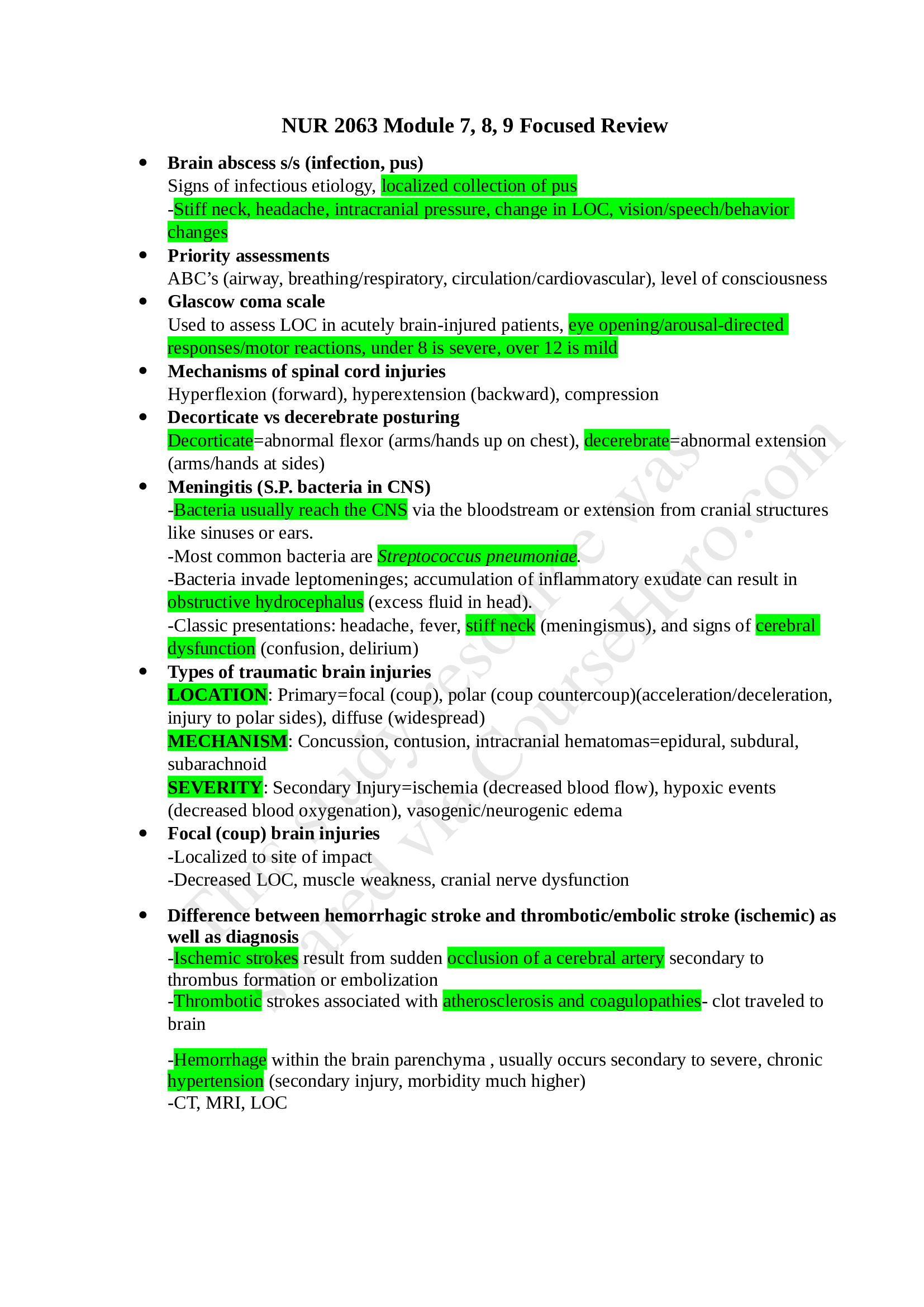
NUR 2063 Module 7, 8, 9 Focused Review

 Brain abscess s/s (infection, pus)

Signs of infectious etiology, localized collection of pus

-Stiff neck, headache, intracranial pressure, change in LOC, vision/speech/behavior

changes

 Priority assessments

ABC’s (airway, breathing/respiratory, circulation/cardiovascular), level of consciousness

 Glascow coma scale

Used to assess LOC in acutely brain-injured patients, eye opening/arousal-directed

responses/motor reactions, under 8 is severe, over 12 is mild

 Mechanisms of spinal cord injuries

Hyperflexion (forward), hyperextension (backward), compression

 Decorticate vs decerebrate posturing

Decorticate=abnormal flexor (arms/hands up on chest), decerebrate=abnormal extension

(arms/hands at sides)

 Meningitis (S.P. bacteria in CNS)

-Bacteria usually reach the CNS via the bloodstream or extension from cranial structures

like sinuses or ears.

-Most common bacteria are Streptococcus pneumoniae.

-Bacteria invade leptomeninges; accumulation of inflammatory exudate can result in

obstructive hydrocephalus (excess fluid in head).

-Classic presentations: headache, fever, stiff neck (meningismus), and signs of cerebral

dysfunction (confusion, delirium)

 Types of traumatic brain injuries

LOCATION: Primary=focal (coup), polar (coup countercoup)(acceleration/deceleration,

injury to polar sides), diffuse (widespread)

MECHANISM: Concussion, contusion, intracranial hematomas=epidural, subdural,

subarachnoid

SEVERITY: Secondary Injury=ischemia (decreased blood flow), hypoxic events

(decreased blood oxygenation), vasogenic/neurogenic edema

 Focal (coup) brain injuries

-Localized to site of impact

-Decreased LOC, muscle weakness, cranial nerve dysfunction

 Difference between hemorrhagic stroke and thrombotic/embolic stroke (ischemic) as

well as diagnosis

-Ischemic strokes result from sudden occlusion of a cerebral artery secondary to

thrombus formation or embolization

-Thrombotic strokes associated with atherosclerosis and coagulopathies- clot traveled to

brain

-Hemorrhage within the brain parenchyma , usually occurs secondary to severe, chronic

hypertension (secondary injury, morbidity much higher)

-CT, MRI, LOC

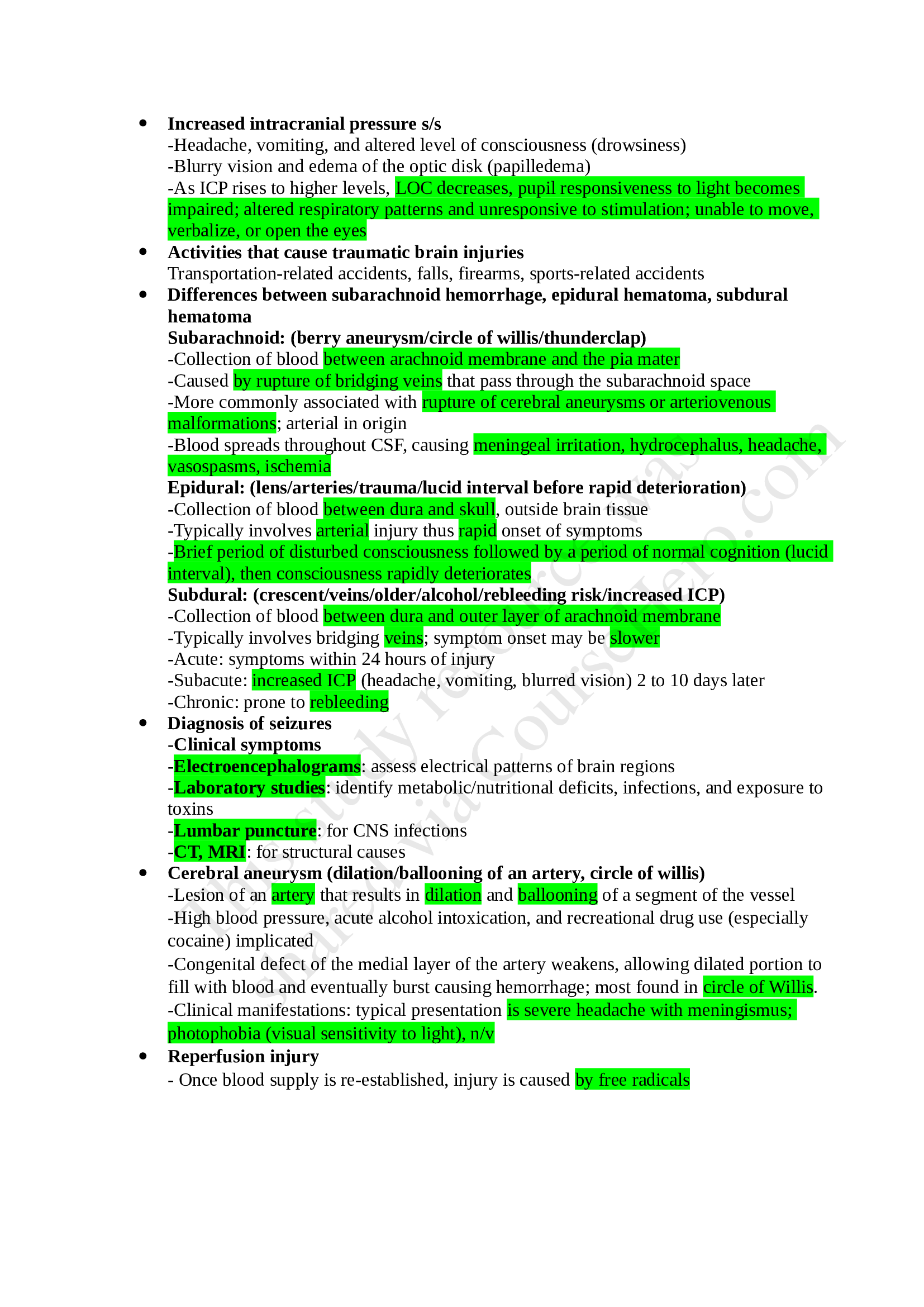
 Increased intracranial pressure s/s

-Headache, vomiting, and altered level of consciousness (drowsiness)

-Blurry vision and edema of the optic disk (papilledema)

-As ICP rises to higher levels, LOC decreases, pupil responsiveness to light becomes

impaired; altered respiratory patterns and unresponsive to stimulation; unable to move,

verbalize, or open the eyes

 Activities that cause traumatic brain injuries

Transportation-related accidents, falls, firearms, sports-related accidents

 Differences between subarachnoid hemorrhage, epidural hematoma, subdural

hematoma

Subarachnoid: (berry aneurysm/circle of willis/thunderclap)

-Collection of blood between arachnoid membrane and the pia mater

-Caused by rupture of bridging veins that pass through the subarachnoid space

-More commonly associated with rupture of cerebral aneurysms or arteriovenous

malformations; arterial in origin

-Blood spreads throughout CSF, causing meningeal irritation, hydrocephalus, headache,

vasospasms, ischemia

Epidural: (lens/arteries/trauma/lucid interval before rapid deterioration)

-Collection of blood between dura and skull, outside brain tissue

-Typically involves arterial injury thus rapid onset of symptoms

-Brief period of disturbed consciousness followed by a period of normal cognition (lucid

interval), then consciousness rapidly deteriorates

Subdural: (crescent/veins/older/alcohol/rebleeding risk/increased ICP)

-Collection of blood between dura and outer layer of arachnoid membrane

-Typically involves bridging veins; symptom onset may be slower

-Acute: symptoms within 24 hours of injury

-Subacute: increased ICP (headache, vomiting, blurred vision) 2 to 10 days later

-Chronic: prone to rebleeding

 Diagnosis of seizures

-Clinical symptoms

-Electroencephalograms: assess electrical patterns of brain regions

-Laboratory studies: identify metabolic/nutritional deficits, infections, and exposure to

toxins

-Lumbar puncture: for CNS infections

-CT, MRI: for structural causes

 Cerebral aneurysm (dilation/ballooning of an artery, circle of willis)

-Lesion of an artery that results in dilation and ballooning of a segment of the vessel

-High blood pressure, acute alcohol intoxication, and recreational drug use (especially

cocaine) implicated

-Congenital defect of the medial layer of the artery weakens, allowing dilated portion to

fill with blood and eventually burst causing hemorrhage; most found in circle of Willis.

-Clinical manifestations: typical presentation is severe headache with meningismus;

photophobia (visual sensitivity to light), n/v

 Reperfusion injury

- Once blood supply is re-established, injury is caused by free radicals

Contact the Seller

Please Sign In to contact this seller.


  • 👎  Report Copyright Violation

Frequently Asked Questions

What Do I Get When I Buy This Study Material?

+

When you buy a study material on Passing Grades, an instant download link will be sent directly to your email, giving you access to the file anytime after payment is completed.

Is Passing Grades a Trusted Platform?

+

Yes, Passing Grades is a reputable students’ marketplace with a secure payment system and reliable customer support. You can trust us to ensure a safe and seamless transaction experience.

Will I Be Stuck with a Subscription?

+

No, all purchases on Passing Grades are one-time transactions. You only pay for the notes you choose to buy, with no subscriptions or hidden fees attached.

Who Am I Buying These Study Materials From?

+

Passing Grades is a marketplace, which means you are purchasing the document from an individual vendor, not directly from us. We facilitate the payment and delivery process between you and the vendor.

Does Passing Grades Offer Free Study Materials?

+

Yes, sellers on Passing Grades have uploaded numerous free test banks, exams, practice questions, and class notes that can be downloaded at no cost.

Pasinggrades - Quality Study Materials

USD 8

    • Quality checked by Pasing Grades
    • 100% satisfaction guarantee
    • Seller: Angelicer
Buy PDF $8

Seller Information

Angelicer

Member since April 2021

  • icon
  • icon
View Profile
  • total sales

    0
  • Favourites

    0
  • Comments

    0
    ( 0 Ratings )

Item Information

  • Uploaded

    17 May 2024

  • Updated

    24 October 2025

  • Category

    Nursing

  • Item Type

    exam

  • Tags

    NUR2063 Final Exam module 7 8 9 Focused Review 2021 graded A+

Related Exam Prep Guides by Angelicer

Test Bank for Success in Practical Vocational Nursing 8th Edition by Knecht
View Document

Test Bank for Succes...

  • Angelicer

    Angelicer

  • exam

Enhance your study with the Test Bank for Success in Practical Vocational Nursing 8th Edition by Kne...

8 USD

0

0

Test Bank for Illustrated Anatomy of the Head and Neck 5th Edition by Fehrenbach
View Document

Test Bank for Illust...

  • Angelicer

    Angelicer

  • exam

Boost your understanding with the Test Bank for Illustrated Anatomy of the Head and Neck 5th Edition...

8 USD

0

0

ATI PEDS Proctored Exam Questions and Answers 2026 | Comprehensive Study Guide
View Document

ATI PEDS Proctored E...

  • Angelicer

    Angelicer

  • exam

Get the ATI PEDS Proctored Exam Questions and Answers for 2025. This comprehensive study guide offer...

8 USD

0

0

Purchase

Download link will be sent to this email immediately after purchase.

IMPORTANT LINKS

  • How To Upload Class Notes
  • Selling Tips
  • Passing Grades's Study Materials
  • Scholarships for International Students 2025

POPULAR CATEGORIES

  • Law
  • Accounting
  • English
  • Psychology
  • Business
  • Nursing
  • Computer Science
  • General

View Document

  • Blog
  • Contact
  • Delivery Policy
  • Latest Scholarships Around the World
  • How to Pass Bar Exams: Passing Grades’ Strategies
  • How to Study and Pass the CPA Exam
  • All Test Banks
  • Faq
  • Copyright Claims
  • Privacy Policy
  • Terms of Use

KNOWLEDGE BASE

  • How to Write A+ Grade Good Research Paper
  • How to Manage Stress During Exam Period
  • Best Time to Study
  • How to Pass NCLEX-RN Exam
  • How To Effectively Utilize Test Banks
  • Popular Shadow Health Exam Assessments
  • Popular HESI Case Studies
  • How to Prepare for a Nursing Career
  • The Importance Of Summaries in Exam Revisvion

© 2026 Pasing Grades. All rights reserved.