Pasing Grades
  • Start Selling
  • Blog
  • Contact
  • 0

    Your cart is empty!

English

  • English
  • Spanish
  • Arabic
Create Account Sign In
  • Library
    • New Prep Guides
    • Featured Prep Guides
    • Free Exam Prep Guides
    • Best sellers
  • General
  • Nursing
    • Research Paper
    • Case Study
    • Discussion Post
    • Assignment
    • Exam
    • Practice Questions and Answers
    • Test Bank
    • solutions manual
  • Accounting
    • Case Study
    • Thesis
    • Study Guide
    • Summary
    • Research Paper
    • test bank
  • English
    • Creative Writing
    • Research Paper
    • Summary
    • Rhetorics
    • Literature
    • Journal
    • Exam
    • Grammar
    • Discussion Post
    • Essay
  • Psychology
    • Hesi
    • Presentation
    • Essay
    • Summary
    • Study Guide
    • Essay
    • Solution Manual
    • Final Exam Review
    • Class Notes
    • test bank
  • Business
    • Lecture Notes
    • Solution Manual
    • Presentation
    • Business Plan
    • Class Notes
    • Experiment
    • Summary
    • Practice Questions
    • Study Guide
    • Case Study
    • test bank
    • Exam
  • More
    • Computer Science
    • Economics
    • Statistics
    • Engineering
    • Biology
    • Religious Studies
    • Physics
    • Chemistry
    • Mathematics
    • History
    • Sociology
    • Science
    • Philosophy
    • Law
  • Pages
    • About Us
    • Selling Tips
    • Delivery Policy
    • Faq
    • Privacy Policy
  • Flash Sale
  • Home
  • Morrison-Valfre: Foundations of Mental Health Care, 6th Edition Test Bank

Morrison-Valfre: Foundations of Mental Health Care, 6th Edition Test Bank

Preview page 1 Preview page 2 Preview page 3
Add To Favorites

Share this item Share this item

  • Item Details
  • Comments (0)
  • Reviews (0)
  • Contact Seller
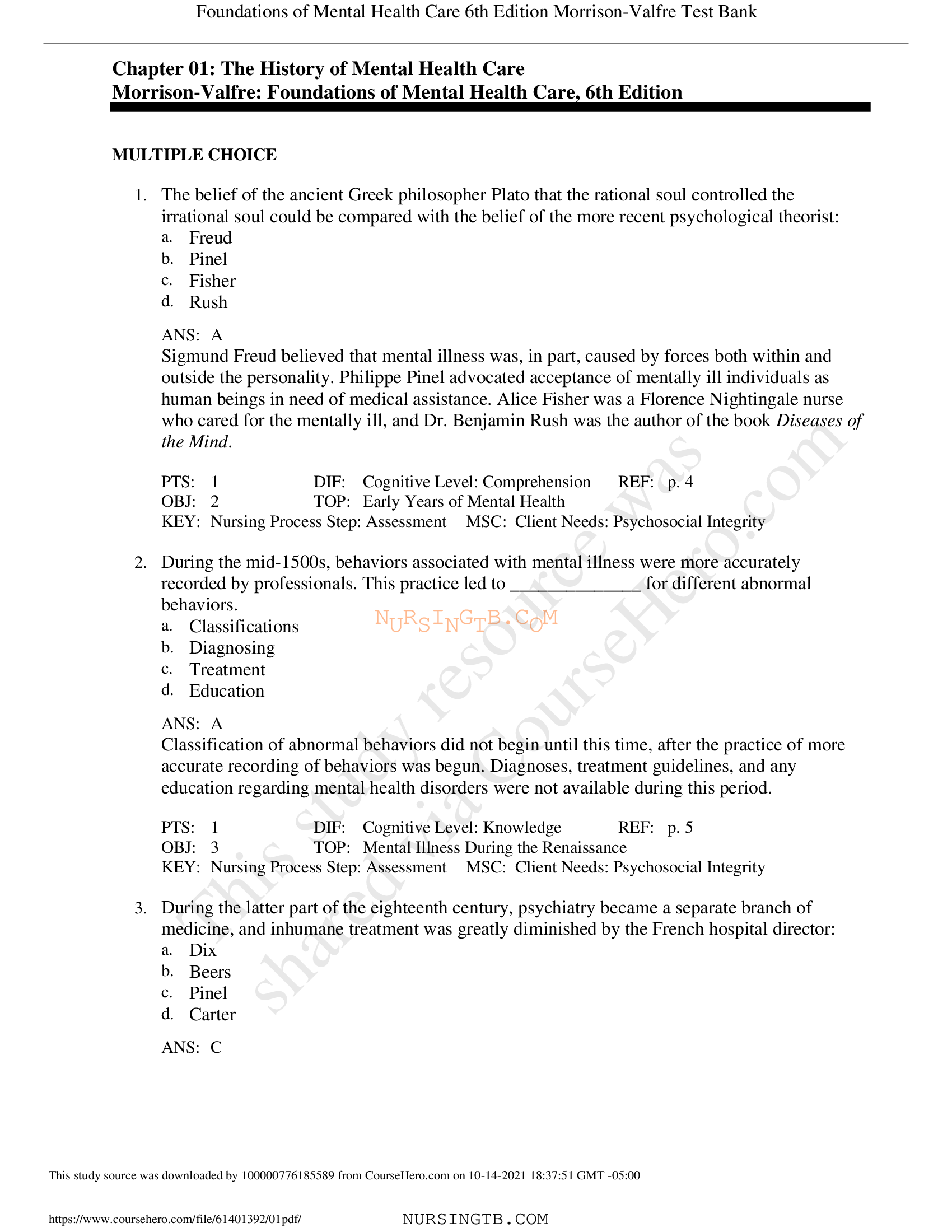
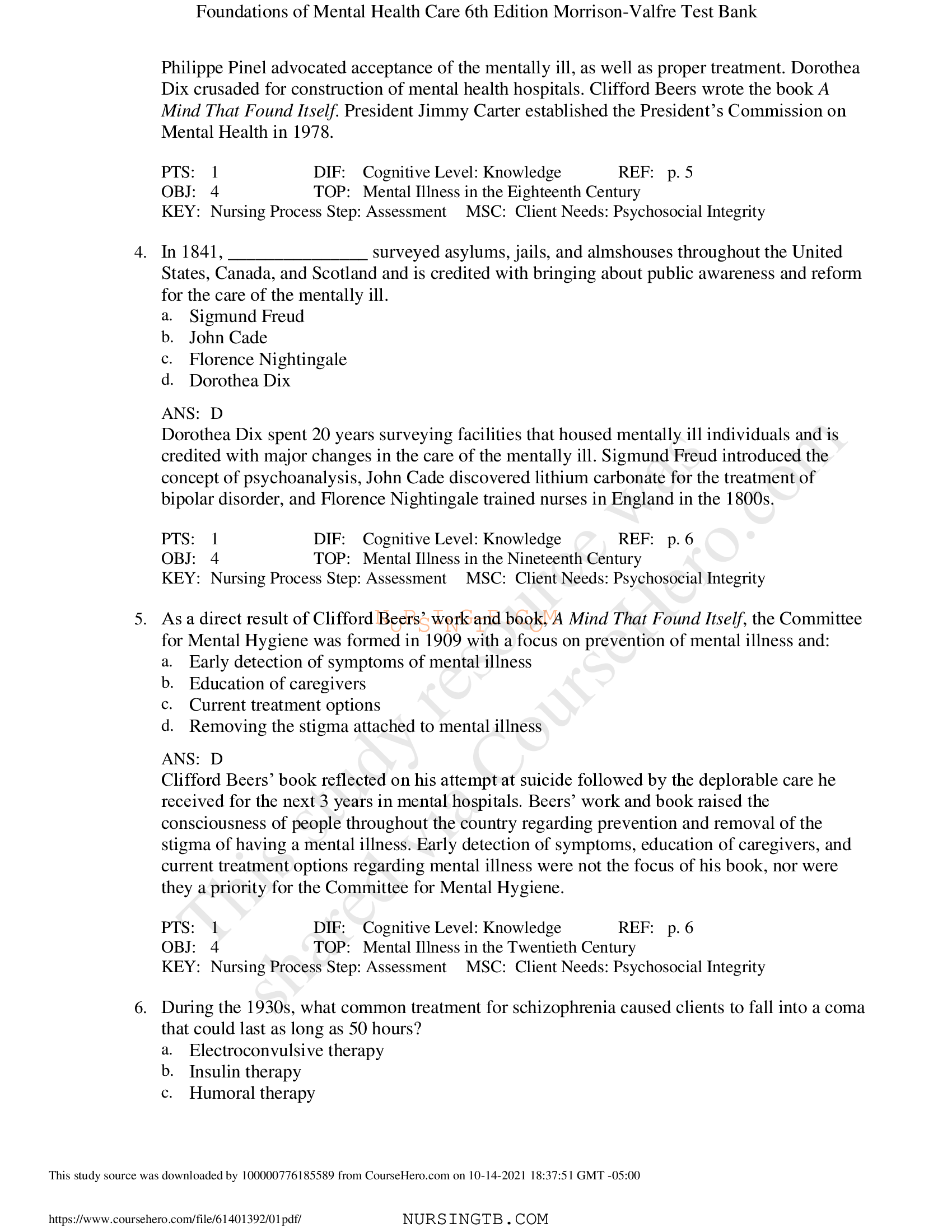
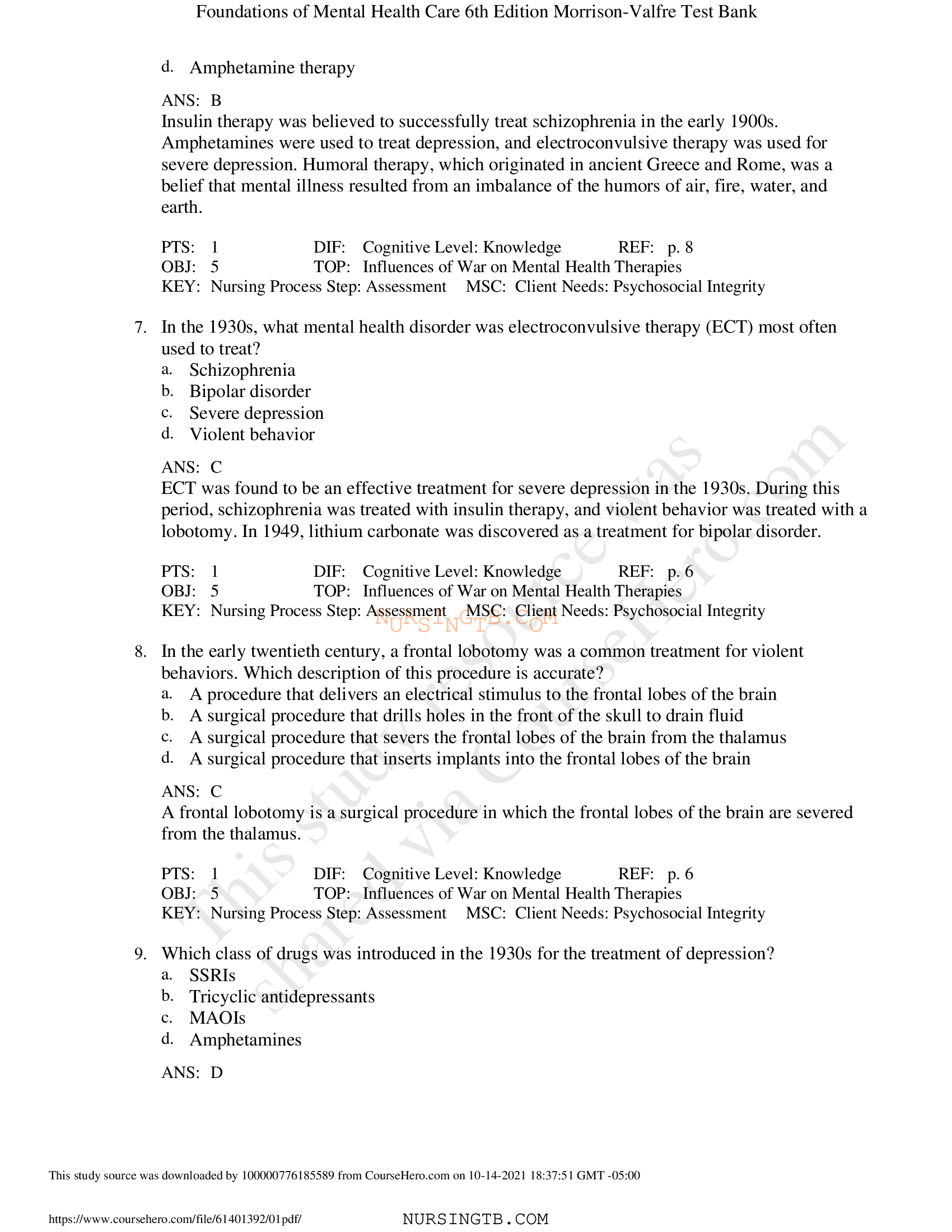
Chapter 01: The History of Mental Health Care Morrison-Valfre: Foundations of Mental Health Care, 6th Edition MULTIPLE CHOICE 1. The belief of the ancient Greek philosopher Plato that the rational soul controlled the irrational soul could be compared with the belief of the more recent psychological theorist: a. Freud b. Pinel c. Fisher d. Rush ANS: A Sigmund Freud believed that mental illness was, in part, caused by forces both within and outside the personality. Philippe Pinel advocated acceptance of mentally ill individuals as human beings in need of medical assistance. Alice Fisher was a Florence Nightingale nurse who cared for the mentally ill, and Dr. Benjamin Rush was the author of the book Diseases of the Mind. PTS: 1 DIF: Cognitive Level: Comprehension REF: p. 4 OBJ: 2 TOP: Early Years of Mental Health KEY: Nursing Process Step: Assessment MSC: Client Needs: Psychosocial Integrity 2. During the mid-1500s, behaviors associated with mental illness were more accurately recorded by professionals. This practice led to ______________ for different abnormal behaviors. a. Classifications b. Diagnosing c. Treatment d. Education ANS: A Classification of abnormal behaviors did not begin until this time, after the practice of more accurate recording of behaviors was begun. Diagnoses, treatment guidelines, and any education regarding mental health disorders were not available during this period. PTS: 1 DIF: Cognitive Level: Knowledge REF: p. 5 OBJ: 3 TOP: Mental Illness During the Renaissance KEY: Nursing Process Step: Assessment MSC: Client Needs: Psychosocial Integrity 3. During the latter part of the eighteenth century, psychiatry became a separate branch of medicine, and inhumane treatment was greatly diminished by the French hospital director: a. Dix b. Beers c. Pinel d. Carter ANS: C Philippe Pinel advocated acceptance of the mentally ill, as well as proper treatment. Dorothea Dix crusaded for construction of mental health hospitals. Clifford Beers wrote the book A Mind That Found Itself. President Jimmy Carter established the President’s Commission on Mental Health in 1978. PTS: 1 DIF: Cognitive Level: Knowledge REF: p. 5 OBJ: 4 TOP: Mental Illness in the Eighteenth Century KEY: Nursing Process Step: Assessment MSC: Client Needs: Psychosocial Integrity 4. In 1841, _______________ surveyed asylums, jails, and almshouses throughout the United States, Canada, and Scotland and is credited with bringing about public awareness and reform for the care of the mentally ill. a. Sigmund Freud b. John Cade c. Florence Nightingale d. Dorothea Dix ANS: D Dorothea Dix spent 20 years surveying facilities that housed mentally ill individuals and is credited with major changes in the care of the mentally ill. Sigmund Freud introduced the concept of psychoanalysis, John Cade discovered lithium carbonate for the treatment of bipolar disorder, and Florence Nightingale trained nurses in England in the 1800s. PTS: 1 DIF: Cognitive Level: Knowledge REF: p. 6 OBJ: 4 TOP: Mental Illness in the Nineteenth Century KEY: Nursing Process Step: Assessment MSC: Client Needs: Psychosocial Integrity 5. As a direct result of Clifford Beers’ work and book, A Mind That Found Itself, the Committee for Mental Hygiene was formed in 1909 with a focus on prevention of mental illness and: a. Early detection of symptoms of mental illness b. Education of caregivers c. Current treatment options d. Removing the stigma attached to mental illness ANS: D Clifford Beers’ book reflected on his attempt at suicide followed by the deplorable care he received for the next 3 years in mental hospitals. Beers’ work and book raised the consciousness of people throughout the country regarding prevention and removal of the stigma of having a mental illness. Early detection of symptoms, education of caregivers, and current treatment options regarding mental illness were not the focus of his book, nor were they a priority for the Committee for Mental Hygiene. PTS: 1 DIF: Cognitive Level: Knowledge REF: p. 6 OBJ: 4 TOP: Mental Illness in the Twentieth Century KEY: Nursing Process Step: Assessment MSC: Client Needs: Psychosocial Integrity 6. During the 1930s, what common treatment for schizophrenia caused clients to fall into a coma that could last as long as 50 hours? a. Electroconvulsive therapy b. Insulin therapy c. Humoral therapy d. Amphetamine therapy ANS: B Insulin therapy was believed to successfully treat schizophrenia in the early 1900s. Amphetamines were used to treat depression, and electroconvulsive therapy was used for severe depression. Humoral therapy, which originated in ancient Greece and Rome, was a belief that mental illness resulted from an imbalance of the humors of air, fire, water, and earth. PTS: 1 DIF: Cognitive Level: Knowledge REF: p. 8 OBJ: 5 TOP: Influences of War on Mental Health Therapies KEY: Nursing Process Step: Assessment MSC: Client Needs: Psychosocial Integrity 7. In the 1930s, what mental health disorder was electroconvulsive therapy (ECT) most often used to treat? a. Schizophrenia b. Bipolar disorder c. Severe depression d. Violent behavior ANS: C ECT was found to be an effective treatment for severe depression in the 1930s. During this period, schizophrenia was treated with insulin therapy, and violent behavior was treated with a lobotomy. In 1949, lithium carbonate was discovered as a treatment for bipolar disorder. PTS: 1 DIF: Cognitive Level: Knowledge REF: p. 6 OBJ: 5 TOP: Influences of War on Mental Health Therapies KEY: Nursing Process Step: Assessment MSC: Client Needs: Psychosocial Integrity 8. In the early twentieth century, a frontal lobotomy was a common treatment for violent behaviors. Which description of this procedure is accurate? a. A procedure that delivers an electrical stimulus to the frontal lobes of the brain b. A surgical procedure that drills holes in the front of the skull to drain fluid c. A surgical procedure that severs the frontal lobes of the brain from the thalamus d. A surgical procedure that inserts implants into the frontal lobes of the brain ANS: C A frontal lobotomy is a surgical procedure in which the frontal lobes of the brain are severed from the thalamus. PTS: 1 DIF: Cognitive Level: Knowledge REF: p. 6 OBJ: 5 TOP: Influences of War on Mental Health Therapies KEY: Nursing Process Step: Assessment MSC: Client Needs: Psychosocial Integrity 9. Which class of drugs was introduced in the 1930s for the treatment of depression? a. SSRIs b. Tricyclic antidepressants c. MAOIs d. Amphetamines ANS: D In the 1930s, amphetamines were found to boost the spirits of depressed people. SSRIs, tricyclic antidepressants, and MAOIs are antidepressant agents, but they were not discovered until much later. PTS: 1 DIF: Cognitive Level: Knowledge REF: p. 6 OBJ: 5 TOP: Influences of War on Mental Health Therapies KEY: Nursing Process Step: Assessment MSC: Client Needs: Psychosocial Integrity 10. In 1937, Congress passed the Hill-Burton Act, which was significant for the treatment of mental health because it funded: a. Research on drugs for the treatment of mental health disorders b. Training of mental health professionals c. Construction of psychiatric units in facilities throughout North America d. Development of community mental health clinics ANS: C The Hill-Burton Act provided money for the construction of psychiatric units in the United States. Research on drugs was not a part of the Hill-Burton Act. Training of mental health professionals was funded by the National Mental Health Act of 1946, and community mental health centers were not instituted until the 1960s. PTS: 1 DIF: Cognitive Level: Knowledge REF: p. 6 OBJ: 5 | 9 TOP: Influences of War on Mental Health Therapies KEY: Nursing Process Step: Assessment MSC: Client Needs: Psychosocial Integrity 11. The National Mental Health Act of 1946 provided a means for funding of programs that promote research on mental health and: a. Development of mental health clinics in the community b. Training of mental health professionals c. Treatment for veterans suffering from mental health disorders d. Educating the public about mental illness ANS: B The National Mental Health Act of 1946 provided much needed training for individuals who cared for patients with mental health disorders. Community mental health clinics were initiated in the 1960s, treatment for veterans was not funded by this act, and education of the public occurred later. PTS: 1 DIF: Cognitive Level: Knowledge REF: p. 6 OBJ: 5 | 9 TOP: Influences of War on Mental Health Therapies KEY: Nursing Process Step: Assessment MSC: Client Needs: Psychosocial Integrity 12. Which of the following best describes the disorder that was first recognized in veterans following the Korean and Vietnam Wars? a. Depression b. Bipolar disorder c. Post-traumatic stress disorder d. Paranoid schizophrenic disorder ANS: C Posttraumatic stress disorder was initially discovered in veterans who had been involved in armed conflicts. The other disorders also occur in veterans but were not first recognized in soldiers who were fighting wars. PTS: 1 DIF: Cognitive Level: Knowledge REF: p. 6 OBJ: 5 TOP: Influences of War on Mental Health Therapies KEY: Nursing Process Step: Assessment MSC: Client Needs: Psychosocial Integrity 13. The introduction of ___________ in the 1950s led to the deinstitutionalization of many mentally ill individuals. a. Psychotherapeutic drugs b. Community mental health clinics c. Residential treatment centers d. State mental health facilities ANS: A Psychotherapeutic drugs allowed for better control of behaviors than did other therapies alone during the 1950s. Patients were being released from state mental health facilities as a result of psychotherapeutic drug therapy. Community mental health clinics and residential treatment centers resulted from the deinstitutionalization of patients. PTS: 1 DIF: Cognitive Level: Knowledge REF: p. 7 OBJ: 6 TOP: Introduction of Psychotherapeutic Drugs KEY: Nursing Process Step: Assessment MSC: Client Needs: Psychosocial Integrity 14. In 1949, an Australian physician discovered which therapy to be an effective treatment for bipolar (manic-depressive) illness? a. Insulin therapy b. Water/ice therapy c. Lithium carbonate therapy d. Electroconvulsive therapy ANS: C To this day, lithium is a treatment that is used to effectively balance the manic states and depressive states of bipolar disorder. None of the other therapies listed are effective for bipolar disorder. PTS: 1 DIF: Cognitive Level: Knowledge REF: p. 7 OBJ: 6 TOP: Introduction of Psychotherapeutic Drugs KEY: Nursing Process Step: Assessment MSC: Client Needs: Psychosocial Integrity 15. In the early 1960s, a committee appointed by President John F. Kennedy recommended the development of a new approach to the way mental health care was administered, with an emphasis on the introduction of: a. Psychotherapeutic drugs b. State mental health care systems c. Community mental health centers d. Deinstitutionalization of patients ANS: C The emergence of community mental health centers was necessary, in part because of the massive deinstitutionalization of patients from state mental health care facilities after the introduction of psychotherapeutic drugs in the 1950s. PTS: 1 DIF: Cognitive Level: Knowledge REF: p. 7 OBJ: 7 TOP: Introduction of Psychotherapeutic Drugs KEY: Nursing Process Step: Assessment MSC: Client Needs: Psychosocial Integrity 16. The Mental Health Systems Act of 1980 was one of the most progressive mental health bills in the history of the United States, but its enactment was interrupted by the: a. Election of a new president b. Appointment of a new Surgeon General c. Rapid expansion of community centers d. National Alliance on Mental Illness (NAMI) surveys ANS: A The election of a new president and his administration led to drastic cuts in federal funding for mental health programs. None of the other three choices were a part of the Mental Health Systems Act of 1980. PTS: 1 DIF: Cognitive Level: Knowledge REF: p. 7 OBJ: 9 TOP: Congressional Actions KEY: Nursing Process Step: Assessment MSC: Client Needs: Psychosocial Integrity 17. The Omnibus Budget Reform Act (OBRA) of 1987 prevented the housing of people with chronic mental illness in: a. Nursing homes b. State mental health facilities c. Residential treatment centers d. Homeless shelters ANS: A Many mentally ill, especially elderly, people were inappropriately placed in nursing homes with personnel who were not trained to care for these people. OBRA prevented this practice. State mental health facilities, residential treatment centers, and homeless shelters were not addressed in the OBRA of 1987. PTS: 1 DIF: Cognitive Level: Knowledge REF: p. 8 OBJ: 9 TOP: Congressional Actions KEY: Nursing Process Step: Assessment MSC: Client Needs: Psychosocial Integrity 18. In the late 1980s, government funding for mental health care dwindled, and most insurance companies __________ coverage for psychiatric care. a. Withdrew b. Increased c. Decreased d. Added ANS: A Unfortunately, insurance companies followed the trend of the national government to the point of actually dropping coverage for psychiatric care. PTS: 1 DIF: Cognitive Level: Knowledge REF: p. 1 OBJ: 9 TOP: Congressional Actions KEY: Nursing Process Step: Assessment MSC: Client Needs: Psychosocial Integrity 19. In 2006, the National Alliance on Mental Illness (NAMI) conducted a comprehensive survey and grading of state mental health care for adults and learned that the overall grade for care was: a. “A” b. “B” c. “C” d. “D” ANS: D The NAMI gave a grade of “D” to the mental health care system based on poor funding, limited availability of care, and patients’ lack of access to mental health care. PTS: 1 DIF: Cognitive Level: Knowledge REF: p. 6 OBJ: 9 TOP: Congressional Actions KEY: Nursing Process Step: Assessment MSC: Client Needs: Psychosocial Integrity 20. Which of the following persons has the greatest risk for developing ineffective coping behaviors? a. The middle-aged man whose diet is high in saturated fat and who has a 20-year history of tobacco use b. The single 30-year-old female facing the death of her father c. The 19-year-old college student with a family history of schizophrenia d. The 9-year-old whose parents are nurturing but provide chores and responsibilities ANS: C Mental health is influenced by three factors: inherited characteristics, childhood nurturing, and life circumstances. The risk for developing ineffective coping behaviors increases when problems exist in any one of these areas. PTS: 1 DIF: Cognitive Level: Knowledge REF: p. 2 OBJ: 2 TOP: Introduction KEY: Nursing Process Step: Assessment MSC: Client Needs: Psychosocial Integrity 21. In the early 1900s the first theory of mental illness that showed behavior could be changed is attributed to: a. Beers b. Dix c. Freud d. Pinel ANS: C Freud was the first person who succeeded in explaining human behavior in psychological terms and in demonstrating that behavior can be changed under the proper circumstances. PTS: 1 DIF: Cognitive Level: Knowledge REF: p. 8 OBJ: 5 TOP: Psychoanalysis KEY: Nursing Process Step: Assessment MSC: Client Needs: Psychosocial Integrity MULTIPLE RESPONSE 1. The humoral theory of disease embraced by Hippocrates required a balance of which elements? (Select all that apply.) a. Fire b. Water c. Light d. Air e. Earth ANS: A, B, D, E Hippocrates viewed mental illness as a result of an imbalance of humors—the fundamental elements of air, fire, water, and earth. Each basic element had a related humor or part in the body. PTS: 1 DIF: Cognitive Level: Knowledge REF: p. 2 OBJ: 2 TOP: Greece and Rome KEY: Nursing Process Step: Assessment MSC: Client Needs: Psychosocial Integrity 2. Which aspects of adult mental health care systems did the National Alliance on Mental Illness survey focus on? (Select all that apply.) a. Availability of care b. Access to care c. Regulation of medications d. Increased funding ANS: A, B, D In 2006, the National Alliance on Mental Illness (NAMI) conducted the “first comprehensive survey and grading of state adult mental health care systems conducted in more than 15 years” (NAMI, 2006). Their results revealed a fragmented system with an overall grade of D. Recommendations focused on increased funding, availability of care, access to care, and greater involvement of consumers and their families. PTS: 1 DIF: Cognitive Level: Knowledge REF: p. 8 OBJ: 9 TOP: Twenty-first century KEY: Nursing Process Step: Assessment MSC: Client Needs: Psychosocial Integrity 3. Mental health is said to be influenced by which of the following factors? (Select all that apply.) a. Diet and nutritional intake b. Inherited characteristics c. Activities of daily living d. Childhood nurturing e. Life circumstances ANS: B, D, E Mental health is influenced by three factors: inherited characteristics, childhood nurturing, and life circumstances. The risk for developing ineffective coping behaviors increases when problems exist in any one of these areas. PTS: 1 DIF: Cognitive Level: Knowledge REF: p. 7 OBJ: 2 TOP: Congressional Actions KEY: Nursing Process Step: Assessment MSC: Client Needs: Psychosocial Integrity COMPLETION 1. During the middle ages, mentally ill patients often were burned at the stake and were greatly mistreated. In an attempt to treat mentally ill people more humanely, Bethlehem Hospital, more commonly called ___________, was created. ANS: Bedlam Bedlam was the nickname for Bethlehem Hospital, which prevented burning of mentally ill people at the stake but provided poor care for the mentally ill. PTS: 1 DIF: Cognitive Level: Knowledge REF: p. 3 OBJ: 3 TOP: Mental Illness in the Middle Ages KEY: Nursing Process Step: Assessment MSC: Client Needs: Psychosocial Integrity

Contact the Seller

Please Sign In to contact this seller.


  • 👎  Report Copyright Violation

Frequently Asked Questions

What Do I Get When I Buy This Study Material?

+

When you buy a study material on Passing Grades, an instant download link will be sent directly to your email, giving you access to the file anytime after payment is completed.

Is Passing Grades a Trusted Platform?

+

Yes, Passing Grades is a reputable students’ marketplace with a secure payment system and reliable customer support. You can trust us to ensure a safe and seamless transaction experience.

Will I Be Stuck with a Subscription?

+

No, all purchases on Passing Grades are one-time transactions. You only pay for the notes you choose to buy, with no subscriptions or hidden fees attached.

Who Am I Buying These Study Materials From?

+

Passing Grades is a marketplace, which means you are purchasing the document from an individual vendor, not directly from us. We facilitate the payment and delivery process between you and the vendor.

Does Passing Grades Offer Free Study Materials?

+

Yes, sellers on Passing Grades have uploaded numerous free test banks, exams, practice questions, and class notes that can be downloaded at no cost.

Pasinggrades - Quality Study Materials

USD 10

    • Quality checked by Pasing Grades
    • 100% satisfaction guarantee
    • Seller: Yna
Buy PDF $10

Seller Information

Yna

Member since October 2021

  • icon
  • icon
View Profile
  • total sales

    0
  • Favourites

    0
  • Comments

    0
    ( 0 Ratings )

Item Information

  • Uploaded

    14 October 2021

  • Updated

    01 October 2025

  • Category

    Nursing

  • Item Type

    exam

  • Tags

    Morrison Valfre Foundations of Mental Health Care 6th Edition Test Bank mental health health care

Related Exam Prep Guides by Yna

ANATOMY BSC2346 A&P Module 03 Case Study,latest 2020 complete solutions 100% correct
View Document

ANATOMY BSC2346 A&P ...

  • Yna

    Yna

  • exam

ANATOMY BSC2346 A&P Module 03 Case Study,latest 2020 complete solutions 100% correct...

10 USD

0

0

Experience Overview FOCUSED EXAM COUGH Patient Danny Rivera Digital Clinical Experience Score 100%
View Document

Experience Overview ...

  • Yna

    Yna

  • exam

Experience Overview FOCUSED EXAM COUGH Patient Danny Rivera Digital Clinical Experience Score 100%...

10 USD

0

0

Health Science 2250 final exam notes
View Document

Health Science 2250 ...

  • Yna

    Yna

  • exam

Health Science 2250 final exam notes...

10 USD

0

0

Purchase

Download link will be sent to this email immediately after purchase.

IMPORTANT LINKS

  • How To Upload Class Notes
  • Selling Tips
  • Passing Grades's Study Materials
  • Scholarships for International Students 2026

POPULAR CATEGORIES

  • Law
  • Accounting
  • English
  • Psychology
  • Business
  • Nursing
  • Computer Science
  • General

View Document

  • Blog
  • Contact
  • Delivery Policy
  • Latest Scholarships Around the World
  • How to Pass Bar Exams: Passing Grades’ Strategies
  • How to Study and Pass the CPA Exam
  • All Test Banks
  • Faq
  • Copyright Claims
  • Privacy Policy
  • Terms of Use

KNOWLEDGE BASE

  • How to Write A+ Grade Good Research Paper
  • How to Manage Stress During Exam Period
  • Best Time to Study
  • How to Pass NCLEX-RN Exam
  • How To Effectively Utilize Test Banks
  • Popular Shadow Health Exam Assessments
  • Popular HESI Case Studies
  • How to Prepare for a Nursing Career
  • The Importance Of Summaries in Exam Revisvion

© 2026 Pasing Grades. All rights reserved.