Pasing Grades
  • Start Selling
  • Blog
  • Contact
  • 0

    Your cart is empty!

English

  • English
  • Spanish
  • Arabic
Create Account Sign In
  • Library
    • New Prep Guides
    • Featured Prep Guides
    • Free Exam Prep Guides
    • Best sellers
  • General
  • Nursing
    • Research Paper
    • Case Study
    • Discussion Post
    • Assignment
    • Exam
    • Practice Questions and Answers
    • Test Bank
    • solutions manual
  • Accounting
    • Case Study
    • Thesis
    • Study Guide
    • Summary
    • Research Paper
    • test bank
  • English
    • Creative Writing
    • Research Paper
    • Summary
    • Rhetorics
    • Literature
    • Journal
    • Exam
    • Grammar
    • Discussion Post
    • Essay
  • Psychology
    • Hesi
    • Presentation
    • Essay
    • Summary
    • Study Guide
    • Essay
    • Solution Manual
    • Final Exam Review
    • Class Notes
    • test bank
  • Business
    • Lecture Notes
    • Solution Manual
    • Presentation
    • Business Plan
    • Class Notes
    • Experiment
    • Summary
    • Practice Questions
    • Study Guide
    • Case Study
    • test bank
    • Exam
  • More
    • Computer Science
    • Economics
    • Statistics
    • Engineering
    • Biology
    • Religious Studies
    • Physics
    • Chemistry
    • Mathematics
    • History
    • Sociology
    • Science
    • Philosophy
    • Law
  • Pages
    • About Us
    • Selling Tips
    • Delivery Policy
    • Faq
    • Privacy Policy
  • Flash Sale
  • Home
  • Lutz's Test Bank for Nutrition and Diet Therapy 7th Edition by Erin E. Mazur

Lutz's Test Bank for Nutrition and Diet Therapy 7th Edition by Erin E. Mazur

Preview page 1 Preview page 2 Preview page 3
Add To Favorites

Share this item Share this item

  • Item Details
  • Comments (0)
  • Reviews (0)
  • Contact Seller

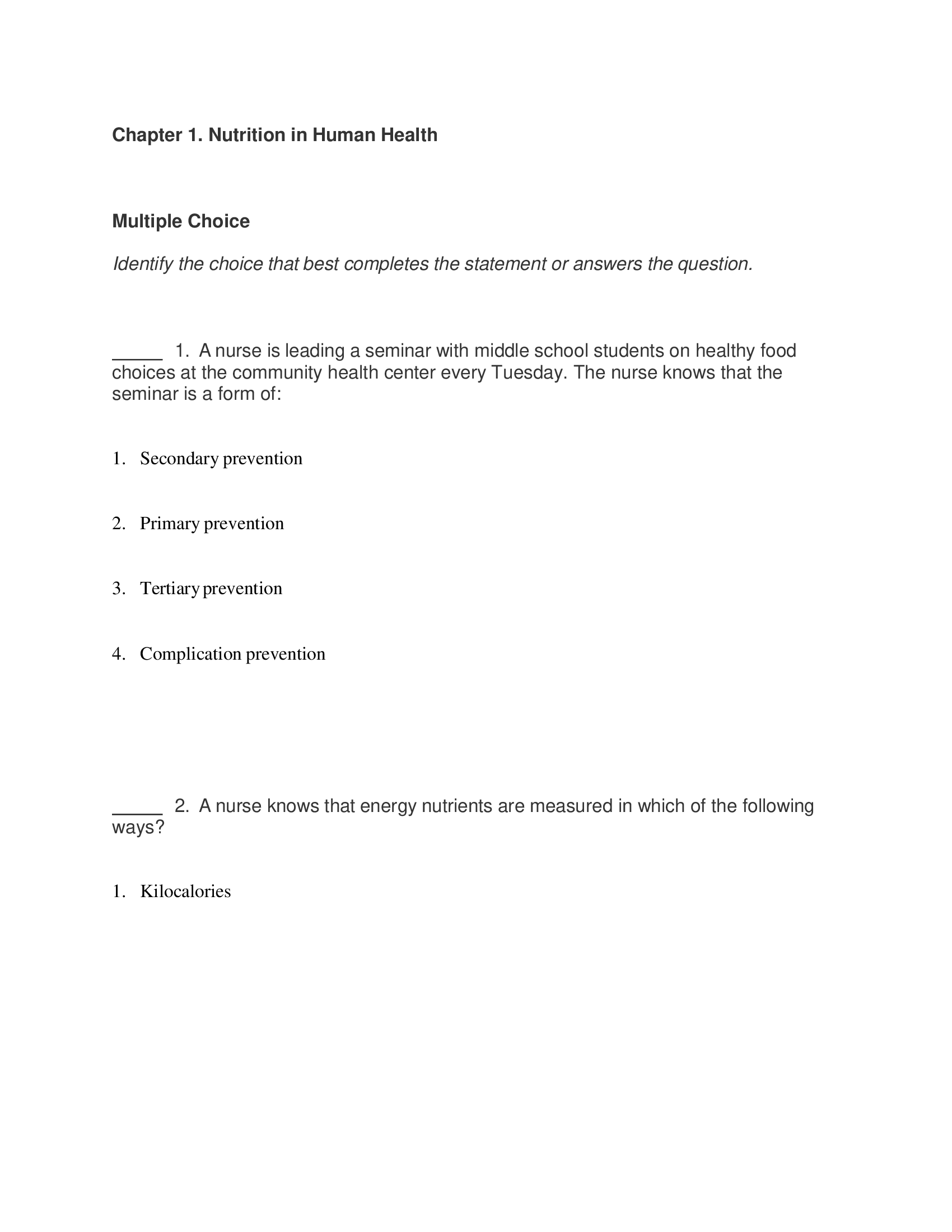
Test Bank for Lutz's Nutrition and Diet Therapy 7th Edition by Erin E. Mazur Chapter 1. Nutrition in Human Health 


Multiple Choice


Identify the choice that best completes the statement or answers the question. 


  1. A nurse is leading a seminar with middle school students on healthy food 

choices at the community health center every Tuesday. The nurse knows that the

seminar is a form of: 


1. Secondary prevention 


2. Primary prevention 


3. Tertiary prevention 


4. Complication prevention 


  2. A nurse knows that energy nutrients are measured in which of the following 

ways? 


1. Kilocalories 


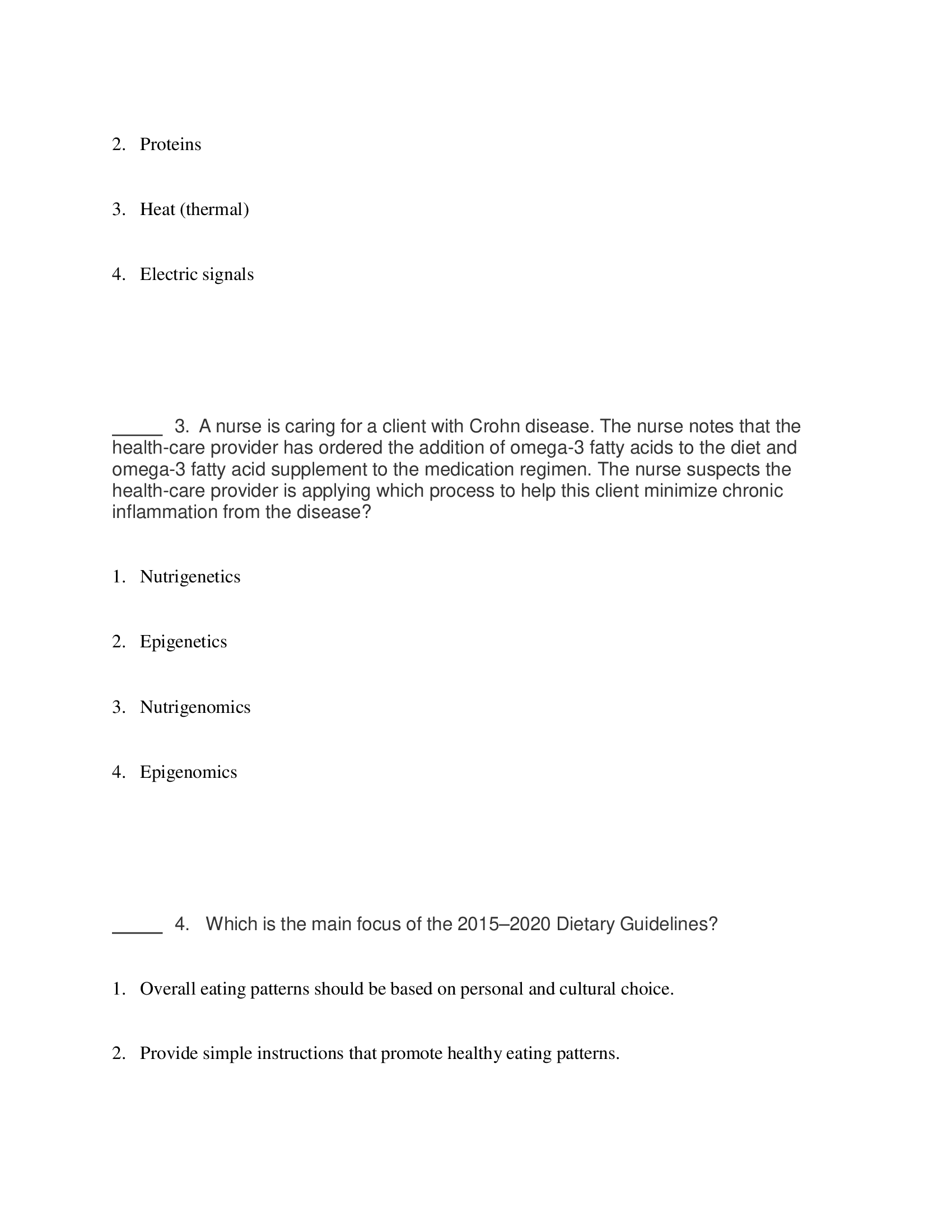
2. Proteins 


3. Heat (thermal) 


4. Electric signals 


  3. A nurse is caring for a client with Crohn disease. The nurse notes that the 

health-care provider has ordered the addition of omega-3 fatty acids to the diet and

omega-3 fatty acid supplement to the medication regimen. The nurse suspects the

health-care provider is applying which process to help this client minimize chronic

inflammation from the disease? 


1. Nutrigenetics 


2. Epigenetics 


3. Nutrigenomics 


4. Epigenomics 


  4. Which is the main focus of the 2015–2020 Dietary Guidelines? 


1. Overall eating patterns should be based on personal and cultural choice. 


2. Provide simple instructions that promote healthy eating patterns. 


3. Monitor dietary intake through a telephone survey. 


4. Increase the number of schools providing fruits and vegetables. 


  5. Which statement made to a nurse about food insecurity is concerning? 


1. “My mom cooks once a week and we go out to eat the other days.” 


2. “We often eat at the local shelter when we can.” 


3. “I often feel like I don’t want to eat; I’m getting so fat!” 


4. “I love to cook. I often cook for my friends and family.” 


  6. In order to make suitable recommendations about nutritional status, which 

criteria must the nurse gather during assessment from a client diagnosed with diabetes? 


1. Reported dietary intake and physical examination 


2. Anthropomorphic measurements and physical examination 


3. Food diary and interview 


4. Dietary recalls and self-report 


  7. A nurse is caring for a client diagnosed with diverticulitis. Which question 

asked during nutritional assessment is most appropriate for the nurse to ask? 


1. “Do you consume meat at most of your meals?” 


2. “Doesn’t everyone like grilled chicken?” 


3. “What comfort foods do you enjoy?” 


4. “What types of food do you do you consume regularly?” 


  8. A nurse is caring for a client admitted to the emergency department (ED). 

When the nurse learns that the client is an Alaskan native, which diagnosis of

acculturation does the nurse suspect? 


1. COPD 


2. Diabetes 


3. Crohn disease 


4. Gastrointestinal bleeding 

            9. When taking care of a client with irritable bowel syndrome (IBS), the nurse

talks about new genetic knowledge that could personalize nutrition prescriptions. The

nurse does this to: 


1. Cure the disease 


2. Research proper use of prescriptions 


3. Utilize nutrients properly 


4. Help address nutritional needs 


Multiple Response


Identify one or more choices that best complete the statement or answer the question. 


  10. A nurse is caring for a client diagnosed with bulimia. In addition to the nurse,

which other members of the health-care team are involved in the comprehensive

nutritional assessment? Select all that apply. 


1. Social worker 


2. Laboratory staff 


3. Dietitian 


4. Physician 


5. Physical therapist 


11. When discharging a client who had gastric-bypass surgery, the nurse makes 

sure to include which information in the client’s discharge planning? Select all that

apply. 


1. Take vitamins daily. 


2. Drink plenty of water. 


3. Include polyphenols in the diet. 


4. Limit carbohydrates and fats. 


5. Eat plenty of protein shakes. 


12. Which are functions of nutrients? Select all that apply. 


1. Serve as a source of heat 


2. Support the growth of tissue 


3. Aid in the loss of weight 


4. Help prevent diabetes 


5. Provide control of disease 


          13. A nurse received report from the GI department and is waiting to admit a

client diagnosed with lactose intolerance. The nurse suspects that the client may be

from which of the following cultures? Select all that apply. 


1. Native American 


2. Italian 


3. Asian 


4. Irish 


5. African 


14. Based on the 2015–2020 DHHS Dietary Guidelines for Americans, which 

recommendations would a nurse manager follow to help reduce the risk for major

chronic diseases in the health clinic? Select all that apply. 


1. Dietary practices should accommodate food preferences. 


2. Dietary practices should accommodate cultural traditions. 


3. Dietary practices should accommodate healthy eating patterns. 


4. Dietary practices should accommodate economic resources. 


5. Dietary practices should accommodate sample menus. 


          15. A nurse is discharging a client to home and discussing food insecurity. Which

component of food insecurity has important implications for health and nutrition? Select

all that apply. 


1. Poverty 


2. Rural living 


3. Health 


4. Wealth 


5. Disease 


16. Which steps to determine a client’s dietary status are similar to that of the 

nursing process? Select all that apply. 


1. Nutritional screening 


2. Physical examination 


3. Prioritizing problems 


4. Dietitian referral 


5. Using dietary journals 


  17. A nurse is reviewing dietary intake with a 45-year-old client with new-onset

diabetes. Which components does the nurse expect to discuss? Select all that apply. 


1. Estimated Average Requirements (EARs) 


2. Body Mass Index (BMI) 


3. Recommended Dietary Allowances (RDAs) 


4. Adequate Intakes (AIs) 


5. Acceptable Macronutrient Distribution Range (AMDR) 


18. Which effects can acculturation have on clients from another culture? 


1. A decrease in risk for disease 


2. An increase in knowledge of healthy foods 


3. A decrease in consumption of fruits and vegetables 


4. An increase in knowledge of proper food preparation 


5. An increase in awareness of healthy food choices 


  19. A nurse is taking care of a client diagnosed with anorexia. What are the

components of nutritional care? 


1. Analysis and implementation 


2. Assessment and planning 


3. Evaluation and implementation 


4. Subjective and objective data 


5. Nutritional assessment and objective data 


Chapter 1. Nutrition in Human Health 


Answer Section 


MULTIPLE CHOICE 


1. ANS: 2 


Chapter: Chapter 1, Nutrition in Human Health 


Objective: A. Describe the relationship between nutrition and health. 


Page: 3 


Heading: The Language of Nutrition: Disease Prevention 


Integrated Processes: Teaching and Learning 


Client Need: Health Promotion and Maintenance 


Cognitive Level: Application 


Concept: Nutrition 


Difficulty: Moderate 


Feedback 


1 This is incorrect. Secondary prevention is the establishment of monitoring

techniques to discover diseases early enough to provide the opportunity to

control their effects. 


2 This is correct. The information the nurse presents to the class is

considered a primary prevention level of disease prevention. The nurse is

teaching about nutritional changes that can prevent diseases caused by

overeating. 


3 This is incorrect. Tertiary prevention is the use of treatment techniques

after disease has occurred to prevent further complication. 


4 This is incorrect. The class is about the different categories of disease

prevention. Actions meant to prevent complications or to promote

maximum adaptation would be considered tertiary prevention. 


PTS: 1 

CON: Nutrition 


2. ANS: 1 

Chapter: Chapter 1, Nutrition in Human Health 


Objective: B. Identify the six classes of nutrients, their functions, and their essentiality. 


Page: 4 


Heading: The Language of Nutrition: Disease Prevention 


Integrated Processes: Teaching and Learning 


Client Need: Health Promotion and Maintenance 


Cognitive Level: Application 


Concept: Nutrition 


Difficulty: Moderate 


Feedback 


1 This is correct. The energy both in foods and in the body is measured in

kilocalories, abbreviated kcal. 


2 This is incorrect. Carbohydrates, fats, and proteins, the nutrients that

supply energy, are referred to as the energy nutrients. 


3 This is incorrect. Energy exists in a variety of forms: electric, thermal

(heat), chemical, mechanical, and nuclear. 


4 This is incorrect. Chemical energy is transformed into electric signals in

nerves and into mechanical energy in muscles. 


PTS: 1 

CON: Nutrition 


3. ANS: 3 


Chapter: Chapter 1, Nutrition in Human Health 


Objective: C. Recognize the possible relationship of genetics to the adequacy of

nutrition 


Page: 5 

Heading: Nutritional Genomics 


Integrated Processes: Teaching and Learning 


Client Need: Health Promotion and Maintenance 


Cognitive Level: Application 


Concept: Evidence-Based Practice 


Difficulty: Moderate 


Feedback 


1 This is incorrect. Nutrigenetics detects gene variants within an individual to

identify nutritional factors that trigger dysfunction or disease. 


2 This is incorrect. Epigenetics is the process that regulates how and when

genes are turned on and off. 


3 This is correct. Nutrigenomics is the study of the interaction between one’s

diet and his or her genes. These interactions can markedly influence

digestion, absorption, and elimination, as well as influence their sites of

actions. 


4 This is incorrect. Epigenomics is the study of the process of epigenetics. 


PTS: 1 

CON: Evidence-Based Practice 


4. ANS: 1 


Chapter: Chapter 1, Nutrition in Human Health 


Objective: D. Compare dietary intakes in the United States with the U.S. Department of

Agriculture Dietary Guidelines. 


Page: 7 


Heading: Dietary Guidelines 


Integrated Processes: Teaching and Learning 

Client Need: Health Promotion and Maintenance 


Cognitive Level: Comprehension 


Concept: Health Promotion 


Difficulty: Moderate 


Feedback 


1 This is correct. The Dietary Guidelines for Americans, 2015-2020 focuses

on overall eating patterns, which should be utilized as a flexible framework

based upon an individual’s personal and cultural choice. 


2 This is incorrect. MyPlate is a USDA program developed to provide simple-

to-follow guidelines and graphics, which promote healthy eating patterns. 


3 This is incorrect. The Centers for Disease Control (CDC) monitors dietary

intake through a telephone survey. 


4 This is incorrect. The Centers for Disease Control (CDC) recommends

increasing the number of schools providing fruits and vegetables. 


PTS: 1 

CON: Nutrition 


5. ANS: 2 


Chapter: Chapter 1, Nutrition in Human Health 


Objective: E. Discuss issues related to food insecurity. 


Page: 9 


Heading: Food Insecurity 


Integrated Processes: Teaching and Learning 


Client Need: Health Promotion and Maintenance 


Cognitive Level: Application 


Concept: Nutrition 

Difficulty: Moderate 


Feedback 


1 This is incorrect. This statement is not about food insecurity, as the client

eats every day. 


2 This is correct. This statement conveys food insecurity because it

expresses that the client is unsure whether food will be attainable or

affordable. Food insecurity is often associated with poverty and low

income. 


3 This is incorrect. This statement indicates an aversion to food, and could

be associated with anorexia, rather than food insecurity. 


4 This is incorrect. This statement indicates that food is readily available and

does not indicate food insecurity. 


PTS: 1 

CON: Nutrition 

6. ANS: 1 


Chapter: Chapter 1, Nutrition in Human Health 


Objective: 6. List and describe the steps in providing nutritional care. 


Page: 12 


Heading: Subjective Data; Objective Data 


Integrated Processes: Teaching and Learning 


Client Need: Health Promotion and Maintenance 


Cognitive Level: Application 


Concept: Metabolism 


Difficulty: Moderate 


Feedback 


1 This is correct. Subjective and objective data are needed to make suitable

recommendations about nutritional status. 


2 This is incorrect. This information is objective only and is not suitable as

the sole criterion on nutritional status. 


3 This is incorrect. This information is subjective only and is not suitable as

the sole criterion on nutritional status. 


4 This is incorrect. This information is subjective only and is not suitable as

the sole criterion on nutritional status. 


PTS: 1 

CON: Metabolism 


7. ANS: 4 


Chapter: Chapter 1, Nutrition in Human Health 


Objective: 8. Give an example of a provider’s use of, and respect for, cultural beliefs

having a favorable impact on a health outcome for a client. 

Page: 18 


Heading: Impact of Cultural Nutrition 


Integrated Processes: Teaching and Learning 


Client Need: Health Promotion and Maintenance 


Cognitive Level: Application 


Concept: Nutrition 


Difficulty: Moderate 


Feedback 


1 This is incorrect. This question implies that the client includes meat in his

or her diet, which may not necessarily be the case. Diet preferences must

be assessed, and not assumed. 


2 This is incorrect. This question implies that the client consumes poultry

based on the nurse’s own assumptions about what “everyone” likes to

consume. It is important for the nurse to assess dietary preferences rather

than assume them. 


3 This is incorrect. This question assumes that the client enjoys comfort

foods and would not help the nurse accurately assess the client’s

nutritional preferences. 


4 This is correct. Dietary preferences differ among people and should be

assessed accordingly. This question allows the client to identify their

preferences, rather than expressing any of the nurse’s assumptions. 


PTS: 1 

CON: Nutrition 


8. ANS: 2 


Chapter: Chapter 1, Nutrition in Human Health 


Objective: 9. State the preferences and dietary restrictions of several cultural and

religious groups. 


Page: 19 


Heading: The Language of Nutrition: Disease Prevention 


Integrated Processes: Teaching and Learning 


Client Need: Health Promotion and Maintenance 


Cognitive Level: Application 


Concept: Metabolism 


Difficulty: Moderate 


Feedback 


1 This is incorrect. COPD is not an effect of acculturation. 


2 This is correct. Diabetes mellitus occurs in high numbers among widely

scattered indigenous populations undergoing acculturation. 


3 This is incorrect. Crohn disease is not an effect of acculturation. 


4 This is incorrect. GI bleeding is not an effect of acculturation. 


PTS: 1 

CON: Metabolism 


9. ANS: 3 


Chapter: Chapter 1, Nutrition in Human Health 


Objective: C. Recognize the possible relationship of genetics to the adequacy of

nutrition 


Page: 5 


Heading: Nutritional Genomics 


Integrated Processes: Teaching and Learning 


Client Need: Health Promotion and Maintenance 


Cognitive Level: Application 


Concept: Evidence-Based Practice 


Difficulty: Moderate 


Feedback 


1 This is incorrect. Nutrition prescriptions do not cure disease. 


2 This is incorrect. New genetic knowledge does not research proper use of

prescriptions. 


3 This is correct. New genetic knowledge offers the potential to personalize

nutrition prescriptions to avoid interactions between one’s diet and his or

her genes, which can adversely affect the body’s use of nutrients. 


4 This is incorrect. Nutrition prescriptions do not help address nutritional

needs. 


PTS: 1 

CON: Evidence-Based Practice 

MULTIPLE RESPONSE 


10. ANS:  1, 2, 3, 4 


Chapter: Chapter 1, Nutrition in Human Health 


Objective: 6. List and describe the steps in providing nutritional care. 


Page: 11 


Heading: Nutritional Care 


Integrated Processes: Teaching and Learning 


Client Need: Health Promotion and Maintenance 


Cognitive Level: Application 


Concept: Addiction and Behaviors 


Difficulty: Moderate 


Feedback 


1. This is correct. Many members of the health-care team are involved in a

comprehensive nutritional assessment, including the social worker. 


2. This is correct. Many members of the health-care team are involved in a

comprehensive nutritional assessment, including the laboratory staff. 


3. This is correct. Many members of the health-care team are involved in a

comprehensive nutritional assessment, including the dietitian. 


4. This is correct. Many members of the health-care team are involved in a

comprehensive nutritional assessment, including the physician. 


5. This is incorrect. Although there are many members of the health-care team

involved in a comprehensive nutritional assessment, the physical therapist is

not typically involved. 


PTS: 1 

CON: Addiction and Behaviors 

11. ANS: 1, 2, 3 


Chapter: Chapter 1, Nutrition in Human Health 


Objective: B. Identify the six classes of nutrients, their functions, and their essentiality. 


Page: 4 


Heading: The Language of Nutrition: Disease Prevention 


Integrated Processes: Teaching and Learning 


Client Need: Health Promotion and Maintenance 


Cognitive Level: Application 


Concept: Nutrition 


Difficulty: Moderate 


Feedback 


1. This is correct. Vitamins are essential nutrients that the body requires but

cannot manufacture sufficiently. 


2. This is correct. Water is an essential nutrient that participates in the continued

growth and maintenance of building body structures. 


3. This is correct. Polyphenols are found in plants and help stimulate the

immune system, prevent cell damage, and reduce inflammation. 


4. This is incorrect. Carbohydrates, fats, and proteins are nutrients that supply

energy. The client, in conjunction with the health-care team, including the

health-care provider and nutritionist, will develop a diet plan that is individual

to the client. 


5. This is incorrect. Protein shakes may contain nonessential nutrients that the

body may make from other substances. The quantity of any one component

of food and its usefulness of function varies and should be planned and

discussed with the health-care team. 


PTS: 1 

CON: Nutrition 


12. ANS: 1, 2 

Chapter: Chapter 1, Nutrition in Human Health 


Objective: B. Identify the six classes of nutrients, their functions, and their essentiality. 


Page: 4 


Heading: Nutrients: Functions 


Integrated Processes: Teaching and Learning 


Client Need: Health Promotion and Maintenance 


Cognitive Level: Comprehension 


Concept: Nutrition 


Difficulty: Moderate 


Feedback 


1. This is correct. All nutrients perform one or more functions, such as serving as

a source of energy or heat. 


2. This is correct. All nutrients perform one or more functions, such as

supporting the growth and maintenance of tissue. 


3. This is incorrect. Nutrients do not aid in weight loss. 


4. This is incorrect. Nutrients do not help prevent diabetes, but they may help

control it. 


5. This is incorrect. This is a secondary prevention function; nutrients do not

provide control of disease. 


PTS: 1 

CON: Nutrition 


13. ANS: 1, 3, 5 


Chapter: Chapter 1, Nutrition in Human Health 


Objective: C. Recognize the possible relationship of genetics to the adequacy of

nutrition. 

Page: 6 


Heading: Nutritional Genomics 


Integrated Processes: Teaching and Learning 


Client Need: Health Promotion and Maintenance 


Cognitive Level: Application 


Concept: Culture 


Difficulty: Moderate 


Feedback 


1. This is correct. According to nutrigenetics, a gene variant within an individual

can trigger nutritional dysfunction or disease. Lactose intolerance is more

common in individuals of Native American descent. 


2. This is incorrect. Lactose intolerance is less common in individuals of Italian 


descent. 


3. This is correct. According to nutrigenetics, a gene variant within an individual

can trigger nutritional dysfunction or disease. Lactose intolerance is more

common in individuals of Asian descent. 


4. This is incorrect. Lactose intolerance is not common in individuals of Irish

descent. 


5. This is correct. According to nutrigenetics, a gene variant within an individual

can trigger nutritional dysfunction or disease. Lactose intolerance is more

common in individuals of African descent. 


PTS: 1 

CON: Culture 


14. ANS: 1, 2, 4 


Chapter: Chapter 1, Nutrition in Human Health 


Objective: D. Compare dietary intakes in the United States with the U.S. Department of

Agriculture Dietary Guidelines. 


Page: 7 


Heading: Dietary Guidelines 


Integrated Processes: Teaching and Learning 


Client Need: Health Promotion and Maintenance 


Cognitive Level: Application 


Concept: Nutrition 


Difficulty: Moderate 


Feedback 


1. This is correct. The 2015–2020 DHHS Dietary Guidelines for Americans

accommodate the food preferences of many diverse groups who live in the

United States. 


2. This is correct. The 2015–2020 DHHS Dietary Guidelines for Americans

accommodate the cultural traditions of many diverse groups who live in the

United States. 


3. This is incorrect. The 2015–2020 DHHS Dietary Guidelines for Americans

does not address accommodating for healthy eating practices. 


4. This is correct. The 2015–2020 DHHS Dietary Guidelines for Americans

accommodate the economic resources of many diverse groups who live in the

United States. 


5. This is incorrect. The 2015–2020 DHHS Dietary Guidelines for Americans

does not address accommodating for sample menus. 


PTS: 1 

CON: Nutrition 


15. ANS: 1, 2 


Chapter: Chapter 1, Nutrition in Human Health 


Objective: E. Discuss issues related to food insecurity. 


Page: 9 


Heading: Food Insecurity 


Integrated Processes: Teaching and Learning 


Client Need: Health Promotion and Maintenance 


Cognitive Level: Application 


Concept: Nutrition 


Difficulty: Moderate 


Feedback 


1. This is correct. Food insecurity is the limited or uncertain availability of

nutritionally adequate and safe foods or doubtful ability to acquire food. Food

insecurity is often associated with poverty. 


2. This is correct. Food insecurity is the limited or uncertain availability of

nutritionally adequate and safe foods or doubtful ability to acquire food. It is

most prevalent in households located in nonmetropolitan areas, including 


rural areas. 


3. This is incorrect. Health is not usually associated with food insecurity. 


4. This is incorrect. Wealth is not usually associated with food insecurity. 


5. This is incorrect. Disease is not usually associated with food insecurity. 


PTS: 1 

CON: Nutrition 


16. ANS: 1, 2, 3 


Chapter: Chapter 1, Nutrition in Human Health 


Objective: 6. List and describe the steps in providing nutritional care. 


Page: 12 

Heading: Nutritional Care 


Integrated Processes: Teaching and Learning 


Client Need: Health Promotion and Maintenance 


Cognitive Level: Application 


Concept: Patient-Centered Care 


Difficulty: Moderate 


Feedback 


1. This is correct. A nutritional screening is the assessment portion of the

nursing process to help determine a client’s nutritional status. 


2. This is correct. A physical examination is the analysis/diagnosis portion of the

nursing process and is compared with standard nutritional parameters. 


3. This is correct. Prioritizing problems is the planning/intervention portion of the

nursing process. To be successful in initiating behavior change, the health-

care provider together with the client must prioritize the problems and select

acceptable interventions. 


4. This is incorrect. Referral to a dietitian can ensure comprehensive care and 


increase client awareness of the need for nutritional services, but is not a part

of the nursing process. 


5. This is incorrect. Using dietary journals can help the client determine a pattern

of nutrition, but is not a part of the nursing process. 


PTS: 1 

CON: Patient-Centered Care 


17. ANS:  1, 3, 4, 5 


Chapter: Chapter 1, Nutrition in Human Health 


Objective: 7. Explain the intended use of the Dietary Reference Intakes. 


Page: 16 


Heading: Using Dietary Reference Intakes 

Integrated Processes: Teaching and Learning 


Client Need: Health Promotion and Maintenance 


Cognitive Level: Application 


Concept: Nutrition 


Difficulty: Moderate 


Feedback 


1. This is correct. The dietary reference intakes (DRIs) are composed of five

nutrient-based reference values that can be used for assessing and planning

diets according to life stage and gender. Estimated Average Requirements

(EARs) are intakes that meet the estimated nutrient needs of 50% of the

individuals in the defined group (in this case diabetics). 


2. This is incorrect. The body mass index is the most commonly used indirect

indicator of obesity and body adiposity, but is not a dietary reference intake

(DRI) component. 


3. This is correct. The dietary reference intakes (DRIs) are composed of five

nutrient-based reference values that can be used for assessing and planning

diets according to life stage and gender. Recommended Dietary Allowances

(RDAs) are intended for use as a goal for daily intake by individuals, not for

assessing the adequacy of an individual’s nutrient intake. 


4. This is correct. The dietary reference intakes (DRIs) are composed of five

nutrient-based reference values that can be used for assessing and planning

diets according to life stage and gender. Adequate Intakes (AIs) are the

average observed or experimentally determined intake that appears sufficient

to meet a diabetic client’s needs. 


5. This is correct. The dietary reference intakes (DRIs) are composed of five

nutrient-based reference values that can be used for assessing and planning

diets according to life stage and gender. Acceptable Macronutrient

Distribution Range (AMDR) is the percentage of kilocalories associated with

reduced risk of chronic disease while still providing sufficient intake of

essential nutrients. 


PTS: 1 

CON: Nutrition 


18. ANS: 2, 4, 5 


Chapter: Chapter 1, Nutrition in Human Health 


Objective: 9. State the preferences and dietary restrictions of several cultural and

religious groups. 

Page: 19 


Heading: The Language of Nutrition: Disease Prevention 


Integrated Processes: Teaching and Learning 


Client Need: Health Promotion and Maintenance 


Cognitive Level: Application 


Concept: Culture 


Difficulty: Moderate 


Feedback 


1. This is incorrect. An adverse effect of acculturation is the increase in various

diseases in native populations. 


2. This is correct. Acculturation can have positive effects as well as negative

effects on dietary patterns; it can lead to increased knowledge of healthy

foods. 


3. This is incorrect. Acculturation can have positive effects on dietary patterns, 


such as leading to increased consumption of fruits and vegetables. 


4. This is correct. Acculturation may lead to the affected culture/population

learning more about how to properly prepare foods. 


5. This is correct. Acculturation can have positive as well as negative effects on

dietary patterns; it can lead to increased awareness of healthy foods. 


PTS: 1 

CON: Culture 


19. ANS: 1, 2, 3 


Chapter: Chapter 1, Nutrition in Human Health 


Objective: 6. List and describe the steps in providing nutritional care. 


Page: 11 


Heading: Nutritional Care 


Integrated Processes: Teaching and Learning 


Client Need: Health Promotion and Maintenance 


Cognitive Level: Application 


Concept: Nutrition 


Difficulty: Moderate 


Feedback 


1. This is correct. Nutritional care begins with assessment followed by analysis,

planning, implementation, and evaluation. 


2. This is correct. Nutritional care begins with assessment followed by analysis,

planning, implementation, and evaluation. 


3. This is correct. Nutritional care begins with assessment followed by analysis,

planning, implementation, and evaluation. 


4. This is incorrect. Assessment compiles subjective and objective data that are

then analyzed to identify strengths and weaknesses. 


5. This is incorrect. Nutritional assessment is more comprehensive than a 


screening and objective data is needed for complete nutritional care. 


PTS: 1 

CON: Nutrition 

Contact the Seller

Please Sign In to contact this seller.


  • 👎  Report Copyright Violation

Frequently Asked Questions

What Do I Get When I Buy This Study Material?

+

When you buy a study material on Passing Grades, an instant download link will be sent directly to your email, giving you access to the file anytime after payment is completed.

Is Passing Grades a Trusted Platform?

+

Yes, Passing Grades is a reputable students’ marketplace with a secure payment system and reliable customer support. You can trust us to ensure a safe and seamless transaction experience.

Will I Be Stuck with a Subscription?

+

No, all purchases on Passing Grades are one-time transactions. You only pay for the notes you choose to buy, with no subscriptions or hidden fees attached.

Who Am I Buying These Study Materials From?

+

Passing Grades is a marketplace, which means you are purchasing the document from an individual vendor, not directly from us. We facilitate the payment and delivery process between you and the vendor.

Does Passing Grades Offer Free Study Materials?

+

Yes, sellers on Passing Grades have uploaded numerous free test banks, exams, practice questions, and class notes that can be downloaded at no cost.


Pasinggrades - Quality Study Materials

USD 15

    • Quality checked by Pasing Grades
    • 100% satisfaction guarantee
    • Seller: Laila
Buy PDF $15

Seller Information

Laila

Member since January 2025

  • icon
View Profile
  • total sales

    0
  • Favourites

    0
  • Comments

    0
    ( 0 Ratings )

Item Information

  • Uploaded

    22 January 2025

  • Updated

    01 October 2025

  • Category

    Accounting

  • Item Type

    test bank

  • Tags

    Test Bank for Lutz's Nutrition and Diet Therapy 7th Edition by Erin E. Mazur

Related Exam Prep Guides by Laila

Test Bank Lutz's Nutrition and Diet Therapy 8th Edition by Erin Mazur ISBN 9781719644867
View Document

Test Bank Lutz's Nut...

  • Laila

    Laila

  • test bank

Get the Test Bank (PDF) for Lutz's Nutrition and Diet Therapy, 8th Edition by Erin Mazur. Comprehens...

15 USD

0

0

Sophia Communication In Workplace Milestone 1 Exam 2026 Solutions
View Document

Sophia Communication...

  • Laila

    Laila

  • test bank

Sophia Communication In Workplace Milestone 1 Exam 2025 Solutions...

15 USD

0

0

Test Bank for Ethics: Theory and Contemporary Issues 9th Edition MacKinnon
View Document

Test Bank for Ethics...

  • Laila

    Laila

  • test bank

Get Test Bank (PDF) for Ethics: Theory and Contemporary Issues 9th Edition by Barbara MacKinnon; And...

15 USD

0

0

Purchase

Download link will be sent to this email immediately after purchase.

IMPORTANT LINKS

  • How To Upload Class Notes
  • Selling Tips
  • Passing Grades's Study Materials
  • Scholarships for International Students 2025

POPULAR CATEGORIES

  • Law
  • Accounting
  • English
  • Psychology
  • Business
  • Nursing
  • Computer Science
  • General

View Document

  • Blog
  • Contact
  • Delivery Policy
  • Latest Scholarships Around the World
  • How to Pass Bar Exams: Passing Grades’ Strategies
  • How to Study and Pass the CPA Exam
  • All Test Banks
  • Faq
  • Copyright Claims
  • Privacy Policy
  • Terms of Use

KNOWLEDGE BASE

  • How to Write A+ Grade Good Research Paper
  • How to Manage Stress During Exam Period
  • Best Time to Study
  • How to Pass NCLEX-RN Exam
  • How To Effectively Utilize Test Banks
  • Popular Shadow Health Exam Assessments
  • Popular HESI Case Studies
  • How to Prepare for a Nursing Career
  • The Importance Of Summaries in Exam Revisvion

© 2026 Pasing Grades. All rights reserved.