Pasing Grades
  • Start Selling
  • Blog
  • Contact
  • 0

    Your cart is empty!

English

  • English
  • Spanish
  • Arabic
Create Account Sign In
  • Library
    • New Prep Guides
    • Featured Prep Guides
    • Free Exam Prep Guides
    • Best sellers
  • General
  • Nursing
    • Research Paper
    • Case Study
    • Discussion Post
    • Assignment
    • Exam
    • Practice Questions and Answers
    • Test Bank
    • solutions manual
  • Accounting
    • Case Study
    • Thesis
    • Study Guide
    • Summary
    • Research Paper
    • test bank
  • English
    • Creative Writing
    • Research Paper
    • Summary
    • Rhetorics
    • Literature
    • Journal
    • Exam
    • Grammar
    • Discussion Post
    • Essay
  • Psychology
    • Hesi
    • Presentation
    • Essay
    • Summary
    • Study Guide
    • Essay
    • Solution Manual
    • Final Exam Review
    • Class Notes
    • test bank
  • Business
    • Lecture Notes
    • Solution Manual
    • Presentation
    • Business Plan
    • Class Notes
    • Experiment
    • Summary
    • Practice Questions
    • Study Guide
    • Case Study
    • test bank
    • Exam
  • More
    • Computer Science
    • Economics
    • Statistics
    • Engineering
    • Biology
    • Religious Studies
    • Physics
    • Chemistry
    • Mathematics
    • History
    • Sociology
    • Science
    • Philosophy
    • Law
  • Pages
    • About Us
    • Selling Tips
    • Delivery Policy
    • Faq
    • Privacy Policy
  • Flash Sale
  • Home
  • Instructor Manual for A Concise Introduction to Logic 12th Edition By Patrick Hurley

Instructor Manual for A Concise Introduction to Logic 12th Edition By Patrick Hurley

Preview page 1 Preview page 2 Preview page 3
Add To Favorites

Share this item Share this item

  • Item Details
  • Comments (0)
  • Reviews (0)
  • Contact Seller
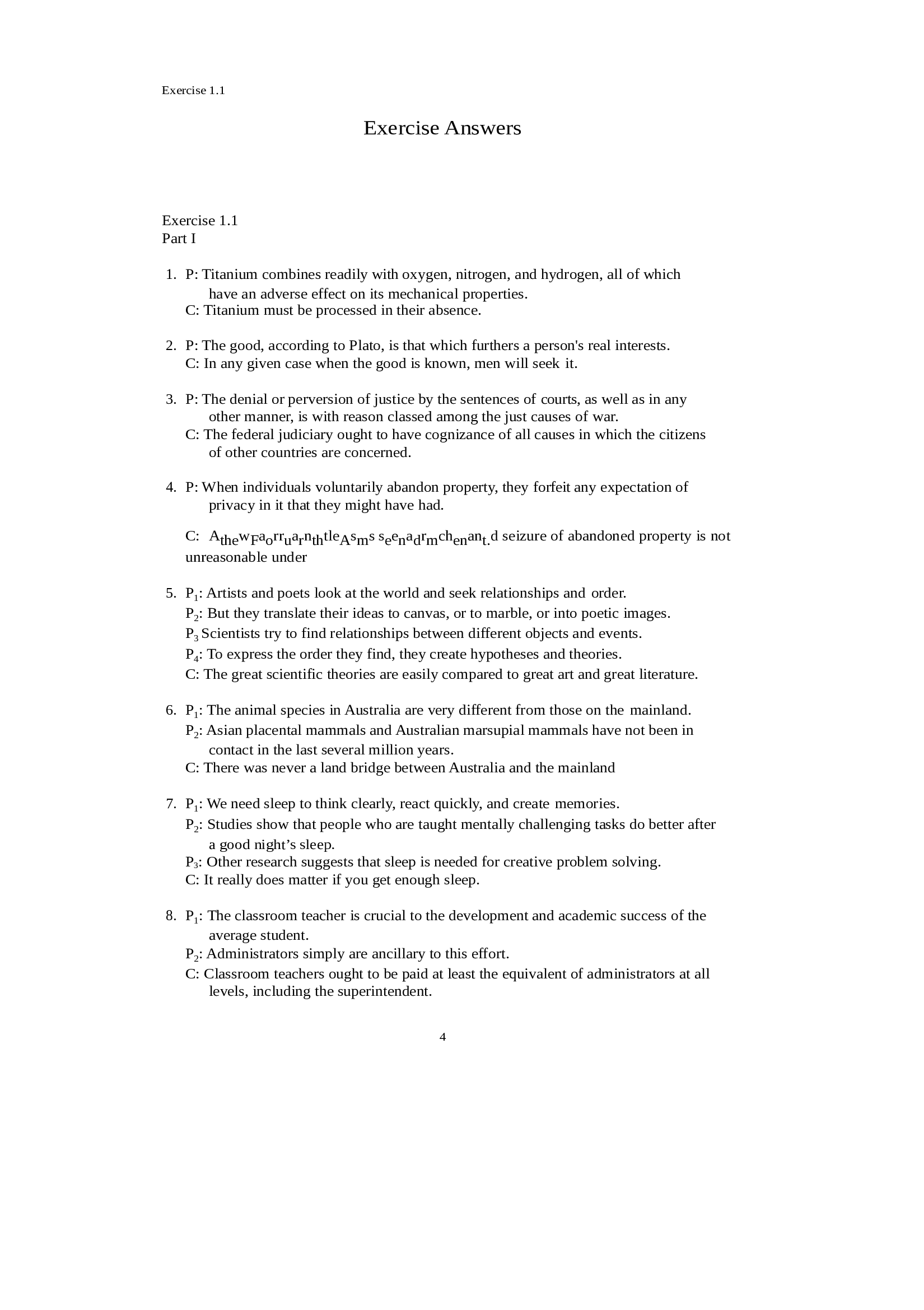
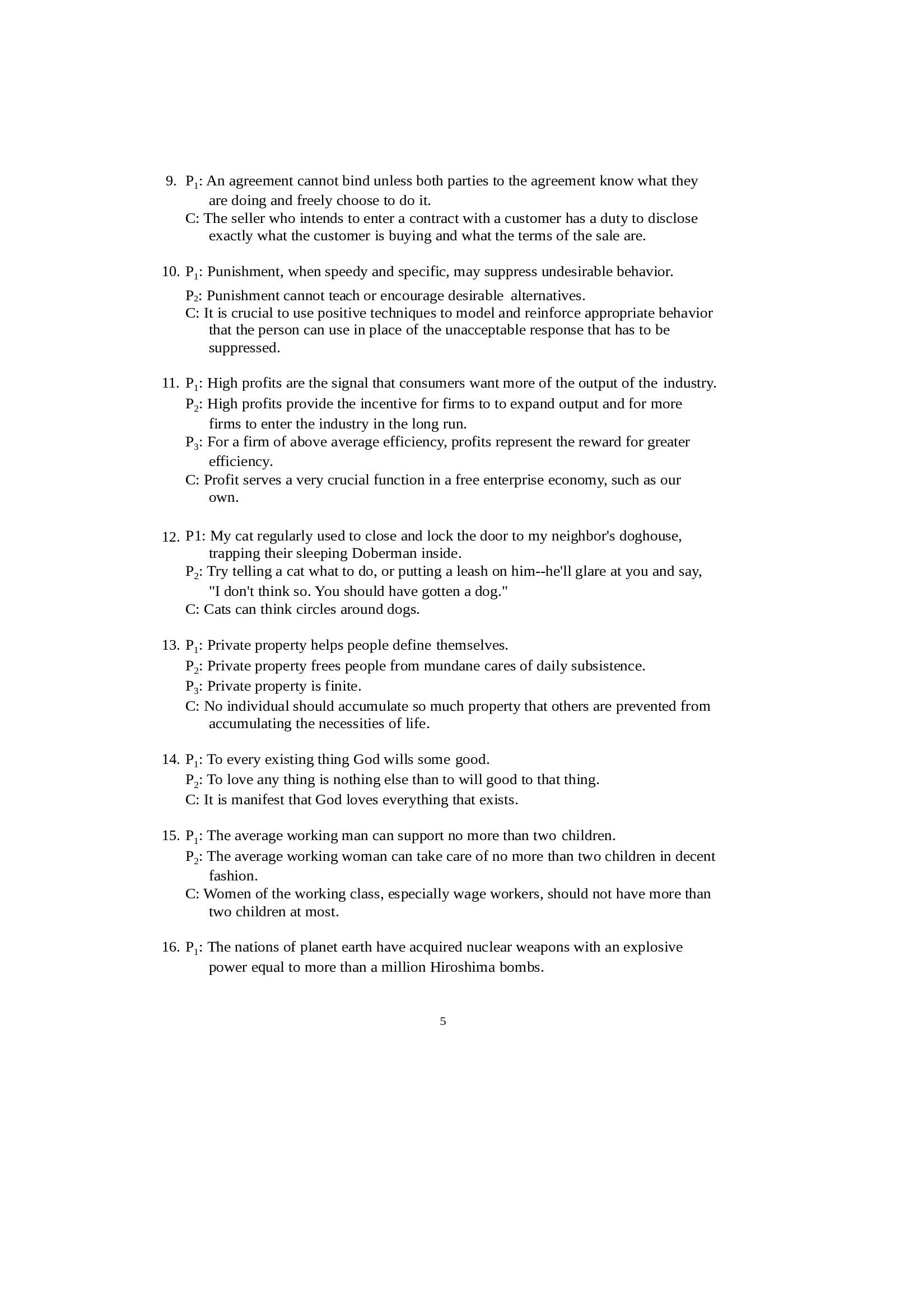
INSTRUCTOR MANUAL FOR A CONCISE INTRODUCTION TO LOGIC 12TH EDITION BY PATRICK HURLEY Exercise 1.1 Exercise Answers Exercise 1.1 Part I 1. P: Titanium combines readily with oxygen, nitrogen, and hydrogen, all of which have an adverse effect on its mechanical properties. C: Titanium must be processed in their absence. 2. P: The good, according to Plato, is that which furthers a person's real interests. C: In any given case when the good is known, men will seek it. 3. P: The denial or perversion of justice by the sentences of courts, as well as in any other manner, is with reason classed among the just causes of war. C: The federal judiciary ought to have cognizance of all causes in which the citizens of other countries are concerned. 4. P: When individuals voluntarily abandon property, they forfeit any expectation of privacy in it that they might have had. C: A the w F a o rr u a r n th tle A s m s s e e n a d r m ch en an t. d seizure of abandoned property is not unreasonable under 5. P1: Artists and poets look at the world and seek relationships and order. P2: But they translate their ideas to canvas, or to marble, or into poetic images. P3 Scientists try to find relationships between different objects and events. P4: To express the order they find, they create hypotheses and theories. C: The great scientific theories are easily compared to great art and great literature. 6. P1: The animal species in Australia are very different from those on the mainland. P2: Asian placental mammals and Australian marsupial mammals have not been in contact in the last several million years. C: There was never a land bridge between Australia and the mainland 7. P1: We need sleep to think clearly, react quickly, and create memories. P2: Studies show that people who are taught mentally challenging tasks do better after a good night’s sleep. P3: Other research suggests that sleep is needed for creative problem solving. C: It really does matter if you get enough sleep. 8. P1: The classroom teacher is crucial to the development and academic success of the average student. P2: Administrators simply are ancillary to this effort. C: Classroom teachers ought to be paid at least the equivalent of administrators at all levels, including the superintendent. 4 9. P1: An agreement cannot bind unless both parties to the agreement know what they are doing and freely choose to do it. C: The seller who intends to enter a contract with a customer has a duty to disclose exactly what the customer is buying and what the terms of the sale are. 10. P1: Punishment, when speedy and specific, may suppress undesirable behavior. P2: Punishment cannot teach or encourage desirable alternatives. C: It is crucial to use positive techniques to model and reinforce appropriate behavior that the person can use in place of the unacceptable response that has to be suppressed. 11. P1: High profits are the signal that consumers want more of the output of the industry. P2: High profits provide the incentive for firms to to expand output and for more firms to enter the industry in the long run. P3: For a firm of above average efficiency, profits represent the reward for greater efficiency. C: Profit serves a very crucial function in a free enterprise economy, such as our own. 12. P1: My cat regularly used to close and lock the door to my neighbor's doghouse, trapping their sleeping Doberman inside. P2: Try telling a cat what to do, or putting a leash on him--he'll glare at you and say, "I don't think so. You should have gotten a dog." C: Cats can think circles around dogs. 13. P1: Private property helps people define themselves. P2: Private property frees people from mundane cares of daily subsistence. P3: Private property is finite. C: No individual should accumulate so much property that others are prevented from accumulating the necessities of life. 14. P1: To every existing thing God wills some good. P2: To love any thing is nothing else than to will good to that thing. C: It is manifest that God loves everything that exists. 15. P1: The average working man can support no more than two children. P2: The average working woman can take care of no more than two children in decent fashion. C: Women of the working class, especially wage workers, should not have more than two children at most. 16. P1: The nations of planet earth have acquired nuclear weapons with an explosive power equal to more than a million Hiroshima bombs. 5 P2: Studies suggest that explosion of only half these weapons would produce enough soot, smoke, and dust to blanket the Earth, block out the sun, and bring on a nuclear winter that would threaten the survival of the human race. C: Radioactive fallout isn't the only concern in the aftermath of nuclear explosions. 17. P1: An ant releases a chemical when it dies, and its fellows carry it away to the compost heap. P2: A healthy ant painted with the death chemical will be dragged to the funeral heap again and again. C: Apparently the communication is highly effective. 18. P: Every art and every inquiry, and similarly every action and pursuit, is thought to aim at some good. C: The good has been rightly declared to be that at which all things aim. 19. P1: Antipoverty programs provide jobs for middle-class professionals in social work, penology and public health. P2: Such workers' future advancement is tied to the continued growth of bureaucracies dependent on the existence of poverty. C: Poverty offers numerous benefits to the non-poor. 20. P1: Corn is an annual crop. P 2 : Butchers meat is a crop which requires four or five years to grow. P3: An acre of land will produce a much smaller quantity of the one species of food (meat) than the other. C: The inferiority of the quantity (of meat) must be compensated by the superiority of the price. 21. P1: Loan oft loses both itself and friend. P2: Borrowing dulls the edge of husbandry. C: Neither a borrower nor lender be. 22. P1: Take the nurse who alleges that physicians enrich themselves in her hospital through unnecessary surgery. P2: Take the engineer who discloses safety defects in the braking systems of a fleet of new rapid-transit vehicles. P : 3 Take the Defense Departm ent official who alerts Congress to military graft and overspending. P4: All know that they pose a threat to those whom they denounce and that their own careers may be at risk. C: The stakes in whistleblowing are high. 23. P1: If a piece of information is not "job relevant," then the employer is not entitled qua employer to know it. P2: Sexual practices, political beliefs, associational activities, etc., are not part of the description of most jobs P3: They do not directly affect one's job performance. 6 C: They are not legitimate information for an employer to know in the determination of the hiring of a job applicant. 24. P1: One of the most noticeable effects of a dark tan is premature aging of the skin. P2: The sun also contributes to certain types of cataracts, and, what is most worrisome, it plays a role in skin cancer. C: Too much sun can lead to health problems. 25. P1: It is generally accepted that by constantly swimming with its mouth open, the shark is simply avoiding suffocation. P2: This assures a continuous flow of oxygen-laden water into their mouths, over their gills, and out through the gill slits. C: Contrary to the tales of some scuba divers, the toothsome, gaping grin on the mouth of an approaching shark is not necessarily anticipatory. 26. P: If you place a piece of Polaroid (for example, one lens of a pair of Polaroid sunglasses) in front of your eye and rotate it as you look at the sky on a clear day, you will notice a change in light intensity with the orientation of the Polaroid. C: Light coming from the sky is partially polarized. 27. P1: The secondary light [from the moon] does not inherently belong to the moon, and is not received from any star or from the sun. P2: In the whole universe there is no other body left but the earth. C: The lunar body (or any other dark and sunless orb) is illuminated by the earth. 28. P1: Anyone familiar with our prison system knows that there are some inmates who behave little better than brute beasts. P2: If the death penalty had been truly effective as a deterrent, such prisoners would long ago have vanished. C: The very fact that these prisoners exist is a telling argument against the efficacy of capital punishment as a deterrent. 29. P1: REM (rapid eye movement) sleep studies conducted on adults indicate that REM pressure increases with deprivation. P2: This would not occur if REM sleep and dreaming were unimportant. C: REM sleep and dreaming are necessary in the adult. 30. P1: We say that an end pursued in its own right is more complete than an end pursued because of something else, and that an end that is never choiceworthy because of something else is more complete than ends that are choiceworthy both in their own right and because of this end. C: An end that is always choiceworthy in its own right, and never because of something else, is complete without qualification. Part II. 1. College sports are as much driven by money as professional sports. 7 2. The creation of a multilingual society is contrary to the best interests of all of us. 3. The competitive aspect of team sports is having a negative impact on the health and fitness of our children. 4. Business majors are robbing themselves of the true purpose of collegiate academics, a sacrifice that outweighs the future salary checks. 5. The sale and purchase of recreational drugs should be legalized. 6. Congress should not cut the National Institutes of Health budget. 7. The religious intolerance of television preachers must not be tolerated. 8. Patients should not be offered elective Cesarean section. 9. Parents who truly love their children allow them to fail once in a while. 10. Protecting the environment requires that we limit population growth. Part III 1. Logic: The organized body of knowledge, or science, that evaluates arguments. 2. Argument: A group of statements one or more of which (the premises) are claimed to provide support for, or reasons to believe, one of the others (the conclusion). 3. Statement: A sentence that is either true or false. 4. Premise: A statement in an argument that sets forth evidence or reasons. 5. Conclusion: The statement in an argument that the premises are claimed to support or imply. 6. Conclusion indicator: A word that provides a clue in identifying the conclusion. 7. Premise indicator: A word that provides a clue in identifying the premises. 8. Inference: The reasoning process used to produce an argument. 9. Proposition: The information content of a statement. 10. Truth value: The attribute by which a statement is either true or false. Part IV 1. True 6. False 8 2. False 7. True 3. False 8. True 4. False 9. True 5. True 10. True 9 Exercise 1.2 Exercise 1.2 Part I 1. Nonargument (explanation) 2. Nonargument; conditional statement 3. Argument (conclusion: Freedom of the press is the most important of our constitutionally guaranteed freedoms.) 4. Nonargument (illustration) 5. Nonargument (piece of advice) 6. Argument (conclusion: Mosquito bites are not always the harmless little irritations most of us take them to be.) 7. Argument (conclusion: If stem-cell research is restricted, then people will die prematurely.) 8. Argument (conclusion: Fiction provides us with the opportunity to ponder how people react in uncommon situations, and to deduce moral lessons, psychological principles, and philosophical insights from their behavior.) 9. Nonargument (statement of belief) 10. Nonargument (report) 11. Argument (conclusion: Any interest of the state in protecting the woman from an inherently hazardous procedure, except when it would be equally dangerous for her to forgo it, has largely disappeared. 12. Nonargument (expository passage) 13. Nonargument (opinion and piece of advice) 14. Nonargument (report of an argument) 15. Argument (conclusion: Economics is of practical value in business.) 16. Nonargument (piece of advice) 17. Nonargument (loosely associated statements) 18. This passage could be interpreted as either an argument or an explanation (or both). If it is interpreted as an argument, the conclusion is: Most business organizations include a credit department which must reach a decision on the credit worthiness of each prospective customer. 9 19. Argument (conclusion: For organisms at the sea surface, sinking into deep water usually means death.) 20. Nonargument (temporal meaning of "since"; "hence" indicates an explanation.) 21. Argument (conclusion: Dachshunds are ideal dogs for small children.) 22. Argument (conclusion: Atoms can combine to form molecules, whose properties are generally very different from those of the constituent atoms.) 23. Argument (conclusion: The coarsest type of humor is the practical joke.) 24. Nonargument (conditional statement) 25. Nonargument (explanation) 26. Argument (conclusion: Words are slippery customers.) 27. Nonargument (report) 28. Argument (conclusion: A person never becomes truly self-reliant.) 29. Nonargument (opinion) 30. Nonargument (expository passage and illustration) 31. This passage could be both an argument and an explanation (conclusion: In areas where rats are a problem, it is very difficult to exterminate them with bait poison.) 32. Argument (conclusion: Population growth has not been a steady march.) 33. Argument (conclusion: Temperance and bravery, then, are ruined by excess and deficiency, but preserved by the mean.) 34. Nonargument (loosely associated statements) 35. Argument (conclusion: One form of energy can be converted to another.) Part II 1. Nonargument 2. Argument (conclusion: Social Security is not merely a retirement program) 3. This passage is probably best considered a nonargument, but it could be rephrased to form an argument. (Possible conclusion: Something is wrong with our approach to education.) 10 4. Nonargument 5. Argument (conclusion: The Democratic Party is more concerned with achieving broad happiness, while the Republican Party is more concerned with fulfilling selfishness.) 6. Argument (conclusion: Treating cruelty to animals with the seriousness it deserves doesn’t only protect animals, it also makes the entire community safer.) 7. Argument (conclusion: Creating a third political party—the independent party—is a good idea.) 8. Argument (conclusion: When women’s voices are silenced, the institutions themselves suffer.) 9. Nonargument 10. Argument (conclusion: Strong anti-bullying programs are needed to provide a means to report bullying anonymously, to train all school personnel to take reports of bullying seriously, and to offer workshops for children on how to respond to being bullied.) Part IV 1. Argument from example: An argument that purports to prove something by giving one or more examples of it. 2. Conditional statement: An "if ... then ..." statement 3. Antecedent: The component of a conditional statement that immediately follows the word "if." 4. Consequent: The component of a conditional statement that immediately follows the word "then"; the component of a conditional statement that is not the antecedent 5. S st u a f t f e i m ci ent condition: The condition represented by the antecedent of a conditional 6. Necessary condition: The condition represented by the consequent of a conditional statement 7. Explanation: A statement or group of statements intended to shed light on some event 8. Explanandum: The component of an explanation that indicates the event or phenomenon to be explained 11 9. Explanans: The component of an explanation that explains the event indicated by the explanandum 10. Illustration: A kind of nonargument composed of statements intended to show what something means or how something is done. 11. Expository passage: A kind of Nonargument consisting of a topic sentence and one or more other sentences that expand or elaborate on the topic sentence. Part V 1. True 6. True 2. False 7. True 3. False 8. True 4. True 9. True 5. True 10. True Part VI 1. Sufficient: If something is a tiger, then it is an animal. 2. Necessary: If something is not an animal, then it is not a tiger. Or: If something is a tiger, then it is an animal. 3. Sufficient: If a person drinks a Coke, then he will quench his thirst. 4. Necessary: If a person has no racquet, then he/she cannot play tennis. Or: If a person plays tennis, then he/she has a racquet. 5. Necessary: If a person does not heat water, then he/she cannot brew coffee. Or: If a person brews coffee, then he/she has heated water. 6. Sufficient: If someone steps on a cat’s tail, then the cat will yowl. 7. Sufficient: If leaves burn, then smoke is produced. 8. Necessary: If a person does not pay attention, then he/she will not understand a lecture. Or: If a person understands a lecture, then he/she pays attention. 9. Sufficient: If a number is exactly divisible by 4, then it is an even number. 10. Necessary: If a person does not utter a falsehood, then he/she does not tell a lie. Or: If a person tells a lie, then he/she utters a falsehood. 12 Exercise 1.3 Exercise 1.3 Part I 1. Deductive (argument based on mathematics; also, the conclusion follows necessarily from the premises.) 2. Inductive (argument based on signs) 3. Inductive (prediction; also, there is an inductive indicator word and the conclusion follows only probably from the premise.) 4. Deductive (categorical syllogism; also, the conclusion follows necessarily from the premises.) 5. Inductive (generalization) 6. Deductive (the conclusion follows necessarily from the premise) 7. Inductive (causal inference; also, the conclusion follows only probably from the premise.) 8. Deductive (the conclusion follows necessarily from the premises.) 9. Inductive (causal inference) 10. Inductive (argument from analogy; also, the conclusion follows only probably from the premises.) 11. Deductive (argument from definition) 12. Deductive (disjunctive syllogism; also, the conclusion follows necessarily from the premises.) 13. Inductive (argument from authority; also, the conclusion follows only probably from the premise.) 14. D pre d m u i c s t e iv s. e ) (hypothetical syllogism; also, the conclusion follows necessarily from the 15. Inductive (causal inference; also, there are inductive indicator words.) 16. Deductive (the conclusion follows necessarily from the premise.) 17. Deductive (the conclusion follows necessarily from the premises.) 18. Inductive (prediction) 19. Inductive (causal inference) 13

Contact the Seller

Please Sign In to contact this seller.


  • 👎  Report Copyright Violation

Frequently Asked Questions

What Do I Get When I Buy This Study Material?

+

When you buy a study material on Passing Grades, an instant download link will be sent directly to your email, giving you access to the file anytime after payment is completed.

Is Passing Grades a Trusted Platform?

+

Yes, Passing Grades is a reputable students’ marketplace with a secure payment system and reliable customer support. You can trust us to ensure a safe and seamless transaction experience.

Will I Be Stuck with a Subscription?

+

No, all purchases on Passing Grades are one-time transactions. You only pay for the notes you choose to buy, with no subscriptions or hidden fees attached.

Who Am I Buying These Study Materials From?

+

Passing Grades is a marketplace, which means you are purchasing the document from an individual vendor, not directly from us. We facilitate the payment and delivery process between you and the vendor.

Does Passing Grades Offer Free Study Materials?

+

Yes, sellers on Passing Grades have uploaded numerous free test banks, exams, practice questions, and class notes that can be downloaded at no cost.

Pasinggrades - Quality Study Materials

USD 15

    • Quality checked by Pasing Grades
    • 100% satisfaction guarantee
    • Seller: mentor2000
Buy PDF $15

Seller Information

mentor2000

Member since April 2021

  • icon
  • icon
View Profile
  • total sales

    0
  • Favourites

    0
  • Comments

    0
    ( 0 Ratings )

Item Information

  • Uploaded

    23 June 2024

  • Updated

    21 April 2025

  • Category

    General

  • Item Type

    solution manual

  • Tags

    Instructor Manual for A Concise Introduction to Logic 12th Edition By Patrick Hurley

Related Exam Prep Guides by mentor2000

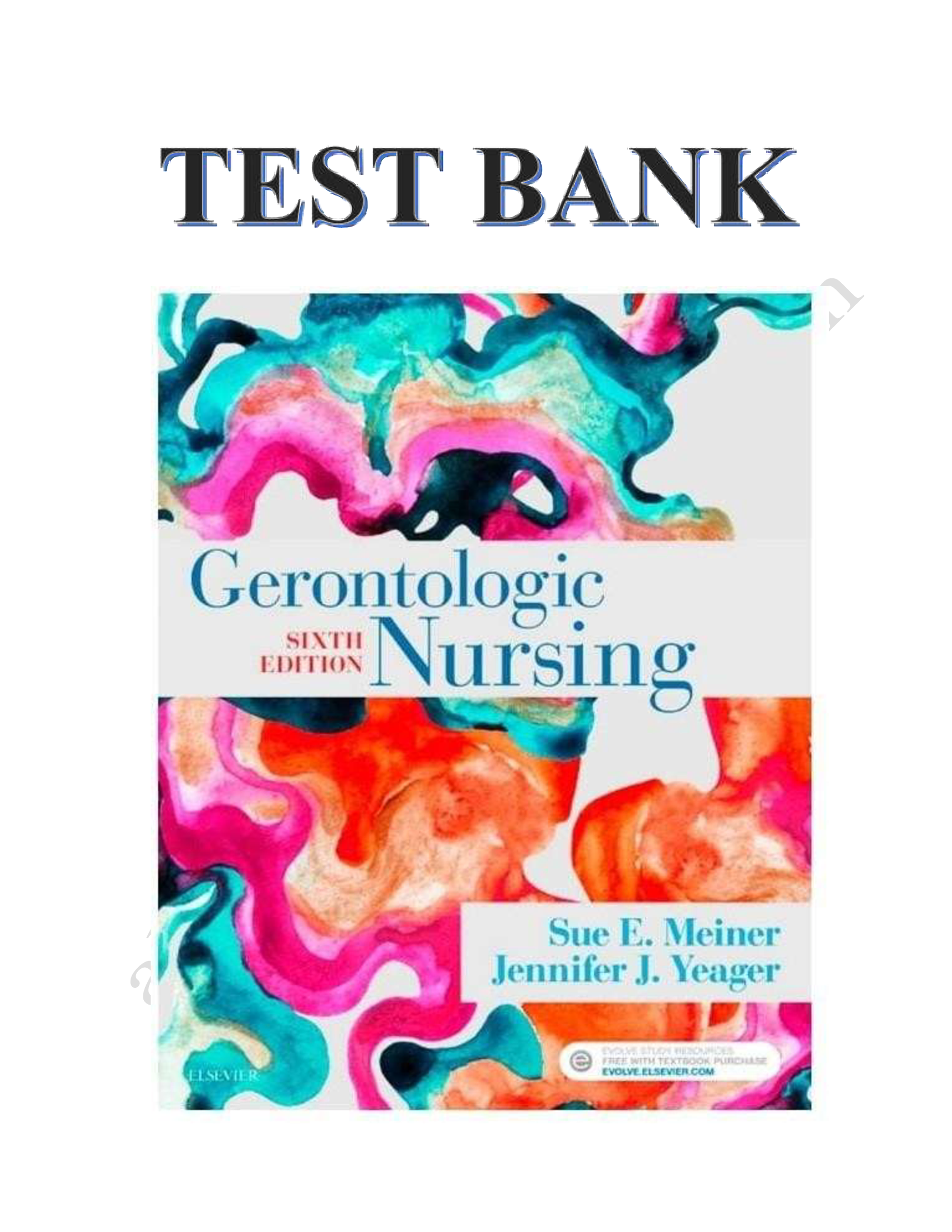
Test Bank for Essentials for Nursing Practice 8th Edition by Potter | All Chapters
View Document

Test Bank for Essent...

  • mentor2000

    mentor2000

  • solution manual

Master nursing concepts with this study material; Test Bank for Essentials for Nursing Practice, 8th...

15 USD

0

0

A &P 1 MA278 BSC2 Final Module II Questions & Answers 2026 Update
View Document

A &P 1 MA278 BSC2 Fi...

  • mentor2000

    mentor2000

  • solution manual

Prepare for success with A&P 1 MA278 BSC2 Final Module II 2024 Q&A. Boost your grades with this comp...

15 USD

0

0

ATI Comprehensive Predictor Exam 2026
View Document

ATI Comprehensive Pr...

  • mentor2000

    mentor2000

  • solution manual

Prepare for success with the ATI Comprehensive Predictor Exam 2026. Access key practice questions to...

15 USD

0

0

Purchase

Download link will be sent to this email immediately after purchase.

IMPORTANT LINKS

  • How To Upload Class Notes
  • Selling Tips
  • Passing Grades's Study Materials
  • Scholarships for International Students 2025

POPULAR CATEGORIES

  • Law
  • Accounting
  • English
  • Psychology
  • Business
  • Nursing
  • Computer Science
  • General

View Document

  • Blog
  • Contact
  • Delivery Policy
  • Latest Scholarships Around the World
  • How to Pass Bar Exams: Passing Grades’ Strategies
  • How to Study and Pass the CPA Exam
  • All Test Banks
  • Faq
  • Copyright Claims
  • Privacy Policy
  • Terms of Use

KNOWLEDGE BASE

  • How to Write A+ Grade Good Research Paper
  • How to Manage Stress During Exam Period
  • Best Time to Study
  • How to Pass NCLEX-RN Exam
  • How To Effectively Utilize Test Banks
  • Popular Shadow Health Exam Assessments
  • Popular HESI Case Studies
  • How to Prepare for a Nursing Career
  • The Importance Of Summaries in Exam Revisvion

© 2026 Pasing Grades. All rights reserved.