Pasing Grades
  • Start Selling
  • Blog
  • Contact
  • 0

    Your cart is empty!

English

  • English
  • Spanish
  • Arabic
Create Account Sign In
  • Library
    • New Prep Guides
    • Featured Prep Guides
    • Free Exam Prep Guides
    • Best sellers
  • General
  • Nursing
    • Research Paper
    • Case Study
    • Discussion Post
    • Assignment
    • Exam
    • Practice Questions and Answers
    • Test Bank
    • solutions manual
  • Accounting
    • Case Study
    • Thesis
    • Study Guide
    • Summary
    • Research Paper
    • test bank
  • English
    • Creative Writing
    • Research Paper
    • Summary
    • Rhetorics
    • Literature
    • Journal
    • Exam
    • Grammar
    • Discussion Post
    • Essay
  • Psychology
    • Hesi
    • Presentation
    • Essay
    • Summary
    • Study Guide
    • Essay
    • Solution Manual
    • Final Exam Review
    • Class Notes
    • test bank
  • Business
    • Lecture Notes
    • Solution Manual
    • Presentation
    • Business Plan
    • Class Notes
    • Experiment
    • Summary
    • Practice Questions
    • Study Guide
    • Case Study
    • test bank
    • Exam
  • More
    • Computer Science
    • Economics
    • Statistics
    • Engineering
    • Biology
    • Religious Studies
    • Physics
    • Chemistry
    • Mathematics
    • History
    • Sociology
    • Science
    • Philosophy
    • Law
  • Pages
    • About Us
    • Selling Tips
    • Delivery Policy
    • Faq
    • Privacy Policy
  • Flash Sale
  • Home
  • Hemodynamics Practice Questions Pre-test 2023 questions and answers

Hemodynamics Practice Questions Pre-test 2023 questions and answers

Preview page 1 Preview page 2 Preview page 3
Add To Favorites

Share this item Share this item

  • Item Details
  • Comments (0)
  • Reviews (0)
  • Contact Seller
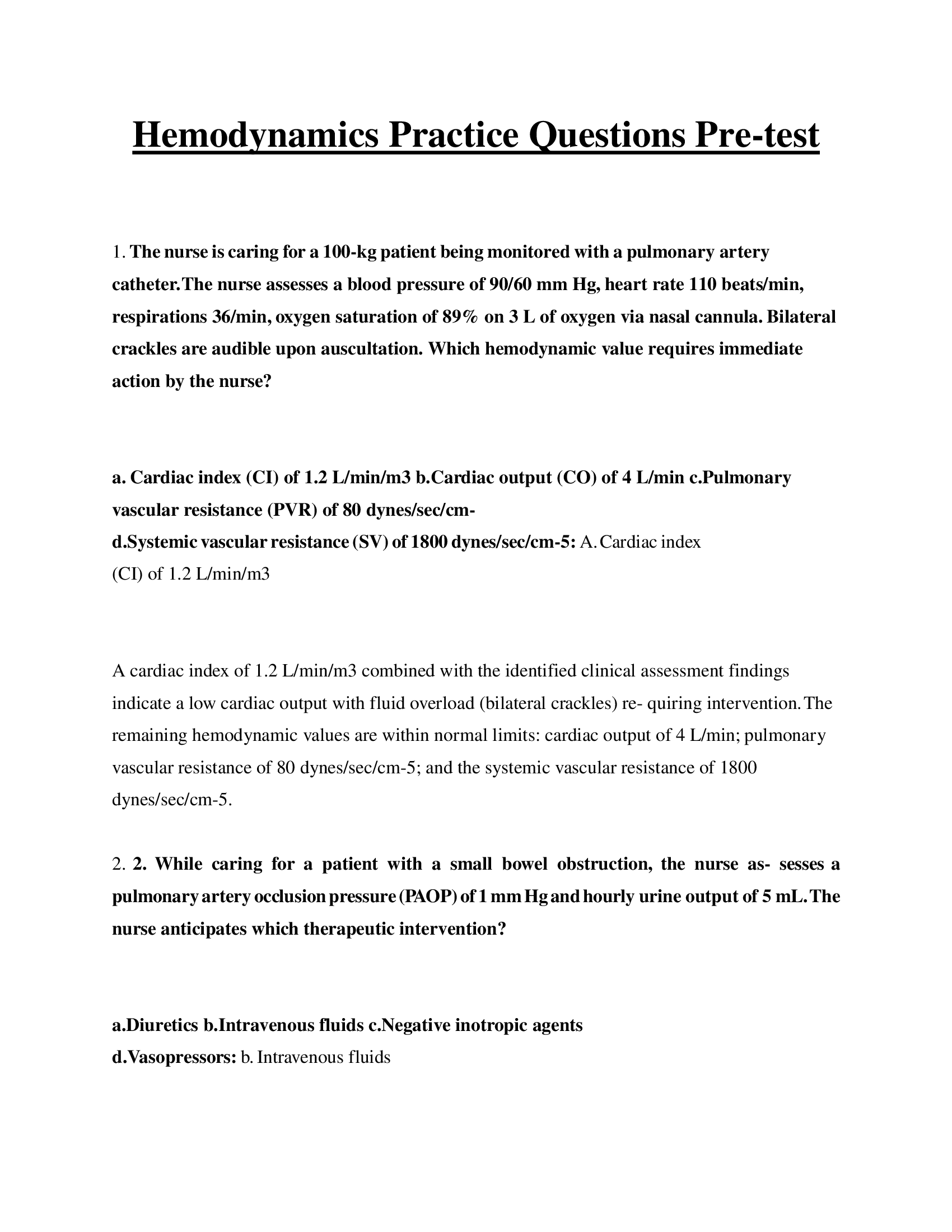
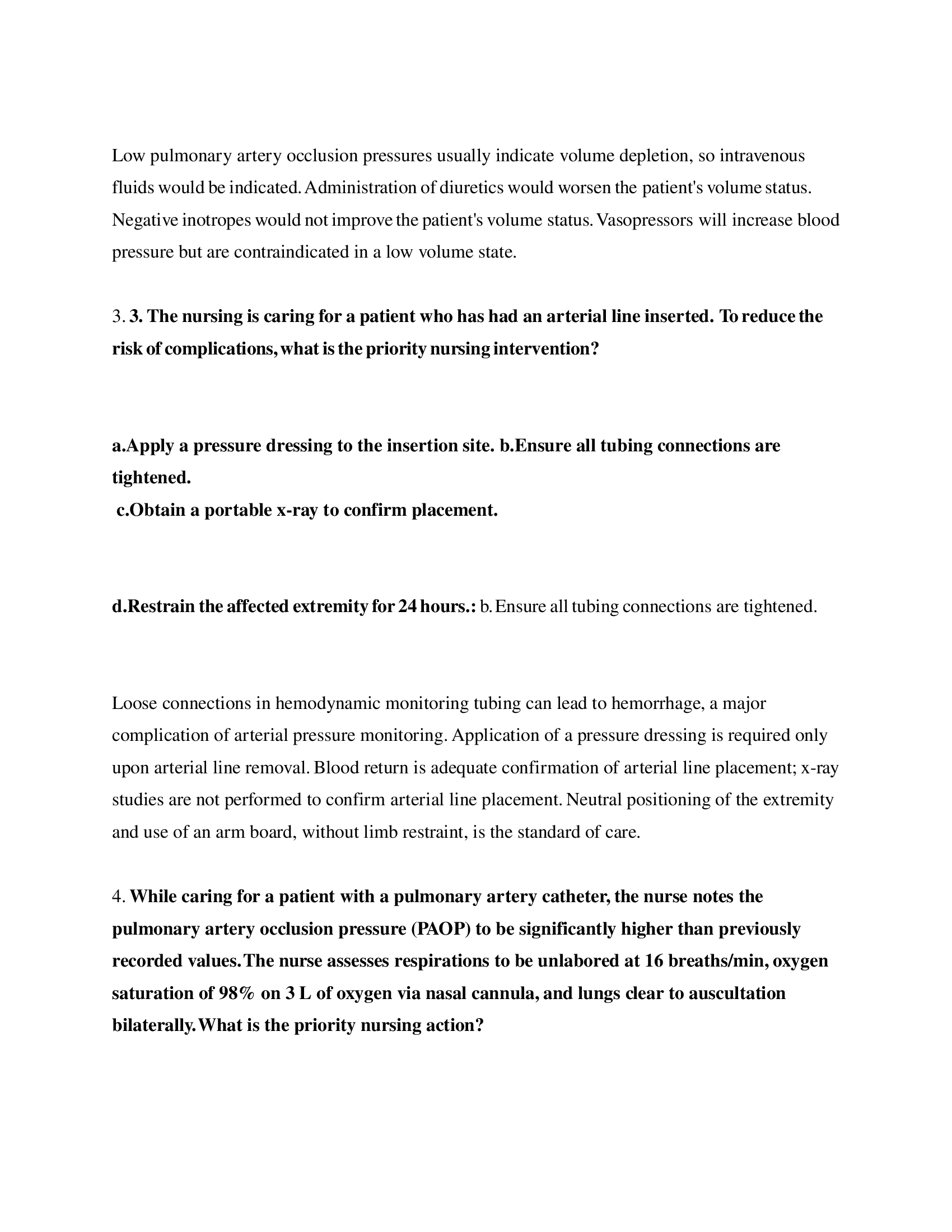
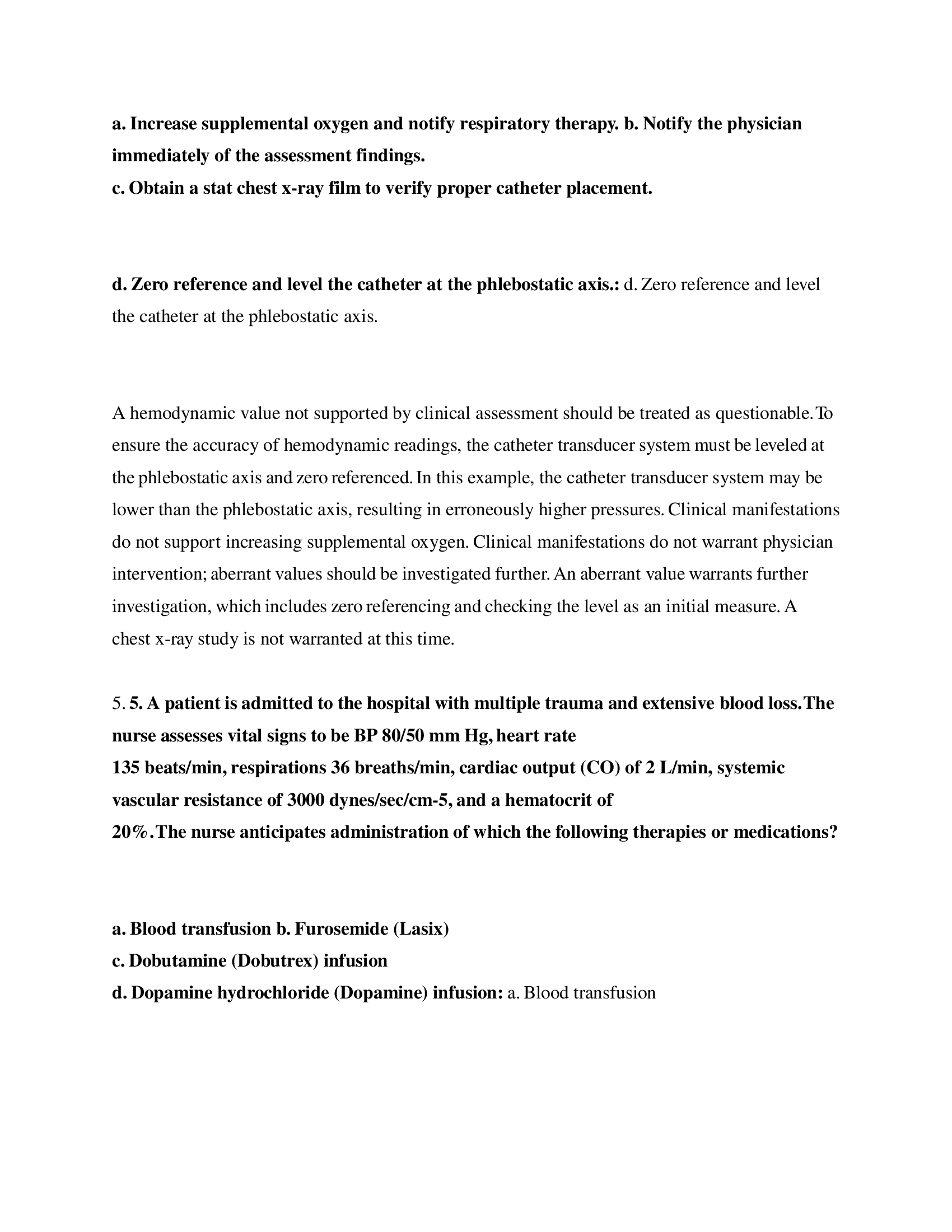
1. The nurse is caring for a 100-kg patient being monitored with a pulmonary artery catheter. The nurse assesses a blood pressure of 90/60 mm Hg, heart rate 110 beats/min, respirations 36/min, oxygen saturation of 89% on 3 L of oxygen via nasal cannula. Bilateral crackles are audible upon auscultation. Which hemodynamic value requires immediate action by the nurse? a. Cardiac index (CI) of 1.2 L/min/m3 b.Cardiac output (CO) of 4 L/min c.Pulmonary vascular resistance (PVR) of 80 dynes/sec/cm- d.Systemic vascular resistance (SV) of 1800 dynes/sec/cm-5: A. Cardiac index (CI) of 1.2 L/min/m3 A cardiac index of 1.2 L/min/m3 combined with the identified clinical assessment findings indicate a low cardiac output with fluid overload (bilateral crackles) re- quiring intervention. The remaining hemodynamic values are within normal limits: cardiac output of 4 L/min; pulmonary vascular resistance of 80 dynes/sec/cm-5; and the systemic vascular resistance of 1800 dynes/sec/cm-5. 2. 2. While caring for a patient with a small bowel obstruction, the nurse as- sesses a pulmonary artery occlusion pressure (PAOP) of 1 mm Hg and hourly urine output of 5 mL. The nurse anticipates which therapeutic intervention? a.Diuretics b.Intravenous fluids c.Negative inotropic agents d.Vasopressors: b. Intravenous fluids Low pulmonary artery occlusion pressures usually indicate volume depletion, so intravenous fluids would be indicated. Administration of diuretics would worsen the patient's volume status. Negative inotropes would not improve the patient's volume status. Vasopressors will increase blood pressure but are contraindicated in a low volume state. 3. 3. The nursing is caring for a patient who has had an arterial line inserted. To reduce the risk of complications, what is the priority nursing intervention? a.Apply a pressure dressing to the insertion site. b.Ensure all tubing connections are tightened. c.Obtain a portable x-ray to confirm placement. d.Restrain the affected extremity for 24 hours.: b. Ensure all tubing connections are tightened. Loose connections in hemodynamic monitoring tubing can lead to hemorrhage, a major complication of arterial pressure monitoring. Application of a pressure dressing is required only upon arterial line removal. Blood return is adequate confirmation of arterial line placement; x-ray studies are not performed to confirm arterial line placement. Neutral positioning of the extremity and use of an arm board, without limb restraint, is the standard of care. 4. While caring for a patient with a pulmonary artery catheter, the nurse notes the pulmonary artery occlusion pressure (PAOP) to be significantly higher than previously recorded values. The nurse assesses respirations to be unlabored at 16 breaths/min, oxygen saturation of 98% on 3 L of oxygen via nasal cannula, and lungs clear to auscultation bilaterally. What is the priority nursing action? a. Increase supplemental oxygen and notify respiratory therapy. b. Notify the physician immediately of the assessment findings. c. Obtain a stat chest x-ray film to verify proper catheter placement. d. Zero reference and level the catheter at the phlebostatic axis.: d. Zero reference and level the catheter at the phlebostatic axis. A hemodynamic value not supported by clinical assessment should be treated as questionable. To ensure the accuracy of hemodynamic readings, the catheter transducer system must be leveled at the phlebostatic axis and zero referenced. In this example, the catheter transducer system may be lower than the phlebostatic axis, resulting in erroneously higher pressures. Clinical manifestations do not support increasing supplemental oxygen. Clinical manifestations do not warrant physician intervention; aberrant values should be investigated further. An aberrant value warrants further investigation, which includes zero referencing and checking the level as an initial measure. A chest x-ray study is not warranted at this time. 5. 5. A patient is admitted to the hospital with multiple trauma and extensive blood loss. The nurse assesses vital signs to be BP 80/50 mm Hg, heart rate 135 beats/min, respirations 36 breaths/min, cardiac output (CO) of 2 L/min, systemic vascular resistance of 3000 dynes/sec/cm-5, and a hematocrit of 20%. The nurse anticipates administration of which the following therapies or medications? a. Blood transfusion b. Furosemide (Lasix) c. Dobutamine (Dobutrex) infusion d. Dopamine hydrochloride (Dopamine) infusion: a. Blood transfusion Both hemodynamic parameters and the reported hematocrit value indicate hy- povolemia and blood loss requiring volume resuscitation with blood products. Furosemide administration will worsen fluid volume status. Inotropic agents will not correct the underlying fluid volume deficit and anemia. Vasoconstrictors are contraindicated in a volume-depleted state. 6. 6. After pulmonary artery catheter insertion, the nurse assesses a pul- monary artery pressure of 45/25 mm Hg, a pulmonary artery occlusion pressure (PAOP) of 20 mm Hg, a cardiac output of 2.6 L/min and a cardiac index of 1.9 L/min/m2. Which physician order is of the highest priority? a. Apply 50% oxygen via venture mask. b. Insert an indwelling urinary catheter. c. Begin a dobutamine (Dobutrex) infusion. d. Obtain stat cardiac enzymes and troponin.: c. Begin a dobutamine (Dobutrex) infusion. The pulmonary pressures are higher than normal, indicating elevated preload, and the cardiac index and output values are low. The priority order for the nurse to implement is to begin a dobutamine (Dobutrex) infusion to improve cardiac output, possibly reducing pulmonary artery occlusion pressures. The other treatments are important, but the dobutamine infusion is the most important at this time. 7. 7. The nurse is caring for a patient with a left subclavian central venous catheter (CVC) and a left radial arterial line. Which assessment finding by the nurse requires immediate action? a. A dampened arterial line waveform b. Numbness and tingling in the left hand c. Slight bloody drainage at subclavian insertion site d. Slight redness at subclavian insertion site: b. Numbness and tingling in the left hand Numbness and tingling in the left hand, which is the location of an arterial catheter, indicates possible neurovascular compromise and requires immediate action. A dampened waveform can indicate problems with arterial line patency but is not an emergent situation. Slight bloody drainage at the subclavian insertion site is not an unusual finding. Slight redness at the insertion site, while of concern, does not require immediate action. 8. 8. The physician writes an order to discontinue a patient's left radial arterial line. When discontinuing the patient's invasive line, what is the priority nursing action? a. Apply an air occlusion dressing to insertion site. b. Apply pressure to the insertion site for 5 minutes. c. Elevate the affected limb on pillows for 24 hours. d. Keep the patient's wrist in a neutral position.: b. Apply pressure to the insertion site for 5 minutes. Upon removal of an invasive arterial line, adequate pressure must be applied for at least 5 minutes to ensure adequate hemostasis. Application of an air occlusion dressing is not standard of care following removal of an arterial line. Elevation of the affected limb following removal of an arterial line is not a necessary intervention. Neutral wrist position is optimum while the catheter is in place and not necessary after catheter discontinuation. 9. 9. Following insertion of a central venous catheter, the nurse obtains a stat chest x-ray film to verify proper catheter placement. The radiologist reports to the nurse: "The tip of the catheter is located in the superior vena cava." What is the best interpretation of these results by the nurse? a. The catheter is not positioned correctly and should be removed. b. The catheter position increases the risk of ventricular dysrhythmias. c. The distal tip of the catheter is in the appropriate position. d. The physician should be called to advance the catheter into the pulmonary artery.: c. The distal tip of the catheter is in the appropriate position. X-ray results indicate proper position of the catheter. The tip of the central venous catheter should rest just above the right atrium in the superior vena cava. The central venous catheter is positioned correctly in the superior vena cava. Dysrhyth- mias occur if the catheter migrates to the right ventricle. Central venous catheters are placed into great vessels of the venous system and not advanced into the pulmonary artery. 10. 10. While inflating the balloon of a pulmonary artery catheter (PAC) with 1.0 mL of air to obtain a pulmonary artery occlusion pressure (PAOP), the nurse encounters resistance. What is the best nursing action? a. Add an additional 0.5 mL of air to the balloon and repeat the procedure. b. Advance the catheter with the balloon deflated and repeat the procedure. c. Deflate the balloon and obtain a chest x-ray study to determine line placement. d.Lock the balloon in the inflated position and flush the distal port of the PAC with normal saline.: c. Deflate the balloon and obtain a chest x-ray study to determine line placement. pulmonary artery, creating resistance to balloon inflation. Verification of proper line placement is warranted to avoid pulmonary artery rupture. In addition, the PAC waveform should be observed to assist in identifying location of the tip of the PAC. In this scenario, adding additional air to the balloon will further risk pulmonary artery rupture. Advancing a pulmonary artery catheter is not within the nurse's scope of practice. Flushing the distal port with saline may be indicated to ensure patency; however, the balloon of the PAC should never be locked in the inflated position as rupture of the pulmonary artery may occur. 11. 11. The nurse is caring for a patient following insertion of a left subclavian central venous catheter (CVC). Which assessment finding 2 hours after insertion by the nurse warrants immediate action? a. Diminished breath sounds over left lung field b. Localized pain at catheter insertion site c. Measured central venous pressure of 5 mm Hg d. Slight bloody drainage around insertion site: a. Diminished breath sounds over left lung field Diminished breaths sounds over the lung field on the same side of the line insertion site may be indicative of a pneumothorax. A pneumothorax, which can develop slowly, is a major complication following insertion of central lines when the subclavian route is used. Localized pain at catheter insertion site is not the immediate priority in this scenario. A measured central venous pressure of 5 mm Hg is normal. Slight bloody drainage at the insertion site soon after the procedure does not require immediate action. 12. 12. The nurse is caring for a mechanically ventilated patient with a pul- monary artery catheter who is receiving continuous enteral tube feedings. When obtaining continuous hemodynamic monitoring measurements, what is the best nursing action? a. Do not document hemodynamic values until the patient can be placed in the supine position. b. Level and zero reference the air-fluid interface of the transducer with the patient in the supine position and record hemodynamic values. c. Level and zero reference the air-fluid interface of the transducer with the patient's head of bed elevated to 30 degrees and record hemodynamic values. d. Level and zero reference the air-fluid interface of the transducer with the patient supine in the side-lying position and record hemodynamic values.: c. Level and zero reference the air-fluid interface of the transducer with the patient's head of bed elevated to 30 degrees and record hemodynamic values. Elevation of the head of bed is an important intervention to prevent aspiration and ventilator-associated pneumonia. Patients who require hemodynamic monitoring while receiving tube feedings should have the air-fluid interface of the transducer leveled with the phlebostatic axis while the head of bed is elevated to at least 30 degrees. Readings will be accurate. Supine positioning of a mechanically ventilated patient increases the risk of aspiration and ventilator-associated pneumonia and is contraindicated in this patient. Hemodynamic values can be accurately measured and trended in with the head of the bed elevated as high as 60 degrees. Even though hemodynamic values can be obtained in lateral positions, it is technically difficult and not accurate unless the positioning of the transducer is exact. Regard- less, head of bed elevation is indicated for this patient. 13. 13. The nurse is educating a patient's family member about a pulmonary artery catheter (PAC). Which statement by the family member best indicates understanding of the purpose of the PAC? a. "The catheter will provide multiple sites to give intravenous fluid." b. "The catheter will allow the physician to better manage fluid therapy." c. "The catheter tip comes to rest inside my brother's pulmonary artery." d. "The catheter will be in position until the heart has a chance to heal.": b. "The catheter will allow the physician to better manage fluid therapy." A pulmonary artery catheter provides hemodynamic measurements that guide interventions that include appropriate fluid therapy. Even though a pulmonary catheter provides multiple intravenous access sites, this is not the primary pur- pose of the catheter. Although the catheter is positioned in the pulmonary artery, positioning is not the purpose of the catheter. The primary purpose of the catheter is not to aid in the healing of the heart but to guide therapy. 14. 14. The nurse is preparing to obtain a pulmonary artery occlusion pres- sure (PAOP) reading for a patient who is mechanically ventilated. Ensuring that the air-fluid interface is at the level of the phlebostatic axis, what is the best nursing action? a. Place the patient in the supine position and record the PAOP immediately after exhalation.

Contact the Seller

Please Sign In to contact this seller.


  • 👎  Report Copyright Violation

Frequently Asked Questions

What Do I Get When I Buy This Study Material?

+

When you buy a study material on Passing Grades, an instant download link will be sent directly to your email, giving you access to the file anytime after payment is completed.

Is Passing Grades a Trusted Platform?

+

Yes, Passing Grades is a reputable students’ marketplace with a secure payment system and reliable customer support. You can trust us to ensure a safe and seamless transaction experience.

Will I Be Stuck with a Subscription?

+

No, all purchases on Passing Grades are one-time transactions. You only pay for the notes you choose to buy, with no subscriptions or hidden fees attached.

Who Am I Buying These Study Materials From?

+

Passing Grades is a marketplace, which means you are purchasing the document from an individual vendor, not directly from us. We facilitate the payment and delivery process between you and the vendor.

Does Passing Grades Offer Free Study Materials?

+

Yes, sellers on Passing Grades have uploaded numerous free test banks, exams, practice questions, and class notes that can be downloaded at no cost.


Pasinggrades - Quality Study Materials

USD 10

    • Quality checked by Pasing Grades
    • 100% satisfaction guarantee
    • Seller: claratutor1
Buy PDF $10

Seller Information

claratutor1

Member since April 2021

  • icon
  • icon
View Profile
  • total sales

    0
  • Favourites

    0
  • Comments

    0
    ( 0 Ratings )

Item Information

  • Uploaded

    08 May 2023

  • Updated

    17 October 2025

  • Category

    Nursing

  • Item Type

    questions & answers

  • Tags

    Hemodynamics Practice Questions Pre test 2023 questions and answers

Related Exam Prep Guides by claratutor1

TEST BANK FOR HEALTH PROMOTION THROUGH THE LIFE SPAN 8TH EDITION EDELMAN.
View Document

TEST BANK FOR HEALTH...

  • claratutor1

    claratutor1

  • questions & answers

TEST BANK FOR HEALTH PROMOTION THROUGH THE LIFE SPAN 8TH EDITION EDELMAN....

10 USD

0

0

NUR 425 PHARM PSYCH FINAL STUDY GUIDE NOTES EXAM
View Document

NUR 425 PHARM PSYCH ...

  • claratutor1

    claratutor1

  • questions & answers

NUR 425 PHARM PSYCH FINAL STUDY GUIDE NOTES EXAM...

10 USD

0

0

PS-201-AB-21-SP Developmental Psych Exam 4 Latest 2025/2026
View Document

PS-201-AB-21-SP Deve...

  • claratutor1

    claratutor1

  • questions & answers

PS-201-AB-21-SP Developmental Psych Exam 4 50 Questions and Answers...

10 USD

0

0

Purchase

Download link will be sent to this email immediately after purchase.

IMPORTANT LINKS

  • How To Upload Class Notes
  • Selling Tips
  • Passing Grades's Study Materials
  • Scholarships for International Students 2025

POPULAR CATEGORIES

  • Law
  • Accounting
  • English
  • Psychology
  • Business
  • Nursing
  • Computer Science
  • General

View Document

  • Blog
  • Contact
  • Delivery Policy
  • Latest Scholarships Around the World
  • How to Pass Bar Exams: Passing Grades’ Strategies
  • How to Study and Pass the CPA Exam
  • All Test Banks
  • Faq
  • Copyright Claims
  • Privacy Policy
  • Terms of Use

KNOWLEDGE BASE

  • How to Write A+ Grade Good Research Paper
  • How to Manage Stress During Exam Period
  • Best Time to Study
  • How to Pass NCLEX-RN Exam
  • How To Effectively Utilize Test Banks
  • Popular Shadow Health Exam Assessments
  • Popular HESI Case Studies
  • How to Prepare for a Nursing Career
  • The Importance Of Summaries in Exam Revisvion

© 2026 Pasing Grades. All rights reserved.