Pasing Grades
  • Start Selling
  • Blog
  • Contact
  • 0

    Your cart is empty!

English

  • English
  • Spanish
  • Arabic
Create Account Sign In
  • Library
    • New Prep Guides
    • Featured Prep Guides
    • Free Exam Prep Guides
    • Best sellers
  • General
  • Nursing
    • Research Paper
    • Case Study
    • Discussion Post
    • Assignment
    • Exam
    • Practice Questions and Answers
    • Test Bank
    • solutions manual
  • Accounting
    • Case Study
    • Thesis
    • Study Guide
    • Summary
    • Research Paper
    • test bank
  • English
    • Creative Writing
    • Research Paper
    • Summary
    • Rhetorics
    • Literature
    • Journal
    • Exam
    • Grammar
    • Discussion Post
    • Essay
  • Psychology
    • Hesi
    • Presentation
    • Essay
    • Summary
    • Study Guide
    • Essay
    • Solution Manual
    • Final Exam Review
    • Class Notes
    • test bank
  • Business
    • Lecture Notes
    • Solution Manual
    • Presentation
    • Business Plan
    • Class Notes
    • Experiment
    • Summary
    • Practice Questions
    • Study Guide
    • Case Study
    • test bank
    • Exam
  • More
    • Computer Science
    • Economics
    • Statistics
    • Engineering
    • Biology
    • Religious Studies
    • Physics
    • Chemistry
    • Mathematics
    • History
    • Sociology
    • Science
    • Philosophy
    • Law
  • Pages
    • About Us
    • Selling Tips
    • Delivery Policy
    • Faq
    • Privacy Policy
  • Flash Sale
  • Home
  • Davis Advantage Medical-Surgical Nursing 2nd Ed. Test Bank

Davis Advantage Medical-Surgical Nursing 2nd Ed. Test Bank

Preview page 1 Preview page 2 Preview page 3
Add To Favorites

Share this item Share this item

  • Item Details
  • Comments (0)
  • Reviews (0)
  • Contact Seller

Davis Advantage for Medical Surgical Nursing: Making Connections to Practice, 2nd Edition Hoffman Test Bank

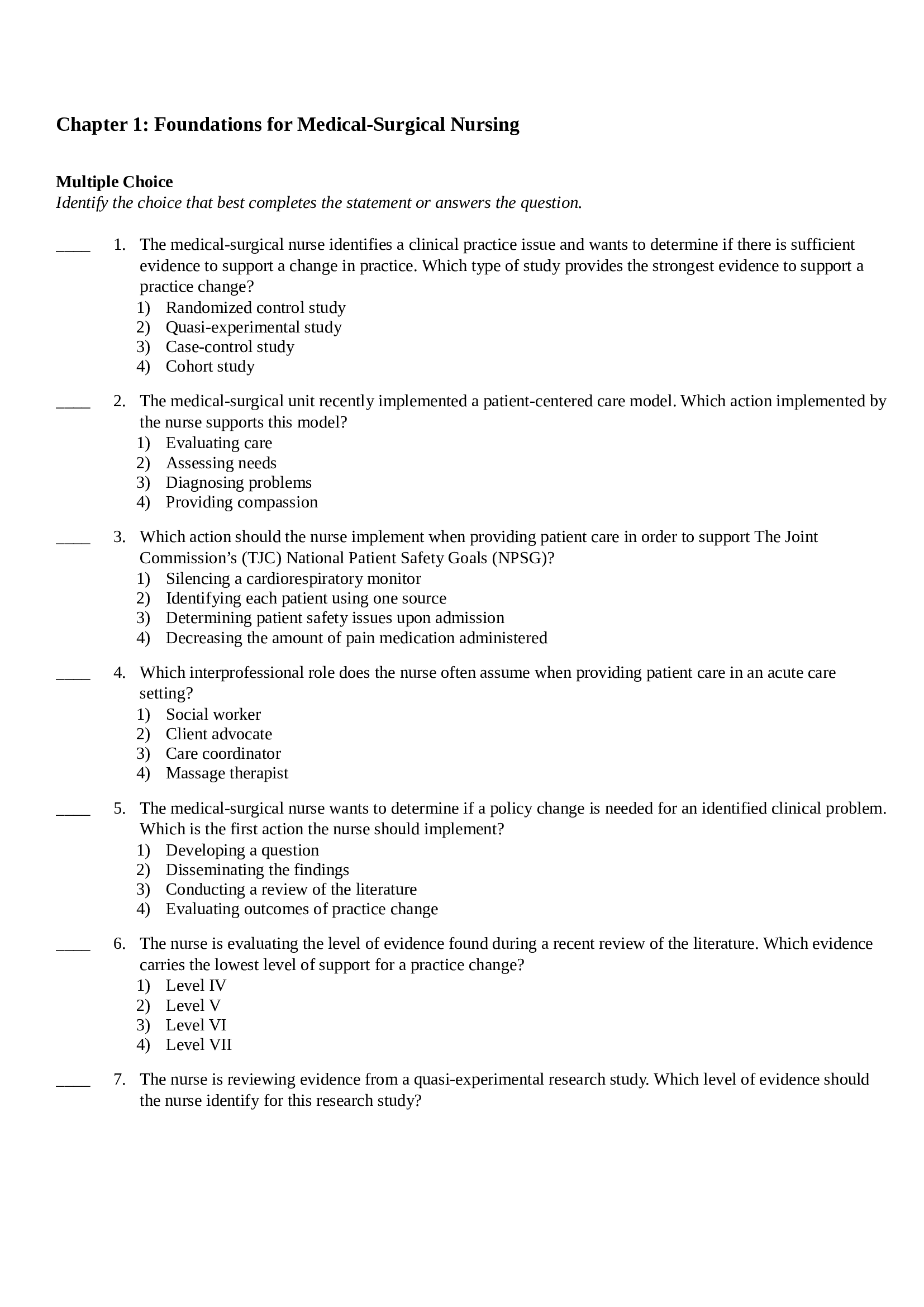
Chapter 1: Foundations for Medical-Surgical Nursing

Multiple Choice

Identify the choice that best completes the statement or answers the question.

____ 1. The medical-surgical nurse identifies a clinical practice issue and wants to determine if there is sufficient

evidence to support a change in practice. Which type of study provides the strongest evidence to support a

practice change?

1) Randomized control study

2) Quasi-experimental study

3) Case-control study

4) Cohort study

____ 2. The medical-surgical unit recently implemented a patient-centered care model. Which action implemented by

the nurse supports this model?

1) Evaluating care

2) Assessing needs

3) Diagnosing problems

4) Providing compassion

____ 3. Which action should the nurse implement when providing patient care in order to support The Joint

Commission’s (TJC) National Patient Safety Goals (NPSG)?

1) Silencing a cardiorespiratory monitor

2) Identifying each patient using one source

3) Determining patient safety issues upon admission

4) Decreasing the amount of pain medication administered

____ 4. Which interprofessional role does the nurse often assume when providing patient care in an acute care

setting?

1) Social worker

2) Client advocate

3) Care coordinator

4) Massage therapist

____ 5. The medical-surgical nurse wants to determine if a policy change is needed for an identified clinical problem.

Which is the first action the nurse should implement?

1) Developing a question

2) Disseminating the findings

3) Conducting a review of the literature

4) Evaluating outcomes of practice change

____ 6. The nurse is evaluating the level of evidence found during a recent review of the literature. Which evidence

carries the lowest level of support for a practice change?

1) Level IV

2) Level V

3) Level VI

4) Level VII

____ 7. The nurse is reviewing evidence from a quasi-experimental research study. Which level of evidence should

the nurse identify for this research study?

1) Level I

2) Level II

3) Level III

4) Level IV

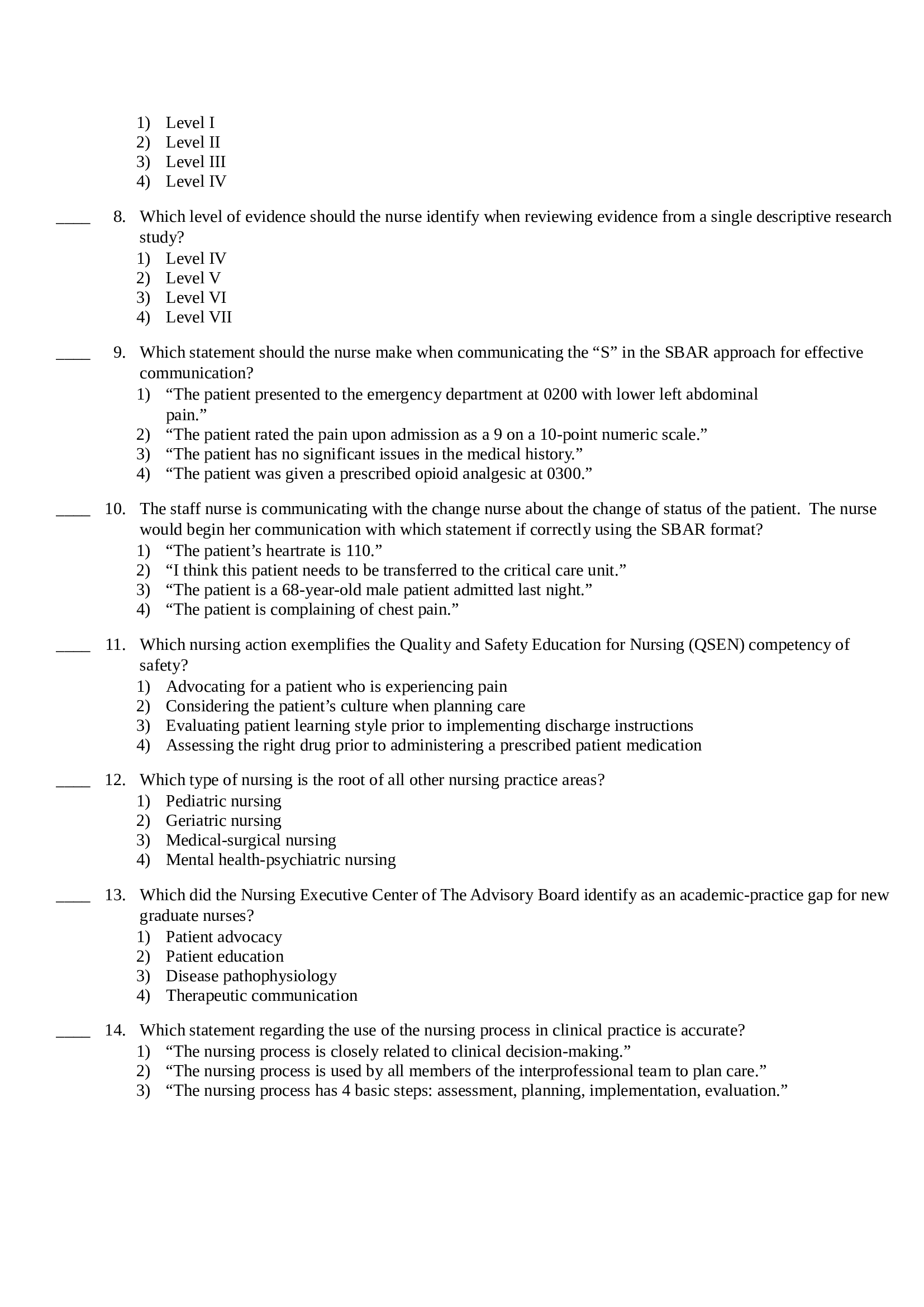
____ 8. Which level of evidence should the nurse identify when reviewing evidence from a single descriptive research

study?

1) Level IV

2) Level V

3) Level VI

4) Level VII

____ 9. Which statement should the nurse make when communicating the “S” in the SBAR approach for effective

communication?

1) “The patient presented to the emergency department at 0200 with lower left abdominal

pain.”

2) “The patient rated the pain upon admission as a 9 on a 10-point numeric scale.”

3) “The patient has no significant issues in the medical history.”

4) “The patient was given a prescribed opioid analgesic at 0300.”

____ 10. The staff nurse is communicating with the change nurse about the change of status of the patient.  The nurse

would begin her communication with which statement if correctly using the SBAR format?

1) “The patient’s heartrate is 110.”

2) “I think this patient needs to be transferred to the critical care unit.”

3) “The patient is a 68-year-old male patient admitted last night.”

4) “The patient is complaining of chest pain.”

____ 11. Which nursing action exemplifies the Quality and Safety Education for Nursing (QSEN) competency of

safety?

1) Advocating for a patient who is experiencing pain

2) Considering the patient’s culture when planning care

3) Evaluating patient learning style prior to implementing discharge instructions

4) Assessing the right drug prior to administering a prescribed patient medication

____ 12. Which type of nursing is the root of all other nursing practice areas?

1) Pediatric nursing

2) Geriatric nursing

3) Medical-surgical nursing

4) Mental health-psychiatric nursing

____ 13. Which did the Nursing Executive Center of The Advisory Board identify as an academic-practice gap for new

graduate nurses?

1) Patient advocacy

2) Patient education

3) Disease pathophysiology

4) Therapeutic communication

____ 14. Which statement regarding the use of the nursing process in clinical practice is accurate?

1) “The nursing process is closely related to clinical decision-making.”

2) “The nursing process is used by all members of the interprofessional team to plan care.”

3) “The nursing process has 4 basic steps: assessment, planning, implementation, evaluation.”

4) “The nursing process is being replaced by the implementation of evidence-based practice.”

____ 15. Which is the basis of nursing care practices and protocols?

1) Assessment

2) Evaluation

3) Diagnosis

4) Research

____ 16. Which is a common theme regarding patient dissatisfaction related to care provided in the hospital setting?

1) Space in hospital rooms

2) Medications received to treat pain

3) Time spent with the health-care team

4) Poor quality food received from dietary

____ 17. The nurse manager is preparing a medical-surgical unit for The Joint Commission (TJC) visit With the nurse

manager presenting staff education focusing on TJC benchmarks, which of the following topics would be

most appropriate?

1) Implementation of evidence-based practice

2) Implementation of patient-centered care

3) Implementation of medical asepsis practices

4) Implementation of interprofessional care

____ 18. Which aspect of patient-centered care should the nurse manager evaluate prior to The Joint Commission site

visit for accreditation?

1) Visitation rights

2) Education level of staff

3) Fall prevention protocol

4) Infection control practices

____ 19. The medical-surgical nurse is providing patient care. Which circumstance would necessitate the nurse

verifying the patient’s identification using at least two sources?

1) Prior to delivering a meal tray

2) Prior to passive range of motion

3) Prior to medication administration

4) Prior to documenting in the medical record

____ 20. The nurse is providing care to several patients on a medical-surgical unit. Which situation would necessitate

the nurse to use SBAR during the hand-off process?

1) Wound care

2) Discharge to home

3) Transfer to radiology

4) Medication education

Multiple Response

Identify one or more choices that best complete the statement or answer the question.

____ 21. The staff nurse is teaching a group of student nurses the situations that necessitate hand-off communication.

Which student responses indicate the need for further education related to this procedure? Select all that

apply.

1) “A hand-off is required prior to administering a medication.”

Downloaded by: Sophiie | abiekay12@gmail.com

Distribution of this document is illegal

Stuvia.com - The Marketplace to Buy and Sell your Study Material

Stuvia.com - The Marketplace to Buy and Sell your Study Material

2) “A hand-off is required during change of shift.”

3) “A hand-off is required for a patient is transferred to the surgical suite.”

4) “A hand-off is required whenever the nurse receives a new patient assignment.”

5) “A hand-off is required prior to family visitation.”

____ 22. Which actions by the nurse enhance patient safety during medication administration? Select all that apply.

1) Answering the call bell while transporting medications for a different patient

2) Identifying the patient using two sources prior to administering the medication

3) Holding a medication if the patient’s diagnosis does not support its use

4) Administering the medication two hours after the scheduled time

5) Having another nurse verify the prescribed dose of insulin the patient is to receive

____ 23. The medical-surgical nurse assumes care for a patient who is receiving continuous cardiopulmonary

monitoring. Which actions by the nurse enhance safety for this patient? Select all that apply.

1) Silencing the alarm during family visitation

2) Assessing the alarm parameters at the start of the shift

3) Responding to the alarm in a timely fashion

4) Decreasing the alarm volume to enhance restful sleep

5) Adjusting alarm parameters based on specified practitioner prescription

____ 24. The nurse is planning an interprofessional care conference for a patient who is approaching discharge from

the hospital. Which members of the interprofessional team should the nurse invite to attend? Select all that

apply.

1) Physician

2) Pharmacist

3) Unit secretary

4) Social worker

5) Home care aide

____ 25. The nurse manager wants to designate a member of the nursing team as the care coordinator for a patient who

will require significant care during the hospitalization. Which skills should this nurse possess in order to

assume this role? Select all that apply.

1) Effective clinical reasoning

2) Effective communication skills

3) Effective infection control procedures

4) Effective documentation

5) Effective intravenous skills

Downloaded by: Sophiie | abiekay12@gmail.com

Distribution of this document is illegal

Stuvia.com - The Marketplace to Buy and Sell your Study Material

Stuvia.com - The Marketplace to Buy and Sell your Study Material

Chapter 1: Foundations for Medical-Surgical Nursing

Answer Section

MULTIPLE CHOICE

1. ANS: 1

Chapter number and title: 1, Foundations for Medical Surgical Practice

Chapter learning objective: Discussing the incorporation of evidence-based practices into medical-surgical

nursing

Chapter page reference: 003-004

Heading: Evidence-Based Nursing Care 

Integrated Processes: Nursing Process: Planning

Client Need: Safe and Effective Care Environment/Management of Care

Cognitive level: Comprehension [Understanding]

Concept: Evidence-Based Practice

Difficulty: Easy

Feedback

1 Systematic reviews of randomized control studies (Level I) are the highest level of

evidence because they include data from selected studies that randomly assigned

participants to control and experimental groups. The lower the numerical rating of the

level of evidence indicates the highest level of evidence; therefore, this type of study

provides the strongest evidence to support a practice change. 

2 Quasi-experimental studies are considered Level III; therefore, this study does not

provide the strongest evidence to support a practice change. 

3 Case-control studies are considered Level IV; therefore, this study does not provide the

strongest evidence to support a practice change.

4 Cohort studies are considered Level IV; therefore, this study does not provide the

strongest evidence to support a practice change.

PTS: 1

CON: Evidence-Based Practice

2. ANS: 4

Chapter number and title: 1, Foundations of Medical-Surgical Practice

Chapter learning objective: Explaining the importance of patient-centered care in the management of medicalsurgical

patients

Chapter

page

reference:

004-005

Heading:

Patient-Centered

Care

in

the

Medical-Surgical

Setting


Integrated

Processes:

Caring


Client

Need:

Psychosocial

Integrity


Cognitive

level:

Application

[Applying]

Concept:

Nursing

Roles


Difficulty:

Moderate

Feedback

1 Evaluation is a step in the nursing process; however, this is not an action that supports

the patient-centered care model. 

Downloaded by: Sophiie | abiekay12@gmail.com

Distribution of this document is illegal

Stuvia.com - The Marketplace to Buy and Sell your Study Material

Stuvia.com - The Marketplace to Buy and Sell your Study Material

2 Assessment is a step in the nursing process; however, this is not an action that supports

the patient-centered care model.

3 Diagnosis is a step in the nursing process; however, this is not an action that supports the

patient-centered care model.

4 Compassion is a competency closely associated with patient-centered care; therefore, this

action supports the patient-centered model of care. 

PTS: 1

CON: Nursing Roles

3. ANS: 3

Chapter number and title: 1, Foundations of Medical-Surgical Nursing Practice

Chapter learning objective: Discussing implications to medical-surgical nurses of Quality and Safety

Education for Nurses (QSEN) competencies

Chapter page reference: 005-006

Heading: Patient Safety Outcomes

Integrated Processes: Nursing Process: Implementation

Client Need: Safe and Effective Care Environment/Management of Care

Cognitive level: Application [Applying]

Concept: Safety

Difficulty: Moderate

Feedback

1 Safely using alarms is a NPSG identified by TJC. Silencing a cardiorespiratory monitor

is not nursing action that supports this NPSG. 

2 Patient identification using two separate resources is a NPSG identified by TJC.

Identifying a patient using only one source does not support this NPSG. 

3

Identification of patient safety risks is a NPSG identified by the TJC. Determining

patient safety issues upon admission supports this NPSG. 

4 Safe use of medication is a NPSG identified by the TJC. Decreasing the amount of pain

medication administered does not support this NPSG. 

PTS: 1

CON: Safety

4. ANS: 3

Chapter number and title: 1, Foundations of Medical-Surgical Nursing Practice

Chapter learning objective: Describing the role and competencies of medical-surgical nursing

Chapter page reference: 006-007

Heading: Interprofessional Collaboration and Communication

Integrated Processes: Nursing Process: Implementation

Client Need: Safe and Effective Care Environment/Management of Care

Cognitive level: Comprehension [Understanding]

Concept: Nursing Roles

Difficulty: Easy

Feedback

1 The nurse does not often assume the interprofessional role of social worker when

providing patient care in an acute care setting. 

2 The nurse does not often assume the interprofessional role of client advocate role when

providing patient care in an acute care setting.

Downloaded by: Sophiie | abiekay12@gmail.com

Distribution of this document is illegal

Stuvia.com - The Marketplace to Buy and Sell your Study Material

Stuvia.com - The Marketplace to Buy and Sell your Study Material

3 The nurse often assumes the interprofessional role of care coordinator when providing

patient care in an acute care setting. 

4 The nurse does not often assume the interprofessional role of massage therapist when

providing patient care in an acute care setting.

PTS: 1

CON: Nursing Roles

5. ANS: 1

Chapter number and title: 1, Foundations of Medical-Surgical Practice

Chapter learning objective: Discussing the incorporation of evidence-based practices into medical-surgical

nursing

Chapter page reference: 003

Heading: Box 1.3 Steps of Evidence-Based Practice

Integrated Processes: Nursing Process: Implementation

Client Need: Safe and Effective Care Environment/Management of Care

Cognitive level: Analysis [Analyzing]

Concept: Evidence-Based Practice

Difficulty: Difficult

Feedback

1 The first step of evidence-based practice is to develop a question based on the clinical

issue. 

2 The last step of evidence-based practice is to disseminate findings. 

3 The second step of evidence-based practice is to conduct a review of the literature, or

current evidence, available. 

4 The fifth step of evidence-based practice is to evaluate the outcomes associated with the

practice change. 

PTS: 1

CON: Evidence-Based Practice

6. ANS: 4

Chapter number and title: 1, Foundations of Medical-Surgical Nursing Practice

Chapter learning objective: Discussing the incorporation of evidence-based practices into medical-surgical

nursing

Chapter page reference: 004

Heading: Box 1.4 Evaluating Levels of Evidence

Integrated Processes: Nursing Process: Planning

Client Need: Safe and Effective Care Environment/Management of Care

Cognitive level: Comprehension [Understanding]

Concept: Evidence-Based Practice

Difficulty: Easy

Feedback

1 The lower the numeric value of the evidence the greater the support for a change in

practice. Level IV evidence does not carry the lowest level of support for a practice

change. 

2 The lower the numeric value of the evidence the greater the support for a change in

practice. Level V evidence does not carry the lowest level of support for a practice

change.

Downloaded by: Sophiie | abiekay12@gmail.com

Distribution of this document is illegal

Stuvia.com - The Marketplace to Buy and Sell your Study Material

Stuvia.com - The Marketplace to Buy and Sell your Study Material

3 The lower the numeric value of the evidence the greater the support for a change in

practice. Level VI evidence does not carry the lowest level of support for a practice

change.

4 The lower the numeric value of the evidence the greater the support for a change in

practice. Level VII evidence carries the lowest level of support for a practice change.

PTS: 1

CON: Evidence-Based Practice

7. ANS: 3

Chapter number and title: 1, Foundations of Medical-Surgical Nursing Practice

Chapter learning objective: Discussing the incorporation of evidence-based practices into medical-surgical

nursing

Chapter page reference: 004

Heading: Box 1.4 Evaluating Levels of Evidence

Integrated Processes: Nursing Process: Implementation

Client Need: Safe and Effective Care Environment/Management of Care

Cognitive level: Application [Applying]

Concept: Evidence-Based Practice

Difficulty: Moderate

Feedback

1 A systemic review of randomized controlled studies, not a quasi-experimental research

study, is identified as Level I. 

2 Evidence from at least one study randomized control study, not a quasi-experimental

research study, is identified as Level II. 

3 A quasi-experimental research study is identified as a Level III. 

4 Evidence from case-control or cohort studies, not a quasi-experimental research study, is

identified as a Level IV. 

PTS: 1

CON: Evidence-Based Practice

8. ANS: 3

Chapter number and title: 1, Foundations of Medical-Surgical Nursing Practice

Chapter learning objective: Discussing the incorporation of evidence-based practices into medical-surgical

nursing

Chapter page reference: 004

Heading: Box 1.4 Evaluating Levels of Evidence

Integrated Processes: Nursing Process: Implementation

Client Need: Safe and Effective Care Environment/Management of Care

Cognitive level: Application [Applying]

Concept: Evidence-Based Practice

Difficulty: Moderate

Feedback

1 Evidence from case-control or cohort studies, not a single descriptive research study, is

identified as a Level IV.

2 Evidence from systemic reviews of descriptive or qualitative studies, not a single

descriptive research study, is identified as Level V. 

3 Evidence from a single descriptive research study is identified as Level VI. 

Downloaded by: Sophiie | abiekay12@gmail.com

Distribution of this document is illegal

Stuvia.com - The Marketplace to Buy and Sell your Study Material

Stuvia.com - The Marketplace to Buy and Sell your Study Material

4 Evidence from expert individual authorities or committees, not a single descriptive

research study, is identified as Level VII. 

PTS: 1

CON: Evidence-Based Practice

9. ANS: 1

Chapter number and title: 1, Foundations of Medical-Surgical Nursing Practice

Chapter learning objective: Describing the role of interprofessional collaboration and teamwork in the

provision of safe, quality patient care

Chapter page reference: 005

Heading: Box 1.6 The SBAR Approach for Effective Communication

Integrated Processes: Nursing Process: Implementation

Client Need: Safe and Effective Care Environment/Management of Care

Cognitive level: Application [Applying]

Concept: Communication

Difficulty: Moderate

Feedback

1 The “S” reflects the patient’s current situation which is communicated by providing a

brief statement of the issue. This statement by the nurse exemplifies the current situation.

2 The “A” reflects the patient’s assessment data. This statement by the nurse exemplifies

the patent’s assessment data. 

3 The “B” reflects the patient’s medical history. This statement by the nurse exemplifies

communicating the patient’s history related to the current problem. 

4 The “R” reflects specific actions needed to address the situation. This statement by the

nurse exemplifies the actions implemented to address current level of pain. 

PTS: 1

CON: Communication

10. ANS: 4

Chapter number and title: 1, Foundations of Medical-Surgical Nursing Practice

Chapter learning objective: Describing the role of interprofessional collaboration and teamwork in the

provision of safe, quality patient care

Chapter page reference: 005

Heading: Box 1.6 The SBAR Approach for Effective Communication

Integrated Processes: Nursing Process: Planning

Client Need: Safe and Effective Care Environment/Management of Care

Cognitive level: Analysis [Analyzing]

Concept: Communication

Difficulty: Moderate

Feedback

1 This statement is the “A” in the SBAR communication. This is an assessment finding by

the staff nurse.

2 This statement is the “R” in the SBAR communication. This is the recommendation by

the staff nurse.

3 This statement is the “B” in the SBAR communication. This is the background

information.

4 This statement is the “S” in the SBAR communication. This is the situation information.

Downloaded by: Sophiie | abiekay12@gmail.com

Distribution of this document is illegal

Stuvia.com - The Marketplace to Buy and Sell your Study Material

Stuvia.com - The Marketplace to Buy and Sell your Study Material

PTS: 1

CON: Communication

11. ANS: 4

Chapter number and title: 1, Foundations of Medical-Surgical Nursing Practice

Chapter learning objective: Discussing implications to medical-surgical nurses of Quality and Safety

Education for Nurses (QSEN) competencies

Chapter page reference: 006

Heading: Box 1.8 Quality and Safety Education for Nursing (QSEN) Competencies

Integrated Processes: Nursing Process: Implementation

Client Need: Safe and Effective Care Environment/Management of Care

Cognitive level: Application [Applying]

Concept: Safety

Difficulty: Moderate

Feedback

1 Advocating for a patient who is in pain exemplifies the QSEN competency of patientcentered

care,

not

safety.

2 Considering the patient’s cultural background exemplifies the QSEN competency of

patient-centered care, not safety.

3 Evaluating the patient’s learning style prior to implementing discharge instructions

exemplifies the QSEN competency of patient-centered care, not safety.

4 Assessing the right drug prior to administering a prescribed medication exemplifies the

QSEN competency of safety. 

PTS: 1

CON: Safety

12. ANS: 3

Chapter number and title: 1, Foundations of Medical-Surgical Nursing Practice

Chapter learning objective: Describing the role and competencies of medical-surgical nursing

Chapter page reference: 002

Heading: Introduction

Integrated Processes: Nursing Process: Planning

Client Need: Safe and Effective Care Environment/Management of Care

Cognitive level: Knowledge [Remembering]

Concept: Nursing

Difficulty: Easy

Feedback

1 Pediatric nursing is not the root of all nursing practice areas. 

2 Geriatric nursing is not the root of all nursing practice areas.

3 Medical-surgical nursing is the root of all nursing practice as care provided here can be

implemented in all other areas of nursing practice. 

4 Mental health-psychiatric nursing is not the root of all nursing practice areas.

PTS: 1

CON: Nursing

13. ANS: 3

Chapter number and title: 1, Foundations of Medical-Surgical Nursing Practice

Chapter learning objective: Describing the role and competencies of medical-surgical nursing

Downloaded by: Sophiie | abiekay12@gmail.com

Distribution of this document is illegal

Stuvia.com - The Marketplace to Buy and Sell your Study Material

Stuvia.com - The Marketplace to Buy and Sell your Study Material

Chapter page reference: 002-003

Heading: Competencies in Medical-Surgical Nursing

Integrated Processes: Teaching and Learning

Client Need: Physiological Integrity/Physiological Adaptation

Cognitive level: Knowledge [Remembering]

Concept: Critical Thinking

Difficulty: Easy

Feedback

1 Patient advocacy is not identified as an academic-practice gap for new graduate nurses. 

2 Patient education is not identified as an academic-practice gap for new graduate nurses. 

3 Knowledge of pathophysiology of patient conditions is identified as an academicpractice

gap

for

new

graduate

nurses.

4 Therapeutic communication is not identified as an academic-practice gap for new

graduate nurses. 

PTS: 1

CON: Critical Thinking

14. ANS: 1

Chapter number and title: 1, Foundations of Medical-Surgical Nursing Practice”

Chapter learning objective: Describing the role and competencies of medical-surgical nursing

Chapter page reference: 003

Heading: Competencies Related to the Nursing Process

Integrated Processes: Teaching and Learning

Client Need: Safe and Effective Care Environment/Management of Care

Cognitive level: Comprehension [Understanding]

Concept: Critical Thinking

Difficulty: Easy

Feedback

1 The nursing process is closely related to the nurse’s decision-making in the clinical

environment. This statement is accurate. 

2 The nursing process is not used by all members of the interprofessional team to plan

care. 

3 The nursing process has 5, not 4, basic steps: assessment, diagnosis, planning,

implementation, and evaluation. 

4 The nursing process is not being replaced by the implementation of evidence-based

practice. 

PTS: 1

CON: Critical Thinking

15. ANS: 4

Chapter number and title: 1, Foundations for Medical-Surgical Nursing Practice

Chapter learning objective: Discussing the incorporation of evidence-based practices into medical-surgical

nursing

Chapter page reference: 003-004

Heading: Evidence-Based Nursing Care

Integrated Processes: Teaching and Learning

Client Need: Safe and Effective Care Environment/Management of Care 

Downloaded by: Sophiie | abiekay12@gmail.com

Distribution of this document is illegal

Stuvia.com - The Marketplace to Buy and Sell your Study Material

Stuvia.com - The Marketplace to Buy and Sell your Study Material

Cognitive level: Knowledge [Remembering]

Concept: Evidence-Based Practice

Difficulty: Easy

Feedback

1 Assessment is a step in the nursing process; however, this is not the basis for nursing

care practices and protocols. 

2 Evaluation is a step in the nursing process; however, this is not the basis for nursing care

practices and protocols.

3 Diagnosis is a step in the nursing process; however, this is not the basis for nursing care

practices and protocols.

4 Evidence that is obtained through research is the basis for nursing care practices and

protocols. 

PTS: 1

CON: Evidence-Based Practice

16. ANS: 3

Chapter number and title: 1, Foundations of Medical-Surgical Nursing Practice

Chapter learning objective: Explaining the importance of patient-centered care in the management of medicalsurgical

patients

Chapter

page

reference:

004-005

Heading:

Patient-Centered

Care

in

the

Medical-Surgical

Setting


Integrated

Processes:

Teaching

and

Learning


Client

Need:

Safe

and

Effective

Care

Environment/Management

of

Care


Cognitive

level:

Knowledge

[Remembering]

Concept:

Communication


Difficulty:

Easy

Feedback

1 Space in each hospital room is not a common theme of patient dissatisfaction. 

2 Medications received for pain management is not a common theme of patient

dissatisfaction. 

3 A lack of time with members of the health care team is a common theme of patient

dissatisfaction. 

4 Poor food quality is not a common theme of patient dissatisfaction. 

PTS: 1

CON: Communication

17. ANS: 2

Chapter number and title: 1, Foundations of Medical-Surgical Nursing Practice

Chapter learning objective: Explaining the importance of patient-centered care in the management of medicalsurgical

patients

Chapter

page

reference:

004-005

Heading:

Patient-Centered

Care

in

the

Medical-Surgical

Setting


Integrated

Processes:

Teaching

and

Learning


Client

Need:

Safe

and

Effective

Care

Environment/Management

of

Care


Cognitive

level:

Application

[Applying]

Concept:

Quality

Improvement


Difficulty:

Moderate

Downloaded by: Sophiie | abiekay12@gmail.com

Distribution of this document is illegal

Stuvia.com - The Marketplace to Buy and Sell your Study Material

Stuvia.com - The Marketplace to Buy and Sell your Study Material

Feedback

1

Implementation of evidence-based practice is not the benchmark in which acute care

facilities are evaluated against. 

2

Implementation of patient-centered care is the benchmark in which acute care facilities

are evaluated against.

3

Implementation of medical asepsis practices is not the benchmark in which acute care

facilities are evaluated against.

4

Implementation of interprofessional care is not the benchmark in which acute care

facilities are evaluated against.

PTS: 1

CON: Quality Improvement

18. ANS: 1

Chapter number and title: 1, Foundations of Medical-Surgical Nursing Practice

Chapter learning objective: Explaining the importance of patient-centered care in the management of medicalsurgical

patients


Chapter

page

reference:

004-005

Heading:

Patient-Centered

Care

in

the

Medical-Surgical

Setting

Integrated

Processes:

Nursing

Process:

Planning


Client

Need:

Safe

and

Effective

Care

Environment/Management

of

Care


Cognitive

level:

Application

[Applying]

Concept:

Quality

Improvement

Difficulty:

Moderate

Feedback

1 Visitation rights should be evaluated prior to a TJC accreditation site visit as this aspect

of patient-centered care is incorporated into the site evaluation. 

2 The education level of staff is not evaluated prior to a TJC accreditation visit. This

information should be evaluated for a hospital that is attempting to earn Magnet status. 

3 While the fall prevention program will be reviewed during a TJC accreditation site visit

this is not an aspect of patient-centered care. 

4 While infection control practices will be reviewed during a TJC accreditation site visit

this is not an aspect of patient-centered care. 

PTS: 1

CON: Quality Improvement

19. ANS: 3

Chapter number and title: 1, Foundations of Medical-Surgical Practice

Chapter learning objective: Discussing implications to medical-surgical nurses of Quality and Safety

Education for Nurses (QSEN) competencies

Chapter page reference:  005-006

Heading: Patient Safety Outcomes

Integrated Processes: Nursing Process: Planning

Client Need: Safe and Effective Care Environment/Safety and Infection Control

Cognitive level: Application [Applying]

Concept: Safety

Difficulty: Moderate

Downloaded by: Sophiie | abiekay12@gmail.com

Distribution of this document is illegal

Stuvia.com - The Marketplace to Buy and Sell your Study Material

Stuvia.com - The Marketplace to Buy and Sell your Study Material

Feedback

1 While the nurse should take care to deliver the meal tray to the correct patient this

circumstance does not require verification of patient identity through two sources. 

2 While the nurse should take care to implement passive range of motion on the correct

patient this circumstance does not require verification of patient identity through two

sources. 

3 The nurse should identify a patient using two sources prior to medication administration. 

4 While the nurse should take care to document patient care in the correct medical record

this circumstance does not require verification of patient identity through two sources. 

PTS: 1

CON: Safety

20. ANS: 3

Chapter number and title: 1, Foundations of Medical-Surgical Nursing Practice

Chapter learning objective: Describing the role of interprofessional collaboration and teamwork in the

provision of safe, quality patient care

Chapter page reference: 005-006

Heading: Patient Safety Outcomes

Integrated Processes: Nursing Process: Implementation

Client Need: Safe and Effective Care Environment/Management of Care

Cognitive level: Application [Applying]

Concept: Communication, Safety

Difficulty: Moderate

Feedback

1 Effective staff communication is essential to safe patient care, especially during handoffs.

Implementation

of

wound

care

is

not

an

example

of

a

hand-off

situation.

2 Effective staff communication is essential to safe patient care, especially during handoffs.

Discharge

to

home

is

not

an

example

of

a

hand-off

situation.

3 Effective staff communication is essential to safe patient care, especially during handoffs.

Patient

transfer

to

another

unit

of

the

hospital

necessitate

a

change

in

who

is


responsible

for

direct

patient

care;

therefore,

this

situation

would

necessitate

the

need

for


SBAR

during

the

hand-off

process.

4 Effective staff communication is essential to safe patient care, especially during handoffs.

Medication

education

is

not

an

example

of

a

hand-off

situation.

PTS: 1

CON: Communication | Safety

MULTIPLE RESPONSE

21. ANS: 2, 3, 4

Chapter number and title: 1, Foundations of Medical-Surgical Nursing Practice

Chapter learning objective: Describing the role of interprofessional collaboration and teamwork in the

provision of safe, quality patient care

Chapter page reference: 005-006

Heading: Patient Safety Outcomes

Integrated Processes: Teaching and Learning

Client Need: Safe and Effective Care Environment/Management of Care 

Downloaded by: Sophiie | abiekay12@gmail.com

Distribution of this document is illegal

Stuvia.com - The Marketplace to Buy and Sell your Study Material

Stuvia.com - The Marketplace to Buy and Sell your Study Material

Cognitive level: Analysis [Analyzing]

Concept: Communication

Difficulty: Difficult

Feedback

1. 

This is incorrect. Hand-off communication is not required prior to the administration of

medication. The nurse would, however, verify the patient’s identity using two sources.

2. 

This is correct. Hand-off communication is required when patient care is transferred from one

provider to another, such as during the change of shift.

3. 

This is correct. Hand-off communication is required when patient care is transferred from one

provider to another, such as when a patient is transferred to the surgical suite.

4. 

This is correct. Hand-off communication is required when patient care is transferred from one

provider to another, such as anytime the nurse receives a new patient assignment.

5. 

This is incorrect. Hand-off communication is not required prior to family visitation. 

PTS: 1

CON: Communication

22. ANS: 2, 3, 5

Chapter number and title: 1, Foundations of Medical-Surgical Nursing Practice

Chapter learning objective: Discussing implications to medical-surgical nurses of Quality and Safety

Education for Nurses (QSEN) competencies

Chapter page reference: 005-006

Heading: Patient Safety Outcomes

Integrated Processes: Nursing Process: Implementation

Client Need: Safe and Effective Care Environment/Safety and Infection Control

Cognitive level: Application [Applying]

Concept: Safety

Difficulty: Moderate

Feedback

1. 

This is incorrect. Interruptions should be minimized during the medication administration

process; therefore, the nurse should not answer the call bell for another patient while

transporting medications for administration.

2. 

This is correct. Verification of the right patient is one of the rights of medication administration;

therefore, the nurse would identify the patient using two sources prior to the administration of

medication.

3. 

This is correct. The nurse should ensure that the rationale for all medications are associated

with the patient condition; therefore, this action enhances patient safety during medication

administration.

4. 

This is incorrect. One of the rights of medication administration is the right time, which

correlates to 30 minutes before or 30 minutes after the scheduled time. This nursing action

would not enhance patient safety during medication administration.

5. 

This is correct. Verifying the dose of a high-risk medication, such as insulin, enhances patient

safety during medication administration. 

PTS: 1

CON: Safety

23. ANS: 2, 3, 5

Chapter number and title: 1, Foundations of Medical-Surgical Nursing Practice 

Downloaded by: Sophiie | abiekay12@gmail.com

Distribution of this document is illegal

Stuvia.com - The Marketplace to Buy and Sell your Study Material

Stuvia.com - The Marketplace to Buy and Sell your Study Material

Chapter learning objective: Discussing implications to medical-surgical nurses of Quality and Safety

Education for Nurses (QSEN) competencies

Chapter page reference: 005-006

Heading: Patient Safety Outcomes

Integrated Processes: Nursing Process: Implementation

Client Need: Safe and Effective Care Environment/Safety and Infection Control

Cognitive level: Analysis [Analyzing]

Concept: Safety

Difficulty: Difficult

Feedback

1. 

This is incorrect. Monitor alarms should be audible even during family visitation. Inaudible

alarms may impede patient safety.

2. 

This is correct. The nurse should assess the alarm parameters, comparing to the prescribed

settings, at the start of each shift. This action enhanced patient safety.

3. 

This is correct. The nurse should respond to all alarms in a timely fashion, which enhances

patient safety.

4. 

This is incorrect. Monitor alarms should be audible at all times, even when the patient is asleep

to enhance patient safety.

5. 

This is correct. The nurse should adjust alarm parameters based on specific practitioner

prescriptions. This action enhances safety. 

PTS: 1

CON: Safety

24. ANS: 1, 2, 4

Chapter number and title: 1, Foundations of Medical-Surgical Nursing Practice

Chapter learning objective: Describing the role of interprofessional collaboration and teamwork in the

provision of safe, quality patient care

Chapter page reference: 006-007

Heading: Interprofessional Collaboration and Communication

Integrated Processes: Nursing Process: Planning

Client Need: Safe and Effective Care Environment/Management of Care

Cognitive level: Application [Applying]

Concept: Collaboration

Difficulty: Moderate

Feedback

1. 

This is correct. The physician is a member of the interprofessional team and should be invited

to participate in the care conference.

2. 

This is correct. The pharmacist is a member of the interprofessional team and should be invited

to participate in the care conference.

3. 

This is incorrect. The unit secretary is not a member of the interprofssional team; therefore,

would not require an invitation to attend the care conference.

4. 

This is correct. The social worker is a member of the interprofessional team; therefore, should

be invited to participate in the care conference.

5. 

This is incorrect. The home care aide, while a member of the interprofessional team, would not

benefit from attending a care conference while the patient is hospitalized. 

Downloaded by: Sophiie | abiekay12@gmail.com

Distribution of this document is illegal

Stuvia.com - The Marketplace to Buy and Sell your Study Material

Stuvia.com - The Marketplace to Buy and Sell your Study Material

PTS: 1

CON: Collaboration

25. ANS: 1, 2, 4

Chapter number and title: 1, Foundation of Medical-Surgical Nursing Practice

Chapter learning objective: Describing the role of interprofessional collaboration and teamwork in the

provision of safe, quality patient care

Chapter page reference: 006-007

Heading: Interprofessional Collaboration and Communication

Integrated Processes: Nursing Process: Planning

Client Need: Safe and Effective Care Environment/Management of Care

Cognitive level: Analysis [Analyzing]

Concept: Collaboration

Difficulty: Difficult

Feedback

1. 

This is correct. Effective clinical reasoning is a skill required for the nurse to assume the role of

care coordinator.

2. 

This is correct. Effective communication is a skill required for the nurse to assume the role of

care coordinator.

3. 

This is incorrect. Effective infection control procedures are expected to meet the standard of

care; however, this skill is not required for the nurse to assume the role of care coordinator.

4. 

This is correct. Effective documentation, a form of communication, is a skill required for the

nurse to assume the role of care coordinator.

5. 

This is incorrect. Effective intravenous skills are not required for the nurse to assume the role of

care coordinator. 

PTS: 1

CON: Collaboration

Downloaded by: Sophiie | abiekay12@gmail.com

Distribution of this document is illegal

Stuvia.com - The Marketplace to Buy and Sell your Study Material

Stuvia.com - The Marketplace to Buy and Sell your Study Material

Chapter 2: Interprofessional Collaboration and Care Coordination

Multiple Choice

Identify the choice that best completes the statement or answers the question.

____ 1. The home care nurse is planning care for a diabetic patient requiring an extensive dressing change twice a

day, assistance with activities of daily living (ADLs), and comprehensive education. Which role is the nurse

assuming by coordinating the care this patient requires?

1) Collaborator

2) Case manager

3) Health educator

4) Health promoter

____ 2. The nurse is discussing follow-up care with a patient who is being discharged. The patient and family cross

their arms and state angrily that the team's suggestions are not acceptable. Which response by the nurse is

appropriate?

1) “We only want what's best for you.”

2) “We will leave you alone to discuss your options.”

3) “Perhaps you did not understand the recommendations.”

4) “Let's discuss other options that might work well for you and your family.”

____ 3. The nurse is preparing a patient for discharge who will be requiring physical therapy (PT) to rehabilitate after

a total knee replacement. After reading the health-care provider’s order for PT, which would be the nurse's

initial action?

1) Teach the family the exercises needed for the patient.

2) Call home health and schedule a therapist to visit the home for therapy.

3) Set up appointments according to the order with the hospital PT department.

4) Discuss the various types of settings for therapy and have the patient choose the venue.

____ 4. The nurse is caring for a patient with rheumatoid arthritis who expresses the desire to remain active as long as

possible. In order for the patient to meet this goal, what should the nurse prepare to do?

1) Tell the patient there is no hope.

2) Ask the patient the reason for the decision.

3) Teach the patient nutrition and joint exercises.

4) Refer the patient to the appropriate professionals.

____ 5. A nurse is working as the designated leader of a group of health-care providers in a community clinic setting.

The team members are working to decrease the number of adolescent pregnancies in the community. They

have defined the problem and are now focusing on objectives and considering various viewpoints presented

by the group. The nurse is tasked with helping the team to stay focused in order to address the defined

problem. Which competency of collaboration does this describe?

1) Trust

2) Mutual respect

3) Communication

4) Decision making

Downloaded by: Sophiie | abiekay12@gmail.com

Distribution of this document is illegal

Stuvia.com - The Marketplace to Buy and Sell your Study Material

Stuvia.com - The Marketplace to Buy and Sell your Study Material

____ 6. The nurse managers in a community hospital have been charged with reviewing job descriptions of unlicensed

assistive personnel (UAPs) and have questions about the delegation of certain patient care activities to UAPs

by nurses. To which group, organization, or individual would committee members direct their questions to

obtain definitive answers about the parameters of nurse delegation to UAPs?

1) The state board of nursing

2) The American Nurses Association

3) The hospital's Chief Nursing Officer

4) The hospital's Chief Executive Officer

____ 7. Which statement is a primary and historical barrier to effective nurse-physician collaboration that has

persisted over time?

1) The view among the general population that nurses’ contributions to patients’ care is less

important to their health and well-being compared to the contribution of physicians

2) The nurses’ and physicians’ perceptions of inequity in their roles, with nurses assuming a

subservient role and physicians assuming leadership and superior role in health-care

settings

3) A general lack of education provided in schools for health professionals about the benefits

on health-care quality linked

4) A lack of published evidence about the effectiveness of collaborative efforts among and

between nurses and physicians to nurse-physician collaboration

____ 8. A patient with Type 1 diabetes mellitus has developed an open sore on the shin and is having trouble meeting

daily goals for exercising. The patient is scheduled for discharge in a couple of days. When planning for this

patient’s continued care, who will the nurse notify regarding the patient’s needs after discharge?

1) The pharmacy

2) The case manager

3) The physical therapist

4) The occupational therapist

____ 9. A patient who is recovering from coronary bypass surgery is placed on a critical pathway for extended care.

Which patient statement indicates appropriate understanding of the plan of care?

1) “I cannot alter the critical pathway plan.”

2) “I must be able to meet goals that are set for me.”

3) “My insurance plan can deny payment if I do not meet goals.”

4) “The chosen critical pathway can be altered to meet my needs.”

____ 10. The case manager interviews an older adult patient hospitalized after hip replacement surgery. The patient

requires in-patient rehabilitation prior to being discharged home. The case manager works with the hospital

nursing staff, the rehabilitation center, the patient’s family members, and other care providers to assist with a

smooth transition. Which is the primary goal of the care management model described here?

1) To provide greater peace of mind for the patient and his or her family members

2) To track a patient’s progress to ensure that appropriate care is provided until discharge

3) To manage concerns that are related to the patient’s medical care and treatment regimen

only

4) To provide a continuum of clinical services in order to help contain costs and improve

patient outcomes

Downloaded by: Sophiie | abiekay12@gmail.com

Distribution of this document is illegal

Stuvia.com - The Marketplace to Buy and Sell your Study Material

Stuvia.com - The Marketplace to Buy and Sell your Study Material

____ 11. The patient’s case manager, diabetes educator, and dietician meet to discuss the patient’s needs in preparation

for discharge to home. The patient’s primary health-care provider arrives and states, “I will be making all

decisions regarding the patient’s discharge care.” With the primary health-care provider’s decision to lead the

team, the dynamic has shifted between which two types of teams?

1) Intradisciplinary to interdisciplinary team

2) Multidisciplinary to intradisciplinary team

3) Interprofessional to interdisciplinary team

4) Interdisciplinary to multidisciplinary team

____ 12. A school-age patient is admitted to the pediatric intensive care unit (PICU), unconscious and with multiple

traumatic injuries, after a skateboard accident that included a closed head injury. Many health professionals

are involved in the patient’s care and the scene is chaotic. The parents are extremely anxious and want to

know what is happening. The case manager asks for an interdisciplinary team meeting to speak with the

patient’s parents. Which is the rationale for this meeting?

1) To allow for each specialty to practice independently

2) To share and evaluate information for care planning and implementation, and prevent

priority conflicts, redundancy, and omissions in care

3) To all the primary health-care provider to make all the decision regarding the patient’s care

4) To prevent the parents from trying to change the plan of care

____ 13. The Chief Nursing Officer and Chief Medical Officer in an urban teaching hospital are leading a series of

meetings with nurses, physicians, hospital lawyers, and risk managers to review and update hospital

privileging procedures and requirements for advanced practice RNs and physicians new to the hospital. This

is an example of which type of collaborative team?

1) Intradisciplinary

2) Interdisciplinary

3) Multidisciplinary

4) Complementary

____ 14. A local hospital formed a neurotrauma (NT) team with the following members: acute care nurses, physicians,

other care partners (e.g., physical therapists, social workers, case managers, dieticians), and representatives

from the NT outpatient clinic. This team is led by a physician who makes treatment decisions based on the

treatment plans developed by individual team members who each communicate with the patients, asking the

same or similar questions to obtain data needed for their treatment plan. Which type of communication and

action is represented in the scenario described?

1) Parallel communication

2) Parallel functioning

3) Information exchange

4) Coordination and consultation

____ 15. The nurse is caring for a patient who is reporting pain of 8/10 on a 1 to 10 numeric pain scale. The nurse

administers the prescribed pain medication. When the nurse re-evaluates the patient one hour later, the patient

is still reporting pain of 8/10. Which action by the nurse is appropriate at this time?

1) Wait for the health-care provider to make rounds to report the problem.

2) Report to the health-care provider by telephone.

3) Increase the dosage of the medication.

4) Include in the nursing report that the medication is ineffective.

Downloaded by: Sophiie | abiekay12@gmail.com

Distribution of this document is illegal

Stuvia.com - The Marketplace to Buy and Sell your Study Material

Stuvia.com - The Marketplace to Buy and Sell your Study Material

____ 16. Handoff communication, the transfer of information during transitions in care such as during change-of-shift

report, includes an opportunity to ask questions, clarify, and confirm the information between sender and

receiver. Which is the main objective for ensuring effective communication during a patient handoff?

1) To avoid lawsuits

2) To ensure patient safety

3) To facilitate quality improvement

4) To make sure all documentation is done

____ 17. The nurse is providing care to a patient diagnosed with end-stage renal disease. When planning a care plan

conference for this patient, who does the nurse invite to participate?

1) The oncologist

2) The psychiatrist

3) The hospital CEO

4) The family members

____ 18. Which should be the focus of an educational session for nurses and other members of the interdisciplinary

team when addressing high rates of patient readmission to the health system?

1) Medication errors

2) Coordination of care

3) Adverse clinical events

4) Roles of each member providing care

____ 19. Which patient population should the nurse focus on to increase access to care that is coordinated, safe, and

focused on the patient’s unique needs across all care settings?

1) Pediatric patients

2) Older adult patients

3) Young adult patients

4) Acute needs patients

____ 20. Which is a basic principle of the Patient Protection and Affordable Care Act of 2010 that the nurse should

include in a teaching session for members of the health-care team?

1) Decreased access

2) Decreased cost of care

3) Decreased quality of care

4) Decreased safety

Multiple Response

Identify one or more choices that best complete the statement or answer the question.

____ 21. The hospital’s nurse case manager has been extensively involved with a shooting victim and members of the

patient’s family in coordinating care of providers from many disciplines as the patient progressed from the

emergency department (ED) to the intensive care unit (ICU), and then onto the medical-surgical unit. After

three weeks of hospitalization, the case manager is helping to prepare the patient for discharge to a

rehabilitation center where treatment will continue. Which outcomes have been documented in the literature

as benefits of such collaboration? Select all that apply.

1) Improved patient outcomes

2) Decreased duplication of health-care services

3) Increased overall cost of health-care services

4) Decreased patient morbidity and mortality

Downloaded by: Sophiie | abiekay12@gmail.com

Distribution of this document is illegal

Stuvia.com - The Marketplace to Buy and Sell your Study Material

Stuvia.com - The Marketplace to Buy and Sell your Study Material

5) Decreased level of job satisfaction

____ 22. The case manager assembles a team of health-care professionals, including the patient’s primary health-care

provider, physical therapist, and social worker, for the purpose of collaborative discharge planning and

decision making. Which type of team did the case manager assemble? Select all that apply.

1) Management

2) Intradisciplinary

3) Interdisciplinary

4) Interprofessional

5) Primary nursing care

____ 23. The nurse is preparing to document care provided to the patient during the day shift. The nurse documents

that the patient experienced an increased pain level while ambulating which required an extra dose of pain

medication; took a shower; visited with family; and ate a small lunch. Which information is important to

include during the oral end-of-shift reporting? Select all that apply.

1) The last antibiotics given

2) The patient’s taking a shower

3) The patient’s visit with family

4) The extra dose of pain medication

5) The patient’s response to ambulation

____ 24. When the nurse receives a telephone order from the health-care provider's office, which guidelines are used to

ensure the order is correct? Select all that apply.

1) Ask the prescriber to speak slowly.

2) Read the order back to the prescriber.

3) Know agency policy for telephone orders.

4) Sign the prescriber’s name and credentials.

5) Ask the prescriber to repeat or spell out medication.

____ 25. When discussing the importance of interprofessional collaboration, which advantages should the nurse

include? Select all that apply.

1) Improved team member satisfaction

2) Increased division among team members

3) Increased safety with medication administration

4) Enhanced communication among team members

5) Increased patient satisfaction with discharge transition process

Downloaded by: Sophiie | abiekay12@gmail.com

Distribution of this document is illegal

Stuvia.com - The Marketplace to Buy and Sell your Study Material

Stuvia.com - The Marketplace to Buy and Sell your Study Material

Chapter 2: Interprofessional Collaboration and Care Coordination

Answer Section

MULTIPLE CHOICE

1. ANS: 2

Chapter number and title: 2, Interprofessional Collaboration and Care Coordination

Chapter learning objective: Exploring the role of the registered nurse in patient-centered transitional care

programs

Chapter page reference: 017

Heading: Case Manager

Integrated Processes: Nursing Process

Client Need: Safe and Effective Care Environment – Management of Care

Cognitive level: Comprehension [Understanding]

Concept: Collaboration

Difficulty: Easy

Feedback

1 Collaboration means a collegial working relationship with other health-care providers to

supply patient care. Collaborative practice requires the discussion of diagnoses and

management in the delivery of care.

2 Case management involves one or more individuals overseeing the needs and

requirements of a particular individual's health.

3 Health promotion activities include disease prevention and healthy lifestyle

interventions. Health education would be included in this particular situation, but

collaboration is a more inclusive definition of what is occurring with these individuals

and the care they require.

4 Health promotion activities include disease prevention and healthy lifestyle

interventions. Health education would be included in this particular situation, but

collaboration is a more inclusive definition of what is occurring with these individuals

and the care they require.

PTS: 1

CON: Collaboration

2. ANS: 4

Chapter number and title: 2, Interprofessional Collaboration and Care Coordination

Chapter learning objective: Defining interprofessional collaboration in the health-care setting

Chapter page reference: 010-011

Heading: The Care Transitions Program

Integrated Processes: Communication and Documentation

Client Need: Psychosocial Integrity

Cognitive level: Application [Applying]

Concept: Communication

Difficulty: Moderate

Feedback

1 Telling the patient that the doctor only wants what is best sends the message that the

patient does not know what is best, when, in fact, a well-informed patient does know

what is best and should be able to make the correct choice. 

Downloaded by: Sophiie | abiekay12@gmail.com

Distribution of this document is illegal

Stuvia.com - The Marketplace to Buy and Sell your Study Material

Stuvia.com - The Marketplace to Buy and Sell your Study Material

2 By leaving the room, the nurse and doctor have turned their backs on the patient.

3 The patient may not understand the recommendations, but pointing that out can be seen

as demeaning.

4 The patient is the center of the team, and the goal is to facilitate healing. There are

always other options to consider to reach that goal. The nurse would discuss other

options with the patient, which will most likely increase cooperation by the patient, who

will feel in control as the decision is made.

PTS: 1

CON: Communication

3. ANS: 4

Chapter number and title: 2, Interprofessional Collaboration and Care Coordination

Chapter learning objective: Exploring the role of the registered nurse in patient-centered transitional care

programs

Chapter page reference: 011

Heading: The Care Transitions Program

Integrated Processes: Nursing Process

Client Need: Safe and Effective Care Environment – Management of Care

Cognitive level: Application [Applying]

Concept: Collaboration

Difficulty: Moderate

Feedback

1 The therapy that the patient requires must be performed by a professional physical

therapist. To teach the family exercises encroaches upon the expertise of the professional

who will be performing the service. 

2 Scheduling home PT is leaving the patient out of the decision-making process.

3 The nurse would not refer the patient for outpatient therapy unless the patient requests

that form of therapy.

4 The nurse best exhibits the characteristic that the patient has a right to self-determination

by presenting the methods available for PT and answering the patient's questions about

each so the patient can make an informed decision.

PTS: 1

CON: Collaboration

4. ANS: 4

Chapter number and title: 2, Interprofessional Collaboration and Care Coordination

Chapter learning objective: Identifying the roles of health-care professionals coordinating care for patients

Chapter page reference: 015-019

Heading: Providers

Integrated Processes: Nursing Process

Client Need: Safe and Effective Care Environment – Management of Care

Cognitive level: Analysis [Analyzing]

Concept: Collaboration

Difficulty: Hard

Feedback

1 The patient with a chronic disease should not be told there is no hope but should be

helped toward reaching desired goals.

2 Asking the patient the reason for the decision is irrelevant to the situation.

3 The nurse can teach some nutrition and exercise but cannot go into the depth that this 

Downloaded by: Sophiie | abiekay12@gmail.com

Distribution of this document is illegal

Stuvia.com - The Marketplace to Buy and Sell your Study Material

Stuvia.com - The Marketplace to Buy and Sell your Study Material

patient would need.

4 The number of patients with chronic diseases with health-care needs is increasing

rapidly, and nurses and primary health-care providers cannot meet all of these patients’

needs. When a patient expresses the desire to live as normally as possible, the nurse

should refer the patient to professionals who can help the patient meet that goal.

PTS: 1

CON: Collaboration

5. ANS: 4

Chapter number and title: 2, Interprofessional Collaboration and Care Coordination

Chapter learning objective: Defining interprofessional collaboration in the health-care setting

Chapter page reference: 013-015

Heading: Interprofessional Collaboration

Integrated Processes: Nursing Process

Client Need: Safe and Effective Care Environment – Management of Care

Cognitive level: Comprehension [Understanding]

Concept: Collaboration

Difficulty: Easy

Feedback

1 Trust occurs when an individual is confident in the actions of another individual. Both

mutual respect and trust imply mutual process and outcome and may be expressed

verbally or nonverbally.

2 Mutual respect occurs when two or more people show or feel honor or esteem toward

one another.

3 Communication is necessary in effective collaboration; it occurs only if the involved

parties are committed to understanding each other's professional roles and appreciating

each other as individuals.

4 Decision making involves shared responsibility for the outcome. The team must follow

specific steps of the decision-making process, beginning with a clear definition of the

problem. Team decision making must be directed at the objectives of the effort and

requires full consideration and respect for various and diverse viewpoints, and often

requires guidance and direction from a group leader.

PTS: 1

CON: Collaboration

6. ANS: 1

Chapter number and title: 2, Interprofessional Collaboration and Care Coordination

Chapter learning objective: Identifying the roles of health-care professionals coordinating care for patients

Chapter page reference: 014-015

Heading: Interprofessional Education

Integrated Processes: Nursing Process

Client Need: Safe and Effective Care Environment – Management of Care

Cognitive level: Comprehension [Understanding]

Concept: Legal

Difficulty: Easy

Feedback

1 Parameters for the delegation of patient care tasks by nurses to UAPs are established by

each state's board of nursing.

2 This organization does not provide definitive answers regarding tasks that nurses can 

Downloaded by: Sophiie | abiekay12@gmail.com

Distribution of this document is illegal

Stuvia.com - The Marketplace to Buy and Sell your Study Material

Stuvia.com - The Marketplace to Buy and Sell your Study Material

delegate to UAPs. 

3 This individual does not provide definitive answers regarding tasks that nurses can

delegate to UAPs.

4 This individual does not provide definitive answers regarding tasks that nurses can

delegate to UAPs.

PTS: 1

CON: Legal

7. ANS: 2

Chapter number and title: 2, Interprofessional Collaboration and Care Coordination

Chapter learning objective: Defining interprofessional collaboration in the health-care setting

Chapter page reference: 013-015

Heading: Interprofessional Collaboration

Integrated Processes: Teaching and Learning

Client Need: Safe and Effective Care Environment – Management of Care

Cognitive level: Comprehension [Understanding]

Concept: Collaboration

Difficulty: Easy

Feedback

1 Evidence does not suggest that the general population views nurses’ contributions to the

care of patients as less important, thus this is not considered a primary barrier to nursephysician

collaboration.

2 A primary and historical barrier to effective nurse-physician collaboration has been

nurses’ and physicians’ perceptions of inequity in their roles, with nurses assuming a

subservient role and medical providers perceiving their role to be superior in the

provision of health-care services.

3 Likewise, because health professional students are in fact educated about the benefits of

collaborative practice and published evidence has documented the effectiveness of

collaboration in improving patient outcomes, these are not barriers to collaboration.

4

In addition, the federal government, as evidenced in particular by the Healthy People

initiative, has promoted collaborative efforts among patients, nurses, physicians, other

health-care providers, and the larger community to improve the health of the U.S.

population.

PTS: 1

CON: Collaboration

8. ANS: 2

Chapter number and title: 2, Interprofessional Collaboration and Care Coordination

Chapter learning objective: Identifying the roles of health-care professionals coordinating care for patients

Chapter page reference: 017-018

Heading: Case Manager

Integrated Processes: Nursing Process

Client Need: Safe and Effective Care Environment – Management of Care

Cognitive level: Application [Applying]

Concept: Collaboration

Difficulty: Moderate

Feedback

1 The pharmacy is not needed as part of the team at this time.

2 The patient’s needs and progress have changed. The nurse notifies the case manager to 

Downloaded by: Sophiie | abiekay12@gmail.com

Distribution of this document is illegal

Stuvia.com - The Marketplace to Buy and Sell your Study Material

Stuvia.com - The Marketplace to Buy and Sell your Study Material

coordinate changes in care needed after discharge. This patient’s exercise program needs

to be revamped, and the case manager is the individual to coordinate this change.

3 A physical therapist may be needed, but the nurse would coordinate care best by

notifying the case manager.

4 The occupational therapist mainly deals with the upper body areas needing rehabilitation.

PTS: 1

CON: Collaboration

9. ANS: 4

Chapter number and title: 2, Interprofessional Collaboration and Care Coordination

Chapter learning objective: Exploring unique patient situations requiring or enhanced by interprofessional

collaboration

Chapter page reference: 019-020

Heading: Unique Patient Situations Requiring or Enhanced by Interprofessional Collaboration

Integrated Processes: Teaching and Learning

Client Need: Safe and Effective Care Environment – Management of Care

Cognitive level: Analysis [Analyzing]

Concept: Management

Difficulty: Difficult

Feedback

1 The patient is included in the discussion of meeting goals.

2 The case manager monitors and works with the patient to alter the pathway as needed

during the recovery process.

3

It is possible to have variances in a critical pathway that, if documented properly, should

be paid for by insurance.

4 Care maps, or critical pathways, are flexible enough to be adjusted and tailored to the

patient's needs and wishes.

PTS: 1

CON: Management

10. ANS: 4

Chapter number and title: 2, Interprofessional Collaboration and Care Coordination

Chapter learning objective: Describing models of transitional care

Chapter page reference: 010-012

Heading: Evidence-Based Models of Transitional Care

Integrated Processes: Teaching and Learning

Client Need: Safe and Effective Care Environment – Management of Care

Cognitive level: Comprehensive [Understanding]

Concept: Management

Difficulty: Easy

Feedback

1 Although the involvement of case managers in care typically provides greater peace of

mind for patients and family members, this is not the primary goal of this service.

2 Toward this end, case managers not only with help to coordinate care and treatment

during hospitalization, but also assist with planning for care following discharge.

3 Their focus includes not only medical care, but issues related to health promotion and

disease prevention, the cost of health care received, and planning for the efficient use of

resources.

4 Case managers coordinate patient care to help ensure that a continuum of clinical 

Downloaded by: Sophiie | abiekay12@gmail.com

Distribution of this document is illegal

Stuvia.com - The Marketplace to Buy and Sell your Study Material

Stuvia.com - The Marketplace to Buy and Sell your Study Material

services is provided. The goal of case management is to improve patient outcomes and to

help contain costs.

PTS: 1

CON: Management

11. ANS: 4

Chapter number and title: 2, Interprofessional Collaboration and Care Coordination

Chapter learning objective: Describing models of transitional care

Chapter page reference: 010-011

Heading: The Transitional Care Model

Integrated Processes: Nursing Process

Client Need: Safe and Effective Care Environment – Management of Care

Cognitive level: Comprehension [Understanding]

Concept: Collaboration

Difficulty: Easy

Feedback

1

Intradisciplinary teams include members of the same profession. Interdisciplinary teams

include professionals of varied backgrounds who share in decision making.

2 Multidisciplinary teams include members of varied backgrounds, but treatment decisions

are made by one member–usually the primary health-care provider. Intradisciplinary

teams include members of the same profession.

3 The term interprofessional team is synonymous with interdisciplinary team.

4

Interdisciplinary teams include professionals of varied backgrounds who share in

decision making. Multidisciplinary teams include members of varied backgrounds, but

treatment decisions are made by one member–usually the primary health-care provider.

PTS: 1

CON: Collaboration

12. ANS: 2

Chapter number and title: 2, Interprofessional Collaboration and Care Coordination

Chapter learning objective: Exploring unique patient situations requiring or enhanced by interprofessional

collaboration

Chapter page reference: 019-020

Heading: Unique Patient Situations Requiring or Enhanced by Interprofessional Collaboration

Integrated Processes: Nursing Process

Client Need: Safe and Effective Care Environment – Management of Care

Cognitive level: Comprehension [Understanding]

Concept: Collaboration

Difficulty: Easy

Feedback

1

Interdisciplinary collaboration engages each professional’s contribution to joint care

planning, implementation, and accomplishment of patient goals, with possibly less

redundancy, more efficiency, and fewer care omissions. The parents of a minor child

should be involved in all aspects of care and decision making.

2

Interdisciplinary collaboration engages each professional’s contribution to joint care

planning, implementation, and accomplishment of patient goals, with possibly less

redundancy, more efficiency, and fewer care omissions. The parents of a minor child

should be involved in all aspects of care and decision making.

Downloaded by: Sophiie | abiekay12@gmail.com

Distribution of this document is illegal

Stuvia.com - The Marketplace to Buy and Sell your Study Material

Stuvia.com - The Marketplace to Buy and Sell your Study Material

3

Interdisciplinary collaboration engages each professional’s contribution to joint care

planning, implementation, and accomplishment of patient goals, with possibly less

redundancy, more efficiency, and fewer care omissions. The parents of a minor child

should be involved in all aspects of care and decision making.

4

Interdisciplinary collaboration engages each professional’s contribution to joint care

planning, implementation, and accomplishment of patient goals, with possibly less

redundancy, more efficiency, and fewer care omissions. The parents of a minor child

should be involved in all aspects of care and decision making.

PTS: 1

CON: Collaboration

13. ANS: 2

Chapter number and title: 2, Interprofessional Collaboration and Care Coordination

Chapter learning objective: Describing models of transitional care

Chapter page reference: 010-011

Heading: The Transitional Care Model

Integrated Processes: Nursing Process

Client Need: Safe and Effective Care Environment – Management of Care

Cognitive level: Comprehension [Understanding]

Concept: Collaboration

Difficulty: Easy

Feedback

1

Intradisciplinary teams comprise members of the same profession working to achieve a

common goal.

2 A team comprising members from different disciplines that is focused on achieving a

common goal is an interdisciplinary team. Their varying professional backgrounds helps

to ensure that other perspectives are represented as the issue is considered.

3 Multidisciplinary teams are more commonly teams whose members work more

autonomously toward the common goal.

4 Complementary is not a type of team, although team members’ efforts can be

complementary and provide a broader perspective of issues.

PTS: 1

CON: Collaboration

14. ANS: 1

Chapter number and title: 2, Interprofessional Collaboration and Care Coordination

Chapter learning objective: Defining interprofessional collaboration in the health-care setting

Chapter page reference: 013-014

Heading: Interprofessional Communication

Integrated Processes: Communication and Documentation

Client Need: Safe and Effective Care Environment – Management of Care

Cognitive level: Comprehension [Understanding]

Concept: Communication

Difficulty: Easy

Feedback

1 The type of communication and action used by this health-care team is parallel

communication. It is at the lowest level along the continuum of communication and

collaboration among health team members and is characterized by each professional 

Contact the Seller

Please Sign In to contact this seller.


  • 👎  Report Copyright Violation

Frequently Asked Questions

What Do I Get When I Buy This Study Material?

+

When you buy a study material on Passing Grades, an instant download link will be sent directly to your email, giving you access to the file anytime after payment is completed.

Is Passing Grades a Trusted Platform?

+

Yes, Passing Grades is a reputable students’ marketplace with a secure payment system and reliable customer support. You can trust us to ensure a safe and seamless transaction experience.

Will I Be Stuck with a Subscription?

+

No, all purchases on Passing Grades are one-time transactions. You only pay for the notes you choose to buy, with no subscriptions or hidden fees attached.

Who Am I Buying These Study Materials From?

+

Passing Grades is a marketplace, which means you are purchasing the document from an individual vendor, not directly from us. We facilitate the payment and delivery process between you and the vendor.

Does Passing Grades Offer Free Study Materials?

+

Yes, sellers on Passing Grades have uploaded numerous free test banks, exams, practice questions, and class notes that can be downloaded at no cost.

Pasinggrades - Quality Study Materials

USD 15

    • Quality checked by Pasing Grades
    • 100% satisfaction guarantee
    • Seller: Angelicer
Buy PDF $15

Seller Information

Angelicer

Member since April 2021

  • icon
  • icon
View Profile
  • total sales

    0
  • Favourites

    0
  • Comments

    0
    ( 0 Ratings )

Item Information

  • Uploaded

    22 May 2022

  • Updated

    17 October 2025

  • Category

    Nursing

  • Item Type

    exam

  • Tags

    Davis Advantage Medical Surgical Nursing Davis Test Bank

Related Exam Prep Guides by Angelicer

Test Bank for Success in Practical Vocational Nursing 8th Edition by Knecht
View Document

Test Bank for Succes...

  • Angelicer

    Angelicer

  • exam

Enhance your study with the Test Bank for Success in Practical Vocational Nursing 8th Edition by Kne...

15 USD

0

0

Test Bank for Illustrated Anatomy of the Head and Neck 5th Edition by Fehrenbach
View Document

Test Bank for Illust...

  • Angelicer

    Angelicer

  • exam

Boost your understanding with the Test Bank for Illustrated Anatomy of the Head and Neck 5th Edition...

15 USD

0

0

ATI PEDS Proctored Exam Questions and Answers 2026 | Comprehensive Study Guide
View Document

ATI PEDS Proctored E...

  • Angelicer

    Angelicer

  • exam

Get the ATI PEDS Proctored Exam Questions and Answers for 2025. This comprehensive study guide offer...

15 USD

0

0

Purchase

Download link will be sent to this email immediately after purchase.

IMPORTANT LINKS

  • How To Upload Class Notes
  • Selling Tips
  • Passing Grades's Study Materials
  • Scholarships for International Students 2026

POPULAR CATEGORIES

  • Law
  • Accounting
  • English
  • Psychology
  • Business
  • Nursing
  • Computer Science
  • General

View Document

  • Blog
  • Contact
  • Delivery Policy
  • Latest Scholarships Around the World
  • How to Pass Bar Exams: Passing Grades’ Strategies
  • How to Study and Pass the CPA Exam
  • All Test Banks
  • Faq
  • Copyright Claims
  • Privacy Policy
  • Terms of Use

KNOWLEDGE BASE

  • How to Write A+ Grade Good Research Paper
  • How to Manage Stress During Exam Period
  • Best Time to Study
  • How to Pass NCLEX-RN Exam
  • How To Effectively Utilize Test Banks
  • Popular Shadow Health Exam Assessments
  • Popular HESI Case Studies
  • How to Prepare for a Nursing Career
  • The Importance Of Summaries in Exam Revisvion

© 2026 Pasing Grades. All rights reserved.