Pasing Grades
  • Start Selling
  • Blog
  • Contact
  • 0

    Your cart is empty!

English

  • English
  • Spanish
  • Arabic
Create Account Sign In
  • Library
    • New Prep Guides
    • Featured Prep Guides
    • Free Exam Prep Guides
    • Best sellers
  • General
  • Nursing
    • Research Paper
    • Case Study
    • Discussion Post
    • Assignment
    • Exam
    • Practice Questions and Answers
    • Test Bank
    • solutions manual
  • Accounting
    • Case Study
    • Thesis
    • Study Guide
    • Summary
    • Research Paper
    • test bank
  • English
    • Creative Writing
    • Research Paper
    • Summary
    • Rhetorics
    • Literature
    • Journal
    • Exam
    • Grammar
    • Discussion Post
    • Essay
  • Psychology
    • Hesi
    • Presentation
    • Essay
    • Summary
    • Study Guide
    • Essay
    • Solution Manual
    • Final Exam Review
    • Class Notes
    • test bank
  • Business
    • Lecture Notes
    • Solution Manual
    • Presentation
    • Business Plan
    • Class Notes
    • Experiment
    • Summary
    • Practice Questions
    • Study Guide
    • Case Study
    • test bank
    • Exam
  • More
    • Computer Science
    • Economics
    • Statistics
    • Engineering
    • Biology
    • Religious Studies
    • Physics
    • Chemistry
    • Mathematics
    • History
    • Sociology
    • Science
    • Philosophy
    • Law
  • Pages
    • About Us
    • Selling Tips
    • Delivery Policy
    • Faq
    • Privacy Policy
  • Flash Sale
  • Home
  • data structure computer science class notes

data structure computer science class notes

Preview page 1 Preview page 2 Preview page 3
Add To Favorites

Share this item Share this item

  • Item Details
  • Comments (0)
  • Reviews (0)
  • Contact Seller

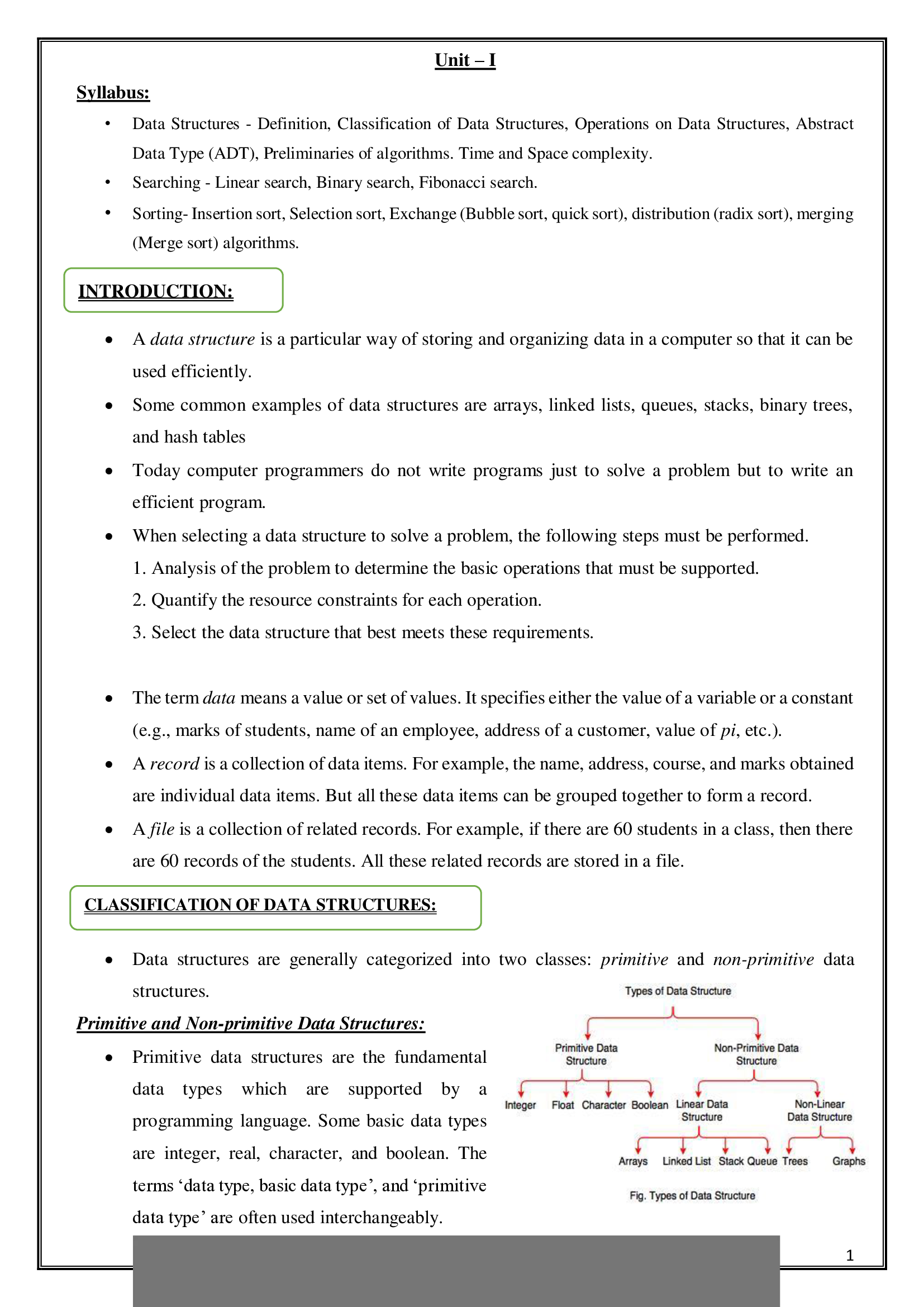
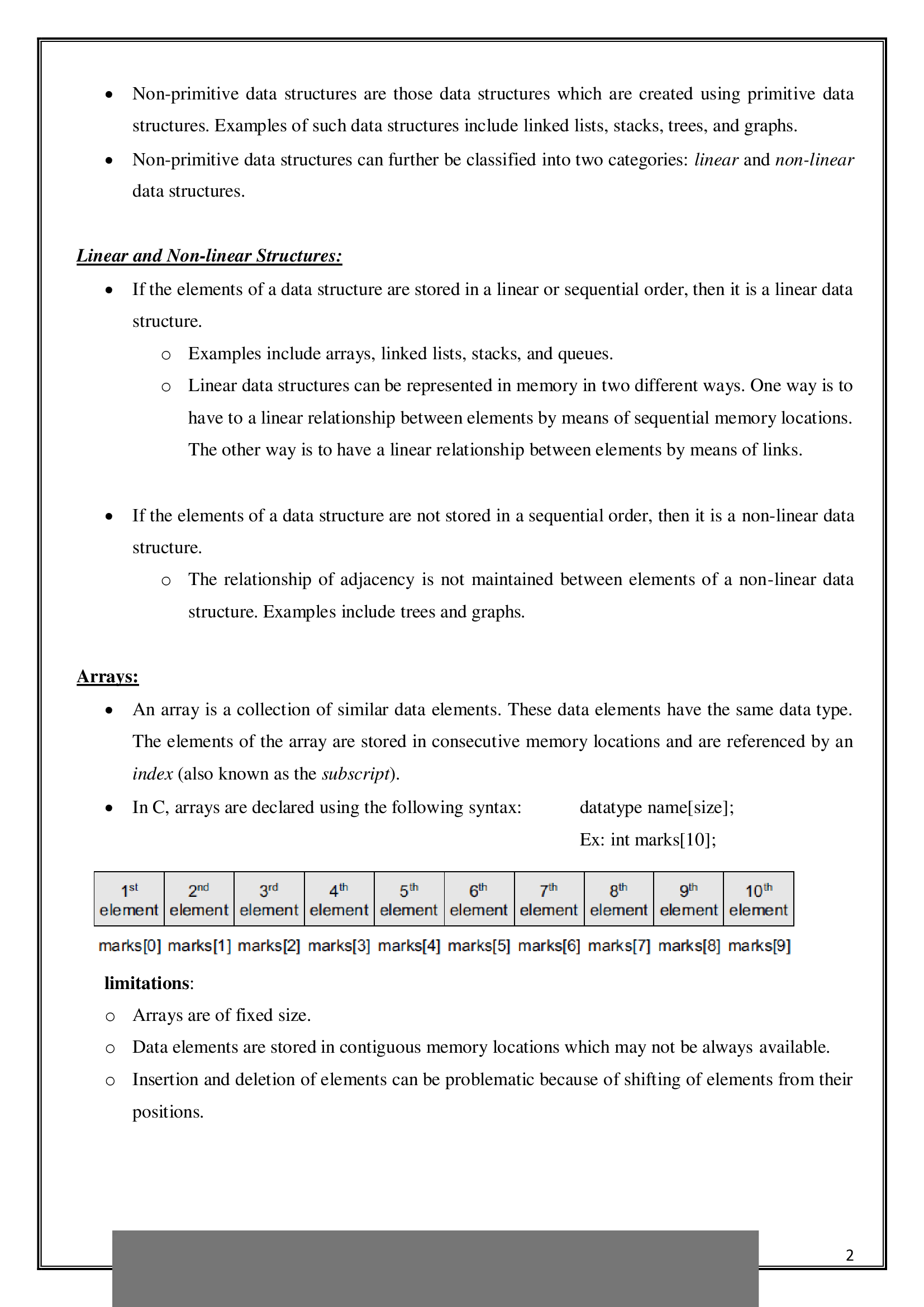
Unit – I Syllabus: • Data Structures - Definition, Classification of Data Structures, Operations on Data Structures, Abstract Data Type (ADT), Preliminaries of algorithms. Time and Space complexity. • Searching - Linear search, Binary search, Fibonacci search. • Sorting- Insertion sort, Selection sort, Exchange (Bubble sort, quick sort), distribution (radix sort), merging (Merge sort) algorithms. ď‚· A data structure is a particular way of storing and organizing data in a computer so that it can be used efficiently. ď‚· Some common examples of data structures are arrays, linked lists, queues, stacks, binary trees, and hash tables ď‚· Today computer programmers do not write programs just to solve a problem but to write an efficient program. ď‚· When selecting a data structure to solve a problem, the following steps must be performed. 1. Analysis of the problem to determine the basic operations that must be supported. 2. Quantify the resource constraints for each operation. 3. Select the data structure that best meets these requirements. ď‚· The term data means a value or set of values. It specifies either the value of a variable or a constant (e.g., marks of students, name of an employee, address of a customer, value of pi, etc.). ď‚· A record is a collection of data items. For example, the name, address, course, and marks obtained are individual data items. But all these data items can be grouped together to form a record. ď‚· A file is a collection of related records. For example, if there are 60 students in a class, then there are 60 records of the students. All these related records are stored in a file. ď‚· Data structures are generally categorized into two classes: primitive and non-primitive data structures. Primitive and Non-primitive Data Structures: ď‚· Primitive data structures are the fundamental data types which are supported by a programming language. Some basic data types are integer, real, character, and boolean. The terms ‘data type, basic data type’, and ‘primitive data type’ are often used interchangeably. INTRODUCTION: CLASSIFICATION OF DATA STRUCTURES: www.Jntufastupdates.com 2 ď‚· Non-primitive data structures are those data structures which are created using primitive data structures. Examples of such data structures include linked lists, stacks, trees, and graphs. ď‚· Non-primitive data structures can further be classified into two categories: linear and non-linear data structures. Linear and Non-linear Structures: ď‚· If the elements of a data structure are stored in a linear or sequential order, then it is a linear data structure. o Examples include arrays, linked lists, stacks, and queues. o Linear data structures can be represented in memory in two different ways. One way is to have to a linear relationship between elements by means of sequential memory locations. The other way is to have a linear relationship between elements by means of links. ď‚· If the elements of a data structure are not stored in a sequential order, then it is a non-linear data structure. o The relationship of adjacency is not maintained between elements of a non-linear data structure. Examples include trees and graphs. Arrays: ď‚· An array is a collection of similar data elements. These data elements have the same data type. The elements of the array are stored in consecutive memory locations and are referenced by an index (also known as the subscript). ď‚· In C, arrays are declared using the following syntax: datatype name[size]; Ex: int marks[10]; limitations: o Arrays are of fixed size. o Data elements are stored in contiguous memory locations which may not be always available. o Insertion and deletion of elements can be problematic because of shifting of elements from their positions.

Contact the Seller

Please Sign In to contact this seller.


  • 👎  Report Copyright Violation

Frequently Asked Questions

What Do I Get When I Buy This Study Material?

+

When you buy a study material on Passing Grades, an instant download link will be sent directly to your email, giving you access to the file anytime after payment is completed.

Is Passing Grades a Trusted Platform?

+

Yes, Passing Grades is a reputable students’ marketplace with a secure payment system and reliable customer support. You can trust us to ensure a safe and seamless transaction experience.

Will I Be Stuck with a Subscription?

+

No, all purchases on Passing Grades are one-time transactions. You only pay for the notes you choose to buy, with no subscriptions or hidden fees attached.

Who Am I Buying These Study Materials From?

+

Passing Grades is a marketplace, which means you are purchasing the document from an individual vendor, not directly from us. We facilitate the payment and delivery process between you and the vendor.

Does Passing Grades Offer Free Study Materials?

+

Yes, sellers on Passing Grades have uploaded numerous free test banks, exams, practice questions, and class notes that can be downloaded at no cost.

Pasinggrades - Quality Study Materials

USD 5

    • Quality checked by Pasing Grades
    • 100% satisfaction guarantee
    • Seller: sravani143
Buy PDF $5

Seller Information

sravani143

Member since January 2025

  • icon
View Profile
  • total sales

    0
  • Favourites

    0
  • Comments

    0
    ( 0 Ratings )

Item Information

  • Uploaded

    10 January 2025

  • Updated

    11 January 2025

  • Category

    Computer Science

  • Item Type

    study guide

  • Tags

    data structure computer science

Related Exam Prep Guides by sravani143

Software Engineering Lecture notes
View Document

Software Engineering...

  • sravani143

    sravani143

  • study guide

Software Engineering Lecture notes...

10 USD

0

0

opearating system SMITW Computer Science Notes
View Document

opearating system SM...

  • sravani143

    sravani143

  • study guide

opearating system...

10 USD

0

0

computer engineering workshop R20 Class Notes
View Document

computer engineering...

  • sravani143

    sravani143

  • study guide

computer engineering work shop...

10 USD

0

0

Purchase

Download link will be sent to this email immediately after purchase.

IMPORTANT LINKS

  • How To Upload Class Notes
  • Selling Tips
  • Passing Grades's Study Materials
  • Scholarships for International Students 2025

POPULAR CATEGORIES

  • Law
  • Accounting
  • English
  • Psychology
  • Business
  • Nursing
  • Computer Science
  • General

View Document

  • Blog
  • Contact
  • Delivery Policy
  • Latest Scholarships Around the World
  • How to Pass Bar Exams: Passing Grades’ Strategies
  • How to Study and Pass the CPA Exam
  • All Test Banks
  • Faq
  • Copyright Claims
  • Privacy Policy
  • Terms of Use

KNOWLEDGE BASE

  • How to Write A+ Grade Good Research Paper
  • How to Manage Stress During Exam Period
  • Best Time to Study
  • How to Pass NCLEX-RN Exam
  • How To Effectively Utilize Test Banks
  • Popular Shadow Health Exam Assessments
  • Popular HESI Case Studies
  • How to Prepare for a Nursing Career
  • The Importance Of Summaries in Exam Revisvion

© 2026 Pasing Grades. All rights reserved.