PasingGrades
  • Start Selling
  • Blog
  • Contact
  • 0

    Your cart is empty!

English

  • English
  • Spanish
  • Arabic
Create Account Sign In
  • Library
    • New Prep Guides
    • Featured Prep Guides
    • Free Exam Prep Guides
    • Best sellers
  • General
  • Nursing
    • Research Paper
    • Case Study
    • Discussion Post
    • Assignment
    • Exam
    • Practice Questions and Answers
    • Test Bank
    • solutions manual
    • study guide
  • Accounting
    • Case Study
    • Thesis
    • Study Guide
    • Summary
    • Research Paper
    • test bank
  • English
    • Creative Writing
    • Research Paper
    • Summary
    • Rhetorics
    • Literature
    • Journal
    • Exam
    • Grammar
    • Discussion Post
    • Essay
  • Psychology
    • Hesi
    • Presentation
    • Essay
    • Summary
    • Study Guide
    • Essay
    • Solution Manual
    • Final Exam Review
    • Class Notes
    • test bank
  • Business
    • Lecture Notes
    • Solution Manual
    • Presentation
    • Business Plan
    • Class Notes
    • Experiment
    • Summary
    • Practice Questions
    • Study Guide
    • Case Study
    • test bank
    • Exam
  • More
    • Computer Science
    • Economics
    • Statistics
    • Engineering
    • Biology
    • Religious Studies
    • Physics
    • Chemistry
    • Mathematics
    • History
    • Sociology
    • Science
    • Philosophy
    • Law
  • Pages
    • About Us
    • Selling Tips
    • Delivery Policy
    • Faq
    • Privacy Policy
  • Flash Sale
  • Home
  • Chapter 27 The Child with a Cardiovascular Disorder - Leifer Maternity and Pediatric Nursing

Chapter 27 The Child with a Cardiovascular Disorder - Leifer Maternity and Pediatric Nursing

Preview page 1 Preview page 2 Preview page 3
Add To Favorites

Share this item Share this item

  • Item Details
  • Comments (0)
  • Reviews (0)
  • Contact Seller

Chapter 27 The Child with a Cardiovascular Disorder - Leifer Maternity and Pediatric Nursing

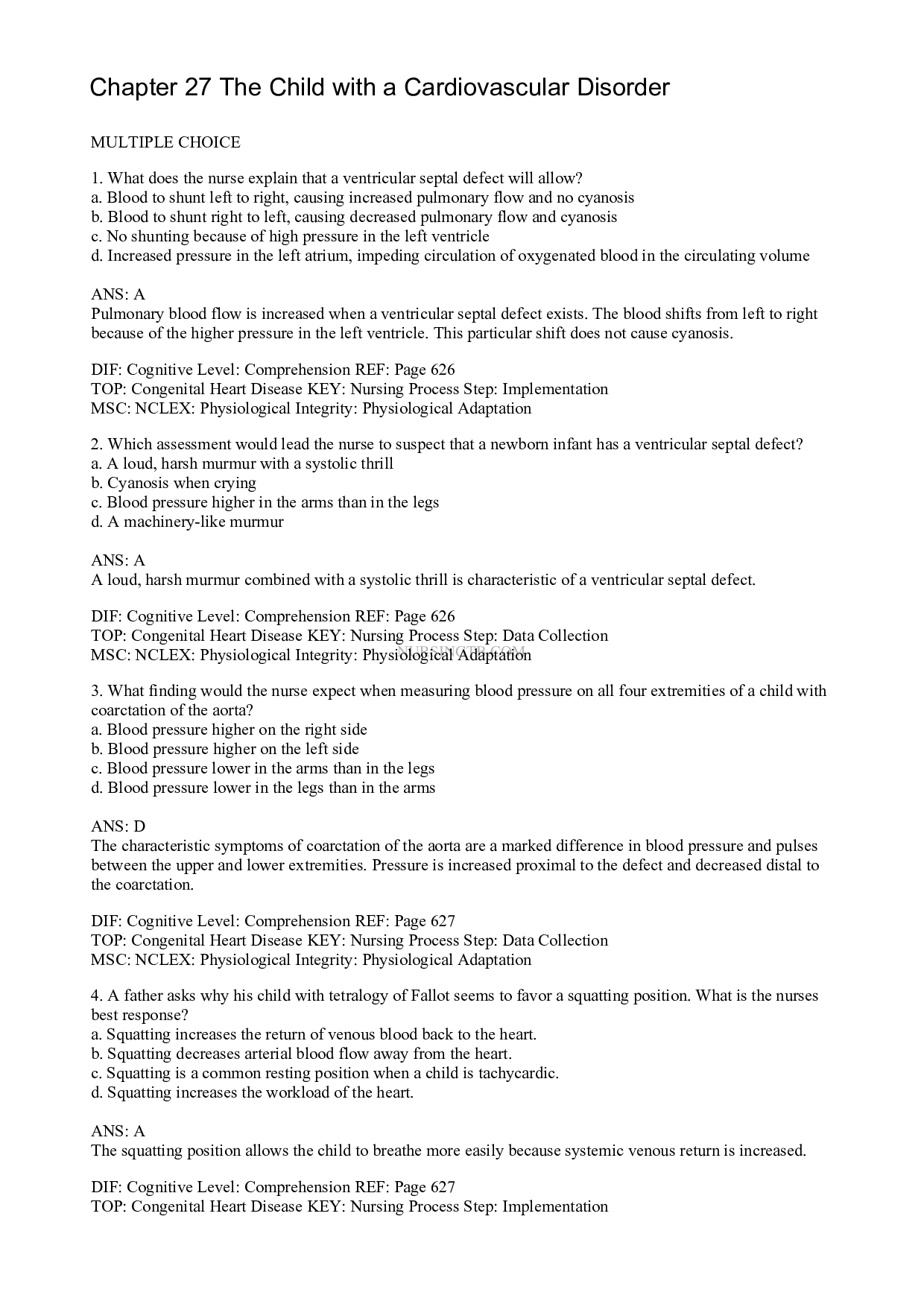
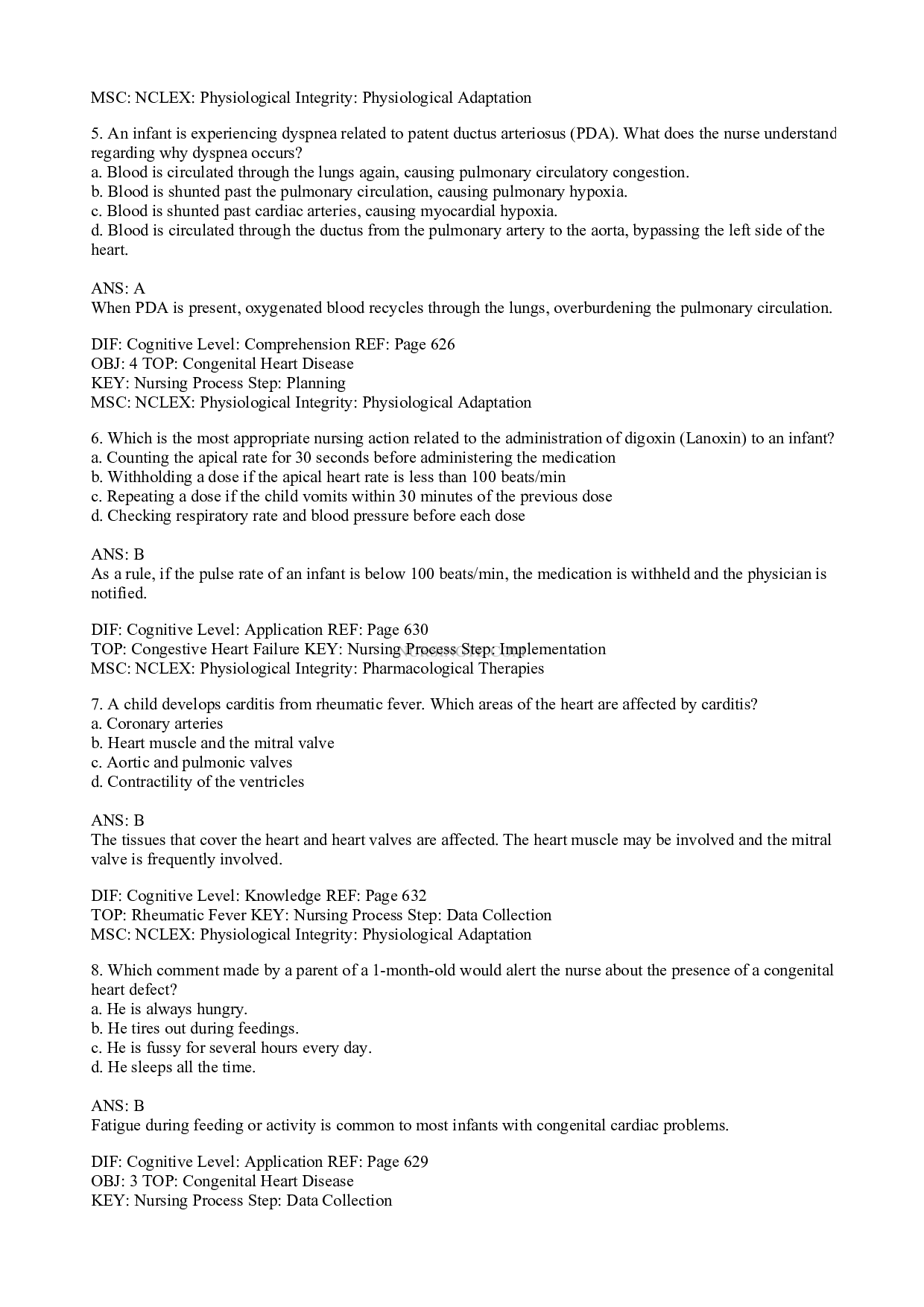
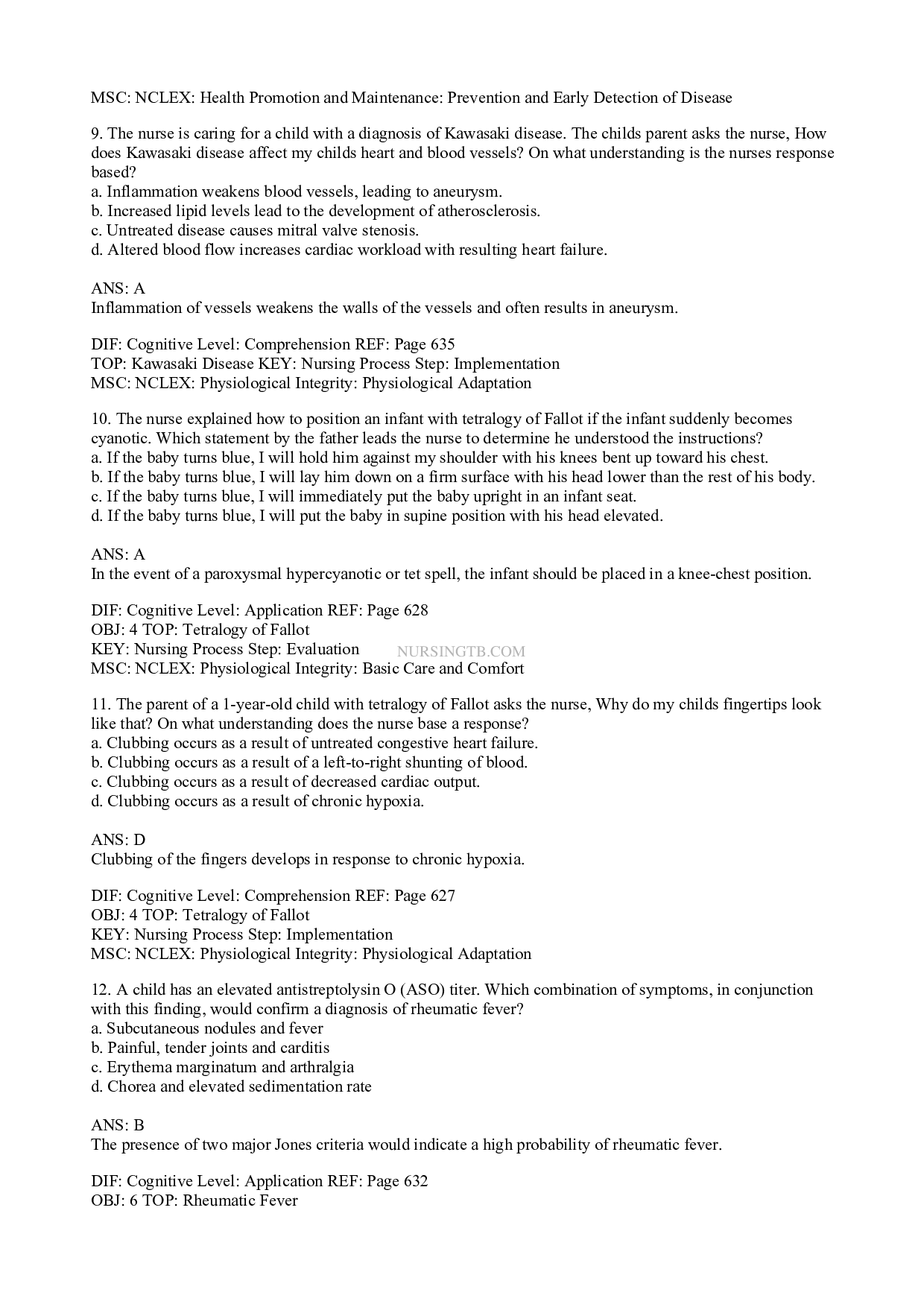
1. What does the nurse explain that a ventricular septal defect will allow? a. Blood to shunt left to right, causing increased pulmonary flow and no cyanosis b. Blood to shunt right to left, causing decreased pulmonary flow and cyanosis c. No shunting because of high pressure in the left ventricle d. Increased pressure in the left atrium, impeding circulation of oxygenated blood in the circulating volume ANS: A Pulmonary blood flow is increased when a ventricular septal defect exists. The blood shifts from left to right because of the higher pressure in the left ventricle. This particular shift does not cause cyanosis. DIF: Cognitive Level: Comprehension REF: Page 626 TOP: Congenital Heart Disease KEY: Nursing Process Step: Implementation MSC: NCLEX: Physiological Integrity: Physiological Adaptation 2. Which assessment would lead the nurse to suspect that a newborn infant has a ventricular septal defect? a. A loud, harsh murmur with a systolic thrill b. Cyanosis when crying c. Blood pressure higher in the arms than in the legs d. A machinery-like murmur ANS: A A loud, harsh murmur combined with a systolic thrill is characteristic of a ventricular septal defect. DIF: Cognitive Level: Comprehension REF: Page 626 TOP: Congenital Heart Disease KEY: Nursing Process Step: Data Collection MSC: NCLEX: Physiological Integrity: Physiological Adaptation 3. What finding would the nurse expect when measuring blood pressure on all four extremities of a child witcoarctation of the aorta? a. Blood pressure higher on the right side b. Blood pressure higher on the left side c. Blood pressure lower in the arms than in the legs d. Blood pressure lower in the legs than in the arms ANS: D The characteristic symptoms of coarctation of the aorta are a marked difference in blood pressure and pulses between the upper and lower extremities. Pressure is increased proximal to the defect and decreased distal to the coarctation. DIF: Cognitive Level: Comprehension REF: Page 627 TOP: Congenital Heart Disease KEY: Nursing Process Step: Data Collection MSC: NCLEX: Physiological Integrity: Physiological Adaptation 4. A father asks why his child with tetralogy of Fallot seems to favor a squatting position. What is the nurses best response? a. Squatting increases the return of venous blood back to the heart. b. Squatting decreases arterial blood flow away from the heart. c. Squatting is a common resting position when a child is tachycardic. d. Squatting increases the workload of the heart. ANS: A The squatting position allows the child to breathe more easily because systemic venous return is increased. DIF: Cognitive Level: Comprehension REF: Page 627 TOP: Congenital Heart Disease KEY: Nursing Process Step: Implementation

Contact the Seller

Please Sign In to contact this seller.


  • 👎  Report Copyright Violation

Frequently Asked Questions

What Do I Get When I Buy This Study Material?

+

When you buy a study material on PasingGrades, an instant download link will be sent directly to your email, giving you access to the file anytime after payment is completed.

Is PasingGrades a Trusted Platform?

+

Yes, PasingGrades is a reputable students’ marketplace with a secure payment system and reliable customer support. You can trust us to ensure a safe and seamless transaction experience.

Will I Be Stuck with a Subscription?

+

No, all purchases on PasingGrades are one-time transactions. You only pay for the notes you choose to buy, with no subscriptions or hidden fees attached.

Who Am I Buying These Study Materials From?

+

PasingGrades is a marketplace, which means you are purchasing the document from an individual vendor, not directly from us. We facilitate the payment and delivery process between you and the vendor.

Does PasingGrades Offer Free Study Materials?

+

Yes, sellers on PasingGrades have uploaded numerous free test banks, exams, practice questions, and class notes that can be downloaded at no cost.

Pasinggrades - Quality Study Materials

USD 6

    • Quality checked by PasingGrades
    • 100% satisfaction guarantee
    • Seller: bundlestudent
Buy PDF $6

Seller Information

bundlestudent

Member since April 2024

  • icon
View Profile
  • total sales

    0
  • Favourites

    0
  • Comments

    0
    ( 0 Ratings )

Item Information

  • Uploaded

    28 March 2026

  • Updated

    29 March 2026

  • Category

    Nursing

  • Item Type

    test bank

  • Tags

    maternity and pediatric nursing

This item belongs to a package deal

LEIFER: Introduction to Maternity and Pediatric Nursing, 10th Edition Ch 1-32 Full Test Bank Chapters

16.00 USD

33 items in bundle

  • Chapter 34 The Child with an E...
  • Chapter 33 Childhood Communica...
  • Chapter 32 The Child with a Me...
View Bundle

Similar Test banks

TEST BANK FOR SAFE MATERNITY & PEDIATRIC NURSING CARE 1ST EDITION BY LINNARD-PALMER
View Document

TEST BANK FOR SAFE MATERNITY & PEDIATRIC NURSING CARE 1ST EDITION BY LINNARD-PALMER

TEST BANK FOR SAFE MATERNITY & PEDIATRIC NURSING CARE 1ST EDITION BY LINNARD-PALMER

15 USD
Test Bank for Maternal Child Nursing Care 7th Edition by Shannon E. Perry, Marilyn J. Hockenberry, Mary Catherine Cashion Chapter 1-50
View Document

Test Bank for Maternal Child Nursing Care 7th Edition by Shannon E. Perry, Marilyn J. Hockenberry, M...

Test Bank for Maternal Child Nursing Care 7th Edition by Shannon E. Perry, Marilyn J. Hockenberry, M...

16 USD
Test Bank for Essentials for Nursing Practice 8th Edition by Potter | All Chapters
View Document

Test Bank for Essentials for Nursing Practice 8th Edition by Potter | All Chapters

Master nursing concepts with this study material; Test Bank for Essentials for Nursing Practice, 8th...

15 USD

Related free study materials

Chapter 24, Personality Disorders, EAQ Halter Valcaroli
Read

Chapter 24, Personality Disorders, EAQ Halter Valc...

Chapter 24, Personality Disorders, EAQ Halter Varcarolis' Foundations of Psychiatric-Mental Health N...

Chapter 08. The Nursing Process in Psychiatric/Mental Health Nursing | Davis Test Bank
Read

Chapter 08. The Nursing Process in Psychiatric/Men...

Study sample test bank Chapter 08. The Nursing Process in Psychiatric/Mental Health Nursing from Tes...

Chapter 13. Integrative Physiology I: Control of Body Movement
Read

Chapter 13. Integrative Physiology I: Control of B...

Chapter 13. Integrative Physiology I: Control of Body Movement

Related Exam Prep Guides by bundlestudent

Chapter 1 Perspectives on Maternal and Child Health Care
View Document

Chapter 1 Perspectiv...

  • bundlestudent

    bundlestudent

  • test bank

Chapter 1 Perspectives on Maternal and Child Health Care Questions and Answers Test Bank for Materni...

6 USD

0

0

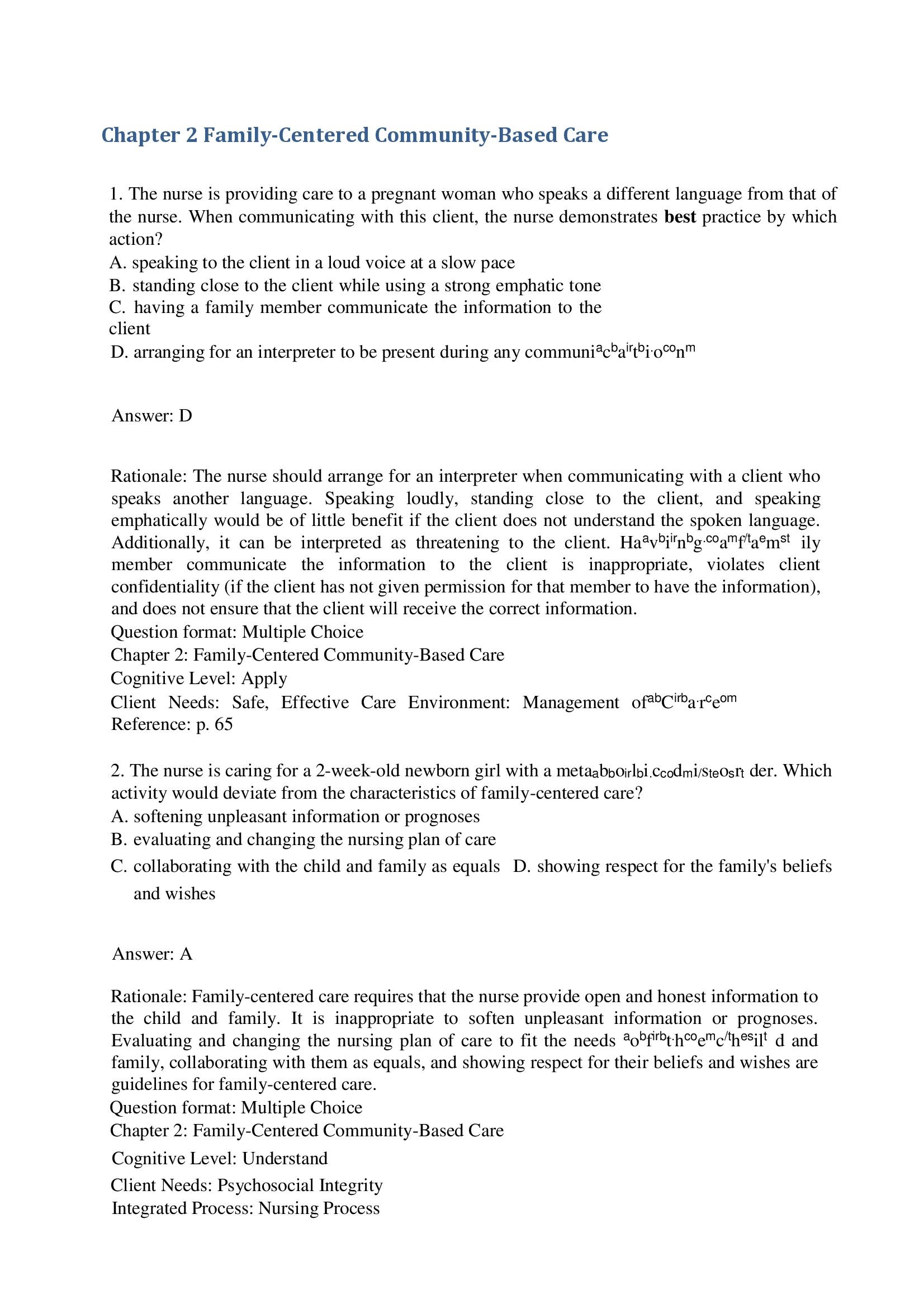
Chapter 2 Family-Centered Community-Based Care
View Document

Chapter 2 Family-Cen...

  • bundlestudent

    bundlestudent

  • test bank

Chapter 2 Family-Centered Community-Based Care Questions and Answers Test Bank for Maternity and Ped...

6 USD

0

0

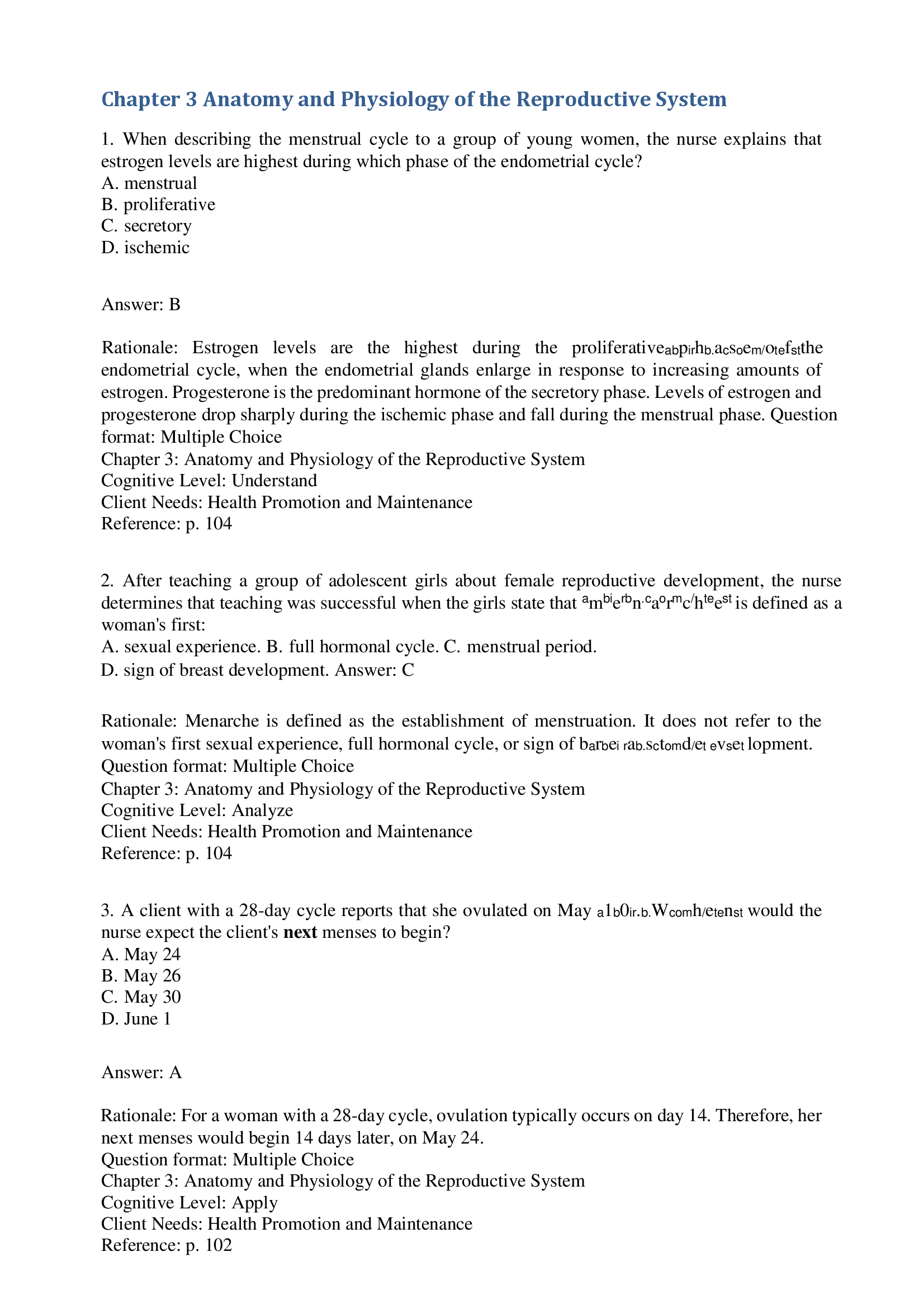
Chapter 3 Anatomy and Physiology of the Reproductive System
View Document

Chapter 3 Anatomy an...

  • bundlestudent

    bundlestudent

  • test bank

Chapter 3 Anatomy and Physiology of the Reproductive System Questions and Answers Test Bank for Mate...

6 USD

0

0

Purchase

Download link will be sent to this email immediately after purchase.

IMPORTANT LINKS

  • How To Upload Class Notes
  • Selling Tips
  • Pasing Grades's Study Materials
  • Scholarships for International Students 2026

POPULAR CATEGORIES

  • Law
  • Accounting
  • English
  • Psychology
  • Business
  • Nursing
  • Computer Science
  • General

View Document

  • Blog
  • Contact
  • Delivery Policy
  • Latest Scholarships Around the World
  • How to Pass Bar Exams: Passing Grades’ Strategies
  • How to Study and Pass the CPA Exam
  • All Test Banks
  • All Exams Preparation Materials
  • Faq
  • Copyright Claims
  • Privacy Policy
  • Terms of Use

KNOWLEDGE BASE

  • How to Write A+ Grade Good Research Paper
  • How to Manage Stress During Exam Period
  • Best Time to Study
  • How to Pass NCLEX-RN Exam
  • How To Effectively Utilize Test Banks
  • Popular Shadow Health Exam Assessments
  • Popular HESI Case Studies
  • How to Prepare for a Nursing Career
  • The Importance Of Summaries in Exam Revisvion

© 2026 PasingGrades. All rights reserved.