Pasing Grades
  • Start Selling
  • Blog
  • Contact
  • 0

    Your cart is empty!

English

  • English
  • Spanish
  • Arabic
Create Account Sign In
  • Library
    • New Prep Guides
    • Featured Prep Guides
    • Free Exam Prep Guides
    • Best sellers
  • General
  • Nursing
    • Research Paper
    • Case Study
    • Discussion Post
    • Assignment
    • Exam
    • Practice Questions and Answers
    • Test Bank
    • solutions manual
  • Accounting
    • Case Study
    • Thesis
    • Study Guide
    • Summary
    • Research Paper
    • test bank
  • English
    • Creative Writing
    • Research Paper
    • Summary
    • Rhetorics
    • Literature
    • Journal
    • Exam
    • Grammar
    • Discussion Post
    • Essay
  • Psychology
    • Hesi
    • Presentation
    • Essay
    • Summary
    • Study Guide
    • Essay
    • Solution Manual
    • Final Exam Review
    • Class Notes
    • test bank
  • Business
    • Lecture Notes
    • Solution Manual
    • Presentation
    • Business Plan
    • Class Notes
    • Experiment
    • Summary
    • Practice Questions
    • Study Guide
    • Case Study
    • test bank
    • Exam
  • More
    • Computer Science
    • Economics
    • Statistics
    • Engineering
    • Biology
    • Religious Studies
    • Physics
    • Chemistry
    • Mathematics
    • History
    • Sociology
    • Science
    • Philosophy
    • Law
  • Pages
    • About Us
    • Selling Tips
    • Delivery Policy
    • Faq
    • Privacy Policy
  • Flash Sale
  • Home
  • CEBS - GBA Practice Exam 2 Questions and Answers

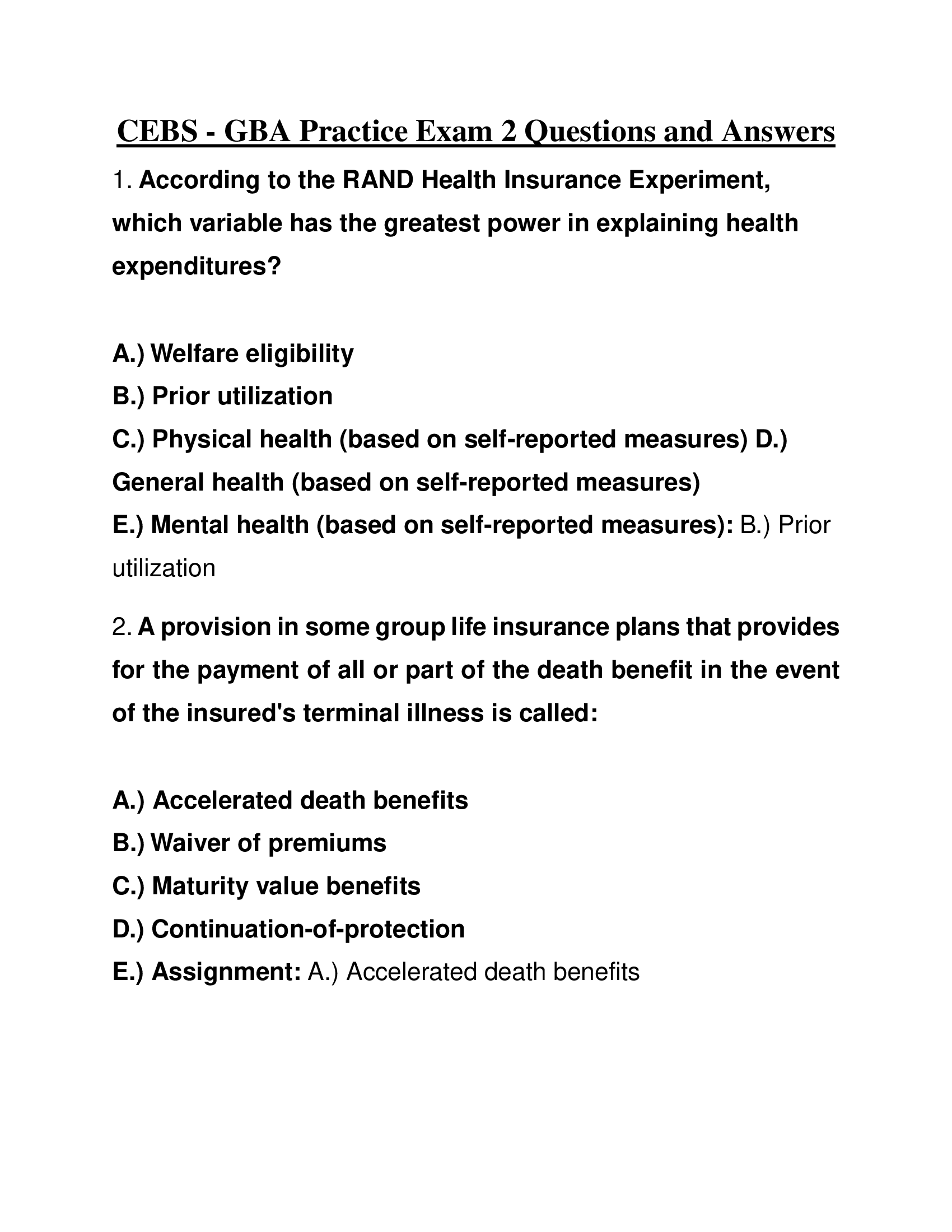
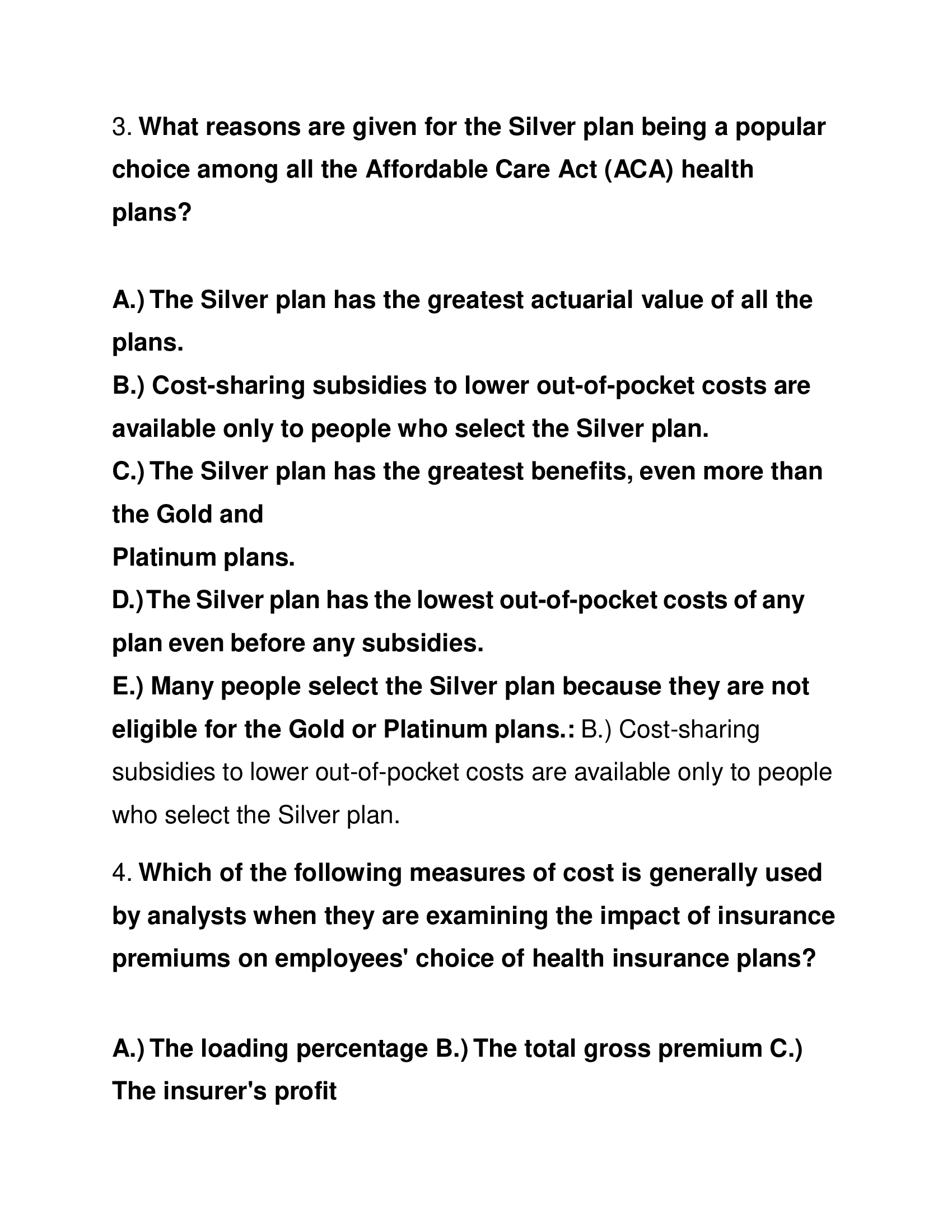
CEBS - GBA Practice Exam 2 Questions and Answers

Preview page 1 Preview page 2 Preview page 3
Add To Favorites

Share this item Share this item

  • Item Details
  • Comments (0)
  • Reviews (0)
  • Contact Seller
CEBS - GBA Practice Exam 2 Questions and Answers

Contact the Seller

Please Sign In to contact this seller.


  • 👎  Report Copyright Violation

Frequently Asked Questions

What Do I Get When I Buy This Study Material?

+

When you buy a study material on Passing Grades, an instant download link will be sent directly to your email, giving you access to the file anytime after payment is completed.

Is Passing Grades a Trusted Platform?

+

Yes, Passing Grades is a reputable students’ marketplace with a secure payment system and reliable customer support. You can trust us to ensure a safe and seamless transaction experience.

Will I Be Stuck with a Subscription?

+

No, all purchases on Passing Grades are one-time transactions. You only pay for the notes you choose to buy, with no subscriptions or hidden fees attached.

Who Am I Buying These Study Materials From?

+

Passing Grades is a marketplace, which means you are purchasing the document from an individual vendor, not directly from us. We facilitate the payment and delivery process between you and the vendor.

Does Passing Grades Offer Free Study Materials?

+

Yes, sellers on Passing Grades have uploaded numerous free test banks, exams, practice questions, and class notes that can be downloaded at no cost.


Pasinggrades - Quality Study Materials

USD 8

    • Quality checked by Pasing Grades
    • 100% satisfaction guarantee
    • Seller: Namwaki
Buy PDF $8

Seller Information

Namwaki

Member since April 2021

  • icon
  • icon
  • icon
View Profile
  • total sales

    0
  • Favourites

    0
  • Comments

    0
    ( 0 Ratings )

Item Information

  • Uploaded

    06 March 2023

  • Updated

    17 October 2025

  • Category

    Nursing

  • Item Type

    exam

  • Tags

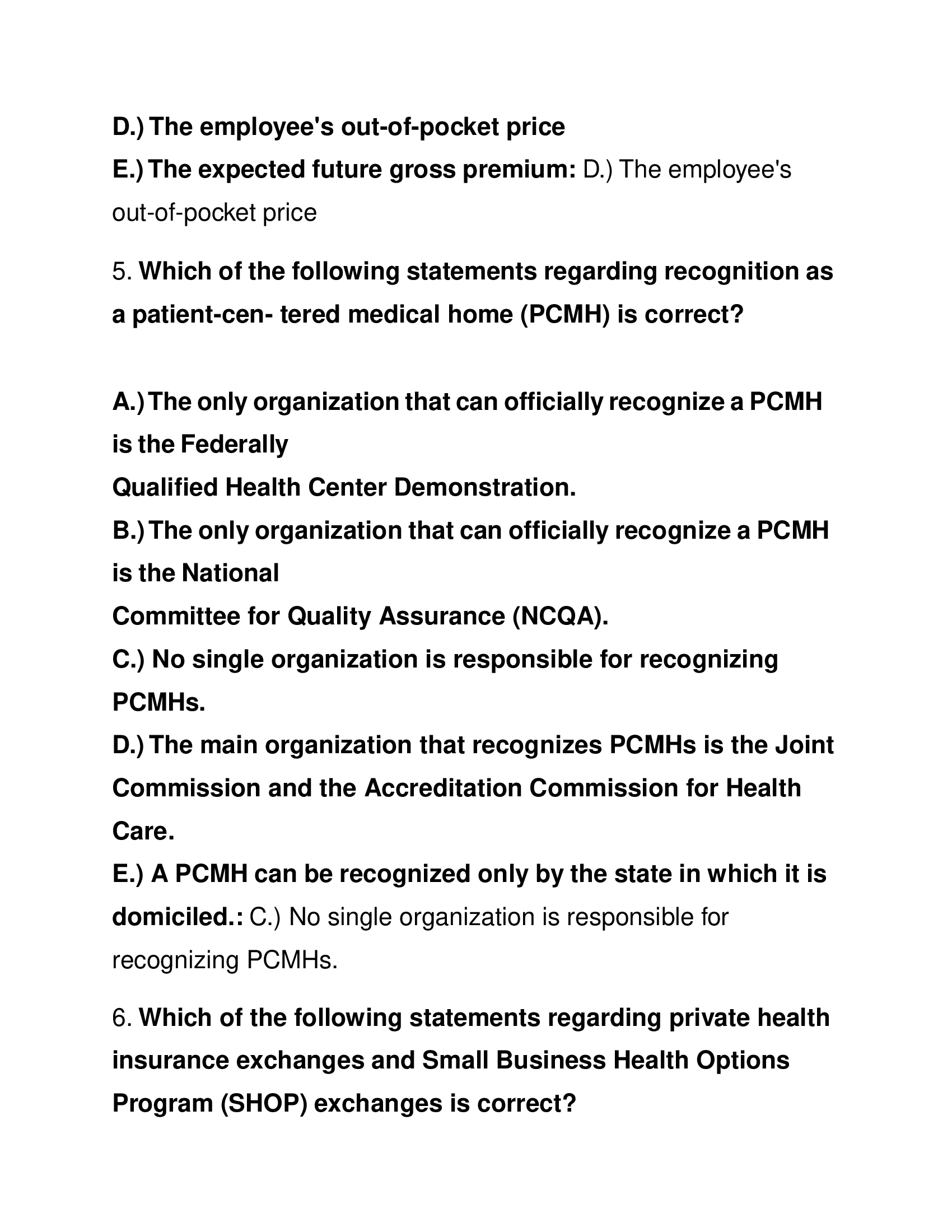
    CEBS GBA Practice Exam 2 Questions and Answers 1. According to the RAND Health Insurance Experiment which variable has the greatest power in explaining health expenditures? A.) Welfare eligibility B.) Prior utilization C.) Physical health (based on self reported measures) D.) General health (based on self reported measures) E.) Mental health (based on self reported measures): B.) Prior utilization 2. A provision in some group life insurance plans that provides for the payment of all or part of the death benefit in the event of the insured's terminal illness is called: A.) Accelerated death benefits B.) Waiver of premiums C.) Maturity value benefits D.) Continuation of protection E.) Assignment: A.) Accelerated death benefits 3. What reasons are given for the Silver plan being a popular choice among all the Affordable Care Act (ACA) health plans? A.) The Silver plan has the greatest actuarial value of all the plans. B.) Cost sharing subsidies to lower out of pocket costs are available only to people who select the Silver plan. C.) The Silver plan has the greatest benefits even more than the Gold and Platinum plans. D.) The Silver plan has the lowest out of pocket costs of any plan even before any subsidies. E.) Many people select the Silver plan because they are not eligible for the Gold or Platinum plans.: B.) Cost sharing subsidies to lower out of pocket costs are available only to people who select the Silver plan. 4. Which of the following measures of cost is generally used by analysts when they are examining the impact of insurance premiums on employees' choice of health insurance plans? A.) The loading percentage B.) The total gross premium C.) The insurer's profit D.) The employee's out of pocket price E.) The expected future gross premium: D.) The employee's out of pocket price 5. Which of the following statements regarding recognition as a patient cen tered medical home (PCMH) is correct? A.) The only organization that can officially recognize a PCMH is the Federally Qualified Health Center Demonstration. B.) The only organization that can officially recognize a PCMH is the National Committee for Quality Assurance (NCQA). C.) No single organization is responsible for recognizing PCMHs. D.) The main organization that recognizes PCMHs is the Joint Commission and the Accreditation Commission for Health Care. E.) A PCMH can be recognized only by the state in which it is domiciled.: C.) No single organization is responsible for recognizing PCMHs. 6. Which of the following statements regarding private health insurance exchanges and Small Business Health Options Program (SHOP) exchanges is correct? A.) A lot of evidence has been produced to show that private exchanges have been designed to make it easier for small business to self insure. B.) The income tax incentives previously provided to small employers in the SHOP program have expired. C.) Recently states were given the option of making SHOP exchanges mandatory for all employers with fewer than 200 employees. D.) Private exchanges could affect SHOP exchanges by siphoning enroll ment from them and thereby reducing revenue (administrative fees) critical to SHOPs' financial viability. E.) Unlike private exchanges SHOP exchanges do not have the ability to offer small employers a number of plan choices.: D.) Private exchanges could affect SHOP exchanges by siphoning enrollment from them and thereby reducing revenue (administrative fees) critical to SHOPs' financial viability. 7. What is the waiting period for Social Security Disability Income (SSDI) benefits? A.) One month B.) Three consecutive months C.) Five consecutive months D.) Six consecutive months E.) Twelve consecutive months: C.) Five consecutive months 8. "Desktop medicine" is a fully integrated approach using information tech nology whose primary goal is to: A.) Recruit prospective health plan subscribers B.) Help track patients through their plan of care C.) Encourage patient self diagnosis using the Internet D.) Gather health status metrics for large patient populations E.) Expedite health provider use of technology: B.) Help track patients through their plan of care 9. Until now the biggest source of cost savings with private health insurance exchanges has been: A.) Transition to the defined contribution approach B.) Increased use of technology C.) Employees choosing less generous plans D.) Better health education of employees E.) Elimination or reduction in administrative waste: C.) Employees choosing less generous plans 10. Out of network health care accounts for approximately what percentage of total covered health insurance expenses? A.) 3 B.) 10 C.) 20 D.) 25 E.) 30: B.) 10 11. The major advantage of term insurance for the policyowner is the fact that: A.) A substantial amount of life insurance can be purchased for relatively modest premiums B.) It provides lifetime protection if the insured continues to pay the premi ums C.) The premiums remain at the same level for the life of the insured D.) With a policy rider it can be used to provide retirement E.) Premiums are highly competitive especially for those at older ages: A.) A substantial amount of life insurance can be purchased for relatively modest premiums 12. Mr. Smith is insured in his company's group life insurance plan. The plan is noncontributory and meets the requirements of Internal Revenue Code Section 79. How much group life insurance can be provided to Mr. Smith without him incurring a federal income tax liability on the value of his employer's contributions? A.) 0 B.) 25 000 C.) 50 000 D.) 100 000 E.) An unlimited amount: C.) 50 000 13. Which of the following statements regarding health expenditures and related research is correct? A.) In general risk adjustment models have been able to predict about 80 percent of total claims. B.) Age and gender account for about 90 percent of explained variation in health care expenditures. C.) Medicare currently pays Medicare Advantage plans on the basis of the Centers for Medicare & Medicaid Services Hierarchical Condition Categories (CMS HCC) model which uses approximately 70 clinical conditions. D.) Health maintenance organizations (HMOs) that could predict health ex penditures only five percentage points better than Medicare would not gain a significant amount of profit per enrollee. E.) Inpatient expenditures are more predictable than outpatient expendi tures.: C.) Medicare currently pays Medicare Advantage plans on the basis of the Centers for Medicare & Medicaid Services Hierarchical Condition Categories (CMS HCC) model which uses approximately 70 clinical conditions. 14. Which of the following has been a key focus of redesign and improvement efforts in healthcare? A.) Hospital care B.) Diagnostic/imaging services C.) Critical care D.) Orthopedic surgery E.) Primary care medicine: E.) Primary care medicine 15. Reference pricing used by some managed care health plans: A.) Is an example of center of excellence pricing. B.) Is one method of giving subscribers an incentive to use lower cost but quality providers. C.) Can only be used in a capitation system. D.) Is a model that has not been used in practice. E.) Is designed to attract healthier individuals into the plan. .: B.) Is one method of giving subscribers an incentive to use lowercost but quality providers 16. The vast majority of long term care needs are met by: A.) Medicare B.) Medicaid C.) Individual health insurance policies D.) Long term care insurance policies E.) Family members on an unpaid basis: E.) Family members on an unpaid basis 17. The practice of hospitals paid based on billed charges by commercial insurers and allowable costs by Medicare ended primarily because: A.) Managed care plans introduced selective contracting into the market. B.) Hospitals started using more advanced technology. C.) Patients became less concerned about the cost of services. D.) Hospitals started to focus more on the quality of services. E.) Physicians gained a greater voice in the pricing of health care.: A.) Managed care plans introduced selective contracting into the market. 18. What is the provision in the Part D Medicare law that gives a significant benefit to pharmaceutical companies? A.) The law allows only pharmaceutical companies registered with a speci fied trade association to market drugs under Part D and virtually all pharmaceutical companies are so registered B.) The law guarantees a certain profit margin to all pharmaceutical compa nies that sell drugs under Part D. C.) The law prohibits the government from using its purchasing power to negotiate widespread discounts with drug plans. D.) The law gives all U.S. pharmaceutical companies special income tax benefits for an extended period of time. E.) The law prohibits the widespread dissemination of information regarding specified drugs.: C.) The law prohibits the government from using its purchasing power to negotiate widespread discounts with drug plans. 19. The definition of disability for Social Security Disability Insurance bene fits requires the impairment to be expected to result in death or to last for a continuous period of at least how many months? A.) Three B.) Four C.) Five D.) Six E.) Twelve: E.) Twelve 20. A small employer has a self funded health plan with reinsurance cover age. Which of the following statements regarding this type of reinsurance is correct? A.) Aggregate stop loss reinsurance limits the dollar amount of coverage on each employee's health care costs. B.) Reinsurers often help small employers revise their health plans. C.) Lower "attachment points" decrease the employer's financial risk. D.) Federal law requires stop loss insurers to provide policyholders an advance notice of at least 90 days before cancelling a policy. E.) Specific stop loss coverage reinsurance limits the dollar amount of health care costs for an entire employee population over a period of time.: C.) Lower "attachment points" decrease the employer's financial risk. 21. Using private exchanges employers have begun to implement the de fined contribution model for medical benefits for which group of individuals? A.) All active full time employees B.) Active full time employees with dependent coverage C.) All part time employees D.) Part time employees with dependent coverage E.) Retirees and their eligible dependents: E.) Retirees and their eligible dependents 22. Objective risk for health insurers is most closely related to which of the following concepts? A.) Expense ratios B.) Carve out coverage such as prescription drug benefits C.) Dispersion (which is often measured by standard deviation) D.) Investment underwriting E.) Subjective risk: C.) Dispersion (which is often measured by standard devia tion) 23. Which of the following statements regarding reimbursement methods for patient centered medical homes (PCMHs) is correct? A.) The most popular approach by far is fee for service. B.) The most common approach is a capitation system. C.) Typically reimbursement is based on a pay forperformance approach. D.) A negotiated or modified fee forservice is the most common. E.) Nearly all approaches utilize a blend of pay forperformance monthly per enrollee payments and fee for service.: E.) Nearly all approaches utilize a blend of pay for performance monthly perenrollee payments and fee for service. 24. A life insurance policy in which the insurance provides lifetime protec tion the premiums are level but they are paid only for a certain period is referred to as: A.) Endowment insurance B.) Term to age 65 C.) Straight life D.) Limited payment life E.) Variable life: D.) Limited payment life 25. For long term care (LTC) purposes the Internal Revenue Code defines a chronically ill individual as one who has been certified by a licensed health care practitioner as unable to perform without substantial assistance from another individual at least how many activities of daily living (ADLs) for a period of at least how many days due to a loss of functional capacity? A.) One ADL 90 days B.) Two ADLs 90 days C.) Three ADLs 90 days D.) Two ADLs 60 days E.) Three ADLs 60 days: B.) Two ADLs 90 days 26. Which of the following statements regarding Small Business Health Op tions Program (SHOP) exchanges is correct? A.) SHOP exchanges are marketplaces that are essentially online portals which enable small employers to select from a range of fully insured plans and contribution arrangements for their employees. B.) Plans marketed on SHOP exchanges are exempt from all federal require ments for insurers. C.) SHOP exchanges require employees to contribute at least 50 75% of premium costs. D.) Employees who receive an employer offer of qualified health care cover age purchased on a SHOP exchange are eligible for federal subsidies. E.) SHOP exchanges are primarily targeted to employers with 50 100 employ ees.: A.) SHOP exchanges are marketplaces that are essentially online portals which enable small employers to select from a range of fully insured plans and contribution arrangements for their employees. 27. Which of the following statements best describes the Affordable Care Act (ACA) approach to the problem of involuntary out of network emergency health care? A.) Higher copayments and coinsurance for out of network emergency room care is permitted but limited and balance billing is prohibited. B.) Higher copayments and coinsurance for out of network emergency room care is allowed but only for certain specific types of care; balance billing is not allowed. C.) Plans cannot impose higher copayments or coinsurance for out of net work emergency room care and balance billing is still allowed within certain parameters; these requirements do not apply to grandfathered plans. D.) Plans cannot impose higher copayments or coinsurance for out of net work emergency room care and balance billing is not allowed; no plans are grandfathered. E.) The ACA has yet to address this issue but new guidance is expected. : C.) Plans cannot impose higher copayments or coinsurance for out of network emergency room care and balance billing is still allowed within certain parameters; these requirements do not apply to grandfathered plans. 28. Which of the following statements best describes the financial liability of self insured plans administered through private health exchanges? A.) The plans can completely cap their financial liabilities by using these exchanges. B.) Using these exchanges the plans can completely cap their financial liabilities by offering plans with a fixed credit that is not indexed to the rate of general inflation. C.) The plans can shift some of their financial liabilities to the private exchange vendor. D.) The plans can cap most of their financial liabilities by participating in a risk pool established by the exchange vendor. E.) The plans cannot in general completely cap their financial liabilities regardless of the delivery vendor they select.: E.) The plans cannot in general completely cap their financial liabilities regardless of the delivery vendor they select. 29. A medical group is paid fee for service up to a withhold amount. The group is paid 75 percent at the time of service and the remaining 25 percent is paid if the managed care plan: A.) Is able to cover its overall claim costs. B.) Covers the physician salaries. C.) Anticipates providing less than two percent of out ofnetwork benefits in the next computation period. D.) Provides virtually 100% in network benefits in the computation period. E.) Is efficient at recapturing capitation fees for late subscriber termina tions.: A.) Is able to cover its overall claim costs. 30. The health insurance rating system in which insurers place policyholders into groups according to their loss producing characteristics is known as: A.) Calibrated rating B.) Manual rating C.) Durational rating D.) General liability rating E.) Objective rating: B.) Manual rating 31. Developed countries other than the U.S. spend a much lower proportion of their gross domestic product on health care and enjoy better quality than the U.S. does. It is widely believed by policy makers that one major reason for this phenomenon is because: A.) The medical educational programs are better in the other countries. B.) The health care systems in such countries are built on a strong primary care base. C.) Other countries use much better technology than the U.S. does. D.) The U.S. has not made quality healthcare a high priority. E.) Other countries have healthier populations.: B.) The health care systems in such countries are built on a strong primary care base. 32. The Affordable Care Act included several risk and market stabilization programs. Which of the following is one of the programs that dealt with limiting insurer losses and gains beyond an allowable range? A.) Reinsurance program B.) Risk adjustment program C.) Medical loss ratio program D.) Risk corridor program E.) Bidding process program for qualified health plans: D.) Risk corridor program 33. Which of the following is the approximate percentage of the U.S. popula tion covered in the specified U.S. healthcare scheme? A.) 40% through private individual insurance B.) 25% through employer sponsored group insurance C.) 25% through the Medicaid program D.) 20% through the Federal Employees Health Benefits (FEHB) program E.) 15% through the Medicare program: E.) 15% through the Medicare program 34. Which of the following statements regarding health insurance rating systems is (are) correct? I. Both prospective and retrospective experience rating use an employer's experience to calculate the insurance rate.

Related Exam Prep Guides by Namwaki

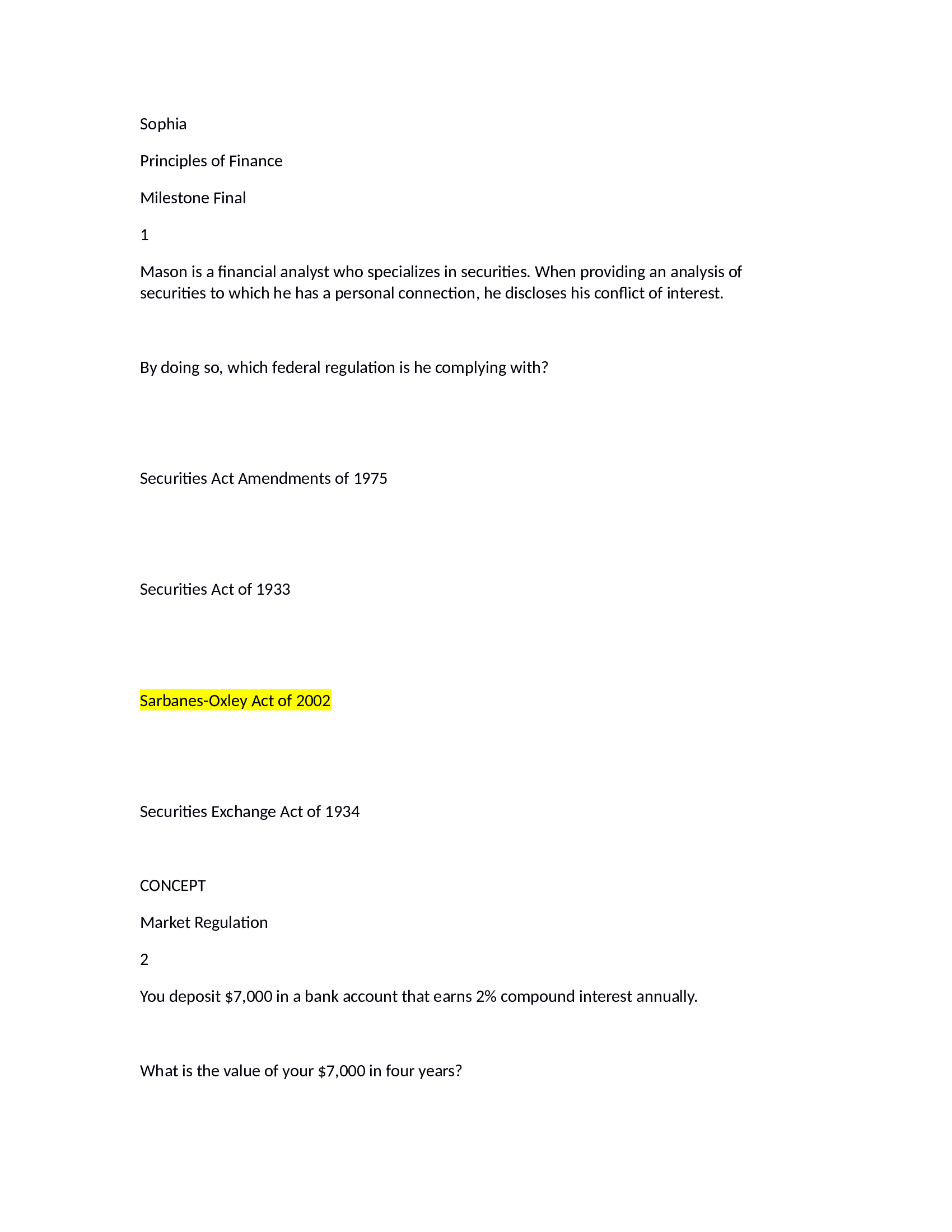
Sophia Finance Milestone Final_Complete Questions and Answers 2021.
View Document

Sophia Finance Miles...

  • Namwaki

    Namwaki

  • exam

Sophia Finance Milestone Final_Complete Questions and Answers 2021...

8 USD

0

0

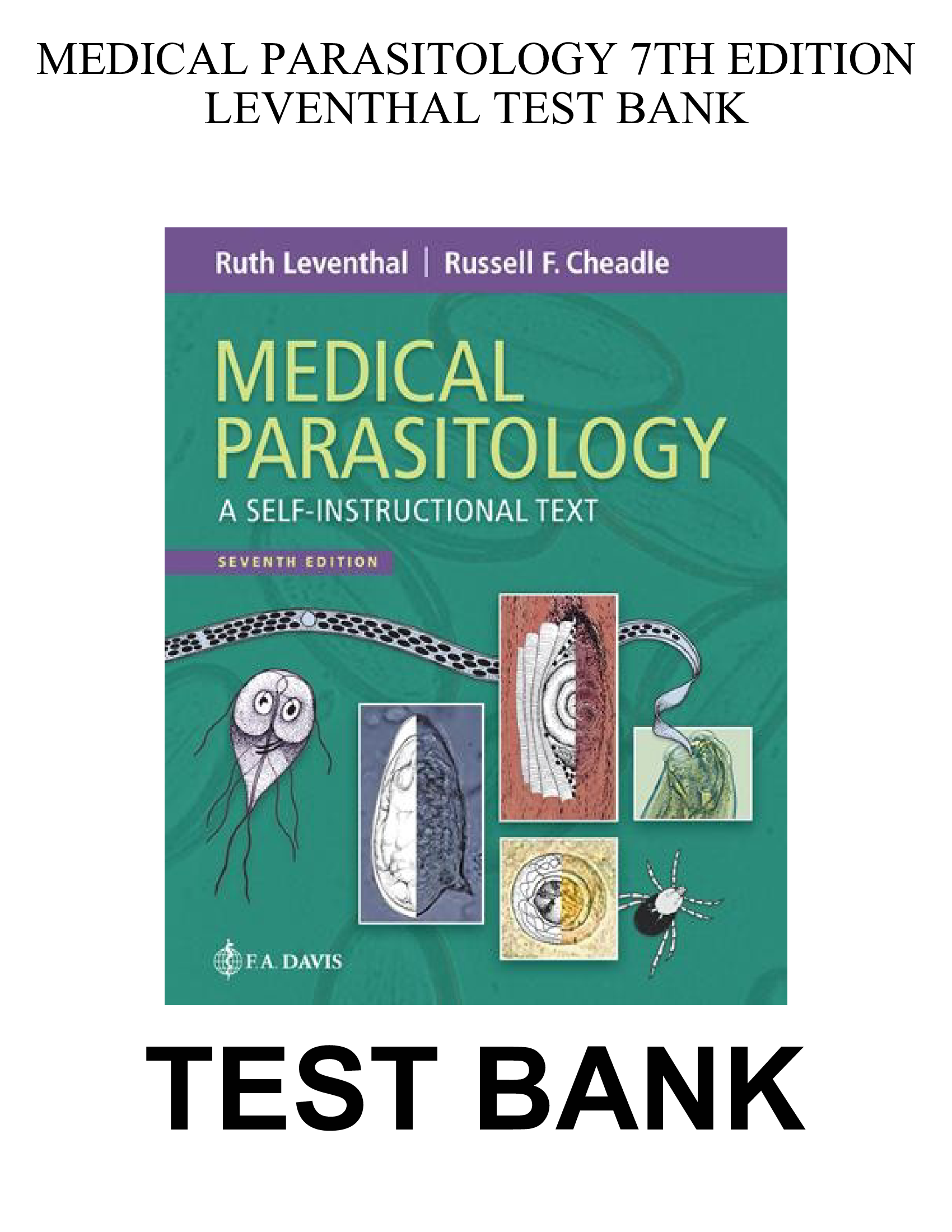
Medical Parasitology 7th Edition Leventhal Test Bank
View Document

Medical Parasitology...

  • Namwaki

    Namwaki

  • exam

Medical Parasitology 7th Edition Leventhal Test Bank...

8 USD

0

0

TEST- BANK FOR WONGS NURSING CARE OF INFANTS AND CHILDREN 11TH EDITION HOCKENBERRY
View Document

TEST- BANK FOR WONGS...

  • Namwaki

    Namwaki

  • exam

TEST- BANK FOR WONGS NURSING CARE OF INFANTS AND CHILDREN 11TH EDITION HOCKENBERRY – Download PDF...

8 USD

0

0

Purchase

Download link will be sent to this email immediately after purchase.

IMPORTANT LINKS

  • How To Upload Class Notes
  • Selling Tips
  • Passing Grades's Study Materials
  • Scholarships for International Students 2026

POPULAR CATEGORIES

  • Law
  • Accounting
  • English
  • Psychology
  • Business
  • Nursing
  • Computer Science
  • General

View Document

  • Blog
  • Contact
  • Delivery Policy
  • Latest Scholarships Around the World
  • How to Pass Bar Exams: Passing Grades’ Strategies
  • How to Study and Pass the CPA Exam
  • All Test Banks
  • Faq
  • Copyright Claims
  • Privacy Policy
  • Terms of Use

KNOWLEDGE BASE

  • How to Write A+ Grade Good Research Paper
  • How to Manage Stress During Exam Period
  • Best Time to Study
  • How to Pass NCLEX-RN Exam
  • How To Effectively Utilize Test Banks
  • Popular Shadow Health Exam Assessments
  • Popular HESI Case Studies
  • How to Prepare for a Nursing Career
  • The Importance Of Summaries in Exam Revisvion

© 2026 Pasing Grades. All rights reserved.