Pasing Grades
  • Start Selling
  • Blog
  • Contact
  • 0

    Your cart is empty!

English

  • English
  • Spanish
  • Arabic
Create Account Sign In
  • Library
    • New Prep Guides
    • Featured Prep Guides
    • Free Exam Prep Guides
    • Best sellers
  • General
  • Nursing
    • Research Paper
    • Case Study
    • Discussion Post
    • Assignment
    • Exam
    • Practice Questions and Answers
    • Test Bank
    • solutions manual
  • Accounting
    • Case Study
    • Thesis
    • Study Guide
    • Summary
    • Research Paper
    • test bank
  • English
    • Creative Writing
    • Research Paper
    • Summary
    • Rhetorics
    • Literature
    • Journal
    • Exam
    • Grammar
    • Discussion Post
    • Essay
  • Psychology
    • Hesi
    • Presentation
    • Essay
    • Summary
    • Study Guide
    • Essay
    • Solution Manual
    • Final Exam Review
    • Class Notes
    • test bank
  • Business
    • Lecture Notes
    • Solution Manual
    • Presentation
    • Business Plan
    • Class Notes
    • Experiment
    • Summary
    • Practice Questions
    • Study Guide
    • Case Study
    • test bank
    • Exam
  • More
    • Computer Science
    • Economics
    • Statistics
    • Engineering
    • Biology
    • Religious Studies
    • Physics
    • Chemistry
    • Mathematics
    • History
    • Sociology
    • Science
    • Philosophy
    • Law
  • Pages
    • About Us
    • Selling Tips
    • Delivery Policy
    • Faq
    • Privacy Policy
  • Flash Sale
  • Home
  • BLET State Exam Study guide

BLET State Exam Study guide

Preview page 1 Preview page 2 Preview page 3
Add To Favorites

Share this item Share this item

  • Item Details
  • Comments (0)
  • Reviews (0)
  • Contact Seller
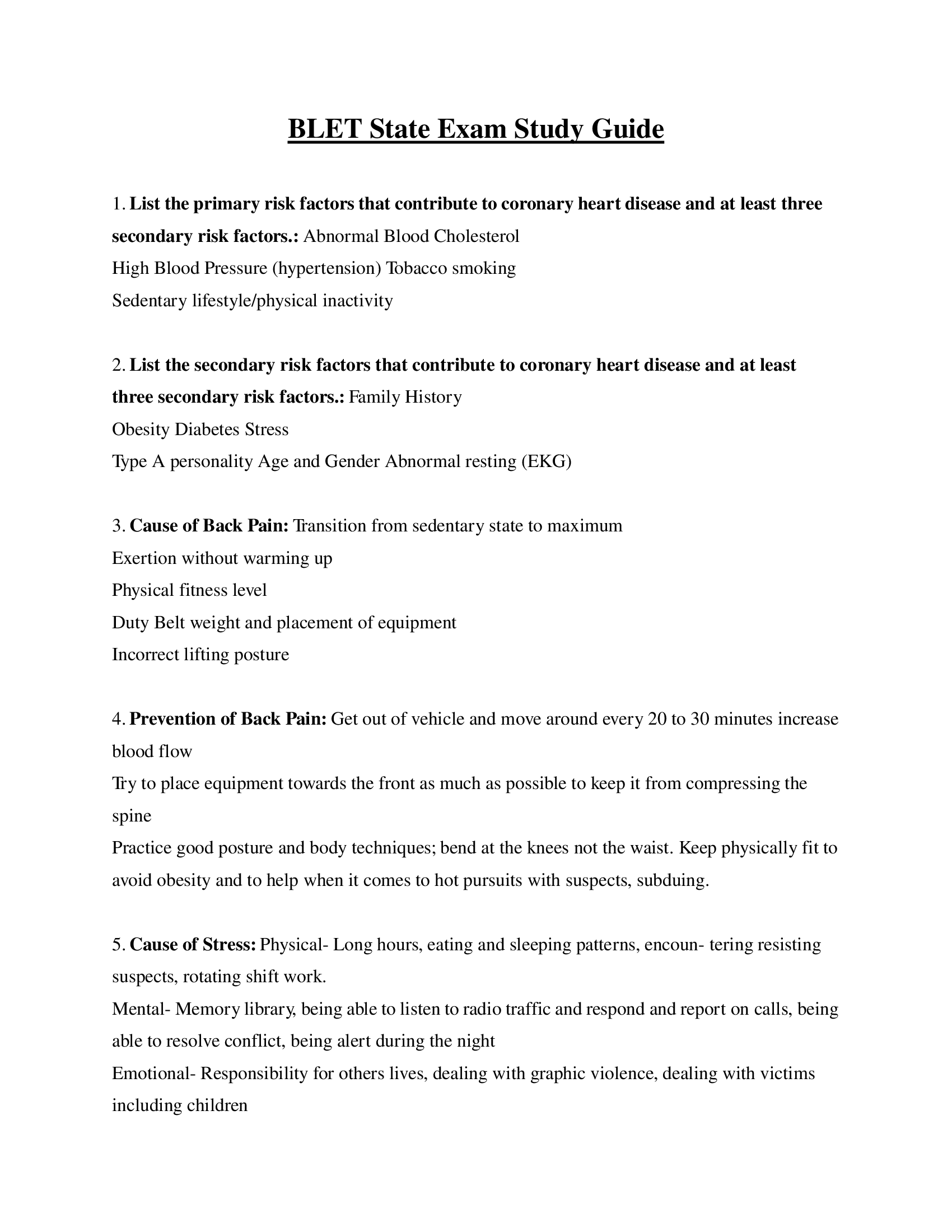
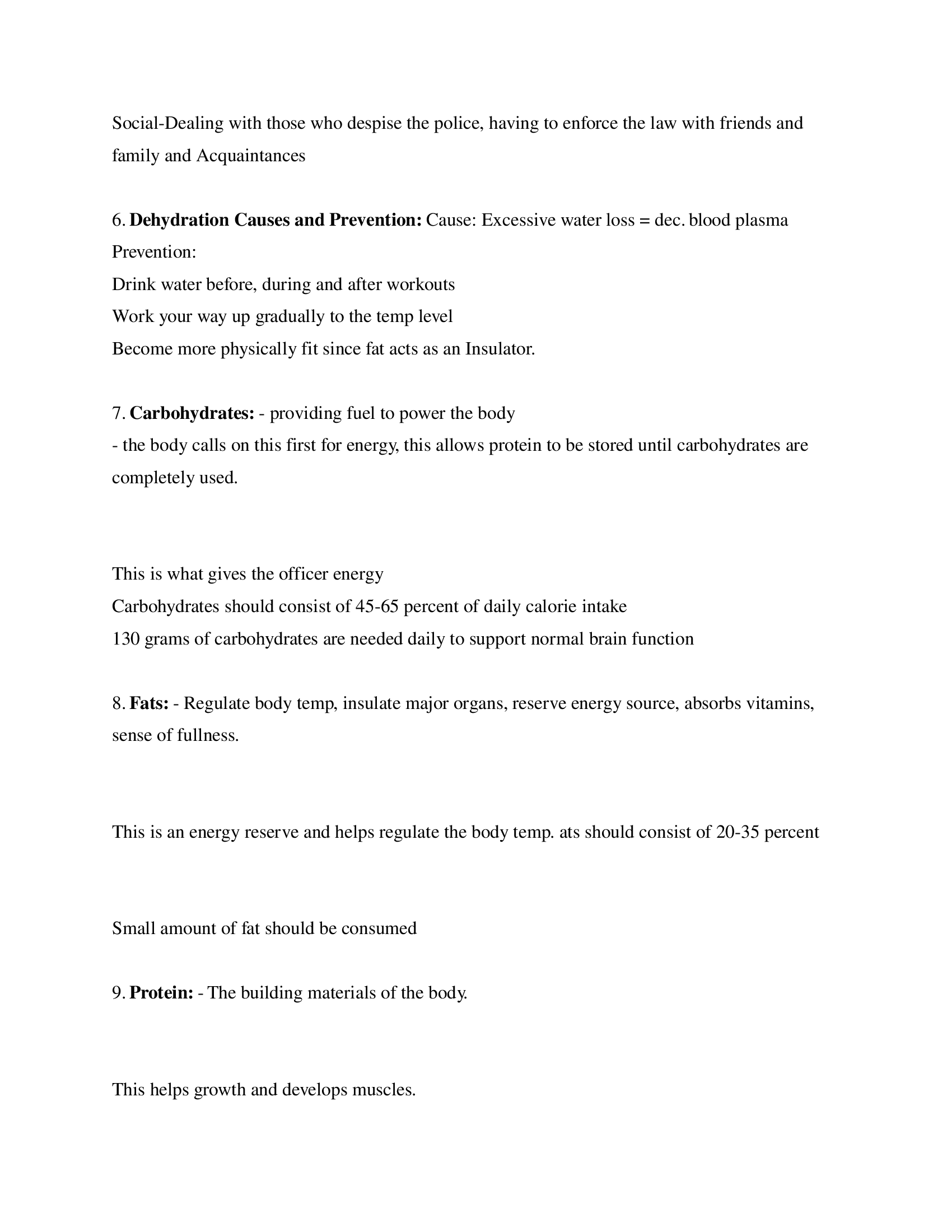
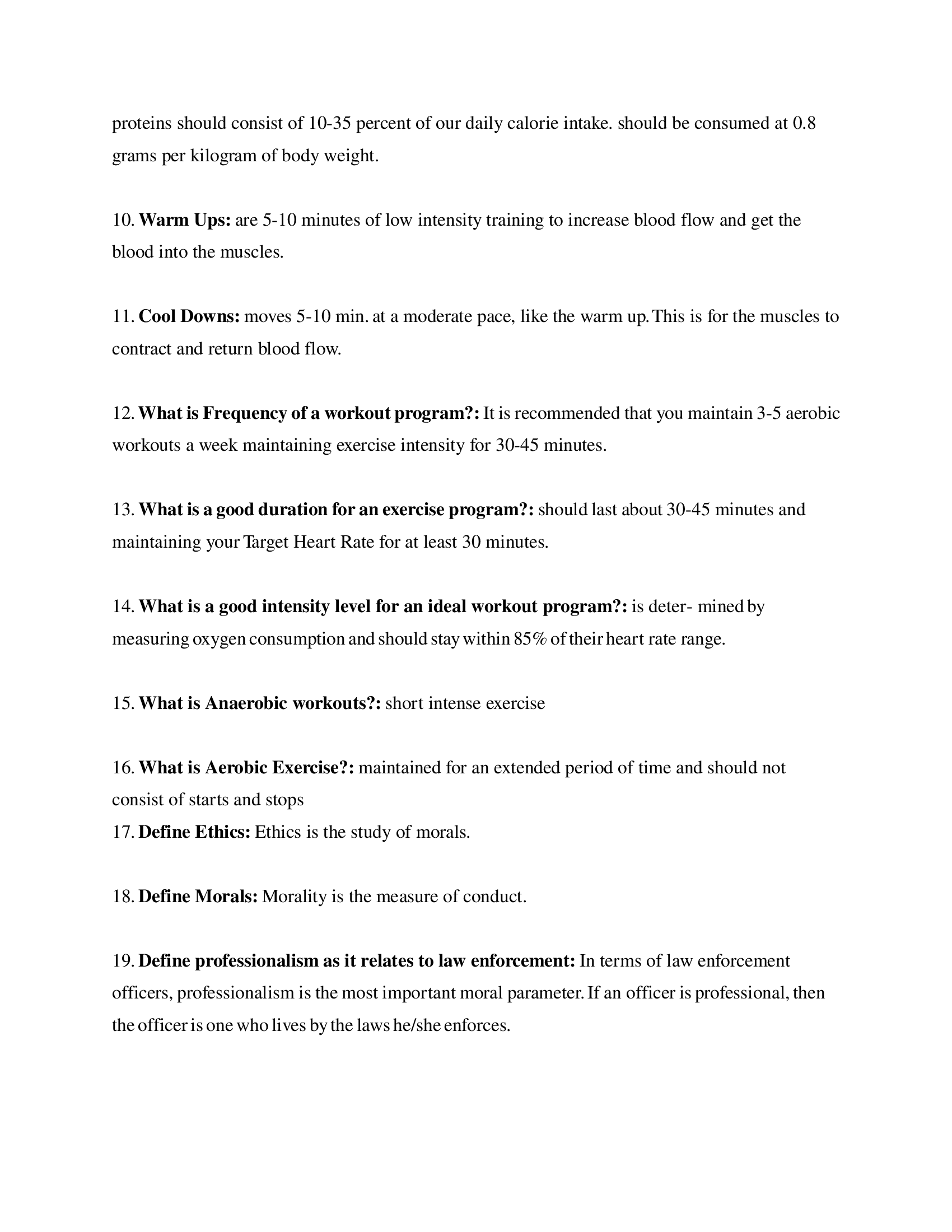
BLET State Exam Study Guide 1. List the primary risk factors that contribute to coronary heart disease and at least three secondary risk factors.: Abnormal Blood Cholesterol High Blood Pressure (hypertension) Tobacco smoking Sedentary lifestyle/physical inactivity 2. List the secondary risk factors that contribute to coronary heart disease and at least three secondary risk factors.: Family History Obesity Diabetes Stress Type A personality Age and Gender Abnormal resting (EKG) 3. Cause of Back Pain: Transition from sedentary state to maximum Exertion without warming up Physical fitness level Duty Belt weight and placement of equipment Incorrect lifting posture 4. Prevention of Back Pain: Get out of vehicle and move around every 20 to 30 minutes increase blood flow Try to place equipment towards the front as much as possible to keep it from compressing the spine Practice good posture and body techniques; bend at the knees not the waist. Keep physically fit to avoid obesity and to help when it comes to hot pursuits with suspects, subduing. 5. Cause of Stress: Physical- Long hours, eating and sleeping patterns, encoun- tering resisting suspects, rotating shift work. Mental- Memory library, being able to listen to radio traffic and respond and report on calls, being able to resolve conflict, being alert during the night Emotional- Responsibility for others lives, dealing with graphic violence, dealing with victims including children Social-Dealing with those who despise the police, having to enforce the law with friends and family and Acquaintances 6. Dehydration Causes and Prevention: Cause: Excessive water loss = dec. blood plasma Prevention: Drink water before, during and after workouts Work your way up gradually to the temp level Become more physically fit since fat acts as an Insulator. 7. Carbohydrates: - providing fuel to power the body - the body calls on this first for energy, this allows protein to be stored until carbohydrates are completely used. This is what gives the officer energy Carbohydrates should consist of 45-65 percent of daily calorie intake 130 grams of carbohydrates are needed daily to support normal brain function 8. Fats: - Regulate body temp, insulate major organs, reserve energy source, absorbs vitamins, sense of fullness. This is an energy reserve and helps regulate the body temp. ats should consist of 20-35 percent Small amount of fat should be consumed 9. Protein: - The building materials of the body. This helps growth and develops muscles. proteins should consist of 10-35 percent of our daily calorie intake. should be consumed at 0.8 grams per kilogram of body weight. 10. Warm Ups: are 5-10 minutes of low intensity training to increase blood flow and get the blood into the muscles. 11. Cool Downs: moves 5-10 min. at a moderate pace, like the warm up. This is for the muscles to contract and return blood flow. 12. What is Frequency of a workout program?: It is recommended that you maintain 3-5 aerobic workouts a week maintaining exercise intensity for 30-45 minutes. 13. What is a good duration for an exercise program?: should last about 30-45 minutes and maintaining your Target Heart Rate for at least 30 minutes. 14. What is a good intensity level for an ideal workout program?: is deter- mined by measuring oxygen consumption and should stay within 85% of their heart rate range. 15. What is Anaerobic workouts?: short intense exercise 16. What is Aerobic Exercise?: maintained for an extended period of time and should not consist of starts and stops 17. Define Ethics: Ethics is the study of morals. 18. Define Morals: Morality is the measure of conduct. 19. Define professionalism as it relates to law enforcement: In terms of law enforcement officers, professionalism is the most important moral parameter. If an officer is professional, then the officer is one who lives by the laws he/she enforces. 20. Describe what factors or influences are present in making law enforce- ment ethical decisions.: immediate family, entire family, church, neighborhood, school, work environment, and our city or nation. 21. What are the Cannons of Police Ethics: The Cannons of Police Ethics breaks down the ideas of professionalism, duty, morality, and ethics into article 22. What is the Code of Ethics: The Law Enforcement Code of Ethics sets forth a list of guidelines a law enforcement officer should strive to live by. 23. What is the Oath of Office: The Oath of Office is a commitment an officer takes to uphold certain ideas while he/she holds the position of law enforcement officer 24. What is Constitutional Law?: The Constitution is the basic law of the land. It defines the fundamental principles for governments, including grants and limita- tions of power. 25. What is Statutory Law: Written laws enacted by the legislative branches of the state or federal governments are called statutes 26. What is Common Law: This source of law refers to the rules and principles from judicial decisions in areas of law where the legislatures have no written statues. Common law is frequently referred to as case law. 27. What are the rights under the First Amendment: The First Amendment establishes rights that we consider basic in a free society. These rights are the freedoms of religion, speech, press, assembly, and petition. 28. What are the consequences of an officer that violates a persons first amendment rights: criminal or civil case brought against the officer, suppression of evidence recovered from the suspect, and department discipline. 29. What is Territorial Jurisdiction: an officer can either have statewide, local, immediate and continuous pursuit, and investigation of an implied-consent offense (happened in jurisdiction, officer can investigate in or out of state for evidence and can make arrests at any place in the state). 30. What is subject matter jurisdiction: an officer may be able to arrest for any crimes or have a limited amount of laws they can enforce. 31. What is reasonable suspicion: Reasonable suspicion can be viewed as whether or not a reasonable person would think something was suspicious. 32. What is Probable Cause: can be defined as whether at the moment the arrest was made, the facts and circumstances within [the officer's] knowledge and of which [the officer] had reasonably trustworthy information were sufficient to warrant a prudent [person] in believing that the [defendant] had committed or was committing an offense. 33. How are Foreign Diplomats handled when it comes to arrest?: diplomatic immunity as a principle of international law by which certain foreign government officials are not subject to the jurisdiction of the local courts and authorities. 34. When can an officer make a warrantless arrest: Any offense committed in the officers presence Has committed a felony Has committed a misdemeanor, and : Will not be apprehended unless immediately arrested or may cause physical injury to himself or others, or damage to property unless immediately arrested Has committed the misdemeanor offense of concealment of merchandise, domes- tic criminal trespass, impaired driving, or impaired driving in a commercial vehicle

Contact the Seller

Please Sign In to contact this seller.


  • 👎  Report Copyright Violation

Frequently Asked Questions

What Do I Get When I Buy This Study Material?

+

When you buy a study material on Passing Grades, an instant download link will be sent directly to your email, giving you access to the file anytime after payment is completed.

Is Passing Grades a Trusted Platform?

+

Yes, Passing Grades is a reputable students’ marketplace with a secure payment system and reliable customer support. You can trust us to ensure a safe and seamless transaction experience.

Will I Be Stuck with a Subscription?

+

No, all purchases on Passing Grades are one-time transactions. You only pay for the notes you choose to buy, with no subscriptions or hidden fees attached.

Who Am I Buying These Study Materials From?

+

Passing Grades is a marketplace, which means you are purchasing the document from an individual vendor, not directly from us. We facilitate the payment and delivery process between you and the vendor.

Does Passing Grades Offer Free Study Materials?

+

Yes, sellers on Passing Grades have uploaded numerous free test banks, exams, practice questions, and class notes that can be downloaded at no cost.

Pasinggrades - Quality Study Materials

USD 7

    • Quality checked by Pasing Grades
    • 100% satisfaction guarantee
    • Seller: Namwaki
Buy PDF $7

Seller Information

Namwaki

Member since April 2021

  • icon
  • icon
  • icon
View Profile
  • total sales

    0
  • Favourites

    0
  • Comments

    0
    ( 0 Ratings )

Item Information

  • Uploaded

    03 April 2023

  • Updated

    29 September 2025

  • Category

    Nursing

  • Item Type

    exam

  • Tags

    BLET State Exam Study guide

Related Exam Prep Guides by Namwaki

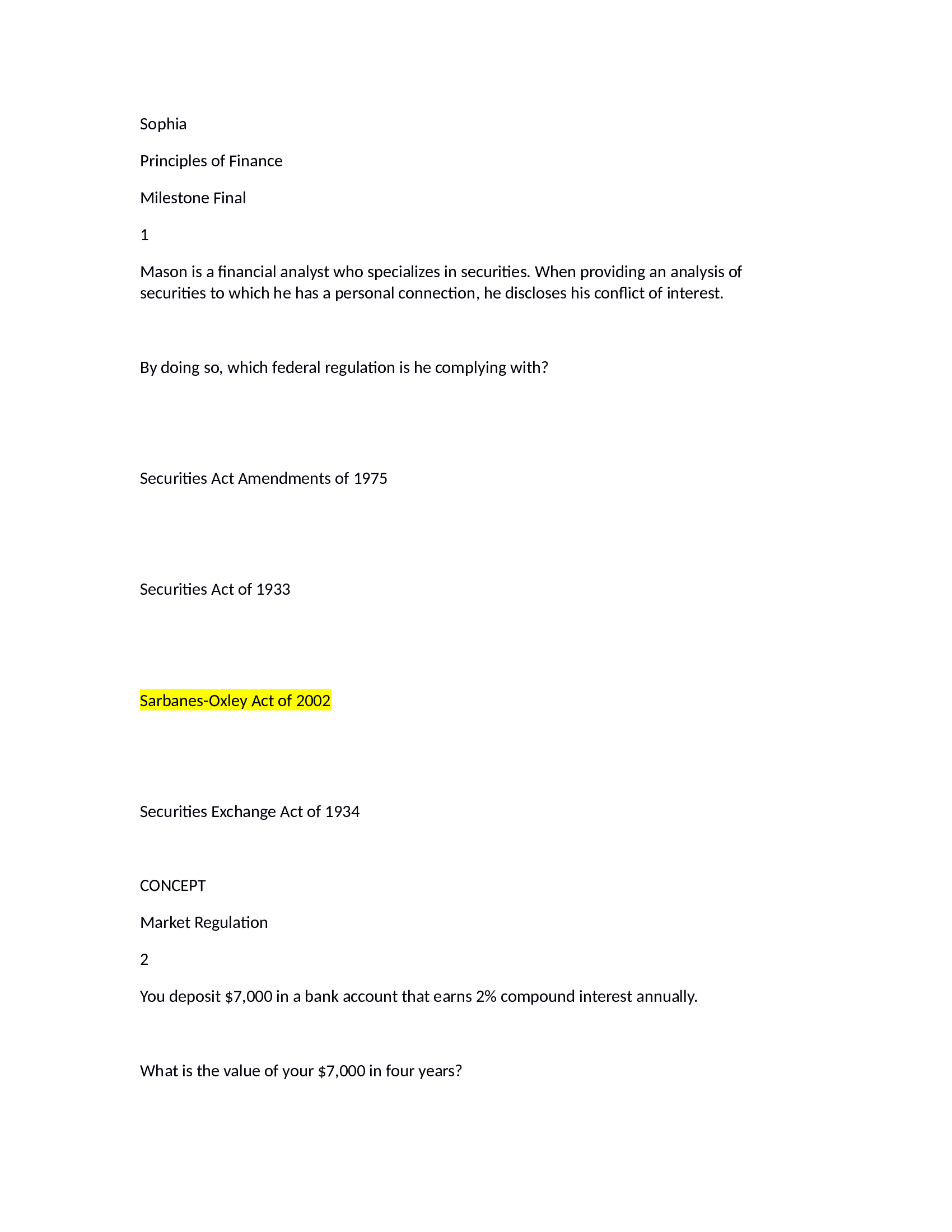
Sophia Finance Milestone Final_Complete Questions and Answers 2021.
View Document

Sophia Finance Miles...

  • Namwaki

    Namwaki

  • exam

Sophia Finance Milestone Final_Complete Questions and Answers 2021...

7 USD

0

0

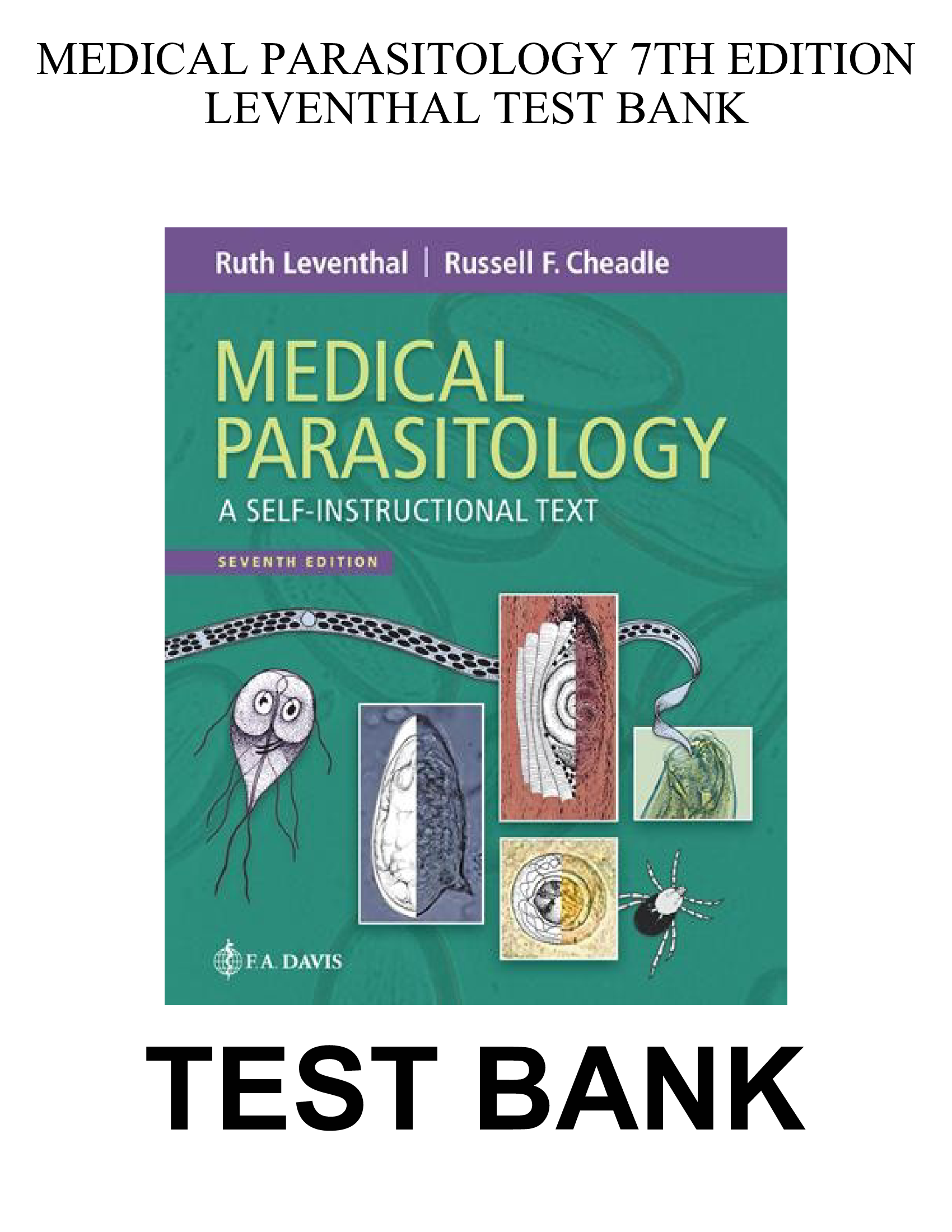
Medical Parasitology 7th Edition Leventhal Test Bank
View Document

Medical Parasitology...

  • Namwaki

    Namwaki

  • exam

Medical Parasitology 7th Edition Leventhal Test Bank...

7 USD

0

0

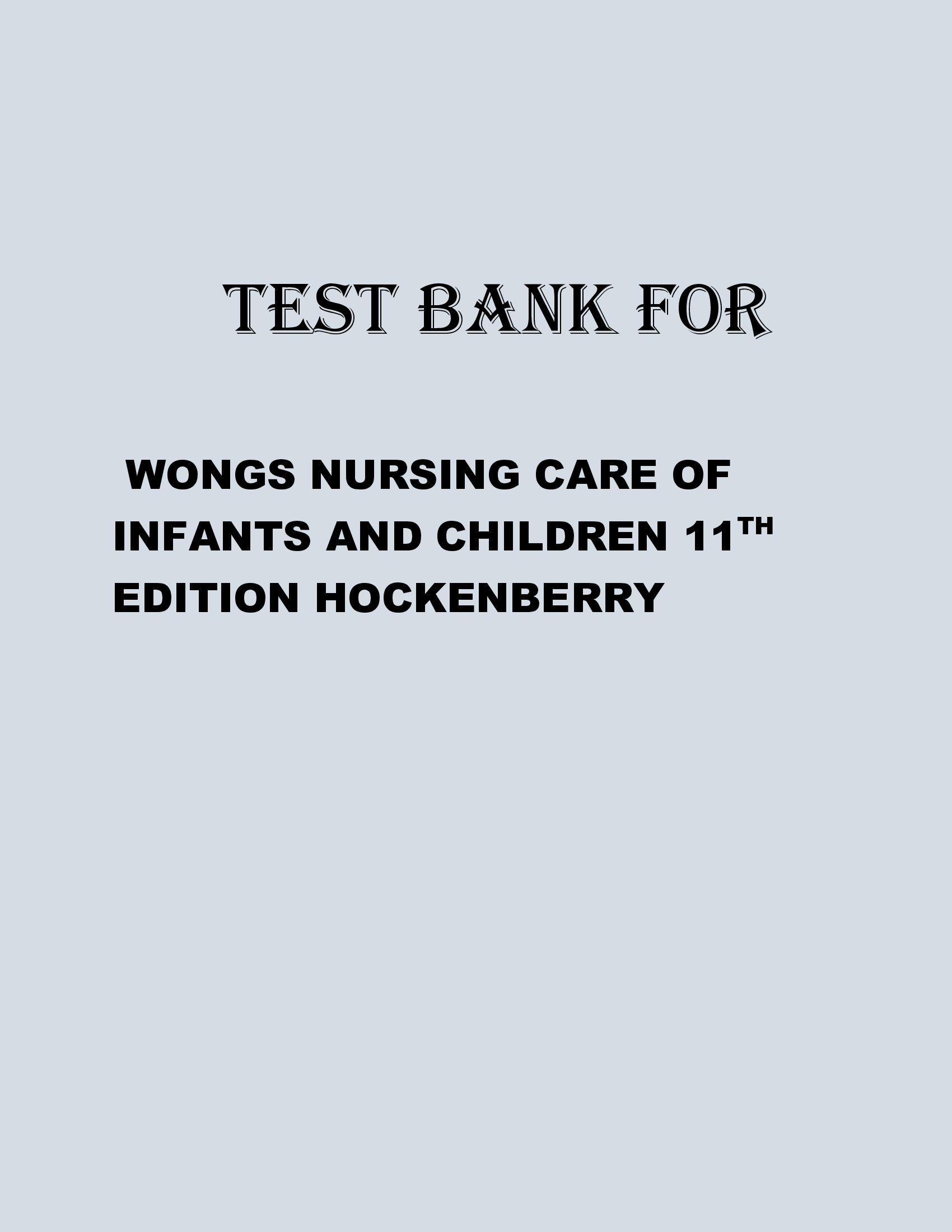
TEST- BANK FOR WONGS NURSING CARE OF INFANTS AND CHILDREN 11TH EDITION HOCKENBERRY
View Document

TEST- BANK FOR WONGS...

  • Namwaki

    Namwaki

  • exam

TEST- BANK FOR WONGS NURSING CARE OF INFANTS AND CHILDREN 11TH EDITION HOCKENBERRY – Download PDF...

7 USD

0

0

Purchase

Download link will be sent to this email immediately after purchase.

IMPORTANT LINKS

  • How To Upload Class Notes
  • Selling Tips
  • Passing Grades's Study Materials
  • Scholarships for International Students 2025

POPULAR CATEGORIES

  • Law
  • Accounting
  • English
  • Psychology
  • Business
  • Nursing
  • Computer Science
  • General

View Document

  • Blog
  • Contact
  • Delivery Policy
  • Latest Scholarships Around the World
  • How to Pass Bar Exams: Passing Grades’ Strategies
  • How to Study and Pass the CPA Exam
  • All Test Banks
  • Faq
  • Copyright Claims
  • Privacy Policy
  • Terms of Use

KNOWLEDGE BASE

  • How to Write A+ Grade Good Research Paper
  • How to Manage Stress During Exam Period
  • Best Time to Study
  • How to Pass NCLEX-RN Exam
  • How To Effectively Utilize Test Banks
  • Popular Shadow Health Exam Assessments
  • Popular HESI Case Studies
  • How to Prepare for a Nursing Career
  • The Importance Of Summaries in Exam Revisvion

© 2026 Pasing Grades. All rights reserved.