Pasing Grades
  • Start Selling
  • Blog
  • Contact
  • 0

    Your cart is empty!

English

  • English
  • Spanish
  • Arabic
Create Account Sign In
  • Library
    • New Prep Guides
    • Featured Prep Guides
    • Free Exam Prep Guides
    • Best sellers
  • General
  • Nursing
    • Research Paper
    • Case Study
    • Discussion Post
    • Assignment
    • Exam
    • Practice Questions and Answers
    • Test Bank
    • solutions manual
  • Accounting
    • Case Study
    • Thesis
    • Study Guide
    • Summary
    • Research Paper
    • test bank
  • English
    • Creative Writing
    • Research Paper
    • Summary
    • Rhetorics
    • Literature
    • Journal
    • Exam
    • Grammar
    • Discussion Post
    • Essay
  • Psychology
    • Hesi
    • Presentation
    • Essay
    • Summary
    • Study Guide
    • Essay
    • Solution Manual
    • Final Exam Review
    • Class Notes
    • test bank
  • Business
    • Lecture Notes
    • Solution Manual
    • Presentation
    • Business Plan
    • Class Notes
    • Experiment
    • Summary
    • Practice Questions
    • Study Guide
    • Case Study
    • test bank
    • Exam
  • More
    • Computer Science
    • Economics
    • Statistics
    • Engineering
    • Biology
    • Religious Studies
    • Physics
    • Chemistry
    • Mathematics
    • History
    • Sociology
    • Science
    • Philosophy
    • Law
  • Pages
    • About Us
    • Selling Tips
    • Delivery Policy
    • Faq
    • Privacy Policy
  • Flash Sale
  • Home
  • BIOD 171 Module 1-6 Exams Questions With Answers

BIOD 171 Module 1-6 Exams Questions With Answers

Preview page 1 Preview page 2 Preview page 3
Add To Favorites

Share this item Share this item

  • Item Details
  • Comments (0)
  • Reviews (0)
  • Contact Seller
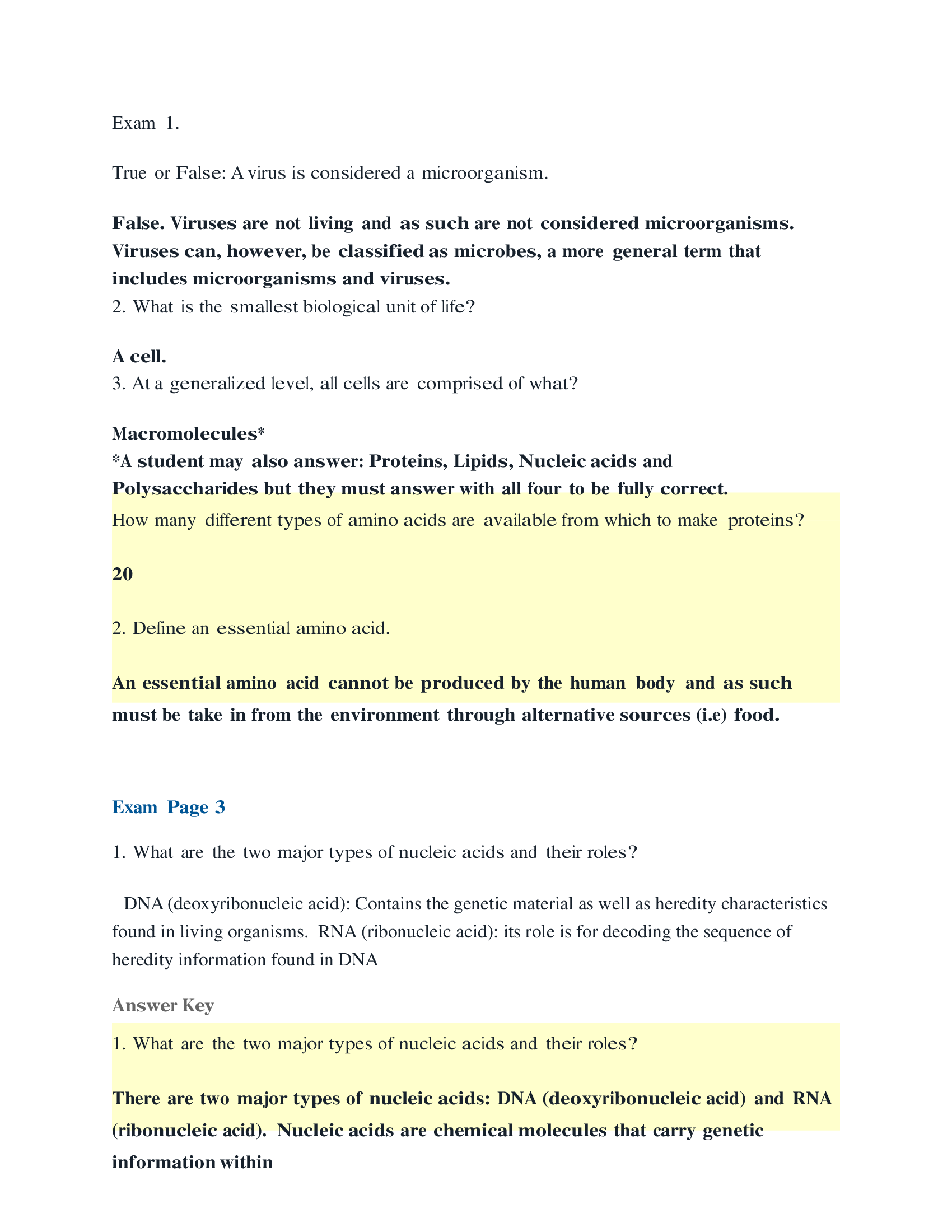
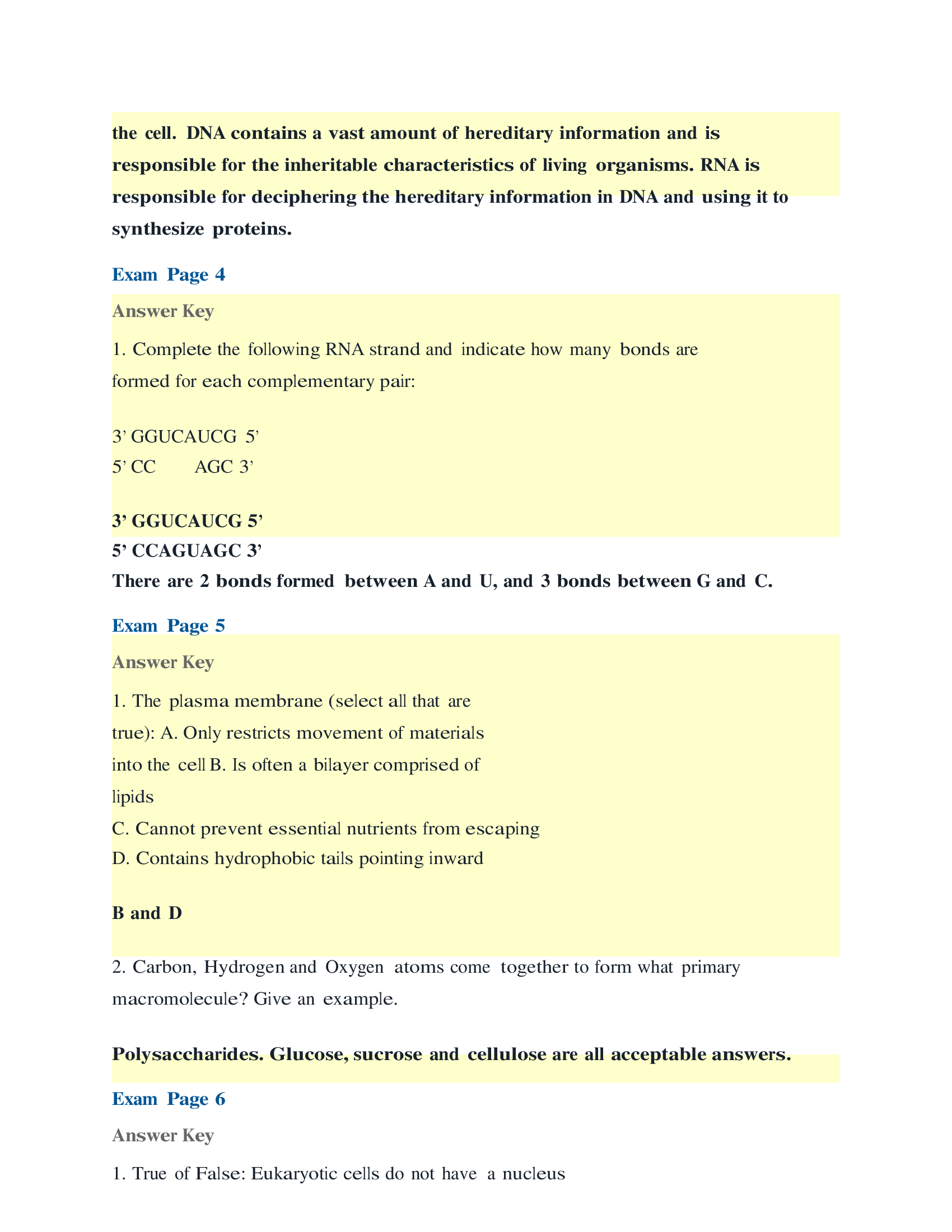
BIOD 171 Module 1-6 Exams Questions With Answers Exam 1. True or False: A virus is considered a microorganism. False. Viruses are not living and as such are not considered microorganisms. Viruses can, however, be classified as microbes, a more general term that includes microorganisms and viruses. 2. What is the smallest biological unit of life? A cell. 3. At a generalized level, all cells are comprised of what? Macromolecules* *A student may also answer: Proteins, Lipids, Nucleic acids and Polysaccharides but they must answer with all four to be fully correct. How many different types of amino acids are available from which to make proteins? 20 2. Define an essential amino acid. An essential amino acid cannot be produced by the human body and as such must be take in from the environment through alternative sources (i.e) food. Exam Page 3 1. What are the two major types of nucleic acids and their roles? DNA (deoxyribonucleic acid): Contains the genetic material as well as heredity characteristics found in living organisms. RNA (ribonucleic acid): its role is for decoding the sequence of heredity information found in DNA Answer Key 1. What are the two major types of nucleic acids and their roles? There are two major types of nucleic acids: DNA (deoxyribonucleic acid) and RNA (ribonucleic acid). Nucleic acids are chemical molecules that carry genetic information within the cell. DNA contains a vast amount of hereditary information and is responsible for the inheritable characteristics of living organisms. RNA is responsible for deciphering the hereditary information in DNA and using it to synthesize proteins. Exam Page 4 Answer Key 1. Complete the following RNA strand and indicate how many bonds are formed for each complementary pair: 3’ GGUCAUCG 5’ 5’ CC AGC 3’ 3’ GGUCAUCG 5’ 5’ CCAGUAGC 3’ There are 2 bonds formed between A and U, and 3 bonds between G and C. Exam Page 5 Answer Key 1. The plasma membrane (select all that are true): A. Only restricts movement of materials into the cell B. Is often a bilayer comprised of lipids C. Cannot prevent essential nutrients from escaping D. Contains hydrophobic tails pointing inward B and D 2. Carbon, Hydrogen and Oxygen atoms come together to form what primary macromolecule? Give an example. Polysaccharides. Glucose, sucrose and cellulose are all acceptable answers. Exam Page 6 Answer Key 1. True of False: Eukaryotic cells do not have a nucleus False. Eukaryotic cells do have a nucleus (prokaryotic cells do not). 2. True or False: Prokaryotic cells can be subdivided into Bacteria and Archaea. True 3. Describe the 4 basic bacterial morphologies. Coccus (round/spherical), bacillus (rod), vibrio (curved rod) or spirillum (spiral/corkscrew). 4. True or False: Archaea, a eukaryotic class of microorganisms, are capable of surviving harsh environments. False. Archaea are prokaryotic bacteria capable of surviving harsh environments. Exam Page 7 Answer Key that apply. A. Animalia B. Plantae C. Fungi D. Protista A,B,C,D 2. True of False: All multicellular microorganisms classified as Animalia are heterotropic. True 3. Microorganisms classified as Plantae obtain most of their energy by converting energy into energy. 1. Which of the following microorganisms are considered to be Eukarya? Select all Light (sunlight); chemical (sugars) Exam Page 8 Answer Key 1. A defining characteristic of fungi is the presence of chitin in the cell walls. Which of following also contain chitin? Select all that apply. A. Mushrooms B. Bacteria C. Yeast D. Molds A, C and D all contain chitin. 2. True or False: A defining characteristic of Protista is the inability of colonies to form tissue layers. True. Exam Page 9 Answer Key 1. Cell walls are found in which of the following (select all that apply): A. Plants B. Fungi C. Bacteria D. Mammalian cells E. Algae A, B, C, E 2. The function of the ribosome is (select all that apply): A. Lipid synthesis B. Protein synthesis C. To produce energy (ATP) D. Protein modification and distribution E. Waste disposal via hydrolytic enzymes B. Ribosomes are located in the cytoplasm of prokaryotic cells and in the ER of eukaryotic cells. Exam Page 10 Answer Key 3 E 4 G 5 D EXAM MODULE 2 True or False: As movement requires energy, metabolism can be defined as a controlled set of biochemical reactions that occur in only motile organisms in order to maintain life. False. Metabolism occurs in all living organisms, not just those that move. 2. True or False: Enzymes slow down chemical reactions to conserve energy. False. Enzyme catalyze (speed up) chemical reactions. 3. What is a cofactor? And give a general example. A cofactor is a small chemical component that assists an enzyme during the catalysis reactions. A cofactor is usually metal ions. Answer Key 1. Define anabolism. Anabolism is the process of building up or biosynthesis of macromolecules from small molecular units into much larger complexes. 2. In order to convert proteins into amino acids which metabolic process would be active? Catabolism would be active as proteins are made up of amino acids. Therefore the process described (proteins into amino acids) is the breakdown, or catabolism of protein. Exam Page 3 Answer Key 1. Describe the energy transfer process relative to both ATP and ADP.  ATP has the energy (phosphate group) to donate while ADP can accept energy in the form of a phosphate group. Thus, ATP can be reduced (ATP →ADP + Pi) while ADP can be built into ATP (ADP + Pi →ATP). 2. An organism that derives its energy (generates ATP) from photons of light is called a ? Phototrophic microorganism. An organism that derives its energy by removing electrons from elemental sulfur would be classified as a ? Lithotroph 4. A reactive intermediate would be present in which phosphorylation process? A. Photophosphorylation B. Substrate-level phosphorylation C. Oxidative phosphorylation B. The chemical compound losing the phosphate group is referred to as the phosphorylated reactive intermediate. Exam Page 4 Answer Key 1. The catabolism of a single molecule of glucose goes through what 3 distinct transitions? The breakdown of glucose goes through (1) Glycolysis then (2) Fermentation or Respiration and finally through (3) the electron transport chain (ETC). 2. What is the most energetic transition in the catabolism of glucose? The electron transport chain yields 34 ATP while both glycolysis and fermentation (or respiration) each yield only 2 ATP. 3. Identify the reactants of the following chemical equation: Glucose + 2NAD+ → 2 NADH + 2 Pyruvate + 2 ATP  The reactants are to the left of the arrow: Glucose and 2NAD+ 4. The presence of what molecule ‘signals’ to the cell that glycolysis is about to start? Glucose-6-phosphate (G6P) 5. True or False: In the absence of oxygen fermentation produces 2 ATP. False. Fermentation only reduces NADH back to NAD+ Exam Page 5 Answer Key 1. What is the primary byproduct of the TCA cycle? Select all that apply. A. NAD+ C. NADH D. FADH2 C and D. The TCA cycle produces an abundance of reduced electron carriers (NADH and FADH2). 2. True or False. The reactants of the TCA cycle directly enter and fuel the electron transport system. B. FAD 1. In the absence of glucose, which of the following can be used as alternative energy sources? Select all that apply. A. Lactose B. Nucleic acids C. False. The products of the TCA cycle (reduced electron carriers) enter and drive the production of ATP via the electron transport system. Exam Page 6 Answer Key The reactants are to the left of the arrow: Glucose and 2NAD+ Carbohydrates D. Lipids A, C, D can all be used as alternative energy sources. 

Contact the Seller

Please Sign In to contact this seller.


  • 👎  Report Copyright Violation

Frequently Asked Questions

What Do I Get When I Buy This Study Material?

+

When you buy a study material on Passing Grades, an instant download link will be sent directly to your email, giving you access to the file anytime after payment is completed.

Is Passing Grades a Trusted Platform?

+

Yes, Passing Grades is a reputable students’ marketplace with a secure payment system and reliable customer support. You can trust us to ensure a safe and seamless transaction experience.

Will I Be Stuck with a Subscription?

+

No, all purchases on Passing Grades are one-time transactions. You only pay for the notes you choose to buy, with no subscriptions or hidden fees attached.

Who Am I Buying These Study Materials From?

+

Passing Grades is a marketplace, which means you are purchasing the document from an individual vendor, not directly from us. We facilitate the payment and delivery process between you and the vendor.

Does Passing Grades Offer Free Study Materials?

+

Yes, sellers on Passing Grades have uploaded numerous free test banks, exams, practice questions, and class notes that can be downloaded at no cost.

Pasinggrades - Quality Study Materials

USD 10

    • Quality checked by Pasing Grades
    • 100% satisfaction guarantee
    • Seller: Emily
Buy PDF $10

Seller Information

Emily

Member since November 2022

  • icon
View Profile
  • total sales

    0
  • Favourites

    0
  • Comments

    0
    ( 0 Ratings )

Item Information

  • Uploaded

    04 February 2023

  • Updated

    17 October 2025

  • Category

    General

  • Item Type

    exam

  • Tags

    BIOD 171 Module 1 6 Exams Questions With Answers

Related Exam Prep Guides by Emily

2022 NR 222 VATI Mental Health VATI Greenlight STUDY SET Questions and Answers
View Document

2022 NR 222 VATI Men...

  • Emily

    Emily

  • exam

2022 NR 222 VATI Mental Health VATI Greenlight STUDY SET Questions and Answers...

10 USD

0

0

ATI Care of Children RN 2019 Proctored Exam - Level 3!. Peds 2019. All 70 Questions correctly Answered
View Document

ATI Care of Children...

  • Emily

    Emily

  • exam

ATI Care of Children RN 2019 Proctored Exam - Level 3!. Peds 2019. All 70 Questions correctly Answer...

10 USD

0

0

ATI RN MEDSURG PROCTORED EXAM {All Questions Answered And Elaborated}
View Document

ATI RN MEDSURG PROCT...

  • Emily

    Emily

  • exam

ATI RN MEDSURG PROCTORED EXAM {All Questions Answered And Elaborated}...

10 USD

0

0

Purchase

Download link will be sent to this email immediately after purchase.

IMPORTANT LINKS

  • How To Upload Class Notes
  • Selling Tips
  • Passing Grades's Study Materials
  • Scholarships for International Students 2025

POPULAR CATEGORIES

  • Law
  • Accounting
  • English
  • Psychology
  • Business
  • Nursing
  • Computer Science
  • General

View Document

  • Blog
  • Contact
  • Delivery Policy
  • Latest Scholarships Around the World
  • How to Pass Bar Exams: Passing Grades’ Strategies
  • How to Study and Pass the CPA Exam
  • All Test Banks
  • Faq
  • Copyright Claims
  • Privacy Policy
  • Terms of Use

KNOWLEDGE BASE

  • How to Write A+ Grade Good Research Paper
  • How to Manage Stress During Exam Period
  • Best Time to Study
  • How to Pass NCLEX-RN Exam
  • How To Effectively Utilize Test Banks
  • Popular Shadow Health Exam Assessments
  • Popular HESI Case Studies
  • How to Prepare for a Nursing Career
  • The Importance Of Summaries in Exam Revisvion

© 2026 Pasing Grades. All rights reserved.