Pasing Grades
  • Start Selling
  • Blog
  • Contact
  • 0

    Your cart is empty!

English

  • English
  • Spanish
  • Arabic
Create Account Sign In
  • Library
    • New Prep Guides
    • Featured Prep Guides
    • Free Exam Prep Guides
    • Best sellers
  • General
  • Nursing
    • Research Paper
    • Case Study
    • Discussion Post
    • Assignment
    • Exam
    • Practice Questions and Answers
    • Test Bank
    • solutions manual
  • Accounting
    • Case Study
    • Thesis
    • Study Guide
    • Summary
    • Research Paper
    • test bank
  • English
    • Creative Writing
    • Research Paper
    • Summary
    • Rhetorics
    • Literature
    • Journal
    • Exam
    • Grammar
    • Discussion Post
    • Essay
  • Psychology
    • Hesi
    • Presentation
    • Essay
    • Summary
    • Study Guide
    • Essay
    • Solution Manual
    • Final Exam Review
    • Class Notes
    • test bank
  • Business
    • Lecture Notes
    • Solution Manual
    • Presentation
    • Business Plan
    • Class Notes
    • Experiment
    • Summary
    • Practice Questions
    • Study Guide
    • Case Study
    • test bank
    • Exam
  • More
    • Computer Science
    • Economics
    • Statistics
    • Engineering
    • Biology
    • Religious Studies
    • Physics
    • Chemistry
    • Mathematics
    • History
    • Sociology
    • Science
    • Philosophy
    • Law
  • Pages
    • About Us
    • Selling Tips
    • Delivery Policy
    • Faq
    • Privacy Policy
  • Flash Sale
  • Home
  • BIOD 171 Lab Exams 1-9 (Answered)

BIOD 171 Lab Exams 1-9 (Answered)

Preview page 1 Preview page 2 Preview page 3
Add To Favorites

Share this item Share this item

  • Item Details
  • Comments (0)
  • Reviews (0)
  • Contact Seller
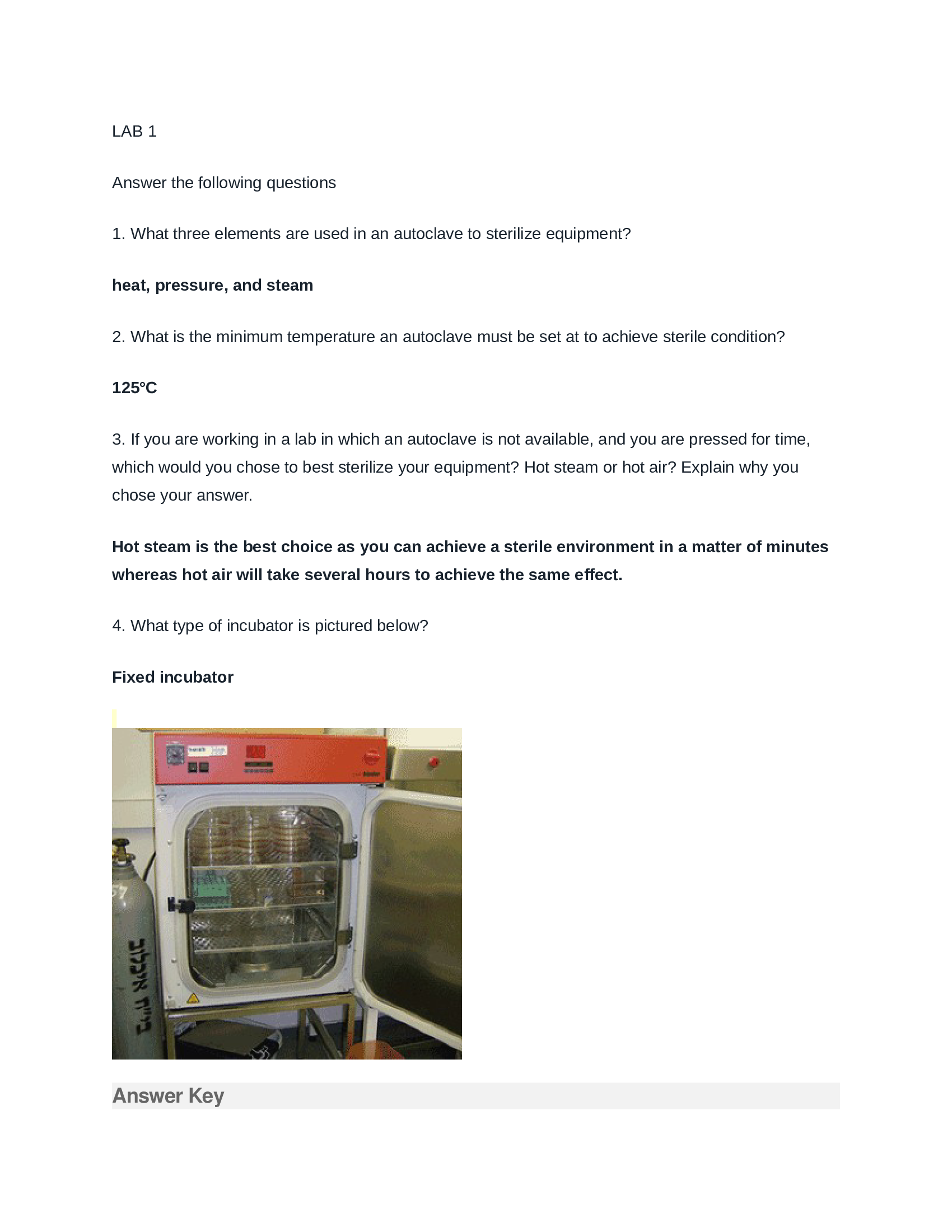
LAB 1 Answer the following questions 1. What three elements are used in an autoclave to sterilize equipment? heat, pressure, and steam 2. What is the minimum temperature an autoclave must be set at to achieve sterile condition? 125°C 3. If you are working in a lab in which an autoclave is not available, and you are pressed for time, which would you chose to best sterilize your equipment? Hot steam or hot air? Explain why you chose your answer. Hot steam is the best choice as you can achieve a sterile environment in a matter of minutes whereas hot air will take several hours to achieve the same effect. 4. What type of incubator is pictured below? Answer Key Answer the following questions. 1. At what temperature is the fixed incubator set to, as presented in the lab video? 37°C 2. At what temperature should you refrigerate bacterial samples? Explain why this is beneficial. 4°C. This temperature slows bacterial growth and prolongs the life of the sample. 3. What are the FOUR types of gloves presented in the lab video? Latex, Nitrile, Thermal cold, Thermal heat 4. What THREE rules were discussed in regards to lab safety that would protect you and others from contamination? 1. Never eat or drink in the lab 2. Always wear appropriate PPE 3. Never leave the lab wearing PPE 5. What are the main sections that should be found in a lab notebook? Name at least 4. Objective, Procedure, Notes, Results and Deviations Answer the following questions. 1. You are a lab instructor and Sally Miller has turned in her lab notebook for you to grade the lab experiment #1 on lab safety. Based upon what was covered in the lab video, how should Sally have entitled her experiment? SM01 Lab Safety 2. You arrive to your first day of work at a new lab. You are taking over for someone who took a new job at another lab. Your boss informs you that because of time restraints, this person did not exactly follow the experimental protocol. In order to proceed, you must know what he did differently. (1) According to the lab lecture, under what section of his notebook would you look to find the experimental steps? (2) As changes to the experimental steps were made, what are these differences called and how should it appear in the lab notebook? (1) Procedure—this is where the steps for the experimental protocol are recorded. (2) Deviations. All deviations should be written in red to immediately bring attention to the changes in the protocol. LAB 2 1. Identify the part of the microscope indicated by the arrow.Oculars (or eyepiece) 2. Identify the part of the microscope indicated by the arrow. Objectives (or objective lens) 3. Identify the part of the microscope indicated by the arrow. Course focus 1. You are about to study a bacterial sample under a light microscope. You look into the oculars and see two circles. What adjustments need to be made? Compress or expand the oculars until a single circle can be seen while using both eyes simultaneously. 2. What 2 parts of the microscope contributes to the total magnification to your sample? Objective and oculars (eyepiece) 3. As you looking through the microscope you wish to dim (or limit) the amount of light entering into the eyepiece—what component of the microscope other than the light source itself can be adjusted to make these modifications? Diaphragm 1. What objective power is best suited if you are uncertain what the sample is and where to begin? 4x (or lowest power objective) 2. You are viewing a sample of bacteria that is 3 mm in diameter through a 40x objective lens. The eyepiece has a magnification power of 10x. What size will the sample appear through the eyepiece? 1200 mm in diameter (or 400x’s larger) 3. Based on the microscope shown in the lab lecture, which objectives would NOT require placing oil on the slide? 4x, 10x and 40x LAB 3 1. List the 4 main steps used to prepare a DRY mount and indicate which step is optional. 1 – Clean slide 2 – Circle area on slide for specimen placement (OPTIONAL) 3 – Apply organism to slide 4 – Air dry at room temperature 2. Why is it important to first clean your slide before applying your sample? You must first remove any unwanted contaminants from the slide otherwise it may be difficult to distinguish between the pathogen of interest and a contaminant. 3. When performing a wet mount technique, what is the advantage of using a wax or hydrophobic pen? Creating a hydrophobic barrier (the circle) helps to keep the water within the circle so it does not spill off of the slide. 4. What dye do Gram-positive bacteria primarily retain? Crystal violet 1. Why are Gram-positive bacteria able to retain the crystal violet dye? They contain a thick peptidoglycan layer in their cell wall that readily retains the dye. 2. Identify the Gram status (positive or negative) and shape of the bacteria pictured below. Gram-Negative; Bacillus (rod) 3. An acid-fast stain is most commonly used to identify what type of bacterium? What is the name of the primary dye used in this technique? Mycobacterium; carbolfuchsin dye 4. Why do bacteria repel the dye nigrosin? Nigrosin is a negatively charged dye. The membranes of most cells are also negatively charged. The membrane will repel the dye not allowing it to be absorbed. 1. What is one disadvantage of heat fixing a sample? The heat fixing procedure kills the specimen. This also prevents any observations on motility and enzymatic properties. 2. What is the proper way to dispose of all materials used during the lab? All materials must be place in a biohazardous waste bag and placed into an autoclave for sterilization. 3. What are the Gram status, shape and identification of organism #2 from the Gram stain procedure? Gram-negative; Bacillus (rod); E. Coli 4. What are the Gram status, shape and identification of organism #5 from the Gram stain procedure? Gram-positive; Cocci (spherical) chain; Streptococcus LAB 4 1. What type of media is best used to eliminate certain bacteria from within a mixed culture? Selective media 2. According the lab module, what type of agar plate is the most commonly used nutrient agar? What color is it? LB agar; Light (or pale) yellow 3. What was the name of the selective agar plate (shown below) that is similar to a blood agar plate? MacConkey agar 1. What type of bacteria does MacConkey agar select for? Gram-negative bacteria 2. Sorbitol MacConkey (SMAC) agar is: A. Selective media B. Differential media C. Selective and differential media D. None of the above C 3.What pathogen is best identified using a SMAC agar? E coli O157:H7. SMAC agar specifically differentiates between non-pathogenic E coli and the pathogenic E coli strain O157:H7. 4. What is the purpose of doing a 4-phase dilution streak? The purpose of a 4-phase dilution streak is to isolate individual bacterial colonies. 5. If you were required to grow 4 types of bacteria on a single agar plate without cross contaminating the samples, what method would you use? Quadrant growth method 1. Based on the 4-phase dilution streaking experiment, in what phase were bacterial isolates (colonies) observed? Individual colonies were observed within Phase 3. 2. Identify the plating method (below) as demonstrated in the lab

Contact the Seller

Please Sign In to contact this seller.


  • 👎  Report Copyright Violation

Frequently Asked Questions

What Do I Get When I Buy This Study Material?

+

When you buy a study material on Passing Grades, an instant download link will be sent directly to your email, giving you access to the file anytime after payment is completed.

Is Passing Grades a Trusted Platform?

+

Yes, Passing Grades is a reputable students’ marketplace with a secure payment system and reliable customer support. You can trust us to ensure a safe and seamless transaction experience.

Will I Be Stuck with a Subscription?

+

No, all purchases on Passing Grades are one-time transactions. You only pay for the notes you choose to buy, with no subscriptions or hidden fees attached.

Who Am I Buying These Study Materials From?

+

Passing Grades is a marketplace, which means you are purchasing the document from an individual vendor, not directly from us. We facilitate the payment and delivery process between you and the vendor.

Does Passing Grades Offer Free Study Materials?

+

Yes, sellers on Passing Grades have uploaded numerous free test banks, exams, practice questions, and class notes that can be downloaded at no cost.


Pasinggrades - Quality Study Materials

USD 10

    • Quality checked by Pasing Grades
    • 100% satisfaction guarantee
    • Seller: Emily
Buy PDF $10

Seller Information

Emily

Member since November 2022

  • icon
View Profile
  • total sales

    0
  • Favourites

    0
  • Comments

    0
    ( 0 Ratings )

Item Information

  • Uploaded

    04 February 2023

  • Updated

    17 October 2025

  • Category

    Nursing

  • Item Type

    exam

  • Tags

    BIOD 171 Lab Exams 1 9

Related Exam Prep Guides by Emily

2022 NR 222 VATI Mental Health VATI Greenlight STUDY SET Questions and Answers
View Document

2022 NR 222 VATI Men...

  • Emily

    Emily

  • exam

2022 NR 222 VATI Mental Health VATI Greenlight STUDY SET Questions and Answers...

10 USD

0

0

ATI Care of Children RN 2019 Proctored Exam - Level 3!. Peds 2019. All 70 Questions correctly Answered
View Document

ATI Care of Children...

  • Emily

    Emily

  • exam

ATI Care of Children RN 2019 Proctored Exam - Level 3!. Peds 2019. All 70 Questions correctly Answer...

10 USD

0

0

ATI RN MEDSURG PROCTORED EXAM {All Questions Answered And Elaborated}
View Document

ATI RN MEDSURG PROCT...

  • Emily

    Emily

  • exam

ATI RN MEDSURG PROCTORED EXAM {All Questions Answered And Elaborated}...

10 USD

0

0

Purchase

Download link will be sent to this email immediately after purchase.

IMPORTANT LINKS

  • How To Upload Class Notes
  • Selling Tips
  • Passing Grades's Study Materials
  • Scholarships for International Students 2025

POPULAR CATEGORIES

  • Law
  • Accounting
  • English
  • Psychology
  • Business
  • Nursing
  • Computer Science
  • General

View Document

  • Blog
  • Contact
  • Delivery Policy
  • Latest Scholarships Around the World
  • How to Pass Bar Exams: Passing Grades’ Strategies
  • How to Study and Pass the CPA Exam
  • All Test Banks
  • Faq
  • Copyright Claims
  • Privacy Policy
  • Terms of Use

KNOWLEDGE BASE

  • How to Write A+ Grade Good Research Paper
  • How to Manage Stress During Exam Period
  • Best Time to Study
  • How to Pass NCLEX-RN Exam
  • How To Effectively Utilize Test Banks
  • Popular Shadow Health Exam Assessments
  • Popular HESI Case Studies
  • How to Prepare for a Nursing Career
  • The Importance Of Summaries in Exam Revisvion

© 2026 Pasing Grades. All rights reserved.