Pasing Grades
  • Start Selling
  • Blog
  • Contact
  • 0

    Your cart is empty!

English

  • English
  • Spanish
  • Arabic
Create Account Sign In
  • Library
    • New Prep Guides
    • Featured Prep Guides
    • Free Exam Prep Guides
    • Best sellers
  • General
  • Nursing
    • Research Paper
    • Case Study
    • Discussion Post
    • Assignment
    • Exam
    • Practice Questions and Answers
    • Test Bank
    • solutions manual
  • Accounting
    • Case Study
    • Thesis
    • Study Guide
    • Summary
    • Research Paper
    • test bank
  • English
    • Creative Writing
    • Research Paper
    • Summary
    • Rhetorics
    • Literature
    • Journal
    • Exam
    • Grammar
    • Discussion Post
    • Essay
  • Psychology
    • Hesi
    • Presentation
    • Essay
    • Summary
    • Study Guide
    • Essay
    • Solution Manual
    • Final Exam Review
    • Class Notes
    • test bank
  • Business
    • Lecture Notes
    • Solution Manual
    • Presentation
    • Business Plan
    • Class Notes
    • Experiment
    • Summary
    • Practice Questions
    • Study Guide
    • Case Study
    • test bank
    • Exam
  • More
    • Computer Science
    • Economics
    • Statistics
    • Engineering
    • Biology
    • Religious Studies
    • Physics
    • Chemistry
    • Mathematics
    • History
    • Sociology
    • Science
    • Philosophy
    • Law
  • Pages
    • About Us
    • Selling Tips
    • Delivery Policy
    • Faq
    • Privacy Policy
  • Flash Sale
  • Home
  • Assessment of Gastrointestinal System Lewis: Medical-Surgical Nursing, 10th Edition

Assessment of Gastrointestinal System Lewis: Medical-Surgical Nursing, 10th Edition

Preview page 1 Preview page 2 Preview page 3
Add To Favorites

Share this item Share this item

  • Item Details
  • Comments (0)
  • Reviews (0)
  • Contact Seller
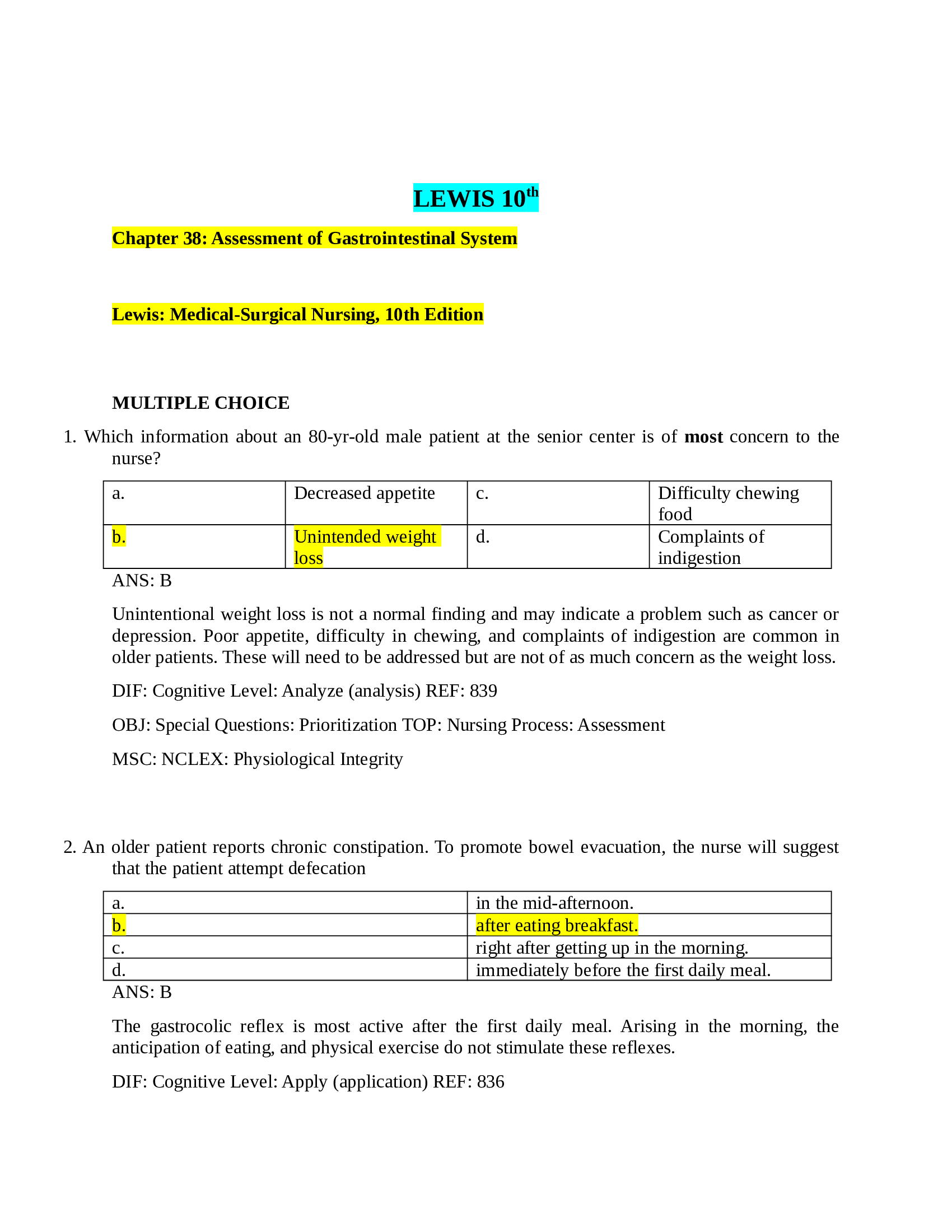
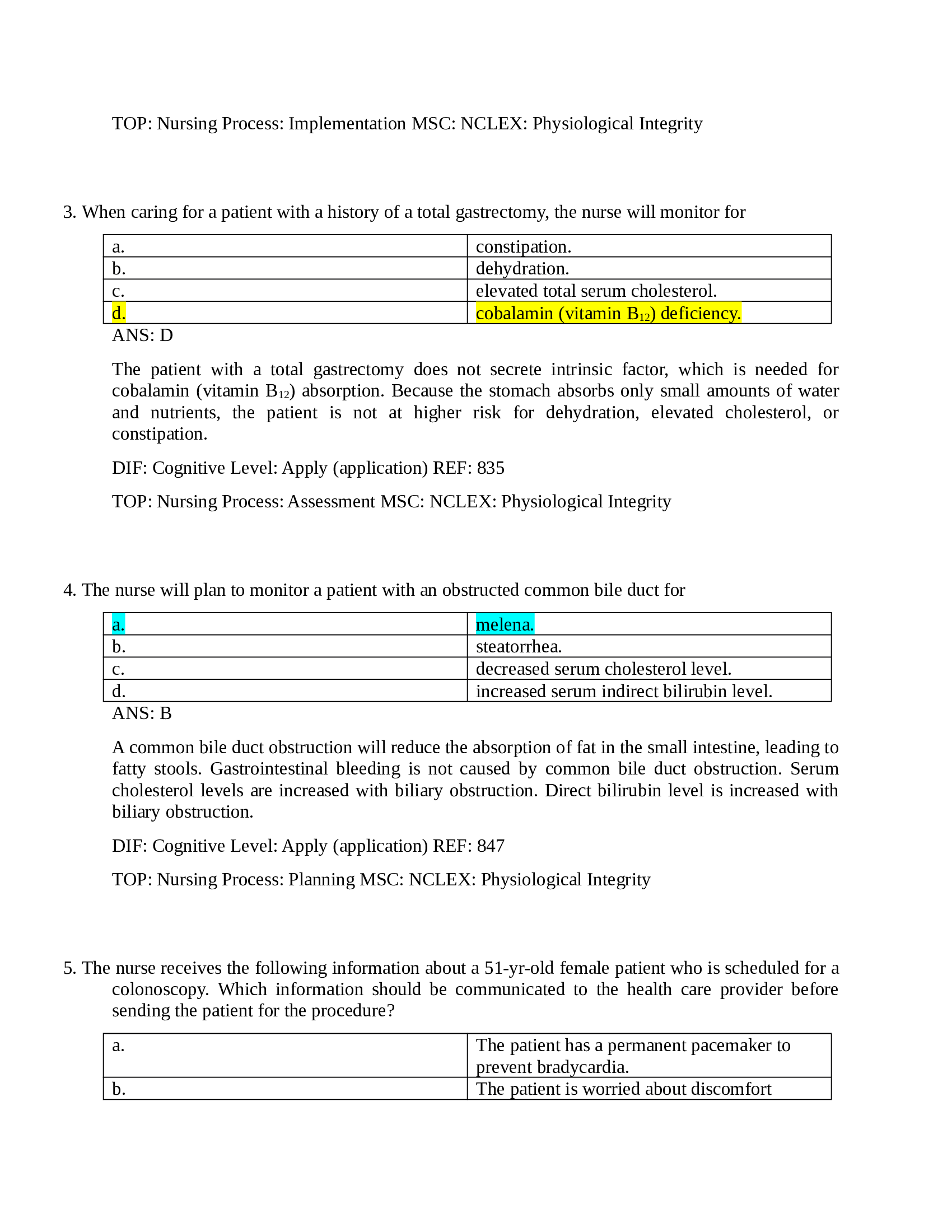
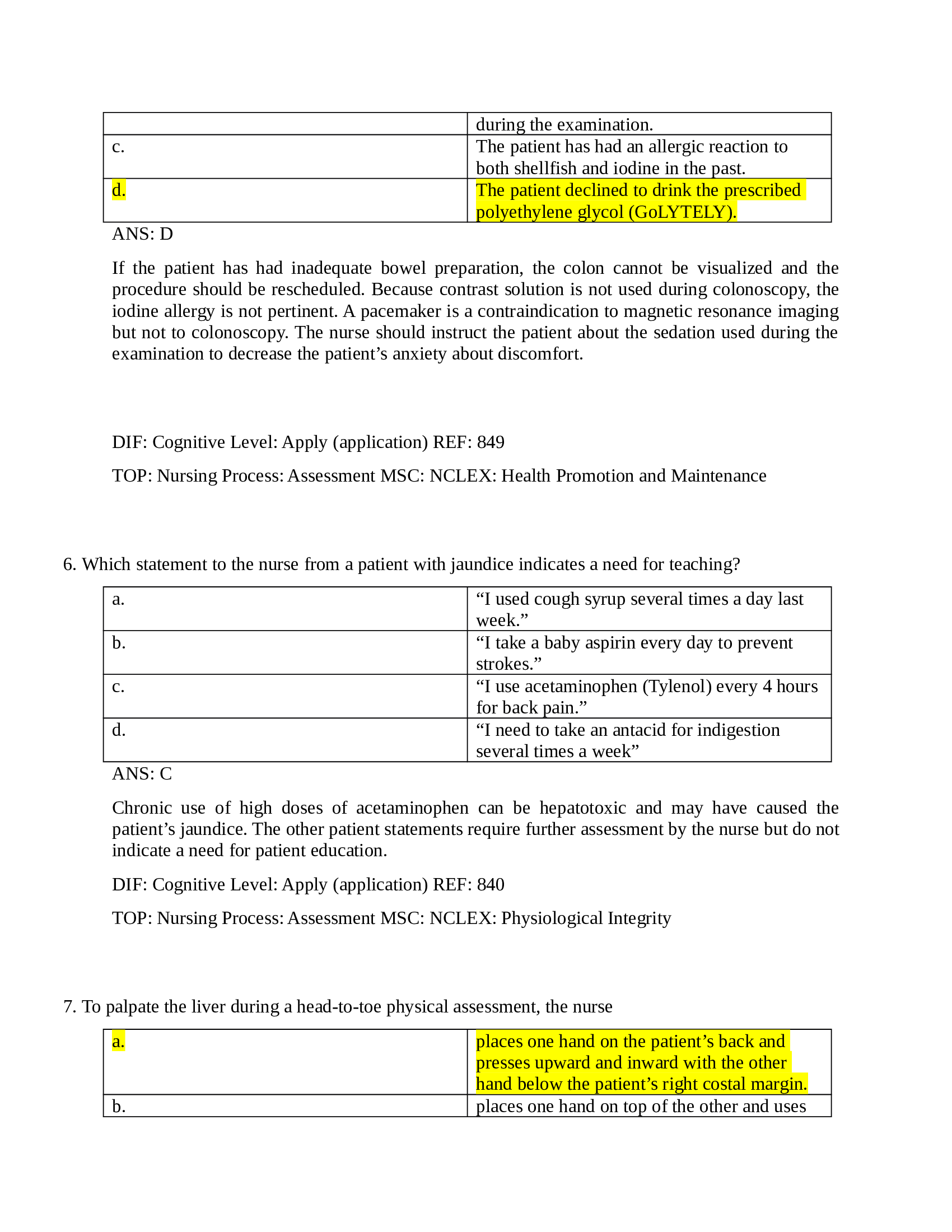
1. Which information about an 80-yr-old male patient at the senior center is of most concern to the nurse? a. Decreased appetite c. Difficulty chewing food b. Unintended weight loss d. Complaints of indigestion ANS: B Unintentional weight loss is not a normal finding and may indicate a problem such as cancer or depression. Poor appetite, difficulty in chewing, and complaints of indigestion are common in older patients. These will need to be addressed but are not of as much concern as the weight loss. DIF: Cognitive Level: Analyze (analysis) REF: 839 OBJ: Special Questions: Prioritization TOP: Nursing Process: Assessment MSC: NCLEX: Physiological Integrity 2. An older patient reports chronic constipation. To promote bowel evacuation, the nurse will suggest that the patient attempt defecation a. in the mid-afternoon. b. after eating breakfast. c. right after getting up in the morning. d. immediately before the first daily meal. ANS: B The gastrocolic reflex is most active after the first daily meal. Arising in the morning, the anticipation of eating, and physical exercise do not stimulate these reflexes. DIF: Cognitive Level: Apply (application) REF: 836 TOP: Nursing Process: Implementation MSC: NCLEX: Physiological Integrity 3. When caring for a patient with a history of a total gastrectomy, the nurse will monitor for a. constipation. b. dehydration. c. elevated total serum cholesterol. d. cobalamin (vitamin B12) deficiency. ANS: D The patient with a total gastrectomy does not secrete intrinsic factor, which is needed for cobalamin (vitamin B12) absorption. Because the stomach absorbs only small amounts of water and nutrients, the patient is not at higher risk for dehydration, elevated cholesterol, or constipation. DIF: Cognitive Level: Apply (application) REF: 835 TOP: Nursing Process: Assessment MSC: NCLEX: Physiological Integrity 4. The nurse will plan to monitor a patient with an obstructed common bile duct for a. melena. b. steatorrhea. c. decreased serum cholesterol level. d. increased serum indirect bilirubin level. ANS: B A common bile duct obstruction will reduce the absorption of fat in the small intestine, leading to fatty stools. Gastrointestinal bleeding is not caused by common bile duct obstruction. Serum cholesterol levels are increased with biliary obstruction. Direct bilirubin level is increased with biliary obstruction. DIF: Cognitive Level: Apply (application) REF: 847 TOP: Nursing Process: Planning MSC: NCLEX: Physiological Integrity 5. The nurse receives the following information about a 51-yr-old female patient who is scheduled for a colonoscopy. Which information should be communicated to the health care provider before sending the patient for the procedure? a. The patient has a permanent pacemaker to prevent bradycardia. b. The patient is worried about discomfort during the examination. c. The patient has had an allergic reaction to both shellfish and iodine in the past. d. The patient declined to drink the prescribed polyethylene glycol (GoLYTELY). ANS: D If the patient has had inadequate bowel preparation, the colon cannot be visualized and the procedure should be rescheduled. Because contrast solution is not used during colonoscopy, the iodine allergy is not pertinent. A pacemaker is a contraindication to magnetic resonance imaging but not to colonoscopy. The nurse should instruct the patient about the sedation used during the examination to decrease the patient’s anxiety about discomfort. DIF: Cognitive Level: Apply (application) REF: 849 TOP: Nursing Process: Assessment MSC: NCLEX: Health Promotion and Maintenance 6. Which statement to the nurse from a patient with jaundice indicates a need for teaching? a. “I used cough syrup several times a day last week.” b. “I take a baby aspirin every day to prevent strokes.” c. “I use acetaminophen (Tylenol) every 4 hours for back pain.” d. “I need to take an antacid for indigestion several times a week” ANS: C Chronic use of high doses of acetaminophen can be hepatotoxic and may have caused the patient’s jaundice. The other patient statements require further assessment by the nurse but do not indicate a need for patient education. DIF: Cognitive Level: Apply (application) REF: 840 TOP: Nursing Process: Assessment MSC: NCLEX: Physiological Integrity 7. To palpate the liver during a head-to-toe physical assessment, the nurse a. places one hand on the patient’s back and presses upward and inward with the other hand below the patient’s right costal margin. b. places one hand on top of the other and uses the upper fingers to apply pressure and the bottom fingers to feel for the liver edge. c. presses slowly and firmly over the right costal margin with one hand and withdraws the fingers quickly after the liver edge is felt. d. places one hand under the patient’s lower ribs and presses the left lower rib cage forward, palpating below the costal margin with the other hand. ANS: A The liver is normally not palpable below the costal margin. The nurse needs to push inward below the right costal margin while lifting the patient’s back slightly with the left hand. The other methods will not allow palpation of the liver. DIF: Cognitive Level: Apply (application) REF: 844 TOP: Nursing Process: Assessment MSC: NCLEX: Health Promotion and Maintenance

Contact the Seller

Please Sign In to contact this seller.


  • 👎  Report Copyright Violation

Frequently Asked Questions

What Do I Get When I Buy This Study Material?

+

When you buy a study material on Passing Grades, an instant download link will be sent directly to your email, giving you access to the file anytime after payment is completed.

Is Passing Grades a Trusted Platform?

+

Yes, Passing Grades is a reputable students’ marketplace with a secure payment system and reliable customer support. You can trust us to ensure a safe and seamless transaction experience.

Will I Be Stuck with a Subscription?

+

No, all purchases on Passing Grades are one-time transactions. You only pay for the notes you choose to buy, with no subscriptions or hidden fees attached.

Who Am I Buying These Study Materials From?

+

Passing Grades is a marketplace, which means you are purchasing the document from an individual vendor, not directly from us. We facilitate the payment and delivery process between you and the vendor.

Does Passing Grades Offer Free Study Materials?

+

Yes, sellers on Passing Grades have uploaded numerous free test banks, exams, practice questions, and class notes that can be downloaded at no cost.


Pasinggrades - Quality Study Materials

USD 18

    • Quality checked by Pasing Grades
    • 100% satisfaction guarantee
    • Seller: Charlsy
Buy PDF $18

Seller Information

Charlsy

Member since August 2021

  • icon
View Profile
  • total sales

    0
  • Favourites

    0
  • Comments

    0
    ( 0 Ratings )

Item Information

  • Uploaded

    01 September 2021

  • Updated

    17 October 2025

  • Category

    No category

  • Item Type

    questions & answers

  • Tags

    1. Which information about an 80 yr old male patient at the senior center is of most concern to the nurse? a. Decreased appetite c. Difficulty chewing food b. Unintended weight loss d. Complaints of indigestion ANS: B Unintentional weight loss is not a normal finding and may indicate a problem such as cancer or depression. Poor appetite difficulty in chewing and complaints of indigestion are common in older patients. These will need to be addressed but are not of as much concern as the weight loss. DIF: Cognitive Level: Analyze (analysis) REF: 839 OBJ: Special Questions: Prioritization TOP: Nursing Process: Assessment MSC: NCLEX: Physiological Integrity 2. An older patient reports chronic constipation. To promote bowel evacuation the nurse will suggest that the patient attempt defecation a. in the mid afternoon. b. after eating breakfast. c. right after getting up in the morning. d. immediately before the first daily meal. ANS: B The gastrocolic reflex is most active after the first daily meal. Arising in the morning the anticipation of eating and physical exercise do not stimulate these reflexes. DIF: Cognitive Level: Apply (application) REF: 836 TOP: Nursing Process: Implementation MSC: NCLEX: Physiological Integrity 3. When caring for a patient with a history of a total gastrectomy the nurse will monitor for a. constipation. b. dehydration. c. elevated total serum cholesterol. d. cobalamin (vitamin B12) deficiency. ANS: D The patient with a total gastrectomy does not secrete intrinsic factor which is needed for cobalamin (vitamin B12) absorption. Because the stomach absorbs only small amounts of water and nutrients the patient is not at higher risk for dehydration elevated cholesterol or constipation. DIF: Cognitive Level: Apply (application) REF: 835 TOP: Nursing Process: Assessment MSC: NCLEX: Physiological Integrity 4. The nurse will plan to monitor a patient with an obstructed common bile duct for a. melena. b. steatorrhea. c. decreased serum cholesterol level. d. increased serum indirect bilirubin level. ANS: B A common bile duct obstruction will reduce the absorption of fat in the small intestine leading to fatty stools. Gastrointestinal bleeding is not caused by common bile duct obstruction. Serum cholesterol levels are increased with biliary obstruction. Direct bilirubin level is increased with biliary obstruction. DIF: Cognitive Level: Apply (application) REF: 847 TOP: Nursing Process: Planning MSC: NCLEX: Physiological Integrity 5. The nurse receives the following information about a 51 yr old female patient who is scheduled for a colonoscopy. Which information should be communicated to the health care provider before sending the patient for the procedure? a. The patient has a permanent pacemaker to prevent bradycardia. b. The patient is worried about discomfort during the examination. c. The patient has had an allergic reaction to both shellfish and iodine in the past. d. The patient declined to drink the prescribed polyethylene glycol (GoLYTELY). ANS: D If the patient has had inadequate bowel preparation the colon cannot be visualized and the procedure should be rescheduled. Because contrast solution is not used during colonoscopy the iodine allergy is not pertinent. A pacemaker is a contraindication to magnetic resonance imaging but not to colonoscopy. The nurse should instruct the patient about the sedation used during the examination to decrease the patient’s anxiety about discomfort. DIF: Cognitive Level: Apply (application) REF: 849 TOP: Nursing Process: Assessment MSC: NCLEX: Health Promotion and Maintenance 6. Which statement to the nurse from a patient with jaundice indicates a need for teaching? a. “I used cough syrup several times a day last week.” b. “I take a baby aspirin every day to prevent strokes.” c. “I use acetaminophen (Tylenol) every 4 hours for back pain.” d. “I need to take an antacid for indigestion several times a week” ANS: C Chronic use of high doses of acetaminophen can be hepatotoxic and may have caused the patient’s jaundice. The other patient statements require further assessment by the nurse but do not indicate a need for patient education. DIF: Cognitive Level: Apply (application) REF: 840 TOP: Nursing Process: Assessment MSC: NCLEX: Physiological Integrity 7. To palpate the liver during a head to toe physical assessment the nurse a. places one hand on the patient’s back and presses upward and inward with the other hand below the patient’s right costal margin. b. places one hand on top of the other and uses the upper fingers to apply pressure and the bottom fingers to feel for the liver edge. c. presses slowly and firmly over the right costal margin with one hand and withdraws the fingers quickly after the liver edge is felt. d. places one hand under the patient’s lower ribs and presses the left lower rib cage forward palpating below the costal margin with the other hand. ANS: A The liver is normally not palpable below the costal margin. The nurse needs to push inward below the right costal margin while lifting the patient’s back slightly with the left hand. The other methods will not allow palpation of the liver. DIF: Cognitive Level: Apply (application) REF: 844 TOP: Nursing Process: Assessment MSC: NCLEX: Health Promotion and Maintenance

Related Exam Prep Guides by Charlsy

PHI208 Week 2 Quiz
View Document

PHI208 Week 2 Quiz...

  • Charlsy

    Charlsy

  • questions & answers

PHI208 Week 2 Quiz...

18 USD

0

0

NURS 6512 FINAL EXAM
View Document

NURS 6512 FINAL EXAM...

  • Charlsy

    Charlsy

  • questions & answers

NURS 6512 FINAL EXAM...

18 USD

0

0

HIstory Final Milestone
View Document

HIstory Final Milest...

  • Charlsy

    Charlsy

  • questions & answers

HIstory Final Milestone...

18 USD

0

0

Purchase

Download link will be sent to this email immediately after purchase.

IMPORTANT LINKS

  • How To Upload Class Notes
  • Selling Tips
  • Passing Grades's Study Materials
  • Scholarships for International Students 2026

POPULAR CATEGORIES

  • Law
  • Accounting
  • English
  • Psychology
  • Business
  • Nursing
  • Computer Science
  • General

View Document

  • Blog
  • Contact
  • Delivery Policy
  • Latest Scholarships Around the World
  • How to Pass Bar Exams: Passing Grades’ Strategies
  • How to Study and Pass the CPA Exam
  • All Test Banks
  • Faq
  • Copyright Claims
  • Privacy Policy
  • Terms of Use

KNOWLEDGE BASE

  • How to Write A+ Grade Good Research Paper
  • How to Manage Stress During Exam Period
  • Best Time to Study
  • How to Pass NCLEX-RN Exam
  • How To Effectively Utilize Test Banks
  • Popular Shadow Health Exam Assessments
  • Popular HESI Case Studies
  • How to Prepare for a Nursing Career
  • The Importance Of Summaries in Exam Revisvion

© 2026 Pasing Grades. All rights reserved.