Pasing Grades
  • Start Selling
  • Blog
  • Contact
  • 0

    Your cart is empty!

English

  • English
  • Spanish
  • Arabic
Create Account Sign In
  • Library
    • New Prep Guides
    • Featured Prep Guides
    • Free Exam Prep Guides
    • Best sellers
  • General
  • Nursing
    • Research Paper
    • Case Study
    • Discussion Post
    • Assignment
    • Exam
    • Practice Questions and Answers
    • Test Bank
    • solutions manual
  • Accounting
    • Case Study
    • Thesis
    • Study Guide
    • Summary
    • Research Paper
    • test bank
  • English
    • Creative Writing
    • Research Paper
    • Summary
    • Rhetorics
    • Literature
    • Journal
    • Exam
    • Grammar
    • Discussion Post
    • Essay
  • Psychology
    • Hesi
    • Presentation
    • Essay
    • Summary
    • Study Guide
    • Essay
    • Solution Manual
    • Final Exam Review
    • Class Notes
    • test bank
  • Business
    • Lecture Notes
    • Solution Manual
    • Presentation
    • Business Plan
    • Class Notes
    • Experiment
    • Summary
    • Practice Questions
    • Study Guide
    • Case Study
    • test bank
    • Exam
  • More
    • Computer Science
    • Economics
    • Statistics
    • Engineering
    • Biology
    • Religious Studies
    • Physics
    • Chemistry
    • Mathematics
    • History
    • Sociology
    • Science
    • Philosophy
    • Law
  • Pages
    • About Us
    • Selling Tips
    • Delivery Policy
    • Faq
    • Privacy Policy
  • Flash Sale
  • Home
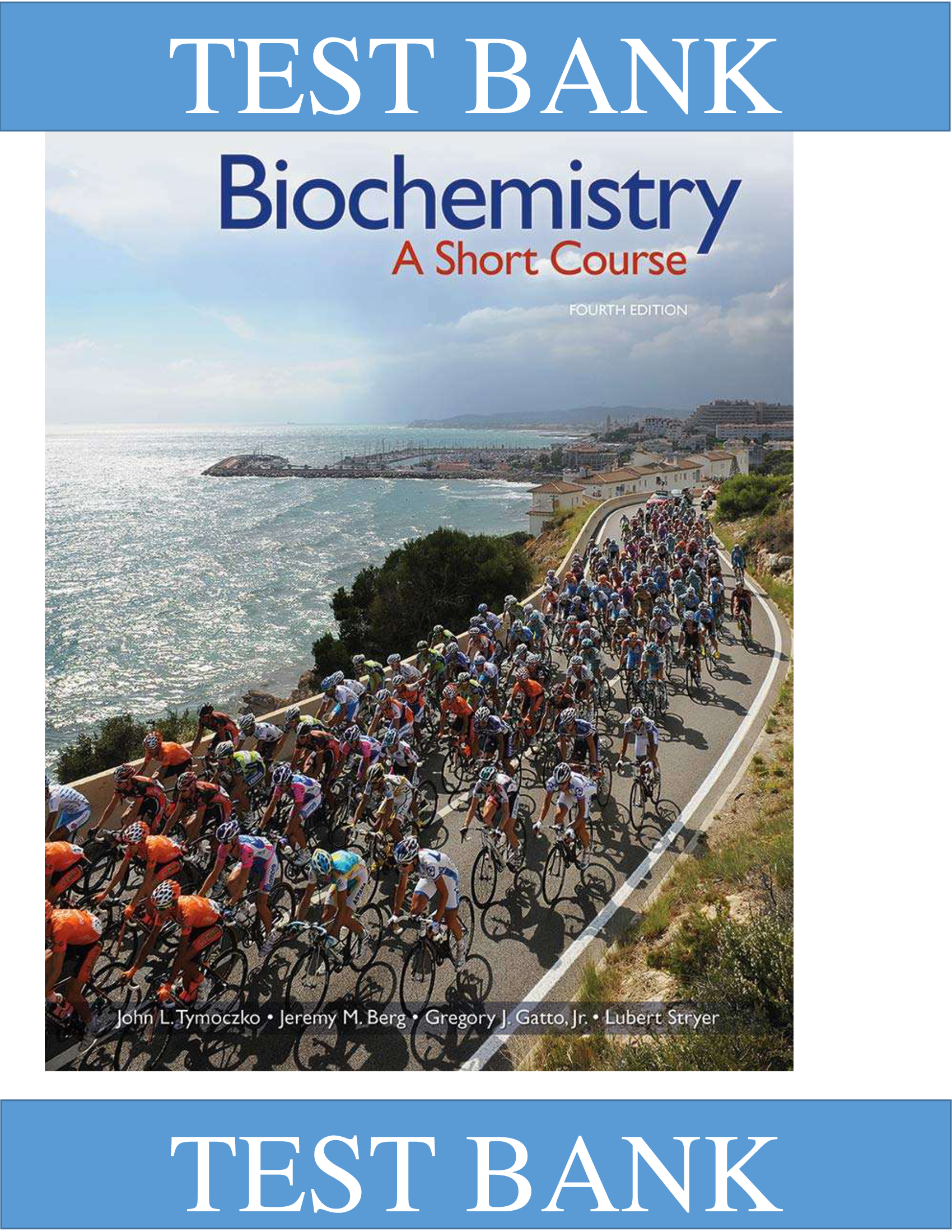
  • (All Chapters) Test Bank for Biochemistry, A Short Course, 4th Edition, John Tymoczko

(All Chapters) Test Bank for Biochemistry, A Short Course, 4th Edition, John Tymoczko

Preview page 1 Preview page 2 Preview page 3
Add To Favorites

Share this item Share this item

  • Item Details
  • Comments (0)
  • Reviews (0)
  • Contact Seller

Biochemistry, A Short Course, 4th Edition, John Tymoczko, Jeremy M. Berg, Gregory J. Gatto Jr., Lubert Stryer Test Bank


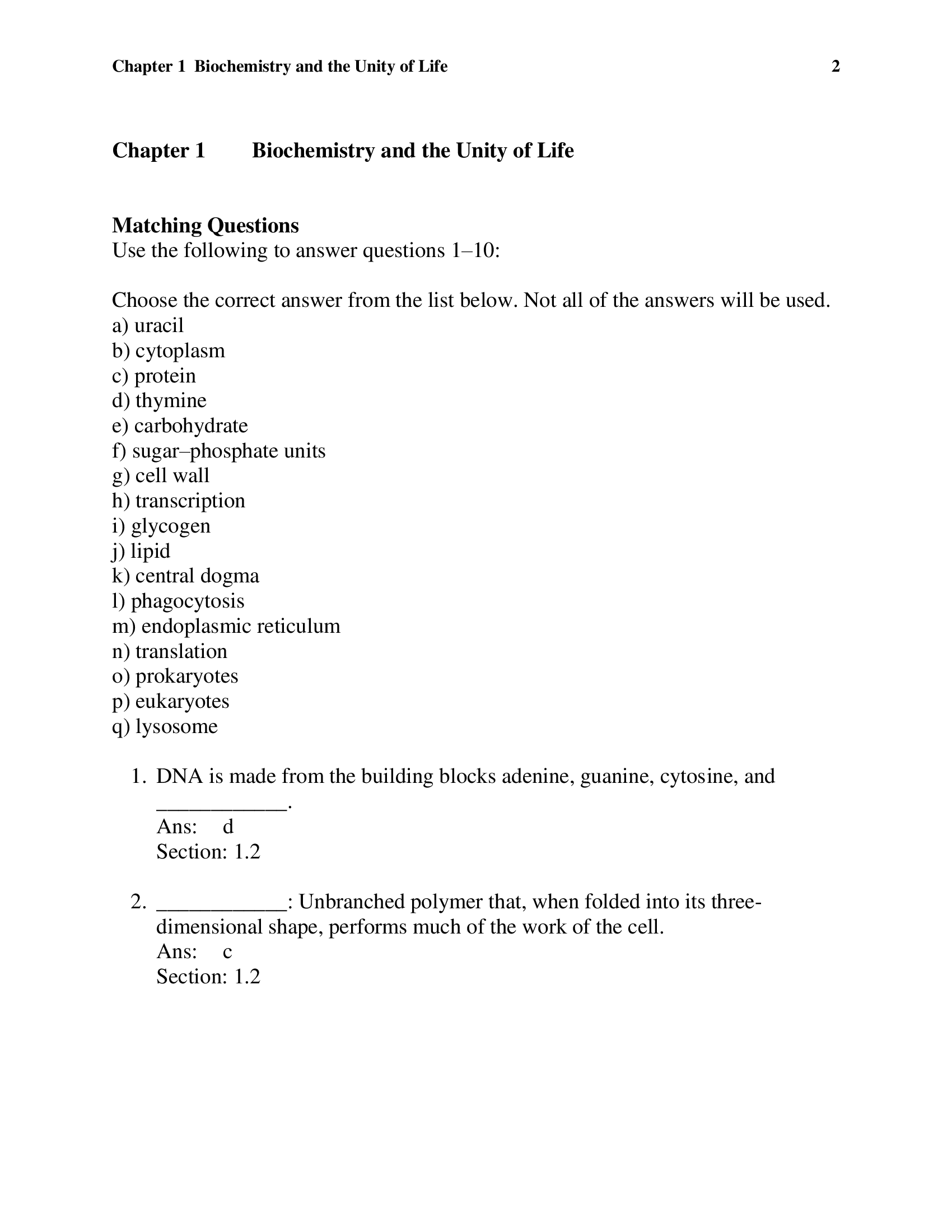
Choose the correct answer from the list below. Not all of the answers will be used. a) uracil

b)            cytoplasm

c)            protein

d)            thymine

e)            carbohydrate

f)             sugar–phosphate units

g)            cell wall

h)            transcription

i)             glycogen

j)             lipid

k)            central dogma

l)             phagocytosis

m)          endoplasmic reticulum

n)            translation

o)            prokaryotes

p)            eukaryotes

q)            lysosome 

1.            DNA is made from the building blocks adenine, guanine, cytosine, and ____________.  Ans:     d 

 Section: 1.2


2.            ____________: Unbranched polymer that, when folded into its threedimensional shape, performs much of the work of the cell. 

Ans:       c

 Section: 1.2

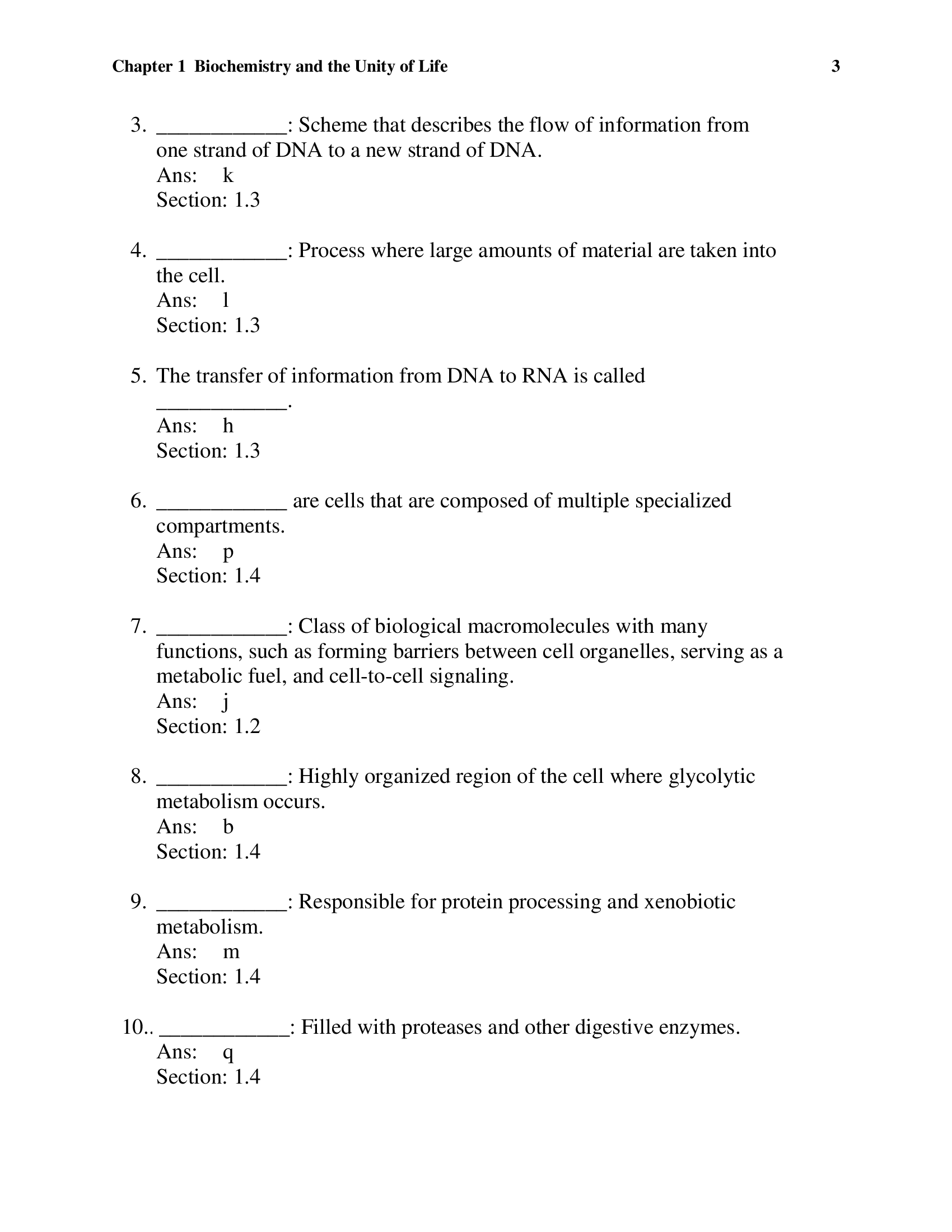
3.            ____________: Scheme that describes the flow of information from one strand of DNA to a new strand of DNA.

Ans:       k 

 Section: 1.3

4.            ____________: Process where large amounts of material are taken into the cell.

Ans:       l 

 Section: 1.3

5.            The transfer of information from DNA to RNA is called ____________.

Ans:       h

 Section: 1.3

6.            ____________ are cells that are composed of multiple specialized compartments. 

Ans:       p

 Section: 1.4

7.            ____________: Class of biological macromolecules with many functions, such as forming barriers between cell organelles, serving as a metabolic fuel, and cell-to-cell signaling.

 Ans:       j

 Section: 1.2

8.            ____________: Highly organized region of the cell where glycolytic metabolism occurs. Ans:     b 

 Section: 1.4

9.            ____________: Responsible for protein processing and xenobiotic metabolism. 

Ans:       m 

 Section: 1.4

10.. ____________: Filled with proteases and other digestive enzymes.  Ans: q 

 Section: 1.4

Fill-in-the-Blank Questions

11.          Organisms are known to be highly uniform at the       level. Ans: molecular  Section: Introduction

12.          After hydrogen and oxygen, the next most common element in living systems is      .

                Ans: carbon                        Section: 1.1


13.          A chemical that can dissolve in water is said to be      .

Ans: hydrophilic Section: 1.2

14.          A nucleotide consists of one or more       groups, a 5-carbon ribose sugar, and a nitrogen-containing aromatic ring group.

Ans: phosphoryl                               Section: 1.2

15.          The most common carbohydrate fuel is      .

                 Ans: glucose                      Section: 1.2


16.          Heritable information is packaged into discrete units called      .

                 Ans: genes                         Section: 1.3


17.          A group of enzymes called      catalyze replication.

                 Ans: DNA polymerase                   Section: 1.3


18.          Although all cells in an organism have the same DNA, tissues differ due to selective      .

                 Ans: expression               Section: 1.3


19.          The basic unit of life is considered the      .  Ans: cell                          Section: 1.4


20.          Secretory vesicles fuse with the plasma membrane to release material outside of the cell via      .   

                 Ans: exocytosis                Section: 1.4


Multiple-Choice Questions


21.          The structure of DNA described by Watson and Crick       included:

A)           a double helix. 

B)            the sugar–phosphate backbone aligned in the center of the helix. 

C)            the base pairs that are stacked on the inside of the double helix.  D) A and B. 

E) A and C. 

                 Ans: E                   Section: 1.2


22.          In higher organisms, which of the following is composed of a polymer with double-stranded phosphodiester-linked monomers? 

A)           RNA

B)            DNA

C)            protein

D)           carbohydrate E) None of the above.

                 Ans: B                 Section 1.2


23.          What gives proteins such a dominant role in biochemistry? 

A)           the variation in protein sizes

B)            the ability to act as a blueprint

C)            their ability to self-replicate

D)           their ability to spontaneously fold into complex three-dimensional structures E) All of the above.

                 Ans: D                  Section: 1.2


24.          Proteins are chiefly composed of which of the following? 

A)           carbohydrate and amino acids

B)            long unbranched amino acid polymers

C)            peptide bonds formed between lipid moieties

D)           aggregated amino acids

E)            A and B

                 Ans: B                 Section 1.3


25.          How a protein folds is determined by:

A)           whether the environment is hydrophobic or hydrophilic.

B)            the location in the cell in which the protein is located.

C)            the pH of the cytoplasm.

D)           the order of the amino acids found in the sequence.

E)            All of the above.

                 Ans: D                  Section: 1.2


26.          The half-life of which of the following is likely to be shortest?

A)           protein

B)            lipid

C)            carbohydrate

D)           DNA

E)            RNA

                 Ans: E                   Section: 1.2


27.          The central dogma describes:

A)           the formation of cells from individual components.

B)            the selective expression of genes.

C)            the flow of information between DNA, RNA, and protein.

D)           the work of polymerases on RNA and DNA.

E)            All of the above.

                 Ans: C                 Section: 1.3


28.          Translation takes place on/in the:  A) ribosomes.

B)            smooth endoplasmic reticulum.

C)            nucleus.

D)           DNA polymerases.

E)            DNA parent strand.

                 Ans: A                  Section: 1.3


29.          Which of the following organelles has a double membrane?

A)           nucleus

B)            endoplasmic reticulum

C)            mitochondria

D)           plasma membrane

E)            A and C

F)            All of the above.

                 Ans: E                   Section: 1.4


30.          The main function of the plasma membrane is to: 

A)           provide the interior of the cell an enclosed environment that no molecules may cross.

B)            provide a selectively permeable barrier with the aid of transport proteins.

C)            give eukaryote and prokaryote cells structural strength.

D)           allow only the free passage of water in and out of the cell.

E) None of the above.

                 Ans: B                 Section: 1.4


31.Filaments and microtubules are components of a network called the: A) chloroplast.

B)            cytoplasm.

C)            cytoskeleton.

D)           cell wall.

E)            B and D.

                 Ans: C                 Section: 1.4

32.Poisons that kill an organism as a result of a loss of high-energy ATP molecules are most likely to target which organelle? 

A)           mitochondria

B)            cytoskeleton

C)            cytoplasm

D)           endoplasmic reticulum

E)            nucleus

                 Ans: A                  Section: 1.4

33.A secreted protein would be processed through organelles in the following order:

A)           nucleus; secretory vesicle; Golgi complex.

B)            cytoplasm; Golgi complex; cytosol; secretory vesicle.

C)            endoplasmic reticulum; cytoplasmic reticulum; Golgi complex.

D)           nucleus; cytoplasm; endoplasmic reticulum; Golgi complex; secretory vesicle.

E)            None of the above.

                 Ans: E                   Section: 1.4


34.          Extracellular material is taken into the cell via which process?

A)           exocytosis

B)            phagocytosis

C)            lysosome-mediated endocytosis

D)           reverse secretory mechanism

E)            phago-cytosolic internalization

                 Ans: B                 Section 1.4

35.          The rigid material that provides structural support to a plant cell is/are called the:

A)           plant cytoskeleton.

B)            plasma membrane.

C)            cell wall.

D)           chloroplast anchor proteins.

E)            microfilaments and microtubules.

                 Ans: C                 Section: 1.4

36.          In studying secreted proteins, you find that Substance X inhibits the secretion of a labeled protein. However, you do find a fully synthesized, folded, and glycosylated proteins in the cell. Where is the most likely site in the synthesis and secretion of proteins for Substance X to act?

A)           nucleus during translation

B)            budding of the secretory granule

C)            translation on the ribosome D) enzyme modification in the Golgi

E) All of the above.

                Ans: B                   Section: 1.4


37. Below is the scheme known as the central dogma. Each of the arrows (A, B, C) represents a particular process in gene expression. A, B, and C, respectively, are:

A)           replication, transcription, translation.

B)            reverse transcription, transcription, translation.

C)            transcription, translation, replication.

D)           replication translation, expression.

E)            None of the above.

                Ans: A  Section: 1.3

38. Match the loss of a particular organelle with the associated disease. 

A)           Hypercholesterolemia – smooth endoplasmic reticulum

B)            Diabetes – endosome

C)            Tay-Sachs disease - lysosome

D)           Muscle degeneration – mitochondria

E)            Stroke – Golgi body

                Ans: C                   Section: 1.4

39. In a biochemistry lab course, you are asked to design an experiment to identify a strain of bacteria.  Your lab partner claims that she thinks the bacterium contains a rough endoplasmic reticulum. To verify her claim, which of the following experiments would you preform?

A)           determine whether the bacterium can synthesize ATP in the presence of fuel molecules and O2

B)            determine whether the bacterium can synthesize proteins

C)            determine whether the bacterium generates CO2 in the presence of fuel molecules

D)           determine whether the bacterium has an internal membrane-enclosed compartment

E)            All of these experiments will work.

                Ans: D  Section: 1.4

Short-Answer Questions

40.          What are the four key classes of biomolecules? 

Ans:       Proteins, DNA/RNA, lipids, carbohydrates. These are the larger, monomer or biopolymer molecules, which perform many functions to maintain cellular life. Each has a different biochemical make-up.   Section: 1.2

41.          How do eukaryotic cells differ from prokaryotic cells? 

Ans:       The simplest answer is defined by the existence of organelles. Eukaryotic cells contain organelles including a nucleus, while prokaryotic cells do not have such compartments.   Section: 1.4

42.          Describe the central dogma and why it is important for cell life. 

Ans:       This is the phrase coined by Francis Crick and is the overview of how a cell uses the information from DNA to produce RNA, protein, and more DNA. Much of the fate of a cell (metabolism, survival, growth, movement, and cell differentiation) is based on the control of the central dogma. Which genes are transcribed and translated defines the function of a cell. 

 Section: 1.3

43.          Define an organelle. 

Ans:       An organelle is an intracellular compartment, often, but not always, enclosed by a membrane. Examples include the nucleus, mitochondria, and chloroplasts. However, the cytoplasm is defined as that area surrounded by the plasma membrane, excluding the organelles. 

 Section: 1.4

44.          What is the role of the endoplasmic reticulum (ER)? 

Ans:       The endoplasmic reticulum is series of membrane tubes or sacs. When studded with ribosomes, the endoplasmic reticulum is considered rough ER and is involved with the processing of nascent protein. Smooth ER is involved in maturing proteins and carbohydrates, and is responsible for xenophobic metabolism of foreign compounds.  Section: 1.4

45. Of the biochemical macromolecules, which class is chiefly responsible for catalysis of cellular processes? 

Ans:       Proteins. 

 Section: 1.2

46. DNA and RNA are composed of what basic biochemical compounds? 

Ans: Both RNA and DNA are nucleotides. Central to nucleotides is a carbohydrate molecule called a ribose or deoxyribose. Bonded to the ribose is one of several aromatic nitrogen-containing organic compounds, which are generically called “bases.” One or more phosphate groups are also bonded to the ribose or deoxyribose.   Section: 1.2

47.          What are the important functions of carbohydrates? 

Ans:       Structural, energy storage, modify proteins, cell–cell recognition..  Section: 1.2

48.          What is significant about the DNA process of replication? 

Ans: It provides a mechanism for copying the DNA from one generation to the next. 

 Section: 1.4

49.          Which property of lipids drives the formation of membranes? 

Ans:       The dual chemical nature of lipids allows them to self-organize into membranes.  Section: 1.2

50.          What data might Monod cite to justify the phrase “Anything found to be true of E. coli must also be true of elephants”?

Ans: He would most likely describe similarities between eukaryotic and prokaryotic cells. The first is a barrier, a membrane, that separates the cell form its environment such that independent of cell type, the interior of the cell is chemically different that the external environment. The membrane is more than a barrier; it is selectively permeable and directs the flow of molecules into and out of the cell. The second is the structure of the molecule that carries information regarding cell activities as the cell undergoes duplication each generation. Nucleic acids are the information storage molecule for living systems. 


Contact the Seller

Please Sign In to contact this seller.


  • 👎  Report Copyright Violation

Frequently Asked Questions

What Do I Get When I Buy This Study Material?

+

When you buy a study material on Passing Grades, an instant download link will be sent directly to your email, giving you access to the file anytime after payment is completed.

Is Passing Grades a Trusted Platform?

+

Yes, Passing Grades is a reputable students’ marketplace with a secure payment system and reliable customer support. You can trust us to ensure a safe and seamless transaction experience.

Will I Be Stuck with a Subscription?

+

No, all purchases on Passing Grades are one-time transactions. You only pay for the notes you choose to buy, with no subscriptions or hidden fees attached.

Who Am I Buying These Study Materials From?

+

Passing Grades is a marketplace, which means you are purchasing the document from an individual vendor, not directly from us. We facilitate the payment and delivery process between you and the vendor.

Does Passing Grades Offer Free Study Materials?

+

Yes, sellers on Passing Grades have uploaded numerous free test banks, exams, practice questions, and class notes that can be downloaded at no cost.

Pasinggrades - Quality Study Materials

USD 15

    • Quality checked by Pasing Grades
    • 100% satisfaction guarantee
    • Seller: Angelicer
Buy PDF $15

Seller Information

Angelicer

Member since April 2021

  • icon
  • icon
View Profile
  • total sales

    0
  • Favourites

    0
  • Comments

    0
    ( 0 Ratings )

Item Information

  • Uploaded

    12 July 2025

  • Updated

    12 July 2025

  • Category

    Biology

  • Item Type

    test bank

  • Tags

    Test Bank for Biochemistry A Short Course 4th Edition

Related Exam Prep Guides by Angelicer

Test Bank for Success in Practical Vocational Nursing 8th Edition by Knecht
View Document

Test Bank for Succes...

  • Angelicer

    Angelicer

  • test bank

Enhance your study with the Test Bank for Success in Practical Vocational Nursing 8th Edition by Kne...

15 USD

0

0

Test Bank for Illustrated Anatomy of the Head and Neck 5th Edition by Fehrenbach
View Document

Test Bank for Illust...

  • Angelicer

    Angelicer

  • test bank

Boost your understanding with the Test Bank for Illustrated Anatomy of the Head and Neck 5th Edition...

15 USD

0

0

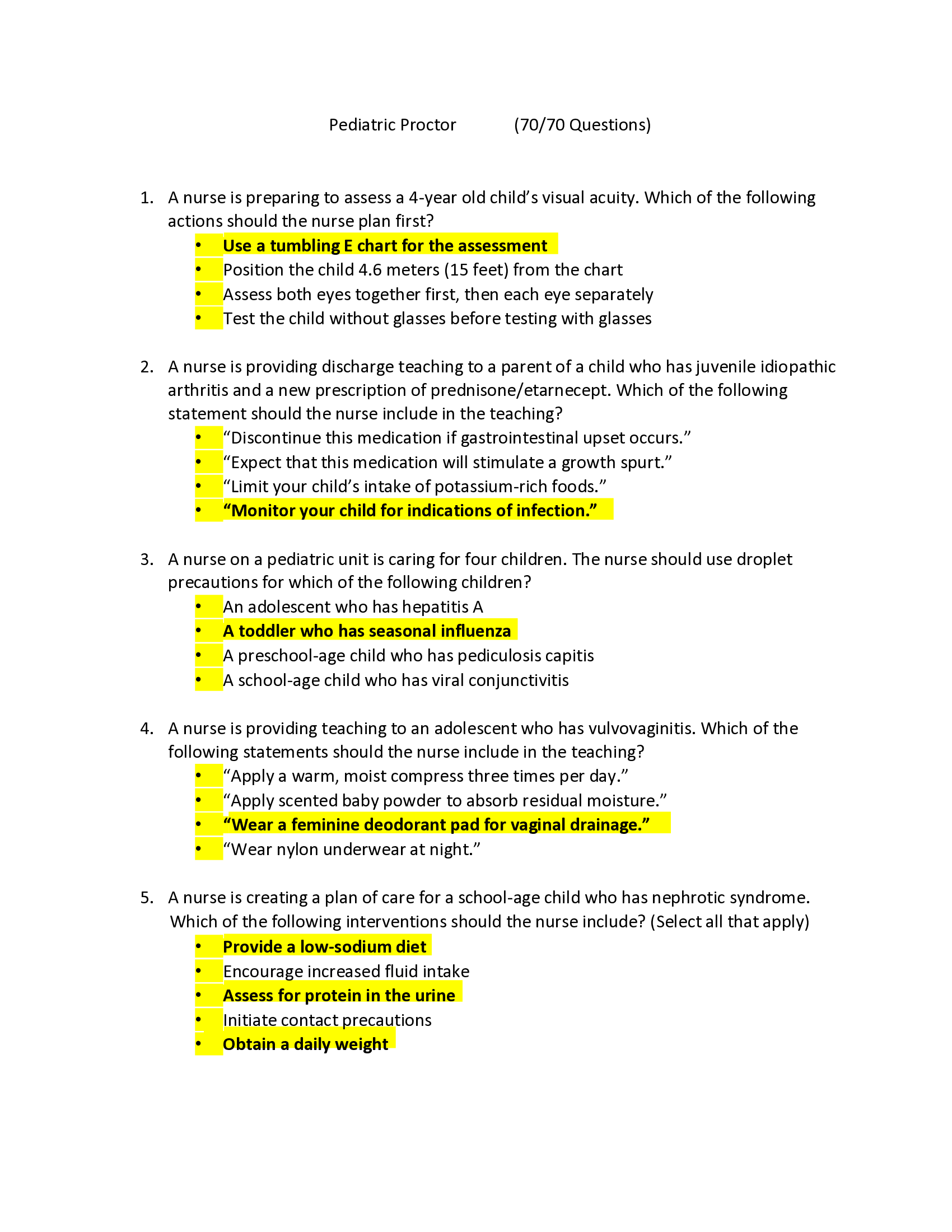
ATI PEDS Proctored Exam Questions and Answers 2026 | Comprehensive Study Guide
View Document

ATI PEDS Proctored E...

  • Angelicer

    Angelicer

  • test bank

Get the ATI PEDS Proctored Exam Questions and Answers for 2025. This comprehensive study guide offer...

15 USD

0

0

Purchase

Download link will be sent to this email immediately after purchase.

IMPORTANT LINKS

  • How To Upload Class Notes
  • Selling Tips
  • Passing Grades's Study Materials
  • Scholarships for International Students 2025

POPULAR CATEGORIES

  • Law
  • Accounting
  • English
  • Psychology
  • Business
  • Nursing
  • Computer Science
  • General

View Document

  • Blog
  • Contact
  • Delivery Policy
  • Latest Scholarships Around the World
  • How to Pass Bar Exams: Passing Grades’ Strategies
  • How to Study and Pass the CPA Exam
  • All Test Banks
  • Faq
  • Copyright Claims
  • Privacy Policy
  • Terms of Use

KNOWLEDGE BASE

  • How to Write A+ Grade Good Research Paper
  • How to Manage Stress During Exam Period
  • Best Time to Study
  • How to Pass NCLEX-RN Exam
  • How To Effectively Utilize Test Banks
  • Popular Shadow Health Exam Assessments
  • Popular HESI Case Studies
  • How to Prepare for a Nursing Career
  • The Importance Of Summaries in Exam Revisvion

© 2026 Pasing Grades. All rights reserved.