
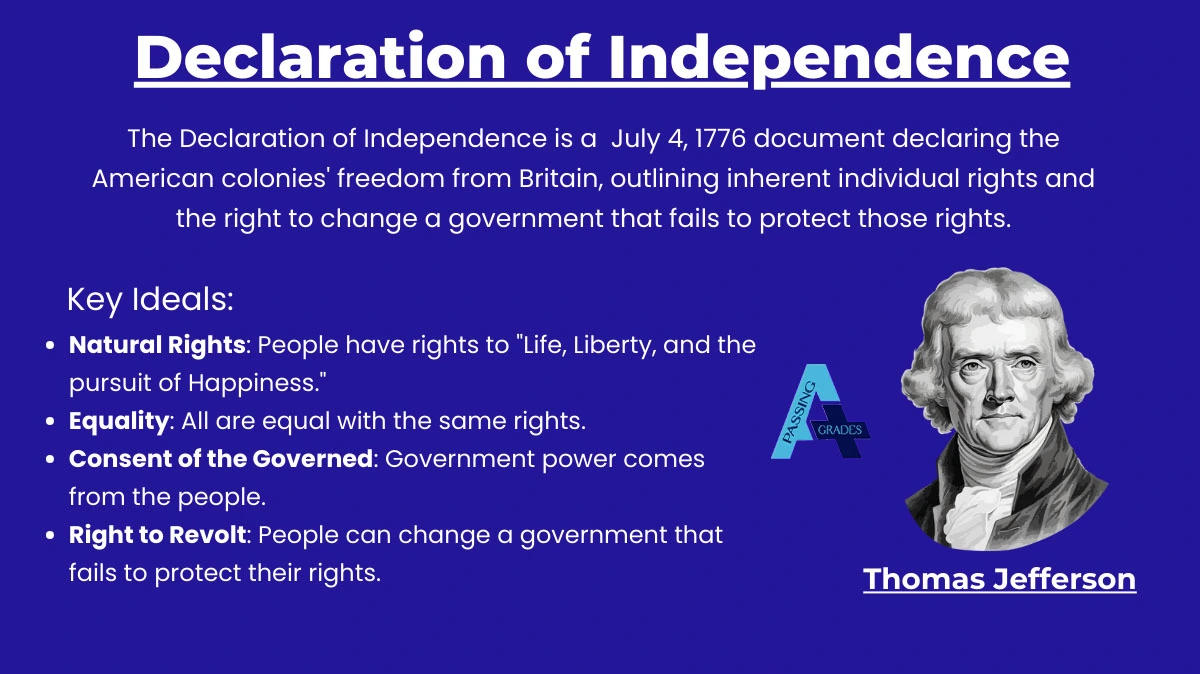
The Declaration of Independence written by Thomas Jefferson is a symbol of one of the greatest achievements of America. It was the claim of separation from Great Britain as a nation on July 4, 1776. This document went through many criticisms and was finally passed on July 4, 1776 according to Thomas Jefferson’s Autobiography of Thomas Jefferson (pg 29).
This autobiography states the states that voted against the Declaration of Independence might have not been mature enough to gaining independence from Great Britain. This document that symbolized freedom and equality to all people of the United States does not completely represent the total promise that is in its purpose, as it is even evident in the modern society.
Symbolism allows a person to create ideas of something that cannot be physically experienced. It gives a person a sense of meaning. In this case, the Declaration of Independence gives people of the colonies a sense of freedom and equality.
In Autobiography of Thomas Jefferson, he starts his writings by saying that he created a “memoranda” (pg 3) or documents of his family at the age of seventy seven. He describes how he included the records of his grandfather. He speaks of how his father was continuing his education. Jefferson says on page 5, that his father died after his family moved to a new location
and he and his brother were left land in which Jefferson still lived. He then continues to speak of his education. On page 7, he says that he got involved with politics by becoming a member of the legislature in 1769 until it was closed and then he married on January 1, 1772.
On page 8, Thomas Jefferson says that he was a student of Law in Williamsburg when the famous Revolutions of 1765 against the Stamp Act occurred. There he says he “heard the splendid display of Mr. Henry’s talents as a popular orator. They were indeed; such as I [Jefferson] never heard from any other man. He appeared to me [Jefferson] to speak as Homer wrote”(pg 8).
In his writings, he explains his process of passing bills with the people that he worked with. He describes how they had to move fast but carefully; getting the right people from their group to present the bills to the parliament. One of the bills he describes on page 11 was the Boston Port bill that moved to shut down the port on June 1, 1774. He says that the bill was “passed with no opposition” (pg 12).
Jefferson says, “On the 15th of May, 1776, the convention of Virginia instructed their delegates in Congress to propose to that body to declare the colonies independent of G. Britain, and appointed a commee to prepare a declaration of right and plan of government” (pg 20).
He writes that the people that they made this suggestion to were hesitant of the idea and emphasized the consequences of separation of the colonies and Great Britain. In some cases, they felt that the colonies were not ready for independence. He says, “That such a succession would weaken us more than could be compensated by any foreign alliance.
That in the event of such a division, foreign powers would either refuse to join themselves to our fortunes, or, having us so much in their power as that desperate declaration would place us, they would insist on terms proportionably more hard and prejudicial…” (pg 23).
Another consequence that was stated was on page 24 saying that the colonies would not get any help with trying to gain independence. In contrast, as Jefferson states that others had their own reasons of how independence from Great Britain would be beneficial to the colonies. He says that they believed that the declaration would “declare what already exists” (pg 24).
He asserts, “That as to the people or parliament of England, we had always been independent of them, their restraints on our trade deriving efficacy from our acquiescence only, & not from any rights they possessed of imposing them, & that so far our connection had been federal only & was now dissolved by the commencement of hostilities” (pg 24).
One reason they believed this is because the United colonies were not protected by the King. If there were ever attacks on the colonies, Britain was not obligated to fight on their side. He also states, “That the people wait for us to lead the way… That the voice of the representatives is not always consonant with the voice of the people, and that this is remarkably the case in the middle colonies” (pg 25).
In other words, there were a lot of conflicting political views. It is also stated, “That it would be in vain to wait either weeks or months for perfect unanimity, since it was impossible that all men should ever become of one sentiment on any question” (pg 26).
As Jefferson writes, they believed that even if they lost the help of other countries, at least they would be more knowledgeable about the condition the colonies are in. Also, they want the authority of making the decision to enter an alliance and not want to waste time in unnecessary alliances.
Jefferson states, “It is appearing in the course of these debates that the colonies of N. York, New Jersey, Pennsylvania, Delaware, Maryland, and South Carolina were not yet matured for the falling from the parent stem, but that they were fast advancing to that state, it was thought most prudent to wait a while for them, and to postpone the final decision to July 1…” (pg 28) He says, on this page, that a committee was formed, including J. Adams, Dr. Franklin, Roger Sherman. Robert R. Livingston and himself.
Jefferson says that he wrote the Declaration of Independence, got it approved by the committee, then presented it to the house on Friday the 28th of June. It was then voted on, on July 1st. Jefferson writes that everyone voted for the declaration to pass; however, “South Carolina and Pennsylvania voted against it.
Delaware having but two members present, they were divided” (pg 31) and New York abstained. Then it is said that a delegate of South Carolina requested to put the decision off until the next day. A third delegate of Delaware came in and voted for the resolution according to Jefferson on page 32.
Thomas Jefferson then explains the aspects of the Declaration of Independence by saying on page 35 that “all men are created equal; that they are endowed by their creator with inherent and inalienable rights; that among men, deriving their just powers from the consent of the governed; that whenever any form of government becomes destructive of these ends, it is the right of the people to alter or abolish it, & to institute new government… (pg 35).
In other words all people have the same rights and if those rights are infringed upon by government, it is in the people’s power to do what they feel is necessary in action.
He then goes on to explain facts about how Great Britain’s government was the cause of the suffering of the United Colonies. On page 36, he says that the king refused to pass the necessary laws that would be beneficial to public good. Jefferson also states that the king would not pass the laws for a large group of people unless they gave up some of their rights. It was also in the intentions of the king to hold the meetings in uncomfortable places so that the people would give in to what he wanted from them. The judges of the colonies were forced to be dependent on the king as stated on page 37. This effected how and how much they were paid.
People were being harasses by the officers that the king sent in according to Jefferson. It is also said the king made law and military decisions without the consent of the colonies’ legislature on
page 38. He goes on to explain that the king was the cause of destruction in the lives of the colonies.
The main purpose of the Declaration of Independence was to state that all people had the same rights. No one was better than the other. It is evident that everyone society never thought this way. In the novel entitled Inventing America: Jefferson’s Declaration of Independence by Garry Wills, it is written in the prologue of pg xxi, “America is the American Idea for Lincoln [the late Pres. Lincoln], and that idea is contained in the Declaration: ‘I have insisted that, in legislating for new countries where it [slavery] does not exist, there is not just rule other than of moral abstract right.”
Then slavery was abolished in 1865. It is also stated in the prologue on page xxi that Lincoln said, “I am exceedingly anxious that this Union, the Constitution, and the liberties, of the people shall be perpetuated in accordance with the original idea for which the struggle was made,” which was the idea that everyone is entitled to their rights as an American.
Wills writes that people should in a sense practice what they preach. If America states the way an American should live, then that individual must follow to be considered a “true American” (pg xxii). But to say that, as Wills says, is to say that the individual is “not worthy of citizenship” (pg xxii) in which was one of the concepts he disagrees with.
On Dalehusband.com a blog written by Dale Husband entitled, “A critique of The Declaration of Independence” he states his opinions about the relevancy in today’s society of the document that was written so long ago in the 1800’s. He agrees that the Declaration of Independence “is indeed one of the greatest writings ever made in human history…..but that hardly means that it is flawless.”
(Husband 2011) Therefore, he critiques individual aspects of the document that he believes has little or no power in the current times of the United States of America. First of all he says that, the same European- Caucasian people who wrote about the
“separate and equal station to which the Laws of Nature and of Nature’s God” (Husband 2011), did not consider the abolition of slavery, and that it would have had another mean if the Black people from Africa were fighting for their freedom the British.
Then he critiques the part of the Declaration of Independence that talks about it being self-evident that people are separate but equal with unalienable rights by their Creator. Husband states, “No, those ideas are NOT self- evident. What about the slavery issue? And if by “Creator” they meant the Biblical God, that is certainly not valid.
That God was by nature an absolute monarch and ruled his subjects like kings and emperors did, condemning them to hell those who rejected his rule. What rights do people have in such a system? NONE!”
In the article, “Mike Argento: A critique of The Declaration of Independence,” by Mike Argento, he also gives his opinions in a sort of amusing tone to get his point across about his views against what the declaration states about being equal. Argento says that the Declaration of Independence was similar to a break up letter from the colonies to the King.
He says that if this were to occur today they would have probably just sent a text or changed their Facebook status to single. Overall in his article, he says that it did not include black men, Native American men, anyone who did not own property or other people, or women which was apparent. He says that even today it is evident as by the Supreme Court’s decision, Wal-Mart could not be sued for treating women less equal to men.
An article by USHistory.org makes its claims about the extent of freedom and rights that the Declaration of Independence promises to the people. It first asks the question of what the declaration of the Declaration of Independence and why do people celebrate it every year.
Then is proposes the real question of what did it mean when it was first written. It says that it mostly speaks of a “list of abuses that were blamed on King George III” (USHistory.org 2024). The
author believes that the document was both “legalistic and practical” (USHistory.org 2024) because of its request to be aided by countries that were enemies of Great Britain.
It is written that the Declaration of Independence influenced other declarations for women and African Americans. However, they state that the fact that slavery was still legal does not equal to the fact that the Declaration of Independence says that all people were created equally.
The article says that in some cases total equality for slaves and women were discussed on small group terms but these rights did not go through. It says that Thomas Jefferson and some of his signers did own slaves, but he compared to his colleagues, pushed more against slavery.
The Autobiography of Thomas Jefferson tells the sole purpose of what the Declaration of Independence was supposed to give to the people. In contrast, at the time pf development, it only took into consideration those who had the power to push for the movement.
In the Autobiography of Thomas Jefferson the introduction reads, “And because he [Jefferson] believed that only the people truly knew what the people needed; that those who could take care of themselves were wise and practical enough to help care for the nation; and that they should be made by those who are to obey them, he undertook, with reluctance and self-sacrifice, to be the instrument of popular action” (pg xvii).
Jefferson most likely could only relate to those who surrounded him. He and the others who influenced the independence of the states did not see that all people including minorities had to obey whatever laws that were put in place meaning that they should’ve had a say so in the process.
USHistory states, “While the signers of the Declaration thought of “the people” more narrowly thank we do today, they articulated principles that are still vital markers of American ideals. And while the Declaration did not initially lead to the equality for all, it did provide an
inspiring start on working toward equality” (USHistory, 2024). In other words, it was a good step in the process of making everyone equal and representing American freedom. However, the United States has made only a little progress in reaching this goal so far.
Annotated Bibliography
Argento, Mike. “Mike Argento: A critique of the Declaration of Independence.” Yrd.com Yrd.com, 6 Jul. 2011. Web. 18 Jul. 2024.
The author of this article uses an amusing tone to get his point across about his views on the Declaration of Independence. He does not agree that it stood for the equality and freedom of all. He relates the document to how people today would break up, by text or social media. He states, “Much is made of the Declaration of Independence, but essentially, it’s a letter to King George, a break-up letter. This ways he catches the attention of a younger audience.
Husband, Dale. “A critique of the Declaration of Independence.” Dale Husband’s Intellectual Rants: Expressions of a Honorable Skepticism. Dalehusband, 12 Jul. 2011. Web. 17 Jul. 2024.
Dale Husband uses a more upset tone about the freedom and equality the Declaration of Independence fails to provide for all people. He breaks down parts of the document and gives his opinions of each aspect. However, Husband does agree that the document “is indeed one of the greatest writings ever made.” He just thinks that it is becoming more and more irrelevant as the time passes.
Jefferson, Thomas. “The Autobiography of Thomas Jefferson, 1743-1790: Together with a Summary of the Chief Events in Jefferson’s Life” (1914): ii-41. Web. 17 Jul. 2024.
Thomas Jefferson writes about his life experiences growing up and during his time in politics. He writes this book at the age of 77. He begins with what he remembers about being about to learn about his ancestor. He included his education, and first politic experiences.
He writes the Declaration of Independence in 1776. It is written in the introduction, “And because he knew what the people needed… and that the only way of enforcing laws was that they should be made by those who obey them…” (pg xvii) It later becomes a very inspirational document.
USHistory.org. “The Declaration of Independence and Its Legacy.” U.S. History Online Textbook. U. S. History. Web. 18 Jul. 2024.
This article discusses the extent to which all people did not get the rights that the Declaration of Independence promised. It answered the question, “What did it mean when it was written in the summer of 1776?” (USHistory.org, n.d) It explains that it was inspirational to African Americans and women when they wrote their own declarations of freedom. It also concludes that it was a good start of equality of the people.
Wills, Gary. “Inventing America: Jefferson’s Declaration of Independence.” (2002): xvii-xxi. Web. 18 Jul. 2024.
The prologue of this book explains the impact of the Declaration of Independence on the colonies in the 1800s. He says that the Declaration of Independence was in the vision of Lincoln. Lincoln also believed that freedom should go to slaves as well. Wills writes, “If America states the ideal way an American should live, then that individual must follow to be considered a true American” (pg xxii). Otherwise, and he disagrees with this part, that individual should be denied citizenship
Works Cited
Argento, Mike. “Mike Argento: A critique of the Declaration of Independence.” Yrd.com Yrd.com, 6 Jul. 2011. Web. 18 Jul. 2024.
Husband, Dale. “A critique of the Declaration of Independence.” Dale Husband’s Intellectual Rants: Expressions of a Honorable Skepticism. Dalehusband, 12 Jul. 2011. Web. 17 Jul. 2024.
Jefferson, Thomas. “The Autobiography of Thomas Jefferson, 1743-1790: Together with a Summary of the Chief Events in Jefferson’s Life” (1914): ii-41. Web. 17 Jul. 2024.
USHistory.org. “The Declaration of Independence and Its Legacy.” U.S. History Online Textbook. U. S. History. Web. 18 Jul. 2024.
Wills, Gary. “Inventing America: Jefferson’s Declaration of Independence.” (2002): xvii-xxi. Web. 18 Jul. 2024.
0
1521