Pasing Grades
  • Start Selling
  • Blog
  • Contact
  • 0

    Your cart is empty!

English

  • English
  • Spanish
  • Arabic
Create Account Sign In
  • Library
    • New Prep Guides
    • Featured Prep Guides
    • Free Exam Prep Guides
    • Best sellers
  • General
  • Nursing
    • Research Paper
    • Case Study
    • Discussion Post
    • Assignment
    • Exam
    • Practice Questions and Answers
    • Test Bank
    • solutions manual
  • Accounting
    • Case Study
    • Thesis
    • Study Guide
    • Summary
    • Research Paper
    • test bank
  • English
    • Creative Writing
    • Research Paper
    • Summary
    • Rhetorics
    • Literature
    • Journal
    • Exam
    • Grammar
    • Discussion Post
    • Essay
  • Psychology
    • Hesi
    • Presentation
    • Essay
    • Summary
    • Study Guide
    • Essay
    • Solution Manual
    • Final Exam Review
    • Class Notes
    • test bank
  • Business
    • Lecture Notes
    • Solution Manual
    • Presentation
    • Business Plan
    • Class Notes
    • Experiment
    • Summary
    • Practice Questions
    • Study Guide
    • Case Study
    • test bank
    • Exam
  • More
    • Computer Science
    • Economics
    • Statistics
    • Engineering
    • Biology
    • Religious Studies
    • Physics
    • Chemistry
    • Mathematics
    • History
    • Sociology
    • Science
    • Philosophy
    • Law
  • Pages
    • About Us
    • Selling Tips
    • Delivery Policy
    • Faq
    • Privacy Policy
  • Flash Sale
  • Home
  • Test Bank Traditions and Encounters A Global Perspective on the Past 6th Edition Bentley

Test Bank Traditions and Encounters A Global Perspective on the Past 6th Edition Bentley

Preview page 1 Preview page 2 Preview page 3
Add To Favorites

Share this item Share this item

  • Item Details
  • Comments (0)
  • Reviews (0)
  • Contact Seller

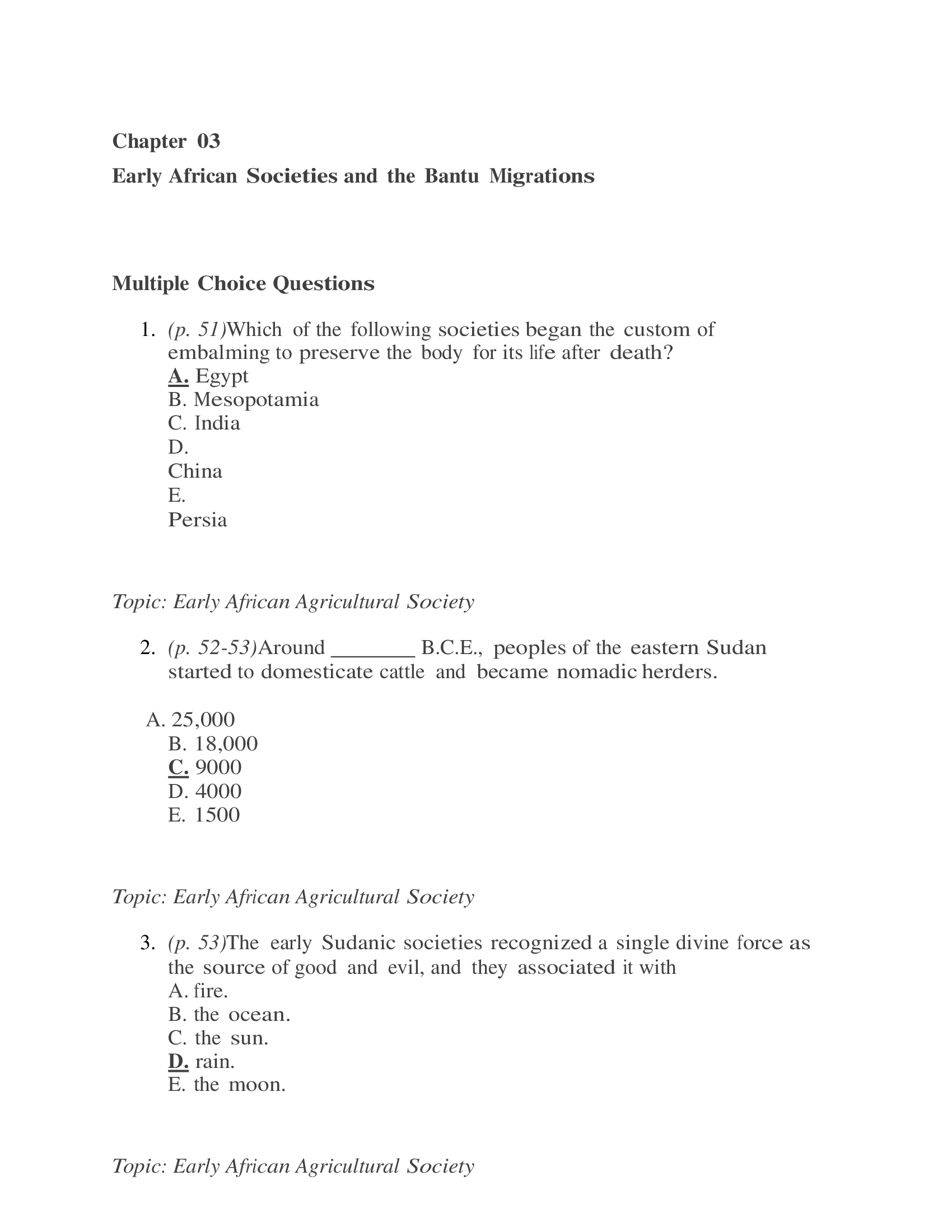
TEST BANK TRADITIONS AND ENCOUNTERS A GLOBAL PERSPECTIVE ON THE PAST 6TH EDITION BENTLEY Chapter 03 Early African Societies and the Bantu Migrations Multiple Choice Questions 1. (p. 51)Which of the following societies began the custom of embalming to preserve the body for its life after death? A. Egypt B. Mesopotamia C. India D. China E. Persia Topic: Early African Agricultural Society 2. (p. 52-53)Around B.C.E., peoples of the eastern Sudan started to domesticate cattle and became nomadic herders. A. 25,000 B. 18,000 C. 9000 D. 4000 E. 1500 Topic: Early African Agricultural Society 3. (p. 53)The early Sudanic societies recognized a single divine force as the source of good and evil, and they associated it with A. fire. B. the ocean. C. the sun. D. rain. E. the moon. Topic: Early African Agricultural Society 4. (p. 54)The Greek historian Herodotus used the phrase “the gift of the ” to describe Egypt. A. Indus B. Huang He C. Nile D. Tigris E. Issus Topic: Early African Agricultural Society 5. (p. 54)The earliest Egyptian and Nubian states were A. city-states. B. small kingdoms. C. centralized empires. D. trading networks. E. unified early because of the unique nature of the Tigris. Topic: Early African Agricultural Society 6. (p. 54)Tradition suggests that Egypt was united around 3100 B.C.E. by the conqueror A. Menes. B. Khufu. C. Sargon of Akkad. D. Hatshepsut. E. Hammurabi. Topic: Early African Agricultural Society 7. (p. 55)The largest Egyptian pyramids were built during the A. Middle Kingdom. B. Old Kingdom. C. New Kingdom. D. Archaic Period. E. Second Intermediary Period. Topic: Early African Agricultural Society 8. (p. 55)The pyramid of is the largest of all the pyramids. A. Sargon of Akkad B. Khufu C. Hyksos D. Menes E. Giza Topic: Early African Agricultural Society 9. (p. 55)The capital of the kingdom of Kush was A. Kerma. B. Axum. C. Memphis. D. Harappa. E. Harkhuf. Topic: Early African Agricultural Society 10. (p. 55)Harkhuf was A. the capital of Kush. B. the most powerful pharaoh of the Old Kingdom. C. an Egyptian explorer who visited Nubia. D. the largest Middle Kingdom pyramid. E. the first woman pharaoh. Topic: Early African Agricultural Society 11. (p. 57)Pharaohs in the New Kingdom were A. more powerful than pharaohs of the Old Kingdom. B. descended from a line of Babylonian kings. C. set on the throne by the Roman emperor Julius Caesar. D. more vigorous in their attempts to extend Egyptian authority beyond the Nile valley and delta. E. sacrificed at age thirty-two to insure a bountiful harvest. Topic: Early African Agricultural Society 12. (p. 54)Around 3100 B.C.E., the conqueror Menes founded , a city that would serve as the capital for early Egypt. A. Heliopolis B. Kerma C. Uruk D. Memphis E. Thebes Topic: Early African Agricultural Society 13. (p. 56)The Hyksos were A. nomads who eventually settled around the city of Babylon. B. horse-riding external invaders who eventually captured Memphis and levied tribute throughout Egypt. C. Mesopotamian kings. D. the priestly class in ancient Egypt. E. demons who punished the wicked in the Egyptian underworld. Topic: Early African Agricultural Society 14. (p. 56)Horse-drawn chariots and bronze weapons were introduced into Egypt by the A. Hyksos. B. Babylonians. C. Kushites. D. Harappans. E. Qin. Topic: Early African Agricultural Society 15. (p. 57)The most vigorous of all New Kingdom pharaohs was , who led his troops into Palestine and Syria and who even received tribute from the Mesopotamian city-states. A. Ahmose I B. Menes C. Sargon of Akkad D. Tuthmosis III E. Hatshepsut Topic: Early African Agricultural Society 16. (p. 57)The Egyptians were the most imperialistic during the A. First Intermediary Period. B. Archaic Period. C. New Kingdom. D. Old Kingdom. E. Middle Kingdom. Topic: Early African Agricultural Society 17. (p. 58)During the eighth century B.C.E., Egypt fell under the control of the for around a century. A. Persians B. Romans C. Greeks D. Babylonians E. Kushites Topic: Early African Agricultural Society 18. (p. 58)Around 760 B.C.E. the Kushite king Kashta A. ended the rule of Egypt by the pharaoh. B. founded a dynasty that ruled Egypt for around a hundred years. C. formed a long-lasting trading agreement with Egypt, marking their first contact. D. surrendered to Assyrian domination. E. surrendered to Egyptian domination. Topic: Early African Agricultural Society 19. (p. 59)In the mid-seventh century B.C.E. Egypt lost its independence and became a part of the A. Assyrian empire. B. Arabic empire. C. Persian empire. D. Roman empire. E. Harappan empire. Topic: Early African Agricultural Society 20. (p. 61)Hatshepsut was A. a Mesopotamian king of the gods. B. the Hebrew term for their god. C. the first conqueror to unite all of Mesopotamia. D. a woman who ruled Egypt as pharaoh. E. the most important early city of the Harappan society. Topic: Forming Societies and Cultural Traditions in Africa 21. (p. 61)In which of the following societies did women enjoy the most political influence? A. Mesopotamia B. Egypt C. Hyksos D. Assyria E. Sumer Topic: Forming Societies and Cultural Traditions in Africa 22. (p. 61)In Kush, A. the cities were much larger than they were in Egypt. B. woman’s only role was to serve as a slave. C. there were apparently never any female rulers. D. trade was officially restricted with Egypt. E. there is evidence of many female rulers. Topic: Forming Societies and Cultural Traditions in Africa 23. (p. 64)In Africa, iron metallurgy A. was introduced by Persian merchants. B. did not appear until after the rise of trans-Saharan trade. C. arose independently. D. began after an odd meeting between a Kushite king and the Egyptian explorer Harkhuf. E. was imported into the continent by trade with the Mesopotamians. Topic: Forming Societies and Cultural Traditions in Africa 24. (p. 66)The Egyptians traded through the Red Sea with a land they called Punt, which was probably A. Harappan India. B. Sri Lanka. C. modern-day Somalia. D. Assyria. E. modern-day Angola. Topic: Forming Societies and Cultural Traditions in Africa 25. (p. 66)The Greek words meaning “holy inscriptions” refer to A. hieroglyphs. B. cuneiform. C. the Old Testament. D. the Phoenician alphabet. E. the Coptic script. Topic: Forming Societies and Cultural Traditions in Africa 26. (p. 67)Meroitic writing A. has now been completely translated. B. expressed the general Egyptian optimism with life. C. was introduced into India by the Indo-Europeans. D. was a Nubian script that borrowed Egyptian hieroglyphs. E. cannot be read because it’s simply too different from its base cuneiform. Topic: Forming Societies and Cultural Traditions in Africa 27. (p. 67)The cult of Amon-Re A. was a failed monotheistic religion in Egypt. B. worshipped the god of the underworld. C. revered a combination of two gods associated with the sun. D. worshipped the Egyptian god of the desert. E. was borrowed by the Egyptians from Nubian sources. Topic: Forming Societies and Cultural Traditions in Africa 28. (p. 67)Which pharaoh tried, unsuccessfully, to transform Egypt into a monotheistic society? A. Menes B. Akhenaten C. Tuthmosis III D. Ahmose I E. Tuthmosis I Topic: Forming Societies and Cultural Traditions in Africa 29. (p. 67-68)The Egyptian god of the underworld was A. Amon-Re. B. Aten. C. Horus. D. Osiris. E. Ptah. Topic: Forming Societies and Cultural Traditions in Africa 30. (p. 68)Osiris judged whether or not souls were worthy of immortality A. by weighing their hearts against a feather symbolizing justice. B. through their completion of a journey full of tests. C. through the individual’s level of sincere faith in Osiris as a redeemer. D. by examining their holiness at the moment of their death. E. through their adherence to the code of Hammurabi. Topic: Forming Societies and Cultural Traditions in Africa 31. (p. 70)The Bantu originally came from around A. the Swahili area. B. modern-day Nigeria. C. far southern Africa. D. Egypt. E. modern-day Algeria. Topic: Bantu Migrations and Early Sub-Saharan Agricultural Societies 32. (p. 70)The tribes that, as early as 3000 B.C.E., began to spread their language and agricultural techniques throughout Africa were the A. Mali. B. Persians. C. Xiongnu. D. Kongo. E. Bantu. Topic: Bantu Migrations and Early Sub-Saharan Agricultural Societies 33. (p. 70)By spreading their language across a huge stretch of Africa, the Bantu played a role similar to that played by the A. Indo-Europeans. B. Mongols. C. Xiongnu. D. Visigoths. E. Babylonians. Topic: Bantu Migrations and Early Sub-Saharan Agricultural Societies 34. (p. 71)The Bantu probably began their migrations because of A. invasions from the Mediterranean basin. B. a conscious desire for conquest. C. the threat of epidemic disease. D. a desire to spread their monotheistic faith. E. population pressures. Topic: Bantu Migrations and Early Sub-Saharan Agricultural Societies True / False Questions 35. (p. 51)Mummification was the process by which Egyptians preserved bodies of deceased individuals. TRUE Topic: Early African Agricultural Society 36. (p. 66)The Egyptians supplemented their pictographs with symbols representing sounds and ideas; they were called hieroglyphs by the Greeks. TRUE Topic: Forming Societies and Cultural Traditions in Africa 37. (p. 57)The New Kingdom was a powerful Egyptian state created after the Hyksos were pushed out of power. TRUE Topic: Early African Agricultural Society 38. (p. 67)Osiris was the Egyptian god of the underworld. TRUE Topic: Forming Societies and Cultural Traditions in Africa 39. (p. 54)Menes is credited with unification of Egypt about 3100 B.C.E. He also founded the city of Memphis. TRUE Topic: Early African Agricultural Society 40. (p. 61)Queen Hatshepsut served as co-ruler with her stepson Tuthmosis III. TRUE Topic: Forming Societies and Cultural Traditions in Africa 41. (p. 55)Harkhuf was a Nubian trader who brought back exotic products from tropical Africa. FALSE Topic: Forming Societies and Cultural Traditions in Africa 42. (p. 67)Akhenaten was devoted to the Egyptian god Aten. This represented one of the world’s first expressions of monotheism. TRUE Topic: Forming Societies and Cultural Traditions in Africa 43. (p. 55)Kerma was the ancient capital of Nubia. FALSE Topic: Early African Agricultural Society 44. (p. 52)The Nile River links the Mediterranean basin to the north and sub-Saharan Africa to the south. TRUE Topic: Early African Agricultural Society Essay Questions 45. In The Great Hymn to Aten, the god Aten is referred to as “O Sole God beside whom there is none!” Why was this statement so revolutionary for the time? What were the foundations of Akhenaten’s beliefs? Were their other examples from the ancient world of monotheistic religions? Answers will vary Topic: Forming Societies and Cultural Traditions in Africa 46. What were the major achievements of the Egyptians? How did they influence later societies? Answers will vary Topic: Early African Agricultural Society Topic: Forming Societies and Cultural Traditions in Africa 47. What could the modern reader learn about the relationship between Egypt and Nubia by reading Harkhuf’s account of his journey to Nubia? What did the two societies have in common? Answers will vary Topic: Early African Agricultural Society 48. Examine the creation of early methods of writing. How did this innovation influence the lives of the peoples of the ancient world? Answers will vary Topic: Forming Societies and Cultural Traditions in Africa 49. Compare and contrast the worldviews of the Mesopotamians and Egyptians. What factors help to explain any differences? Answers will vary Topic: Early African Agricultural Society Topic: Forming Societies and Cultural Traditions in Africa 50. How influential were the societies of Nubia in the ancient world? In what ways were the Kushite kingdoms unique? Answers will vary Topic: Early African Agricultural Society Topic: Forming Societies and Cultural Traditions in Africa 51. Compare and contrast the religious beliefs of the Mesopotamians, Egyptians, and Hebrews. What do the differences tell us about these societies? Answers will vary Topic: Early African Agricultural Society Topic: Forming Societies and Cultural Traditions in Africa 52. Discuss the concept of an afterlife. Why did the Egyptians reach a complex understanding of this concept before the Mesopotamians? Does this mean that the Egyptians were morbid? Answers will vary Topic: Forming Societies and Cultural Traditions in Africa 53. In what ways do the pyramids express the worldview of the Egyptians? Answers will vary Topic: Early African Agricultural Society Topic: Forming Societies and Cultural Traditions in Africa 54. Trace the political history of the Egyptians. What were the major events and contributions of the Old and New Kingdoms? Answers will vary Topic: Early African Agricultural Society Topic: Forming Societies and Cultural Traditions in Africa 55. Compare the social structure of the Mesopotamians and Egyptians. What were the conditions for women like during this period? Answers will vary Topic: Early African Agricultural Society Topic: Forming Societies and Cultural Traditions in Africa 56. What role did technological innovations and trade play in the rise of the Egyptians? What innovations led to turning points in the history of Egypt? How widely did the Egyptians trade? Answers will vary Topic: Forming Societies and Cultural Traditions in Africa 57. Examine the illustration of Osiris on page 69. What does this ceremony tell us about the Egyptian view of death, morality, and the afterworld? Answers will vary Topic: Forming Societies and Cultural Traditions in Africa 58. What do the pyramids tell you about Egyptian political and religious views? Now look at the picture on page 60. What does it tell us about the social structure of Egyptian society? Answers will vary Topic: Early African Agricultural Society Topic: Forming Societies and Cultural Traditions in Africa 59. Describe the development of hieroglyphic and Meroitic writing and their influence on culture. Answers will vary Topic: Forming Societies and Cultural Traditions in Africa 60. How did climatic change influence the early development of African cultures? Answers will vary Topic: Early African Agricultural Society 61. How did the institution of the pharaoh evolve, and what was the nature of the pharaoh’s power through the Old Kingdom period? Answers will vary Topic: Early African Agricultural Society 62. Describe the early Kingdom of Kush. What was its relationship with Egypt like? Answers will vary Topic: Early African Agricultural Society 63. How did the invasion of the Hyksos influence the later development of Egypt? Answers will vary Topic: Early African Agricultural Society 64. In what ways was the New Kingdom period of Egypt different from the earlier ones? What were the relations with Kush like during this period? Answers will vary Topic: Early African Agricultural Society 65. What was society like in Egypt and Nubia in terms of both social classes and gender roles? Answers will vary Topic: Forming Societies and Cultural Traditions in Africa 66. What kind of transportation systems did the Egyptians use, and how did their transportation influence the development of their trade networks? Answers will vary Topic: Forming Societies and Cultural Traditions in Africa 67. What was the societal structure of the early Bantu speakers, and how did they approach food acquisition? Answers will vary Topic: Bantu Migrations and Early Sub-Saharan Agricultural Societies 68. How did the Bantu migrations influence the development of the societies of sub-Saharan Africa? Answers will vary Topic: Bantu Migrations and Early Sub-Saharan Agricultural Societies 69. How did the development of iron tools change the nature of the Bantu migrations and their impact? Answers will vary Topic: Bantu Migrations and Early Sub-Saharan Agricultural Societies 70. Describe the religious beliefs of the Bantu peoples and compare them to those of the Egyptians. Answers will vary Topic: Bantu Migrations and Early Sub-Saharan Agricultural Societies Chapter 05 Early Society in Mainland East Asia Multiple Choice Questions 1. (p. 91)The legendary founder of the Xia dynasty, who constructed dikes and dams and organized flood control projects, was A. Confucius. B. Erlitou. C. King Yu. D. Prince Wu. E. Prince Shun. Topic: Early Chinese Political Organization 2. (p. 91)The legendary early Chinese sage-king who ordered the four seasons and who established uniform weights, measures, and units of time was A. Qin Shihuangdi. B. Shun. C. Confucius. D. Yu. E. Moksha. Topic: Early Chinese Political Organization 3. (p. 92)Groups of Homo erectus made their appearance in east Asia A. more than one million years ago. B. about five hundred thousand years ago. C. eight hundred thousand years ago. D. around fifty thousand years ago. E. ten thousand years ago. Topic: Early Chinese Political Organization 4. (p. 92)Which river takes its name from its light-colored loess soil? A. Yangzi B. Xi Jiang C. Chengdu D. Meking E. Huang He Topic: Early Chinese Political Organization 5. (p. 92)The Huang He River was given the nickname A. China’s Sorrow. B. Mandate of Heaven. C. China’s Father. D. Yellow Terror. E. Old Man. Topic: Early Chinese Political Organization 6. (p. 92)Which of the following was true of the Yellow River in China? A. The region around the Yellow River was unworkable for agriculture until metal tools were developed. B. The course of the Yellow River has remained remarkably table for the last ten thousand years. C. It provides for stable agriculture because it rarely floods. D. It’s soil is extremely fertile and easy to work. E. The unpredictable nature of the river prevented organized society until 2500 B.C.E. Topic: Early Chinese Political Organization 7. (p. 93)Which neolithic society flourished in China between 5000 and 3000 B.C.E.? A. Xia B. Yangshao C. Shang D. Zhou E. Yu Topic: Early Chinese Political Organization 8. (p. 93)The most important archaeological site from the neolithic Yangshao culture is A. Banpo. B. Huang He. C. Xia. D. Ao. E. Shun. Topic: Early Chinese Political Organization 9. (p. 93-96)Which of the following answers is correct chronologically? A. Xia, Zhou, Shang, Qin B. Shang, Yangshao, Xia, Zhou C. Yangshao, Xia, Shang, Zhou D. Yangshao, Shang, Xia, Zhou E. Zhou, Shang, Yangshao, Xia Topic: Early Chinese Political Organization 10. (p. 93)The first attempt to organize public life in China on a large scale occurred during the A. Shang dynasty. B. Yangshao culture. C. Xia dynasty. D. Zhou dynasty. E. Banpo period. Topic: Early Chinese Political Organization 11. (p. 93)The capital of the Xia dynasty may have been A. Ao. B. Banpo. C. Beijing. D. Erlitou. E. Mohenjo-daro. Topic: Early Chinese Political Organization 12. (p. 93-94)The Shang rulers were strengthened by their control over the technological advantage of A. iron. B. bronze. C. tin. D. copper. E. steel. Topic: Early Chinese Political Organization 13. (p. 94)Along with bronze weapons, the Shang nobles used to devastating effect against their opponents. A. the bronze axe B. the bow and arrow C. long pikes D. spear-throwers E. chariots Topic: Early Chinese Political Organization 14. (p. 94)The Shang enjoyed a military advantage with armies as large as A. two thousand troops. B. eight thousand troops. C. thirteen thousand troops. D. forty-two thousand troops. E. one-hundred thousand troops. Topic: Early Chinese Political Organization 15. (p. 95)Ao was an important early capital of the dynasty. A. Qin B. Xia C. Zhou D. Shang E. Harappan Topic: Early Chinese Political Organization 16. (p. 95)The last capital of the Shang dynasty, which featured lavish tombs for the kings, was A. Yin. B. Beijing. C. Erlitou. D. Banpo. E. Shun. Topic: Early Chinese Political Organization 17. (p. 97)Which dynasty laid the foundation for principles of government and political legitimacy? A. Xia B. Zhou C. Shang D. Qin E. Yangshao Topic: Early Chinese Political Organization 18. (p. 97)The mandate of heaven A. gave the Chinese emperors unlimited power. B. created the notion of the Chinese emperors as gods. C. positioned China as a theocracy ruled by priests. D. allowed the ruler to serve as a link between the heavens and the earth. E. originated with the Indo-Europeans before they reached China. Topic: Early Chinese Political Organization 19. (p. 97)Because of the immense size of the Zhou state, its emperors were forced to A. rely on a decentralized system of government. B. rule through the use of incredible terror. C. establish a rule based on the accepted divinity of the ruler. D. bring in troops from their Indian allies. E. practice a rudimentary form of democracy. Topic: Early Chinese Political Organization 20. (p. 97)One of the reasons for the eventual collapse of the Zhou dynasty was the inability of its emperors to control the production of A. bronze. B. iron. C. tin. D. copper. E. steel. Topic: Early Chinese Political Organization 21. (p. 98)The “Period of the Warring States” refers to the A. early war between China and India. B. conquest of later Shang emperors by the rising Zhou military forces. C. chaotic last centuries of the Zhou dynasty. D. period of disunity before Xia unification. E. political disunity during the Qin dynasty. Topic: Early Chinese Political Organization 22. (p. 101)In ancient China, which group presided at the rites and ceremonies honoring ancestors’ spirits? A. members of the official priesthood B. women represented the nurturing earth goddess C. the Buddhist hierarchy D. the patriarchal heads of the families E. Shinto priests Topic: Ancient Chinese Family and Society

Contact the Seller

Please Sign In to contact this seller.


  • 👎  Report Copyright Violation

Frequently Asked Questions

What Do I Get When I Buy This Study Material?

+

When you buy a study material on Passing Grades, an instant download link will be sent directly to your email, giving you access to the file anytime after payment is completed.

Is Passing Grades a Trusted Platform?

+

Yes, Passing Grades is a reputable students’ marketplace with a secure payment system and reliable customer support. You can trust us to ensure a safe and seamless transaction experience.

Will I Be Stuck with a Subscription?

+

No, all purchases on Passing Grades are one-time transactions. You only pay for the notes you choose to buy, with no subscriptions or hidden fees attached.

Who Am I Buying These Study Materials From?

+

Passing Grades is a marketplace, which means you are purchasing the document from an individual vendor, not directly from us. We facilitate the payment and delivery process between you and the vendor.

Does Passing Grades Offer Free Study Materials?

+

Yes, sellers on Passing Grades have uploaded numerous free test banks, exams, practice questions, and class notes that can be downloaded at no cost.

Pasinggrades - Quality Study Materials

USD 15

    • Quality checked by Pasing Grades
    • 100% satisfaction guarantee
    • Seller: Namwaki
Buy PDF $15

Seller Information

Namwaki

Member since April 2021

  • icon
  • icon
  • icon
View Profile
  • total sales

    0
  • Favourites

    0
  • Comments

    0
    ( 0 Ratings )

Item Information

  • Uploaded

    25 September 2023

  • Updated

    17 April 2025

  • Category

    General

  • Item Type

    test bank

  • Tags

    Test Bank Traditions and Encounters A Global Perspective on the Past 6th Edition Bentley

Related Exam Prep Guides by Namwaki

Sophia Finance Milestone Final_Complete Questions and Answers 2021.
View Document

Sophia Finance Miles...

  • Namwaki

    Namwaki

  • test bank

Sophia Finance Milestone Final_Complete Questions and Answers 2021...

15 USD

0

0

Medical Parasitology 7th Edition Leventhal Test Bank
View Document

Medical Parasitology...

  • Namwaki

    Namwaki

  • test bank

Medical Parasitology 7th Edition Leventhal Test Bank...

15 USD

0

0

TEST- BANK FOR WONGS NURSING CARE OF INFANTS AND CHILDREN 11TH EDITION HOCKENBERRY
View Document

TEST- BANK FOR WONGS...

  • Namwaki

    Namwaki

  • test bank

TEST- BANK FOR WONGS NURSING CARE OF INFANTS AND CHILDREN 11TH EDITION HOCKENBERRY – Download PDF...

15 USD

0

0

Purchase

Download link will be sent to this email immediately after purchase.

IMPORTANT LINKS

  • How To Upload Class Notes
  • Selling Tips
  • Passing Grades's Study Materials
  • Scholarships for International Students 2025

POPULAR CATEGORIES

  • Law
  • Accounting
  • English
  • Psychology
  • Business
  • Nursing
  • Computer Science
  • General

View Document

  • Blog
  • Contact
  • Delivery Policy
  • Latest Scholarships Around the World
  • How to Pass Bar Exams: Passing Grades’ Strategies
  • How to Study and Pass the CPA Exam
  • All Test Banks
  • Faq
  • Copyright Claims
  • Privacy Policy
  • Terms of Use

KNOWLEDGE BASE

  • How to Write A+ Grade Good Research Paper
  • How to Manage Stress During Exam Period
  • Best Time to Study
  • How to Pass NCLEX-RN Exam
  • How To Effectively Utilize Test Banks
  • Popular Shadow Health Exam Assessments
  • Popular HESI Case Studies
  • How to Prepare for a Nursing Career
  • The Importance Of Summaries in Exam Revisvion

© 2026 Pasing Grades. All rights reserved.