Pasing Grades
  • Start Selling
  • Blog
  • Contact
  • 0

    Your cart is empty!

English

  • English
  • Spanish
  • Arabic
Create Account Sign In
  • Library
    • New Prep Guides
    • Featured Prep Guides
    • Free Exam Prep Guides
    • Best sellers
  • General
  • Nursing
    • Research Paper
    • Case Study
    • Discussion Post
    • Assignment
    • Exam
    • Practice Questions and Answers
    • Test Bank
    • solutions manual
  • Accounting
    • Case Study
    • Thesis
    • Study Guide
    • Summary
    • Research Paper
    • test bank
  • English
    • Creative Writing
    • Research Paper
    • Summary
    • Rhetorics
    • Literature
    • Journal
    • Exam
    • Grammar
    • Discussion Post
    • Essay
  • Psychology
    • Hesi
    • Presentation
    • Essay
    • Summary
    • Study Guide
    • Essay
    • Solution Manual
    • Final Exam Review
    • Class Notes
    • test bank
  • Business
    • Lecture Notes
    • Solution Manual
    • Presentation
    • Business Plan
    • Class Notes
    • Experiment
    • Summary
    • Practice Questions
    • Study Guide
    • Case Study
    • test bank
    • Exam
  • More
    • Computer Science
    • Economics
    • Statistics
    • Engineering
    • Biology
    • Religious Studies
    • Physics
    • Chemistry
    • Mathematics
    • History
    • Sociology
    • Science
    • Philosophy
    • Law
  • Pages
    • About Us
    • Selling Tips
    • Delivery Policy
    • Faq
    • Privacy Policy
  • Flash Sale
  • Home
  • Test Bank for Wheeler’s Dental Anatomy Physiology and Occlusion, 9th Edition, Stanley Nelson

Test Bank for Wheeler’s Dental Anatomy Physiology and Occlusion, 9th Edition, Stanley Nelson

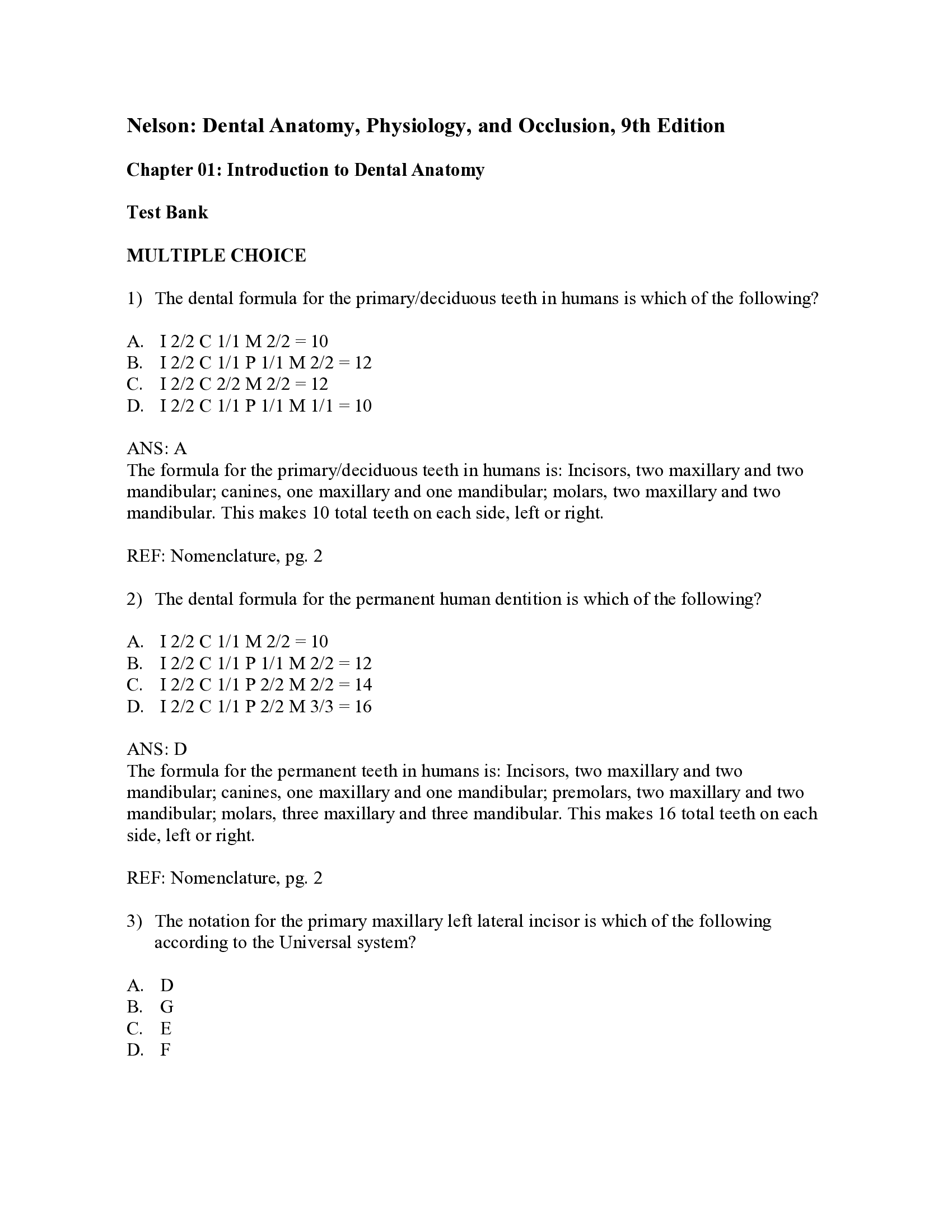
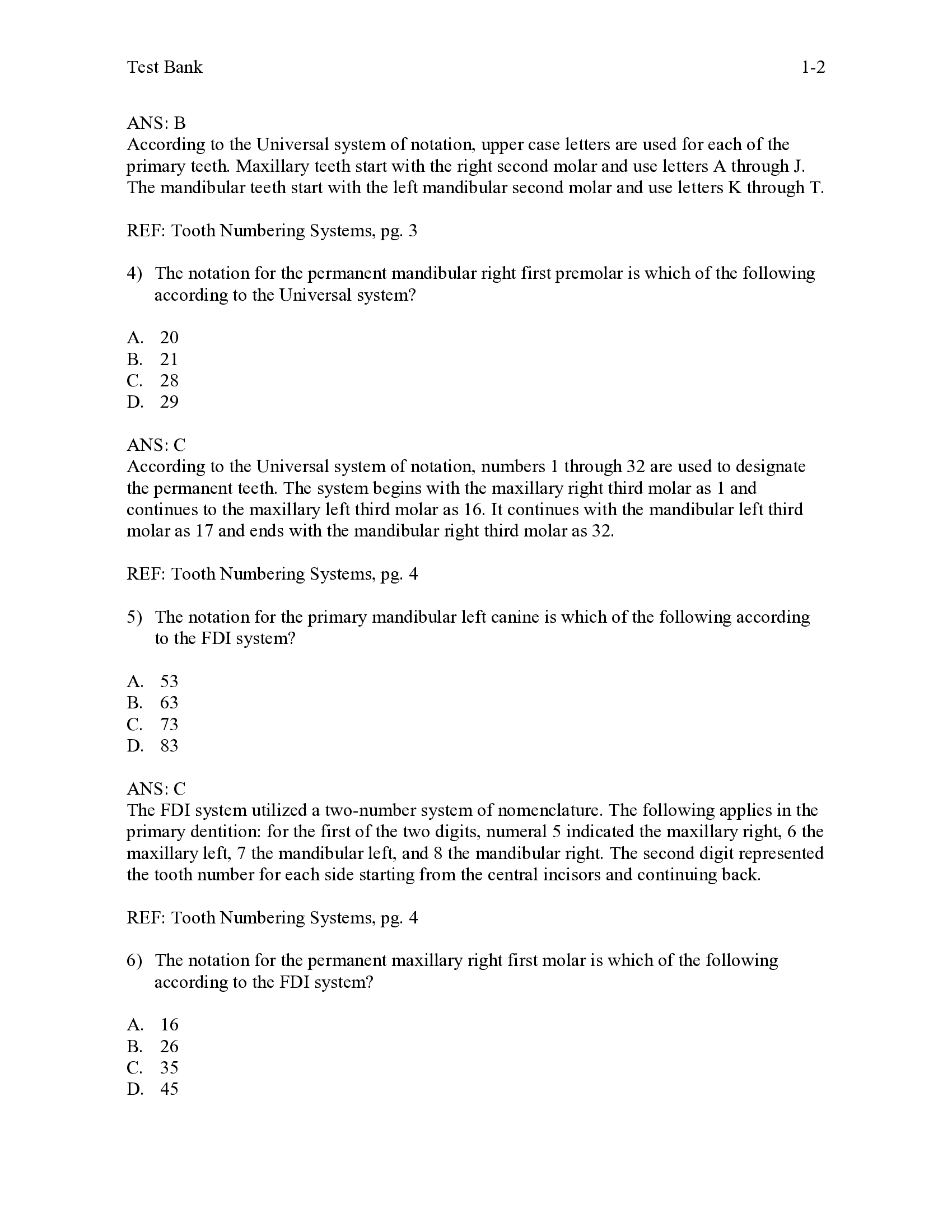
Preview page 1 Preview page 2 Preview page 3
Add To Favorites

Share this item Share this item

  • Item Details
  • Comments (0)
  • Reviews (0)
  • Contact Seller
Test Bank for Wheeler’s Dental Anatomy Physiology and Occlusion, 9th Edition, Stanley Nelson Nelson: Dental Anatomy, Physiology, and Occlusion, 9th Edition Chapter 01: Introduction to Dental Anatomy Test Bank MULTIPLE CHOICE 1) The dental formula for the primary/deciduous teeth in humans is which of the following? A. I 2/2 C 1/1 M 2/2 = 10 B. I 2/2 C 1/1 P 1/1 M 2/2 = 12 C. I 2/2 C 2/2 M 2/2 = 12 D. I 2/2 C 1/1 P 1/1 M 1/1 = 10 ANS: A The formula for the primary/deciduous teeth in humans is: Incisors, two maxillary and two mandibular; canines, one maxillary and one mandibular; molars, two maxillary and two mandibular. This makes 10 total teeth on each side, left or right. REF: Nomenclature, pg. 2 2) The dental formula for the permanent human dentition is which of the following? A. I 2/2 C 1/1 M 2/2 = 10 B. I 2/2 C 1/1 P 1/1 M 2/2 = 12 C. I 2/2 C 1/1 P 2/2 M 2/2 = 14 D. I 2/2 C 1/1 P 2/2 M 3/3 = 16 ANS: D The formula for the permanent teeth in humans is: Incisors, two maxillary and two mandibular; canines, one maxillary and one mandibular; premolars, two maxillary and two mandibular; molars, three maxillary and three mandibular. This makes 16 total teeth on each side, left or right. REF: Nomenclature, pg. 2 3) The notation for the primary maxillary left lateral incisor is which of the following according to the Universal system? A. D B. G C. E D. F Test Bank 1-2 ANS: B According to the Universal system of notation, upper case letters are used for each of the primary teeth. Maxillary teeth start with the right second molar and use letters A through J. The mandibular teeth start with the left mandibular second molar and use letters K through T. REF: Tooth Numbering Systems, pg. 3 4) The notation for the permanent mandibular right first premolar is which of the following according to the Universal system? A. 20 B. 21 C. 28 D. 29 ANS: C According to the Universal system of notation, numbers 1 through 32 are used to designate the permanent teeth. The system begins with the maxillary right third molar as 1 and continues to the maxillary left third molar as 16. It continues with the mandibular left third molar as 17 and ends with the mandibular right third molar as 32. REF: Tooth Numbering Systems, pg. 4 5) The notation for the primary mandibular left canine is which of the following according to the FDI system? A. 53 B. 63 C. 73 D. 83 ANS: C The FDI system utilized a two-number system of nomenclature. The following applies in the primary dentition: for the first of the two digits, numeral 5 indicated the maxillary right, 6 the maxillary left, 7 the mandibular left, and 8 the mandibular right. The second digit represented the tooth number for each side starting from the central incisors and continuing back. REF: Tooth Numbering Systems, pg. 4 6) The notation for the permanent maxillary right first molar is which of the following according to the FDI system? A. 16 B. 26 C. 35 D. 45 Test Bank 1-3 ANS: A The FDI system utilized a two-number system of nomenclature. The following applies in the permanent dentition: for the first of the two digits, numeral 1 indicated the maxillary right, 2 the maxillary left, 3 the mandibular left, and 4 the mandibular right. The second digit represented the tooth number for each side starting from the central incisors and continuing back. REF: Tooth Numbering Systems, pg. 4 7) Which of the following tissues found in teeth is responsible for furnishing blood and nerve supply to the tooth? A. Enamel B. Cementum C. Dentin D. Pulp ANS: D Answers A, B, and C are known as “hard” tissues. Pulp is the only “soft” tissue that comprises tooth structure. It is responsible for blood and nerve supply to the tooth. REF: The Crown and Root, pg. 4 8) Which of the following represents the name of the bone of the tooth socket that firmly fixes each tooth root? A. Alveolar process B. Alveolus C. Cementoenamel junction D. Dentinoenamel junction ANS: B The alveolar process is the portion of the jaw supporting the teeth. The cementoenamel junction and dentinoenamel junction are both areas of the tooth itself where two different tissues join. The alveolus specifically refers to the bone of the tooth socket. REF: The Crown and Root, pg. 5 9) Which of the following terms represents the surface of a tooth that is facing toward an adjoining tooth in the same dental arch? A. Occlusal B. Incisal C. Facial D. Proximal Test Bank 1-4 ANS: D The occlusal and incisal surfaces are those that come in contact with those in the opposite jaw during the act of closure in the molar and premolars, and the incisors and canines, respectively. The facial surface is the collective term used for tooth surfaces that face the cheeks and lips. REF: Surfaces and Ridges, pg. 6 10) Which of the following pairs of teeth have mesial surfaces that touch each other (Universal system)? A. 7 and 8 B. 8 and 9 C. 22 and 23 D. 25 and 26 ANS: B Only four teeth have mesial surfaces that contact each other, the maxillary and mandibular central incisors. Teeth number 8 and 9 are maxillary central incisors. REF: Surfaces and Ridges, pg. 6 11) Which of the following is considered a “posterior” tooth? A. Central incisor B. Canine C. First premolar D. Lateral incisor ANS: C Premolars and molars are grouped as posterior teeth; central and lateral incisors and canines are grouped as anterior teeth. REF: Surfaces and Ridges, pg. 6 12) A _____ is the lingual lobe of an anterior tooth. A. Cingulum B. Cusp C. Tubercle D. Marginal ridge ANS: A A cingulum is the lingual lobe of an anterior tooth. A cusp is an elevation or mound on the crown portion of a tooth making up a divisional part of the occlusal surface. A tubercle is a smaller elevation on some portion of the crown produced by an extra formation of enamel. Test Bank Marginal ridges are rounded boarders of the enamel that form the mesial and distal margins of the occlusal surfaces of premolars and molars and lingual surfaces of incisors and canines. REF: Other Landmarks, pg. 7 13) __________ descend from the tips of the cusps of molars and premolars toward the central part of the occlusal surfaces. A. Marginal ridges B. Triangular ridges C. Oblique ridges D. Developmental grooves ANS: B Triangular ridges descend from the tips of the cusps of molars and premolars toward the central part of the occlusal surfaces. Marginal ridges are rounded boarders of the enamel that form the mesial and distal margins of the occlusal surfaces of premolars and molars and lingual surfaces of incisors and canines. Oblique ridges cross obliquely from the triangular ridge of the distobuccal cusp and the distal cusp ridge of the mesiolingual cusp of maxillary first molars. Developmental grooves are shallow grooves or lines between the primary parts of the crown or root. REF: Other Landmarks, pg. 8 14) __________ cross from the triangular ridge of the distobuccal cusp and the distal cusp ridge of the mesiolingual cusp of maxillary first molars. A. Marginal ridges B. Triangular ridges C. Oblique ridges D. Developmental grooves ANS: C Oblique ridges cross obliquely from the triangular ridge of the distobuccal cusp and the distal cusp ridge of the mesiolingual cusp of maxillary first molars. Triangular ridges descend from the tips of the cusps of molars and premolars toward the central part of the occlusal surfaces. Marginal ridges are rounded boarders of the enamel that form the mesial and distal margins of the occlusal surfaces of premolars and molars and lingual surfaces of incisors and canines. Developmental grooves are shallow grooves or lines between the primary parts of the crown or root. REF: Other Landmarks, pg. 8 15) A _________ is a pinpoint depression located at the junction of developmental grooves. A. Pit 1-5 Test Bank B. Fossa C. Sulcus D. Cusp ANS: A Pits are small, pinpoint depressions located at the junction of developmental grooves or at terminals of those grooves. A fossa is an irregular depression or cavity. A sulcus is a long depression or valley in the surface of a tooth between ridges and cusps. A cusp is an elevation or mound on the crown portion of a tooth. REF: Other Landmarks, pg. 9 16) A __________ is any one of the three rounded protuberances found on the incisal ridges of newly erupted incisor teeth. A. Lobe B. Mamelon C. Cusp D. Supplemental groove ANS: B A mamelon is specifically any one of the three rounded protuberances on a newly erupted incisor. A lobe is one of the primary sections of formation in the development of the crown. Cusps are elevations or mounds on the crown portion of canines or posterior teeth. A supplemental groove is a shallow linear depression on the surface of a tooth. REF: Other Landmarks, pg. 9 17) Which of the following is formed by the junction of two surfaces and derives its name from the combination of the two surfaces that join? A. Line angle B. Point angle C. Sulcus D. Marginal ridge ANS: A A line angle forms from the junction of two surfaces. A point angle is formed by the junction of three surfaces. A sulcus is a long depression or valley in the surface of a tooth between ridges and cusps. Marginal ridges are rounded boarders of the enamel that form the mesial and distal margins of the occlusal surfaces of premolars and molars and lingual surfaces of incisors and canines. REF: Division into Thirds, Line Angles and Point Angles, pg. 9 1-6 Test Bank 18) Which of the following is formed by the junction of three surfaces and derives its name from the combination of the three surfaces that join? A. Line angle B. Point angle C. Sulcus D. Marginal ridge ANS: B A point angle is formed by the junction of three surfaces. A line angle forms from the junction of two surfaces. A sulcus is a long depression or valley in the surface of a tooth between ridges and cusps. Marginal ridges are rounded boarders of the enamel that form the mesial and distal margins of the occlusal surfaces of premolars and molars and lingual surfaces of incisors and canines. REF: Division into Thirds, Line Angles and Point Angles, pg. 10 19) Which of the following is not a line angle of the anterior teeth? A. Mesiolabial B. Distolingual C. Distolabial D. Disto-occlusal ANS: D The disto-occlusal is a line angle of posterior teeth. All of the other choices are line angles found on anterior teeth. REF: Division into Thirds, Line Angles, and Point Angles, pg. 10 20) Which of the following is a point angle of the posterior teeth? A. Mesiolabioincisal B. Distolinguoincisal C. Distobucco-occlusal D. Disto-occlusal ANS: C The distobucco-occlusal is a point angle of posterior teeth. Mesiolabioincisal and distolinguoincisal are point angles of anterior teeth. Disto-occlusal is a line angle of posterior teeth. REF: Division into Thirds, Line Angles, and Point Angles, pg. 10 1-7

Contact the Seller

Please Sign In to contact this seller.


  • 👎  Report Copyright Violation

Frequently Asked Questions

What Do I Get When I Buy This Study Material?

+

When you buy a study material on Passing Grades, an instant download link will be sent directly to your email, giving you access to the file anytime after payment is completed.

Is Passing Grades a Trusted Platform?

+

Yes, Passing Grades is a reputable students’ marketplace with a secure payment system and reliable customer support. You can trust us to ensure a safe and seamless transaction experience.

Will I Be Stuck with a Subscription?

+

No, all purchases on Passing Grades are one-time transactions. You only pay for the notes you choose to buy, with no subscriptions or hidden fees attached.

Who Am I Buying These Study Materials From?

+

Passing Grades is a marketplace, which means you are purchasing the document from an individual vendor, not directly from us. We facilitate the payment and delivery process between you and the vendor.

Does Passing Grades Offer Free Study Materials?

+

Yes, sellers on Passing Grades have uploaded numerous free test banks, exams, practice questions, and class notes that can be downloaded at no cost.

Pasinggrades - Quality Study Materials

USD 15

    • Quality checked by Pasing Grades
    • 100% satisfaction guarantee
    • Seller: Pasing-Grades
Buy PDF $15

Seller Information

Pasing-Grades

Member since May 2021

  • icon
View Profile
  • total sales

    0
  • Favourites

    0
  • Comments

    0
    ( 0 Ratings )

Item Information

  • Uploaded

    28 August 2023

  • Updated

    01 October 2025

  • Category

    No category

  • Item Type

    test bank

  • Tags

    Test Bank for Wheeler’s Dental Anatomy Physiology and Occlusion 9th Edition Stanley Nelson

Related Exam Prep Guides by Pasing-Grades

Understanding Anatomy and Physiology; A Visual, Auditory, Interactive Approach by Gale. S. Thompson
View Document

Understanding Anatom...

  • Pasing-Grades

    Pasing-Grades

  • test bank

Third Edition: Understanding Anatomy and Physiology; A Visual, Auditory, Interactive Approach by Gal...

15 USD

0

0

Workbook to Accompany Understanding Anatomy & Physiology: A Visual, Auditory, Interactive Approach by Gale Sloan Thompson RN
View Document

Workbook to Accompan...

  • Pasing-Grades

    Pasing-Grades

  • test bank

Workbook to Accompany Understanding Anatomy & Physiology: A Visual, Auditory, Interactive Approach b...

15 USD

0

0

Test Bank for Fundamentals of Nursing 10th Edition by Taylor
View Document

Test Bank for Fundam...

  • Pasing-Grades

    Pasing-Grades

  • test bank

Get now the Test Bank for Fundamentals of Nursing 10th Edition by Taylor. Instant PDF Download....

15 USD

0

0

Purchase

Download link will be sent to this email immediately after purchase.

IMPORTANT LINKS

  • How To Upload Class Notes
  • Selling Tips
  • Passing Grades's Study Materials
  • Scholarships for International Students 2025

POPULAR CATEGORIES

  • Law
  • Accounting
  • English
  • Psychology
  • Business
  • Nursing
  • Computer Science
  • General

View Document

  • Blog
  • Contact
  • Delivery Policy
  • Latest Scholarships Around the World
  • How to Pass Bar Exams: Passing Grades’ Strategies
  • How to Study and Pass the CPA Exam
  • All Test Banks
  • Faq
  • Copyright Claims
  • Privacy Policy
  • Terms of Use

KNOWLEDGE BASE

  • How to Write A+ Grade Good Research Paper
  • How to Manage Stress During Exam Period
  • Best Time to Study
  • How to Pass NCLEX-RN Exam
  • How To Effectively Utilize Test Banks
  • Popular Shadow Health Exam Assessments
  • Popular HESI Case Studies
  • How to Prepare for a Nursing Career
  • The Importance Of Summaries in Exam Revisvion

© 2026 Pasing Grades. All rights reserved.