Pasing Grades
  • Start Selling
  • Blog
  • Contact
  • 0

    Your cart is empty!

English

  • English
  • Spanish
  • Arabic
Create Account Sign In
  • Library
    • New Prep Guides
    • Featured Prep Guides
    • Free Exam Prep Guides
    • Best sellers
  • General
  • Nursing
    • Research Paper
    • Case Study
    • Discussion Post
    • Assignment
    • Exam
    • Practice Questions and Answers
    • Test Bank
    • solutions manual
  • Accounting
    • Case Study
    • Thesis
    • Study Guide
    • Summary
    • Research Paper
    • test bank
  • English
    • Creative Writing
    • Research Paper
    • Summary
    • Rhetorics
    • Literature
    • Journal
    • Exam
    • Grammar
    • Discussion Post
    • Essay
  • Psychology
    • Hesi
    • Presentation
    • Essay
    • Summary
    • Study Guide
    • Essay
    • Solution Manual
    • Final Exam Review
    • Class Notes
    • test bank
  • Business
    • Lecture Notes
    • Solution Manual
    • Presentation
    • Business Plan
    • Class Notes
    • Experiment
    • Summary
    • Practice Questions
    • Study Guide
    • Case Study
    • test bank
    • Exam
  • More
    • Computer Science
    • Economics
    • Statistics
    • Engineering
    • Biology
    • Religious Studies
    • Physics
    • Chemistry
    • Mathematics
    • History
    • Sociology
    • Science
    • Philosophy
    • Law
  • Pages
    • About Us
    • Selling Tips
    • Delivery Policy
    • Faq
    • Privacy Policy
  • Flash Sale
  • Home
  • Test Bank for Vander’s Human Physiology, 16th Edition, Eric Widmaier, Hershel Raff, Kevin Strang

Test Bank for Vander’s Human Physiology, 16th Edition, Eric Widmaier, Hershel Raff, Kevin Strang

Preview page 1 Preview page 2 Preview page 3
Add To Favorites

Share this item Share this item

  • Item Details
  • Comments (0)
  • Reviews (0)
  • Contact Seller

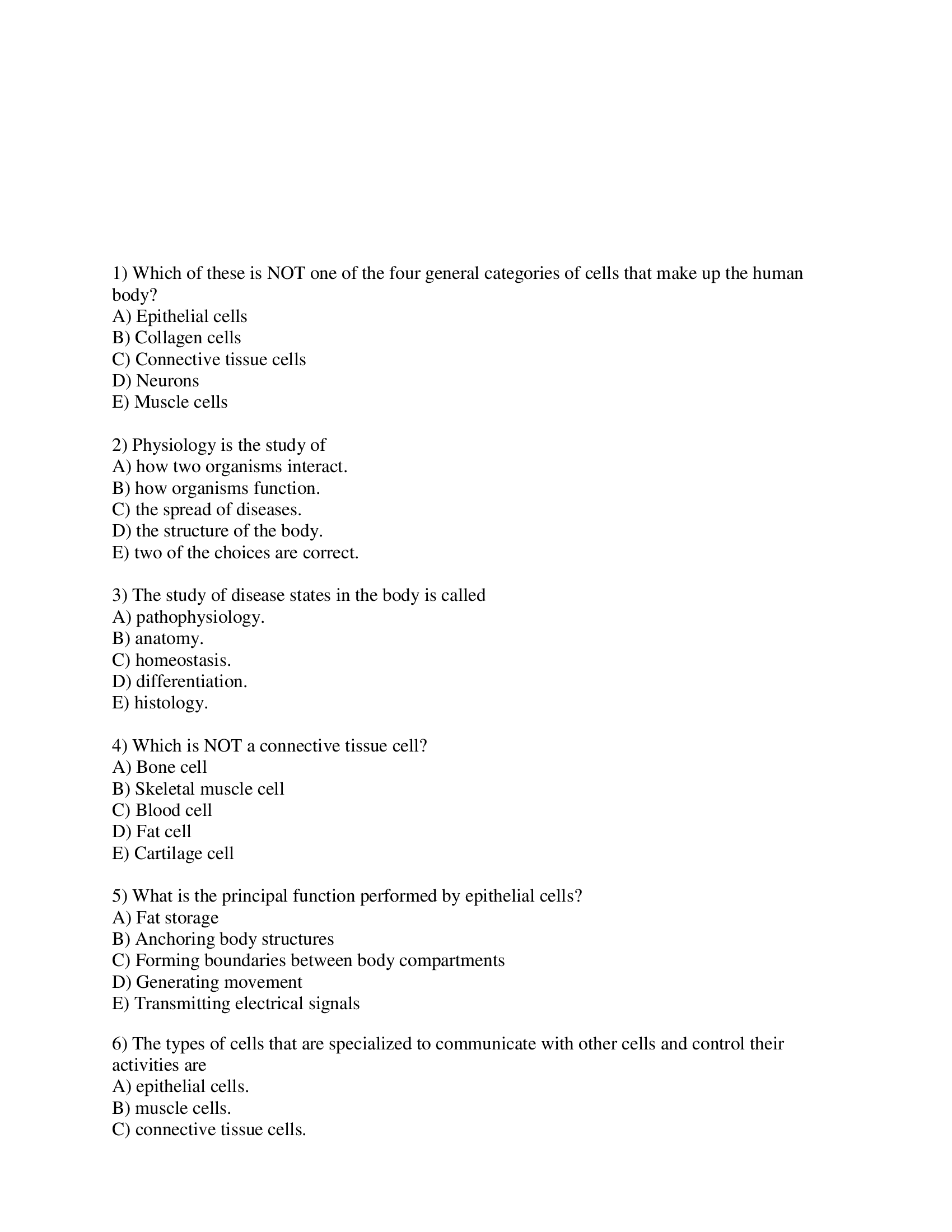
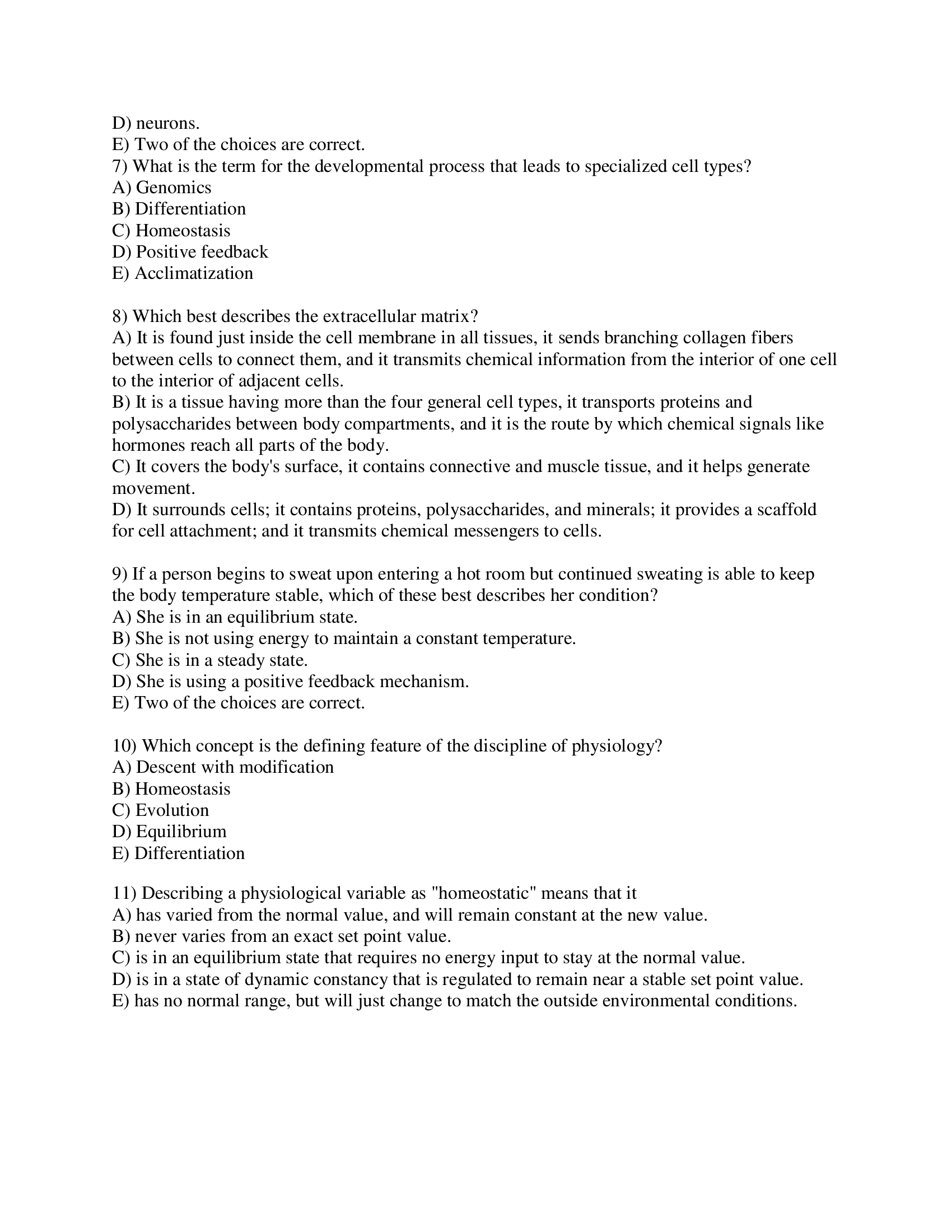
Test Bank for Vander’s Human Physiology, 16th Edition, Eric Widmaier, Hershel Raff, Kevin Strang 1) Which of these is NOT one of the four general categories of cells that make up the human body? A) Epithelial cells B) Collagen cells C) Connective tissue cells D) Neurons E) Muscle cells 2) Physiology is the study of A) how two organisms interact. B) how organisms function. C) the spread of diseases. D) the structure of the body. E) two of the choices are correct. 3) The study of disease states in the body is called A) pathophysiology. B) anatomy. C) homeostasis. D) differentiation. E) histology. 4) Which is NOT a connective tissue cell? A) Bone cell B) Skeletal muscle cell C) Blood cell D) Fat cell E) Cartilage cell 5) What is the principal function performed by epithelial cells? A) Fat storage B) Anchoring body structures C) Forming boundaries between body compartments D) Generating movement E) Transmitting electrical signals 6) The types of cells that are specialized to communicate with other cells and control their activities are A) epithelial cells. B) muscle cells. C) connective tissue cells. D) neurons. E) Two of the choices are correct. 7) What is the term for the developmental process that leads to specialized cell types? A) Genomics B) Differentiation C) Homeostasis D) Positive feedback E) Acclimatization 8) Which best describes the extracellular matrix? A) It is found just inside the cell membrane in all tissues, it sends branching collagen fibers between cells to connect them, and it transmits chemical information from the interior of one cell to the interior of adjacent cells. B) It is a tissue having more than the four general cell types, it transports proteins and polysaccharides between body compartments, and it is the route by which chemical signals like hormones reach all parts of the body. C) It covers the body's surface, it contains connective and muscle tissue, and it helps generate movement. D) It surrounds cells; it contains proteins, polysaccharides, and minerals; it provides a scaffold for cell attachment; and it transmits chemical messengers to cells. 9) If a person begins to sweat upon entering a hot room but continued sweating is able to keep the body temperature stable, which of these best describes her condition? A) She is in an equilibrium state. B) She is not using energy to maintain a constant temperature. C) She is in a steady state. D) She is using a positive feedback mechanism. E) Two of the choices are correct. 10) Which concept is the defining feature of the discipline of physiology? A) Descent with modification B) Homeostasis C) Evolution D) Equilibrium E) Differentiation 11) Describing a physiological variable as "homeostatic" means that it A) has varied from the normal value, and will remain constant at the new value. B) never varies from an exact set point value. C) is in an equilibrium state that requires no energy input to stay at the normal value. D) is in a state of dynamic constancy that is regulated to remain near a stable set point value. E) has no normal range, but will just change to match the outside environmental conditions. 12) Which of the following situations best represents a homeostatic mechanism? A) A person who becomes very nervous begins to sweat profusely. B) After going outside on a hot day, the core body temperature increases. C) Increasing the size of fast-food restaurant portions causes body weight to increase. D) After eating a large batch of salty popcorn, levels of salt in the urine increase. E) As age increases, the amount of calcium in bones tends to decrease. 13) What term is used to describe the steady-state value for any variable that the body attempts to maintain? A) Set point B) Equilibrium potential C) Error signal D) Reflex arc E) Median value 14) Which of components of a general reflex arc are listed in the order information typically flows through them following a stimulus? A) Effector, afferent pathway, integrating center, efferent pathway, receptor B) Effector, efferent pathway, integrating center, afferent pathway, receptor C) Integrating center, receptor, afferent pathway, efferent pathway, effector D) Receptor, efferent pathway, integrating center, afferent pathway, effector E) Receptor, afferent pathway, integrating center, efferent pathway, effector 15) Feedforward regulatory processes A) work in anticipation of changes in regulated variables. B) are identical to positive feedback processes. C) lead to instability of the regulated variable. D) maximize fluctuations in the regulated variable. E) tend to force physiological variables away from their set point. 16) Which situation describes a feedforward mechanism? A) Blood glucose returns toward normal an hour after a meal. B) The smell of rotten food on a plate triggers the vomit reflex. C) A drop in core body temperature triggers shivering. D) An increase in core body temperature stimulates sweating. E) Food in the stomach triggers the production of stomach acid. 17) What is the general purpose of positive feedback mechanisms? A) To maintain a constant internal environment B) To anticipate changes in the environment C) To return a variable toward the set point D) To bring about a rapid change in the body E) To detect changes in the external environment 18) Shivering in response to a cold draft is an example of A) a homeostatic mechanism. B) positive feedback. C) feedforward regulation. D) acclimation. E) Two of the choices are correct. 19) If the amount of sodium in the blood decreases, what would a negative feedback control mechanism be expected to do? A) Decrease the amount of sodium in the blood B) Increase the amount of sodium in the blood C) Leave the amount of sodium unchanged D) Change the set point for sodium E) Inhibit the ingestion of more sodium 20) What is the best description of the efferent pathway of a reflex arc? A) Signals from the integrating center to receptors B) The route by which receptors send signals to effectors C) Signaling pathway for receptors to influence the integrating center D) The route by which effector organs send signals to receptors E) The route by which signals from an integrating center reach effector organs 21) Which one of the following is the correct sequence for a regulatory reflex arc? A) Stimulus, effector, efferent pathway, integrating center, afferent pathway, receptor B) Stimulus, receptor, efferent pathway, integrating center, afferent pathway, effector C) Stimulus, receptor, afferent pathway, integrating center, efferent pathway, effector D) Stimulus, effector, afferent pathway, integrating center, efferent pathway, receptor E) Effector, efferent pathway, integrating center, afferent pathway, receptor, stimulus 22) Identify the effectors in this homeostatic reflex: Eating a salt-rich meal increases blood volume and pressure, stretching blood vessel walls. Nerve signals sent to the brainstem stimulate changes in hormonal and neural signaling. The heart rate is slowed, blood vessel walls are relaxed, and the kidneys increase urinary salt. The blood pressure returns toward normal. A) Brainstem and blood vessels B) Blood vessels, hormones, and nerves C) Heart, blood vessels, and kidneys D) Brainstem, blood vessels, and kidneys E) Hormones and nerves 23) The hormone insulin enhances the transport of glucose into body cells. Its secretion is controlled by a negative feedback system between the concentration of glucose in the blood and the cells that secrete insulin. Which of the following statements is most likely to be correct? A) A decrease in blood glucose concentration will stimulate insulin secretion, which will in turn lower the blood glucose concentration still further. B) An increase in blood glucose concentration will stimulate insulin secretion, which will in turn lower the blood glucose concentration. C) A decrease in blood glucose concentration will stimulate insulin secretion, which will in turn increase the blood glucose concentration. D) An increase in blood glucose concentration will stimulate insulin secretion, which will in turn increase the blood glucose concentration still further. 24) How are endocrine glands and hormones involved in homeostatic reflexes? A) Endocrine glands can be receptors, and hormones can be effectors. B) Endocrine glands can be integrating centers, and hormones can be efferent pathways. C) Endocrine glands can be efferent pathways, and hormones can be effectors. D) Endocrine glands are not part of reflex mechanisms, but hormones can be afferent or efferent pathways. E) They are not involved; reflexes only involve actions of the nervous system. 25) What is a hormone? A) A chemical released from a nerve cell that affects nearby cells across a synapse B) A chemical released from an endocrine gland that affects target cells without entering the bloodstream C) A chemical found in the blood that catalyzes the destruction of ingested toxins and foreign substances D) A chemical found in the sweat that signals other individuals about the physiological status of the body E) A chemical regulator secreted from an endocrine gland that travels through the bloodstream to affect target cells 26) Some neurons in the vagus nerve have synaptic connections to sinoatrial cells (pacemaker) in the heart. These neurons secrete acetylcholine, which ultimately results in a decreased heart rate. This is an example of A) endocrine control. B) exocrine control. C) hormonal control. D) neural control. E) paracrine control. 27) Heart rate is increased by the release of epinephrine by the adrenal medulla into the bloodstream. This is an example of A) endocrine control. B) exocrine control. C) paracrine control. D) direct neural control. E) positive feedback. 28) How is autocrine regulation best described? A) Chemical regulators are released directly into blood vessels. B) Chemical regulators released by cells affect the functional status of different kinds of cells in the vicinity of the secretory cell. C) Chemical regulators affect the same cells that produce them. D) Chemical regulators reach their site of action through a duct. E) Chemical regulators are continuously released in constant amounts by the cell. 29) The tall slender body shape that helps to dissipate heat in people native to equatorial regions is an example of A) an adaptation. B) acclimatization. C) set point resetting. D) homeostasis. E) phase shift. 30) After spending several days at a high altitude, where oxygen pressure is low, a person will begin to produce more red blood cells, which enhances the ability of blood to carry oxygen to the tissues. What term best describes this type of response? A) Developmental acclimatization B) Positive feedback C) Physiological acclimatization D) Feedforward regulation E) Evolution 31) Circadian rhythms are biological rhythms with what main characteristic? A) They are cyclical, like the 28-day female menstrual cycle. B) They are cyclical, like the rhythmic beating of the heart. C) They are voluntary rhythms, like the time you decide to eat lunch each day. D) They cease to occur when a person is in a dark environment. E) They repeat approximately every 24 hours, like daily spikes in hormone secretion. 32) What is the location of the internal pacemaker that sets biological rhythms? A) Suprachiasmatic nucleus of the brain B) Ventricles of the heart C) Endocrine gland in the gonads D) Photoreceptors of the eye E) The adrenal glands 33) A protein is found in blood that is produced by the pancreas and acts on receptors of cells in the liver. What type of physiological regulator is it most likely to be? A) A hormone B) An autocrine signal C) A paracrine signal D) A neurotransmitter E) An enzyme 34) Which best describes how the total body balance of any chemical substance is determined? A) The rate the body produces the substance B) The rate the substance is secreted from the body C) The rate the substance is metabolized by the body D) The difference between the amount of substance lost from the body and the amount gained the body E) The amount produced by the body minus the amount metabolized by the body 35) A burn patient ingests 100 grams of protein per day and loses 110 grams of protein per day due to the injury. What is the overall protein state of the patient? A) Positive protein balance B) Negative protein balance C) Stable protein balance D) A state that can't be determined 36) Eating a bag of salty potato chips without increasing sodium excretion would result in what state? A) Positive sodium balance B) Negative sodium balance C) Stable sodium balance D) It can't be determined without knowing the size of the sodium pool 37) An experimental subject is isolated in an underground room with no windows, no clocks, and no contact with the outside world. Researchers monitoring his behavior observe that he eats breakfast a little bit later each day. What term best describes the subject's biological activity? A) Circadian rhythm B) Free-running rhythm C) Jet lag D) Phase shift E) Entrainment 38) Which equation is most accurate? A) Extracellular fluid volume + interstitial fluid volume = whole body fluid volume B) Intracellular fluid volume + interstitial fluid volume = extracellular fluid volume C) Extracellular fluid volume - interstitial fluid volume = plasma volume D) Plasma volume + intracellular fluid volume = extracellular fluid volume E) Total body fluid volume - intracellular fluid volume = interstitial fluid volume 39) The internal environment of the body refers to A) the plasma. B) the interstitial fluid. C) the intracellular fluid. D) the interstitial fluid and the intracellular fluid combined. E) the plasma, the interstitial fluid, and the intracellular fluid combined. 40) The interstitial fluid refers to A) the fluid within the cells. B) the plasma. C) the fluid between the cells. D) the plasma and fluid between the cells. E) the fluid between the cells and the fluid within the cells. 41) Neglecting protein differences, which of the following fluids has a virtually identical solute concentration? A) The interstitial fluid and the intracellular fluid B) The interstitial fluid and the plasma C) The extracellular fluid and the plasma D) The interstitial fluid, the extracellular fluid, and the plasma E) None of these choices 42) When a blood vessel is injured, it releases chemicals that activate platelets and cause them to stick to the injury site. The activated platelets in turn release more chemicals and attract more platelets to the injury site until the wound is fully sealed. This process of blood clotting is an example of A) negative feedback. B) positive feedback. C) feedforward regulation. D) adaptation. E) acclimatization. 43) During childbirth, as a baby's head is pressed against the mother's cervix, signals are relayed via nerves from cervix to the mother's brain. The brain initiates the secretion of oxytocin (a hormone) from the mother's pituitary gland. Oxytocin stimulates further uterine contractions. As the uterus contracts even harder in response to oxytocin, the baby's head is pushed harder against the cervix; this stimulates yet more nerve signals to the mother's brain, resulting in yet more oxytocin secretion until finally the baby is pushed through the cervix. This process of childbirth is an example of A) negative feedback. B) positive feedback. C) feedforward regulation. D) adaptation. E) acclimatization. 44) During childbirth, as a baby's head is pressed against the mother's cervix, signals are relayed via nerves from cervix to the mother's brain. The brain initiates the secretion of oxytocin (a hormone) from the mother's pituitary gland. Oxytocin stimulates further uterine contractions. As the uterus contracts even harder in response to oxytocin, the baby's head is pushed harder against the cervix; this stimulates yet more nerve signals to the mother's brain, resulting in yet more oxytocin secretion until finally the baby is pushed through the cervix. The integrating center in this process of childbirth is A) the mother's brain. B) the mother's cervix. C) the nerve signals to the mother's brain. D) oxytocin. E) the mother's pituitary gland. 45) During childbirth, as a baby's head is pressed against the mother's cervix, signals are relayed via nerves from cervix to the mother's brain. The brain initiates the secretion of oxytocin (a hormone) from the mother's pituitary gland. Oxytocin stimulates further uterine contractions. As the uterus contracts even harder in response to oxytocin, the baby's head is pushed harder against the cervix; this stimulates yet more nerve signals to the mother's brain, resulting in yet more oxytocin secretion until finally the baby is pushed through the cervix. The effector in this process of childbirth is A) the mother's brain. B) the mother's cervix. C) the nerve signals to the mother's brain. D) oxytocin. E) the mother's pituitary gland. 46) During breastfeeding, as the baby suckles, nerve signals are relayed from the mother's nipple to the mother's brain. The brain initiates the mother's pituitary gland to produce more prolactin (a hormone), which causes more milk to be ejected. This process of breastfeeding is an example of A) negative feedback. B) positive feedback. C) feedforward regulation. D) adaptation. E) acclimatization. 47) Some adults have the ability to digest lactose in milk. This is an example of A) negative feedback. B) positive feedback. C) feedforward regulation. D) adaptation. E) None of the choices are correct. 48) As soon as a person sees a cup of lemon juice, they start to salivate. This is an example of A) negative feedback. B) positive feedback. C) feedforward regulation. D) adaptation. E) None of the choices are correct. 49) Differentiation is necessary before a cell can exchange material with its environment. 50) The number of distinct cell types in the human body is about twenty. 51) One function of epithelial cells is to form selective barriers regulating exchange of materials across them. 52) Organs are generally composed of only one kind of tissue. 53) The respiratory system is primarily responsible for transporting blood to the body's tissues. 54) Homeostasis refers to the relative constancy of the external environment. 55) The composition of the fluid bathing the cells of the body is the same as that within the cells. 56) The extracellular fluid compartment includes the interstitial fluid and plasma. 57) Homeostatic control systems and acclimatization are examples of biological adaptations. 58) A person who is acclimated to a hot environment will begin to react physiologically to a decreased environmental temperature faster than a person who is not. 59) When loss of a substance from the body exceeds gain, the body is said to be in positive balance for that substance. 60) The negative feedback system is much more common than the positive feedback system. 61) ________ is the general term for a chemical released by the endings of neurons onto other neurons, muscle cells, or gland cells. 62) ________ is the general term for a chemical released by the endings of neurons into the bloodstream. 63) ________ regulation describes regulation of cellular activity by messengers from nearby cells. 64) ________ is the term describing regulation of cellular activity by chemical mediators produced by that same cell.

Contact the Seller

Please Sign In to contact this seller.


  • 👎  Report Copyright Violation

Frequently Asked Questions

What Do I Get When I Buy This Study Material?

+

When you buy a study material on Passing Grades, an instant download link will be sent directly to your email, giving you access to the file anytime after payment is completed.

Is Passing Grades a Trusted Platform?

+

Yes, Passing Grades is a reputable students’ marketplace with a secure payment system and reliable customer support. You can trust us to ensure a safe and seamless transaction experience.

Will I Be Stuck with a Subscription?

+

No, all purchases on Passing Grades are one-time transactions. You only pay for the notes you choose to buy, with no subscriptions or hidden fees attached.

Who Am I Buying These Study Materials From?

+

Passing Grades is a marketplace, which means you are purchasing the document from an individual vendor, not directly from us. We facilitate the payment and delivery process between you and the vendor.

Does Passing Grades Offer Free Study Materials?

+

Yes, sellers on Passing Grades have uploaded numerous free test banks, exams, practice questions, and class notes that can be downloaded at no cost.


Pasinggrades - Quality Study Materials

USD 15

    • Quality checked by Pasing Grades
    • 100% satisfaction guarantee
    • Seller: Pasing-Grades
Buy PDF $15

Seller Information

Pasing-Grades

Member since May 2021

  • icon
View Profile
  • total sales

    0
  • Favourites

    0
  • Comments

    0
    ( 0 Ratings )

Item Information

  • Uploaded

    10 August 2024

  • Updated

    01 October 2025

  • Category

    Nursing

  • Item Type

    test bank

  • Tags

    Test Bank for Vander’s Human Physiology 16th Edition Eric Widmaier Hershel Raff Kevin Strang

Related Exam Prep Guides by Pasing-Grades

Understanding Anatomy and Physiology; A Visual, Auditory, Interactive Approach by Gale. S. Thompson
View Document

Understanding Anatom...

  • Pasing-Grades

    Pasing-Grades

  • test bank

Third Edition: Understanding Anatomy and Physiology; A Visual, Auditory, Interactive Approach by Gal...

15 USD

0

0

Workbook to Accompany Understanding Anatomy & Physiology: A Visual, Auditory, Interactive Approach by Gale Sloan Thompson RN
View Document

Workbook to Accompan...

  • Pasing-Grades

    Pasing-Grades

  • test bank

Workbook to Accompany Understanding Anatomy & Physiology: A Visual, Auditory, Interactive Approach b...

15 USD

0

0

Test Bank for Fundamentals of Nursing 10th Edition by Taylor
View Document

Test Bank for Fundam...

  • Pasing-Grades

    Pasing-Grades

  • test bank

Get now the Test Bank for Fundamentals of Nursing 10th Edition by Taylor. Instant PDF Download....

15 USD

0

0

Purchase

Download link will be sent to this email immediately after purchase.

IMPORTANT LINKS

  • How To Upload Class Notes
  • Selling Tips
  • Passing Grades's Study Materials
  • Scholarships for International Students 2025

POPULAR CATEGORIES

  • Law
  • Accounting
  • English
  • Psychology
  • Business
  • Nursing
  • Computer Science
  • General

View Document

  • Blog
  • Contact
  • Delivery Policy
  • Latest Scholarships Around the World
  • How to Pass Bar Exams: Passing Grades’ Strategies
  • How to Study and Pass the CPA Exam
  • All Test Banks
  • Faq
  • Copyright Claims
  • Privacy Policy
  • Terms of Use

KNOWLEDGE BASE

  • How to Write A+ Grade Good Research Paper
  • How to Manage Stress During Exam Period
  • Best Time to Study
  • How to Pass NCLEX-RN Exam
  • How To Effectively Utilize Test Banks
  • Popular Shadow Health Exam Assessments
  • Popular HESI Case Studies
  • How to Prepare for a Nursing Career
  • The Importance Of Summaries in Exam Revisvion

© 2026 Pasing Grades. All rights reserved.